"a338a1d501976271"{"id":"1001348","slug":"goblin-sword-shield-animset","title":"Goblin Sword Shield AnimSet","category":"Combat","engine":"4.26+,5.0+","assetVersion":"","engineVersion":"Engine Version: 4.26+,5.0+","tag":"Combat","accent":"blue","visual":"mech","summary":"An in-depth look at Goblin Sword Shield AnimSet, featuring 53+ combat, locomotion, and reaction animations tailored for action RPG monsters.","platform":"Unreal Engine","publishedAt":"2026-10-04T10:17:26.298Z","updatedAt":"2026-10-04T10:17:26.298Z","sourceNotes":[],"fileContents":[],"compatibility":["Unreal Engine","Engine Version: 4.26+,5.0+"],"featuredImage":{"alt":"Goblin Sword Shield AnimSet","src":"/wp-content/uploads/published/2026/10/e76e0fb0ab63-ec5506fd-1581-4671-b9f0-b4c4db368abc-40a2cff64a.webp"},"hasDownloadLink":true,"downloads":0,"terms":[{"taxonomy":"category","slug":"combat","name":"Combat"}],"galleryImages":[{"src":"/wp-content/uploads/published/2026/10/fecc14496430-c50268d3-04a2-4c05-8eac-5fee48392ed7-770cab13f6.webp","alt":"Goblin Sword Shield AnimSet"},{"src":"/wp-content/uploads/published/2026/10/3cffb5ee3e73-f3e3a4ec-0fdb-4922-bb22-f04b6a35aceb-6f2468d2c7.webp","alt":"Goblin Sword Shield AnimSet"},{"src":"/wp-content/uploads/published/2026/10/bc57ca50a121-2872b89c-a8bc-4d25-a12b-798cd68743a5-fd692fd585.webp","alt":"Goblin Sword Shield AnimSet"},{"src":"/wp-content/uploads/published/2026/10/34fd2a45ca90-92648b4a-24a7-476f-9202-12915b2d101a-2c45418615.webp","alt":"Goblin Sword Shield AnimSet"},{"src":"/wp-content/uploads/published/2026/10/0dec62cd2229-514646a3-a9a4-4cd8-8a93-a94588276c27-88318d93db.webp","alt":"Goblin Sword Shield AnimSet"},{"src":"/wp-content/uploads/published/2026/10/005531728d66-12766a3e-f2d0-4895-b3d4-4fa2f32f42ba-c664d949e4.webp","alt":"Goblin Sword Shield AnimSet"},{"src":"/wp-content/uploads/published/2026/10/b8dafb014005-799afac6-423a-426d-ad8e-5a1c99f881f6-3fe72ae6e6.webp","alt":"Goblin Sword Shield AnimSet"},{"src":"/wp-content/uploads/published/2026/10/ac83c9c4f438-7e20acbb-d4e2-4307-9d61-89d885c5bb3d-89e5976f92.webp","alt":"Goblin Sword Shield AnimSet"},{"src":"/wp-content/uploads/published/2026/10/73d84a06dae4-0b8015c0-595c-441b-88e2-64b455fb1226-8d28ed7d1f.webp","alt":"Goblin Sword Shield AnimSet"},{"src":"/wp-content/uploads/published/2026/10/e59e11eeeaab-331cedc5-318b-4b96-98b8-a3d70f6d0faf-6180012fb9.webp","alt":"Goblin Sword Shield AnimSet"}],"accessPanel":{"kind":"resource","title":"Download this resource","eyebrow":"Free Download","message":"Log in or create a free account to start your download.","fileName":"Content.7z","safetyNote":"Resources are manually reviewed before listing to improve quality and reduce obvious risks.","actionLabel":"Download Free","resourceType":"Resource archive"},"contentHtml":"\u003cp\u003eDark stone corridors, damp cavern clearings, and muddy forest encampments routinely require reliable enemy archetypes to challenge advancing adventurers. In action RPG level design, the sword-wielding scout or sentry creature serves as an essential staple. Goblin Sword Shield AnimSet establishes this exact creature presence, delivering tailored monster choreography focused on an armed, shielded frontline combatant. Built for creature roles that require both aggressive tactical strikes and calculated defensive maneuvers, the asset supplies a comprehensive library of motion capture or keyframed behaviors calibrated specifically for monster encounters.\u003c/p\u003e \u003ch2\u003eTactical Combat Staging with Goblin Sword Shield AnimSet\u003c/h2\u003e\n\u003cp\u003eAction RPG combat demands variety in close-quarters skirmishes to prevent enemy encounters from turning static. Because player characters attack from diverse angles with varying weapon timings, enemy responses need clear visual distinction. Goblin Sword Shield AnimSet addresses this requirement across an integrated roster of 53+ animations dedicated to sword-and-shield combatants.\u003c/p\u003e \u003cp\u003eThe pack structures melee engagement across four discrete attack animations, enabling developers to build distinct combo strings, quick directional slashes, or deliberate power swings. Rather than limiting the goblin archetype to reckless offensive swings, the collection introduces defensive capability via two dedicated defense clips. In practical game design, these defensive frames can be mapped directly to shield-block states, deflection windows, or parry-and-riposte gameplay mechanics, turning standard dungeon minions into tactical obstacles that require player timing to overcome.\u003c/p\u003e \u003cp\u003eMobility during duels is bolstered by evasive mechanics. The set provides four avoid motions alongside four roll animations. These athletic recovery states allow AI-controlled monsters to step back from sweeping player attacks, barrel out of incoming area-of-effect spells, or re-center their defensive shields during intense close-range combat sequences.\u003c/p\u003e \u003ch2\u003eLocomotion Dynamics: Walk \u0026 Run Motion Blending\u003c/h2\u003e\n\u003cp\u003eSmooth pathfinding and arena navigation depend on varied locomotion clips, especially when AI agents patrol irregular dungeon terrain or close distances during pursuit. Locomotion in this collection is organized across 18 move animations covering both walk and run variations.\u003c/p\u003e \u003cp\u003eDistributing movement across 18 individual locomotion states gives animators and gameplay programmers the coverage needed to populate directional blend spaces. Instead of relying on a single uniform trot, characters can be configured with speed thresholds, strafing variants, and weighted running loops that match the aggressive, low-to-the-ground posture expected of goblin combatants. Transitioning between relaxed perimeter walks and aggressive sprints keeps the monster visually grounded in action RPG environments, whether it is skulking behind obstacles or rushing forward with shield raised.\u003c/p\u003e \u003cp\u003eThese dynamic movement cycles are complemented by four separate idle clips. Multiple idles allow developers to inject variety into lingering guard duties, break repetitive patrol loops, or reflect escalating alert levels as players approach detected boundaries.\u003c/p\u003e \u003ch2\u003eDamage Responses, Fear, and Stun Sequences\u003c/h2\u003e\n\u003cp\u003eMonster encounters depend on clear physical feedback whenever weapon strikes land or crowd-control abilities take effect. A resilient action RPG system must clearly communicate whether a creature has suffered light damage, collapsed, or been placed in a vulnerable incapacitated state.\u003c/p\u003e \u003cp\u003eThe collection accounts for these hit-state hierarchies with varied reaction assets:\u003c/p\u003e\n\u003cul\u003e \u003cli\u003e\u003cstrong\u003eDirect Hits:\u003c/strong\u003e Two hit reaction clips provide visceral impact response during regular melee exchanges.\u003c/li\u003e \u003cli\u003e\u003cstrong\u003eExtended Disruption:\u003c/strong\u003e A dedicated fear clip and four bound animations allow systems to handle immobilization, magic-based entrapment, or severe impact forces.\u003c/li\u003e \u003cli\u003e\u003cstrong\u003eMulti-Phase Stun System:\u003c/strong\u003e The stun sequence is split across three distinct phases—Start, Loop, and End—allowing game developers to tether stun durations dynamically to custom status effect timers.\u003c/li\u003e \u003cli\u003e\u003cstrong\u003eDefeat and Recovery:\u003c/strong\u003e Three dead animations deliver distinct death falls, while a rise animation provides an unassisted transition back to active combat if an encounter calls for ground recoveries.\u003c/li\u003e\n\u003c/ul\u003e \u003cp\u003eFor cinematic encounter entrances, the inclusion of a showup animation allows designers to trigger dynamic ambush sequences, such as a goblin dropping into a cavern or lunging from shadows. In addition, equip and unequip animations provide the physical transitions necessary for sheathing gear or readying sword and shield when moving from ambient exploration to active combat alert.\u003c/p\u003e \u003ch2\u003eContinuity with the Goblin Warrior AnimSet\u003c/h2\u003e\n\u003cp\u003eUniformity across enemy ranks is a common challenge when assembling varied factions in action RPG titles. Goblin Sword Shield AnimSet is built on the same idle framework as the Goblin Warrior AnimSet, with general motions mirroring that asset family. This shared structural base simplifies asset blending across related combat units, ensuring that a sword-and-shield variant moves, reacts, and idles with the same behavioral profile as other warriors within the same lineage.\u003c/p\u003e \u003cp\u003eThe collection also shares motion alignment with the Werewolf AnimSet pipeline, facilitating cross-compatible animation integration when coordinating enemy motion sets across diverse creature types. This structural continuity ensures that developers building complex faction behaviors can scale encounter rosters while retaining cohesive visual and systemic rules across their combat AI.\u003c/p\u003e\n\n\u003ch2\u003eContinue Browsing Similar Packs\u003c/h2\u003e\n\u003cul\u003e\n\u003cli\u003e\u003ca href=\"https://3dcghub.com/twinsword-animset-expansion/\" title=\"TwinSword Animset Expansion\"\u003eTwinSword Animset Expansion\u003c/a\u003e\u003c/li\u003e\n\u003cli\u003e\u003ca href=\"https://3dcghub.com/weapon-and-shield-animations/\" title=\"Weapon And Shield Animations\"\u003eWeapon And Shield Animations\u003c/a\u003e\u003c/li\u003e\n\u003cli\u003e\u003ca href=\"https://3dcghub.com/magical-knight-animset/\" title=\"Magical-Knight AnimSet\"\u003eMagical-Knight AnimSet\u003c/a\u003e\u003c/li\u003e\n\u003cli\u003e\u003ca href=\"https://3dcghub.com/great-dualblade-animset/\" title=\"Great DualBlade AnimSet\"\u003eGreat DualBlade AnimSet\u003c/a\u003e\u003c/li\u003e\n\u003cli\u003e\u003ca href=\"https://3dcghub.com/sword-sheath-animset/\" title=\"Sword sheath AnimSet\"\u003eSword sheath AnimSet\u003c/a\u003e\u003c/li\u003e\n\u003c/ul\u003e","contentTextLength":5745,"navigation":{"current":54,"total":3338,"previous":{"id":"1001349","slug":"grunge-military-horror-dark-gui-ui-kit-commonui-psd-ai-source-files","title":"Grunge / Military / Horror Dark GUI / UI KIT (CommonUI) + psd/ai source files","category":"UI Kits / HUDs","platform":"Unreal Engine","updatedAt":"2026-10-04T10:18:06.452Z"},"next":{"id":"1001347","slug":"garbage-and-debris-vol-1-by-unimodels","title":"Garbage and Debris Vol. 1 by Unimodels","category":"Trashyard","platform":"Unreal Engine","updatedAt":"2026-10-04T10:10:57.586Z"}},"relatedResources":[{"id":"1000899","slug":"twinsword-animset-expansion","title":"TwinSword Animset Expansion","category":"Combat","engine":"4.26+,5.0+","assetVersion":"","engineVersion":"Engine Version: 4.26+,5.0+","tag":"Combat","accent":"blue","visual":"mech","summary":"UE5 twin-sword combat animation pack with 80 anims, Niagara VFX, dynamic colors, interactive skill map, and native Manny \u0026 Quinn support.","platform":"Unreal Engine","publishedAt":"2026-08-06T05:00:23.948Z","updatedAt":"2026-08-06T05:00:23.948Z","sourceNotes":[],"fileContents":[],"compatibility":["Unreal Engine","Engine Version: 4.26+,5.0+"],"featuredImage":{"alt":"TwinSword Animset Expansion","src":"/wp-content/uploads/published/2026/08/8d2b33bf9226-61ff1a14-4ee8-4a3a-9bea-9e2e147946ce-480645ac47.webp"},"hasDownloadLink":true,"downloads":5},{"id":"1000411","slug":"weapon-and-shield-animations","title":"Weapon And Shield Animations","category":"Combat","engine":"4.26+,5.0+","assetVersion":"","engineVersion":"Engine Version: 4.26+,5.0+","tag":"Combat","accent":"blue","visual":"animation","summary":"A set of lowpoly weapon and shield animations designed for character archetypes ranging from historical vikings to modern policemen wielding axes, swords, or cl","platform":"Unreal Engine","publishedAt":"2026-07-08T12:03:33.893Z","updatedAt":"2026-07-08T12:03:33.893Z","sourceNotes":[],"fileContents":[],"compatibility":["Unreal Engine","Engine Version: 4.26+,5.0+"],"featuredImage":{"alt":"Weapon And Shield Animations","src":"/wp-content/uploads/published/2026/07/980b221da177-4f8f515e-78cc-4a3e-a7b8-727c7deae424-4620e78832.webp"},"hasDownloadLink":true,"downloads":0},{"id":"1000311","slug":"magical-knight-animset","title":"Magical-Knight AnimSet","category":"Combat","engine":"4.26+,5.0+","assetVersion":"","engineVersion":"Engine Version: 4.26+,5.0+","tag":"Combat","accent":"blue","visual":"mech","summary":"A handcrafted animation library featuring 117 animations and 9 poses tailored for action RPG protagonists who seamlessly mix sword combat with spellcasting.","platform":"Unreal Engine","publishedAt":"2026-07-04T10:19:55.382Z","updatedAt":"2026-07-04T10:19:55.382Z","sourceNotes":[],"fileContents":[],"compatibility":["Unreal Engine","Engine Version: 4.26+,5.0+"],"featuredImage":{"alt":"Magical-Knight AnimSet","src":"/wp-content/uploads/published/2026/07/840c5d12ac15-f91d4f51-e10a-4741-adce-a10598c2fcd8-528b002446.webp"},"hasDownloadLink":true,"downloads":0}]}
Combat
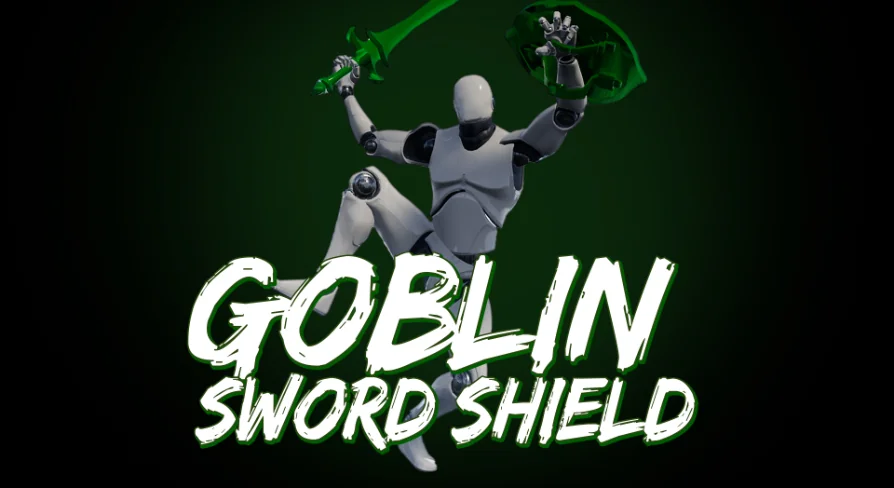
Goblin Sword Shield AnimSet
An in-depth look at Goblin Sword Shield AnimSet, featuring 53+ combat, locomotion, and reaction animations tailored for action RPG monsters.
Category:Unreal Engine,CombatPlatform: Unreal EngineEngine Version: 4.26+,5.0+Published: Oct 4, 2026
Combat
Resource overview
Dark stone corridors, damp cavern clearings, and muddy forest encampments routinely require reliable enemy archetypes to challenge advancing adventurers. In action RPG level design, the sword-wielding scout or sentry creature serves as an essential staple. Goblin Sword Shield AnimSet establishes this exact creature presence, delivering tailored monster choreography focused on an armed, shielded frontline combatant. Built for creature roles that require both aggressive tactical strikes and calculated defensive maneuvers, the asset supplies a comprehensive library of motion capture or keyframed behaviors calibrated specifically for monster encounters.
Tactical Combat Staging with Goblin Sword Shield AnimSet
Action RPG combat demands variety in close-quarters skirmishes to prevent enemy encounters from turning static. Because player characters attack from diverse angles with varying weapon timings, enemy responses need clear visual distinction. Goblin Sword Shield AnimSet addresses this requirement across an integrated roster of 53+ animations dedicated to sword-and-shield combatants.
The pack structures melee engagement across four discrete attack animations, enabling developers to build distinct combo strings, quick directional slashes, or deliberate power swings. Rather than limiting the goblin archetype to reckless offensive swings, the collection introduces defensive capability via two dedicated defense clips. In practical game design, these defensive frames can be mapped directly to shield-block states, deflection windows, or parry-and-riposte gameplay mechanics, turning standard dungeon minions into tactical obstacles that require player timing to overcome.
Mobility during duels is bolstered by evasive mechanics. The set provides four avoid motions alongside four roll animations. These athletic recovery states allow AI-controlled monsters to step back from sweeping player attacks, barrel out of incoming area-of-effect spells, or re-center their defensive shields during intense close-range combat sequences.
Locomotion Dynamics: Walk & Run Motion Blending
Smooth pathfinding and arena navigation depend on varied locomotion clips, especially when AI agents patrol irregular dungeon terrain or close distances during pursuit. Locomotion in this collection is organized across 18 move animations covering both walk and run variations.
Distributing movement across 18 individual locomotion states gives animators and gameplay programmers the coverage needed to populate directional blend spaces. Instead of relying on a single uniform trot, characters can be configured with speed thresholds, strafing variants, and weighted running loops that match the aggressive, low-to-the-ground posture expected of goblin combatants. Transitioning between relaxed perimeter walks and aggressive sprints keeps the monster visually grounded in action RPG environments, whether it is skulking behind obstacles or rushing forward with shield raised.
These dynamic movement cycles are complemented by four separate idle clips. Multiple idles allow developers to inject variety into lingering guard duties, break repetitive patrol loops, or reflect escalating alert levels as players approach detected boundaries.
Damage Responses, Fear, and Stun Sequences
Monster encounters depend on clear physical feedback whenever weapon strikes land or crowd-control abilities take effect. A resilient action RPG system must clearly communicate whether a creature has suffered light damage, collapsed, or been placed in a vulnerable incapacitated state.
The collection accounts for these hit-state hierarchies with varied reaction assets:
Direct Hits: Two hit reaction clips provide visceral impact response during regular melee exchanges.
Extended Disruption: A dedicated fear clip and four bound animations allow systems to handle immobilization, magic-based entrapment, or severe impact forces.
Multi-Phase Stun System: The stun sequence is split across three distinct phases—Start, Loop, and End—allowing game developers to tether stun durations dynamically to custom status effect timers.
Defeat and Recovery: Three dead animations deliver distinct death falls, while a rise animation provides an unassisted transition back to active combat if an encounter calls for ground recoveries.
For cinematic encounter entrances, the inclusion of a showup animation allows designers to trigger dynamic ambush sequences, such as a goblin dropping into a cavern or lunging from shadows. In addition, equip and unequip animations provide the physical transitions necessary for sheathing gear or readying sword and shield when moving from ambient exploration to active combat alert.
Continuity with the Goblin Warrior AnimSet
Uniformity across enemy ranks is a common challenge when assembling varied factions in action RPG titles. Goblin Sword Shield AnimSet is built on the same idle framework as the Goblin Warrior AnimSet, with general motions mirroring that asset family. This shared structural base simplifies asset blending across related combat units, ensuring that a sword-and-shield variant moves, reacts, and idles with the same behavioral profile as other warriors within the same lineage.
The collection also shares motion alignment with the Werewolf AnimSet pipeline, facilitating cross-compatible animation integration when coordinating enemy motion sets across diverse creature types. This structural continuity ensures that developers building complex faction behaviors can scale encounter rosters while retaining cohesive visual and systemic rules across their combat AI.
 Combat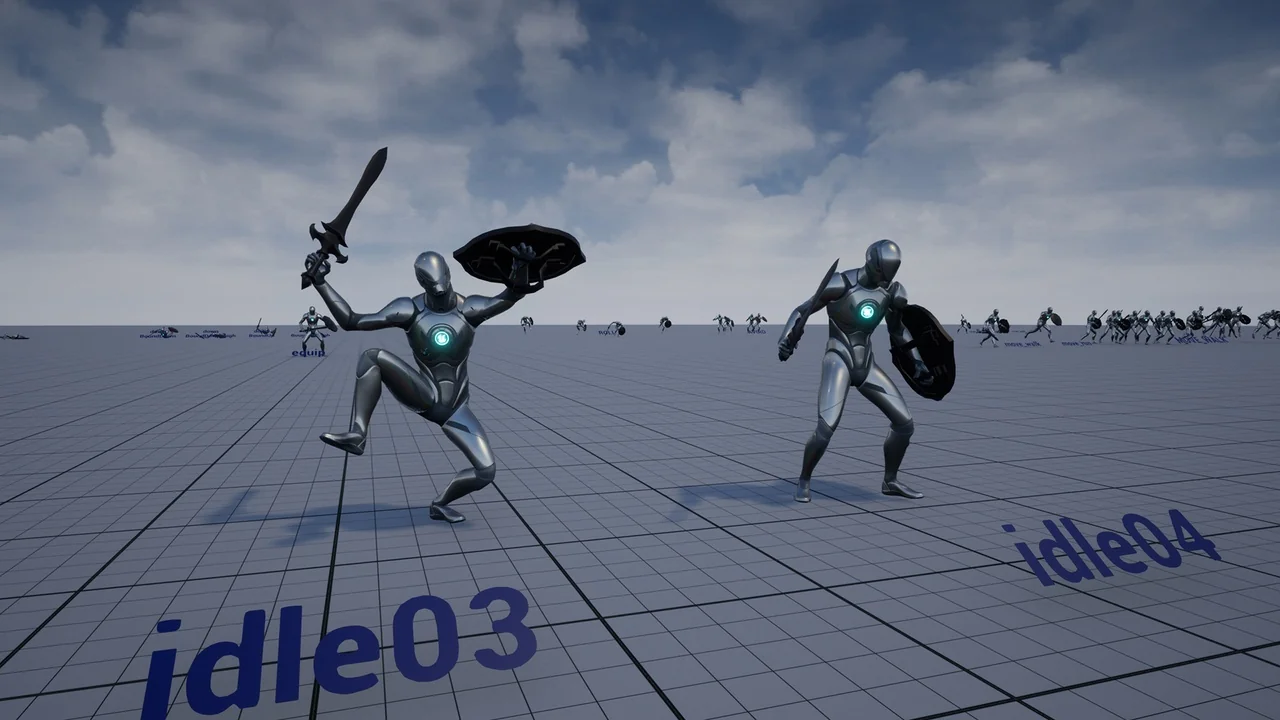
 Combat
 Combat
 Combat