"0148f1904a9b0d16"{"id":"1002608","slug":"train-pack","title":"Train pack","category":"Trains","engine":"5.0+","assetVersion":"","engineVersion":"Engine Version: 5.0+","tag":"Trains","accent":"blue","visual":"mech","summary":"Explore the Train pack features, including blueprint railway paths, skeletal mesh wagons with animated wheelbases, and color variations for heavy cargo.","platform":"Unreal Engine","indexPolicy":"index","publishedAt":"2026-11-14T06:07:12.844Z","updatedAt":"2026-11-14T06:07:12.844Z","sourceNotes":[],"fileContents":[],"compatibility":["Unreal Engine","Engine Version: 5.0+"],"featuredImage":{"alt":"Train pack","src":"/wp-content/uploads/published/2026/11/35037b2240c4-319a1820-9559-43cc-8072-cc8864a2206a-fdf7dc20f7.webp"},"hasDownloadLink":true,"downloads":0,"terms":[{"taxonomy":"category","slug":"trains","name":"Trains"}],"galleryImages":[{"src":"/wp-content/uploads/published/2026/11/e10a52e75ef2-1f934d7b-18c4-4b31-a227-944dd83f05d6-cb02d19971.webp","alt":"Train pack"},{"src":"/wp-content/uploads/published/2026/11/e028b5d6e0cf-e05d4d2e-d90c-4433-8b32-986be65bd2ed-854980128b.webp","alt":"Train pack"},{"src":"/wp-content/uploads/published/2026/11/48049d597e65-88a75c3e-2412-4c9e-8410-549f463df619-7157f4a43f.webp","alt":"Train pack"},{"src":"/wp-content/uploads/published/2026/11/fb9fa977b0e5-c6ad4f07-35d7-49f7-99c5-7c6d29931783-16f5f55de5.webp","alt":"Train pack"},{"src":"/wp-content/uploads/published/2026/11/313eb629c54d-63fef592-9cae-48ef-ac9c-352d55e37175-4a820c0b2a.webp","alt":"Train pack"},{"src":"/wp-content/uploads/published/2026/11/347a04b6847d-5fb5df7c-8c3b-415a-9e96-a138791b2f8a-3f8729b7e3.webp","alt":"Train pack"},{"src":"/wp-content/uploads/published/2026/11/4727e175f869-894aaf55-c03c-49da-a0fc-eedc801ec3d1-9157b31829.webp","alt":"Train pack"},{"src":"/wp-content/uploads/published/2026/11/226508b871f0-57768300-5bbb-460e-aac0-3d81bcf300cf-e818d9d15c.webp","alt":"Train pack"},{"src":"/wp-content/uploads/published/2026/11/567064402217-2991f460-542d-4bd1-b1b1-399311d29ea2-1073cf6260.webp","alt":"Train pack"},{"src":"/wp-content/uploads/published/2026/11/6ae9dfc4a2af-9c9949b2-c3d5-4648-b2e4-6759444062b5-42f9d8b884.webp","alt":"Train pack"}],"accessPanel":{"kind":"resource","title":"Get this resource","eyebrow":"Free resource","message":"Download this resource in your browser.","fileName":"Content.7z","safetyNote":"Resources are manually reviewed before listing to improve quality and reduce obvious risks.","actionLabel":"Get this resource","resourceType":"Resource archive","versions":[]},"contentHtml":"\u003ch2\u003eBlueprint Railway Setup and Track Layout\u003c/h2\u003e\u003cp\u003eIntegrating rolling stock into a game level begins with establishing the physical transit route. The included blueprint railway serves as the structural foundation for guiding rolling stock across the terrain. Instead of placing isolated track segments that require manual point-to-point correction, the blueprint-driven railway establishes a cohesive track path that vehicles can systematically follow. Placing the track within the editor allows designers to sketch out transit corridors through rugged hills, open countryside, or tight industrial yards.\u003c/p\u003e\u003cp\u003eAligning vehicles with track paths can often introduce translation errors if the rolling stock does not respect the underlying rail geometry. With this blueprint system, the heavy locomotive and accompanying carriage units snap along the designated rail vector. As tracks curve, descend, or bank, the railway blueprint manages the vector orientation, ensuring that multi-unit train assemblies remain coupled while navigating line changes. This provides an immediate structural framework for staging moving trains, background cargo transport, or stationary rail lines waiting on sidings.\u003c/p\u003e\u003ch2\u003eSkeletal Mesh Structure and Animated Wheelbase Mechanics in the Train Pack\u003c/h2\u003e\u003cp\u003eThe core movement of rail transit relies entirely on how running gear contacts the track. Within the Train pack, the train and wagons are constructed as skeletal meshes rather than rigid static objects. Relying on a skeletal mesh hierarchy permits individual components of the vehicle—specifically the wheel assemblies and structural pivots—to behave independently of the primary hull. This underlying rigging provides the articulation necessary for heavy carriages to respond naturally to path changes along the railway.\u003c/p\u003e\u003cp\u003eA critical technical element in this hierarchy is the animated wheelbase. Fixed wheels completely break immersion the moment a locomotive begins accelerating down a track. Because the wheelbases are animated, their rotational velocity can accurately reflect the forward speed of the locomotive and connected wagons. As the train travels along the blueprint railway, the spinning wheel assemblies register real mechanical action. When entering curved sections of track, the articulated wheelbase rotates on its designated axis to preserve proper alignment with the rails underneath, preventing the visual clipping that occurs when rigid vehicle models slide through turns.\u003c/p\u003e\u003ch2\u003eWagon Color Variations and Heavy Freight Styling\u003c/h2\u003e\u003cp\u003eConstructing believable freight trains requires visual variety from carriage to carriage. Uniform rolling stock tends to make a train look repetitive and unfinished, particularly across extended consists that stretch hundreds of meters. The package addresses this by providing different colors of wagons, allowing scene creators to break up visual monotony across successive rail cars.\u003c/p\u003e\u003cp\u003eThese distinct wagon colors make it straightforward to assemble varied compositions tailored to specific gameplay or scene objectives:\u003c/p\u003e\u003cul\u003e\u003cli\u003eAlternating color blocks across long cargo formations to convey mixed-operator freight transit.\u003c/li\u003e\u003cli\u003eAssigning specific wagon colors to distinct types of freight, separating industrial raw materials from refined cargo.\u003c/li\u003e\u003cli\u003eCreating visual contrast between the primary locomotive engine and the trailing carriage line.\u003c/li\u003e\u003cli\u003eArranging dedicated single-color industrial trains to serve specific distribution depots or mining operations.\u003c/li\u003e\u003c/ul\u003e\u003cp\u003eThe vehicle design focuses on heavy cargo aesthetics. The wagon silhouettes feature reinforced frames, industrial paneling, and sturdy carriage profiles that sit low on the animated wheelbases. This heavy vehicle profile gives each wagon the visual weight expected of industrial rolling stock, complementing the powerful presence of the lead train engine.\u003c/p\u003e\u003ch2\u003eStaging the Train Pack in Exterior Environments\u003c/h2\u003e\u003cp\u003eDemonstration media for this asset utilizes the Open World Demo Collection environment to present the rail equipment in context. That specific open-world landscape is not included with the package, meaning artists must provide their own terrain, foliage, and structural environment assets. The vehicle scale, industrial detailing, and carriage geometry are tailored to blend seamlessly into broad, natural environments as well as dense utility hubs.\u003c/p\u003e\u003cp\u003eWhen planning environmental placement, the rail blueprint should be laid down before final terrain painting and prop dressing. Laying the track first guarantees that natural clearings, rock cuts, bridges, and tunnels accommodate the physical width and clearance envelope of both the train and its trailing wagons. Once the path is set, surrounding scenery—such as industrial loading gantries, trackside signaling equipment, gravel ballast, and depot buildings—can be arranged directly against the rail line. Because the wagons feature distinct colors, they retain strong visibility against natural ground foliage, dry desert expanses, or gray industrial concrete.\u003c/p\u003e\u003ch2\u003eTechnical Documentation and Cross-System Compatibility\u003c/h2\u003e\u003cp\u003eImplementing articulated vehicles into an interactive project requires precise understanding of blueprint components and animation setups. The package includes dedicated documentation and video materials to guide developers through the implementation pipeline. Consulting the video demonstration clarifies how the animated wheelbase correlates with directional movement, while the written technical documentation outlines how the blueprint railway interacts with the skeletal mesh components.\u003c/p\u003e\u003cp\u003eThese instructional resources assist with configuring carriage connections, laying down rail pathways, and ensuring that the wheel assemblies spin correctly along spline segments. For teams maintaining diverse vehicle fleets, compatibility notes highlight that the asset aligns with Helicopter customizable standards, facilitating unified integration alongside other vehicle systems in a project. By following the provided documentation and video guides, developers can integrate the Train pack into real-time environments smoothly, establishing dynamic, heavy rail transit with functional tracks, articulated wheelbases, and varied wagon designs.\u003c/p\u003e\n\n\u003ch2\u003eMore From The Same Workflow\u003c/h2\u003e\n\u003cul\u003e\n\u003cli\u003e\u003ca href=\"https://3dcghub.com/freight-train/\" rel=\"noopener noreferrer\"\u003eFreight Train\u003c/a\u003e\u003c/li\u003e\n\u003cli\u003e\u003ca href=\"https://3dcghub.com/retro-80-s-vol-3-toys-nanite-and-low-poly/\" rel=\"noopener noreferrer\"\u003eRetro 80\u0026#039;s VOL.3 - Toys (Nanite and Low Poly)\u003c/a\u003e\u003c/li\u003e\n\u003cli\u003e\u003ca href=\"https://3dcghub.com/classic-vehicles-bundle-driveable-functional-classic-vehicles-car-cars-3d/\" rel=\"noopener noreferrer\"\u003eClassic Vehicles Bundle / Driveable / Functional (Classic Vehicles Car Cars 3D)\u003c/a\u003e\u003c/li\u003e\n\u003cli\u003e\u003ca href=\"https://3dcghub.com/ultimate-train-system-train-locomotive-steam-engine-wild-west-train/\" rel=\"noopener noreferrer\"\u003eUltimate Train System (Train, Locomotive, Steam Engine, Wild West Train)\u003c/a\u003e\u003c/li\u003e\n\u003cli\u003e\u003ca href=\"https://3dcghub.com/steam-locomotive/\" rel=\"noopener noreferrer\"\u003eSteam Locomotive\u003c/a\u003e\u003c/li\u003e\n\u003c/ul\u003e","contentTextLength":6419,"navigation":{"current":41,"total":4543,"previous":{"id":"1002609","slug":"warrior","title":"Warrior","category":"Characters \u0026 Creatures","platform":"Unreal Engine","updatedAt":"2026-11-14T06:08:11.574Z"},"next":{"id":"1002607","slug":"stylized-harvest-farm-environment","title":"Stylized Harvest Farm Environment","category":"Environments","platform":"Unreal Engine","updatedAt":"2026-11-14T06:04:21.056Z"}},"relatedResources":[{"id":"1001807","slug":"freight-train","title":"Freight Train","category":"Trains","engine":"5.6+","assetVersion":"","engineVersion":"Engine Version: 5.6+","tag":"Trains","accent":"blue","visual":"mech","summary":"Assemble customizable industrial freight trains using the BP_Train blueprint, multi-wagon presets, weathering controls, and detailed rolling stock.","platform":"Unreal Engine","indexPolicy":"index","publishedAt":"2026-10-21T07:58:51.633Z","updatedAt":"2026-10-21T07:58:51.633Z","sourceNotes":[],"fileContents":[],"compatibility":["Unreal Engine","Engine Version: 5.6+"],"featuredImage":{"alt":"Freight Train","src":"/wp-content/uploads/published/2026/10/aa6793636cea-b3eb7e0c-2f97-4d9e-9528-6a01e7537344-4eed8872fc.webp"},"hasDownloadLink":true,"downloads":0},{"id":"1001448","slug":"retro-80-s-vol-3-toys-nanite-and-low-poly","title":"Retro 80's VOL.3 - Toys (Nanite and Low Poly)","category":"Trains","engine":"5.1+","assetVersion":"","engineVersion":"Engine Version: 5.1+","tag":"Trains","accent":"blue","visual":"mech","summary":"Retro 80's VOL.3 - Toys delivers 80 Nanite and low-poly meshes, 4K RMAO textures, a working lava lamp, and Lumen support for Unreal Engine 5.","platform":"Unreal Engine","indexPolicy":"index","publishedAt":"2026-10-08T00:52:05.381Z","updatedAt":"2026-10-08T00:52:05.381Z","sourceNotes":[],"fileContents":[],"compatibility":["Unreal Engine","Engine Version: 5.1+"],"featuredImage":{"alt":"Retro 80's VOL.3 - Toys (Nanite and Low Poly)","src":"/wp-content/uploads/published/2026/10/c0de1495fa4e-0f96335e-e94b-43d3-82aa-b4becb6fea41-ab53d1598f.webp"},"hasDownloadLink":true,"downloads":0},{"id":"1000944","slug":"classic-vehicles-bundle-driveable-functional-classic-vehicles-car-cars-3d","title":"Classic Vehicles Bundle / Driveable / Functional (Classic Vehicles Car Cars 3D)","category":"Trains","engine":"5.1+","assetVersion":"","engineVersion":"Engine Version: 5.1+","tag":"Trains","accent":"blue","visual":"mech","summary":"Eight classic vehicles from F1 to limousine, tram, motorbike, and pickup truck, all driveable with Blueprints, 90 separate meshes, material instances, and a rad","platform":"Unreal Engine","indexPolicy":"index","publishedAt":"2026-08-13T03:59:50.178Z","updatedAt":"2026-08-13T03:59:50.178Z","sourceNotes":[],"fileContents":[],"compatibility":["Unreal Engine","Engine Version: 5.1+"],"featuredImage":{"alt":"Classic Vehicles Bundle / Driveable / Functional (Classic Vehicles Car Cars 3D)","src":"/wp-content/uploads/published/2026/08/b1c461098829-a87ea7eb-e855-4435-b6a2-43d684dafb6a-bafcd850cc.webp"},"hasDownloadLink":true,"downloads":0}]}
Trains
Train pack
Explore the Train pack features, including blueprint railway paths, skeletal mesh wagons with animated wheelbases, and color variations for heavy cargo.
Category:Unreal Engine,TrainsPlatform: Unreal EngineEngine Version: 5.0+Published: Nov 14, 2026
Trains
Resource overview
Blueprint Railway Setup and Track Layout
Integrating rolling stock into a game level begins with establishing the physical transit route. The included blueprint railway serves as the structural foundation for guiding rolling stock across the terrain. Instead of placing isolated track segments that require manual point-to-point correction, the blueprint-driven railway establishes a cohesive track path that vehicles can systematically follow. Placing the track within the editor allows designers to sketch out transit corridors through rugged hills, open countryside, or tight industrial yards.
Aligning vehicles with track paths can often introduce translation errors if the rolling stock does not respect the underlying rail geometry. With this blueprint system, the heavy locomotive and accompanying carriage units snap along the designated rail vector. As tracks curve, descend, or bank, the railway blueprint manages the vector orientation, ensuring that multi-unit train assemblies remain coupled while navigating line changes. This provides an immediate structural framework for staging moving trains, background cargo transport, or stationary rail lines waiting on sidings.
Skeletal Mesh Structure and Animated Wheelbase Mechanics in the Train Pack
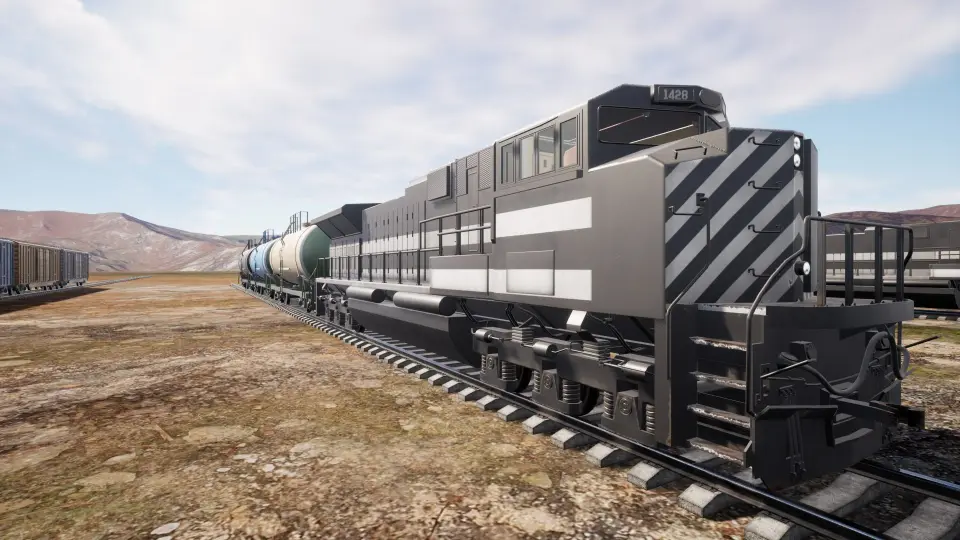
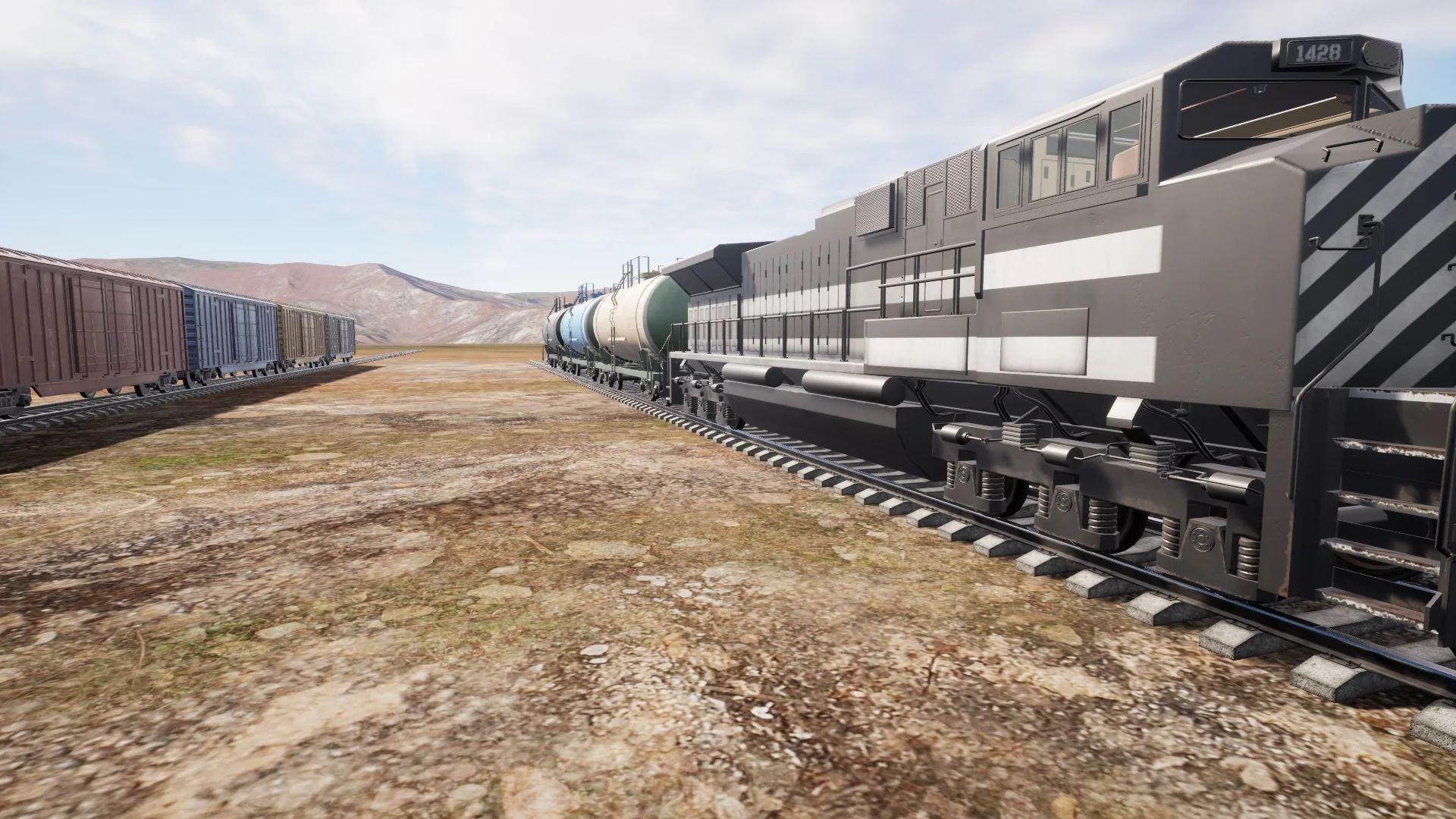
The core movement of rail transit relies entirely on how running gear contacts the track. Within the Train pack, the train and wagons are constructed as skeletal meshes rather than rigid static objects. Relying on a skeletal mesh hierarchy permits individual components of the vehicle—specifically the wheel assemblies and structural pivots—to behave independently of the primary hull. This underlying rigging provides the articulation necessary for heavy carriages to respond naturally to path changes along the railway.
A critical technical element in this hierarchy is the animated wheelbase. Fixed wheels completely break immersion the moment a locomotive begins accelerating down a track. Because the wheelbases are animated, their rotational velocity can accurately reflect the forward speed of the locomotive and connected wagons. As the train travels along the blueprint railway, the spinning wheel assemblies register real mechanical action. When entering curved sections of track, the articulated wheelbase rotates on its designated axis to preserve proper alignment with the rails underneath, preventing the visual clipping that occurs when rigid vehicle models slide through turns.
Wagon Color Variations and Heavy Freight Styling
Constructing believable freight trains requires visual variety from carriage to carriage. Uniform rolling stock tends to make a train look repetitive and unfinished, particularly across extended consists that stretch hundreds of meters. The package addresses this by providing different colors of wagons, allowing scene creators to break up visual monotony across successive rail cars.
These distinct wagon colors make it straightforward to assemble varied compositions tailored to specific gameplay or scene objectives:
Alternating color blocks across long cargo formations to convey mixed-operator freight transit.
Assigning specific wagon colors to distinct types of freight, separating industrial raw materials from refined cargo.
Creating visual contrast between the primary locomotive engine and the trailing carriage line.
Arranging dedicated single-color industrial trains to serve specific distribution depots or mining operations.
The vehicle design focuses on heavy cargo aesthetics. The wagon silhouettes feature reinforced frames, industrial paneling, and sturdy carriage profiles that sit low on the animated wheelbases. This heavy vehicle profile gives each wagon the visual weight expected of industrial rolling stock, complementing the powerful presence of the lead train engine.
Staging the Train Pack in Exterior Environments
Demonstration media for this asset utilizes the Open World Demo Collection environment to present the rail equipment in context. That specific open-world landscape is not included with the package, meaning artists must provide their own terrain, foliage, and structural environment assets. The vehicle scale, industrial detailing, and carriage geometry are tailored to blend seamlessly into broad, natural environments as well as dense utility hubs.
When planning environmental placement, the rail blueprint should be laid down before final terrain painting and prop dressing. Laying the track first guarantees that natural clearings, rock cuts, bridges, and tunnels accommodate the physical width and clearance envelope of both the train and its trailing wagons. Once the path is set, surrounding scenery—such as industrial loading gantries, trackside signaling equipment, gravel ballast, and depot buildings—can be arranged directly against the rail line. Because the wagons feature distinct colors, they retain strong visibility against natural ground foliage, dry desert expanses, or gray industrial concrete.
Technical Documentation and Cross-System Compatibility
Implementing articulated vehicles into an interactive project requires precise understanding of blueprint components and animation setups. The package includes dedicated documentation and video materials to guide developers through the implementation pipeline. Consulting the video demonstration clarifies how the animated wheelbase correlates with directional movement, while the written technical documentation outlines how the blueprint railway interacts with the skeletal mesh components.
These instructional resources assist with configuring carriage connections, laying down rail pathways, and ensuring that the wheel assemblies spin correctly along spline segments. For teams maintaining diverse vehicle fleets, compatibility notes highlight that the asset aligns with Helicopter customizable standards, facilitating unified integration alongside other vehicle systems in a project. By following the provided documentation and video guides, developers can integrate the Train pack into real-time environments smoothly, establishing dynamic, heavy rail transit with functional tracks, articulated wheelbases, and varied wagon designs.
 Trains
 Trains
 Trains
 Trains