"efaa631e936fd3ee"{"id":"1002230","slug":"terrain-materials-vol-4","title":"Terrain Materials VOL.4","category":"Nature \u0026 Terrain","engine":"4.26+,5.0+","assetVersion":"","engineVersion":"Engine Version: 4.26+,5.0+","tag":"Nature \u0026 Terrain","accent":"blue","visual":"luts","summary":"Terrain Materials VOL.4 features 13 landscape material layers with 2048x2048 Base Color, Normal, Roughness, Height, and Ambient Occlusion maps.","platform":"Unreal Engine","publishedAt":"2026-10-29T15:31:40.076Z","updatedAt":"2026-10-29T15:31:40.076Z","sourceNotes":[],"fileContents":[],"compatibility":["Unreal Engine","Engine Version: 4.26+,5.0+"],"featuredImage":{"alt":"Terrain Materials VOL.4","src":"/wp-content/uploads/published/2026/10/5c5f40895049-d4e7ec8c-ccca-4fe4-bba9-ccbb92a37e74-780f770516.webp"},"hasDownloadLink":true,"downloads":0,"terms":[{"taxonomy":"category","slug":"nature-and-terrain","name":"Nature \u0026 Terrain"}],"galleryImages":[{"src":"/wp-content/uploads/published/2026/10/3a4a9a9a15d5-542c1f53-7670-4fdd-ab1b-bd1bfb3d5cfd-f11e8fe638.webp","alt":"Terrain Materials VOL.4"},{"src":"/wp-content/uploads/published/2026/10/2c25ee3cc1f5-b0a8cf33-22cf-480b-9492-62285ed06a87-1472ad0d1b.webp","alt":"Terrain Materials VOL.4"},{"src":"/wp-content/uploads/published/2026/10/92e104d4e401-fd426a01-1360-4b1e-903a-4df8be6ea56e-2a2d8e3c91.webp","alt":"Terrain Materials VOL.4"},{"src":"/wp-content/uploads/published/2026/10/9098de6a3390-9768a3cb-e69f-456d-84d0-0a2759ed0c56-fdade7b5fd.webp","alt":"Terrain Materials VOL.4"},{"src":"/wp-content/uploads/published/2026/10/18361b9228b7-6b97869b-51ea-40e4-bac6-88ea690a41ce-9ae2c6e183.webp","alt":"Terrain Materials VOL.4"},{"src":"/wp-content/uploads/published/2026/10/636d7e2d055a-3cfc1396-955d-4e5f-989e-a75abdb9c1f9-0462489ff1.webp","alt":"Terrain Materials VOL.4"},{"src":"/wp-content/uploads/published/2026/10/1e2784bc3679-2a3acaa2-2e95-4732-b3ae-385b615343b5-4fc0995611.webp","alt":"Terrain Materials VOL.4"},{"src":"/wp-content/uploads/published/2026/10/0be31a051051-28a494ca-194e-4168-aa9a-a964af61af70-46493ed96b.webp","alt":"Terrain Materials VOL.4"},{"src":"/wp-content/uploads/published/2026/10/a549326a57cd-410b742b-0192-451d-afd5-010009494adc-da02d4b3f8.webp","alt":"Terrain Materials VOL.4"}],"accessPanel":{"kind":"resource","title":"Download this resource","eyebrow":"Free Download","message":"Log in or create a free account to start your download.","fileName":"Terrain Materials VOL.4.7z","safetyNote":"Resources are manually reviewed before listing to improve quality and reduce obvious risks.","actionLabel":"Download Free","resourceType":"Resource archive"},"contentHtml":"\u003ch2\u003eResolving Ground Repetition Across 13 Landscape Material Layers\u003c/h2\u003e\u003cp\u003eLarge-scale outdoor environments quickly suffer from visible repetition when a project relies on only a handful of base ground surfaces. Terrain Materials VOL.4 tackles this terrain texturing challenge by providing 13 distinct layers of landscape Material, offering the layer variety needed to paint believable transitions across expansive outdoor scenes.\u003c/p\u003e\u003cp\u003eA versatile landscape setup requires distinct ground variations to distinguish open fields, rocky inclines, eroded gullies, and compacted paths. By supplying 13 independent material layers, this package allows artists to assign dedicated surface types to specific topographical features rather than forcing a single texture set to stretch across multiple terrain contexts. Distributing these layers across heightmaps, slope masks, or manual painting passes ensures that mountain slopes, lower valleys, and mid-elevation transitions maintain visual contrast without recurring tiling patterns breaking the scene.\u003c/p\u003e\u003ch2\u003eTexture Map Structure Across the 2048x2048 Terrain Materials\u003c/h2\u003e\u003cp\u003eConsistent channel configuration is critical when assembling complex terrain shaders that pull from multiple texture collections. Every surface in this package is built with a five-map setup consisting of Base Color, Normal, Roughness, Height, and Ambient Occlusion, authored at a standard resolution of 2048x2048.\u003c/p\u003e\u003cp\u003eUniform texture inputs prevent shader errors and erratic rendering behavior when blending multiple landscape layers simultaneously. The Base Color map provides clean albedo information free from baked-in directional lighting, enabling real-time lights and skylights to shade the ground naturally. The Roughness map defines how light scatters across differing ground conditions, controlling whether surfaces appear matte, dry, or slightly reflective. Paired with a dedicated Normal map to render micro-surface details like loose pebbles and fine fissures, the texture set provides all essential surface channels across every single one of the 13 layers.\u003c/p\u003e\u003ch2\u003eHeight and Ambient Occlusion in Layer Blending\u003c/h2\u003e\u003cp\u003eStandard alpha blending often softens material transitions into unnatural, smudged gradients where two surface types meet. The dedicated Height and Ambient Occlusion maps included with each layer in Terrain Materials VOL.4 offer the structural data required for crisp, realistic ground intersections.\u003c/p\u003e\u003cp\u003eHaving an authored Height map for each of the 13 layers allows terrain shaders to calculate height-modulated blending. In practice, this means rock outcroppings, stones, and elevated soil contours emerge realistically through lower dirt or silt layers, allowing recessed areas to fill up first rather than fading together through a flat opacity dissolve. The accompanying Ambient Occlusion map complements this by accentuating the natural crevices, undercuts, and contact shadows between fine surface features. These self-shadowing cues anchor ground details under indirect illumination, preventing the landscape from looking flat or washed out in overcast lighting conditions.\u003c/p\u003e\u003ch2\u003eBalancing Texture Memory with 2048x2048 Resolution\u003c/h2\u003e\u003cp\u003eReal-time terrain rendering requires a deliberate balance between up-close surface clarity and hardware resource allocation. Because all textures across the 13 landscape layers are set to 2048x2048, the package maintains a practical footprint while preserving crisp texel density across expansive ground meshes.\u003c/p\u003e\u003cp\u003eLandscape shaders frequently sample multiple layers within a single landscape component or terrain quadrant. Textures authored at 2048x2048 provide the visual fidelity needed for third-person, first-person, or cinematic camera angles without overloading memory pools or triggering aggressive streaming drops. This specific resolution allows environment artists to paint intricate paths, rocky shoulders, and diverse ground covers across large outdoor maps while maintaining consistent surface definition across every painted stroke.\u003c/p\u003e\u003ch2\u003ePairing with the Stylized Terrain Pack of 50 Materials\u003c/h2\u003e\u003cp\u003eExpanding an environment library requires seamless compatibility so that different assets can function side by side within a single landscape workflow. Terrain Materials VOL.4 is noted for its compatibility with the Stylized Terrain Pack of 50 Materials, making it an effective extension for larger ground texturing pipelines.\u003c/p\u003e\u003cp\u003eWhen scaling up world-building efforts, mixing assets with divergent channel configurations or mismatched texture sets can create friction in shader maintenance. Because these 13 landscape layers provide the standard Base Color, Normal, Roughness, Height, and Ambient Occlusion pipeline, they integrate smoothly into terrain master materials alongside broader packs like the Stylized Terrain Pack of 50 Materials. This compatibility gives level designers and technical artists an expanded palette of ground variations that interact predictably within shared landscape paint layers and procedural distribution networks.\u003c/p\u003e\u003ch2\u003eDeploying Terrain Materials VOL.4 in Landscape Pipelines\u003c/h2\u003e\u003cp\u003eAssembling an effective ground texturing workflow depends on having clean, complete texture sets ready to plug into multi-layer landscape setups without missing texture channels.\u003c/p\u003e\u003cp\u003eTerrain Materials VOL.4 fits directly into environment production pipelines where expansive outdoor scenes demand structured, high-resolution ground surfaces. With 13 dedicated layers, full five-channel mapping per layer, and uniform 2048x2048 resolution, the package supplies the core surface components needed to construct layered, believable terrain systems across varied digital environments.\u003c/p\u003e\n\n\u003ch2\u003eMore From The Same Workflow\u003c/h2\u003e\n\u003cul\u003e\n\u003cli\u003e\u003ca href=\"https://3dcghub.com/sand-vol-40-hand-painted-textures/\" title=\"Sand Vol.40 - Hand Painted Textures\"\u003eSand Vol.40 - Hand Painted Textures\u003c/a\u003e\u003c/li\u003e\n\u003cli\u003e\u003ca href=\"https://3dcghub.com/grass-vol-21-hand-painted-textures/\" title=\"Grass Vol.21 - Hand Painted Textures\"\u003eGrass Vol.21 - Hand Painted Textures\u003c/a\u003e\u003c/li\u003e\n\u003cli\u003e\u003ca href=\"https://3dcghub.com/brushify-environment-shaders-pack/\" title=\"Brushify - Environment Shaders Pack\"\u003eBrushify - Environment Shaders Pack\u003c/a\u003e\u003c/li\u003e\n\u003cli\u003e\u003ca href=\"https://3dcghub.com/landscape-pro-2-0-auto-generated-material/\" title=\"Landscape Pro 2.0 Auto-Generated Material\"\u003eLandscape Pro 2.0 Auto-Generated Material\u003c/a\u003e\u003c/li\u003e\n\u003cli\u003e\u003ca href=\"https://3dcghub.com/stylized-egypt-textures-rpg-environment/\" title=\"Stylized Egypt Textures - RPG Environment\"\u003eStylized Egypt Textures - RPG Environment\u003c/a\u003e\u003c/li\u003e\n\u003c/ul\u003e","contentTextLength":5836,"navigation":{"current":55,"total":4209,"previous":{"id":"1002231","slug":"terrain-models-pack-vol-3","title":"Terrain Models Pack Vol. 3","category":"Nature \u0026 Plants","platform":"Unreal Engine","updatedAt":"2026-10-29T15:34:00.934Z"},"next":{"id":"1002229","slug":"tattoo-and-makeup-layer-system","title":"Tattoo \u0026 Makeup Layer System","category":"Variety","platform":"Unreal Engine","updatedAt":"2026-10-29T15:27:59.468Z"}},"relatedResources":[{"id":"1001907","slug":"sand-vol-40-hand-painted-textures","title":"Sand Vol.40 - Hand Painted Textures","category":"Nature \u0026 Terrain","engine":"4.22+,5.0+","assetVersion":"","engineVersion":"Engine Version: 4.22+,5.0+","tag":"Nature \u0026 Terrain","accent":"blue","visual":"luts","summary":"Examine Sand Vol.40 - Hand Painted Textures, featuring 7 tillable 2048px PBR surfaces designed for stylized deserts, rocky grit, and fantasy environments.","platform":"Unreal Engine","publishedAt":"2026-10-22T11:45:22.411Z","updatedAt":"2026-10-22T11:45:22.411Z","sourceNotes":[],"fileContents":[],"compatibility":["Unreal Engine","Engine Version: 4.22+,5.0+"],"featuredImage":{"alt":"Sand Vol.40 - Hand Painted Textures","src":"/wp-content/uploads/published/2026/10/1da18eae57da-85e5c46c-0333-4304-94ba-a4edf0bbbb9d-8949436dd0.webp"},"hasDownloadLink":true,"downloads":1},{"id":"1001884","slug":"grass-vol-21-hand-painted-textures","title":"Grass Vol.21 - Hand Painted Textures","category":"Nature \u0026 Terrain","engine":"4.26+,5.0+","assetVersion":"","engineVersion":"Engine Version: 4.26+,5.0+","tag":"Nature \u0026 Terrain","accent":"blue","visual":"luts","summary":"Grass Vol.21 provides five unique hand-painted, tillable grass textures with full PBR map passes at 2048x2048 resolution for mobile and stylized environments.","platform":"Unreal Engine","publishedAt":"2026-10-22T11:23:47.706Z","updatedAt":"2026-10-22T11:23:47.706Z","sourceNotes":[],"fileContents":[],"compatibility":["Unreal Engine","Engine Version: 4.26+,5.0+"],"featuredImage":{"alt":"Grass Vol.21 - Hand Painted Textures","src":"/wp-content/uploads/published/2026/10/7e9c1afb1d96-7b28f831-bb44-428c-adc4-91d37af9ae2c-9048ea8553.webp"},"hasDownloadLink":true,"downloads":0},{"id":"1000942","slug":"brushify-environment-shaders-pack","title":"Brushify - Environment Shaders Pack","category":"Nature \u0026 Terrain","engine":"4.26+,5.0+","assetVersion":"","engineVersion":"Engine Version: 4.26+,5.0+","tag":"Nature \u0026 Terrain","accent":"blue","visual":"city","summary":"A shader pack for UE5 that handles landscape auto-material, near-mesh shading, foliage, and atmosphere, with example levels and Nanite/Lumen support.","platform":"Unreal Engine","publishedAt":"2026-08-10T04:39:33.784Z","updatedAt":"2026-08-10T04:39:33.784Z","sourceNotes":[],"fileContents":[],"compatibility":["Unreal Engine","Engine Version: 4.26+,5.0+"],"featuredImage":{"alt":"Brushify - Environment Shaders Pack","src":"/wp-content/uploads/published/2026/08/5f946d4dc268-1824a260-53a7-4b6d-a41e-a2baf144c952-0d994eedec.webp"},"hasDownloadLink":true,"downloads":4}]}
Nature & Terrain
Terrain Materials VOL.4
Terrain Materials VOL.4 features 13 landscape material layers with 2048x2048 Base Color, Normal, Roughness, Height, and Ambient Occlusion maps.
Resolving Ground Repetition Across 13 Landscape Material Layers
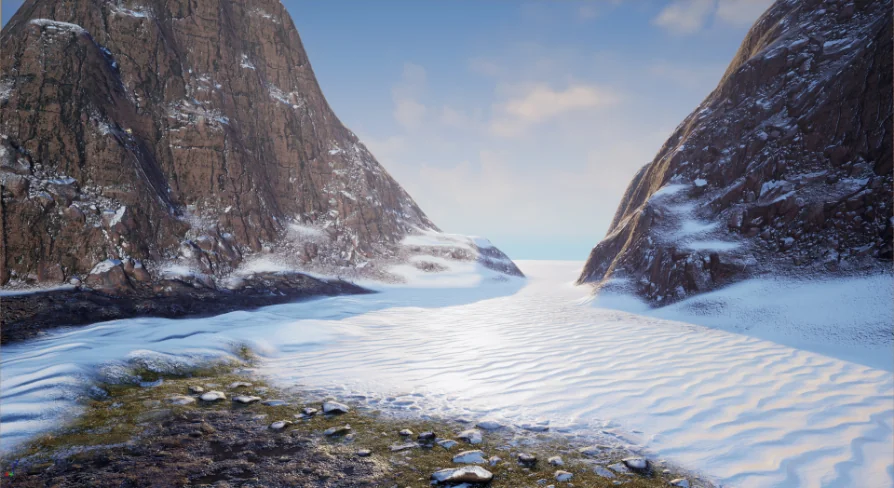
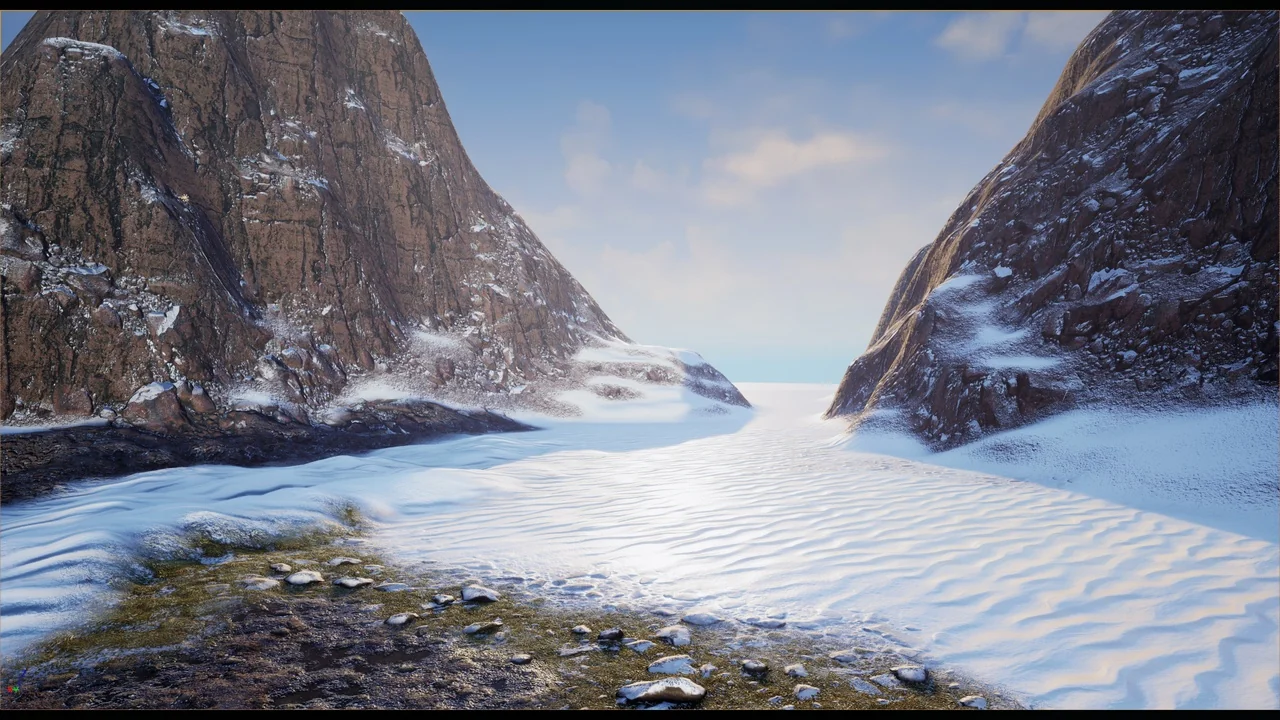
Large-scale outdoor environments quickly suffer from visible repetition when a project relies on only a handful of base ground surfaces. Terrain Materials VOL.4 tackles this terrain texturing challenge by providing 13 distinct layers of landscape Material, offering the layer variety needed to paint believable transitions across expansive outdoor scenes.
A versatile landscape setup requires distinct ground variations to distinguish open fields, rocky inclines, eroded gullies, and compacted paths. By supplying 13 independent material layers, this package allows artists to assign dedicated surface types to specific topographical features rather than forcing a single texture set to stretch across multiple terrain contexts. Distributing these layers across heightmaps, slope masks, or manual painting passes ensures that mountain slopes, lower valleys, and mid-elevation transitions maintain visual contrast without recurring tiling patterns breaking the scene.
Texture Map Structure Across the 2048x2048 Terrain Materials
Consistent channel configuration is critical when assembling complex terrain shaders that pull from multiple texture collections. Every surface in this package is built with a five-map setup consisting of Base Color, Normal, Roughness, Height, and Ambient Occlusion, authored at a standard resolution of 2048x2048.
Uniform texture inputs prevent shader errors and erratic rendering behavior when blending multiple landscape layers simultaneously. The Base Color map provides clean albedo information free from baked-in directional lighting, enabling real-time lights and skylights to shade the ground naturally. The Roughness map defines how light scatters across differing ground conditions, controlling whether surfaces appear matte, dry, or slightly reflective. Paired with a dedicated Normal map to render micro-surface details like loose pebbles and fine fissures, the texture set provides all essential surface channels across every single one of the 13 layers.
Height and Ambient Occlusion in Layer Blending
Standard alpha blending often softens material transitions into unnatural, smudged gradients where two surface types meet. The dedicated Height and Ambient Occlusion maps included with each layer in Terrain Materials VOL.4 offer the structural data required for crisp, realistic ground intersections.
Having an authored Height map for each of the 13 layers allows terrain shaders to calculate height-modulated blending. In practice, this means rock outcroppings, stones, and elevated soil contours emerge realistically through lower dirt or silt layers, allowing recessed areas to fill up first rather than fading together through a flat opacity dissolve. The accompanying Ambient Occlusion map complements this by accentuating the natural crevices, undercuts, and contact shadows between fine surface features. These self-shadowing cues anchor ground details under indirect illumination, preventing the landscape from looking flat or washed out in overcast lighting conditions.
Balancing Texture Memory with 2048x2048 Resolution
Real-time terrain rendering requires a deliberate balance between up-close surface clarity and hardware resource allocation. Because all textures across the 13 landscape layers are set to 2048x2048, the package maintains a practical footprint while preserving crisp texel density across expansive ground meshes.
Landscape shaders frequently sample multiple layers within a single landscape component or terrain quadrant. Textures authored at 2048x2048 provide the visual fidelity needed for third-person, first-person, or cinematic camera angles without overloading memory pools or triggering aggressive streaming drops. This specific resolution allows environment artists to paint intricate paths, rocky shoulders, and diverse ground covers across large outdoor maps while maintaining consistent surface definition across every painted stroke.
Pairing with the Stylized Terrain Pack of 50 Materials
Expanding an environment library requires seamless compatibility so that different assets can function side by side within a single landscape workflow. Terrain Materials VOL.4 is noted for its compatibility with the Stylized Terrain Pack of 50 Materials, making it an effective extension for larger ground texturing pipelines.
When scaling up world-building efforts, mixing assets with divergent channel configurations or mismatched texture sets can create friction in shader maintenance. Because these 13 landscape layers provide the standard Base Color, Normal, Roughness, Height, and Ambient Occlusion pipeline, they integrate smoothly into terrain master materials alongside broader packs like the Stylized Terrain Pack of 50 Materials. This compatibility gives level designers and technical artists an expanded palette of ground variations that interact predictably within shared landscape paint layers and procedural distribution networks.
Deploying Terrain Materials VOL.4 in Landscape Pipelines
Assembling an effective ground texturing workflow depends on having clean, complete texture sets ready to plug into multi-layer landscape setups without missing texture channels.
Terrain Materials VOL.4 fits directly into environment production pipelines where expansive outdoor scenes demand structured, high-resolution ground surfaces. With 13 dedicated layers, full five-channel mapping per layer, and uniform 2048x2048 resolution, the package supplies the core surface components needed to construct layered, believable terrain systems across varied digital environments.
 Nature & Terrain
 Nature & Terrain
 Nature & Terrain
 Nature & Terrain