"efaa631e936fd3ee"{"id":"1002229","slug":"tattoo-and-makeup-layer-system","title":"Tattoo \u0026 Makeup Layer System","category":"Variety","engine":"5.0+","assetVersion":"","engineVersion":"Engine Version: 5.0+","tag":"Variety","accent":"blue","visual":"mech","summary":"Explore the Tattoo \u0026 Makeup Layer System for MetaHumans, featuring modular cosmetic masks, scar generation, tillable freckles, and multi-LOD body ink.","platform":"Unreal Engine","publishedAt":"2026-10-29T15:27:59.468Z","updatedAt":"2026-10-29T15:27:59.468Z","sourceNotes":[],"fileContents":[],"compatibility":["Unreal Engine","Engine Version: 5.0+"],"featuredImage":{"alt":"Tattoo \u0026 Makeup Layer System","src":"/wp-content/uploads/published/2026/10/2d40eafb6be7-a14ea0fa-07ed-4f58-91a9-8d3eb4008f14-e14692e449.webp"},"hasDownloadLink":true,"downloads":0,"terms":[{"taxonomy":"category","slug":"variety","name":"Variety"}],"galleryImages":[{"src":"/wp-content/uploads/published/2026/10/324571cbf2ee-203781f5-8853-41f4-b527-d21b8608a266-a181e303e6.webp","alt":"Tattoo \u0026 Makeup Layer System"},{"src":"/wp-content/uploads/published/2026/10/86bff4960619-f81646a0-b382-415e-9db9-ee15f7c057be-53f9283bcc.webp","alt":"Tattoo \u0026 Makeup Layer System"},{"src":"/wp-content/uploads/published/2026/10/4d3b7128a6d9-1923dcc5-27ac-4ab7-abdc-48866abbf769-33691bffc9.webp","alt":"Tattoo \u0026 Makeup Layer System"},{"src":"/wp-content/uploads/published/2026/10/285da937b1c4-64244ddf-4547-4928-8e2d-a4a116c06539-1e5d428c59.webp","alt":"Tattoo \u0026 Makeup Layer System"},{"src":"/wp-content/uploads/published/2026/10/f513cb4a5452-ff8792fd-9c6d-444c-90fb-bfc176bcf04d-444b02fa25.webp","alt":"Tattoo \u0026 Makeup Layer System"},{"src":"/wp-content/uploads/published/2026/10/cdc0ac388400-47bde332-fdb2-490b-8076-346eda5f1d50-7ba578e9d8.webp","alt":"Tattoo \u0026 Makeup Layer System"},{"src":"/wp-content/uploads/published/2026/10/24f027d9d998-1e33a128-1f3c-4310-a8a2-51de45624baa-18d3842a6a.webp","alt":"Tattoo \u0026 Makeup Layer System"},{"src":"/wp-content/uploads/published/2026/10/d81228d9df01-ed8d1c86-9970-4d4a-9d9d-fbdeefd07352-8248d0d19c.webp","alt":"Tattoo \u0026 Makeup Layer System"},{"src":"/wp-content/uploads/published/2026/10/17f9fe6fac4f-69085e5f-56c2-4ada-a25c-31ac1a81e3eb-222ef0b6c2.webp","alt":"Tattoo \u0026 Makeup Layer System"}],"accessPanel":{"kind":"resource","title":"Download this resource","eyebrow":"Free Download","message":"Log in or create a free account to start your download.","fileName":"Content.7z","safetyNote":"Resources are manually reviewed before listing to improve quality and reduce obvious risks.","actionLabel":"Download Free","resourceType":"Resource archive"},"contentHtml":"\u003ch2\u003eCrafting Digital Human Identity in MetaHuman Character Pipelines\u003c/h2\u003e\n\u003cp\u003eClose-up character rendering demands surface irregularities that break standard digital perfection. MetaHuman assets provide sophisticated topology and skin shading out of the box, yet achieving a distinct visual identity requires granular control over surface details like weathering, cosmetic styling, and permanent markings. The Tattoo \u0026 Makeup Layer System targets this exact production challenge by overhauling standard cosmetic application and replacing static workflows with an adaptable, multi-tier layering framework. Whether designing a weathered warrior marked by physical encounters or a stylized urban protagonist with sharp cosmetic accents, the toolset provides immediate control over how pigments, skin breaks, and decorative elements integrate across the face and body.\u003c/p\u003e \u003cp\u003eThe asset adapts to varying skill levels without locking creators into inflexible defaults. Artists setting up their first custom digital human can rapidly apply presets and make clean modifications to facial surfaces, while seasoned technical artists can push customization across all levels of detail without breaking visual fidelity as the camera pulls away.\u003c/p\u003e \u003ch2\u003eReconstructed Base Makeup and Decoupled Facial Layers\u003c/h2\u003e\n\u003cp\u003eAt the core of the toolset is an improved base makeup architecture working alongside a modular layer system. Standard face setups often bake makeup passes together, which limits how individual elements can be tinted, blended, or adjusted against natural skin tones. This system refines the underlying base makeup pass by providing heightened control over foundation, concealer, and blush. These foundational passes establish the base tone, smooth out uneven colorations, and simulate genuine skin preparation prior to applying expressive elements.\u003c/p\u003e \u003cp\u003eTo maximize stylistic freedom, eye and lip makeups have been extracted completely from the base tier and moved directly into the modular layer system. By decoupling these zones, lipstick, eyeliner, and eyeshadow no longer compete with underlying concealer or foundation values. Instead, they function as independent graphic elements that can be individually tinted, balanced, and layered atop base adjustments without degrading underlying skin textures.\u003c/p\u003e \u003ch2\u003eLayering Eyeliner, Eyeshadow, and Highlight Masks\u003c/h2\u003e\n\u003cp\u003eThe makeup layer library provides an extensive set of masks tailored for intricate styling combinations. The pack includes:\u003c/p\u003e\n\u003cul\u003e \u003cli\u003e\u003cstrong\u003e18 Eyeliner masks:\u003c/strong\u003e Offering varied profiles from subtle lash-line definitions to dramatic wings and graphic framing.\u003c/li\u003e \u003cli\u003e\u003cstrong\u003e53 Eyeshadow masks:\u003c/strong\u003e Spanning soft natural gradients, sharp cut-creases, smoky contours, and stylized spreads across the eyelid and brow bone.\u003c/li\u003e \u003cli\u003e\u003cstrong\u003e14 Lipstick masks:\u003c/strong\u003e Supplying clean edge profiles, blurred gradients, lip-liner emphases, and full-coverage shapes.\u003c/li\u003e \u003cli\u003e\u003cstrong\u003e14 Highlight masks:\u003c/strong\u003e Delivering targeted placement masks to emphasize facial planes, cheekbones, brow arches, and the bridge of the nose.\u003c/li\u003e\n\u003c/ul\u003e \u003cp\u003eBecause each mask operates within a multi-layer paradigm, artists can stack individual passes to invent combined aesthetics. Multiple eyeshadow shapes can be blended with varying opacities and colors, paired with crisp eyeliner passes, and finished with layered lip configurations. This stacking mechanic eliminates the need to author bespoke texture files for every cosmetic variation, allowing an immense range of character appearances to be generated directly in-engine.\u003c/p\u003e \u003ch2\u003eTillable Freckles, Scar Generation, and Full-Body Tattoo Placement\u003c/h2\u003e\n\u003cp\u003eBeyond clean cosmetics, surface credibility depends on organic imperfections, environmental adaptations, and body modifications. The layer system extends well past simple facial makeup by integrating procedural and modular controls for realistic wear and unique markings across both head and body surfaces.\u003c/p\u003e \u003cp\u003eThe framework incorporates a tillable freckle system that scatters natural pigmentation variations without producing noticeable tiling artifacts. Working alongside this is a dedicated scar generation system, capable of depicting tissue disruptions, old wounds, and healed lacerations. Surface flaws such as blemishes, moles, and beauty marks can be mapped instantly onto the face, accompanied by broader physical alterations like tan-lines, bold face-paint patterns, and full-coverage tattoos.\u003c/p\u003e \u003cp\u003eThe tattoo application framework covers both the head and the body, supporting everything from fine facial script and knuckle ink to expansive body art. PBR-compliant responses ensure that these decals maintain accurate roughness and normal interaction with ambient light, avoiding the flat, painted-on look that often compromises skin-layer decals in real-time viewports.\u003c/p\u003e \u003ch2\u003eLOD Scaling, Daz3D Compatibility, and Unreal Engine 5.2 Implementation\u003c/h2\u003e\n\u003cp\u003eHigh-end character setups must maintain consistency under strict performance constraints. One of the strongest technical implementations within the Tattoo \u0026 Makeup Layer System is its support across all LODs. Rather than dropping layer data or snapping abruptly to simplified base materials when meshes step down in detail, the system can be linked across every level of detail. This guarantees that tattoos, scars, and key makeup silhouettes remain intact whether the character is framed in a tight cinematic cutscene or viewed from a distance in an interactive gameplay scenario.\u003c/p\u003e \u003cp\u003eIn terms of environment compatibility, the toolset is available for Unreal Engine 5.2. In its current implementation, no alterations regarding the Substrate material framework have been introduced, meaning the system continues to run on standard material paradigms. The architecture also interfaces with materials conversion and layer setups geared toward Daz3D imports, expanding utility for artists who bridge external character models into Unreal Engine workflows.\u003c/p\u003e \u003ch2\u003eProject Integration Guidance\u003c/h2\u003e\n\u003cp\u003eSelecting this system suits productions that demand high-frequency character visual variations across cinematic and interactive pipelines. When building vast ensembles of unique NPCs, the mix-and-match approach to foundation, eyeliner, eyeshadow, lip masks, and tattoos provides extensive distinctiveness without bloating texture memory through hundreds of static diffuse bakes. For hero assets, the scar generation and tillable freckle controls provide the exact balance of imperfection needed to elevate standard digital humans into memorable, story-rich characters.\u003c/p\u003e\n\n\u003ch2\u003eMore From The Same Workflow\u003c/h2\u003e\n\u003cul\u003e\n\u003cli\u003e\u003ca href=\"https://3dcghub.com/master-materials-and-layer-system-for-daz3d-imports/\" title=\"Master Materials and Layer System for Daz3D Imports\"\u003eMaster Materials and Layer System for Daz3D Imports\u003c/a\u003e\u003c/li\u003e\n\u003cli\u003e\u003ca href=\"https://3dcghub.com/stylized-animated-lava-material-pack-85-pcs/\" title=\"Stylized Animated Lava Material Pack 85 Pcs\"\u003eStylized Animated Lava Material Pack 85 Pcs\u003c/a\u003e\u003c/li\u003e\n\u003cli\u003e\u003ca href=\"https://3dcghub.com/aerial-survey-hdr-collection-vol-1/\" title=\"Aerial Survey HDR Collection vol.1\"\u003eAerial Survey HDR Collection vol.1\u003c/a\u003e\u003c/li\u003e\n\u003cli\u003e\u003ca href=\"https://3dcghub.com/ascii-post-process-material/\" title=\"ASCII Post Process Material\"\u003eASCII Post Process Material\u003c/a\u003e\u003c/li\u003e\n\u003cli\u003e\u003ca href=\"https://3dcghub.com/multi-color-masking/\" title=\"Multi Color Masking\"\u003eMulti Color Masking\u003c/a\u003e\u003c/li\u003e\n\u003c/ul\u003e","contentTextLength":6595,"navigation":{"current":56,"total":4209,"previous":{"id":"1002230","slug":"terrain-materials-vol-4","title":"Terrain Materials VOL.4","category":"Nature \u0026 Terrain","platform":"Unreal Engine","updatedAt":"2026-10-29T15:31:40.076Z"},"next":{"id":"1002228","slug":"target-lock-system","title":"Target Lock System","category":"Gameplay Features","platform":"Unreal Engine","updatedAt":"2026-10-29T15:27:07.100Z"}},"relatedResources":[{"id":"25079","slug":"master-materials-and-layer-system-for-daz3d-imports","title":"Master Materials and Layer System for Daz3D Imports","category":"Variety","engine":"5.0+","assetVersion":"Engine version: 5.0+","engineVersion":"","tag":"Variety","accent":"blue","visual":"luts","summary":"This material system gives imported characters a faster path into game-ready presentation, with runtime control over roughness, tint, makeup, and tattoos. It also centralizes shared parameters so multiple body regions can be adjusted together instead of edi...","platform":"Unreal Engine","publishedAt":"2026-04-18T17:32:35.000Z","updatedAt":"2026-04-20T06:12:33.000Z","sourceNotes":[],"fileContents":[],"compatibility":["Unreal Engine","Engine version: 5.0+"],"featuredImage":{"alt":"Master Materials and Layer System for Daz3D Imports","src":"https://3dcghub.com/wp-content/uploads/2026/04/d40f210d6801_8fc4237c-0e00-4c8a-ab90-795e96b288d2.webp"},"hasDownloadLink":true,"downloads":0},{"id":"13277","slug":"stylized-animated-lava-material-pack-85-pcs","title":"Stylized Animated Lava Material Pack 85 Pcs","category":"Variety","engine":"5.0+","assetVersion":"Engine version: 5.0+","engineVersion":"5.0","tag":"Variety","accent":"blue","visual":"luts","summary":"Discover a comprehensive collection of 85 high-quality, animated lava materials. These 4K tilable textures are perfect for environmental and character design in games and movies.","platform":"Unreal Engine","publishedAt":"2026-03-10T16:38:40.000Z","updatedAt":"2026-04-19T15:46:30.000Z","sourceNotes":[],"fileContents":[],"compatibility":["Unreal Engine","Engine version: 5.0+"],"featuredImage":{"alt":"Stylized Animated Lava Material Pack 85 Pcs","src":"https://3dcghub.com/wp-content/uploads/2026/03/e021cdf5-7000-4c8d-befc-b88f953326ae.webp"},"hasDownloadLink":true,"downloads":0},{"id":"27297","slug":"aerial-survey-hdr-collection-vol-1","title":"Aerial Survey HDR Collection vol.1","category":"Variety","engine":"4.26+,5.0+","assetVersion":"Engine version: 4.26+,5.0+","engineVersion":"4.19","tag":"Variety","accent":"blue","visual":"luts","summary":"Aerial Survey HDR Collection vol.1 brings together unique HDR maps created using aerial survey, with a clear focus on sky and realism. It suits scenes that need a grounded outdoor mood and a sky presence that feels direct rather than decorative.","platform":"Unreal Engine","publishedAt":"2026-04-23T16:39:22.000Z","updatedAt":"2026-04-23T16:39:23.000Z","sourceNotes":[],"fileContents":[],"compatibility":["Unreal Engine","Engine version: 4.26+,5.0+"],"featuredImage":{"alt":"Aerial Survey HDR Collection vol.1","src":"https://3dcghub.com/wp-content/uploads/2026/04/b2abd2acf2aa_02771f08-67f2-4921-9383-33084657d345.webp"},"hasDownloadLink":true,"downloads":0}]}
Variety
Tattoo & Makeup Layer System
Explore the Tattoo & Makeup Layer System for MetaHumans, featuring modular cosmetic masks, scar generation, tillable freckles, and multi-LOD body ink.
Category:Unreal Engine,VarietyPlatform: Unreal EngineEngine Version: 5.0+Published: Oct 29, 2026
Variety
Resource overview
Crafting Digital Human Identity in MetaHuman Character Pipelines
Close-up character rendering demands surface irregularities that break standard digital perfection. MetaHuman assets provide sophisticated topology and skin shading out of the box, yet achieving a distinct visual identity requires granular control over surface details like weathering, cosmetic styling, and permanent markings. The Tattoo & Makeup Layer System targets this exact production challenge by overhauling standard cosmetic application and replacing static workflows with an adaptable, multi-tier layering framework. Whether designing a weathered warrior marked by physical encounters or a stylized urban protagonist with sharp cosmetic accents, the toolset provides immediate control over how pigments, skin breaks, and decorative elements integrate across the face and body.
The asset adapts to varying skill levels without locking creators into inflexible defaults. Artists setting up their first custom digital human can rapidly apply presets and make clean modifications to facial surfaces, while seasoned technical artists can push customization across all levels of detail without breaking visual fidelity as the camera pulls away.
Reconstructed Base Makeup and Decoupled Facial Layers
At the core of the toolset is an improved base makeup architecture working alongside a modular layer system. Standard face setups often bake makeup passes together, which limits how individual elements can be tinted, blended, or adjusted against natural skin tones. This system refines the underlying base makeup pass by providing heightened control over foundation, concealer, and blush. These foundational passes establish the base tone, smooth out uneven colorations, and simulate genuine skin preparation prior to applying expressive elements.
To maximize stylistic freedom, eye and lip makeups have been extracted completely from the base tier and moved directly into the modular layer system. By decoupling these zones, lipstick, eyeliner, and eyeshadow no longer compete with underlying concealer or foundation values. Instead, they function as independent graphic elements that can be individually tinted, balanced, and layered atop base adjustments without degrading underlying skin textures.
Layering Eyeliner, Eyeshadow, and Highlight Masks
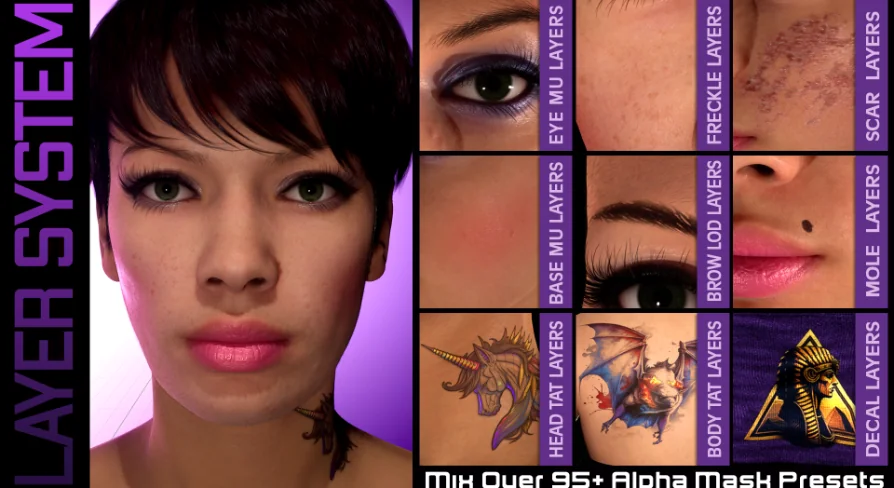
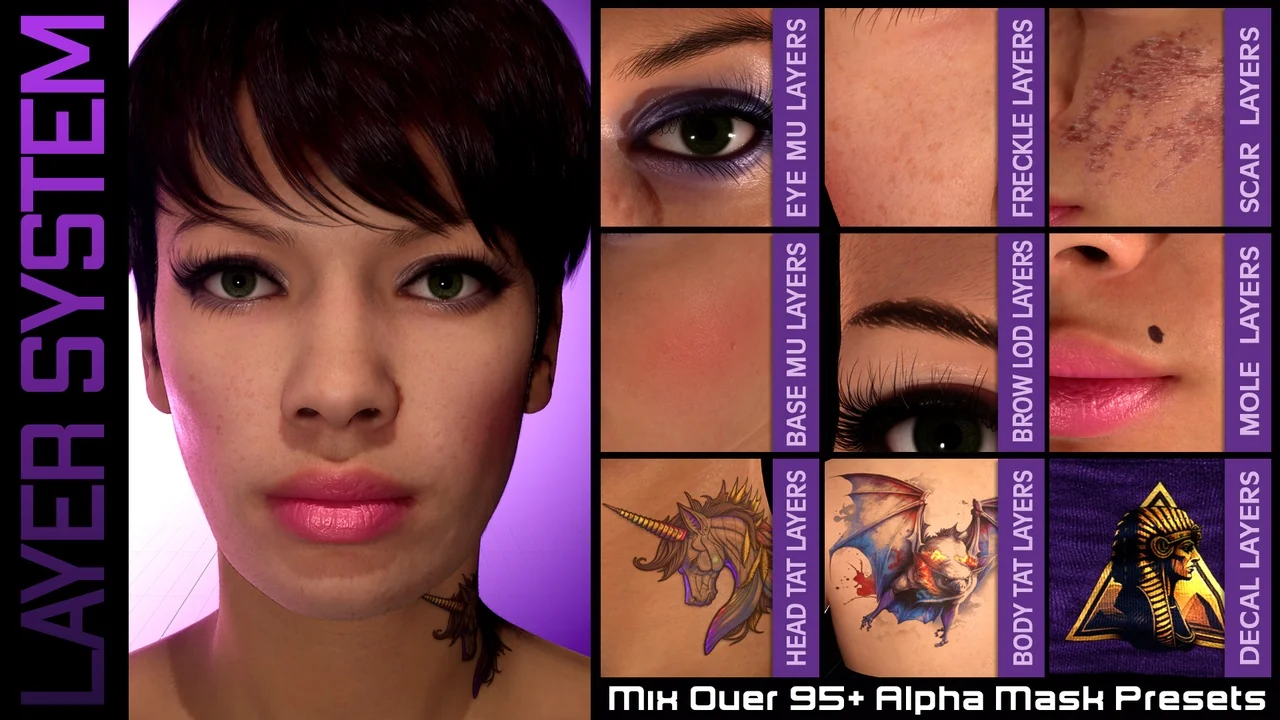
The makeup layer library provides an extensive set of masks tailored for intricate styling combinations. The pack includes:
18 Eyeliner masks: Offering varied profiles from subtle lash-line definitions to dramatic wings and graphic framing.
53 Eyeshadow masks: Spanning soft natural gradients, sharp cut-creases, smoky contours, and stylized spreads across the eyelid and brow bone.
14 Highlight masks: Delivering targeted placement masks to emphasize facial planes, cheekbones, brow arches, and the bridge of the nose.
Because each mask operates within a multi-layer paradigm, artists can stack individual passes to invent combined aesthetics. Multiple eyeshadow shapes can be blended with varying opacities and colors, paired with crisp eyeliner passes, and finished with layered lip configurations. This stacking mechanic eliminates the need to author bespoke texture files for every cosmetic variation, allowing an immense range of character appearances to be generated directly in-engine.
Tillable Freckles, Scar Generation, and Full-Body Tattoo Placement
Beyond clean cosmetics, surface credibility depends on organic imperfections, environmental adaptations, and body modifications. The layer system extends well past simple facial makeup by integrating procedural and modular controls for realistic wear and unique markings across both head and body surfaces.
The framework incorporates a tillable freckle system that scatters natural pigmentation variations without producing noticeable tiling artifacts. Working alongside this is a dedicated scar generation system, capable of depicting tissue disruptions, old wounds, and healed lacerations. Surface flaws such as blemishes, moles, and beauty marks can be mapped instantly onto the face, accompanied by broader physical alterations like tan-lines, bold face-paint patterns, and full-coverage tattoos.
The tattoo application framework covers both the head and the body, supporting everything from fine facial script and knuckle ink to expansive body art. PBR-compliant responses ensure that these decals maintain accurate roughness and normal interaction with ambient light, avoiding the flat, painted-on look that often compromises skin-layer decals in real-time viewports.
LOD Scaling, Daz3D Compatibility, and Unreal Engine 5.2 Implementation
High-end character setups must maintain consistency under strict performance constraints. One of the strongest technical implementations within the Tattoo & Makeup Layer System is its support across all LODs. Rather than dropping layer data or snapping abruptly to simplified base materials when meshes step down in detail, the system can be linked across every level of detail. This guarantees that tattoos, scars, and key makeup silhouettes remain intact whether the character is framed in a tight cinematic cutscene or viewed from a distance in an interactive gameplay scenario.
In terms of environment compatibility, the toolset is available for Unreal Engine 5.2. In its current implementation, no alterations regarding the Substrate material framework have been introduced, meaning the system continues to run on standard material paradigms. The architecture also interfaces with materials conversion and layer setups geared toward Daz3D imports, expanding utility for artists who bridge external character models into Unreal Engine workflows.
Project Integration Guidance
Selecting this system suits productions that demand high-frequency character visual variations across cinematic and interactive pipelines. When building vast ensembles of unique NPCs, the mix-and-match approach to foundation, eyeliner, eyeshadow, lip masks, and tattoos provides extensive distinctiveness without bloating texture memory through hundreds of static diffuse bakes. For hero assets, the scar generation and tillable freckle controls provide the exact balance of imperfection needed to elevate standard digital humans into memorable, story-rich characters.
 Variety
 Variety
 Variety
 Variety