"7e6fc58c410f2894"{"id":"1001667","slug":"space-frontier-stations-and-ships","title":"Space Frontier Stations \u0026 Ships","category":"Sky \u0026 Space","engine":"5.0+","assetVersion":"","engineVersion":"Engine Version: 5.0+","tag":"Sky \u0026 Space","accent":"blue","visual":"mech","summary":"Build vast sci-fi environments with Space Frontier Stations \u0026 Ships, featuring 60+ blueprints, procedural scattering, flyable ships, and Nanite/Lumen support.","platform":"Unreal Engine","publishedAt":"2026-10-13T15:09:29.578Z","updatedAt":"2026-10-13T15:09:29.578Z","sourceNotes":[],"fileContents":[],"compatibility":["Unreal Engine","Engine Version: 5.0+"],"featuredImage":{"alt":"Space Frontier Stations \u0026 Ships","src":"/wp-content/uploads/published/2026/10/bc4215e944b8-2c47d31a-f13b-40d5-a5c8-3a6f3f1b6ef5-5a5ee01424.webp"},"hasDownloadLink":true,"downloads":0,"terms":[{"taxonomy":"category","slug":"sky-and-space","name":"Sky \u0026 Space"}],"galleryImages":[{"src":"/wp-content/uploads/published/2026/10/43a4af1b3420-cf167f50-ce37-4fa0-a389-c0c8312a2b97-58fd21e775.webp","alt":"Space Frontier Stations \u0026 Ships"},{"src":"/wp-content/uploads/published/2026/10/05a262855255-388d5b71-ee97-4221-be97-96debbeab37b-f8c315b515.webp","alt":"Space Frontier Stations \u0026 Ships"},{"src":"/wp-content/uploads/published/2026/10/c14f82d1e2ce-592b5064-3033-43ff-a403-4d35f24dc78a-dc3f8871f8.webp","alt":"Space Frontier Stations \u0026 Ships"},{"src":"/wp-content/uploads/published/2026/10/f8be3882175b-bf18255f-817f-4055-b3a8-eac7c5596a25-e385a56464.webp","alt":"Space Frontier Stations \u0026 Ships"},{"src":"/wp-content/uploads/published/2026/10/47395494790b-4ebe31bb-36cc-4d67-9c4c-00db764e2544-c06e8292f2.webp","alt":"Space Frontier Stations \u0026 Ships"},{"src":"/wp-content/uploads/published/2026/10/c39b48c14835-dcd71fb5-811e-42b8-b600-d7323dc280a2-391c26fa64.webp","alt":"Space Frontier Stations \u0026 Ships"},{"src":"/wp-content/uploads/published/2026/10/ecfecdef734f-7e534228-dc18-44bf-9969-ce567f8449b2-c0e7cf2fce.webp","alt":"Space Frontier Stations \u0026 Ships"},{"src":"/wp-content/uploads/published/2026/10/f5c2e1aa54eb-0dc783e1-505a-414d-9179-4a209e504c09-b5469b812f.webp","alt":"Space Frontier Stations \u0026 Ships"},{"src":"/wp-content/uploads/published/2026/10/330e2d279033-783579b6-7113-448c-9211-085f28fd10db-3d164650b7.webp","alt":"Space Frontier Stations \u0026 Ships"}],"accessPanel":{"kind":"resource","title":"Download this resource","eyebrow":"Free Download","message":"Log in or create a free account to start your download.","fileName":"Content.7z","safetyNote":"Resources are manually reviewed before listing to improve quality and reduce obvious risks.","actionLabel":"Download Free","resourceType":"Resource archive"},"contentHtml":"\u003ch2\u003eAssembling Orbital Layouts with Space Frontier Stations Blueprints\u003c/h2\u003e\u003cp\u003eConstructing believable space environments usually demands a delicate balance between visual scale and scene performance. Space Frontier Stations \u0026 Ships addresses this balance by centering its level-building workflow around an extensive suite of over 60 blueprints. These utility tools eliminate the friction of manually placing thousands of structural components, giving artists and technical designers a direct method for establishing large cosmic environments quickly.\u003c/p\u003e\u003cp\u003eRather than placing individual meshes by hand, level generation starts with specialized procedural blueprints designed to orchestrate entire orbital hubs. The blueprint framework handles geometry placement while keeping draw calls and computational budgets optimized for real-time applications. By offloading repetitive arrangement tasks to these systems, you can establish the primary layout of a mission zone, space port, or orbital waypoint within a few clicks, ensuring that performance stays intact even as structural complexity increases.\u003c/p\u003e\u003ch2\u003eStation Exterior Generation and Space Port Customization\u003c/h2\u003e\u003cp\u003eThe space structure systems included in the package generate exterior shells for varied station designs and multi-dock space ports. These procedural generators allow developers to configure diverse architectures without relying on repetitive pre-assembled silhouettes. Stations can range from compact outpost modules to sprawling industrial hubs surrounded by docking bays.\u003c/p\u003e\u003cp\u003eAppearance controls built directly into the generation tools offer deep visual authority over final surfaces. Designers can modify exterior colors, surface accents, and stylistic variations across structural panels using integrated vertex color and shader parameters. This procedural tinting and exterior manipulation ensures that adjoining modules look unified while preventing neighboring stations from appearing cloned. Whether building an isolated orbital station or a crowded transit depot, the station structure systems supply granular control over surface coloration, layout footprint, and docking layout points.\u003c/p\u003e\u003ch2\u003eSpline Paths, Asteroid Rings, and Scattering Tools\u003c/h2\u003e\u003cp\u003eConnecting sprawling station complexes requires flexible infrastructure, which is handled directly by specialized spline blueprints. These tools allow technical artists to trace continuous routes through three-dimensional space, generating structural utility paths such as flexible cords, pressurized transfer hoses, and fuel conduits slung between separate hull components. Beyond static geometry, spline actors can be established to define precise navigation routes for moving spaceships, providing guided pathways through crowded shipyards or dangerous debris fields.\u003c/p\u003e\u003cp\u003eCosmic surroundings are populated through complementary scattering blueprints and procedural spline configurations:\u003c/p\u003e\u003cul\u003e\u003cli\u003e\u003cstrong\u003eSpline-based Asteroid Rings:\u003c/strong\u003e Define dense circular or arc-shaped planetary rings using custom curves that orient rocks smoothly along orbital trajectories.\u003c/li\u003e\u003cli\u003e\u003cstrong\u003eProcedural Field Scattering:\u003c/strong\u003e Populate cubic light-years of space with floating rock clusters, setting density thresholds and distribution parameters across custom bounding volumes.\u003c/li\u003e\u003cli\u003e\u003cstrong\u003eBreakable Meteorites:\u003c/strong\u003e Populate hazards using dedicated destructible asteroid meshes, allowing for dynamic shattering effects when ships interact with or fire upon incoming rocks.\u003c/li\u003e\u003cli\u003e\u003cstrong\u003eOrbital Wreckage Belts:\u003c/strong\u003e Distribute broken hulls and structural space debris around stations to depict past conflicts or derelict facilities.\u003c/li\u003e\u003c/ul\u003e\u003ch2\u003eMulti-Layer Planet Materials and Parameterized Rock Surfaces\u003c/h2\u003e\u003cp\u003ePlanetary bodies and celestial backdrops in the package rely on a multi-layered planet material setup engineered to handle orbital vantage points. Rather than relying on simple static texture projections, the planet shader splits visual attributes into dedicated, adjustable layers:\u003c/p\u003e\u003cul\u003e\u003cli\u003e\u003cstrong\u003eAtmospheric Scatter:\u003c/strong\u003e Renders atmospheric depth and horizon glow around the planetary limb to simulate realistic light dispersion.\u003c/li\u003e\u003cli\u003e\u003cstrong\u003eDynamic Cloud Decks:\u003c/strong\u003e Generates independent cloud layers above the terrain surface with customizable opacity and drift.\u003c/li\u003e\u003cli\u003e\u003cstrong\u003eWater and Continental Separation:\u003c/strong\u003e Incorporates surface moisture maps and reflective properties for oceans and surface water bodies.\u003c/li\u003e\u003cli\u003e\u003cstrong\u003eEmissive Night Layers:\u003c/strong\u003e Displays localized artificial light emissions on the darkened hemisphere to convey ground-level civilization.\u003c/li\u003e\u003cli\u003e\u003cstrong\u003eMicro and Macro Detail Maps:\u003c/strong\u003e Balances surface visibility across extreme distances, maintaining crisp ground features whether viewed from deep orbit or a lower flight path.\u003c/li\u003e\u003c/ul\u003e\u003cp\u003eRock surfaces utilize a specialized material designed to cover the full spectrum of asteroids and meteorites. The rock shader features extensive parametric controls to alter roughness, surface weathering, color tints, and edge definition. These adjustable settings ensure that a single rock asset can visually adapt to icy outer-belt hazards, burned metallic meteorites, or dusty orbital fragments seamlessly.\u003c/p\u003e\u003ch2\u003eInteractive Systems and Mechanics for Flyable Spaceships\u003c/h2\u003e\u003cp\u003eBeyond passive environment art, the collection provides fully functional, flyable spaceships configured with robust gameplay features. These spacecraft bypass the need to assemble base vehicle controllers from scratch, offering out-of-the-box flight capabilities that integrate directly with interactive space scenes.\u003c/p\u003e\u003cp\u003eThe craft contain pre-built functional modules addressing core spaceflight mechanics:\u003c/p\u003e\u003cul\u003e\u003cli\u003e\u003cstrong\u003eFuel Consumption:\u003c/strong\u003e Tracks active resource burn rates during cruising, thrusting, and maneuvering.\u003c/li\u003e\u003cli\u003e\u003cstrong\u003eCargo Management:\u003c/strong\u003e Allocates inventory space for trading, hauling, or resource extraction systems.\u003c/li\u003e\u003cli\u003e\u003cstrong\u003eCrew Handling:\u003c/strong\u003e Tracks personnel allocations and occupancy parameters within the vehicle framework.\u003c/li\u003e\u003cli\u003e\u003cstrong\u003eWeapon Control:\u003c/strong\u003e Directs firing routines, projectile logic, and interaction with destructible world targets.\u003c/li\u003e\u003cli\u003e\u003cstrong\u003eActive Scanning:\u003c/strong\u003e Scans surrounding coordinate space to identify points of interest, nearby hazards, and resource-bearing asteroids.\u003c/li\u003e\u003c/ul\u003e\u003ch2\u003eAsset Scope, Nanite Pipeline, and Production Maintenance\u003c/h2\u003e\u003cp\u003eThe core library provides 120 different space-themed assets, ranging from massive space stations and background celestial bodies to broken space debris, individual modular hull elements, asteroids, and diverse spaceship variants. Every asset is constructed to function natively with Unreal Engine's modern rendering toolset, including full support for Nanite virtualized geometry and Lumen dynamic global illumination and reflections. Nanite compatibility allows dense mesh micro-details on metallic plating and craggy asteroid crusts to render without manual level-of-detail compromises, while Lumen handles complex bounce lighting between floating hulls and glowing engine thrusters.\u003c/p\u003e\u003cp\u003eFor teams operating across shared creative universes, the pack offers direct visual and workflow compatibility with the Post Apocalyptic Bundle, enabling smooth asset integration when depicting scavenged stations, derelict outposts, or desperate survival enclaves in deep orbit. Maintenance of the project relies on direct user feedback channels, with technical documentation and dedicated communication servers available to guide implementation and support incoming expansions over the asset's active production lifespan.\u003c/p\u003e\n\n\u003ch2\u003eContinue Browsing Similar Packs\u003c/h2\u003e\n\u003cul\u003e\n\u003cli\u003e\u003ca href=\"https://3dcghub.com/sci-fi-observation-station-kit/\" title=\"Sci Fi Observation Station Kit\"\u003eSci Fi Observation Station Kit\u003c/a\u003e\u003c/li\u003e\n\u003cli\u003e\u003ca href=\"https://3dcghub.com/rocket-launch-pad-interior-modular-environment/\" title=\"Rocket Launch Pad \u0026amp; Interior / Modular Environment\"\u003eRocket Launch Pad \u0026amp; Interior / Modular Environment\u003c/a\u003e\u003c/li\u003e\n\u003cli\u003e\u003ca href=\"https://3dcghub.com/space-creator-pro/\" title=\"Space Creator Pro\"\u003eSpace Creator Pro\u003c/a\u003e\u003c/li\u003e\n\u003cli\u003e\u003ca href=\"https://3dcghub.com/incredible-earth-80k-photorealistic-planet/\" title=\"Incredible Earth 80K - Photorealistic Planet\"\u003eIncredible Earth 80K - Photorealistic Planet\u003c/a\u003e\u003c/li\u003e\n\u003cli\u003e\u003ca href=\"https://3dcghub.com/blue-gem-earth-80k/\" title=\"Blue Gem Earth 80k\"\u003eBlue Gem Earth 80k\u003c/a\u003e\u003c/li\u003e\n\u003c/ul\u003e","contentTextLength":7431,"navigation":{"current":15,"total":3618,"previous":{"id":"1001668","slug":"stylized-forest-cave","title":"Stylized Forest Cave","category":"Forest \u0026 Jungle","platform":"Unreal Engine","updatedAt":"2026-10-13T15:10:51.205Z"},"next":{"id":"1001666","slug":"simple-cartoon-fx-pack","title":"Simple Cartoon FX Pack","category":"Variety","platform":"Unreal Engine","updatedAt":"2026-10-13T15:07:26.502Z"}},"relatedResources":[{"id":"1001360","slug":"sci-fi-observation-station-kit","title":"Sci Fi Observation Station Kit","category":"Sky \u0026 Space","engine":"4.23+,5.0+","assetVersion":"","engineVersion":"Engine Version: 4.23+,5.0+","tag":"Sky \u0026 Space","accent":"blue","visual":"mech","summary":"Modular Sci Fi Observation Station Kit featuring interactive Blueprints, dynamic lighting, customizable materials, atmospheric sound, and Foley.","platform":"Unreal Engine","publishedAt":"2026-10-04T10:29:34.335Z","updatedAt":"2026-10-04T10:29:34.335Z","sourceNotes":[],"fileContents":[],"compatibility":["Unreal Engine","Engine Version: 4.23+,5.0+"],"featuredImage":{"alt":"Sci Fi Observation Station Kit","src":"/wp-content/uploads/published/2026/10/19027157401b-ae2ef43f-9e50-4e7e-9e81-8bb77d04feb2-de08298b3c.webp"},"hasDownloadLink":true,"downloads":0},{"id":"9765","slug":"rocket-launch-pad-interior-modular-environment","title":"Rocket Launch Pad \u0026 Interior / Modular Environment","category":"Sky \u0026 Space","engine":"4.26+,5.0+","assetVersion":"Engine version: 4.26+,5.0+","engineVersion":"4.24","tag":"Sky \u0026 Space","accent":"blue","visual":"city","summary":"Discover a professional PBR environment package featuring a modular rocket launch pad and detailed interiors. This set is optimized for AAA quality and high performance.","platform":"Unreal Engine","publishedAt":"2026-03-01T17:47:11.000Z","updatedAt":"2026-04-19T15:51:01.000Z","sourceNotes":[],"fileContents":[],"compatibility":["Unreal Engine","Engine version: 4.26+,5.0+"],"featuredImage":{"alt":"Rocket Launch Pad \u0026 Interior / Modular Environment","src":"https://3dcghub.com/wp-content/uploads/2026/03/46cac0ba-718b-44ac-8433-9163d43c0e16.webp"},"hasDownloadLink":true,"downloads":1},{"id":"1001572","slug":"space-creator-pro","title":"Space Creator Pro","category":"Sky \u0026 Space","engine":"5.0+","assetVersion":"","engineVersion":"Engine Version: 5.0+","tag":"Sky \u0026 Space","accent":"blue","visual":"mech","summary":"Build film-quality celestial scenes using Space Creator Pro, featuring 16K skyboxes, parametric planets, star systems, black holes, and asteroid fields.","platform":"Unreal Engine","publishedAt":"2026-10-10T04:06:11.432Z","updatedAt":"2026-10-10T04:06:11.432Z","sourceNotes":[],"fileContents":[],"compatibility":["Unreal Engine","Engine Version: 5.0+"],"featuredImage":{"alt":"Space Creator Pro","src":"/wp-content/uploads/published/2026/10/c621ed20932e-311b762b-9e14-46b4-ad3c-fda4b077a28e-d09556b24c.webp"},"hasDownloadLink":true,"downloads":0}]}
Sky & Space
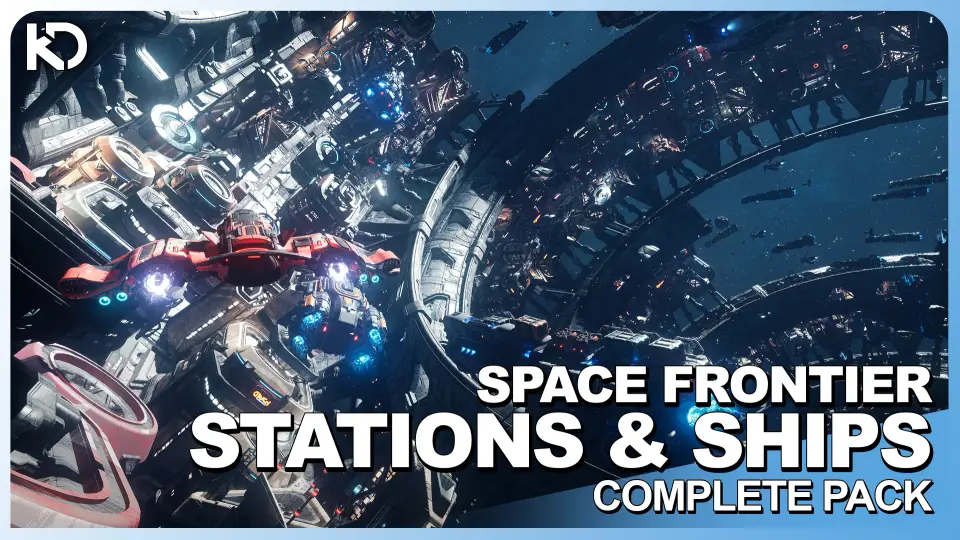
Space Frontier Stations & Ships
Build vast sci-fi environments with Space Frontier Stations & Ships, featuring 60+ blueprints, procedural scattering, flyable ships, and Nanite/Lumen support.
Assembling Orbital Layouts with Space Frontier Stations Blueprints
Constructing believable space environments usually demands a delicate balance between visual scale and scene performance. Space Frontier Stations & Ships addresses this balance by centering its level-building workflow around an extensive suite of over 60 blueprints. These utility tools eliminate the friction of manually placing thousands of structural components, giving artists and technical designers a direct method for establishing large cosmic environments quickly.
Rather than placing individual meshes by hand, level generation starts with specialized procedural blueprints designed to orchestrate entire orbital hubs. The blueprint framework handles geometry placement while keeping draw calls and computational budgets optimized for real-time applications. By offloading repetitive arrangement tasks to these systems, you can establish the primary layout of a mission zone, space port, or orbital waypoint within a few clicks, ensuring that performance stays intact even as structural complexity increases.
Station Exterior Generation and Space Port Customization
The space structure systems included in the package generate exterior shells for varied station designs and multi-dock space ports. These procedural generators allow developers to configure diverse architectures without relying on repetitive pre-assembled silhouettes. Stations can range from compact outpost modules to sprawling industrial hubs surrounded by docking bays.
Appearance controls built directly into the generation tools offer deep visual authority over final surfaces. Designers can modify exterior colors, surface accents, and stylistic variations across structural panels using integrated vertex color and shader parameters. This procedural tinting and exterior manipulation ensures that adjoining modules look unified while preventing neighboring stations from appearing cloned. Whether building an isolated orbital station or a crowded transit depot, the station structure systems supply granular control over surface coloration, layout footprint, and docking layout points.
Spline Paths, Asteroid Rings, and Scattering Tools
Connecting sprawling station complexes requires flexible infrastructure, which is handled directly by specialized spline blueprints. These tools allow technical artists to trace continuous routes through three-dimensional space, generating structural utility paths such as flexible cords, pressurized transfer hoses, and fuel conduits slung between separate hull components. Beyond static geometry, spline actors can be established to define precise navigation routes for moving spaceships, providing guided pathways through crowded shipyards or dangerous debris fields.
Cosmic surroundings are populated through complementary scattering blueprints and procedural spline configurations:
Spline-based Asteroid Rings: Define dense circular or arc-shaped planetary rings using custom curves that orient rocks smoothly along orbital trajectories.
Procedural Field Scattering: Populate cubic light-years of space with floating rock clusters, setting density thresholds and distribution parameters across custom bounding volumes.
Breakable Meteorites: Populate hazards using dedicated destructible asteroid meshes, allowing for dynamic shattering effects when ships interact with or fire upon incoming rocks.
Orbital Wreckage Belts: Distribute broken hulls and structural space debris around stations to depict past conflicts or derelict facilities.
Multi-Layer Planet Materials and Parameterized Rock Surfaces
Planetary bodies and celestial backdrops in the package rely on a multi-layered planet material setup engineered to handle orbital vantage points. Rather than relying on simple static texture projections, the planet shader splits visual attributes into dedicated, adjustable layers:
Atmospheric Scatter: Renders atmospheric depth and horizon glow around the planetary limb to simulate realistic light dispersion.
Dynamic Cloud Decks: Generates independent cloud layers above the terrain surface with customizable opacity and drift.
Water and Continental Separation: Incorporates surface moisture maps and reflective properties for oceans and surface water bodies.
Emissive Night Layers: Displays localized artificial light emissions on the darkened hemisphere to convey ground-level civilization.
Micro and Macro Detail Maps: Balances surface visibility across extreme distances, maintaining crisp ground features whether viewed from deep orbit or a lower flight path.
Rock surfaces utilize a specialized material designed to cover the full spectrum of asteroids and meteorites. The rock shader features extensive parametric controls to alter roughness, surface weathering, color tints, and edge definition. These adjustable settings ensure that a single rock asset can visually adapt to icy outer-belt hazards, burned metallic meteorites, or dusty orbital fragments seamlessly.
Interactive Systems and Mechanics for Flyable Spaceships
Beyond passive environment art, the collection provides fully functional, flyable spaceships configured with robust gameplay features. These spacecraft bypass the need to assemble base vehicle controllers from scratch, offering out-of-the-box flight capabilities that integrate directly with interactive space scenes.
The craft contain pre-built functional modules addressing core spaceflight mechanics:
Fuel Consumption: Tracks active resource burn rates during cruising, thrusting, and maneuvering.
Cargo Management: Allocates inventory space for trading, hauling, or resource extraction systems.
Crew Handling: Tracks personnel allocations and occupancy parameters within the vehicle framework.
Weapon Control: Directs firing routines, projectile logic, and interaction with destructible world targets.
Active Scanning: Scans surrounding coordinate space to identify points of interest, nearby hazards, and resource-bearing asteroids.
Asset Scope, Nanite Pipeline, and Production Maintenance
The core library provides 120 different space-themed assets, ranging from massive space stations and background celestial bodies to broken space debris, individual modular hull elements, asteroids, and diverse spaceship variants. Every asset is constructed to function natively with Unreal Engine's modern rendering toolset, including full support for Nanite virtualized geometry and Lumen dynamic global illumination and reflections. Nanite compatibility allows dense mesh micro-details on metallic plating and craggy asteroid crusts to render without manual level-of-detail compromises, while Lumen handles complex bounce lighting between floating hulls and glowing engine thrusters.
For teams operating across shared creative universes, the pack offers direct visual and workflow compatibility with the Post Apocalyptic Bundle, enabling smooth asset integration when depicting scavenged stations, derelict outposts, or desperate survival enclaves in deep orbit. Maintenance of the project relies on direct user feedback channels, with technical documentation and dedicated communication servers available to guide implementation and support incoming expansions over the asset's active production lifespan.
 Sky & Space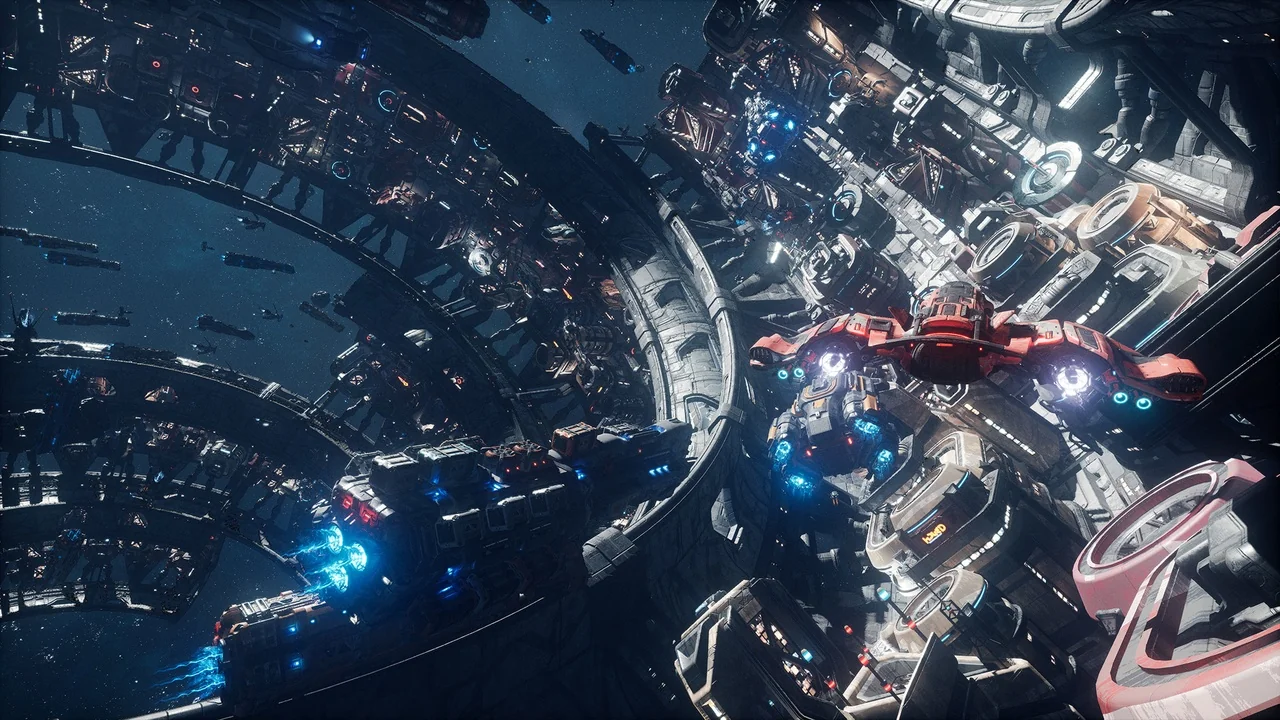
 Sky & Space
 Sky & Space
 Sky & Space