"a5ffaf404b9c2b7e"{"id":"1002642","slug":"sidewalk-debris-and-trash-cigarettes-masks-gum-cans","title":"Sidewalk Debris \u0026 Trash - Cigarettes, Masks, Gum, Cans","category":"Trashyard","engine":"5.0+","assetVersion":"","engineVersion":"Engine Version: 5.0+","tag":"Trashyard","accent":"blue","visual":"mech","summary":"An in-depth look at optimized photo-realistic sidewalk debris, covering cigarettes, gum smears, squashed cans, and dirty masks for real-time clutter.","platform":"Unreal Engine","indexPolicy":"index","publishedAt":"2026-11-15T06:29:55.844Z","updatedAt":"2026-11-15T06:29:55.844Z","sourceNotes":[],"fileContents":[],"compatibility":["Unreal Engine","Engine Version: 5.0+"],"featuredImage":{"alt":"Sidewalk Debris \u0026 Trash - Cigarettes, Masks, Gum, Cans","src":"/wp-content/uploads/published/2026/11/6bdaa34e31d8-833f2e25-9eb1-4e63-8336-973fa9aa0801-48394dc745.webp"},"hasDownloadLink":true,"downloads":0,"terms":[{"taxonomy":"category","slug":"trashyard","name":"Trashyard"}],"galleryImages":[{"src":"/wp-content/uploads/published/2026/11/c710b1ec4f10-7cdb5f1d-4776-42f2-88cc-1f96204d614b-1c91d93179.webp","alt":"Sidewalk Debris \u0026 Trash - Cigarettes, Masks, Gum, Cans"},{"src":"/wp-content/uploads/published/2026/11/89110283a0a6-6d974d88-013b-4a4b-ad49-abf029cae473-1e89ca1b4b.webp","alt":"Sidewalk Debris \u0026 Trash - Cigarettes, Masks, Gum, Cans"},{"src":"/wp-content/uploads/published/2026/11/419269b5580f-0ae98bae-6420-4bc0-863c-99c15ea92833-b26537a6ee.webp","alt":"Sidewalk Debris \u0026 Trash - Cigarettes, Masks, Gum, Cans"},{"src":"/wp-content/uploads/published/2026/11/24104719ed3c-928a615c-92a0-4a64-b1c1-4b784542ba0e-6fccb2bdec.webp","alt":"Sidewalk Debris \u0026 Trash - Cigarettes, Masks, Gum, Cans"},{"src":"/wp-content/uploads/published/2026/11/312b5e662079-f96ccabb-ff3a-4ca6-9281-718b80715948-f3927d84a6.webp","alt":"Sidewalk Debris \u0026 Trash - Cigarettes, Masks, Gum, Cans"},{"src":"/wp-content/uploads/published/2026/11/9e02f623b365-d8147e6d-be42-4a9d-ad22-09bbd59d439a-6dc650b4f2.webp","alt":"Sidewalk Debris \u0026 Trash - Cigarettes, Masks, Gum, Cans"},{"src":"/wp-content/uploads/published/2026/11/30c9c1bd471b-01852b2c-5fb5-476d-b343-93f75b591591-05c54322ae.webp","alt":"Sidewalk Debris \u0026 Trash - Cigarettes, Masks, Gum, Cans"},{"src":"/wp-content/uploads/published/2026/11/4d21cc6fea8c-4774cdb0-2e77-4704-9a63-6c8609eab6cf-eb5bee6702.webp","alt":"Sidewalk Debris \u0026 Trash - Cigarettes, Masks, Gum, Cans"},{"src":"/wp-content/uploads/published/2026/11/8ae8e63877cf-e6556ae5-e34f-4d65-b546-1ce7adb2cbc9-23dc3425f4.webp","alt":"Sidewalk Debris \u0026 Trash - Cigarettes, Masks, Gum, Cans"},{"src":"/wp-content/uploads/published/2026/11/0c3dd41a0d8e-2fabf6df-d210-4075-91c5-dac0f3369b33-5c16555038.webp","alt":"Sidewalk Debris \u0026 Trash - Cigarettes, Masks, Gum, Cans"}],"accessPanel":{"kind":"resource","title":"Get this resource","eyebrow":"Free resource","message":"Download this resource in your browser.","fileName":"Content.7z","safetyNote":"Resources are manually reviewed before listing to improve quality and reduce obvious risks.","actionLabel":"Get this resource","resourceType":"Resource archive","versions":[]},"contentHtml":"\u003cp\u003eContemporary city streets, industrial alleys, and transit corridors rely heavily on micro-detailing to break up flat, repetitive surfaces. Paved environments in modern game engines often look artificially pristine without realistic ground scatter. Fine urban waste—discarded smoking materials, flattened beverage containers, discarded facial coverings, and trodden chewing gum—anchors roads, curbs, and walking paths into believable spaces. Ground dressing at this scale must strike a strict balance: assets need to convey convincing surface photo-realism at ground level while retaining an exceptionally low geometry footprint so runtime performance remains stable across dense scenes.\u003c/p\u003e \u003ch2\u003ePopulating Sidewalk Scenarios with Ground Clutter\u003c/h2\u003e\n\u003cp\u003eThe collection focuses entirely on low-lying ground litter designed specifically to act as clutter rather than hero assets. In contemporary interactive productions, clutter objects sit close to the floor plane and are rarely viewed in isolated isolation from inches away. Their purpose is to enrich terrain materials, curbsides, sewer grates, and pedestrian thoroughfares. Constructing these micro-elements with standard prop workflows often results in unnecessary polygon density, which strains rendering budgets when hundreds of tiny pieces populate a single city block.\u003c/p\u003e\n\u003cp\u003eBy defining these assets strictly as background scatter, the geometry remains heavily optimized for current-generation pipelines. Urban environments, industrial facilities, construction perimeters, and simulation testbeds can be surfaced with layer upon layer of small-scale debris without introducing rendering bottlenecks. The assets work seamlessly around architectural assets, street furniture, asphalt, and concrete walkways, providing the realistic dirtiness characteristic of lived-in municipal spaces.\u003c/p\u003e \u003ch2\u003eCigarettes and Static-Mesh Decals for Micro Detail\u003c/h2\u003e\n\u003cp\u003eThe core of the package addresses one of the most common yet tedious forms of urban litter: discarded cigarette butts. The collection divides these assets across distinct implementation methods to give environment artists direct control over geometry count and layout strategy.\u003c/p\u003e\n\u003cp\u003eIndividual cigarette assets total 15 separate mesh variants, scaling between 2 and 40 triangles each. This micro-budget footprint allows artists to scatter individual, unburned, or crushed butts across steps, cracks, and ground crevices without concern over polygon inflation. For scenarios requiring ultra-low overhead, the set provides 15 static-mesh decal variations that range from just 2 to 6 triangles. These decal cards project realistic cigarette shapes flat against ground planes, curbs, and pavement cracks, virtually eliminating geometric load while preserving silhouette definition and shadowing.\u003c/p\u003e\n\u003cp\u003eTo assist with natural grouping, 13 pre-arranged clusters combine multiple butts into single meshes. Rather than hand-placing dozen-piece piles around building entrances, smoking areas, or transit shelters, level designers can place pre-composed clusters in a single pass. This reduces draw calls and ensures naturally dispersed patterns that mimic real-world waste accumulation.\u003c/p\u003e \u003ch2\u003eScattering Gum, Cans, and Masks Across Roads\u003c/h2\u003e\n\u003cp\u003eBeyond smoking waste, authentic roadside dressing demands varied debris types reflecting varied human activity. The package incorporates bonus assets pre-configured to work straight out of the box, expanding the visual palette across road surfaces and pedestrian walkways.\u003c/p\u003e\n\u003cp\u003eChewing gum deposits are supplied through 25 sidewalk gum variants divided across dark and light tones. Trodden gum represents a critical layer of urban weathering that standard tiling materials rarely capture effectively. The light variants mimic fresh deposits, while the dark variants simulate aged, dirt-encrusted smears embedded into asphalt or concrete. Because these smears sit directly on the ground plane, they break up pavement texture repetition without needing dedicated height displacement.\u003c/p\u003e\n\u003cp\u003eFor mid-sized ground debris, the collection includes 7 flattened and squashed drink cans. Bent and crushed metal surfaces capture light realistically while maintaining a completely flat footprint suitable for driving tracks, roadside gutters, and pedestrian footpaths. Discarded pandemic-era waste is covered by 5 dirty mask variants, reflecting discarded surgical and fabric coverings wrinkled against curbs and alley floors.\u003c/p\u003e\n\u003cp\u003eEvery asset in the package features completely unbranded textures. Modern production settings frequently encounter intellectual property constraints when dealing with consumer packaging, beverage labels, or commercial products. Because the cans and other components carry no real-world logos or trademarked graphics, they integrate directly into commercial games, cinematics, and architectural visualizations without requiring texture sanitization or legal clearances.\u003c/p\u003e \u003ch2\u003eProcedural Foliage Generators and Foliage Painting Workflows\u003c/h2\u003e\n\u003cp\u003eManually scattering tiny debris meshes by hand across expansive exterior maps is prohibitively time-consuming. To eliminate manual placement bottlenecks, the assets are integrated with procedural generation systems and standard foliage painting setups.\u003c/p\u003e\n\u003cp\u003eThe package includes 3 procedural foliage generators set up to distribute the cigarette models automatically across target surfaces. These generators calculate natural dispersion patterns, handling rotation, scale variations, and density thresholds across selected landscape or mesh layers. For targeted manual control, the models support standard foliage painting tools, enabling artists to brush ground clutter into corners, around planters, and along curb lines with precise density falloffs.\u003c/p\u003e\n\u003cp\u003eAll bonus assets—including the 25 gum variants, 7 flattened cans, and 5 masks—come fully configured with procedural spawners and matching foliage types. Artists can blend cans, gum spots, masks, and cigarette clusters into unified scatter layers. Level decorators can establish multi-tiered debris profiles in minutes: high-density gum smears along main walking corridors, dispersed cigarette clusters near building thresholds, and squashed cans drifting into gutters and corners.\u003c/p\u003e \u003ch2\u003eTarget Productions and Clutter Application\u003c/h2\u003e\n\u003cp\u003eEnvironment artists, level designers, and technical directors building contemporary real-time projects benefit most from this collection. Teams handling current-gen action titles, open-world urban games, survival environments, and architectural simulations often spend disproportionate hours modeling and setting up micro-props that players barely register individually. Having pre-configured, unbranded micro-debris with dedicated procedural foliage rules accelerates map dress stages significantly, ensuring consistent visual density across expansive city streets while keeping polygon budgets strictly in check.\u003c/p\u003e\n\n\u003ch2\u003eMore From The Same Workflow\u003c/h2\u003e\n\u003cul\u003e\n\u003cli\u003e\u003ca href=\"https://3dcghub.com/garbage-and-debris-vol-1-by-unimodels/\" rel=\"noopener noreferrer\"\u003eGarbage and Debris Vol. 1 by Unimodels\u003c/a\u003e\u003c/li\u003e\n\u003cli\u003e\u003ca href=\"https://3dcghub.com/trash-vol-1-city-streets-nanite-and-low-poly-versions/\" rel=\"noopener noreferrer\"\u003eTrash VOL.1 - City Streets (Nanite and Low Poly Versions)\u003c/a\u003e\u003c/li\u003e\n\u003cli\u003e\u003ca href=\"https://3dcghub.com/trash-set-2/\" rel=\"noopener noreferrer\"\u003eTrash Set.2\u003c/a\u003e\u003c/li\u003e\n\u003cli\u003e\u003ca href=\"https://3dcghub.com/fishing-village/\" rel=\"noopener noreferrer\"\u003eFishing Village\u003c/a\u003e\u003c/li\u003e\n\u003cli\u003e\u003ca href=\"https://3dcghub.com/street-creator-set/\" rel=\"noopener noreferrer\"\u003eStreet Creator Set\u003c/a\u003e\u003c/li\u003e\n\u003c/ul\u003e","contentTextLength":6976,"navigation":{"current":6,"total":4570,"previous":{"id":"1002643","slug":"skeleton-knight-modular","title":"Skeleton Knight Modular","category":"Humans","platform":"Unreal Engine","updatedAt":"2026-11-15T06:31:36.477Z"},"next":{"id":"1002641","slug":"sci-fi-weapon-pack-mini","title":"Sci-Fi Weapon Pack Mini","category":"Weapons \u0026 Combat","platform":"Unreal Engine","updatedAt":"2026-11-15T06:28:56.634Z"}},"relatedResources":[{"id":"1001347","slug":"garbage-and-debris-vol-1-by-unimodels","title":"Garbage and Debris Vol. 1 by Unimodels","category":"Trashyard","engine":"4.18+,5.0+","assetVersion":"","engineVersion":"Engine Version: 4.18+,5.0+","tag":"Trashyard","accent":"blue","visual":"mech","summary":"Garbage and Debris Vol. 1 by Unimodels delivers 52 photoscanned trash assets and 3 tiled dirt materials optimized for light baking and real-time performance.","platform":"Unreal Engine","indexPolicy":"index","publishedAt":"2026-10-04T10:10:57.586Z","updatedAt":"2026-10-04T10:10:57.586Z","sourceNotes":[],"fileContents":[],"compatibility":["Unreal Engine","Engine Version: 4.18+,5.0+"],"featuredImage":{"alt":"Garbage and Debris Vol. 1 by Unimodels","src":"/wp-content/uploads/published/2026/10/a5d4bcfbb697-c87cf08a-02ae-4dad-a636-1a91cd89ed08-1e585be53b.webp"},"hasDownloadLink":true,"downloads":1},{"id":"1001472","slug":"trash-vol-1-city-streets-nanite-and-low-poly-versions","title":"Trash VOL.1 - City Streets (Nanite and Low Poly Versions)","category":"Trashyard","engine":"5.1+","assetVersion":"","engineVersion":"Engine Version: 5.1+","tag":"Trashyard","accent":"blue","visual":"city","summary":"Examine Trash VOL.1 - City Streets, featuring 300 Nanite and low-poly meshes, 4K RMAO textures, custom branding, and Unreal Engine Lumen support.","platform":"Unreal Engine","indexPolicy":"index","publishedAt":"2026-10-08T08:24:01.253Z","updatedAt":"2026-10-08T08:24:01.253Z","sourceNotes":[],"fileContents":[],"compatibility":["Unreal Engine","Engine Version: 5.1+"],"featuredImage":{"alt":"Trash VOL.1 - City Streets (Nanite and Low Poly Versions)","src":"/wp-content/uploads/published/2026/10/7f1bd73b760f-91f75056-4bad-41e2-a9dc-08955bd55e6b-5ea8ee19a4.webp"},"hasDownloadLink":true,"downloads":0},{"id":"1000700","slug":"trash-set-2","title":"Trash Set.2","category":"Trashyard","engine":"4.26+,5.0+","assetVersion":"","engineVersion":"Engine Version: 4.26+,5.0+","tag":"Trashyard","accent":"blue","visual":"mech","summary":"PBR low-poly trash and garbage collection for game engines and renderers. Includes dumpsters, bins, bottles, and food fragments for realistic scenes.","platform":"Unreal Engine","indexPolicy":"index","publishedAt":"2026-07-24T00:01:13.253Z","updatedAt":"2026-07-24T00:01:13.253Z","sourceNotes":[],"fileContents":[],"compatibility":["Unreal Engine","Engine Version: 4.26+,5.0+"],"featuredImage":{"alt":"Trash Set.2","src":"/wp-content/uploads/published/2026/07/bc5acc044324-61ec9d30-38c0-45dc-8f2d-d3bb6afeeb34-6cb4298d88.webp"},"hasDownloadLink":true,"downloads":1}]}
An in-depth look at optimized photo-realistic sidewalk debris, covering cigarettes, gum smears, squashed cans, and dirty masks for real-time clutter.
Category:Unreal Engine,TrashyardPlatform: Unreal EngineEngine Version: 5.0+Published: Nov 15, 2026
Trashyard
Resource overview
Contemporary city streets, industrial alleys, and transit corridors rely heavily on micro-detailing to break up flat, repetitive surfaces. Paved environments in modern game engines often look artificially pristine without realistic ground scatter. Fine urban waste—discarded smoking materials, flattened beverage containers, discarded facial coverings, and trodden chewing gum—anchors roads, curbs, and walking paths into believable spaces. Ground dressing at this scale must strike a strict balance: assets need to convey convincing surface photo-realism at ground level while retaining an exceptionally low geometry footprint so runtime performance remains stable across dense scenes.
Populating Sidewalk Scenarios with Ground Clutter
The collection focuses entirely on low-lying ground litter designed specifically to act as clutter rather than hero assets. In contemporary interactive productions, clutter objects sit close to the floor plane and are rarely viewed in isolated isolation from inches away. Their purpose is to enrich terrain materials, curbsides, sewer grates, and pedestrian thoroughfares. Constructing these micro-elements with standard prop workflows often results in unnecessary polygon density, which strains rendering budgets when hundreds of tiny pieces populate a single city block.
By defining these assets strictly as background scatter, the geometry remains heavily optimized for current-generation pipelines. Urban environments, industrial facilities, construction perimeters, and simulation testbeds can be surfaced with layer upon layer of small-scale debris without introducing rendering bottlenecks. The assets work seamlessly around architectural assets, street furniture, asphalt, and concrete walkways, providing the realistic dirtiness characteristic of lived-in municipal spaces.
Cigarettes and Static-Mesh Decals for Micro Detail
The core of the package addresses one of the most common yet tedious forms of urban litter: discarded cigarette butts. The collection divides these assets across distinct implementation methods to give environment artists direct control over geometry count and layout strategy.
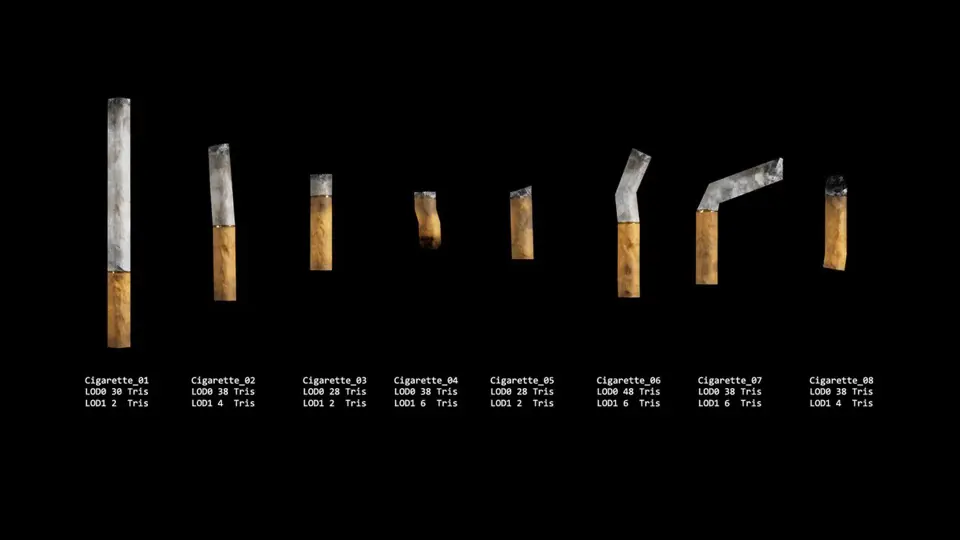
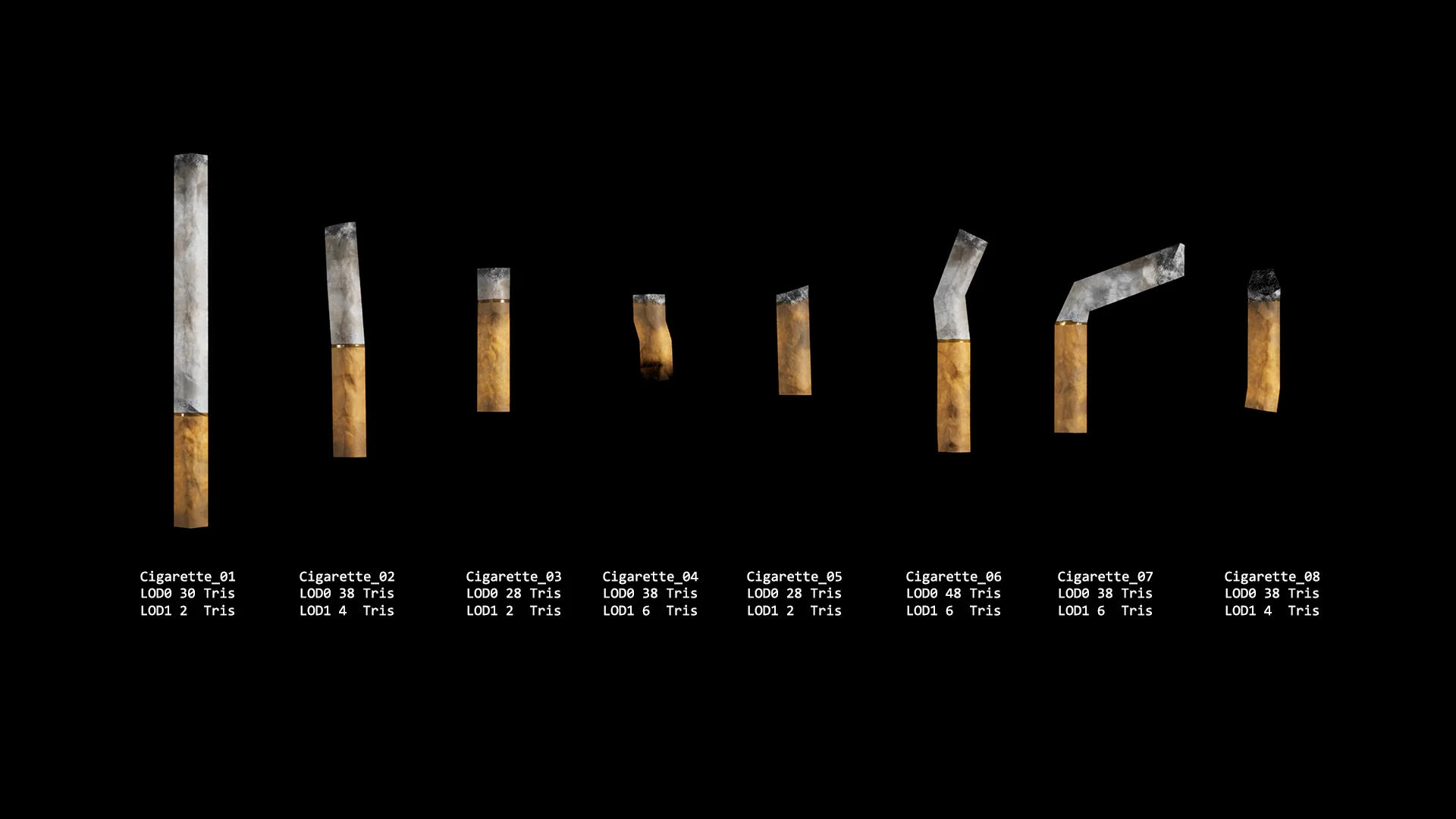
Individual cigarette assets total 15 separate mesh variants, scaling between 2 and 40 triangles each. This micro-budget footprint allows artists to scatter individual, unburned, or crushed butts across steps, cracks, and ground crevices without concern over polygon inflation. For scenarios requiring ultra-low overhead, the set provides 15 static-mesh decal variations that range from just 2 to 6 triangles. These decal cards project realistic cigarette shapes flat against ground planes, curbs, and pavement cracks, virtually eliminating geometric load while preserving silhouette definition and shadowing.
To assist with natural grouping, 13 pre-arranged clusters combine multiple butts into single meshes. Rather than hand-placing dozen-piece piles around building entrances, smoking areas, or transit shelters, level designers can place pre-composed clusters in a single pass. This reduces draw calls and ensures naturally dispersed patterns that mimic real-world waste accumulation.
Scattering Gum, Cans, and Masks Across Roads
Beyond smoking waste, authentic roadside dressing demands varied debris types reflecting varied human activity. The package incorporates bonus assets pre-configured to work straight out of the box, expanding the visual palette across road surfaces and pedestrian walkways.
Chewing gum deposits are supplied through 25 sidewalk gum variants divided across dark and light tones. Trodden gum represents a critical layer of urban weathering that standard tiling materials rarely capture effectively. The light variants mimic fresh deposits, while the dark variants simulate aged, dirt-encrusted smears embedded into asphalt or concrete. Because these smears sit directly on the ground plane, they break up pavement texture repetition without needing dedicated height displacement.
For mid-sized ground debris, the collection includes 7 flattened and squashed drink cans. Bent and crushed metal surfaces capture light realistically while maintaining a completely flat footprint suitable for driving tracks, roadside gutters, and pedestrian footpaths. Discarded pandemic-era waste is covered by 5 dirty mask variants, reflecting discarded surgical and fabric coverings wrinkled against curbs and alley floors.
Every asset in the package features completely unbranded textures. Modern production settings frequently encounter intellectual property constraints when dealing with consumer packaging, beverage labels, or commercial products. Because the cans and other components carry no real-world logos or trademarked graphics, they integrate directly into commercial games, cinematics, and architectural visualizations without requiring texture sanitization or legal clearances.
Procedural Foliage Generators and Foliage Painting Workflows
Manually scattering tiny debris meshes by hand across expansive exterior maps is prohibitively time-consuming. To eliminate manual placement bottlenecks, the assets are integrated with procedural generation systems and standard foliage painting setups.
The package includes 3 procedural foliage generators set up to distribute the cigarette models automatically across target surfaces. These generators calculate natural dispersion patterns, handling rotation, scale variations, and density thresholds across selected landscape or mesh layers. For targeted manual control, the models support standard foliage painting tools, enabling artists to brush ground clutter into corners, around planters, and along curb lines with precise density falloffs.
All bonus assets—including the 25 gum variants, 7 flattened cans, and 5 masks—come fully configured with procedural spawners and matching foliage types. Artists can blend cans, gum spots, masks, and cigarette clusters into unified scatter layers. Level decorators can establish multi-tiered debris profiles in minutes: high-density gum smears along main walking corridors, dispersed cigarette clusters near building thresholds, and squashed cans drifting into gutters and corners.
Target Productions and Clutter Application
Environment artists, level designers, and technical directors building contemporary real-time projects benefit most from this collection. Teams handling current-gen action titles, open-world urban games, survival environments, and architectural simulations often spend disproportionate hours modeling and setting up micro-props that players barely register individually. Having pre-configured, unbranded micro-debris with dedicated procedural foliage rules accelerates map dress stages significantly, ensuring consistent visual density across expansive city streets while keeping polygon budgets strictly in check.
 Trashyard
 Trashyard
 Trashyard
 Trashyard