"1a0e4ac4dc71d030"{"id":"1000200","slug":"sci-fi-fruit-market-nanite","title":"Sci-Fi Fruit Market - Nanite","category":"Sci-Fi","engine":"5.0+","assetVersion":"","engineVersion":"Engine Version: 5.0+","tag":"Sci-Fi","accent":"blue","visual":"mech","summary":"A high-poly sci-fi fruit market kit bash for Unreal Engine 5 with Nanite and Lumen support, animated machines, smart materials, LUTs, and demo levels.","platform":"Unreal Engine","publishedAt":"2026-06-23T14:28:16.189Z","updatedAt":"2026-06-23T14:28:16.189Z","sourceNotes":[],"fileContents":[],"compatibility":["Unreal Engine","Engine Version: 5.0+"],"featuredImage":{"alt":"Sci-Fi Fruit Market - Nanite","src":"/wp-content/uploads/published/2026/06/74413fec2873-3a72388b-2226-4984-9107-23fc19af5d24-476369b57e.webp"},"hasDownloadLink":true,"downloads":0,"terms":[{"taxonomy":"category","slug":"sci-fi","name":"Sci-Fi"}],"galleryImages":[{"src":"/wp-content/uploads/published/2026/06/074cf85f826e-2f2e3d7b-c853-4df1-8e5f-cf6a33a3c229-d1c3e15e31.webp","alt":"Sci-Fi Fruit Market - Nanite"},{"src":"/wp-content/uploads/published/2026/06/becda485c92a-522de794-9d7e-4e3d-a4a8-1b2ea987db45-de1d11021a.webp","alt":"Sci-Fi Fruit Market - Nanite"},{"src":"/wp-content/uploads/published/2026/06/2c810119dce6-98cc14ca-4912-4312-9bfb-bcbfc564d3e9-95b6e21184.webp","alt":"Sci-Fi Fruit Market - Nanite"},{"src":"/wp-content/uploads/published/2026/06/7af8b624b7a5-d8127cae-c3a0-44de-b516-9322ae941bd4-20b3c2e5ec.webp","alt":"Sci-Fi Fruit Market - Nanite"},{"src":"/wp-content/uploads/published/2026/06/adaffa583cbc-78ce1f88-94bc-4b5c-93c7-e1d79e1e0444-47226cf752.webp","alt":"Sci-Fi Fruit Market - Nanite"},{"src":"/wp-content/uploads/published/2026/06/7cee7ef4780e-9c9b3678-8131-40af-9b7d-0711d7be3506-ee0f82a3af.webp","alt":"Sci-Fi Fruit Market - Nanite"},{"src":"/wp-content/uploads/published/2026/06/5dc81b613759-f063bee8-dbe9-4c60-8e58-82d0cdeec51f-c37850f213.webp","alt":"Sci-Fi Fruit Market - Nanite"},{"src":"/wp-content/uploads/published/2026/06/1f5e28b88eb6-158fae51-3ec6-4319-ad5d-23e5ed7eb765-b43d50afd1.webp","alt":"Sci-Fi Fruit Market - Nanite"},{"src":"/wp-content/uploads/published/2026/06/826989b15215-f2d4758e-035c-412f-99a7-9cabe462bfcd-69acce8518.webp","alt":"Sci-Fi Fruit Market - Nanite"},{"src":"/wp-content/uploads/published/2026/06/f49a12fb9ec5-eac8ef16-01f4-4b34-8557-1a0a004a38fc-c80d3d0e2c.webp","alt":"Sci-Fi Fruit Market - Nanite"}],"accessPanel":{"kind":"resource","title":"Download this resource","eyebrow":"Free Download","message":"Log in or create a free account to start your download.","fileName":"Content.7z","safetyNote":"Resources are manually reviewed before listing to improve quality and reduce obvious risks.","actionLabel":"Download Free","resourceType":"Resource archive"},"contentHtml":"\u003cp\u003eBusy futuristic stalls, dense prop arrangements, and close camera work are where \u003cstrong\u003eSci-Fi Fruit Market - Nanite\u003c/strong\u003e Makes the most sense. It is a high-poly science fiction kit bash focused on building a fruit market with a cinematic result, suited to realistic scene composition as well as immersive video game environments.\u003c/p\u003e\n\u003cp\u003eThe package leans into visual richness at short viewing distances. Its meshes are modeled to hold up when the camera gets close, and the overall setup supports scenes that want layered materials, animated mechanical elements, and a market layout that feels assembled rather than flatly dressed.\u003c/p\u003e \u003ch2\u003eWhere a Sci-Fi Fruit Market fits best\u003c/h2\u003e\n\u003cp\u003eThis is not a broad sci-fi backdrop with vague utility. Its strongest use is clear: constructing a science fiction fruit market with enough realism to carry hero shots, environmental storytelling, or explorable market corners inside a larger futuristic setting. The cinematic emphasis runs through the whole package, from the high-poly modeling approach to the included trailer material and post-treatment LUTs.\u003c/p\u003e\n\u003cp\u003eFor game scenes, that makes it a natural fit for immersive hubs, side streets, underground stalls, or cyberpunk-style commercial spaces where props need to survive scrutiny. For cinematic work, it offers a prebuilt direction toward realistic lighting response, modular scene building, and moving parts that keep the frame alive.\u003c/p\u003e\n\u003cp\u003eThe package is also part of a broader sci-fi collection, alongside Sci-Fi Work Station, Sci-Fi Computer Station, Sci-Fi Starter Pack, and Sci-Fi Spaceship and base kit Bash. That places it firmly inside a consistent futuristic visual family, while still keeping this specific pack driven by the fruit market theme.\u003c/p\u003e \u003ch2\u003eThe six machines and what they add to the market\u003c/h2\u003e\n\u003cp\u003eA major part of the scene identity comes from the six included machines: \u003cstrong\u003eRobotic Arm, Flying Droid, Flying Insect, Smart Tray, SciFi Box, and SciFi Ant\u003c/strong\u003e. Each one includes its own animations and is supported by Nanite. This helps because the market is not limited to static shelves and containers. It can be populated with moving mechanical elements that help the space feel operational.\u003c/p\u003e\n\u003cp\u003eThe set of machines covers different kinds of visual roles. A robotic arm can read as handling or processing equipment. A flying droid or flying insect can add hovering activity overhead. Smart Tray, SciFi Box, and SciFi Ant push the scene further into a stylized but still grounded science fiction direction. The important point is not a fictional backstory for each device, but the practical fact that they introduce animation into the environment instead of leaving motion to camera work alone.\u003c/p\u003e\n\u003cp\u003eThere are also dedicated overview and animation materials to help navigate this side of the pack. Two overview maps are included: \u003cstrong\u003eMeshes_Blueprint_Materials\u003c/strong\u003e And \u003cstrong\u003eAnimations\u003c/strong\u003e. Three movie sequences are included as well: \u003cstrong\u003eLS_Animations_OverviewAnimationMap\u003c/strong\u003e, which opens in the Overview_Animations map, \u003cstrong\u003eLS_SciFiFruitMarket_01\u003c/strong\u003e, which opens in the DemoLevel_FruitSeller map, and \u003cstrong\u003eLS_SciFiFruitMarket_02_LowSettingsMap\u003c/strong\u003e, which opens in the DemoLevel_FruitSeller_LowSettings map.\u003c/p\u003e\n\u003cp\u003eThat structure gives the package a practical edge. It is not only a collection of meshes and materials; it also includes scene and sequence organization that helps users inspect the assets, see the animated elements in context, and work from existing setups.\u003c/p\u003e \u003ch2\u003eHigh-poly Nanite meshes built for close views\u003c/h2\u003e\n\u003cp\u003eThe visual strategy is explicit. The high-poly meshes are modeled with \u003cstrong\u003e2 bevels on their entire edge\u003c/strong\u003e So they reflect light properly. This is presented as a realism choice that a normal map could not match. In practice, that defines the pack as one aimed at geometry-driven detail rather than relying on simpler surfaces to fake depth.\u003c/p\u003e\n\u003cp\u003eThat decision connects directly to the Nanite support for Unreal Engine 5.0 and above. The resource supports Nanite, which fits the use of dense meshes intended for close inspection. The text also makes an important limitation clear: meshes representing glass objects are not activated, because Nanite does not currently work on translucent materials. That is a specific implementation note worth knowing when planning scenes that mix opaque market props with glass elements.\u003c/p\u003e\n\u003cp\u003eThe claim that you can zoom in as much as you like is tied to this same approach. The pack is clearly meant for scenes where the camera can move close to surfaces without the usual breakdown associated with lighter geometry and blurrier texture handling. If the goal is to frame stalls, containers, or machinery in tight shots, this package is set up with that use in mind.\u003c/p\u003e\n\u003cp\u003eLumen support is also included for Unreal Engine 5.0 and above. Combined with the beveled modeling and dense geometry, that points toward scenes where lighting and reflections are expected to do a lot of visual work. It keeps the resource aligned with realistic science fiction presentation rather than a flat or purely stylized look.\u003c/p\u003e \u003ch2\u003eModular kit bash workflow on a Base 10 grid\u003c/h2\u003e\n\u003cp\u003eA lot of the meshes are modular and can be moved easily on a \u003cstrong\u003eBase 10 grid\u003c/strong\u003e. That makes the pack useful beyond a single fixed arrangement. The market can be assembled, adjusted, or expanded by repositioning modular parts rather than treating the environment as one locked scene.\u003c/p\u003e\n\u003cp\u003eThis is where the kit bash character of the package becomes practical. A science fiction fruit market can be shaped into compact alleys, denser stalls, more open display areas, or mixed indoor-outdoor compositions, depending on how those modular pieces are arranged. The text does not define exact prop counts or exact layout categories, so the safer takeaway is that the resource supports scene construction through movable modular meshes rather than only serving as a finished diorama.\u003c/p\u003e\n\u003cp\u003eThe material setup also feeds into that flexibility. Meshes use between \u003cstrong\u003e1 and 12 materials\u003c/strong\u003e To reach a high level of realism. That suggests some pieces are relatively simple while others are built to support more layered surface treatment. Instead of flattening the whole market into one repeated material style, the pack allows variation across props and machines.\u003c/p\u003e \u003ch2\u003eSmart materials, 3 layers, and the trailer workflow\u003c/h2\u003e\n\u003cp\u003eSmart materials are one of the most concrete workflow features here. The meshes are textured with them, and each setup can use \u003cstrong\u003e3 overlapping layers\u003c/strong\u003e, with the example given as \u003cem\u003eBase texture + Dirt + Damage\u003c/em\u003e. Masks are assigned to each layer so the appearance of the meshes can be changed freely.\u003c/p\u003e\n\u003cp\u003eThis gives the market a controlled way to shift between cleaner surfaces and more worn-down ones. Rather than baking a single finish into every prop, the pack supports layered variation that can push the environment toward polished science fiction, heavier use, or a more lived-in cyberpunk mood. The kit bash already includes several smart materials, and it is also possible to create custom ones by dragging and dropping textures.\u003c/p\u003e\n\u003cp\u003eThree LUTs are included for post-treatment, which supports the broader cinematic angle. The package also includes the trailer itself, and that trailer can be watched and edited in the sequencer. On top of that, the Movie Render Queue settings used for the trailer are present in the content folder path \u003cstrong\u003eContent\u0026gt;P5_FruitSeller\u0026gt;Movies\u0026gt;MPMC_MoviePipelineMasterConfig\u003c/strong\u003e. Using those rendering settings requires the Movie Render Queue plugin.\u003c/p\u003e\n\u003cp\u003eThat combination is especially relevant for users who want more than environment assembly. There is a direct bridge here between the assets in the level and an existing cinematic presentation workflow, including sequence content and rendering configuration.\u003c/p\u003e \u003ch2\u003eDemo levels, low settings, and who this serves best\u003c/h2\u003e\n\u003cp\u003eThe demo level is available in \u003cstrong\u003eTwo versions\u003c/strong\u003e: normal and low settings. There is also a clear warning that the normal settings demo level requires a powerful GPU. This helps because the resource openly targets high visual fidelity, and the two demo variants give users a way to inspect or work with the scene at different performance levels.\u003c/p\u003e\n\u003cp\u003eThe included features can be summed up very concretely: high-poly meshes, a realistic kit bash structure, modular construction, smart materials, three LUTs, two overview maps, three movie sequences, support for Nanite, support for Lumen, and six animated machines. All of that points to a resource best suited to Unreal Engine 5 users who want a futuristic market scene with strong close-up detail and a ready-made cinematic lean.\u003c/p\u003e\n\u003cp\u003eIt will be most useful to artists building realistic sci-fi corners, cyberpunk-style commercial spaces, or showcase scenes where lighting, geometry, and layered surface wear need to carry the image without falling apart up close.\u003c/p\u003e\n\n\u003ch2\u003eExplore Similar Assets\u003c/h2\u003e\n\u003cul\u003e\n\u003cli\u003e\u003ca href=\"https://3dcghub.com/scifi-environment-offworld/\" title=\"SciFi Environment — \u0026#039;Offworld\u0026#039;\"\u003eSciFi Environment — \u0026#039;Offworld\u0026#039;\u003c/a\u003e\u003c/li\u003e\n\u003cli\u003e\u003ca href=\"https://3dcghub.com/concrete-hallway/\" title=\"Concrete Hallway\"\u003eConcrete Hallway\u003c/a\u003e\u003c/li\u003e\n\u003cli\u003e\u003ca href=\"https://3dcghub.com/alchemist-starbase-chapter-1/\" title=\"Alchemist Starbase: Chapter 1\"\u003eAlchemist Starbase: Chapter 1\u003c/a\u003e\u003c/li\u003e\n\u003cli\u003e\u003ca href=\"https://3dcghub.com/sci-fi-orion-mars-living-quarters/\" title=\"Sci Fi Orion Mars Living Quarters\"\u003eSci Fi Orion Mars Living Quarters\u003c/a\u003e\u003c/li\u003e\n\u003cli\u003e\u003ca href=\"https://3dcghub.com/lunar-modular-base/\" title=\"Lunar Modular Base\"\u003eLunar Modular Base\u003c/a\u003e\u003c/li\u003e\n\u003c/ul\u003e","contentTextLength":8816,"navigation":{"current":1102,"total":3200,"previous":{"id":"1000201","slug":"scl-restaurant-002","title":"SCL Restaurant 002","category":"Buildings \u0026 Architecture","platform":"Unreal Engine","updatedAt":"2026-06-23T18:50:46.932Z"},"next":{"id":"1000199","slug":"polygon-goblin-war-camp","title":"POLYGON - Goblin War Camp","category":"Towns \u0026 Villages","platform":"Unreal Engine","updatedAt":"2026-06-23T11:24:33.942Z"}},"relatedResources":[{"id":"1000559","slug":"alien-growth-environment","title":"Alien Growth Environment","category":"Sci-Fi","engine":"5.6+","assetVersion":"","engineVersion":"Engine Version: 5.6+","tag":"Sci-Fi","accent":"blue","visual":"city","summary":"Photoscanned alien growth environment assets for Unreal Engine 5 featuring Nanite-ready meshes, tiled micro-detail materials, moss decals, and a demo level.","platform":"Unreal Engine","publishedAt":"2026-07-15T18:44:12.611Z","updatedAt":"2026-07-15T18:44:12.611Z","sourceNotes":[],"fileContents":[],"compatibility":["Unreal Engine","Engine Version: 5.6+"],"featuredImage":{"alt":"Alien Growth Environment","src":"/wp-content/uploads/published/2026/07/81d10bf51a44-e3ae6231-2f4a-434f-9557-cb4e0600cfd3-6c4f020a69.webp"},"hasDownloadLink":true,"downloads":2},{"id":"1000636","slug":"modular-sci-fi-hangar-area-environment","title":"Modular Sci-fi Hangar Area Environment","category":"Sci-Fi","engine":"5.3+","assetVersion":"","engineVersion":"Engine Version: 5.3+","tag":"Sci-Fi","accent":"blue","visual":"city","summary":"A modular science fiction hangar facility for UE4/5 with corridors, control center, animated sci-fi doors, terrain, sound effects, and extra surface texture til","platform":"Unreal Engine","publishedAt":"2026-07-21T16:59:42.611Z","updatedAt":"2026-07-21T17:01:12.782Z","sourceNotes":[],"fileContents":[],"compatibility":["Unreal Engine","Engine Version: 5.3+"],"featuredImage":{"alt":"Modular Sci-fi Hangar Area Environment","src":"/wp-content/uploads/published/2026/07/45bc4d86939c-79324c73-0de0-4d34-8848-7303602b3c32-8009ac1883.webp"},"hasDownloadLink":true,"downloads":0},{"id":"1000209","slug":"modular-sci-fi-base-indoor-outdoor-moon-theme","title":"Modular Sci-Fi Base - Indoor Outdoor - Moon Theme","category":"Sci-Fi","engine":"5.0+","assetVersion":"","engineVersion":"Engine Version: 5.0+","tag":"Sci-Fi","accent":"blue","visual":"mech","summary":"Construct realistic lunar environments with this high-poly kitbash set, featuring physically beveled meshes, layered intelligent materials, and UE5 integration.","platform":"Unreal Engine","publishedAt":"2026-06-24T15:13:26.573Z","updatedAt":"2026-06-24T15:13:26.573Z","sourceNotes":[],"fileContents":[],"compatibility":["Unreal Engine","Engine Version: 5.0+"],"featuredImage":{"alt":"Modular Sci-Fi Base - Indoor Outdoor - Moon Theme","src":"/wp-content/uploads/published/2026/06/5d7e8f560d5c-a4db3fea-965d-4943-bbc7-725e9673c380-f62c90ca5e.webp"},"hasDownloadLink":true,"downloads":1}]}
Sci-Fi
Sci-Fi Fruit Market - Nanite
A high-poly sci-fi fruit market kit bash for Unreal Engine 5 with Nanite and Lumen support, animated machines, smart materials, LUTs, and demo levels.
Category:Unreal Engine, Sci-FiPlatform: Unreal EngineEngine Version: 5.0+Published: Jun 23, 2026
Sci-Fi
Resource overview
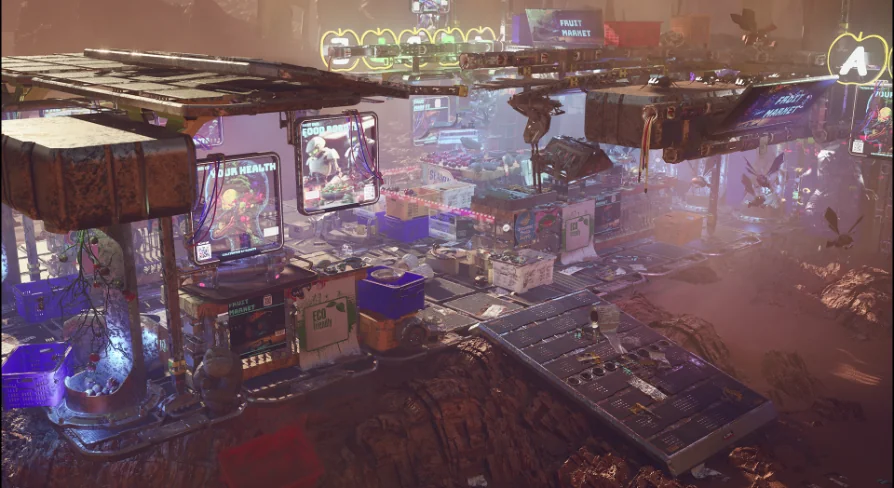
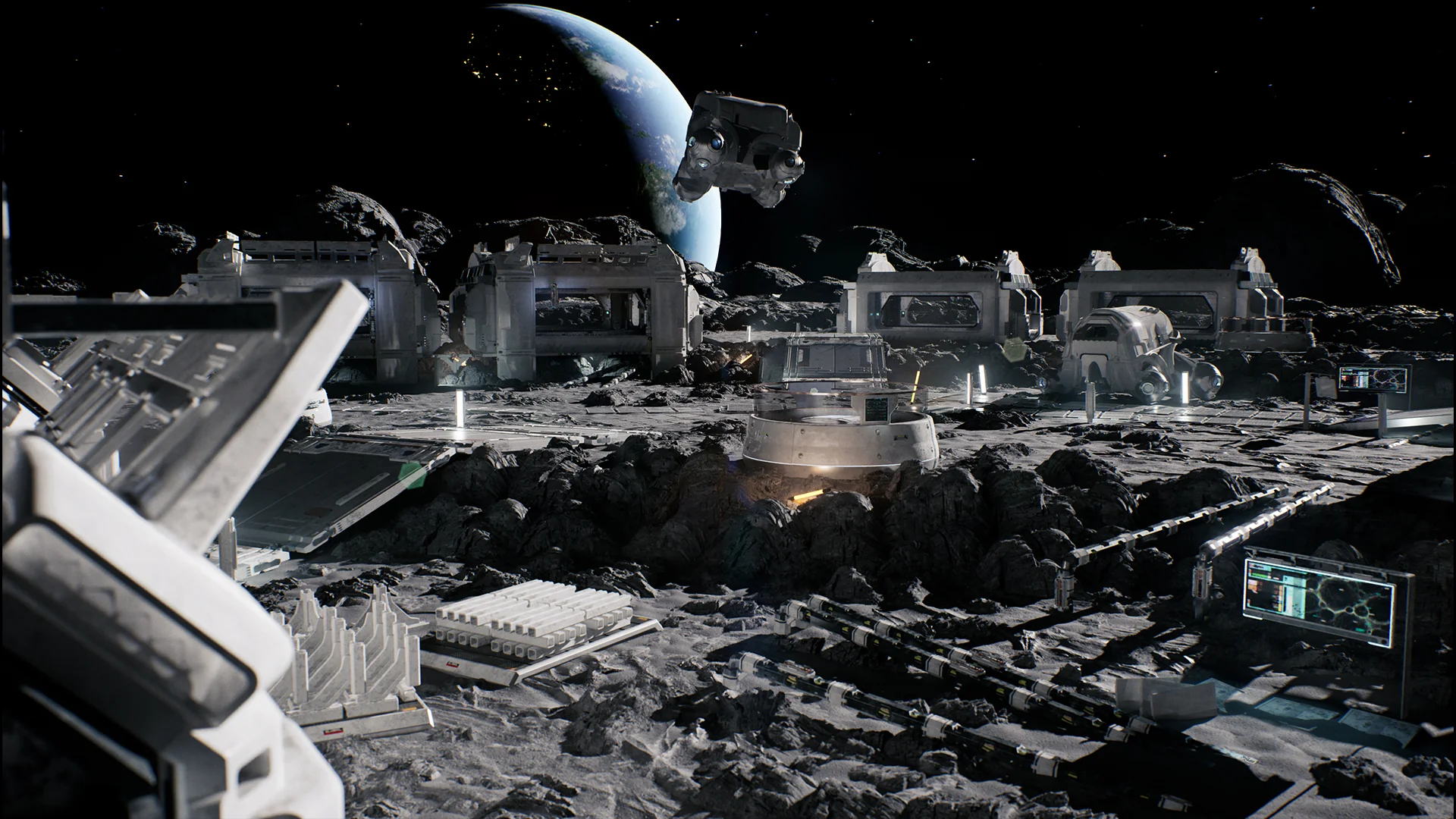
Busy futuristic stalls, dense prop arrangements, and close camera work are where Sci-Fi Fruit Market - Nanite Makes the most sense. It is a high-poly science fiction kit bash focused on building a fruit market with a cinematic result, suited to realistic scene composition as well as immersive video game environments.
The package leans into visual richness at short viewing distances. Its meshes are modeled to hold up when the camera gets close, and the overall setup supports scenes that want layered materials, animated mechanical elements, and a market layout that feels assembled rather than flatly dressed.
Where a Sci-Fi Fruit Market fits best
This is not a broad sci-fi backdrop with vague utility. Its strongest use is clear: constructing a science fiction fruit market with enough realism to carry hero shots, environmental storytelling, or explorable market corners inside a larger futuristic setting. The cinematic emphasis runs through the whole package, from the high-poly modeling approach to the included trailer material and post-treatment LUTs.
For game scenes, that makes it a natural fit for immersive hubs, side streets, underground stalls, or cyberpunk-style commercial spaces where props need to survive scrutiny. For cinematic work, it offers a prebuilt direction toward realistic lighting response, modular scene building, and moving parts that keep the frame alive.
The package is also part of a broader sci-fi collection, alongside Sci-Fi Work Station, Sci-Fi Computer Station, Sci-Fi Starter Pack, and Sci-Fi Spaceship and base kit Bash. That places it firmly inside a consistent futuristic visual family, while still keeping this specific pack driven by the fruit market theme.
The six machines and what they add to the market
A major part of the scene identity comes from the six included machines: Robotic Arm, Flying Droid, Flying Insect, Smart Tray, SciFi Box, and SciFi Ant. Each one includes its own animations and is supported by Nanite. This helps because the market is not limited to static shelves and containers. It can be populated with moving mechanical elements that help the space feel operational.
The set of machines covers different kinds of visual roles. A robotic arm can read as handling or processing equipment. A flying droid or flying insect can add hovering activity overhead. Smart Tray, SciFi Box, and SciFi Ant push the scene further into a stylized but still grounded science fiction direction. The important point is not a fictional backstory for each device, but the practical fact that they introduce animation into the environment instead of leaving motion to camera work alone.
There are also dedicated overview and animation materials to help navigate this side of the pack. Two overview maps are included: Meshes_Blueprint_Materials And Animations. Three movie sequences are included as well: LS_Animations_OverviewAnimationMap, which opens in the Overview_Animations map, LS_SciFiFruitMarket_01, which opens in the DemoLevel_FruitSeller map, and LS_SciFiFruitMarket_02_LowSettingsMap, which opens in the DemoLevel_FruitSeller_LowSettings map.
That structure gives the package a practical edge. It is not only a collection of meshes and materials; it also includes scene and sequence organization that helps users inspect the assets, see the animated elements in context, and work from existing setups.
High-poly Nanite meshes built for close views
The visual strategy is explicit. The high-poly meshes are modeled with 2 bevels on their entire edge So they reflect light properly. This is presented as a realism choice that a normal map could not match. In practice, that defines the pack as one aimed at geometry-driven detail rather than relying on simpler surfaces to fake depth.
That decision connects directly to the Nanite support for Unreal Engine 5.0 and above. The resource supports Nanite, which fits the use of dense meshes intended for close inspection. The text also makes an important limitation clear: meshes representing glass objects are not activated, because Nanite does not currently work on translucent materials. That is a specific implementation note worth knowing when planning scenes that mix opaque market props with glass elements.
The claim that you can zoom in as much as you like is tied to this same approach. The pack is clearly meant for scenes where the camera can move close to surfaces without the usual breakdown associated with lighter geometry and blurrier texture handling. If the goal is to frame stalls, containers, or machinery in tight shots, this package is set up with that use in mind.
Lumen support is also included for Unreal Engine 5.0 and above. Combined with the beveled modeling and dense geometry, that points toward scenes where lighting and reflections are expected to do a lot of visual work. It keeps the resource aligned with realistic science fiction presentation rather than a flat or purely stylized look.
Modular kit bash workflow on a Base 10 grid
A lot of the meshes are modular and can be moved easily on a Base 10 grid. That makes the pack useful beyond a single fixed arrangement. The market can be assembled, adjusted, or expanded by repositioning modular parts rather than treating the environment as one locked scene.
This is where the kit bash character of the package becomes practical. A science fiction fruit market can be shaped into compact alleys, denser stalls, more open display areas, or mixed indoor-outdoor compositions, depending on how those modular pieces are arranged. The text does not define exact prop counts or exact layout categories, so the safer takeaway is that the resource supports scene construction through movable modular meshes rather than only serving as a finished diorama.
The material setup also feeds into that flexibility. Meshes use between 1 and 12 materials To reach a high level of realism. That suggests some pieces are relatively simple while others are built to support more layered surface treatment. Instead of flattening the whole market into one repeated material style, the pack allows variation across props and machines.
Smart materials, 3 layers, and the trailer workflow
Smart materials are one of the most concrete workflow features here. The meshes are textured with them, and each setup can use 3 overlapping layers, with the example given as Base texture + Dirt + Damage. Masks are assigned to each layer so the appearance of the meshes can be changed freely.
This gives the market a controlled way to shift between cleaner surfaces and more worn-down ones. Rather than baking a single finish into every prop, the pack supports layered variation that can push the environment toward polished science fiction, heavier use, or a more lived-in cyberpunk mood. The kit bash already includes several smart materials, and it is also possible to create custom ones by dragging and dropping textures.
Three LUTs are included for post-treatment, which supports the broader cinematic angle. The package also includes the trailer itself, and that trailer can be watched and edited in the sequencer. On top of that, the Movie Render Queue settings used for the trailer are present in the content folder path Content>P5_FruitSeller>Movies>MPMC_MoviePipelineMasterConfig. Using those rendering settings requires the Movie Render Queue plugin.
That combination is especially relevant for users who want more than environment assembly. There is a direct bridge here between the assets in the level and an existing cinematic presentation workflow, including sequence content and rendering configuration.
Demo levels, low settings, and who this serves best
The demo level is available in Two versions: normal and low settings. There is also a clear warning that the normal settings demo level requires a powerful GPU. This helps because the resource openly targets high visual fidelity, and the two demo variants give users a way to inspect or work with the scene at different performance levels.
The included features can be summed up very concretely: high-poly meshes, a realistic kit bash structure, modular construction, smart materials, three LUTs, two overview maps, three movie sequences, support for Nanite, support for Lumen, and six animated machines. All of that points to a resource best suited to Unreal Engine 5 users who want a futuristic market scene with strong close-up detail and a ready-made cinematic lean.
It will be most useful to artists building realistic sci-fi corners, cyberpunk-style commercial spaces, or showcase scenes where lighting, geometry, and layered surface wear need to carry the image without falling apart up close.
 Sci-Fi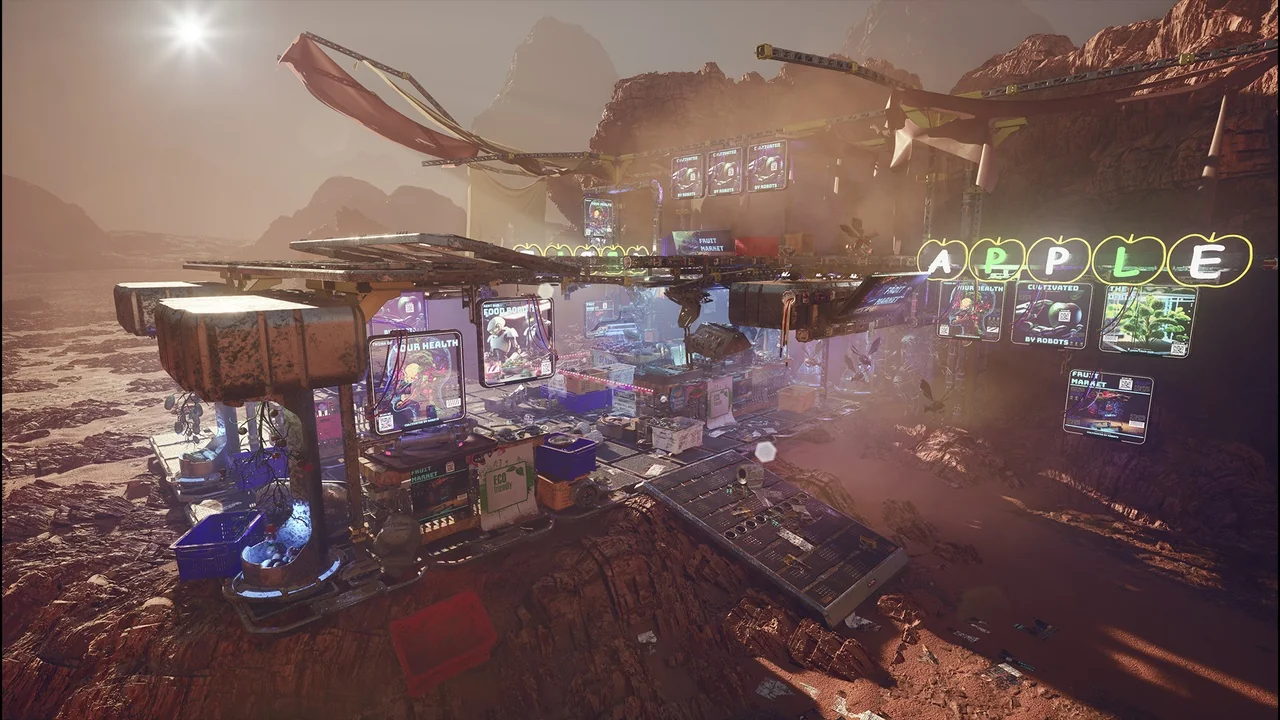
 Sci-Fi
 Sci-Fi
 Sci-Fi