"1a0e4ac4dc71d030"{"id":"1000199","slug":"polygon-goblin-war-camp","title":"POLYGON - Goblin War Camp","category":"Towns \u0026 Villages","engine":"4.26+,5.0+","assetVersion":"","engineVersion":"Engine Version: 4.26+,5.0+","tag":"Towns \u0026 Villages","accent":"blue","visual":"mech","summary":"A stylized swamp stronghold pack with 600+ blueprints, 15 rigged characters, war camp buildings, props, weapons, FX, and a demo scene.","platform":"Unreal Engine","publishedAt":"2026-06-23T11:24:33.942Z","updatedAt":"2026-06-23T11:24:33.942Z","sourceNotes":[],"fileContents":[],"compatibility":["Unreal Engine","Engine Version: 4.26+,5.0+"],"featuredImage":{"alt":"POLYGON - Goblin War Camp","src":"/wp-content/uploads/published/2026/06/ed918f3dbe1d-156e1b13-64f9-46db-a4f2-d9f67fae7972-c52baae97f.webp"},"hasDownloadLink":true,"downloads":4,"terms":[{"taxonomy":"category","slug":"towns-and-villages","name":"Towns \u0026 Villages"}],"galleryImages":[{"src":"/wp-content/uploads/published/2026/06/045d6f24e2c8-fc6acbe7-c4e2-4ff5-b448-1c4f077e6c20-0942909473.webp","alt":"POLYGON - Goblin War Camp"},{"src":"/wp-content/uploads/published/2026/06/10d96f1f4a51-162e7b6e-8b86-4b7f-95e8-b9004fb55acb-337fa2c491.webp","alt":"POLYGON - Goblin War Camp"},{"src":"/wp-content/uploads/published/2026/06/4d459223b84c-aa020b3f-0d1a-4bc6-91e4-54d205bc877e-6aaed9e1e9.webp","alt":"POLYGON - Goblin War Camp"},{"src":"/wp-content/uploads/published/2026/06/14b123fdb739-544f2a76-24d3-4baf-807b-70358df93281-cbe094ea38.webp","alt":"POLYGON - Goblin War Camp"},{"src":"/wp-content/uploads/published/2026/06/e409f66af4f7-a8e7d1c5-851c-4ed9-84f6-b21de1cae9b6-1f5e0af792.webp","alt":"POLYGON - Goblin War Camp"},{"src":"/wp-content/uploads/published/2026/06/7674bea043f1-6d5505e6-9e99-4150-a52a-a3a6d54d57bb-004bf46185.webp","alt":"POLYGON - Goblin War Camp"},{"src":"/wp-content/uploads/published/2026/06/c88473057ca4-a99fe808-a6cd-4237-a4b0-f34eebc26c6c-c8cc88bc16.webp","alt":"POLYGON - Goblin War Camp"},{"src":"/wp-content/uploads/published/2026/06/b5bdc91c3f5e-4e78ddd1-83ab-40c5-87e5-d85ac7411298-f2dc4ef554.webp","alt":"POLYGON - Goblin War Camp"},{"src":"/wp-content/uploads/published/2026/06/81d697bb090f-180cda78-1840-4d34-a267-3d127837cc4a-eb87d29d0c.webp","alt":"POLYGON - Goblin War Camp"},{"src":"/wp-content/uploads/published/2026/06/669fdb123c8a-fef44392-4cd3-49d6-a316-07d5ae392b6f-7761e53cbe.webp","alt":"POLYGON - Goblin War Camp"}],"accessPanel":{"kind":"resource","title":"Download this resource","eyebrow":"Free Download","message":"Log in or create a free account to start your download.","fileName":"PolygonGoblinWarCamp.7z","safetyNote":"Resources are manually reviewed before listing to improve quality and reduce obvious risks.","actionLabel":"Download Free","resourceType":"Resource archive"},"contentHtml":"\u003cp\u003eGetting started with \u003cstrong\u003ePOLYGON - Goblin War Camp\u003c/strong\u003e Begins with a ready-made identity rather than a blank collection of parts. The pack includes a swampy goblin stronghold demo scene, and that immediately shapes how it can be approached in production: place the camp as a complete hostile location, study its arrangement, then break it back down into structures, parts, characters, and dressing pieces to support your own scenes.\u003c/p\u003e\u003cp\u003eThe setting is sharply defined. This is a goblin war camp sunk into a festering swamp, ringed by makeshift walls reinforced with wood, hide, bone, and scraps. Fires burn in pits, weapons are being readied for battle, and some structures stand on stilts above the wet ground. That combination gives the environment a clear visual direction for anyone building a fantasy level, a battle staging area, or a dangerous settlement that feels improvised rather than orderly. The mood is not polished military architecture. It is haphazard, smoky, damp, and crowded with evidence of rough survival.\u003c/p\u003e\u003ch2\u003eStarting from the Goblin War Camp demo scene\u003c/h2\u003e\u003cp\u003eThe included demo scene provides a practical first route into the pack because the environment is already framed as a complete swampy goblin stronghold. For an artist, that means the material can be read as a finished example of spacing, silhouette, and atmosphere. For a developer, it offers a usable foundation for encounter spaces, traversal paths, or story beats set inside an occupied camp.\u003c/p\u003e\u003cp\u003eThe camp’s strongest visual cues are already embedded in its description: makeshift walls, burning pits, elevated structures, and a heavy swamp atmosphere. Those cues support a useful workflow. You can begin with the broad shape of the settlement, establish its perimeter with walls and gates, then fill the interior with tents, towers, platforms, and utility structures. After that, the environment dressing can push the camp toward either a more defensive look, a more lived-in look, or a stronger war-preparation mood through props, weapons, and character placement.\u003c/p\u003e\u003cp\u003eThe pack also includes \u003cstrong\u003e600+ premium blueprints\u003c/strong\u003e, which points to breadth in scene assembly. Rather than relying on one or two large hero pieces, the pack supports building out a fuller location with many individual components and set pieces. That matters most in a camp setting, where repetition can easily flatten the scene if there are not enough variants in walls, platforms, clutter, and supporting details.\u003c/p\u003e\u003ch2\u003eGoblin War Camp structures and building parts\u003c/h2\u003e\u003cp\u003eThe environment side of the pack is not limited to complete structures. It combines \u003cstrong\u003eUnique complete buildings and structures\u003c/strong\u003e With separate building parts, which opens up two distinct ways to use it.\u003c/p\u003e\u003cp\u003eOn the one hand, the complete pieces can help block out a camp quickly. Buildings include tents, towers, log walls, gates, bases and platforms, chimneys, and a mine. Those are enough to establish a perimeter, create vertical lookout points, suggest habitation, and introduce practical spaces where goblins work, sleep, guard, or gather equipment. A mine adds another layer, pushing the camp beyond a surface settlement and hinting at extraction, storage, or underground activity.\u003c/p\u003e\u003cp\u003eOn the other hand, the pack also includes building parts such as banners, bones, fences, logs, planks, platforms, rugs, spikes, stilts, thatches, and walls. These are explicitly noted as \u003cstrong\u003eNot made for grid snapping\u003c/strong\u003e, which is an important production detail. The parts are better suited to looser composition and irregular assembly than to rigid modular snapping. That fits the subject well. A goblin stronghold in a swamp should look uneven, patched together, and opportunistic. Planks can be layered into unstable-looking walkways, spikes can turn open ground into a hostile perimeter, and stilts can lift structures over waterlogged terrain in a way that reinforces the camp’s improvised engineering.\u003c/p\u003e\u003cp\u003eThis split between full structures and freeform parts makes the pack useful for more than one scale of work. It can support a wide establishing shot of the whole camp, then hold up when the camera moves closer and the scene needs hand-placed details like hanging banners, sharpened stakes, rough fences, or patched wall sections.\u003c/p\u003e\u003ch2\u003eFifteen rigged characters and attachments for camp life and conflict\u003c/h2\u003e\u003cp\u003eThe pack includes \u003cstrong\u003e15 characters, rigged and ready for animation\u003c/strong\u003e, which broadens it from an environment set into a more complete scene-building kit. The named character roles cover a useful range of camp activity and battlefield identity: Archer Male, Archer Female, Beast Tamer, Cook, Kings, Knight, Prisoners, Ranger, Shaman, Troll, Warrior, and Wizard.\u003c/p\u003e\u003cp\u003eThat lineup creates more than a single enemy type. It supports different zones and different moods inside the same camp. Archers and warriors fit walls, towers, and entry points. A shaman or wizard can anchor ritual spaces, shrines, or smoky fire-lit corners. A cook gives the settlement a daily-life layer that keeps it from feeling like nothing but combat dressing. Prisoners can change the tone of the space entirely, turning one section of the camp into a holding area and adding tension even before any battle begins. A troll introduces a larger or more imposing figure within the same visual family, while a beast tamer suggests creatures, labor, or rough control within the camp’s routines.\u003c/p\u003e\u003cp\u003eCharacter attachments add another level of variation without needing to rely on entirely separate character types. The pack includes backpacks, bags, beards, bottles, capes, crowns, an eye patch, a glider, goggles, hairs, hats, helmets, hoods, masks, and a shawl. With those pieces, a developer or artist can give individual goblins stronger silhouettes and clearer jobs at a glance. Guards can be helmeted, scavengers can carry bags and bottles, a leader can stand apart with a crown or cape, and mysterious or ritual-focused figures can lean into hoods, masks, or shawls.\u003c/p\u003e\u003cp\u003eBecause the characters are already rigged and ready for animation, they are not confined to static placement. They can populate patrols, idle scenes around fire pits, weapon-preparation areas, or confrontations along platforms and gates. That matters in a war camp, where the feeling of constant readiness is part of the environment itself.\u003c/p\u003e\u003ch2\u003eSwamp environment, FX, and the grime between the walls\u003c/h2\u003e\u003cp\u003eThe swamp identity of the camp is reinforced by a large environment set that goes well beyond a few ground pieces. The environment category includes algae, bones, bushes, clouds, ferns, footprints, grasses, grounds, logs, mine tracks, mountain elements, cliffs, mushrooms, pebbles, reeds, paths, rocks, roots, stumps, trees, and vines. Taken together, these assets support both the camp interior and the broader landscape around it.\u003c/p\u003e\u003cp\u003eThat matters creatively because a goblin stronghold in a swamp needs transition zones. The camp should not feel as if it simply begins at a wall and ends at a prop cluster. Reeds, roots, muddy paths, rocks, and stumps can create the outer approach. Algae, logs, and low plants can thicken the wet ground around stilted structures. Mine tracks can guide the eye toward work areas or suggest movement of materials through the camp. Cliffs and mountain pieces can help frame the wider territory and keep the location from reading as a flat patch of marsh.\u003c/p\u003e\u003cp\u003eFX push the atmosphere even further. The pack includes sparks, explosion, fires, flies, fog, smoke, stink lines, bubbles, and wind streaks. Those details are especially useful in a camp defined by damp earth, smoke, and sweat. Fires and smoke establish habitation and metalwork. Sparks and explosions can shift the scene toward conflict or siege preparation. Flies, bubbles, and stink lines emphasize rot, filth, and stagnant swamp conditions. Fog and wind streaks can shape visibility and motion, helping the camp feel uneasy and alive even when little is moving.\u003c/p\u003e\u003cp\u003eUsed carefully, these elements can separate sections of the stronghold by mood: a smoky forge area, a foul prison corner buzzing with flies, a ritual patch wrapped in fog, or a heavily trafficked path marked by footprints and churned ground.\u003c/p\u003e\u003ch2\u003eProps, siege vehicles, and weapons that sell the war-readiness\u003c/h2\u003e\u003cp\u003eThe strongest functional identity of the pack comes through in its dense prop, vehicle, and weapon selection. The prop list covers both rough domestic life and open preparation for violence: anvils, archways, arrows, barrels, barriers, beds, benches, animal parts, bones, braziers, buckets, buntings, candles, chains, bone chimes, crates, spikes, drums, effigies, fire pits, flags, food, a forge, cages, a gong, grindstone, hammers, head spikes, helmets, racks, an idol, ladders, lanterns, kitchenware, ropes, ruins, sacks, seats, shields, a shrine, signs, skeletons, skulls, spears, spits, steps, swords, a table, targets, torches, a tub, walkways, and hanging weapons.\u003c/p\u003e\u003cp\u003eThat range gives scene builders enough material to define spaces by purpose. A food area can be shaped with kitchenware, spits, buckets, and tables. A punishment or intimidation zone can lean on cages, chains, skulls, skeletons, and head spikes. A forge area can use the anvil, forge, hammers, grindstone, and nearby weapon racks. Targets, drums, flags, and barriers can turn open ground into a training or rally point.\u003c/p\u003e\u003cp\u003eThe vehicle set extends the camp beyond passive decoration. Ballista, battering ram, cannon, carts, scoop, trebuchet, wagon cages, and balloon all support the idea that the horde is preparing for its next battle. Some of these assets can read as siege machinery ready for deployment, while carts and wagon cages suggest transport, supply, or prisoner movement. A balloon is an especially distinctive addition in the context of a goblin war camp, giving the settlement a more eccentric and aggressive sense of invention.\u003c/p\u003e\u003cp\u003eWeapons complete the picture with arrows, axes, bombs, bows, cleavers, clubs, dagger, pick axe, shields, shovel, spears, staffs, and swords. These are useful not only for arming characters but also for environmental storytelling. A heap of bombs beside a wall, clubs near a sleeping area, staffs around a shaman’s corner, or shovels and pick axes near the mine all help different parts of the stronghold tell their own story without changing the setting’s overall identity.\u003c/p\u003e\u003ch2\u003eWhere POLYGON - Goblin War Camp fits best\u003c/h2\u003e\u003cp\u003eThis pack is at its strongest when the goal is to create a stylized fantasy stronghold with a clear hostile theme and enough variety to move between wide environment work and denser close-range dressing. Its tags point directly to that fit: vehicle, stronghold, fantasy, level, battle, stylized, weapon, swamp, and character.\u003c/p\u003e\u003cp\u003eThe combination of 600+ blueprints, unique complete structures, freeform building parts, 15 rigged characters, environment dressing, FX, siege vehicles, and weapons makes it well suited to building a goblin settlement that feels active rather than merely occupied. The demo scene offers a practical starting point, and the breadth of parts supports expansion into custom layouts. For teams or solo creators looking to stage a swamp war camp with smoke, stilts, spikes, clutter, and battle preparation everywhere, the pack is ready to carry that theme from first setup through final scene dressing.\u003c/p\u003e\n\n\u003ch2\u003eRelated Resources Worth Checking\u003c/h2\u003e\n\u003cul\u003e\n\u003cli\u003e\u003ca href=\"https://3dcghub.com/asian-fire-stage-arena/\" title=\"ASIAN - Fire Stage Arena\"\u003eASIAN - Fire Stage Arena\u003c/a\u003e\u003c/li\u003e\n\u003cli\u003e\u003ca href=\"https://3dcghub.com/polygon-apocalypse-wasteland/\" title=\"POLYGON - Apocalypse Wasteland\"\u003ePOLYGON - Apocalypse Wasteland\u003c/a\u003e\u003c/li\u003e\n\u003cli\u003e\u003ca href=\"https://3dcghub.com/polygon-street-racer/\" title=\"POLYGON - Street Racer\"\u003ePOLYGON - Street Racer\u003c/a\u003e\u003c/li\u003e\n\u003cli\u003e\u003ca href=\"https://3dcghub.com/goblin-shaman/\" title=\"Goblin Shaman\"\u003eGoblin Shaman\u003c/a\u003e\u003c/li\u003e\n\u003cli\u003e\u003ca href=\"https://3dcghub.com/minions-and-monsters-goblin-pack/\" title=\"Minions and Monsters: Goblin Pack\"\u003eMinions and Monsters: Goblin Pack\u003c/a\u003e\u003c/li\u003e\n\u003c/ul\u003e","contentTextLength":11355,"navigation":{"current":1103,"total":3200,"previous":{"id":"1000200","slug":"sci-fi-fruit-market-nanite","title":"Sci-Fi Fruit Market - Nanite","category":"Sci-Fi","platform":"Unreal Engine","updatedAt":"2026-06-23T14:28:16.189Z"},"next":{"id":"1000198","slug":"monsters-wraith","title":"Monsters - Wraith","category":"Creatures \u0026 Monsters","platform":"Unreal Engine","updatedAt":"2026-06-23T11:17:03.690Z"}},"relatedResources":[{"id":"1001008","slug":"polygon-ancient-empire","title":"POLYGON - Ancient Empire","category":"Historical","engine":"4.26+,5.0+","assetVersion":"","engineVersion":"Engine Version: 4.26+,5.0+","tag":"Historical","accent":"blue","visual":"mech","summary":"Explore POLYGON - Ancient Empire, a Greek-Roman fusion pack with over 700 prefabs including modular buildings, characters, props, weapons, FX, and environment a","platform":"Unreal Engine","publishedAt":"2026-08-22T13:02:43.200Z","updatedAt":"2026-08-22T13:02:43.200Z","sourceNotes":[],"fileContents":[],"compatibility":["Unreal Engine","Engine Version: 4.26+,5.0+"],"featuredImage":{"alt":"POLYGON - Ancient Empire","src":"/wp-content/uploads/published/2026/08/3f8cd4387afb-c5898e6e-497d-409c-b499-509aba6363f3-7d0e370e4b.webp"},"hasDownloadLink":true,"downloads":1},{"id":"27051","slug":"asian-fire-stage-arena","title":"ASIAN - Fire Stage Arena","category":"Towns \u0026 Villages","engine":"5.0+","assetVersion":"Engine version: 5.0+","engineVersion":"","tag":"Towns \u0026 Villages","accent":"blue","visual":"city","summary":"ASIAN - Fire Stage Arena centers on a burned arena with a strong fire-stage identity. HDRIBackdrop Plugin is enabled, and some CC0 modified assets from freepoly.com and Vue are included. The tags point to a fantasy fighting scene with Asian and East Asian v...","platform":"Unreal Engine","publishedAt":"2026-04-21T08:14:32.000Z","updatedAt":"2026-04-21T08:14:33.000Z","sourceNotes":[],"fileContents":[],"compatibility":["Unreal Engine","Engine version: 5.0+"],"featuredImage":{"alt":"ASIAN - Fire Stage Arena","src":"https://3dcghub.com/wp-content/uploads/2026/04/e1227b0c35d6_2920a710-0af9-4087-803f-f7a1506bbb2a.webp"},"hasDownloadLink":true,"downloads":0},{"id":"28113","slug":"polygon-street-racer","title":"POLYGON - Street Racer","category":"Streets \u0026 Construction","engine":"4.26+,5.0+","assetVersion":"Engine version: 4.26+,5.0+","engineVersion":"","tag":"Streets","accent":"blue","visual":"city","summary":"POLYGON - Street Racer brings together modular vehicles, characters, props, and dockyard environment pieces in a single low poly package. It covers both underground street racing scenes and broader port or container yard production needs, with more than 100...","platform":"Unreal Engine","publishedAt":"2026-05-04T08:50:26.000Z","updatedAt":"2026-05-04T08:50:35.000Z","sourceNotes":[],"fileContents":[],"compatibility":["Unreal Engine","Engine version: 4.26+,5.0+"],"featuredImage":{"alt":"POLYGON - Street Racer","src":"https://3dcghub.com/wp-content/uploads/2026/05/29c5386a2572_878aaf91-dcf3-4d21-b7e5-b69ff21d2534.webp"},"hasDownloadLink":true,"downloads":1}]}
Towns & Villages
POLYGON - Goblin War Camp
A stylized swamp stronghold pack with 600+ blueprints, 15 rigged characters, war camp buildings, props, weapons, FX, and a demo scene.
Getting started with POLYGON - Goblin War Camp Begins with a ready-made identity rather than a blank collection of parts. The pack includes a swampy goblin stronghold demo scene, and that immediately shapes how it can be approached in production: place the camp as a complete hostile location, study its arrangement, then break it back down into structures, parts, characters, and dressing pieces to support your own scenes.
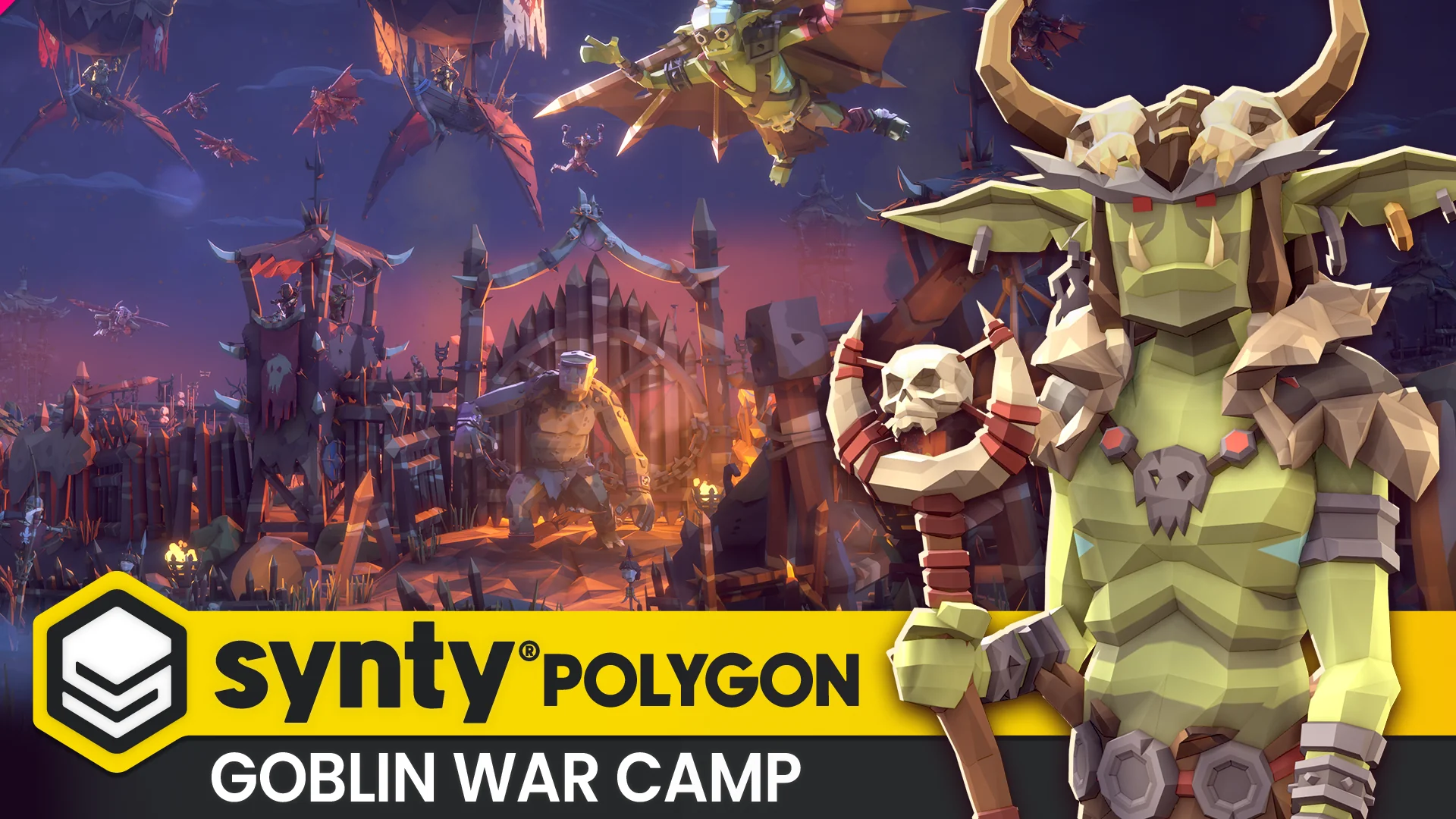
The setting is sharply defined. This is a goblin war camp sunk into a festering swamp, ringed by makeshift walls reinforced with wood, hide, bone, and scraps. Fires burn in pits, weapons are being readied for battle, and some structures stand on stilts above the wet ground. That combination gives the environment a clear visual direction for anyone building a fantasy level, a battle staging area, or a dangerous settlement that feels improvised rather than orderly. The mood is not polished military architecture. It is haphazard, smoky, damp, and crowded with evidence of rough survival.
Starting from the Goblin War Camp demo scene
The included demo scene provides a practical first route into the pack because the environment is already framed as a complete swampy goblin stronghold. For an artist, that means the material can be read as a finished example of spacing, silhouette, and atmosphere. For a developer, it offers a usable foundation for encounter spaces, traversal paths, or story beats set inside an occupied camp.
The camp’s strongest visual cues are already embedded in its description: makeshift walls, burning pits, elevated structures, and a heavy swamp atmosphere. Those cues support a useful workflow. You can begin with the broad shape of the settlement, establish its perimeter with walls and gates, then fill the interior with tents, towers, platforms, and utility structures. After that, the environment dressing can push the camp toward either a more defensive look, a more lived-in look, or a stronger war-preparation mood through props, weapons, and character placement.
The pack also includes 600+ premium blueprints, which points to breadth in scene assembly. Rather than relying on one or two large hero pieces, the pack supports building out a fuller location with many individual components and set pieces. That matters most in a camp setting, where repetition can easily flatten the scene if there are not enough variants in walls, platforms, clutter, and supporting details.
Goblin War Camp structures and building parts
The environment side of the pack is not limited to complete structures. It combines Unique complete buildings and structures With separate building parts, which opens up two distinct ways to use it.
On the one hand, the complete pieces can help block out a camp quickly. Buildings include tents, towers, log walls, gates, bases and platforms, chimneys, and a mine. Those are enough to establish a perimeter, create vertical lookout points, suggest habitation, and introduce practical spaces where goblins work, sleep, guard, or gather equipment. A mine adds another layer, pushing the camp beyond a surface settlement and hinting at extraction, storage, or underground activity.
On the other hand, the pack also includes building parts such as banners, bones, fences, logs, planks, platforms, rugs, spikes, stilts, thatches, and walls. These are explicitly noted as Not made for grid snapping, which is an important production detail. The parts are better suited to looser composition and irregular assembly than to rigid modular snapping. That fits the subject well. A goblin stronghold in a swamp should look uneven, patched together, and opportunistic. Planks can be layered into unstable-looking walkways, spikes can turn open ground into a hostile perimeter, and stilts can lift structures over waterlogged terrain in a way that reinforces the camp’s improvised engineering.
This split between full structures and freeform parts makes the pack useful for more than one scale of work. It can support a wide establishing shot of the whole camp, then hold up when the camera moves closer and the scene needs hand-placed details like hanging banners, sharpened stakes, rough fences, or patched wall sections.
Fifteen rigged characters and attachments for camp life and conflict
The pack includes 15 characters, rigged and ready for animation, which broadens it from an environment set into a more complete scene-building kit. The named character roles cover a useful range of camp activity and battlefield identity: Archer Male, Archer Female, Beast Tamer, Cook, Kings, Knight, Prisoners, Ranger, Shaman, Troll, Warrior, and Wizard.
That lineup creates more than a single enemy type. It supports different zones and different moods inside the same camp. Archers and warriors fit walls, towers, and entry points. A shaman or wizard can anchor ritual spaces, shrines, or smoky fire-lit corners. A cook gives the settlement a daily-life layer that keeps it from feeling like nothing but combat dressing. Prisoners can change the tone of the space entirely, turning one section of the camp into a holding area and adding tension even before any battle begins. A troll introduces a larger or more imposing figure within the same visual family, while a beast tamer suggests creatures, labor, or rough control within the camp’s routines.
Character attachments add another level of variation without needing to rely on entirely separate character types. The pack includes backpacks, bags, beards, bottles, capes, crowns, an eye patch, a glider, goggles, hairs, hats, helmets, hoods, masks, and a shawl. With those pieces, a developer or artist can give individual goblins stronger silhouettes and clearer jobs at a glance. Guards can be helmeted, scavengers can carry bags and bottles, a leader can stand apart with a crown or cape, and mysterious or ritual-focused figures can lean into hoods, masks, or shawls.
Because the characters are already rigged and ready for animation, they are not confined to static placement. They can populate patrols, idle scenes around fire pits, weapon-preparation areas, or confrontations along platforms and gates. That matters in a war camp, where the feeling of constant readiness is part of the environment itself.
Swamp environment, FX, and the grime between the walls
The swamp identity of the camp is reinforced by a large environment set that goes well beyond a few ground pieces. The environment category includes algae, bones, bushes, clouds, ferns, footprints, grasses, grounds, logs, mine tracks, mountain elements, cliffs, mushrooms, pebbles, reeds, paths, rocks, roots, stumps, trees, and vines. Taken together, these assets support both the camp interior and the broader landscape around it.
That matters creatively because a goblin stronghold in a swamp needs transition zones. The camp should not feel as if it simply begins at a wall and ends at a prop cluster. Reeds, roots, muddy paths, rocks, and stumps can create the outer approach. Algae, logs, and low plants can thicken the wet ground around stilted structures. Mine tracks can guide the eye toward work areas or suggest movement of materials through the camp. Cliffs and mountain pieces can help frame the wider territory and keep the location from reading as a flat patch of marsh.
FX push the atmosphere even further. The pack includes sparks, explosion, fires, flies, fog, smoke, stink lines, bubbles, and wind streaks. Those details are especially useful in a camp defined by damp earth, smoke, and sweat. Fires and smoke establish habitation and metalwork. Sparks and explosions can shift the scene toward conflict or siege preparation. Flies, bubbles, and stink lines emphasize rot, filth, and stagnant swamp conditions. Fog and wind streaks can shape visibility and motion, helping the camp feel uneasy and alive even when little is moving.
Used carefully, these elements can separate sections of the stronghold by mood: a smoky forge area, a foul prison corner buzzing with flies, a ritual patch wrapped in fog, or a heavily trafficked path marked by footprints and churned ground.
Props, siege vehicles, and weapons that sell the war-readiness
The strongest functional identity of the pack comes through in its dense prop, vehicle, and weapon selection. The prop list covers both rough domestic life and open preparation for violence: anvils, archways, arrows, barrels, barriers, beds, benches, animal parts, bones, braziers, buckets, buntings, candles, chains, bone chimes, crates, spikes, drums, effigies, fire pits, flags, food, a forge, cages, a gong, grindstone, hammers, head spikes, helmets, racks, an idol, ladders, lanterns, kitchenware, ropes, ruins, sacks, seats, shields, a shrine, signs, skeletons, skulls, spears, spits, steps, swords, a table, targets, torches, a tub, walkways, and hanging weapons.
That range gives scene builders enough material to define spaces by purpose. A food area can be shaped with kitchenware, spits, buckets, and tables. A punishment or intimidation zone can lean on cages, chains, skulls, skeletons, and head spikes. A forge area can use the anvil, forge, hammers, grindstone, and nearby weapon racks. Targets, drums, flags, and barriers can turn open ground into a training or rally point.
The vehicle set extends the camp beyond passive decoration. Ballista, battering ram, cannon, carts, scoop, trebuchet, wagon cages, and balloon all support the idea that the horde is preparing for its next battle. Some of these assets can read as siege machinery ready for deployment, while carts and wagon cages suggest transport, supply, or prisoner movement. A balloon is an especially distinctive addition in the context of a goblin war camp, giving the settlement a more eccentric and aggressive sense of invention.
Weapons complete the picture with arrows, axes, bombs, bows, cleavers, clubs, dagger, pick axe, shields, shovel, spears, staffs, and swords. These are useful not only for arming characters but also for environmental storytelling. A heap of bombs beside a wall, clubs near a sleeping area, staffs around a shaman’s corner, or shovels and pick axes near the mine all help different parts of the stronghold tell their own story without changing the setting’s overall identity.
Where POLYGON - Goblin War Camp fits best
This pack is at its strongest when the goal is to create a stylized fantasy stronghold with a clear hostile theme and enough variety to move between wide environment work and denser close-range dressing. Its tags point directly to that fit: vehicle, stronghold, fantasy, level, battle, stylized, weapon, swamp, and character.
The combination of 600+ blueprints, unique complete structures, freeform building parts, 15 rigged characters, environment dressing, FX, siege vehicles, and weapons makes it well suited to building a goblin settlement that feels active rather than merely occupied. The demo scene offers a practical starting point, and the breadth of parts supports expansion into custom layouts. For teams or solo creators looking to stage a swamp war camp with smoke, stilts, spikes, clutter, and battle preparation everywhere, the pack is ready to carry that theme from first setup through final scene dressing.
 Towns & Villages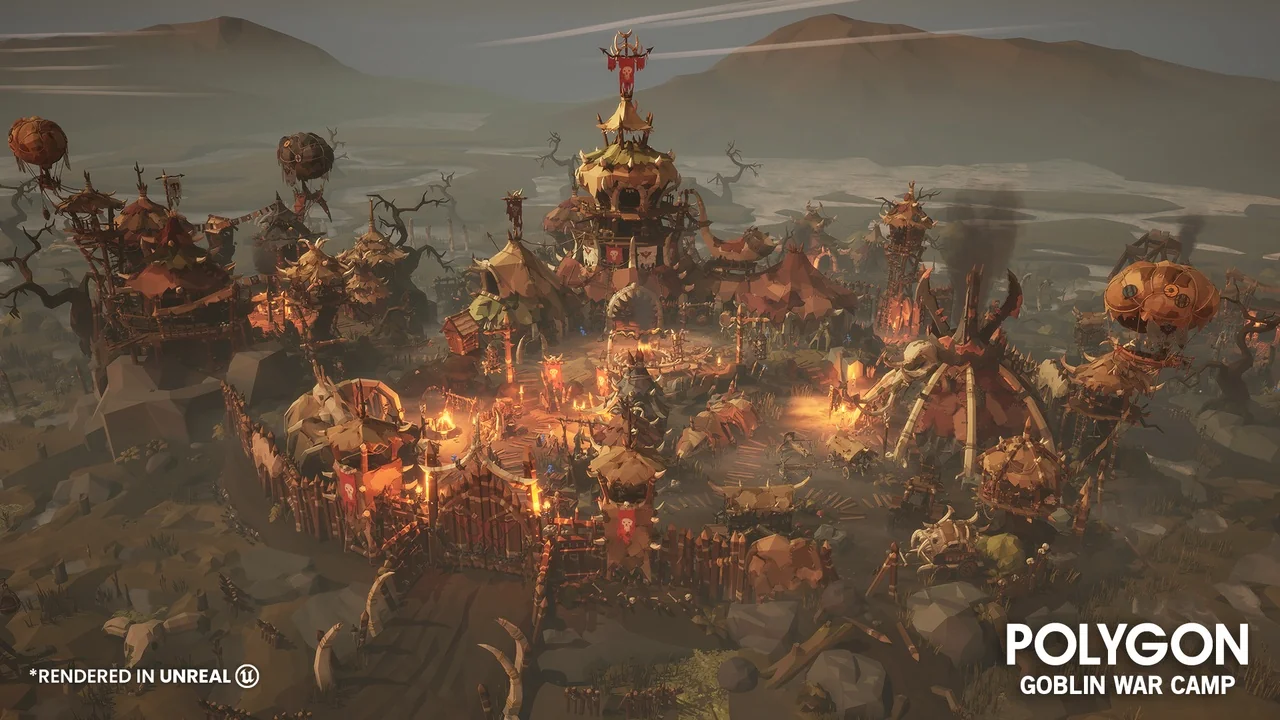
 Historical
 Towns & Villages
 Streets