"fa182e0cd0a6ea73"{"id":"1000636","slug":"modular-sci-fi-hangar-area-environment","title":"Modular Sci-fi Hangar Area Environment","category":"Sci-Fi","engine":"5.3+","assetVersion":"","engineVersion":"Engine Version: 5.3+","tag":"Sci-Fi","accent":"blue","visual":"city","summary":"A modular science fiction hangar facility for UE4/5 with corridors, control center, animated sci-fi doors, terrain, sound effects, and extra surface texture til","platform":"Unreal Engine","publishedAt":"2026-07-21T16:59:42.611Z","updatedAt":"2026-07-21T17:01:12.782Z","sourceNotes":[],"fileContents":[],"compatibility":["Unreal Engine","Engine Version: 5.3+"],"featuredImage":{"alt":"Modular Sci-fi Hangar Area Environment","src":"/wp-content/uploads/published/2026/07/45bc4d86939c-79324c73-0de0-4d34-8848-7303602b3c32-8009ac1883.webp"},"hasDownloadLink":true,"downloads":1,"terms":[{"taxonomy":"category","slug":"sci-fi","name":"Sci-Fi"},{"taxonomy":"category","slug":"unity-3d-environments-sci-fi","name":"Sci-Fi"}],"galleryImages":[{"src":"/wp-content/uploads/published/2026/07/36cfe282bf50-80d8a4fa-3ba0-4110-996a-584e6446c823-6ab9246caf.webp","alt":"Modular Sci-fi Hangar Area Environment"},{"src":"/wp-content/uploads/published/2026/07/bf4fa6f75760-4e82c9f3-f87c-4bef-b7c5-d1dd124c06c6-cf6eec8f7c.webp","alt":"Modular Sci-fi Hangar Area Environment"},{"src":"/wp-content/uploads/published/2026/07/ca24c7084810-c9540bb0-8e4c-4f38-b462-f6e1d147eb86-9707d51fba.webp","alt":"Modular Sci-fi Hangar Area Environment"},{"src":"/wp-content/uploads/published/2026/07/89eec657d59a-1354ec0f-23f5-4bea-bffd-6d9a1341bce3-ede48ebc3e.webp","alt":"Modular Sci-fi Hangar Area Environment"},{"src":"/wp-content/uploads/published/2026/07/1c50e9a92c33-901beee5-3074-4aee-9c4e-ed44f5768bb0-a07ee25d69.webp","alt":"Modular Sci-fi Hangar Area Environment"},{"src":"/wp-content/uploads/published/2026/07/7fe72468d47e-48dc918b-7fbe-49f3-ad97-1ffbe593601c-a847e3f76f.webp","alt":"Modular Sci-fi Hangar Area Environment"},{"src":"/wp-content/uploads/published/2026/07/ae282f685871-1c67e863-13e8-467e-b5a1-776fa97fbf0f-33384f480a.webp","alt":"Modular Sci-fi Hangar Area Environment"},{"src":"/wp-content/uploads/published/2026/07/172626176f73-a1410acf-8749-4cae-be54-0de1b2106ec5-56278525fe.webp","alt":"Modular Sci-fi Hangar Area Environment"},{"src":"/wp-content/uploads/published/2026/07/89dc3a2ee7b2-e079d436-ce91-49a4-ba39-867655aa934a-9b398a3f55.webp","alt":"Modular Sci-fi Hangar Area Environment"}],"accessPanel":{"kind":"resource","title":"Download this resource","eyebrow":"Free Download","message":"Log in or create a free account to start your download.","fileName":"Content.7z","safetyNote":"Resources are manually reviewed before listing to improve quality and reduce obvious risks.","actionLabel":"Download Free","resourceType":"Resource archive"},"contentHtml":"\u003cp\u003eThe Modular Sci-fi Hangar Area Environment is a facility package based on the idea of a maintenance hangar inside a science fiction setting. It can function as a standard maintenance hangar or as a flight maintenance hangar, with one particular constraint worth noting up front: the hangar itself does not carry an exterior design view. The focus stays on the interior and the connective tissue around it — corridors, entrances, control systems, and props that can be linked into larger level structures.\u003c/p\u003e\u003cp\u003eThe package works across both Unreal Engine 4 and Unreal Engine 5, and the accompanying live document covers all of the creator's UE4 and UE5 products in a generic capacity. A document asset accompanies the package with overview images, custom collisions, and product update notes. This structure means the package is not just a static set of meshes — it includes collision data tuned for the environment and ongoing update documentation that tracks additions and fixes over time.\u003c/p\u003e\u003ch2\u003eHangar Area Structure and Corridor Linking\u003c/h2\u003e\u003cp\u003eThe core of the package is the hangar area, considered as a maintenance hangar for science fiction environment creation. The layout is designed so corridor areas can be linked into your own levels, letting you connect this facility to broader level architectures rather than treating it as an isolated set piece. The corridor connections were specifically strengthened in the version 1.3 update dated 22 April 2023, bringing them to what the creator describes as a stronger level.\u003c/p\u003e\u003cp\u003eOne distinction that anyone working with this package needs to understand is how modularity applies differently across its systems. Material structures are modular, which means the surface treatments and texture systems can be swapped and recombined. The general hangar area, however, is not delivered as meshes. The overview and document images clarify this structural choice, so it governs how you approach building out the space — you work with the material modularity and the corridor system rather than treating the hangar volume itself as a collection of discrete mesh modules.\u003c/p\u003e\u003ch2\u003eSurface Tiles: Plastic, Metal, Nylon, Rubber, and Trim\u003c/h2\u003e\u003cp\u003eThe package includes extra texture tiles beyond the base environment assets. These cover Plastic, Metal, Nylon, Rubber, and Trim sci-fi surface categories. Having these surface types available means the material system can address a range of finishes you would expect in a working hangar — hard metallic structures, flexible rubber components, plastic housings, and trim details that define edges and panel lines.\u003c/p\u003e\u003cp\u003eBecause the material structures are modular, these texture tiles can be applied in combination across the environment. The trim textures in particular serve the kind of edge detailing that makes science fiction paneling read convincingly, while the plastic, metal, nylon, and rubber tiles let different props and structural elements carry distinct material identities rather than sharing a single surface treatment across the whole facility.\u003c/p\u003e\u003ch2\u003eAnimated Doors, Ventilation, and Control Center Blueprints\u003c/h2\u003e\u003cp\u003eFunctional elements extend the hangar beyond static geometry. Hallway entrances and exits feature a sci-fi door with animations, so transitions between corridor sections and the hangar area are not just visual cuts but moving components. On the ceiling, horizontal ventilation covers have opening and closing control, giving the space moving mechanical detail above the work area.\u003c/p\u003e\u003cp\u003eThe control center adds further interactivity through Blueprint-based controls. Descent and exit controls for the control center are handled through Blueprints, which means these are scripted behaviors rather than simple animated clips. The version 1.3 update notes that BP functions were fixed for ease of use, indicating the Blueprint systems have gone through a refinement pass to make them more straightforward to work with inside Unreal Engine.\u003c/p\u003e\u003ch2\u003eTerrain, Outer Area, and Game-Ready Optimization\u003c/h2\u003e\u003cp\u003eWhile the hangar interior does not have an exterior design view, the package does include a hangar outer area and area-based terrain. This provides a ground level and surrounding context beyond the facility floor, so the hangar can sit within a broader landscape rather than floating in an undefined space. A new level design connected to the corridor was also added in the version 1.3 update.\u003c/p\u003e\u003cp\u003eThe package carries better optimization in game-ready format as of the version 1.3 update. The update also brought over 100 new meshes, materials, and textures into the package, substantially expanding the available asset pool beyond what earlier versions contained. Extra props have been added as well, giving the hangar and its connected areas more set dressing options for populating the environment with detail objects.\u003c/p\u003e\u003ch2\u003eSound Effects and Atmosphere Building\u003c/h2\u003e\u003cp\u003eSound effects are included with the package, covering the auditory dimension of the hangar and its connected spaces. This means the environment does not ship silent — the corridors, doors, ventilation systems, and general facility ambience can carry audio when placed in a level.\u003c/p\u003e\u003cp\u003eThe creator also points out that assets inside the package can be added into your own level environments to create stronger atmospheres. This positions the hangar package not just as a standalone facility but as a source of components — props, materials, structural pieces, sound elements — that can reinforce other science fiction scenes you are building in Unreal Engine.\u003c/p\u003e\u003ch2\u003eOngoing Updates and Package Evolution\u003c/h2\u003e\u003cp\u003eThe version 1.3 update from 22 April 2023 represents a substantial expansion pass. Beyond the Blueprint fixes and the 100-plus new meshes, materials, and textures, it introduced the control center descent and exit controls, the opening and closing ceiling ventilation, sound effects, the hangar outer area with terrain, and the improved game-ready optimization. The corridor connections were strengthened, and a new level design tied into the corridor system was added.\u003c/p\u003e\u003cp\u003eThe creator notes that additions can be made in the corridors, and optional media shaping and adjustments can be requested. The package has clearly moved through multiple update cycles, and the update documentation suggests that user requests can influence what gets included in future package contents.\u003c/p\u003e\u003ch2\u003eCompatibility and Expanded Bundle Fit\u003c/h2\u003e\u003cp\u003eThe Modular Sci-fi Hangar Area Environment carries compatibility with the 4 IN 1 Modular Research Facility and Mega Bundle 2025. This means the hangar is designed to slot into a larger modular facility context — research installations and other science fiction structures that share a compatible design language. For anyone building a connected facility complex not just one isolated hangar, this compatibility positions the package as part of a system of environments that can be assembled together.\u003c/p\u003e\u003cp\u003eThe key practical takeaway is that this package serves interior-focused facility construction with corridor connections and functional Blueprint systems, while relying on modular materials rather than a fully mesh-modular hangar volume. Understanding that distinction before starting level work determines how effectively the package fits a given production.\u003c/p\u003e\n\n\u003ch2\u003eExplore Similar Assets\u003c/h2\u003e\n\u003cul\u003e\n\u003cli\u003e\u003ca href=\"https://3dcghub.com/alien-growth-environment/\" rel=\"noopener noreferrer\"\u003eAlien Growth Environment\u003c/a\u003e\u003c/li\u003e\n\u003cli\u003e\u003ca href=\"https://3dcghub.com/modular-sci-fi-base-indoor-outdoor-moon-theme/\" rel=\"noopener noreferrer\"\u003eModular Sci-Fi Base - Indoor Outdoor - Moon Theme\u003c/a\u003e\u003c/li\u003e\n\u003cli\u003e\u003ca href=\"https://3dcghub.com/survivor-girl-3-modular/\" rel=\"noopener noreferrer\"\u003eSurvivor Girl 3 (Modular)\u003c/a\u003e\u003c/li\u003e\n\u003cli\u003e\u003ca href=\"https://3dcghub.com/scifi-environment-offworld/\" rel=\"noopener noreferrer\"\u003eSciFi Environment — \u0026#039;Offworld\u0026#039;\u003c/a\u003e\u003c/li\u003e\n\u003cli\u003e\u003ca href=\"https://3dcghub.com/concrete-hallway/\" rel=\"noopener noreferrer\"\u003eConcrete Hallway\u003c/a\u003e\u003c/li\u003e\n\u003c/ul\u003e","contentTextLength":7345,"navigation":{"current":1299,"total":3789,"previous":{"id":"1000637","slug":"love-fx","title":"Love FX","category":"Variety","platform":"Unreal Engine","updatedAt":"2026-07-21T17:06:02.994Z"},"next":{"id":"1000635","slug":"medieval-modular-town-with-interiors","title":"Medieval Modular Town (With Interiors)","category":"Medieval","platform":"Unreal Engine","updatedAt":"2026-07-21T16:24:47.965Z"}},"relatedResources":[{"id":"1001415","slug":"modular-sci-fi-base-indoor","title":"Modular Sci-Fi Base - Indoor","category":"Sci-Fi","engine":"5.0+","assetVersion":"","engineVersion":"Engine Version: 5.0+","tag":"Sci-Fi","accent":"blue","visual":"mech","summary":"Modular Sci-Fi Base - Indoor provides high-poly modular kitbash meshes, three-layer intelligent materials, 24 HDRIs, and UE5 Nanite and Lumen support.","platform":"Unreal Engine","publishedAt":"2026-10-05T06:56:56.578Z","updatedAt":"2026-10-05T06:56:56.578Z","sourceNotes":[],"fileContents":[],"compatibility":["Unreal Engine","Engine Version: 5.0+"],"featuredImage":{"alt":"Modular Sci-Fi Base - Indoor","src":"/wp-content/uploads/published/2026/10/f858274712b8-26646d9f-3d84-496a-abdb-954b1dabb97b-885f941928.webp"},"hasDownloadLink":true,"downloads":2},{"id":"1001746","slug":"modular-sci-fi-outpost-sci-fi-outpost-sci-fi-base-sci-fi-outpost-base","title":"Modular Sci Fi Outpost (Sci Fi Outpost, Sci Fi Base, Sci Fi , Outpost, Base)","category":"Sci-Fi","engine":"5.4+","assetVersion":"","engineVersion":"Engine Version: 5.4+","tag":"Sci-Fi","accent":"blue","visual":"mech","summary":"Modular Sci Fi Outpost offers fully enterable structures, interior props, dynamic screens, customizable emissive shaders, and Nanite Martian landscapes.","platform":"Unreal Engine","publishedAt":"2026-10-20T02:51:54.338Z","updatedAt":"2026-10-20T02:51:54.338Z","sourceNotes":[],"fileContents":[],"compatibility":["Unreal Engine","Engine Version: 5.4+"],"featuredImage":{"alt":"Modular Sci Fi Outpost (Sci Fi Outpost, Sci Fi Base, Sci Fi , Outpost, Base)","src":"/wp-content/uploads/published/2026/10/d801f2b3b981-640fc2d2-842b-4369-a1b5-40a669071a7b-5cdc6e342e.webp"},"hasDownloadLink":true,"downloads":0},{"id":"1000559","slug":"alien-growth-environment","title":"Alien Growth Environment","category":"Sci-Fi","engine":"5.6+","assetVersion":"","engineVersion":"Engine Version: 5.6+","tag":"Sci-Fi","accent":"blue","visual":"city","summary":"Photoscanned alien growth environment assets for Unreal Engine 5 featuring Nanite-ready meshes, tiled micro-detail materials, moss decals, and a demo level.","platform":"Unreal Engine","publishedAt":"2026-07-15T18:44:12.611Z","updatedAt":"2026-07-15T18:44:12.611Z","sourceNotes":[],"fileContents":[],"compatibility":["Unreal Engine","Engine Version: 5.6+"],"featuredImage":{"alt":"Alien Growth Environment","src":"/wp-content/uploads/published/2026/07/81d10bf51a44-e3ae6231-2f4a-434f-9557-cb4e0600cfd3-6c4f020a69.webp"},"hasDownloadLink":true,"downloads":3}]}
Sci-Fi
Modular Sci-fi Hangar Area Environment
A modular science fiction hangar facility for UE4/5 with corridors, control center, animated sci-fi doors, terrain, sound effects, and extra surface texture til
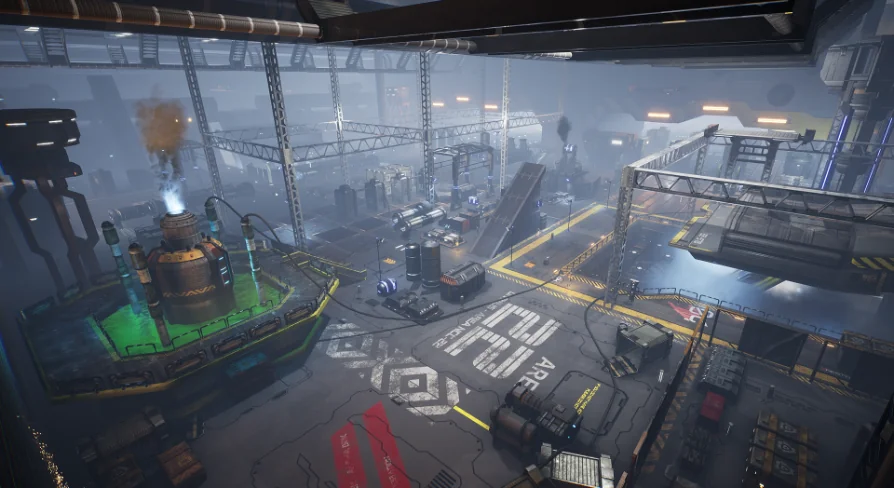
The Modular Sci-fi Hangar Area Environment is a facility package based on the idea of a maintenance hangar inside a science fiction setting. It can function as a standard maintenance hangar or as a flight maintenance hangar, with one particular constraint worth noting up front: the hangar itself does not carry an exterior design view. The focus stays on the interior and the connective tissue around it — corridors, entrances, control systems, and props that can be linked into larger level structures.
The package works across both Unreal Engine 4 and Unreal Engine 5, and the accompanying live document covers all of the creator's UE4 and UE5 products in a generic capacity. A document asset accompanies the package with overview images, custom collisions, and product update notes. This structure means the package is not just a static set of meshes — it includes collision data tuned for the environment and ongoing update documentation that tracks additions and fixes over time.
Hangar Area Structure and Corridor Linking
The core of the package is the hangar area, considered as a maintenance hangar for science fiction environment creation. The layout is designed so corridor areas can be linked into your own levels, letting you connect this facility to broader level architectures rather than treating it as an isolated set piece. The corridor connections were specifically strengthened in the version 1.3 update dated 22 April 2023, bringing them to what the creator describes as a stronger level.
One distinction that anyone working with this package needs to understand is how modularity applies differently across its systems. Material structures are modular, which means the surface treatments and texture systems can be swapped and recombined. The general hangar area, however, is not delivered as meshes. The overview and document images clarify this structural choice, so it governs how you approach building out the space — you work with the material modularity and the corridor system rather than treating the hangar volume itself as a collection of discrete mesh modules.
Surface Tiles: Plastic, Metal, Nylon, Rubber, and Trim
The package includes extra texture tiles beyond the base environment assets. These cover Plastic, Metal, Nylon, Rubber, and Trim sci-fi surface categories. Having these surface types available means the material system can address a range of finishes you would expect in a working hangar — hard metallic structures, flexible rubber components, plastic housings, and trim details that define edges and panel lines.
Because the material structures are modular, these texture tiles can be applied in combination across the environment. The trim textures in particular serve the kind of edge detailing that makes science fiction paneling read convincingly, while the plastic, metal, nylon, and rubber tiles let different props and structural elements carry distinct material identities rather than sharing a single surface treatment across the whole facility.
Animated Doors, Ventilation, and Control Center Blueprints
Functional elements extend the hangar beyond static geometry. Hallway entrances and exits feature a sci-fi door with animations, so transitions between corridor sections and the hangar area are not just visual cuts but moving components. On the ceiling, horizontal ventilation covers have opening and closing control, giving the space moving mechanical detail above the work area.
The control center adds further interactivity through Blueprint-based controls. Descent and exit controls for the control center are handled through Blueprints, which means these are scripted behaviors rather than simple animated clips. The version 1.3 update notes that BP functions were fixed for ease of use, indicating the Blueprint systems have gone through a refinement pass to make them more straightforward to work with inside Unreal Engine.
Terrain, Outer Area, and Game-Ready Optimization
While the hangar interior does not have an exterior design view, the package does include a hangar outer area and area-based terrain. This provides a ground level and surrounding context beyond the facility floor, so the hangar can sit within a broader landscape rather than floating in an undefined space. A new level design connected to the corridor was also added in the version 1.3 update.
The package carries better optimization in game-ready format as of the version 1.3 update. The update also brought over 100 new meshes, materials, and textures into the package, substantially expanding the available asset pool beyond what earlier versions contained. Extra props have been added as well, giving the hangar and its connected areas more set dressing options for populating the environment with detail objects.
Sound Effects and Atmosphere Building
Sound effects are included with the package, covering the auditory dimension of the hangar and its connected spaces. This means the environment does not ship silent — the corridors, doors, ventilation systems, and general facility ambience can carry audio when placed in a level.
The creator also points out that assets inside the package can be added into your own level environments to create stronger atmospheres. This positions the hangar package not just as a standalone facility but as a source of components — props, materials, structural pieces, sound elements — that can reinforce other science fiction scenes you are building in Unreal Engine.
Ongoing Updates and Package Evolution
The version 1.3 update from 22 April 2023 represents a substantial expansion pass. Beyond the Blueprint fixes and the 100-plus new meshes, materials, and textures, it introduced the control center descent and exit controls, the opening and closing ceiling ventilation, sound effects, the hangar outer area with terrain, and the improved game-ready optimization. The corridor connections were strengthened, and a new level design tied into the corridor system was added.
The creator notes that additions can be made in the corridors, and optional media shaping and adjustments can be requested. The package has clearly moved through multiple update cycles, and the update documentation suggests that user requests can influence what gets included in future package contents.
Compatibility and Expanded Bundle Fit
The Modular Sci-fi Hangar Area Environment carries compatibility with the 4 IN 1 Modular Research Facility and Mega Bundle 2025. This means the hangar is designed to slot into a larger modular facility context — research installations and other science fiction structures that share a compatible design language. For anyone building a connected facility complex not just one isolated hangar, this compatibility positions the package as part of a system of environments that can be assembled together.
The key practical takeaway is that this package serves interior-focused facility construction with corridor connections and functional Blueprint systems, while relying on modular materials rather than a fully mesh-modular hangar volume. Understanding that distinction before starting level work determines how effectively the package fits a given production.
 Sci-Fi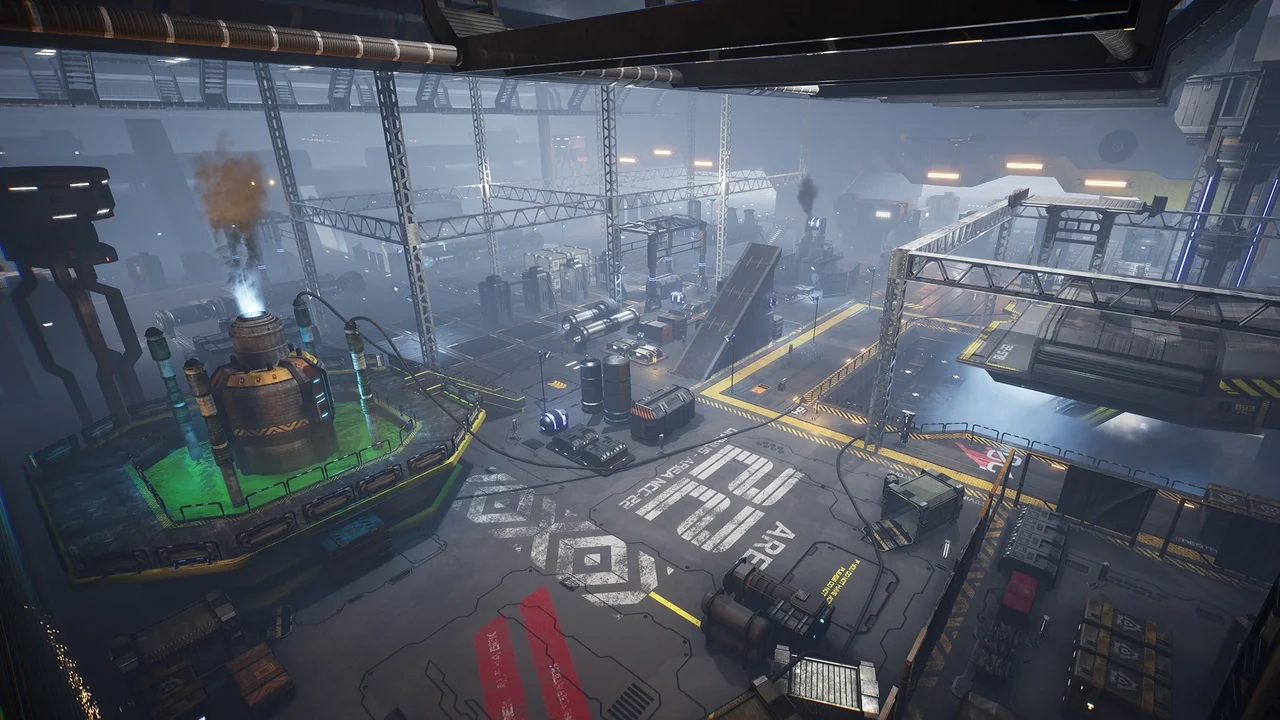
 Sci-Fi
 Sci-Fi
 Sci-Fi