"fa182e0cd0a6ea73"{"id":"1000635","slug":"medieval-modular-town-with-interiors","title":"Medieval Modular Town (With Interiors)","category":"Medieval","engine":"4.26+,5.0+","assetVersion":"","engineVersion":"Engine Version: 4.26+,5.0+","tag":"Medieval","accent":"blue","visual":"mech","summary":"Professional Unreal Engine modular medieval environment with timber frame architecture, fully explorable interiors, Blueprint assembly, Nanite and Lumen support","platform":"Unreal Engine","publishedAt":"2026-07-21T16:24:47.965Z","updatedAt":"2026-07-21T16:24:47.965Z","sourceNotes":[],"fileContents":[],"compatibility":["Unreal Engine","Engine Version: 4.26+,5.0+"],"featuredImage":{"alt":"Medieval Modular Town (With Interiors)","src":"/wp-content/uploads/published/2026/07/d26366caee14-156e5d51-6f21-421e-9bd2-fa981529b613-8f7a142ddd.webp"},"hasDownloadLink":true,"downloads":0,"terms":[{"taxonomy":"category","slug":"medieval","name":"Medieval"}],"galleryImages":[{"src":"/wp-content/uploads/published/2026/07/a4ba68edb239-d910d684-9f7a-4cdf-ac99-d44b07527d96-ae8e34b5c9.webp","alt":"Medieval Modular Town (With Interiors)"},{"src":"/wp-content/uploads/published/2026/07/fb47abf84c28-5dd34dad-c618-47fc-895f-2d91cb07dc61-691bdbf0a4.webp","alt":"Medieval Modular Town (With Interiors)"},{"src":"/wp-content/uploads/published/2026/07/e7c43bb27215-debf9c8d-61d1-4204-b946-6baf8c3ac541-3c8b7827f5.webp","alt":"Medieval Modular Town (With Interiors)"},{"src":"/wp-content/uploads/published/2026/07/9d13a2a3a0e4-2c492706-94f6-4fd2-abb4-67c42f11e1c5-605c2d2d78.webp","alt":"Medieval Modular Town (With Interiors)"},{"src":"/wp-content/uploads/published/2026/07/016894bec8f4-74d99719-64fd-40e0-931e-813cd68d34ee-9bbb110242.webp","alt":"Medieval Modular Town (With Interiors)"},{"src":"/wp-content/uploads/published/2026/07/12ef939c2e78-e23660af-9ea9-4932-9dd0-2750af8690f6-ed6ce2b961.webp","alt":"Medieval Modular Town (With Interiors)"},{"src":"/wp-content/uploads/published/2026/07/a5839348086e-8d23e743-c578-4014-8092-e9316980191b-3a97f0f993.webp","alt":"Medieval Modular Town (With Interiors)"},{"src":"/wp-content/uploads/published/2026/07/147b1660caf6-9a4ed248-124c-41a3-bfee-6be5f6cf4fa3-83e6e86668.webp","alt":"Medieval Modular Town (With Interiors)"},{"src":"/wp-content/uploads/published/2026/07/608c0e0ba7fb-c7a0c38a-d609-4efe-b0e8-4a7f086ae925-a2ad9db700.webp","alt":"Medieval Modular Town (With Interiors)"},{"src":"/wp-content/uploads/published/2026/07/2478cc62514f-927fcea6-0650-4624-ac11-b98ce72f8b8f-94fa304f15.webp","alt":"Medieval Modular Town (With Interiors)"}],"accessPanel":{"kind":"resource","title":"Download this resource","eyebrow":"Free Download","message":"Log in or create a free account to start your download.","fileName":"Content.7z","safetyNote":"Resources are manually reviewed before listing to improve quality and reduce obvious risks.","actionLabel":"Download Free","resourceType":"Resource archive"},"contentHtml":"\u003cp\u003eWalking through a scene assembled with this package feels less like looking at a static game level and more like wandering through an actual settlement. Every structure carries the visual identity of traditional European Timber Frame architecture, with a modular building system that snaps together to produce villages, marketplaces, inns, and larger fantasy towns. The interiors are not hollow shells; they are fully explorable, complete with furniture and essential props that give each room a specific purpose. A tavern gets tables and the appropriate clutter. A shop gets shelving. A house gets the pieces that make a medieval living space readable at a glance.\u003c/p\u003e \u003ch2\u003eBuilding the Town with Modular Architecture\u003c/h2\u003e \u003cp\u003eThe architecture kit is deep enough to cover structural and decorative needs. The modular pieces include timber frame walls, wooden beams, stone foundations, floors, roof modules, chimneys, doors, windows, and arcades. Structural elements and architectural details round out the kit. The range of these pieces means that a creator working on a medieval street scene can combine stone and timber components to create buildings with distinct visual personalities rather than repeating the same house three times down a road.\u003c/p\u003e \u003cp\u003eMuch of the speed comes from the package's Blueprint system. Eight pre-assembled building Blueprints are included, covering common configurations that developers could drop straight into a scene for immediate progress. The modularity does not stop there. Blueprint windows, Blueprint doors, Blueprint wall sections, and Blueprint architectural modules all keep the system flexible. A developer could use a pre-assembled building as a starting point, then swap wall sections, replace doors, or add architectural modules to iterate on a design quickly while maintaining a consistent construction logic.\u003c/p\u003e \u003ch3\u003ePopulating Fully Explorable Interiors\u003c/h3\u003e \u003cp\u003eThe interior content is grouped around building types. Inns, taverns, houses, shops, and general medieval buildings all receive furniture and essential interior props. The fact that the interiors are fully explorable shapes how the asset functions in gameplay. A developer building a third-person RPG can let the player walk from a street, through a door, and into a populated tavern. An architectural visualization project could demonstrate the spatial flow of a timber frame house. A cinematic environment could stage a scene inside a shop without needing to cut away to a separately constructed set. The interior props are specific enough to read clearly, which matters when an environment needs to support narrative or gameplay interaction rather than just serving as background geometry.\u003c/p\u003e \u003cp\u003eA candle flame particle effect is included. It is a small addition that reinforces the atmosphere of a populated interior. The lighting of a candle in a dark medieval room, combined with the Lumen support the package offers, could produce a convincing warm glow on timber frame walls without the need for manually placed lighting rigs or fake glow sprites.\u003c/p\u003e \u003ch2\u003eCustomizing Visual State with the Material System\u003c/h2\u003e \u003cp\u003eThe material setup behaves as a creative tool rather than a fixed finish. Artists can easily customize dirt intensity, edge wear, and color variations. This is where the apparent value of the asset multiplies. The same building pieces can represent wealthy districts, poor villages, abandoned settlements, or newly constructed areas purely through material instance changes. A freshly built house could have minimal edge wear and a cleaner color profile. A weathered shop in a poorer district could show heavy dirt intensity and faded color. An abandoned structure could stack dirt and wear until the timber frame looks rotten and the stone foundations look centuries old.\u003c/p\u003e \u003cp\u003eThe technical foundation of the material system supports 4K PBR textures. Metallic, Roughness, and Ambient Occlusion are packed into the textures. UV baked textures handle some surface detail. RGB mask support drives the customization options. Seamless material support ensures that surfaces tile cleanly. Material Instances enable rapid customization, so adjusting a color or dirt value does not require opening a texture editor or re-exporting from an external software. Substance Painter was used for the texturing, which aligns the asset with a standard texturing pipeline used across real-time production.\u003c/p\u003e \u003ch2\u003eLeveraging Unreal Engine Features for Scene Fidelity\u003c/h2\u003e \u003cp\u003eRelying on recent Unreal Engine capabilities shapes how the environment performs and looks. Nanite support allows the high-poly roof meshes and high-poly stone wall meshes included in the latest version to render efficiently without the traditional polygon budget concerns that constrain open-world scenes. Lumen support brings real-time global illumination to the stone streets and timber frame interiors. A developer working on Unreal Engine 5.1 could assemble a large fantasy town with countless high-poly roof meshes and still expect the scene to handle well under Nanite, while Lumen handles the light bounce between stone walls and wooden beams.\u003c/p\u003e \u003cp\u003eThe package includes legacy low-poly meshes. This inclusion hints at a practical consideration for developers maintaining projects across different engine versions or targeting platforms where Nanite is not the right choice. A production team could use the legacy low-poly meshes for optimization passes on distant buildings in a large open world, reserving the high-poly meshes for hero structures or interiors the player approaches closely.\u003c/p\u003e \u003cp\u003eAn example map is provided. For developers evaluating how the modular pieces fit together in practice, the example map serves as a reference for scale, layout, and density. A demonstration map walkthrough video exists for versions up to Unreal Engine 5.0. A third-person walkthrough video covers the latest update for Unreal Engine 5.1. The Gothic Knight character visible in the screenshot is not included with the environment.\u003c/p\u003e \u003ch3\u003eIntegrating Medieval Modular Town with Medieval Modular Church\u003c/h2\u003e \u003cp\u003eThe asset is part of a broader ecosystem. It is designed to work seamlessly with the Medieval Modular Church package, sharing the same artistic style, scale, and material quality. A developer owning both packages could assemble a complete medieval settlement. The church serves as a landmark and community center. The town package supplies the surrounding houses, inns, shops, and streets. The shared scale means a character could walk from a church entrance down a street and into a tavern without the architecture feeling mismatched. The shared material quality means the stone of the church and the stone foundations of the town houses would read as belonging to the same construction period and region.\u003c/p\u003e \u003cp\u003eThe package is noted to be compatible with the Asian Modular Temple (With Interiors). This compatibility opens a route for developers building diverse virtual worlds, but the primary artistic focus of the town package remains European medieval and fantasy architecture.\u003c/p\u003e \u003ch3\u003eSuitable Project Types and Production Scenarios\u003c/h2\u003e \u003cp\u003eThe asset was created with a wide range of project types in mind. For medieval RPGs, fantasy RPGs, action RPGs, and adventure games, the explorable interiors and modular exteriors could support quest locations, shop interfaces, and player housing. For open-world games and survival games, the ability to customize building state through materials could create a visual progression system where a settlement looks more ruined or more prosperous depending on player actions or world events. Strategy games and city builders could use the modular pieces for representative town views or closer-zoom settlement management screens. Historical games could use the Timber Frame architecture as a basis for period-accurate village reconstruction.\u003c/p\u003e \u003cp\u003eThe package extends into pre-rendered and real-time cinematic territory. Cinematic environments and virtual production pipelines could use the modular architecture as set pieces, adjusting dirt and color variations to match the script's tone. Architectural visualization projects could use the asset to demonstrate historical building techniques or village layouts. Unreal Engine demos and marketplace showcases could use the town as a stress test for Nanite and Lumen capabilities, filling a scene with high-poly meshes and materials to demonstrate rendering performance.\u003c/p\u003e \u003ch2\u003ePractical Takeaway for Development Teams\u003c/h2\u003e \u003cp\u003eA team evaluating this asset should consider it a construction system. The combination of modular architecture, pre-assembled Blueprints, interior props, and deeply customizable material instances means it can support a small medieval street, a complete fantasy town, or a cinematic village without requiring additional modeling work. The integration with the Medieval Modular Church and compatibility with the Asian Modular Temple expands its world-building potential. For a production that needs a medieval environment built quickly while retaining the ability to iterate on visual style and condition, this package provides the pieces and the tools to do so.\u003c/p\u003e\n\n\u003ch2\u003eContinue Browsing Similar Packs\u003c/h2\u003e\n\u003cul\u003e\n\u003cli\u003e\u003ca href=\"https://3dcghub.com/king-arthur-medieval-castle-interior-environment-castle-medieval-throne-room/\" title=\"King Arthur Medieval Castle Interior Environment ( Castle Medieval Throne Room )\"\u003eKing Arthur Medieval Castle Interior Environment ( Castle Medieval Throne Room )\u003c/a\u003e\u003c/li\u003e\n\u003cli\u003e\u003ca href=\"https://3dcghub.com/medieval-windmill-with-interiors-medieval-rural-windmill-medieval-landscape/\" title=\"Medieval Windmill with interiors ( Medieval Rural Windmill, Medieval Landscape )\"\u003eMedieval Windmill with interiors ( Medieval Rural Windmill, Medieval Landscape )\u003c/a\u003e\u003c/li\u003e\n\u003cli\u003e\u003ca href=\"https://3dcghub.com/medieval-armory/\" title=\"Medieval Armory\"\u003eMedieval Armory\u003c/a\u003e\u003c/li\u003e\n\u003cli\u003e\u003ca href=\"https://3dcghub.com/medieval-tavern-medieval-tavern-interior-exterior-modular-medieval-tavern/\" title=\"Medieval Tavern ( Medieval Tavern Interior Exterior Modular Medieval Tavern )\"\u003eMedieval Tavern ( Medieval Tavern Interior Exterior Modular Medieval Tavern )\u003c/a\u003e\u003c/li\u003e\n\u003cli\u003e\u003ca href=\"https://3dcghub.com/stylized-village-village-stylized-village-stylized-town-medieval-village/\" title=\"Stylized Village (Village, Stylized Village, Stylized Town, Medieval Village)\"\u003eStylized Village (Village, Stylized Village, Stylized Town, Medieval Village)\u003c/a\u003e\u003c/li\u003e\n\u003c/ul\u003e","contentTextLength":9401,"navigation":{"current":1300,"total":3789,"previous":{"id":"1000636","slug":"modular-sci-fi-hangar-area-environment","title":"Modular Sci-fi Hangar Area Environment","category":"Sci-Fi","platform":"Unreal Engine","updatedAt":"2026-07-21T17:01:12.782Z"},"next":{"id":"1000634","slug":"medieval-italian-village-environment","title":"Medieval Italian Village Environment","category":"Medieval","platform":"Unreal Engine","updatedAt":"2026-07-21T15:28:08.126Z"}},"relatedResources":[{"id":"1001101","slug":"medieval-village","title":"Medieval Village","category":"Medieval","engine":"4.26+,5.0+","assetVersion":"","engineVersion":"Engine Version: 4.26+,5.0+","tag":"Medieval","accent":"blue","visual":"mech","summary":"Medieval Village packs 490+ static meshes, 17 building blueprints, enterable interiors, dynamic doors, foliage, and free Unreal Engine 5.3/5.6 updates.","platform":"Unreal Engine","publishedAt":"2026-09-07T04:26:16.624Z","updatedAt":"2026-09-07T04:26:16.624Z","sourceNotes":[],"fileContents":[],"compatibility":["Unreal Engine","Engine Version: 4.26+,5.0+"],"featuredImage":{"alt":"Medieval Village","src":"/wp-content/uploads/published/2026/09/31203a4cd48e-5c1efcdc-2e2d-4dcb-a43f-767d2f2a7e13-96448a57bb.webp"},"hasDownloadLink":true,"downloads":1},{"id":"1001100","slug":"medieval-castle-village-environment-medieval-castle-village-medieval-castle","title":"Medieval Castle Village Environment ( Medieval Castle Village Medieval Castle )","category":"Medieval","engine":"4.26+,5.0+","assetVersion":"","engineVersion":"Engine Version: 4.26+,5.0+","tag":"Medieval","accent":"blue","visual":"city","summary":"Medieval Castle Village Environment: 300 static meshes, tileable wall materials, enterable interiors, ULAT tool, and preassembled medieval village scene.","platform":"Unreal Engine","publishedAt":"2026-09-07T04:09:55.311Z","updatedAt":"2026-09-07T04:09:55.311Z","sourceNotes":[],"fileContents":[],"compatibility":["Unreal Engine","Engine Version: 4.26+,5.0+"],"featuredImage":{"alt":"Medieval Castle Village Environment ( Medieval Castle Village Medieval Castle )","src":"/wp-content/uploads/published/2026/09/8d366b969d67-8d13f5db-3842-444b-9dc8-8d45f3739306-9f3c6e8151.webp"},"hasDownloadLink":true,"downloads":1},{"id":"1000373","slug":"king-arthur-medieval-castle-interior-environment-castle-medieval-throne-room","title":"King Arthur Medieval Castle Interior Environment ( Castle Medieval Throne Room )","category":"Medieval","engine":"4.26+,5.0+","assetVersion":"","engineVersion":"Engine Version: 4.26+,5.0+","tag":"Medieval","accent":"blue","visual":"city","summary":"A detailed Unreal Engine environment pack featuring Gothic architecture, modular castle interiors, and the Ultimate Level Art Tool for streamlined scene creatio","platform":"Unreal Engine","publishedAt":"2026-07-06T16:20:13.608Z","updatedAt":"2026-07-06T16:20:13.608Z","sourceNotes":[],"fileContents":[],"compatibility":["Unreal Engine","Engine Version: 4.26+,5.0+"],"featuredImage":{"alt":"King Arthur Medieval Castle Interior Environment ( Castle Medieval Throne Room )","src":"/wp-content/uploads/published/2026/07/2d911dc39af1-7f24a259-868e-4d4f-8d16-f072b5c32b3b-58faa04780.webp"},"hasDownloadLink":true,"downloads":2}]}
Medieval
Medieval Modular Town (With Interiors)
Professional Unreal Engine modular medieval environment with timber frame architecture, fully explorable interiors, Blueprint assembly, Nanite and Lumen support
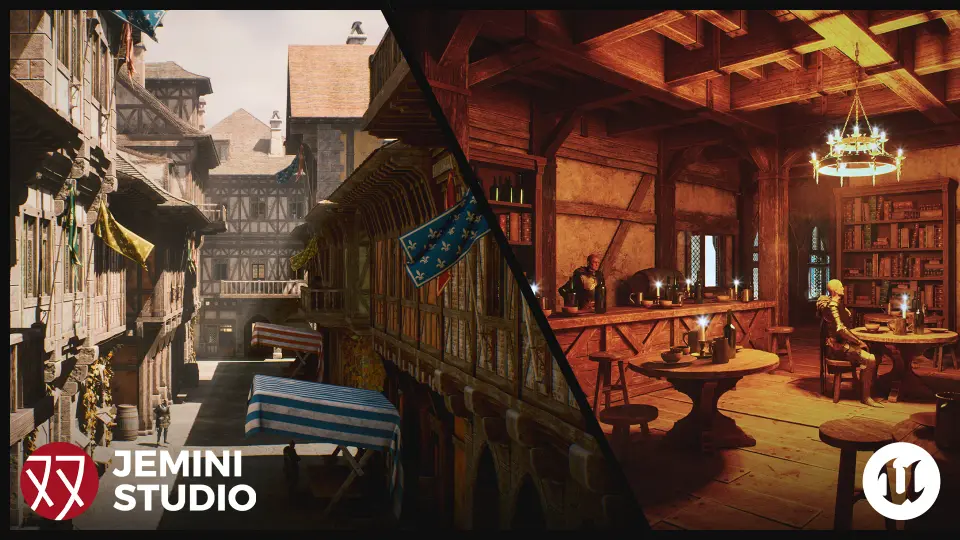
Walking through a scene assembled with this package feels less like looking at a static game level and more like wandering through an actual settlement. Every structure carries the visual identity of traditional European Timber Frame architecture, with a modular building system that snaps together to produce villages, marketplaces, inns, and larger fantasy towns. The interiors are not hollow shells; they are fully explorable, complete with furniture and essential props that give each room a specific purpose. A tavern gets tables and the appropriate clutter. A shop gets shelving. A house gets the pieces that make a medieval living space readable at a glance.
Building the Town with Modular Architecture
The architecture kit is deep enough to cover structural and decorative needs. The modular pieces include timber frame walls, wooden beams, stone foundations, floors, roof modules, chimneys, doors, windows, and arcades. Structural elements and architectural details round out the kit. The range of these pieces means that a creator working on a medieval street scene can combine stone and timber components to create buildings with distinct visual personalities rather than repeating the same house three times down a road.
Much of the speed comes from the package's Blueprint system. Eight pre-assembled building Blueprints are included, covering common configurations that developers could drop straight into a scene for immediate progress. The modularity does not stop there. Blueprint windows, Blueprint doors, Blueprint wall sections, and Blueprint architectural modules all keep the system flexible. A developer could use a pre-assembled building as a starting point, then swap wall sections, replace doors, or add architectural modules to iterate on a design quickly while maintaining a consistent construction logic.
Populating Fully Explorable Interiors
The interior content is grouped around building types. Inns, taverns, houses, shops, and general medieval buildings all receive furniture and essential interior props. The fact that the interiors are fully explorable shapes how the asset functions in gameplay. A developer building a third-person RPG can let the player walk from a street, through a door, and into a populated tavern. An architectural visualization project could demonstrate the spatial flow of a timber frame house. A cinematic environment could stage a scene inside a shop without needing to cut away to a separately constructed set. The interior props are specific enough to read clearly, which matters when an environment needs to support narrative or gameplay interaction rather than just serving as background geometry.
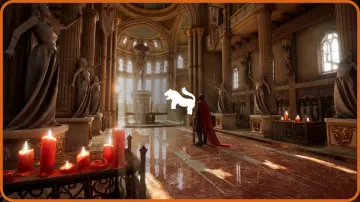
A candle flame particle effect is included. It is a small addition that reinforces the atmosphere of a populated interior. The lighting of a candle in a dark medieval room, combined with the Lumen support the package offers, could produce a convincing warm glow on timber frame walls without the need for manually placed lighting rigs or fake glow sprites.
Customizing Visual State with the Material System
The material setup behaves as a creative tool rather than a fixed finish. Artists can easily customize dirt intensity, edge wear, and color variations. This is where the apparent value of the asset multiplies. The same building pieces can represent wealthy districts, poor villages, abandoned settlements, or newly constructed areas purely through material instance changes. A freshly built house could have minimal edge wear and a cleaner color profile. A weathered shop in a poorer district could show heavy dirt intensity and faded color. An abandoned structure could stack dirt and wear until the timber frame looks rotten and the stone foundations look centuries old.
The technical foundation of the material system supports 4K PBR textures. Metallic, Roughness, and Ambient Occlusion are packed into the textures. UV baked textures handle some surface detail. RGB mask support drives the customization options. Seamless material support ensures that surfaces tile cleanly. Material Instances enable rapid customization, so adjusting a color or dirt value does not require opening a texture editor or re-exporting from an external software. Substance Painter was used for the texturing, which aligns the asset with a standard texturing pipeline used across real-time production.
Leveraging Unreal Engine Features for Scene Fidelity
Relying on recent Unreal Engine capabilities shapes how the environment performs and looks. Nanite support allows the high-poly roof meshes and high-poly stone wall meshes included in the latest version to render efficiently without the traditional polygon budget concerns that constrain open-world scenes. Lumen support brings real-time global illumination to the stone streets and timber frame interiors. A developer working on Unreal Engine 5.1 could assemble a large fantasy town with countless high-poly roof meshes and still expect the scene to handle well under Nanite, while Lumen handles the light bounce between stone walls and wooden beams.
The package includes legacy low-poly meshes. This inclusion hints at a practical consideration for developers maintaining projects across different engine versions or targeting platforms where Nanite is not the right choice. A production team could use the legacy low-poly meshes for optimization passes on distant buildings in a large open world, reserving the high-poly meshes for hero structures or interiors the player approaches closely.
An example map is provided. For developers evaluating how the modular pieces fit together in practice, the example map serves as a reference for scale, layout, and density. A demonstration map walkthrough video exists for versions up to Unreal Engine 5.0. A third-person walkthrough video covers the latest update for Unreal Engine 5.1. The Gothic Knight character visible in the screenshot is not included with the environment.
Integrating Medieval Modular Town with Medieval Modular Church
The asset is part of a broader ecosystem. It is designed to work seamlessly with the Medieval Modular Church package, sharing the same artistic style, scale, and material quality. A developer owning both packages could assemble a complete medieval settlement. The church serves as a landmark and community center. The town package supplies the surrounding houses, inns, shops, and streets. The shared scale means a character could walk from a church entrance down a street and into a tavern without the architecture feeling mismatched. The shared material quality means the stone of the church and the stone foundations of the town houses would read as belonging to the same construction period and region.
The package is noted to be compatible with the Asian Modular Temple (With Interiors). This compatibility opens a route for developers building diverse virtual worlds, but the primary artistic focus of the town package remains European medieval and fantasy architecture.
Suitable Project Types and Production Scenarios
The asset was created with a wide range of project types in mind. For medieval RPGs, fantasy RPGs, action RPGs, and adventure games, the explorable interiors and modular exteriors could support quest locations, shop interfaces, and player housing. For open-world games and survival games, the ability to customize building state through materials could create a visual progression system where a settlement looks more ruined or more prosperous depending on player actions or world events. Strategy games and city builders could use the modular pieces for representative town views or closer-zoom settlement management screens. Historical games could use the Timber Frame architecture as a basis for period-accurate village reconstruction.
The package extends into pre-rendered and real-time cinematic territory. Cinematic environments and virtual production pipelines could use the modular architecture as set pieces, adjusting dirt and color variations to match the script's tone. Architectural visualization projects could use the asset to demonstrate historical building techniques or village layouts. Unreal Engine demos and marketplace showcases could use the town as a stress test for Nanite and Lumen capabilities, filling a scene with high-poly meshes and materials to demonstrate rendering performance.
Practical Takeaway for Development Teams
A team evaluating this asset should consider it a construction system. The combination of modular architecture, pre-assembled Blueprints, interior props, and deeply customizable material instances means it can support a small medieval street, a complete fantasy town, or a cinematic village without requiring additional modeling work. The integration with the Medieval Modular Church and compatibility with the Asian Modular Temple expands its world-building potential. For a production that needs a medieval environment built quickly while retaining the ability to iterate on visual style and condition, this package provides the pieces and the tools to do so.
 Medieval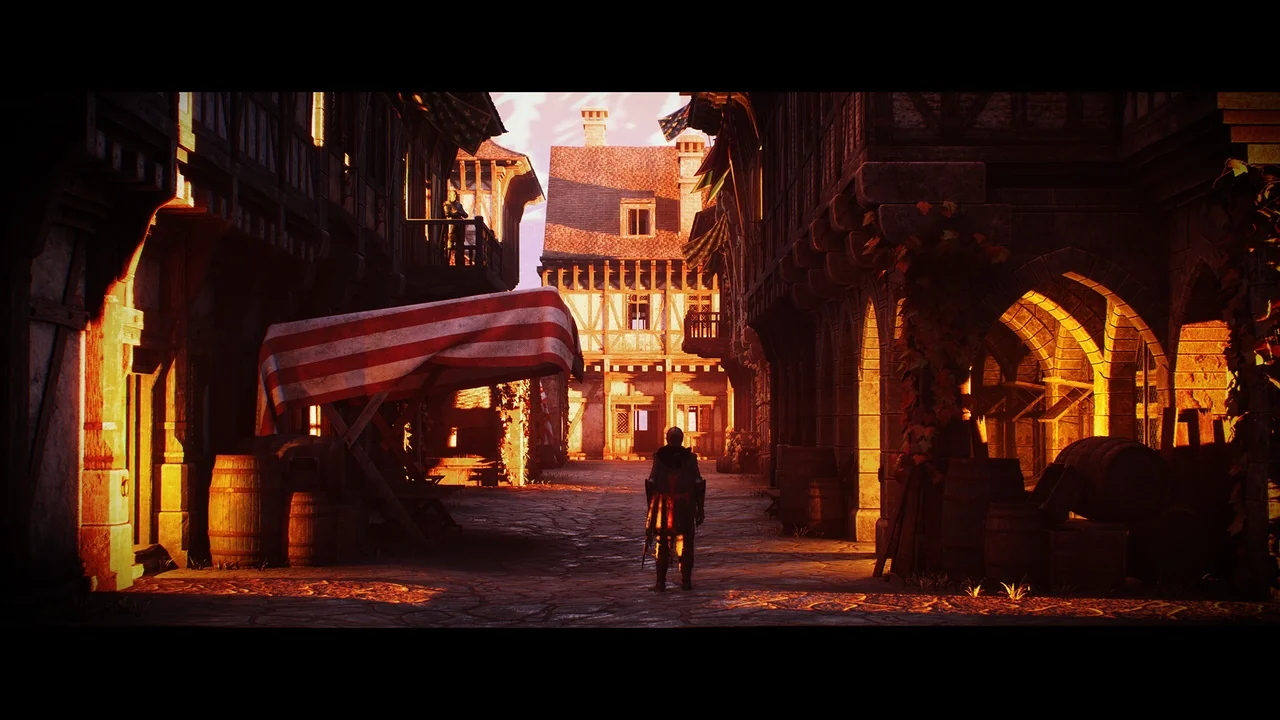
 Medieval
 Medieval
 Medieval