"fa182e0cd0a6ea73"{"id":"1000634","slug":"medieval-italian-village-environment","title":"Medieval Italian Village Environment","category":"Medieval","engine":"5.5+","assetVersion":"","engineVersion":"Engine Version: 5.5+","tag":"Medieval","accent":"blue","visual":"city","summary":"Medieval Italian Village Environment delivers modular houses, props, vertex painting, Lumen lighting, Nanite support, and a detailed sample map for Unreal Engin","platform":"Unreal Engine","publishedAt":"2026-07-21T15:28:08.126Z","updatedAt":"2026-07-21T15:28:08.126Z","sourceNotes":[],"fileContents":[],"compatibility":["Unreal Engine","Engine Version: 5.5+"],"featuredImage":{"alt":"Medieval Italian Village Environment","src":"/wp-content/uploads/published/2026/07/d7659ac5d811-57c5277f-8c56-4adc-a39f-1e5237d2682c-527089ab1b.webp"},"hasDownloadLink":true,"downloads":3,"terms":[{"taxonomy":"category","slug":"medieval","name":"Medieval"}],"galleryImages":[{"src":"/wp-content/uploads/published/2026/07/378307c6a29b-3b299fe2-6982-4a46-b84f-4cea9749d193-5c7e79b7e2.webp","alt":"Medieval Italian Village Environment"},{"src":"/wp-content/uploads/published/2026/07/e852e25566d0-5ac4db85-1358-4231-aa6f-17d61f65595d-7ebb79962b.webp","alt":"Medieval Italian Village Environment"},{"src":"/wp-content/uploads/published/2026/07/af444ae07abf-ac57dd36-8d88-4fcf-8478-c9ac8c6b2558-d432719719.webp","alt":"Medieval Italian Village Environment"},{"src":"/wp-content/uploads/published/2026/07/d88be3697e56-2691512a-5c1c-4ca7-8de1-dd773a92b0c1-c67fd34d3a.webp","alt":"Medieval Italian Village Environment"},{"src":"/wp-content/uploads/published/2026/07/08689f09ab24-716d378e-1de5-4dd7-b202-e067c28a7c57-07d4288772.webp","alt":"Medieval Italian Village Environment"},{"src":"/wp-content/uploads/published/2026/07/2b8f655467cb-94641d10-30f3-4983-9e71-662a41659485-aab5b391ee.webp","alt":"Medieval Italian Village Environment"},{"src":"/wp-content/uploads/published/2026/07/4ccf54d1c26d-d82039ec-5e0e-4da0-bf83-fc3f234404e8-68d76b28b4.webp","alt":"Medieval Italian Village Environment"},{"src":"/wp-content/uploads/published/2026/07/1da7fe7b3c06-cd805953-ac1c-462c-9853-48012e60cf58-7a119cac8f.webp","alt":"Medieval Italian Village Environment"},{"src":"/wp-content/uploads/published/2026/07/5acbbbf39492-49bca5ca-5b4e-45a9-8a04-34f125cc1895-a3809fd253.webp","alt":"Medieval Italian Village Environment"},{"src":"/wp-content/uploads/published/2026/07/36c69c1356bf-eb84dc4a-2865-43da-9ae3-96f77e913609-d5279709ce.webp","alt":"Medieval Italian Village Environment"}],"accessPanel":{"kind":"resource","title":"Download this resource","eyebrow":"Free Download","message":"Log in or create a free account to start your download.","fileName":"Content.7z","safetyNote":"Resources are manually reviewed before listing to improve quality and reduce obvious risks.","actionLabel":"Download Free","resourceType":"Resource archive"},"contentHtml":"\u003cp\u003eHistorical games, fantasy RPGs, and atmospheric experiences all share a common need: environments that feel inhabited rather than assembled. Medieval Italian Village Environment is built specifically to serve those project types, drawing from the architecture and atmosphere of the Italian countryside to provide a foundation that leans into the romance and intrigue of a bygone era. The pack is intended to let developers construct medieval hamlet scenes without starting from raw primitives, giving them pre-built structures and props that already carry the character the setting demands.\u003c/p\u003e\u003ch2\u003eArchitecture Inspired by the Italian Countryside\u003c/h2\u003e\u003cp\u003eThe visual identity of the pack is rooted in medieval Italian hamlets. The design approach focuses on faithfully recreating the charm and character of these villages, with a heavy emphasis on detail. Rather than relying on generic medieval structures, the assets reflect the architectural language specific to Italian countryside settlements. That specificity matters when a project needs to evoke a real historical period or when a fantasy setting calls for a grounded, believable backdrop rather than a stylized one.\u003c/p\u003e\u003cp\u003eEvery building and prop in the collection contributes to that visual goal. The creator describes the environment as meticulously designed and filled with detail, which positions it as a package for developers who need their scenes to hold up under close inspection, whether during gameplay exploration or cinematic framing.\u003c/p\u003e\u003ch2\u003ePre-Built Houses and Modular Construction\u003c/h2\u003e\u003cp\u003eSpeed is a central concern in the package. A wide array of pre-built houses and props is included so that environments can be constructed quickly and efficiently. These ready-made structures let developers drop complete buildings into a scene and populate it with props without first assembling walls, roofs, and details from scratch.\u003c/p\u003e\u003cp\u003eAlongside the pre-built assets, the pack provides modular pieces for flexible layout construction. This combination serves two workflow stages. When a developer needs to block out a town or village rapidly, the pre-built houses handle the heavy lifting. When unique layouts are required—perhaps to fit terrain, accommodate gameplay paths, or create variation across a large settlement—the modular pieces allow those pre-built structures to be supplemented or reconfigured.\u003c/p\u003e\u003cp\u003eThe modular approach also supports scalability. A small hamlet can be assembled from a handful of pre-built houses, while a larger town can be expanded with modular pieces that introduce structural variety without breaking the visual consistency established by the core assets.\u003c/p\u003e\u003ch2\u003eVertex Painting for Per-Building Customization\u003c/h2\u003e\u003cp\u003eOne of the more technically significant features in the pack is vertex painting support. This allows developers to customize the appearance of every building directly, adding depth and a unique style to scenes without relying solely on texture variation or material swaps.\u003c/p\u003e\u003cp\u003eVertex painting is particularly useful in medieval village settings where surfaces need to show age, weathering, dirt accumulation, or material blending. A stone wall can be given moss at its base, a plaster facade can show exposed brick in patches, and pathways can be darkened where foot traffic would naturally concentrate. Because this customization happens at the vertex level, it integrates into the environment construction workflow rather than requiring separate texture authoring.\u003c/p\u003e\u003cp\u003eFor projects that prioritize visual storytelling—where the state of a building communicates history—the vertex painting support provides a practical method for achieving that without leaving the engine.\u003c/p\u003e\u003ch2\u003eSample Map with Dual Lighting Presets\u003c/h2\u003e\u003cp\u003eThe pack includes a highly detailed sample map, which serves as both a reference and a starting point. Developers can examine how the pre-built and modular assets come together in a complete village scene, then use that map as a foundation for their own layouts or study it to understand the intended composition.\u003c/p\u003e\u003cp\u003eTwo different lighting presets are provided with the sample map. This is a meaningful inclusion because lighting fundamentally changes how a medieval environment reads. The same village can shift between two distinct moods, allowing developers to evaluate which atmosphere suits their project or to swap between presets during development to test how materials and geometry respond under different conditions.\u003c/p\u003e\u003ch2\u003ePlugin Requirements: HDRI and PCG\u003c/h2\u003e\u003cp\u003eThe package depends on two Unreal Engine plugins being enabled: the HDRI Plugin and the PCG (Procedural Content Generation) Plugin. The HDRI Plugin is typically involved in environment lighting and background rendering, while the PCG Plugin handles procedural generation tasks within the engine.\u003c/p\u003e\u003cp\u003eDevelopments relying on this pack need to confirm both plugins are active to ensure everything runs smoothly. This is a setup consideration rather than a feature—incompatible or disabled plugins would prevent the environment from functioning as intended—but it also signals that the pack integrates with engine-level systems rather than operating as a static collection of meshes.\u003c/p\u003e\u003ch2\u003eTechnical Tags and Rendering Features\u003c/h2\u003e\u003cp\u003eThe pack carries tags that indicate its technical positioning within Unreal Engine. Lumen is referenced, which means the materials and lighting setup are intended to work with the engine's real-time global illumination system. Nanite is also tagged, pointing to high-detail mesh handling that leverages Unreal's virtualized geometry system for performance efficiency.\u003c/p\u003e\u003cp\u003eAdditional tags—PBR, Realistic, Modular, Medieval, Italian, Village, Town, City, Street, and Level—cement the pack's position as a realistic, physically based rendering environment asset. The presence of both \"Village\" and \"City\" among the tags suggests the assets can scale from smaller settlement scenes to larger urban-style layouts, though the core identity remains medieval Italian.\u003c/p\u003e\u003ch2\u003e Compatibility with Other Medieval Assets\u003c/h2\u003e\u003cp\u003eThe pack is noted as compatible with the Medieval Castle Megapack. This opens the door to combining the village environment with castle structures, allowing developers to build larger medieval settings that include both residential hamlets and fortification elements. For projects that need a full settlement ecosystem rather than isolated buildings, that compatibility extends the usable scope of both packages.\u003c/p\u003e\u003ch2\u003eWho Benefits Most from This Package\u003c/h2\u003e\u003cp\u003eDevelopers building historical games set in or inspired by medieval Italy will find the pack directly aligned with their needs. The authentic design, combined with modular flexibility and vertex painting, means the environment can be tailored to match specific narrative or gameplay requirements without losing its regional character.\u003c/p\u003e\u003cp\u003eFantasy RPG developers also fall squarely within the intended audience. The romantic, atmospheric quality of Italian medieval hamlets translates well into fantasy settings that demand believable, lived-in worlds. The dual lighting presets further support this by enabling distinct moods for different regions, times of day, or story beats within a single project.\u003c/p\u003e\u003cp\u003eCreators focused on atmospheric experiences—exploration demos, cinematic sequences, or environment-driven storytelling—gain a detailed sample map and lighting presets that can serve as immediate starting points. Rather than building a village scene from zero, they can begin with a pre-assembled, highly detailed environment and modify it to fit their vision.\u003c/p\u003e\u003cp\u003eTeams already using the Medieval Castle Megapack have an additional reason to consider this package, as the compatibility between the two allows for expanded medieval world construction without visual or technical conflict.\u003c/p\u003e\n\n\u003ch2\u003eMore From The Same Workflow\u003c/h2\u003e\n\u003cul\u003e\n\u003cli\u003e\u003ca href=\"https://3dcghub.com/medieval-village-megapack/\" title=\"Medieval Village Megapack\"\u003eMedieval Village Megapack\u003c/a\u003e\u003c/li\u003e\n\u003cli\u003e\u003ca href=\"https://3dcghub.com/demonic-village-environment-demonic-medieval-village-village-medieval-3d-art/\" title=\"Demonic Village Environment ( Demonic Medieval Village Village Medieval 3D Art )\"\u003eDemonic Village Environment ( Demonic Medieval Village Village Medieval 3D Art )\u003c/a\u003e\u003c/li\u003e\n\u003cli\u003e\u003ca href=\"https://3dcghub.com/medieval-russian-village/\" title=\"Medieval Russian Village\"\u003eMedieval Russian Village\u003c/a\u003e\u003c/li\u003e\n\u003cli\u003e\u003ca href=\"https://3dcghub.com/stylized-village-village-stylized-village-stylized-town-medieval-village/\" title=\"Stylized Village (Village, Stylized Village, Stylized Town, Medieval Village)\"\u003eStylized Village (Village, Stylized Village, Stylized Town, Medieval Village)\u003c/a\u003e\u003c/li\u003e\n\u003cli\u003e\u003ca href=\"https://3dcghub.com/medieval-village-environment/\" title=\"Medieval Village Environment\"\u003eMedieval Village Environment\u003c/a\u003e\u003c/li\u003e\n\u003c/ul\u003e","contentTextLength":7930,"navigation":{"current":1301,"total":3789,"previous":{"id":"1000635","slug":"medieval-modular-town-with-interiors","title":"Medieval Modular Town (With Interiors)","category":"Medieval","platform":"Unreal Engine","updatedAt":"2026-07-21T16:24:47.965Z"},"next":{"id":"1000632","slug":"kronos-matchmaking","title":"Kronos Matchmaking","category":"Network \u0026 Multiplayer","platform":"Unreal Engine","updatedAt":"2026-07-21T14:46:21.329Z"}},"relatedResources":[{"id":"1001766","slug":"the-aftermath-environment-medieval-village-medieval-village-witcher","title":"The Aftermath Environment ( Medieval Village Medieval Village Witcher )","category":"Medieval","engine":"5.3+","assetVersion":"","engineVersion":"Engine Version: 5.3+","tag":"Medieval","accent":"blue","visual":"city","summary":"Build dark fantasy settlements with The Aftermath Environment, featuring 294 unique meshes, ULAT modular building tools, and UE5 Nanite and Lumen support.","platform":"Unreal Engine","publishedAt":"2026-10-20T03:11:51.807Z","updatedAt":"2026-10-20T03:11:51.807Z","sourceNotes":[],"fileContents":[],"compatibility":["Unreal Engine","Engine Version: 5.3+"],"featuredImage":{"alt":"The Aftermath Environment ( Medieval Village Medieval Village Witcher )","src":"/wp-content/uploads/published/2026/10/cc22e5df7667-aaf1ddd9-19f6-40f9-b46c-eddd0e71033e-331c6ab70b.webp"},"hasDownloadLink":true,"downloads":0},{"id":"1000523","slug":"medieval-village-megapack","title":"Medieval Village Megapack","category":"Medieval","engine":"5.0+","assetVersion":"","engineVersion":"Engine Version: 5.0+","tag":"Medieval","accent":"blue","visual":"mech","summary":"Over 550 Romanesque medieval assets with Nanite and Lumen support, weather control tools, modular grid-snapping prefabs, and a customizable NPC for Unreal Engin","platform":"Unreal Engine","publishedAt":"2026-07-14T15:32:22.101Z","updatedAt":"2026-07-14T15:32:22.101Z","sourceNotes":[],"fileContents":[],"compatibility":["Unreal Engine","Engine Version: 5.0+"],"featuredImage":{"alt":"Medieval Village Megapack","src":"/wp-content/uploads/published/2026/07/3321eb710ab4-a5853349-cb6b-4ee3-ad3d-f21d65b1c17b-6a78748e95.webp"},"hasDownloadLink":true,"downloads":3},{"id":"1000721","slug":"modular-medieval-town-docks-medieval-town-medieval-village-town-village","title":"Modular Medieval Town, Docks (Medieval Town, Medieval Village, Town, Village)","category":"Medieval","engine":"5.3+","assetVersion":"","engineVersion":"Engine Version: 5.3+","tag":"Medieval","accent":"blue","visual":"mech","summary":"A modular medieval town and docks environment for Unreal Engine 5.3 with 323 meshes, enterable furnished buildings, Nanite foliage, VFX, and Lumen support.","platform":"Unreal Engine","publishedAt":"2026-07-26T12:57:47.702Z","updatedAt":"2026-07-26T12:57:47.702Z","sourceNotes":[],"fileContents":[],"compatibility":["Unreal Engine","Engine Version: 5.3+"],"featuredImage":{"alt":"Modular Medieval Town, Docks (Medieval Town, Medieval Village, Town, Village)","src":"/wp-content/uploads/published/2026/07/067f38254eaf-8a9d01b4-c6a8-4614-aca4-315e195a5b12-22f24b8584.webp"},"hasDownloadLink":true,"downloads":1}]}
Medieval
Medieval Italian Village Environment
Medieval Italian Village Environment delivers modular houses, props, vertex painting, Lumen lighting, Nanite support, and a detailed sample map for Unreal Engin
Historical games, fantasy RPGs, and atmospheric experiences all share a common need: environments that feel inhabited rather than assembled. Medieval Italian Village Environment is built specifically to serve those project types, drawing from the architecture and atmosphere of the Italian countryside to provide a foundation that leans into the romance and intrigue of a bygone era. The pack is intended to let developers construct medieval hamlet scenes without starting from raw primitives, giving them pre-built structures and props that already carry the character the setting demands.
Architecture Inspired by the Italian Countryside
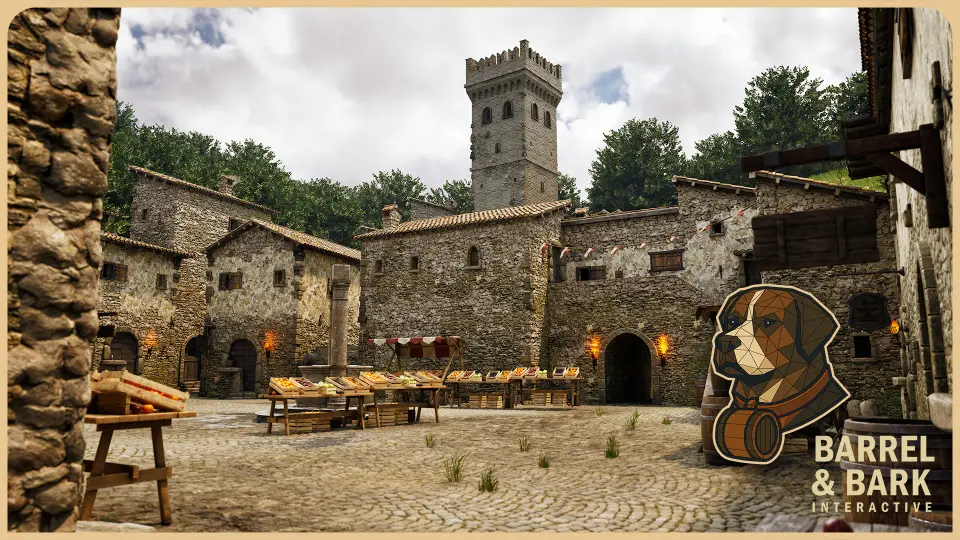
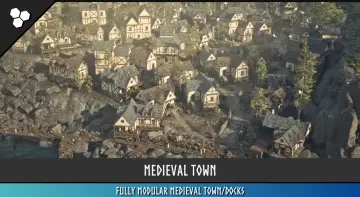
The visual identity of the pack is rooted in medieval Italian hamlets. The design approach focuses on faithfully recreating the charm and character of these villages, with a heavy emphasis on detail. Rather than relying on generic medieval structures, the assets reflect the architectural language specific to Italian countryside settlements. That specificity matters when a project needs to evoke a real historical period or when a fantasy setting calls for a grounded, believable backdrop rather than a stylized one.
Every building and prop in the collection contributes to that visual goal. The creator describes the environment as meticulously designed and filled with detail, which positions it as a package for developers who need their scenes to hold up under close inspection, whether during gameplay exploration or cinematic framing.
Pre-Built Houses and Modular Construction
Speed is a central concern in the package. A wide array of pre-built houses and props is included so that environments can be constructed quickly and efficiently. These ready-made structures let developers drop complete buildings into a scene and populate it with props without first assembling walls, roofs, and details from scratch.
Alongside the pre-built assets, the pack provides modular pieces for flexible layout construction. This combination serves two workflow stages. When a developer needs to block out a town or village rapidly, the pre-built houses handle the heavy lifting. When unique layouts are required—perhaps to fit terrain, accommodate gameplay paths, or create variation across a large settlement—the modular pieces allow those pre-built structures to be supplemented or reconfigured.
The modular approach also supports scalability. A small hamlet can be assembled from a handful of pre-built houses, while a larger town can be expanded with modular pieces that introduce structural variety without breaking the visual consistency established by the core assets.
Vertex Painting for Per-Building Customization
One of the more technically significant features in the pack is vertex painting support. This allows developers to customize the appearance of every building directly, adding depth and a unique style to scenes without relying solely on texture variation or material swaps.
Vertex painting is particularly useful in medieval village settings where surfaces need to show age, weathering, dirt accumulation, or material blending. A stone wall can be given moss at its base, a plaster facade can show exposed brick in patches, and pathways can be darkened where foot traffic would naturally concentrate. Because this customization happens at the vertex level, it integrates into the environment construction workflow rather than requiring separate texture authoring.
For projects that prioritize visual storytelling—where the state of a building communicates history—the vertex painting support provides a practical method for achieving that without leaving the engine.
Sample Map with Dual Lighting Presets
The pack includes a highly detailed sample map, which serves as both a reference and a starting point. Developers can examine how the pre-built and modular assets come together in a complete village scene, then use that map as a foundation for their own layouts or study it to understand the intended composition.
Two different lighting presets are provided with the sample map. This is a meaningful inclusion because lighting fundamentally changes how a medieval environment reads. The same village can shift between two distinct moods, allowing developers to evaluate which atmosphere suits their project or to swap between presets during development to test how materials and geometry respond under different conditions.
Plugin Requirements: HDRI and PCG
The package depends on two Unreal Engine plugins being enabled: the HDRI Plugin and the PCG (Procedural Content Generation) Plugin. The HDRI Plugin is typically involved in environment lighting and background rendering, while the PCG Plugin handles procedural generation tasks within the engine.
Developments relying on this pack need to confirm both plugins are active to ensure everything runs smoothly. This is a setup consideration rather than a feature—incompatible or disabled plugins would prevent the environment from functioning as intended—but it also signals that the pack integrates with engine-level systems rather than operating as a static collection of meshes.
Technical Tags and Rendering Features
The pack carries tags that indicate its technical positioning within Unreal Engine. Lumen is referenced, which means the materials and lighting setup are intended to work with the engine's real-time global illumination system. Nanite is also tagged, pointing to high-detail mesh handling that leverages Unreal's virtualized geometry system for performance efficiency.
Additional tags—PBR, Realistic, Modular, Medieval, Italian, Village, Town, City, Street, and Level—cement the pack's position as a realistic, physically based rendering environment asset. The presence of both "Village" and "City" among the tags suggests the assets can scale from smaller settlement scenes to larger urban-style layouts, though the core identity remains medieval Italian.
Compatibility with Other Medieval Assets
The pack is noted as compatible with the Medieval Castle Megapack. This opens the door to combining the village environment with castle structures, allowing developers to build larger medieval settings that include both residential hamlets and fortification elements. For projects that need a full settlement ecosystem rather than isolated buildings, that compatibility extends the usable scope of both packages.
Who Benefits Most from This Package
Developers building historical games set in or inspired by medieval Italy will find the pack directly aligned with their needs. The authentic design, combined with modular flexibility and vertex painting, means the environment can be tailored to match specific narrative or gameplay requirements without losing its regional character.
Fantasy RPG developers also fall squarely within the intended audience. The romantic, atmospheric quality of Italian medieval hamlets translates well into fantasy settings that demand believable, lived-in worlds. The dual lighting presets further support this by enabling distinct moods for different regions, times of day, or story beats within a single project.
Creators focused on atmospheric experiences—exploration demos, cinematic sequences, or environment-driven storytelling—gain a detailed sample map and lighting presets that can serve as immediate starting points. Rather than building a village scene from zero, they can begin with a pre-assembled, highly detailed environment and modify it to fit their vision.
Teams already using the Medieval Castle Megapack have an additional reason to consider this package, as the compatibility between the two allows for expanded medieval world construction without visual or technical conflict.
 Medieval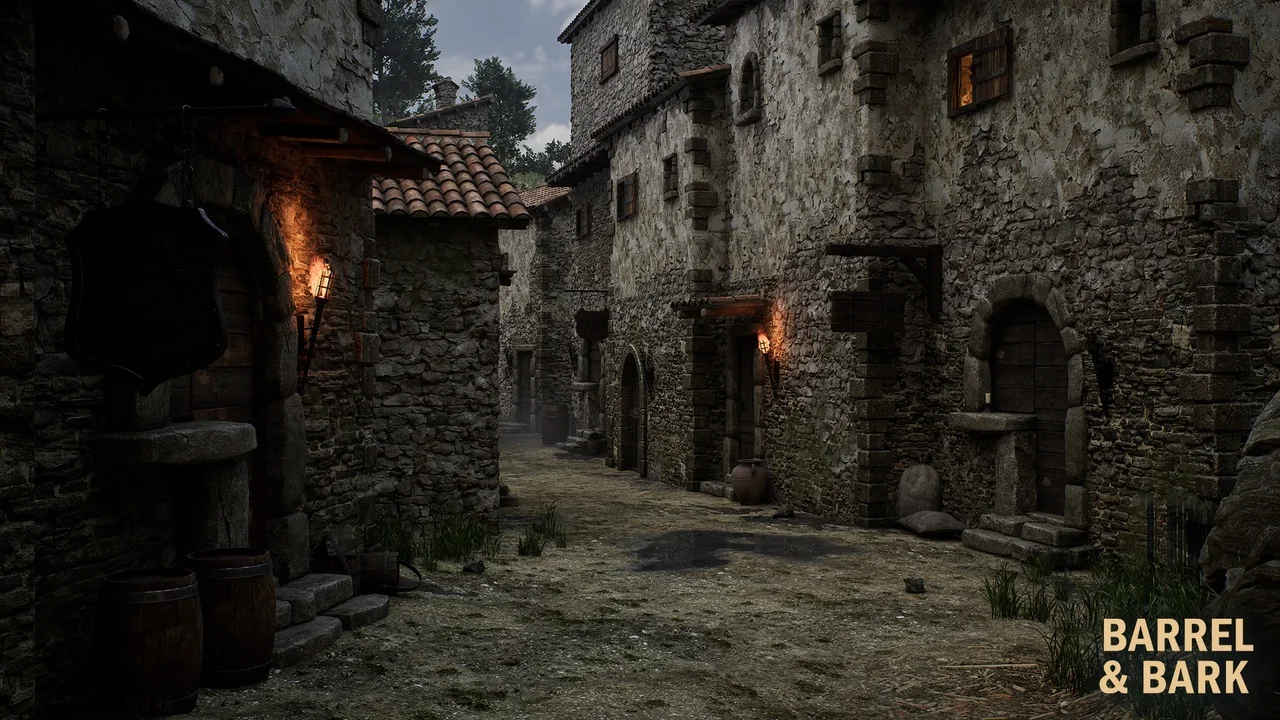
 Medieval
 Medieval
 Medieval