"c68a05d5e51405b3"{"id":"1001122","slug":"rocky-desert","title":"Rocky Desert","category":"Desert","engine":"4.26+,5.0+","assetVersion":"","engineVersion":"Engine Version: 4.26+,5.0+","tag":"Desert","accent":"blue","visual":"mech","summary":"Desert environment with 15 rock and foliage meshes, 765x765m terrain, terrain tessellation, dynamic atmosphere, LODs, and 2048 textures for next-gen game levels","platform":"Unreal Engine","publishedAt":"2026-09-07T13:05:56.081Z","updatedAt":"2026-09-07T13:05:56.081Z","sourceNotes":[],"fileContents":[],"compatibility":["Unreal Engine","Engine Version: 4.26+,5.0+"],"featuredImage":{"alt":"Rocky Desert","src":"/wp-content/uploads/published/2026/09/21e8b63ad822-3c8cde2a-ddfe-446b-8cce-a1281d031970-76856ea1ed.webp"},"hasDownloadLink":true,"downloads":1,"terms":[{"taxonomy":"category","slug":"desert","name":"Desert"}],"galleryImages":[{"src":"/wp-content/uploads/published/2026/09/097611589e0a-664fcc12-158c-48aa-b2b6-a7d79e92f533-87c6391252.webp","alt":"Rocky Desert"},{"src":"/wp-content/uploads/published/2026/09/3c533721c792-16b0e0ff-5538-46c5-8b12-ef092f75578e-19c968a737.webp","alt":"Rocky Desert"},{"src":"/wp-content/uploads/published/2026/09/ed754467fb61-11d3cdfa-0494-4459-8e4a-461c902b22dc-27134e50ba.webp","alt":"Rocky Desert"},{"src":"/wp-content/uploads/published/2026/09/9902615458a7-db3f839f-e566-4dab-a70f-412e1e0b9bc5-7b94430b55.webp","alt":"Rocky Desert"},{"src":"/wp-content/uploads/published/2026/09/b61d99dd17c7-7fcb2eeb-cb2e-4e18-9b82-c6c8162c9436-4921afed2c.webp","alt":"Rocky Desert"},{"src":"/wp-content/uploads/published/2026/09/198ec220ef64-df60f856-dd78-4ef6-8c36-d85d77385db6-68d73ac9c4.webp","alt":"Rocky Desert"}],"accessPanel":{"kind":"resource","title":"Download this resource","eyebrow":"Free Download","message":"Log in or create a free account to start your download.","fileName":"Content.7z","safetyNote":"Resources are manually reviewed before listing to improve quality and reduce obvious risks.","actionLabel":"Download Free","resourceType":"Resource archive"},"contentHtml":"\u003cp\u003ePutting together a desert level in a game engine usually means stitching together a terrain, rocks, dry vegetation, and a believable sky until the scene stops looking like separate kit pieces. Rocky Desert is a single environment written around that exact chore: a highly detailed, realistic desert landscape ready for next-gen game production.\u003c/p\u003e \u003ch2\u003eA 765×765 Meter Example Map That Already Carries the Scene\u003c/h2\u003e\n\u003cp\u003eAt the center of the pack is a terrain example map that covers 765×765 meters. That footprint gives level designers a real area to work with—enough space for a playable segment or a wide visual backdrop, rather than a tiny diorama that needs to be duplicated and blended into something larger. Because it ships as an example map, it replaces the blank starting ground with a landscape already shaped and populated, so time can go straight into layout and gameplay iteration.\u003c/p\u003e\n\u003cp\u003eThe terrain also supports tessellation. Rather than treating the ground as a static flat plane, the scene can add geometric detail to the sand and rock surfaces where the camera comes closer. That becomes useful on a map of this size, where the viewer might wander across the 765×765m stretch and start noticing the transition between distant silhhouettes and near-ground texture.\u003c/p\u003e \u003ch2\u003eFifteen Unique Meshes with LODs, Collision, and Lightmap UVs\u003c/h2\u003e\n\u003cp\u003eFilling that terrain is a focused set of natural assets. The environment contains 15 unique meshes, spanning the rocks and desert foliage that give the level its character. The vertex count per mesh runs from 178 to 16,000, and that range tells a useful story about the collection. Small stones come in at the low end, letting them be clustered and scattered across the ground without dragging the renderer down. Larger formations at the higher end hold enough geometry to stand as focal points or distant landmarks.\u003c/p\u003e\n\u003cp\u003eEach mesh has collision automatically generated, which is one of those quiet practical details that saves a level designer from hand-tagging every rock for gameplay or camera collision. LODs are also included across the set, so those same rocks can lose polygon weight as they recede toward the map boundary. The package also ships with a set of lightmap UVs. Since the terrain encourages placing rocks at many distances, from foreground close-ups to ridge-line silhouettes, having lightmap-ready meshes avoids a common cleanup phase that usually shows up right before lighting is built.\u003c/p\u003e \u003ch2\u003eSSGI, Mesh Distance Fields, and a Fully Dynamic Atmosphere\u003c/h2\u003e\n\u003cp\u003eThe visual identity of Rocky Desert depends on a fully dynamic atmosphere rather than a fixed, static lighting setup. The content calls out two project settings to hit that next-gen look: Generate Mesh Distance Fields and SSGI. Enabling both changes how light and shadow behave across the environment. Mesh distance fields give the scene a more accurate representation of geometry for effects like ambient occlusion and contact shadows, while SSGI—screen-space global illumination—lets indirect light bounce more naturally between rock faces, sandy ground, and sparse foliage.\u003c/p\u003e\n\u003cp\u003eThose settings are the difference between a daytime desert that reads as a single flat golden tone and one that has depth across the terrain. The dynamic atmosphere supports that by keeping sky and lighting in a single responsive system, so a production team can tune the mood of the level without rebuilding static lighting for each change. This also makes the environment a strong starting point for lighting experiments in a realistic sand landscape.\u003c/p\u003e \u003ch2\u003eTextures at 2048 Across a Fourteen-Material Set\u003c/h2\u003e\n\u003cp\u003eMaterial and texture work in the environment is shaped by 14 materials and material instances, backed by 22 textures. Every texture is 2048 resolution. That resolution is a deliberate midpoint: far terrain and repeated rock clusters don't require larger files, while close-up sand, stone, and foliage still benefit from crisp surface detail without ballooning memory usage.\u003c/p\u003e\n\u003cp\u003eWith only 14 materials and instances handling the terrain, rocks, and plant life, the pack keeps shader complexity manageable. The material instances allow quick edits—drying out the sand, shifting rock albedo, or pushing foliage color—without duplicating entire master materials or reimporting textures. For a realistic desert environment, this compact setup helps small teams push the scene through art direction faster.\u003c/p\u003e \u003ch2\u003eWhere a Rocky Desert Level Makes Sense in a Production\u003c/h2\u003e\n\u003cp\u003eBecause Rocky Desert ships as one cohesive environment rather than a general-purpose prop library, it fits projects that need a complete desert sequence right now. A 765×765m terrain is large enough to stage a short gameplay mission, a survival-style opening zone, or a vehicle run through rock-strewn ground. For teams prototyping a game mechanic like traversal, stamina, or shooting inside an arid arena, the included example map lets designers block and test in context immediately.\u003c/p\u003e\n\u003cp\u003eThe production list stays lean in all the places that usually slow down an environment build: collision is already generated, LODs exist, lightmap UVs are ready, and the high-quality visual settings are identified. Developers working on Windows and Mac both sit within the supported platforms, and the environment itself targets the level of realism commonly expected from current and next-gen titles. For an environment artist who wants to light a realistic sandy scene, a designer who needs a full desert playspace fast, or a team assembling an entire arid chapter, Rocky Desert delivers a terrain and asset package that is already dressed and ready to iterate on.\u003c/p\u003e\n\n\u003ch2\u003eMore From The Same Workflow\u003c/h2\u003e\n\u003cul\u003e\n\u003cli\u003e\u003ca href=\"https://3dcghub.com/landscape-procedural-desert-sandstorm/\" title=\"Landscape Procedural Desert - Sandstorm\"\u003eLandscape Procedural Desert - Sandstorm\u003c/a\u003e\u003c/li\u003e\n\u003cli\u003e\u003ca href=\"https://3dcghub.com/crimson-desert-landscape/\" title=\"Crimson Desert Landscape\"\u003eCrimson Desert Landscape\u003c/a\u003e\u003c/li\u003e\n\u003cli\u003e\u003ca href=\"https://3dcghub.com/mw-dune-desert-biome/\" title=\"MW Dune Desert Biome\"\u003eMW Dune Desert Biome\u003c/a\u003e\u003c/li\u003e\n\u003cli\u003e\u003ca href=\"https://3dcghub.com/red-desert-pack/\" title=\"Red Desert Pack\"\u003eRed Desert Pack\u003c/a\u003e\u003c/li\u003e\n\u003cli\u003e\u003ca href=\"https://3dcghub.com/brushify-canyons-pack/\" title=\"Brushify - Canyons Pack\"\u003eBrushify - Canyons Pack\u003c/a\u003e\u003c/li\u003e\n\u003c/ul\u003e","contentTextLength":5722,"navigation":{"current":854,"total":3860,"previous":{"id":"1001123","slug":"scanned-poplar-and-aspen-forest-with-seasons","title":"Scanned Poplar and Aspen Forest with Seasons","category":"Forest \u0026 Jungle","platform":"Unreal Engine","updatedAt":"2026-09-07T13:12:33.459Z"},"next":{"id":"1001120","slug":"point-and-click-adventure-toolkit","title":"Point and Click Adventure Toolkit","category":"Action-Adventure","platform":"Unreal Engine","updatedAt":"2026-09-07T12:59:10.534Z"}},"relatedResources":[{"id":"1001511","slug":"desert-city-ruins","title":"Desert City Ruins","category":"Desert","engine":"4.27+,5.0+","assetVersion":"","engineVersion":"Engine Version: 4.27+,5.0+","tag":"Desert","accent":"blue","visual":"city","summary":"Build desolate rocky desert levels and decrepit city ruins with modular PBR assets, realistic sand environments, and project distance field integration.","platform":"Unreal Engine","publishedAt":"2026-10-09T13:11:33.796Z","updatedAt":"2026-10-09T13:11:33.796Z","sourceNotes":[],"fileContents":[],"compatibility":["Unreal Engine","Engine Version: 4.27+,5.0+"],"featuredImage":{"alt":"Desert City Ruins","src":"/wp-content/uploads/published/2026/10/a4f5284dec98-173ba9f0-45ef-4de6-ac8b-060116f8dec4-f67e79dfa8.webp"},"hasDownloadLink":true,"downloads":0},{"id":"1000231","slug":"landscape-procedural-desert-sandstorm","title":"Landscape Procedural Desert - Sandstorm","category":"Desert","engine":"5.0+","assetVersion":"","engineVersion":"Engine Version: 5.0+","tag":"Desert","accent":"blue","visual":"city","summary":"Generate massive open-world desert landscapes in under 10 minutes using a 12-layer auto-material, procedural foliage spawners, and player-attached sandstorm VFX","platform":"Unreal Engine","publishedAt":"2026-06-28T07:21:47.532Z","updatedAt":"2026-06-28T07:21:47.532Z","sourceNotes":[],"fileContents":[],"compatibility":["Unreal Engine","Engine Version: 5.0+"],"featuredImage":{"alt":"Landscape Procedural Desert - Sandstorm","src":"/wp-content/uploads/published/2026/06/a73f7d583dbc-1031ec2f-55e0-4db1-b4d5-a7a312b642f3-e5533e3ac9.webp"},"hasDownloadLink":true,"downloads":1},{"id":"1000362","slug":"crimson-desert-landscape","title":"Crimson Desert Landscape","category":"Desert","engine":"4.26+,5.0+","assetVersion":"","engineVersion":"Engine Version: 4.26+,5.0+","tag":"Desert","accent":"blue","visual":"city","summary":"A fully stylized PBR environment package for Unreal Engine 4, featuring modular desert meshes, layered landscape materials, and high-resolution textures.","platform":"Unreal Engine","publishedAt":"2026-07-06T07:40:13.165Z","updatedAt":"2026-07-06T07:40:13.165Z","sourceNotes":[],"fileContents":[],"compatibility":["Unreal Engine","Engine Version: 4.26+,5.0+"],"featuredImage":{"alt":"Crimson Desert Landscape","src":"/wp-content/uploads/published/2026/07/beb10262ebcb-af97d694-2740-402a-8b01-55e38009ab79-a5923630c9.webp"},"hasDownloadLink":true,"downloads":0}]}
Desert
Rocky Desert
Desert environment with 15 rock and foliage meshes, 765x765m terrain, terrain tessellation, dynamic atmosphere, LODs, and 2048 textures for next-gen game levels
Putting together a desert level in a game engine usually means stitching together a terrain, rocks, dry vegetation, and a believable sky until the scene stops looking like separate kit pieces. Rocky Desert is a single environment written around that exact chore: a highly detailed, realistic desert landscape ready for next-gen game production.
A 765×765 Meter Example Map That Already Carries the Scene
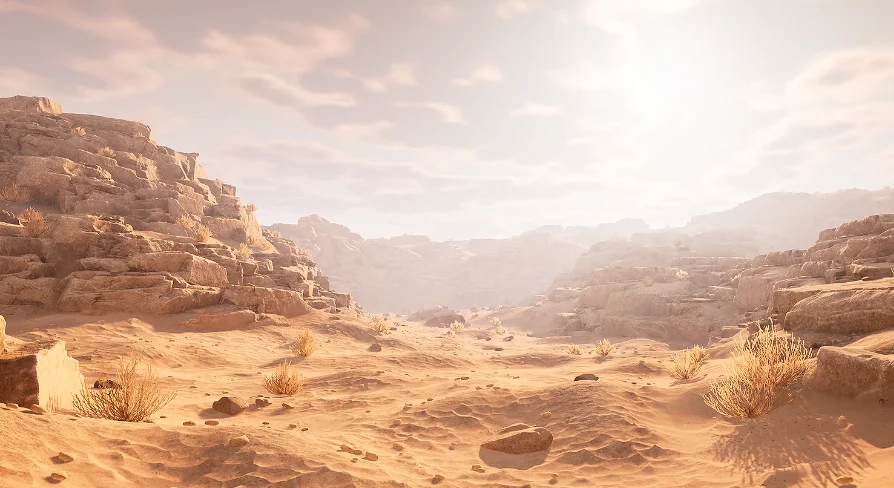
At the center of the pack is a terrain example map that covers 765×765 meters. That footprint gives level designers a real area to work with—enough space for a playable segment or a wide visual backdrop, rather than a tiny diorama that needs to be duplicated and blended into something larger. Because it ships as an example map, it replaces the blank starting ground with a landscape already shaped and populated, so time can go straight into layout and gameplay iteration.
The terrain also supports tessellation. Rather than treating the ground as a static flat plane, the scene can add geometric detail to the sand and rock surfaces where the camera comes closer. That becomes useful on a map of this size, where the viewer might wander across the 765×765m stretch and start noticing the transition between distant silhhouettes and near-ground texture.
Fifteen Unique Meshes with LODs, Collision, and Lightmap UVs
Filling that terrain is a focused set of natural assets. The environment contains 15 unique meshes, spanning the rocks and desert foliage that give the level its character. The vertex count per mesh runs from 178 to 16,000, and that range tells a useful story about the collection. Small stones come in at the low end, letting them be clustered and scattered across the ground without dragging the renderer down. Larger formations at the higher end hold enough geometry to stand as focal points or distant landmarks.
Each mesh has collision automatically generated, which is one of those quiet practical details that saves a level designer from hand-tagging every rock for gameplay or camera collision. LODs are also included across the set, so those same rocks can lose polygon weight as they recede toward the map boundary. The package also ships with a set of lightmap UVs. Since the terrain encourages placing rocks at many distances, from foreground close-ups to ridge-line silhouettes, having lightmap-ready meshes avoids a common cleanup phase that usually shows up right before lighting is built.
SSGI, Mesh Distance Fields, and a Fully Dynamic Atmosphere
The visual identity of Rocky Desert depends on a fully dynamic atmosphere rather than a fixed, static lighting setup. The content calls out two project settings to hit that next-gen look: Generate Mesh Distance Fields and SSGI. Enabling both changes how light and shadow behave across the environment. Mesh distance fields give the scene a more accurate representation of geometry for effects like ambient occlusion and contact shadows, while SSGI—screen-space global illumination—lets indirect light bounce more naturally between rock faces, sandy ground, and sparse foliage.
Those settings are the difference between a daytime desert that reads as a single flat golden tone and one that has depth across the terrain. The dynamic atmosphere supports that by keeping sky and lighting in a single responsive system, so a production team can tune the mood of the level without rebuilding static lighting for each change. This also makes the environment a strong starting point for lighting experiments in a realistic sand landscape.
Textures at 2048 Across a Fourteen-Material Set
Material and texture work in the environment is shaped by 14 materials and material instances, backed by 22 textures. Every texture is 2048 resolution. That resolution is a deliberate midpoint: far terrain and repeated rock clusters don't require larger files, while close-up sand, stone, and foliage still benefit from crisp surface detail without ballooning memory usage.
With only 14 materials and instances handling the terrain, rocks, and plant life, the pack keeps shader complexity manageable. The material instances allow quick edits—drying out the sand, shifting rock albedo, or pushing foliage color—without duplicating entire master materials or reimporting textures. For a realistic desert environment, this compact setup helps small teams push the scene through art direction faster.
Where a Rocky Desert Level Makes Sense in a Production
Because Rocky Desert ships as one cohesive environment rather than a general-purpose prop library, it fits projects that need a complete desert sequence right now. A 765×765m terrain is large enough to stage a short gameplay mission, a survival-style opening zone, or a vehicle run through rock-strewn ground. For teams prototyping a game mechanic like traversal, stamina, or shooting inside an arid arena, the included example map lets designers block and test in context immediately.
The production list stays lean in all the places that usually slow down an environment build: collision is already generated, LODs exist, lightmap UVs are ready, and the high-quality visual settings are identified. Developers working on Windows and Mac both sit within the supported platforms, and the environment itself targets the level of realism commonly expected from current and next-gen titles. For an environment artist who wants to light a realistic sandy scene, a designer who needs a full desert playspace fast, or a team assembling an entire arid chapter, Rocky Desert delivers a terrain and asset package that is already dressed and ready to iterate on.
 Desert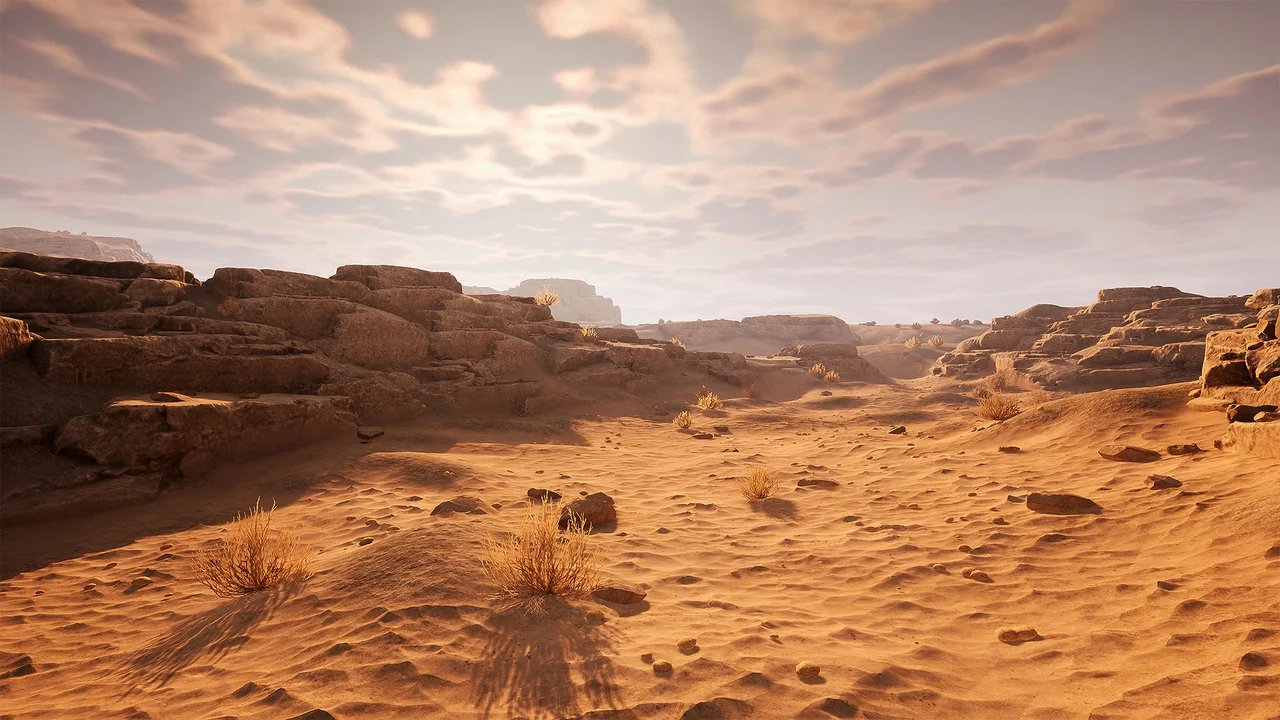
 Desert
 Desert
 Desert