"17301e80e307e80b"{"id":"1002156","slug":"procedural-recoil-system","title":"Procedural Recoil System","category":"Game Mechanics","engine":"4.26+,5.0+","assetVersion":"","engineVersion":"Engine Version: 4.26+,5.0+","tag":"Game Mechanics","accent":"blue","visual":"mech","summary":"An optimized actor component for Unreal Engine handling procedural weapon recoil, reset animations, and runtime adjustments for crouch and ADS.","platform":"Unreal Engine","publishedAt":"2026-10-29T10:00:10.900Z","updatedAt":"2026-10-29T10:00:10.900Z","sourceNotes":[],"fileContents":[],"compatibility":["Unreal Engine","Engine Version: 4.26+,5.0+"],"featuredImage":{"alt":"Procedural Recoil System","src":"/wp-content/uploads/published/2026/10/304ccb4555e2-cba068ae-9fa7-4db1-8c11-28dd5f0f7a2e-8e69f9cad8.webp"},"hasDownloadLink":true,"downloads":0,"terms":[{"taxonomy":"category","slug":"game-mechanics","name":"Game Mechanics"}],"galleryImages":[{"src":"/wp-content/uploads/published/2026/10/f4e457cd854c-f791bbf2-2ff8-4969-adf2-50d973eb83d1-01b51a746a.webp","alt":"Procedural Recoil System"},{"src":"/wp-content/uploads/published/2026/10/940c1ab02617-907a39dd-00ec-4662-bbf2-44b0673f7121-4356465940.webp","alt":"Procedural Recoil System"},{"src":"/wp-content/uploads/published/2026/10/d39ef55fa097-b5e0d400-d0aa-4de7-83c1-657251975f49-01a2af7078.webp","alt":"Procedural Recoil System"}],"accessPanel":{"kind":"resource","title":"Download this resource","eyebrow":"Free Download","message":"Log in or create a free account to start your download.","fileName":"Content.7z","safetyNote":"Resources are manually reviewed before listing to improve quality and reduce obvious risks.","actionLabel":"Download Free","resourceType":"Resource archive"},"contentHtml":"\u003ch2\u003eDynamic Firefight Feedback in Combat Scenes\u003c/h2\u003e\u003cp\u003eIntense combat encounters rely heavily on the visual and mechanical rhythm of weapon handling. Whether framing a claustrophobic hallway breach in a tactical first-person shooter or orchestrating wide-open outdoor firefights in a third-person survival game, the player's connection to their arsenal depends on how weapons respond to trigger pulls. Fixed, pre-rendered weapon kick animations can quickly feel repetitive and detached, particularly when fire rates change or when characters shift their stances mid-skirmish. Procedural Recoil System addresses this feedback loop by generating smooth, customizable recoil movements and responsive recoil reset animations on the fly. By shifting weapon kick from static assets into a procedural calculation, weapon discharge adapts dynamically to the pacing of the engagement without breaking immersion.\u003c/p\u003e\u003ch2\u003eAll-in-One Actor Component Architecture\u003c/h2\u003e\u003cp\u003eIntegrating complex gameplay mechanics into an existing character or inventory framework often introduces pipeline friction, requiring structural rewires or deep rewrites of existing code. Procedural Recoil System avoids this complexity by packaging its entire functionality into a single, self-contained actor component. Setup requires under a minute to attach to an existing actor hierarchy, allowing developers to bypass extensive migration pipelines.\u003c/p\u003e\u003cp\u003eUnder the hood, the blueprint logic is optimized specifically for performance and runtime simplicity. Rather than consuming processing overhead with tangled evaluation loops, the component executes lean mathematical transforms to calculate camera or weapon offsets. This lightweight architecture keeps computational cost minimal during rapid firing sequences, making it suitable for hardware-sensitive projects where dozens of distinct actors or frequent weapon swaps occur simultaneously. In addition, the component offers cross-system compatibility with systems such as Procedural Radial Wheel Menu 2.0, streamlining weapon-switching logic alongside radial UI selection.\u003c/p\u003e\u003ch2\u003eFine-Tuning Fire Mechanics Across 20 Runtime Variables\u003c/h2\u003e\u003cp\u003eWeapon individuality in shooter design is built upon nuance. A heavy battle rifle should feel distinctly different from an agile submachine gun, both in initial impulse and settling time. Procedural Recoil System provides a bank of 20 discrete variables designed to shape the trajectory, intensity, and recovery of every shot.\u003c/p\u003e\u003cp\u003eBecause every variable within the system can be altered at runtime with immediate effect, developers can preview adjustments without restarting play sessions or recompiling assets. This instant feedback loop allows designers to dial in mechanical feel rapidly:\u003c/p\u003e\u003cul\u003e\u003cli\u003eIndividual animation speeds can be calibrated separately for both the initial recoil impulse and the subsequent recoil reset phase.\u003c/li\u003e\u003cli\u003eMovement curves can be softened for steady marksman platforms or sharpened for abrupt, violent muzzle rise.\u003c/li\u003e\u003cli\u003eOffset profiles adjust naturally between distinct firing rates and ballistic profiles.\u003c/li\u003e\u003c/ul\u003e\u003cp\u003eThe runtime flexibility extends beyond editor-side tuning. Because these 20 variables accept real-time input during active gameplay, projects can tie recoil parameters to in-game modifiers such as weapon attachments, character fatigue, suppression effects, or progressive recoil degradation over sustained firing sessions.\u003c/p\u003e\u003ch2\u003eStance Scaling for Aim-Down-Sights and Crouch States\u003c/h2\u003e\u003cp\u003eTactical gunplay demands that player positioning directly influences weapon stability. Moving into a fortified posture or bracing for a distant shot should mechanically reward the player with tighter weapon control. Procedural Recoil System includes built-in custom scale values that modulate kick patterns based on Crouch and Aim-Down-Sights (ADS) states.\u003c/p\u003e\u003cp\u003eWhen a player transitions into ADS view, the component references dedicated scale values to compress the recoil travel, ensuring that optics and iron sights remain legible without blocking peripheral targets. Similarly, dropping into a crouched stance triggers separate scale adjustments that stabilize muzzle climb, simulating the natural bracing of a grounded firing posture. Because these values function as multipliers against the base procedural calculations, adjusting baseline weapon attributes automatically trickles down into crouched and aimed behaviors without requiring duplicate animation state machines.\u003c/p\u003e\u003ch2\u003eUniversal Fire-Mode Handling Across Weapon Archetypes\u003c/h2\u003e\u003cp\u003eWeapon rosters in modern action games span a vast variety of operational patterns. A procedural system that functions well for single rifle shots often falls apart when subjected to continuous automatic fire or cyclical bursts. Procedural Recoil System supports any weapon delivery type, seamlessly processing full-auto, semi-auto, and burst fire modes within the same component logic.\u003c/p\u003e\u003cp\u003eIn high-capacity full-automatic weapons, the reset animation logic smoothly blends across rapid-fire intervals, preventing the system from snapping back awkwardly between rounds. For burst weapons, the component handles the rapid succession of kicks followed by a defined settling interval, mirroring real-world mechanical cycling. Semi-automatic platforms benefit from sharp, predictable recovery rates that reward disciplined trigger discipline. The unified logic ensures that diverse armories can share a singular underlying component without needing specialized blueprint variations for distinct weapon classes.\u003c/p\u003e\u003ch2\u003eImplementation Context and Project Fit\u003c/h2\u003e\u003cp\u003eProcedural Recoil System fits cleanest into projects seeking modular, low-overhead firearm handling without committing to vast animation libraries. For solo developers and small gameplay teams, it cuts down the time spent manually keyframing weapon kickback or authoring bespoke blend spaces for each individual gun. Teams prototyping new combat mechanics benefit immediately from the sub-minute setup and Win64 demo validation, allowing rapid iteration on shooting mechanics during early vertical slice production.\u003c/p\u003e\u003cp\u003eThe system is particularly suited for titles prioritizing responsive tactical combat, modular weapon modification systems, or projects that need dynamic recoil scaling tied cleanly to player movement states. By isolating weapon behavior inside a single, high-performance actor component with full runtime mutability, it provides an efficient, maintainable foundation for procedural gunplay.\u003c/p\u003e\n\n\u003ch2\u003eExplore Similar Assets\u003c/h2\u003e\n\u003cul\u003e\n\u003cli\u003e\u003ca href=\"https://3dcghub.com/envirosense-immersive-hand-ik/\" title=\"EnviroSense: Immersive Hand IK\"\u003eEnviroSense: Immersive Hand IK\u003c/a\u003e\u003c/li\u003e\n\u003cli\u003e\u003ca href=\"https://3dcghub.com/procedural-fps-recoil-system/\" title=\"Procedural FPS Recoil System\"\u003eProcedural FPS Recoil System\u003c/a\u003e\u003c/li\u003e\n\u003cli\u003e\u003ca href=\"https://3dcghub.com/multiplayer-fps-procedural-animation-toolkit/\" title=\"Multiplayer FPS Procedural Animation Toolkit\"\u003eMultiplayer FPS Procedural Animation Toolkit\u003c/a\u003e\u003c/li\u003e\n\u003cli\u003e\u003ca href=\"https://3dcghub.com/uaim-advanced-lock-on-targeting-and-prediction-system/\" title=\"uAim - Advanced Lock-On Targeting and Prediction System\"\u003euAim - Advanced Lock-On Targeting and Prediction System\u003c/a\u003e\u003c/li\u003e\n\u003cli\u003e\u003ca href=\"https://3dcghub.com/engore-procedural-dismemberment/\" title=\"EnGore: Procedural Dismemberment\"\u003eEnGore: Procedural Dismemberment\u003c/a\u003e\u003c/li\u003e\n\u003c/ul\u003e","contentTextLength":6599,"navigation":{"current":107,"total":4188,"previous":{"id":"1002157","slug":"projectiles-pack","title":"Projectiles Pack","category":"Weapons \u0026 Combat","platform":"Unreal Engine","updatedAt":"2026-10-29T10:01:44.466Z"},"next":{"id":"1002155","slug":"pro-hud-pack-horror-skin","title":"Pro HUD Pack: Horror Skin","category":"UI Kits / HUDs","platform":"Unreal Engine","updatedAt":"2026-10-29T09:59:23.096Z"}},"relatedResources":[{"id":"10421","slug":"envirosense-immersive-hand-ik","title":"EnviroSense: Immersive Hand IK","category":"Game Mechanics","engine":"5.3+","assetVersion":"Engine version: 5.3+","engineVersion":"5.1","tag":"Game Mechanics","accent":"blue","visual":"city","summary":"Enhance character realism with EnviroSense: Immersive Hand IK, a modular system for procedural environment interaction and targeted hand placement.","platform":"Unreal Engine","publishedAt":"2026-03-03T15:19:02.000Z","updatedAt":"2026-04-19T15:50:02.000Z","sourceNotes":[],"fileContents":[],"compatibility":["Unreal Engine","Engine version: 5.3+"],"featuredImage":{"alt":"EnviroSense: Immersive Hand IK","src":"https://3dcghub.com/wp-content/uploads/2026/03/94d35ad9-8006-43cf-9acb-f401e4f32b0c.webp"},"hasDownloadLink":true,"downloads":1},{"id":"15301","slug":"procedural-fps-recoil-system","title":"Procedural FPS Recoil System","category":"Procedural Systems","engine":"2025.3.0","assetVersion":"Engine version: 5.6 - 5.7","engineVersion":"Asset Version:2025.3.0","tag":"Procedural Systems","accent":"blue","visual":"audio","summary":"Improve your game's combat with the Procedural FPS Recoil System. This tool offers smooth, customizable recoil animations for any weapon type while saving memory and development time.","platform":"Unreal Engine","publishedAt":"2026-03-12T08:33:53.000Z","updatedAt":"2026-07-05T06:16:23.079Z","sourceNotes":[],"fileContents":[],"compatibility":["Unreal Engine","Engine version: 5.6 - 5.7","Asset Version:2025.3.0"],"featuredImage":{"alt":"Procedural FPS Recoil System","src":"https://3dcghub.com/wp-content/uploads/2026/03/7bb95269-1ed4-43fe-aaa3-4282f29a6582.webp"},"hasDownloadLink":true,"downloads":3},{"id":"1002124","slug":"multiplayer-fps-procedural-animation-toolkit","title":"Multiplayer FPS Procedural Animation Toolkit","category":"Network \u0026 Multiplayer","engine":"5.0","assetVersion":"Asset Version: 1.0","engineVersion":"Engine Version: 5.0","tag":"Network","accent":"blue","visual":"animation","summary":"Examine the Multiplayer FPS Procedural Animation Toolkit, covering C++ procedural recoil, socket-based aiming, character component setup, and multiplayer replic","platform":"Unreal Engine","publishedAt":"2026-10-29T09:04:51.154Z","updatedAt":"2026-10-29T09:04:51.154Z","sourceNotes":[],"fileContents":[],"compatibility":["Unreal Engine","Asset Version: 1.0","Engine Version: 5.0"],"featuredImage":{"alt":"Multiplayer FPS Procedural Animation Toolkit","src":"/wp-content/uploads/published/2026/10/2fcdafd7f87f-817ca7b9-9cb8-4982-9a44-338089bb88d1-a98b77170d.webp"},"hasDownloadLink":true,"downloads":0}]}
Game Mechanics
Procedural Recoil System
An optimized actor component for Unreal Engine handling procedural weapon recoil, reset animations, and runtime adjustments for crouch and ADS.
Category:Unreal Engine,Game MechanicsPlatform: Unreal EngineEngine Version: 4.26+,5.0+Published: Oct 29, 2026
Game Mechanics
Resource overview
Dynamic Firefight Feedback in Combat Scenes
Intense combat encounters rely heavily on the visual and mechanical rhythm of weapon handling. Whether framing a claustrophobic hallway breach in a tactical first-person shooter or orchestrating wide-open outdoor firefights in a third-person survival game, the player's connection to their arsenal depends on how weapons respond to trigger pulls. Fixed, pre-rendered weapon kick animations can quickly feel repetitive and detached, particularly when fire rates change or when characters shift their stances mid-skirmish. Procedural Recoil System addresses this feedback loop by generating smooth, customizable recoil movements and responsive recoil reset animations on the fly. By shifting weapon kick from static assets into a procedural calculation, weapon discharge adapts dynamically to the pacing of the engagement without breaking immersion.
All-in-One Actor Component Architecture
Integrating complex gameplay mechanics into an existing character or inventory framework often introduces pipeline friction, requiring structural rewires or deep rewrites of existing code. Procedural Recoil System avoids this complexity by packaging its entire functionality into a single, self-contained actor component. Setup requires under a minute to attach to an existing actor hierarchy, allowing developers to bypass extensive migration pipelines.
Under the hood, the blueprint logic is optimized specifically for performance and runtime simplicity. Rather than consuming processing overhead with tangled evaluation loops, the component executes lean mathematical transforms to calculate camera or weapon offsets. This lightweight architecture keeps computational cost minimal during rapid firing sequences, making it suitable for hardware-sensitive projects where dozens of distinct actors or frequent weapon swaps occur simultaneously. In addition, the component offers cross-system compatibility with systems such as Procedural Radial Wheel Menu 2.0, streamlining weapon-switching logic alongside radial UI selection.
Fine-Tuning Fire Mechanics Across 20 Runtime Variables
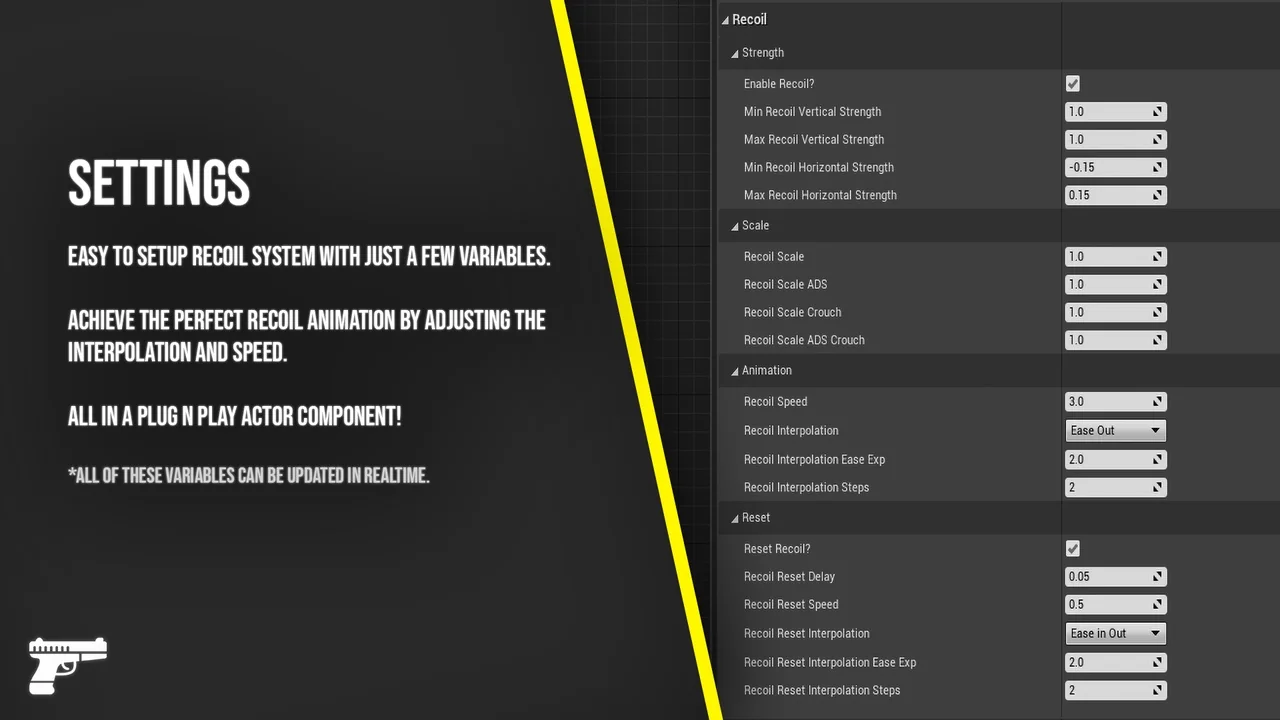
Weapon individuality in shooter design is built upon nuance. A heavy battle rifle should feel distinctly different from an agile submachine gun, both in initial impulse and settling time. Procedural Recoil System provides a bank of 20 discrete variables designed to shape the trajectory, intensity, and recovery of every shot.
Because every variable within the system can be altered at runtime with immediate effect, developers can preview adjustments without restarting play sessions or recompiling assets. This instant feedback loop allows designers to dial in mechanical feel rapidly:
Individual animation speeds can be calibrated separately for both the initial recoil impulse and the subsequent recoil reset phase.
Movement curves can be softened for steady marksman platforms or sharpened for abrupt, violent muzzle rise.
Offset profiles adjust naturally between distinct firing rates and ballistic profiles.
The runtime flexibility extends beyond editor-side tuning. Because these 20 variables accept real-time input during active gameplay, projects can tie recoil parameters to in-game modifiers such as weapon attachments, character fatigue, suppression effects, or progressive recoil degradation over sustained firing sessions.
Stance Scaling for Aim-Down-Sights and Crouch States
Tactical gunplay demands that player positioning directly influences weapon stability. Moving into a fortified posture or bracing for a distant shot should mechanically reward the player with tighter weapon control. Procedural Recoil System includes built-in custom scale values that modulate kick patterns based on Crouch and Aim-Down-Sights (ADS) states.
When a player transitions into ADS view, the component references dedicated scale values to compress the recoil travel, ensuring that optics and iron sights remain legible without blocking peripheral targets. Similarly, dropping into a crouched stance triggers separate scale adjustments that stabilize muzzle climb, simulating the natural bracing of a grounded firing posture. Because these values function as multipliers against the base procedural calculations, adjusting baseline weapon attributes automatically trickles down into crouched and aimed behaviors without requiring duplicate animation state machines.
Universal Fire-Mode Handling Across Weapon Archetypes
Weapon rosters in modern action games span a vast variety of operational patterns. A procedural system that functions well for single rifle shots often falls apart when subjected to continuous automatic fire or cyclical bursts. Procedural Recoil System supports any weapon delivery type, seamlessly processing full-auto, semi-auto, and burst fire modes within the same component logic.
In high-capacity full-automatic weapons, the reset animation logic smoothly blends across rapid-fire intervals, preventing the system from snapping back awkwardly between rounds. For burst weapons, the component handles the rapid succession of kicks followed by a defined settling interval, mirroring real-world mechanical cycling. Semi-automatic platforms benefit from sharp, predictable recovery rates that reward disciplined trigger discipline. The unified logic ensures that diverse armories can share a singular underlying component without needing specialized blueprint variations for distinct weapon classes.
Implementation Context and Project Fit
Procedural Recoil System fits cleanest into projects seeking modular, low-overhead firearm handling without committing to vast animation libraries. For solo developers and small gameplay teams, it cuts down the time spent manually keyframing weapon kickback or authoring bespoke blend spaces for each individual gun. Teams prototyping new combat mechanics benefit immediately from the sub-minute setup and Win64 demo validation, allowing rapid iteration on shooting mechanics during early vertical slice production.
The system is particularly suited for titles prioritizing responsive tactical combat, modular weapon modification systems, or projects that need dynamic recoil scaling tied cleanly to player movement states. By isolating weapon behavior inside a single, high-performance actor component with full runtime mutability, it provides an efficient, maintainable foundation for procedural gunplay.
 Game Mechanics
 Game Mechanics
 Procedural Systems
 Network