"efaa631e936fd3ee"{"id":"1002157","slug":"projectiles-pack","title":"Projectiles Pack","category":"Weapons \u0026 Combat","engine":"5.1+","assetVersion":"","engineVersion":"Engine Version: 5.1+","tag":"Weapons \u0026 Combat","accent":"blue","visual":"mech","summary":"Explore the mechanics, Blueprint interfaces, VFX, and 20 distinct weapons inside Projectiles Pack, from orbital kinetic strikes to homing missiles.","platform":"Unreal Engine","publishedAt":"2026-10-29T10:01:44.466Z","updatedAt":"2026-10-29T10:01:44.466Z","sourceNotes":[],"fileContents":[],"compatibility":["Unreal Engine","Engine Version: 5.1+"],"featuredImage":{"alt":"Projectiles Pack","src":"/wp-content/uploads/published/2026/10/0aaebcac8a5f-72f81404-b1f5-4f25-858a-2bd6d80e665c-1f03b953f3.webp"},"hasDownloadLink":true,"downloads":0,"terms":[{"taxonomy":"category","slug":"weapons-and-combat","name":"Weapons \u0026 Combat"}],"galleryImages":[{"src":"/wp-content/uploads/published/2026/10/60e16c82a079-3f1277df-2e91-46fa-8e18-d9bcc7ec8d2a-7f8dbb9beb.webp","alt":"Projectiles Pack"},{"src":"/wp-content/uploads/published/2026/10/8bb72affea0e-af4a849f-7ff8-4949-ba39-1be0b5b4d152-7affe230ea.webp","alt":"Projectiles Pack"},{"src":"/wp-content/uploads/published/2026/10/6bb500bf9f6d-a21820b5-6613-4ad0-bf48-680bbc167776-bd466fffcc.webp","alt":"Projectiles Pack"},{"src":"/wp-content/uploads/published/2026/10/eb7f699a7109-e768e61e-e37c-4560-a947-28ba72489127-7bc1648fe1.webp","alt":"Projectiles Pack"},{"src":"/wp-content/uploads/published/2026/10/0e8676ffb33e-81db11d1-1f84-4845-8365-edfe291e7318-0f33e9e86e.webp","alt":"Projectiles Pack"}],"accessPanel":{"kind":"resource","title":"Download this resource","eyebrow":"Free Download","message":"Log in or create a free account to start your download.","fileName":"Projectiles Pack.7z","safetyNote":"Resources are manually reviewed before listing to improve quality and reduce obvious risks.","actionLabel":"Download Free","resourceType":"Resource archive"},"contentHtml":"\u003cp\u003eA high-velocity projectile piercing armor, an orbital laser scorching the terrain from above, or a localized black hole dragging surrounding actors into a singular vortex instantly alters combat dynamics. Projectiles Pack supplies a diverse arsenal of twenty distinct projectile behaviors, pairing custom logic with supporting visual and acoustic assets to handle immediate destruction, tactical displacement, and heavy area denial.\u003c/p\u003e \u003ch2\u003eThe Arsenal: 20 Distinct Projectiles and Munition Types\u003c/h2\u003e\n\u003cp\u003eCombat systems frequently require more than standard raycasts and simple ballistic arcs. This collection establishes twenty discrete projectile archetypes, dividing into guided ordnance, conventional small arms, tactical throwables, and heavy experimental artillery.\u003c/p\u003e \u003cp\u003eGuided and self-propelled armaments form a substantial branch of the toolkit:\u003c/p\u003e\n\u003cul\u003e \u003cli\u003e\u003cstrong\u003eHoming missile:\u003c/strong\u003e Actively seeks out designated actor targets, adjusting its trajectory in mid-flight to intercept evasive targets.\u003c/li\u003e \u003cli\u003e\u003cstrong\u003eMulti-missile:\u003c/strong\u003e Discharges a spread of simultaneous warheads that deploy together to saturate target zones.\u003c/li\u003e \u003cli\u003e\u003cstrong\u003eMicrodestructors missile:\u003c/strong\u003e A specialized compact missile type configured for concentrated explosive strikes.\u003c/li\u003e \u003cli\u003e\u003cstrong\u003eInterceptor missile:\u003c/strong\u003e Geared toward counter-measure roles, actively meeting incoming threats mid-trajectory.\u003c/li\u003e\n\u003c/ul\u003e \u003cp\u003eThrown and deployable munitions cover ground-level tactical encounters:\u003c/p\u003e\n\u003cul\u003e \u003cli\u003e\u003cstrong\u003eExplosive grenade:\u003c/strong\u003e Relies on timed or impact fuses, launching standard fragmentation force across a radius.\u003c/li\u003e \u003cli\u003e\u003cstrong\u003eSmoke grenade:\u003c/strong\u003e Produces heavy visual obstruction across its detonation zone to mask player movement.\u003c/li\u003e \u003cli\u003e\u003cstrong\u003eToxic grenade:\u003c/strong\u003e Emits a lingering hazardous cloud intended for lingering area denial and damage over time.\u003c/li\u003e \u003cli\u003e\u003cstrong\u003eTime bomb:\u003c/strong\u003e Employs delayed fuse mechanics, functioning as a stationary hazard until detonation.\u003c/li\u003e\n\u003c/ul\u003e \u003cp\u003eDirect fire ballistics cover traditional weapon profiles alongside advanced directed-energy behaviors:\u003c/p\u003e\n\u003cul\u003e \u003cli\u003e\u003cstrong\u003eBullet:\u003c/strong\u003e Fast-traveling kinetic slug suited for direct weapon fire and standard firearms.\u003c/li\u003e \u003cli\u003e\u003cstrong\u003eRailgun projectile:\u003c/strong\u003e Hyper-velocity penetrator delivering instantaneous, focused ballistic force along a narrow vector.\u003c/li\u003e \u003cli\u003e\u003cstrong\u003ePlasma ball:\u003c/strong\u003e Slower-moving, volumetric orb of intense energy that registers on collision.\u003c/li\u003e \u003cli\u003e\u003cstrong\u003eFlamethrower:\u003c/strong\u003e Emits a steady stream of short-range fire particles to wash targets in continuous heat.\u003c/li\u003e \u003cli\u003e\u003cstrong\u003eBlade swarm:\u003c/strong\u003e Launches an erratic cluster of spinning edged projectiles cutting through open corridors.\u003c/li\u003e \u003cli\u003e\u003cstrong\u003ePrizmatic arrow:\u003c/strong\u003e Aerodynamic piercing shaft utilizing radiant energy trails.\u003c/li\u003e\n\u003c/ul\u003e \u003cp\u003eHeavy tactical operations and sci-fi utility round out the package:\u003c/p\u003e\n\u003cul\u003e \u003cli\u003e\u003cstrong\u003eOrbital laser beam:\u003c/strong\u003e Calls down a sustained vertical column of directed energy from the skybox onto ground coordinates.\u003c/li\u003e \u003cli\u003e\u003cstrong\u003eOrbital kinetic strike:\u003c/strong\u003e Delivers an ultra-dense projectile from low orbit, driving massive physical impact into surface targets.\u003c/li\u003e \u003cli\u003e\u003cstrong\u003eBombardment:\u003c/strong\u003e Calls in an artillery-style saturation barrage landing explosive payloads across wide operational sectors.\u003c/li\u003e \u003cli\u003e\u003cstrong\u003eBlack hole generator:\u003c/strong\u003e Deploys an intense gravitational singularity, actively dragging nearby actors and physical bodies into its core before collapsing.\u003c/li\u003e \u003cli\u003e\u003cstrong\u003eTeleport:\u003c/strong\u003e Displaces the firing pawn or designated target instantly to the impact point of the projectile.\u003c/li\u003e \u003cli\u003e\u003cstrong\u003eECM Strike:\u003c/strong\u003e Releases an electronic countermeasure blast, interfering with electronic signals and sensor functions across the area.\u003c/li\u003e\n\u003c/ul\u003e \u003ch2\u003eBlueprint Interfaces and Payload Customization\u003c/h2\u003e\n\u003cp\u003eSwapping combat behaviors without rewriting core classes relies on modular software design. The package handles this by operating through Blueprint interfaces, separating the physical flight characteristics of a projectile from the damage payload it triggers upon arrival.\u003c/p\u003e \u003cp\u003eDevelopers can alter existing payloads or attach unfamiliar effects to different delivery mechanisms. A conventional bullet mesh can inherit the detonation radius of an explosive grenade, instantly producing an explosive bullet without needing a unique physics asset. When building new projectiles from scratch, implementing the provided Blueprint interfaces ensures the custom actors plug into existing inventory, launching, and hit-detection routines without breaking compatibility.\u003c/p\u003e \u003cp\u003eWith 84 individual Blueprints included, the architecture isolates weapon functions cleanly. Spawning, velocity updates, target tracking calculations, fuse timers, and impact resolutions are encapsulated into reusable nodes and sub-graphs.\u003c/p\u003e \u003ch2\u003eTesting Rigs: First Person Character and Flying Pawn\u003c/h2\u003e\n\u003cp\u003eEvaluating projectile drop, homing responsiveness, and explosion radii requires functional player perspectives. The asset includes two dedicated testing pawns pre-wired with firing inputs and targeting systems.\u003c/p\u003e \u003cp\u003eThe modified first-person character blueprint allows on-foot verification of projectile speeds, throw arcs, and direct-fire weapons. Ground collision tests, grenade bounces, and line-of-sight checks run directly through this character rig. For testing aerial delivery systems, guided interceptors, and high-altitude ordnance like the orbital kinetic strike or bombardment, the included flying pawn provides complete three-dimensional spatial control. Navigating aerial vistas exposes how missile tracking algorithms handle pitch, yaw, and rapid changes in target elevation.\u003c/p\u003e \u003ch2\u003eMesh, Audio, and Visual Effects Asset Breakdown\u003c/h2\u003e\n\u003cp\u003eEvery piece of ordnance requires visible physical geometry, particle emissions, and acoustic feedback to feel reactive in a 3D environment. Projectiles Pack includes an integrated library of technical assets to support its 84 Blueprints:\u003c/p\u003e \u003cul\u003e \u003cli\u003e\u003cstrong\u003e29 Static and Skeletal Meshes:\u003c/strong\u003e Dedicated 3D models representing an array of physical rockets, bullet casings, kinetic slugs, bombs, and grenades.\u003c/li\u003e \u003cli\u003e\u003cstrong\u003e27 Materials and 82 Textures:\u003c/strong\u003e Specialized shader networks and texture maps handling metallic casing finishes, emissive energy cores, glass housings, and scorch masks.\u003c/li\u003e \u003cli\u003e\u003cstrong\u003e25 Visual Effects:\u003c/strong\u003e Particle systems that communicate missile thruster burns, smoke grenade plumes, plasma wakes, swirling blade clusters, and catastrophic explosive blasts.\u003c/li\u003e \u003cli\u003e\u003cstrong\u003eAudio Tracks and Cues:\u003c/strong\u003e 11 audio tracks and 9 sound cues that supply distinct launching thumps, thruster loops, ticking time fuses, and impact detonations.\u003c/li\u003e\n\u003c/ul\u003e \u003ch2\u003eNetwork Replication Scope\u003c/h2\u003e\n\u003cp\u003eTechnical integration depends on knowing where an asset's networking responsibilities begin and end. Projectiles Pack is not network replicated out of the box. All velocity updates, trajectory traces, interface communications, and effect triggers execute strictly on the local client.\u003c/p\u003e \u003cp\u003eFor single-player titles, standalone action games, offline physics simulations, or technical prototypes, this local execution requires zero server setup. Teams implementing these weapons into multiplayer environments must wrap the firing events, actor spawning, and hit registration inside their own server RPCs and replicated actor architecture. Knowing this upfront ensures engineering time is allocated appropriately when moving from solo sandbox testing into multi-client gameplay.\u003c/p\u003e\n\n\u003ch2\u003eMore From The Same Workflow\u003c/h2\u003e\n\u003cul\u003e\n\u003cli\u003e\u003ca href=\"https://3dcghub.com/knives-vol-1-hunting-4k-textured-fps-tactical-knives/\" title=\"Knives VOL.1 - Hunting (4K Textured FPS Tactical Knives)\"\u003eKnives VOL.1 - Hunting (4K Textured FPS Tactical Knives)\u003c/a\u003e\u003c/li\u003e\n\u003cli\u003e\u003ca href=\"https://3dcghub.com/primitive-tools/\" title=\"Primitive tools\"\u003ePrimitive tools\u003c/a\u003e\u003c/li\u003e\n\u003cli\u003e\u003ca href=\"https://3dcghub.com/african-weapon-pack/\" title=\"African Weapon Pack\"\u003eAfrican Weapon Pack\u003c/a\u003e\u003c/li\u003e\n\u003cli\u003e\u003ca href=\"https://3dcghub.com/safe-house-vol-1-supplies-and-guns-nanite-and-low-poly/\" title=\"Safe House VOL.1 - Supplies and Guns (Nanite and Low Poly)\"\u003eSafe House VOL.1 - Supplies and Guns (Nanite and Low Poly)\u003c/a\u003e\u003c/li\u003e\n\u003cli\u003e\u003ca href=\"https://3dcghub.com/world-war-ii-vol-1/\" title=\"World War II - VOL.1\"\u003eWorld War II - VOL.1\u003c/a\u003e\u003c/li\u003e\n\u003c/ul\u003e","contentTextLength":7085,"navigation":{"current":127,"total":4209,"previous":{"id":"1002158","slug":"protector","title":"Protector","category":"Combat","platform":"Unreal Engine","updatedAt":"2026-10-29T10:02:33.368Z"},"next":{"id":"1002156","slug":"procedural-recoil-system","title":"Procedural Recoil System","category":"Game Mechanics","platform":"Unreal Engine","updatedAt":"2026-10-29T10:00:10.900Z"}},"relatedResources":[{"id":"1001529","slug":"knives-vol-1-hunting-4k-textured-fps-tactical-knives","title":"Knives VOL.1 - Hunting (4K Textured FPS Tactical Knives)","category":"Weapons \u0026 Combat","engine":"5.1+","assetVersion":"","engineVersion":"Engine Version: 5.1+","tag":"Weapons \u0026 Combat","accent":"blue","visual":"luts","summary":"Examine the 5 tactical hunting knife meshes built for Unreal Engine, featuring 4K textures, master material controls, and Lumen dynamic lighting support.","platform":"Unreal Engine","publishedAt":"2026-10-09T17:23:34.369Z","updatedAt":"2026-10-09T17:23:34.369Z","sourceNotes":[],"fileContents":[],"compatibility":["Unreal Engine","Engine Version: 5.1+"],"featuredImage":{"alt":"Knives VOL.1 - Hunting (4K Textured FPS Tactical Knives)","src":"/wp-content/uploads/published/2026/10/ee79b6275911-8d47c8c4-6789-4beb-bf5d-9c91185b53bf-38f373981b.webp"},"hasDownloadLink":true,"downloads":1},{"id":"1002154","slug":"primitive-tools","title":"Primitive tools","category":"Weapons \u0026 Combat","engine":"5.0+","assetVersion":"","engineVersion":"Engine Version: 5.0+","tag":"Weapons \u0026 Combat","accent":"blue","visual":"mech","summary":"Implement 15 primitive tools and weapons featuring an animated skeletal bow, PBR material workflows, and optimized mesh budgets.","platform":"Unreal Engine","publishedAt":"2026-10-29T09:58:01.822Z","updatedAt":"2026-10-29T09:58:01.822Z","sourceNotes":[],"fileContents":[],"compatibility":["Unreal Engine","Engine Version: 5.0+"],"featuredImage":{"alt":"Primitive tools","src":"/wp-content/uploads/published/2026/10/69650ba0b74d-b5b9144c-9bea-44db-a0e8-76a9fea4ec5a-ef9ae32335.webp"},"hasDownloadLink":true,"downloads":0},{"id":"1001943","slug":"african-weapon-pack","title":"African Weapon Pack","category":"Weapons \u0026 Combat","engine":"5.0+","assetVersion":"","engineVersion":"Engine Version: 5.0+","tag":"Weapons \u0026 Combat","accent":"blue","visual":"mech","summary":"Explore the African Weapon Pack, featuring 11 historical weapons, two traditional shields, and scalable 1k to 4k PBR textures for character loadouts.","platform":"Unreal Engine","publishedAt":"2026-10-24T11:18:02.991Z","updatedAt":"2026-10-24T11:18:02.991Z","sourceNotes":[],"fileContents":[],"compatibility":["Unreal Engine","Engine Version: 5.0+"],"featuredImage":{"alt":"African Weapon Pack","src":"/wp-content/uploads/published/2026/10/af111046853e-2f8a499f-057e-4b31-a00a-13e4cf28f4dd-9fb6bf5dcd.webp"},"hasDownloadLink":true,"downloads":0}]}
Weapons & Combat
Projectiles Pack
Explore the mechanics, Blueprint interfaces, VFX, and 20 distinct weapons inside Projectiles Pack, from orbital kinetic strikes to homing missiles.
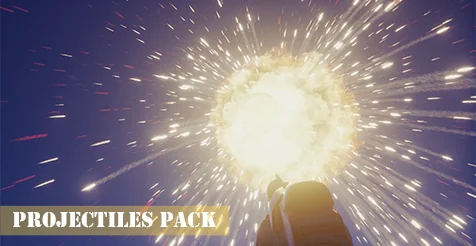
A high-velocity projectile piercing armor, an orbital laser scorching the terrain from above, or a localized black hole dragging surrounding actors into a singular vortex instantly alters combat dynamics. Projectiles Pack supplies a diverse arsenal of twenty distinct projectile behaviors, pairing custom logic with supporting visual and acoustic assets to handle immediate destruction, tactical displacement, and heavy area denial.
The Arsenal: 20 Distinct Projectiles and Munition Types
Combat systems frequently require more than standard raycasts and simple ballistic arcs. This collection establishes twenty discrete projectile archetypes, dividing into guided ordnance, conventional small arms, tactical throwables, and heavy experimental artillery.
Guided and self-propelled armaments form a substantial branch of the toolkit:
Homing missile: Actively seeks out designated actor targets, adjusting its trajectory in mid-flight to intercept evasive targets.
Multi-missile: Discharges a spread of simultaneous warheads that deploy together to saturate target zones.
Microdestructors missile: A specialized compact missile type configured for concentrated explosive strikes.
Thrown and deployable munitions cover ground-level tactical encounters:
Explosive grenade: Relies on timed or impact fuses, launching standard fragmentation force across a radius.
Smoke grenade: Produces heavy visual obstruction across its detonation zone to mask player movement.
Toxic grenade: Emits a lingering hazardous cloud intended for lingering area denial and damage over time.
Time bomb: Employs delayed fuse mechanics, functioning as a stationary hazard until detonation.
Direct fire ballistics cover traditional weapon profiles alongside advanced directed-energy behaviors:
Bullet: Fast-traveling kinetic slug suited for direct weapon fire and standard firearms.
Railgun projectile: Hyper-velocity penetrator delivering instantaneous, focused ballistic force along a narrow vector.
Plasma ball: Slower-moving, volumetric orb of intense energy that registers on collision.
Flamethrower: Emits a steady stream of short-range fire particles to wash targets in continuous heat.
Blade swarm: Launches an erratic cluster of spinning edged projectiles cutting through open corridors.
Prizmatic arrow: Aerodynamic piercing shaft utilizing radiant energy trails.
Heavy tactical operations and sci-fi utility round out the package:
Orbital laser beam: Calls down a sustained vertical column of directed energy from the skybox onto ground coordinates.
Orbital kinetic strike: Delivers an ultra-dense projectile from low orbit, driving massive physical impact into surface targets.
Bombardment: Calls in an artillery-style saturation barrage landing explosive payloads across wide operational sectors.
Black hole generator: Deploys an intense gravitational singularity, actively dragging nearby actors and physical bodies into its core before collapsing.
Teleport: Displaces the firing pawn or designated target instantly to the impact point of the projectile.
ECM Strike: Releases an electronic countermeasure blast, interfering with electronic signals and sensor functions across the area.
Blueprint Interfaces and Payload Customization
Swapping combat behaviors without rewriting core classes relies on modular software design. The package handles this by operating through Blueprint interfaces, separating the physical flight characteristics of a projectile from the damage payload it triggers upon arrival.
Developers can alter existing payloads or attach unfamiliar effects to different delivery mechanisms. A conventional bullet mesh can inherit the detonation radius of an explosive grenade, instantly producing an explosive bullet without needing a unique physics asset. When building new projectiles from scratch, implementing the provided Blueprint interfaces ensures the custom actors plug into existing inventory, launching, and hit-detection routines without breaking compatibility.
With 84 individual Blueprints included, the architecture isolates weapon functions cleanly. Spawning, velocity updates, target tracking calculations, fuse timers, and impact resolutions are encapsulated into reusable nodes and sub-graphs.
Testing Rigs: First Person Character and Flying Pawn
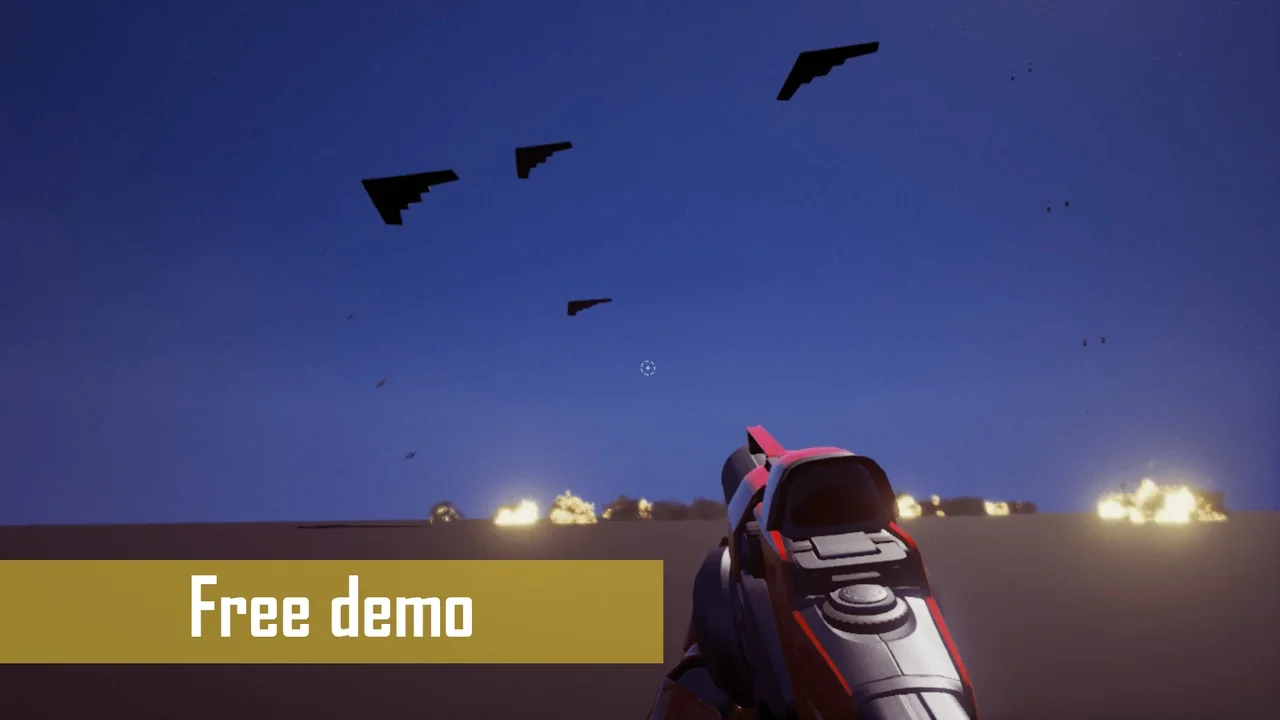
Evaluating projectile drop, homing responsiveness, and explosion radii requires functional player perspectives. The asset includes two dedicated testing pawns pre-wired with firing inputs and targeting systems.
The modified first-person character blueprint allows on-foot verification of projectile speeds, throw arcs, and direct-fire weapons. Ground collision tests, grenade bounces, and line-of-sight checks run directly through this character rig. For testing aerial delivery systems, guided interceptors, and high-altitude ordnance like the orbital kinetic strike or bombardment, the included flying pawn provides complete three-dimensional spatial control. Navigating aerial vistas exposes how missile tracking algorithms handle pitch, yaw, and rapid changes in target elevation.
Mesh, Audio, and Visual Effects Asset Breakdown
Every piece of ordnance requires visible physical geometry, particle emissions, and acoustic feedback to feel reactive in a 3D environment. Projectiles Pack includes an integrated library of technical assets to support its 84 Blueprints:
29 Static and Skeletal Meshes: Dedicated 3D models representing an array of physical rockets, bullet casings, kinetic slugs, bombs, and grenades.
27 Materials and 82 Textures: Specialized shader networks and texture maps handling metallic casing finishes, emissive energy cores, glass housings, and scorch masks.
25 Visual Effects: Particle systems that communicate missile thruster burns, smoke grenade plumes, plasma wakes, swirling blade clusters, and catastrophic explosive blasts.
Audio Tracks and Cues: 11 audio tracks and 9 sound cues that supply distinct launching thumps, thruster loops, ticking time fuses, and impact detonations.
Network Replication Scope
Technical integration depends on knowing where an asset's networking responsibilities begin and end. Projectiles Pack is not network replicated out of the box. All velocity updates, trajectory traces, interface communications, and effect triggers execute strictly on the local client.
For single-player titles, standalone action games, offline physics simulations, or technical prototypes, this local execution requires zero server setup. Teams implementing these weapons into multiplayer environments must wrap the firing events, actor spawning, and hit registration inside their own server RPCs and replicated actor architecture. Knowing this upfront ensures engineering time is allocated appropriately when moving from solo sandbox testing into multi-client gameplay.
 Weapons & Combat
 Weapons & Combat
 Weapons & Combat
 Weapons & Combat