"bf0aee18c0cf03b0"{"id":"1002154","slug":"primitive-tools","title":"Primitive tools","category":"Weapons \u0026 Combat","engine":"5.0+","assetVersion":"","engineVersion":"Engine Version: 5.0+","tag":"Weapons \u0026 Combat","accent":"blue","visual":"mech","summary":"Implement 15 primitive tools and weapons featuring an animated skeletal bow, PBR material workflows, and optimized mesh budgets.","platform":"Unreal Engine","publishedAt":"2026-10-29T09:58:01.822Z","updatedAt":"2026-10-29T09:58:01.822Z","sourceNotes":[],"fileContents":[],"compatibility":["Unreal Engine","Engine Version: 5.0+"],"featuredImage":{"alt":"Primitive tools","src":"/wp-content/uploads/published/2026/10/69650ba0b74d-b5b9144c-9bea-44db-a0e8-76a9fea4ec5a-ef9ae32335.webp"},"hasDownloadLink":true,"downloads":0,"terms":[{"taxonomy":"category","slug":"weapons-and-combat","name":"Weapons \u0026 Combat"}],"galleryImages":[{"src":"/wp-content/uploads/published/2026/10/f27c514a42f7-8b4a5246-5670-4aad-9bdf-d5843b087232-6e4c852470.webp","alt":"Primitive tools"},{"src":"/wp-content/uploads/published/2026/10/5cd81230506b-fd6d4513-75be-4fdf-a335-0989bdd76990-2bcb1c3774.webp","alt":"Primitive tools"},{"src":"/wp-content/uploads/published/2026/10/796d661528a8-c040bd82-9d4d-4a34-81ee-327d4fea74dd-72cbea4484.webp","alt":"Primitive tools"},{"src":"/wp-content/uploads/published/2026/10/6417f2fca573-a04acf7f-8eb6-4c59-aae7-dc700c8d0183-2167d4b963.webp","alt":"Primitive tools"}],"accessPanel":{"kind":"resource","title":"Download this resource","eyebrow":"Free Download","message":"Log in or create a free account to start your download.","fileName":"Content.7z","safetyNote":"Resources are manually reviewed before listing to improve quality and reduce obvious risks.","actionLabel":"Download Free","resourceType":"Resource archive"},"contentHtml":"\u003ch2\u003eSkeletal Grid and Rigging Setup for the Bow\u003c/h2\u003e\u003cp\u003eIntegrating ranged archery mechanics requires dynamic geometry rather than a rigid prop mesh. Within this set of fifteen primitive tools and weapons, the bow is constructed with a dedicated skeleton grid and includes two distinct animations. Having an internal skeletal grid allows the upper and lower limbs of the weapon, along with the bowstring, to bend naturally during tension and release cycles without creating irregular mesh pinching.\u003c/p\u003e\u003cp\u003eThe bow mesh is authored at 3,856 triangles and 1,923 vertices. This geometry allocation concentrates edge loops along the primary flex points where string tension and stave deflection occur. Pairing directly with the bow is the arrow mesh, which is optimized at 345 triangles and 199 vertices. Because projectile systems frequently spawn multiple instances in flight or leave arrows embedded within target colliders, keeping the arrow under 350 triangles ensures that memory overhead remains stable during intense archery exchanges.\u003c/p\u003e\u003ch2\u003eGeometry Budgets for Handheld Bladed and Impact Gear\u003c/h2\u003e\u003cp\u003eClose-quarters combat systems rely on clear weapon silhouettes and tight vertex distributions to maintain smooth frame rates during character socket attachment. The collection provides several distinct options across impact, cutting, and hacking categories, each structured with dedicated geometric profiles.\u003c/p\u003e\u003cp\u003eFor heavy chopping workflows, the axe uses 2,662 triangles across 1,335 vertices. This budget supplies enough contouring to articulate the bound head, stone or metal cutting edge, and organic variations along the wooden haft. In contrast, the blunt impact bat is balanced at a much lighter footprint of 632 triangles and 318 vertices, distributing its geometry evenly around the cylindrical striking zone without excess polygons.\u003c/p\u003e\u003cp\u003eTwo separate variations exist for the knife category, accommodating off-hand utility or swift melee strikes. The primary knife variation runs at 290 triangles and 147 vertices, while an alternate knife model measures 348 triangles across 176 vertices. Both knife assets keep their vertex footprints light enough to serve as baseline crafting items or secondary weapon sockets without burdening memory. The collection also includes a crusher model, which rounds out the high-impact blunt weapon selection alongside the bat and axe.\u003c/p\u003e\u003ch2\u003eThrusting Implements: Three Spear Profiles and Extended Tools\u003c/h2\u003e\u003cp\u003eReach weapons demand varied profiles depending on whether they serve as throwable javelins, basic survival spikes, or reinforced hunting lances. The set addresses this variety by delivering three distinct spear variants, each built with its own targeted polygon density.\u003c/p\u003e\u003cp\u003eSpears 1 is authored at 502 triangles and 253 vertices, providing defined wrapping and point geometry suitable for mid-range weapon display. Spears 2 serves as the most minimalist polearm in the group, operating at 224 triangles and 114 vertices. This reduced footprint makes it an ideal candidate for mass-produced projectile spears or lightweight throwing munitions. Spears 3 occupies a middle tier, balanced at 338 triangles and 177 vertices to maintain shaft curvature and tip definition while staying well below heavy asset budgets.\u003c/p\u003e\u003cp\u003eIn addition to standard spear configurations, the roster features extended agricultural and piercing tools, specifically a pitchfork and a sickle. The sickle is constructed with 1,784 triangles and 896 vertices, reserving the majority of its polygonal detail for the interior curve and tapering edge of the blade. The pitchfork complements this tier, functioning as a multi-tined primitive weapon or environmental work prop.\u003c/p\u003e\u003ch2\u003eHarvesting and Survival Utility Props: Torch and Pickaxe\u003c/h2\u003e\u003cp\u003eResource collection mechanics and dark environmental settings require specialized tools that match the rugged visual tone of early technology. The pickaxe model is built with 2,056 triangles and 1,034 vertices. Its geometry accurately defines the bifurcated head—balancing a pointed piercing tip against a broad chisel edge—while capturing the lashed bindings that secure the working head to the haft.\u003c/p\u003e\u003cp\u003eFor exploration and light generation, the torch mesh matches the structural complexity of primary weapons, coming in at 2,658 triangles and 1,340 vertices. Primitive torches require layered surface information to represent wrapped plant fibers, bound wood, and fuel-soaked rags at the head. The higher polygon count in the torch allows for dense geometry at the upper tip, making it easier to position particle emitters, light components, and heat-distortion visual effects without exposing planar hard edges.\u003c/p\u003e\u003ch2\u003eThrown Weapon Aerodynamics: The Boomerang\u003c/h2\u003e\u003cp\u003eOutside of conventional bow and spear projectiles, the asset collection provides a dedicated boomerang model. Suited to flat rotational flight paths, this curved throwing weapon is modeled at 264 triangles and 134 vertices. The low vertex total allows physics-driven gameplay components to calculate spinning trajectories, ground collisions, and player-catch traces without complex collision hulls dragging down performance. Its low polygon count also fits clean inventory icons or UI preview displays where simple, clean geometry renders efficiently.\u003c/p\u003e\u003ch2\u003ePBR Material Pipeline and Integration Workflows\u003c/h2\u003e\u003cp\u003eAll fifteen models in the collection are authored under a realistic Physically Based Rendering (PBR) framework. This material approach ensures accurate surface light response across porous wood shafts, rough-hewn stone or bone heads, dried twine wrappings, and hand-worked edges. When moved between harsh direct sunlight, dim forest canopies, or flickering torch illumination, the specular and roughness behaviors maintain a cohesive primitive aesthetic.\u003c/p\u003e\u003cp\u003eMarked under reference identifier Y9J, the collection provides native compatibility with the City door kit layout. Whether deployed directly into player inventory frameworks, tied to harvestable node interactions, or parented to animated character weapon sockets, the balanced triangle distributions keep runtime budgets strictly controlled across the entire fifteen-model armory.\u003c/p\u003e\n\n\u003ch2\u003eMore From The Same Workflow\u003c/h2\u003e\n\u003cul\u003e\n\u003cli\u003e\u003ca href=\"https://3dcghub.com/construction-site-vol-2-tools-parts-and-machine-props/\" title=\"Construction Site VOL. 2 - Tools, Parts, and Machine Props\"\u003eConstruction Site VOL. 2 - Tools, Parts, and Machine Props\u003c/a\u003e\u003c/li\u003e\n\u003cli\u003e\u003ca href=\"https://3dcghub.com/post-apocalyptic-melee-weapons-vol-2-post-apocalyptic-melee-weapons-weapon-old/\" title=\"Post Apocalyptic Melee Weapons VOL.2 (Post Apocalyptic Melee Weapons Weapon Old)\"\u003ePost Apocalyptic Melee Weapons VOL.2 (Post Apocalyptic Melee Weapons Weapon Old)\u003c/a\u003e\u003c/li\u003e\n\u003cli\u003e\u003ca href=\"https://3dcghub.com/knives-vol-1-hunting-4k-textured-fps-tactical-knives/\" title=\"Knives VOL.1 - Hunting (4K Textured FPS Tactical Knives)\"\u003eKnives VOL.1 - Hunting (4K Textured FPS Tactical Knives)\u003c/a\u003e\u003c/li\u003e\n\u003cli\u003e\u003ca href=\"https://3dcghub.com/african-weapon-pack/\" title=\"African Weapon Pack\"\u003eAfrican Weapon Pack\u003c/a\u003e\u003c/li\u003e\n\u003cli\u003e\u003ca href=\"https://3dcghub.com/safe-house-vol-1-supplies-and-guns-nanite-and-low-poly/\" title=\"Safe House VOL.1 - Supplies and Guns (Nanite and Low Poly)\"\u003eSafe House VOL.1 - Supplies and Guns (Nanite and Low Poly)\u003c/a\u003e\u003c/li\u003e\n\u003c/ul\u003e","contentTextLength":6390,"navigation":{"current":56,"total":4135,"previous":{"id":"1002155","slug":"pro-hud-pack-horror-skin","title":"Pro HUD Pack: Horror Skin","category":"UI Kits / HUDs","platform":"Unreal Engine","updatedAt":"2026-10-29T09:59:23.096Z"},"next":{"id":"1002153","slug":"post-soviet-souvenirs","title":"Post Soviet Souvenirs","category":"Tools, Objects \u0026 Decor","platform":"Unreal Engine","updatedAt":"2026-10-29T09:56:51.207Z"}},"relatedResources":[{"id":"1000289","slug":"construction-site-vol-2-tools-parts-and-machine-props","title":"Construction Site VOL. 2 - Tools, Parts, and Machine Props","category":"Weapons \u0026 Combat","engine":"4.26+,5.0+","assetVersion":"","engineVersion":"Engine Version: 4.26+,5.0+","tag":"Weapons \u0026 Combat","accent":"blue","visual":"mech","summary":"A collection of 52 fully enclosed, AAA-quality construction and industrial meshes featuring channel-packed textures, master materials, and custom branding.","platform":"Unreal Engine","publishedAt":"2026-07-03T17:20:29.410Z","updatedAt":"2026-07-03T17:20:29.410Z","sourceNotes":[],"fileContents":[],"compatibility":["Unreal Engine","Engine Version: 4.26+,5.0+"],"featuredImage":{"alt":"Construction Site VOL. 2 - Tools, Parts, and Machine Props","src":"/wp-content/uploads/published/2026/07/a7331677dfa6-faca2441-88a4-4e43-8592-bc42f2ae4ebe-bd11c491c5.webp"},"hasDownloadLink":true,"downloads":1},{"id":"28100","slug":"post-apocalyptic-melee-weapons-vol-2-post-apocalyptic-melee-weapons-weapon-old","title":"Post Apocalyptic Melee Weapons VOL.2 (Post Apocalyptic Melee Weapons Weapon Old)","category":"Weapons \u0026 Combat","engine":"4.26+,5.0+","assetVersion":"Engine version: 4.26+,5.0+","engineVersion":"","tag":"Weapons \u0026 Combat","accent":"blue","visual":"city","summary":"Post Apocalyptic Melee Weapons VOL.2 brings together the pictured assets, maps, and materials in an Unreal Engine project. Its stated focus is realistic AAA-quality visuals, with compatibility noted for the Ultimate Level Art Tool.","platform":"Unreal Engine","publishedAt":"2026-05-04T08:21:39.000Z","updatedAt":"2026-05-04T08:21:40.000Z","sourceNotes":[],"fileContents":[],"compatibility":["Unreal Engine","Engine version: 4.26+,5.0+"],"featuredImage":{"alt":"Post Apocalyptic Melee Weapons VOL.2 (Post Apocalyptic Melee Weapons Weapon Old)","src":"https://3dcghub.com/wp-content/uploads/2026/05/1f2485f883aa_16c8546e-3b13-454e-bb27-7b23a3cbdac7.webp"},"hasDownloadLink":true,"downloads":0},{"id":"1001529","slug":"knives-vol-1-hunting-4k-textured-fps-tactical-knives","title":"Knives VOL.1 - Hunting (4K Textured FPS Tactical Knives)","category":"Weapons \u0026 Combat","engine":"5.1+","assetVersion":"","engineVersion":"Engine Version: 5.1+","tag":"Weapons \u0026 Combat","accent":"blue","visual":"luts","summary":"Examine the 5 tactical hunting knife meshes built for Unreal Engine, featuring 4K textures, master material controls, and Lumen dynamic lighting support.","platform":"Unreal Engine","publishedAt":"2026-10-09T17:23:34.369Z","updatedAt":"2026-10-09T17:23:34.369Z","sourceNotes":[],"fileContents":[],"compatibility":["Unreal Engine","Engine Version: 5.1+"],"featuredImage":{"alt":"Knives VOL.1 - Hunting (4K Textured FPS Tactical Knives)","src":"/wp-content/uploads/published/2026/10/ee79b6275911-8d47c8c4-6789-4beb-bf5d-9c91185b53bf-38f373981b.webp"},"hasDownloadLink":true,"downloads":1}]}
Weapons & Combat
Primitive tools
Implement 15 primitive tools and weapons featuring an animated skeletal bow, PBR material workflows, and optimized mesh budgets.
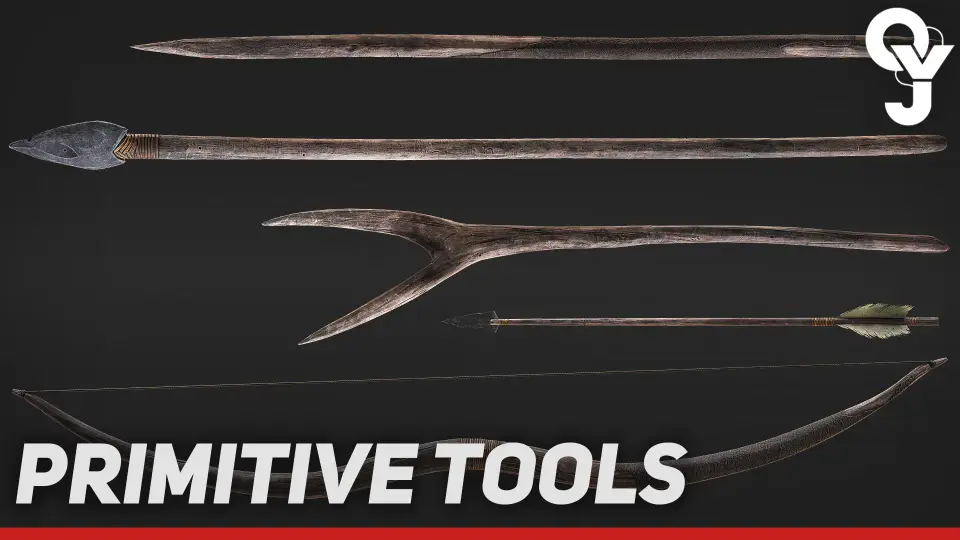
Integrating ranged archery mechanics requires dynamic geometry rather than a rigid prop mesh. Within this set of fifteen primitive tools and weapons, the bow is constructed with a dedicated skeleton grid and includes two distinct animations. Having an internal skeletal grid allows the upper and lower limbs of the weapon, along with the bowstring, to bend naturally during tension and release cycles without creating irregular mesh pinching.
The bow mesh is authored at 3,856 triangles and 1,923 vertices. This geometry allocation concentrates edge loops along the primary flex points where string tension and stave deflection occur. Pairing directly with the bow is the arrow mesh, which is optimized at 345 triangles and 199 vertices. Because projectile systems frequently spawn multiple instances in flight or leave arrows embedded within target colliders, keeping the arrow under 350 triangles ensures that memory overhead remains stable during intense archery exchanges.
Geometry Budgets for Handheld Bladed and Impact Gear
Close-quarters combat systems rely on clear weapon silhouettes and tight vertex distributions to maintain smooth frame rates during character socket attachment. The collection provides several distinct options across impact, cutting, and hacking categories, each structured with dedicated geometric profiles.
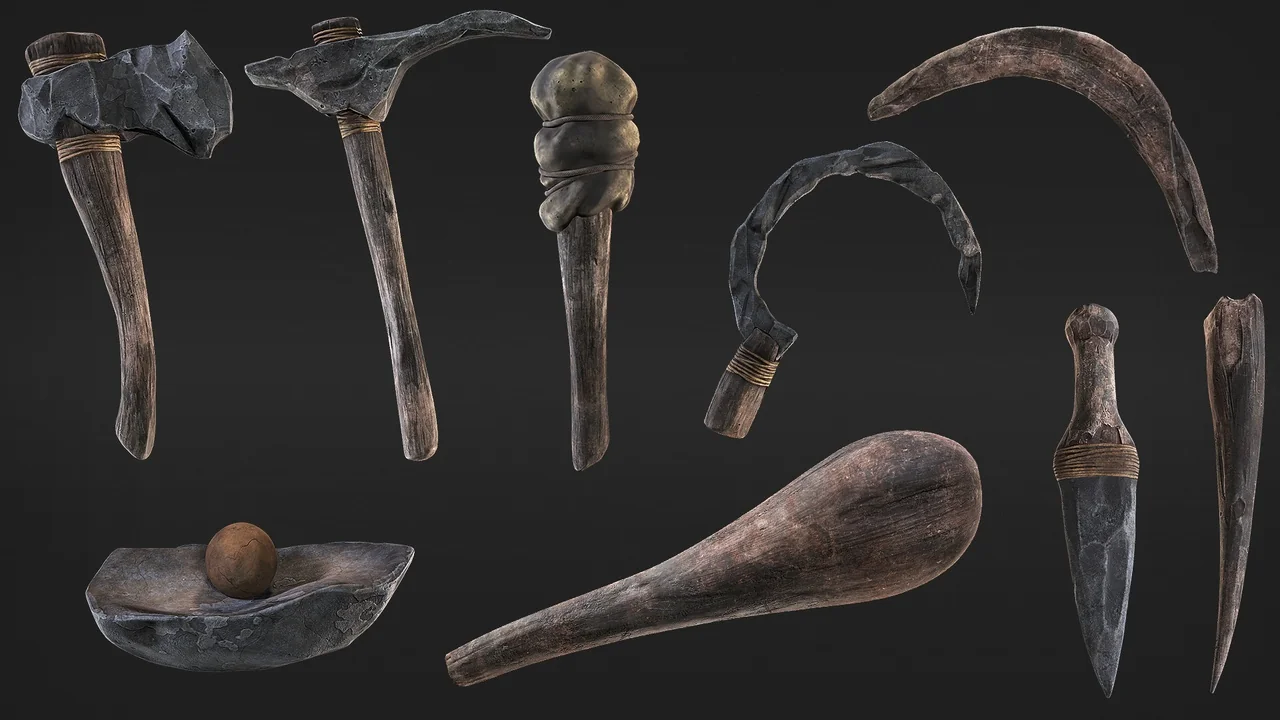
For heavy chopping workflows, the axe uses 2,662 triangles across 1,335 vertices. This budget supplies enough contouring to articulate the bound head, stone or metal cutting edge, and organic variations along the wooden haft. In contrast, the blunt impact bat is balanced at a much lighter footprint of 632 triangles and 318 vertices, distributing its geometry evenly around the cylindrical striking zone without excess polygons.
Two separate variations exist for the knife category, accommodating off-hand utility or swift melee strikes. The primary knife variation runs at 290 triangles and 147 vertices, while an alternate knife model measures 348 triangles across 176 vertices. Both knife assets keep their vertex footprints light enough to serve as baseline crafting items or secondary weapon sockets without burdening memory. The collection also includes a crusher model, which rounds out the high-impact blunt weapon selection alongside the bat and axe.
Thrusting Implements: Three Spear Profiles and Extended Tools
Reach weapons demand varied profiles depending on whether they serve as throwable javelins, basic survival spikes, or reinforced hunting lances. The set addresses this variety by delivering three distinct spear variants, each built with its own targeted polygon density.
Spears 1 is authored at 502 triangles and 253 vertices, providing defined wrapping and point geometry suitable for mid-range weapon display. Spears 2 serves as the most minimalist polearm in the group, operating at 224 triangles and 114 vertices. This reduced footprint makes it an ideal candidate for mass-produced projectile spears or lightweight throwing munitions. Spears 3 occupies a middle tier, balanced at 338 triangles and 177 vertices to maintain shaft curvature and tip definition while staying well below heavy asset budgets.
In addition to standard spear configurations, the roster features extended agricultural and piercing tools, specifically a pitchfork and a sickle. The sickle is constructed with 1,784 triangles and 896 vertices, reserving the majority of its polygonal detail for the interior curve and tapering edge of the blade. The pitchfork complements this tier, functioning as a multi-tined primitive weapon or environmental work prop.
Harvesting and Survival Utility Props: Torch and Pickaxe
Resource collection mechanics and dark environmental settings require specialized tools that match the rugged visual tone of early technology. The pickaxe model is built with 2,056 triangles and 1,034 vertices. Its geometry accurately defines the bifurcated head—balancing a pointed piercing tip against a broad chisel edge—while capturing the lashed bindings that secure the working head to the haft.
For exploration and light generation, the torch mesh matches the structural complexity of primary weapons, coming in at 2,658 triangles and 1,340 vertices. Primitive torches require layered surface information to represent wrapped plant fibers, bound wood, and fuel-soaked rags at the head. The higher polygon count in the torch allows for dense geometry at the upper tip, making it easier to position particle emitters, light components, and heat-distortion visual effects without exposing planar hard edges.
Thrown Weapon Aerodynamics: The Boomerang
Outside of conventional bow and spear projectiles, the asset collection provides a dedicated boomerang model. Suited to flat rotational flight paths, this curved throwing weapon is modeled at 264 triangles and 134 vertices. The low vertex total allows physics-driven gameplay components to calculate spinning trajectories, ground collisions, and player-catch traces without complex collision hulls dragging down performance. Its low polygon count also fits clean inventory icons or UI preview displays where simple, clean geometry renders efficiently.
PBR Material Pipeline and Integration Workflows
All fifteen models in the collection are authored under a realistic Physically Based Rendering (PBR) framework. This material approach ensures accurate surface light response across porous wood shafts, rough-hewn stone or bone heads, dried twine wrappings, and hand-worked edges. When moved between harsh direct sunlight, dim forest canopies, or flickering torch illumination, the specular and roughness behaviors maintain a cohesive primitive aesthetic.
Marked under reference identifier Y9J, the collection provides native compatibility with the City door kit layout. Whether deployed directly into player inventory frameworks, tied to harvestable node interactions, or parented to animated character weapon sockets, the balanced triangle distributions keep runtime budgets strictly controlled across the entire fifteen-model armory.
 Weapons & Combat
 Weapons & Combat
 Weapons & Combat
 Weapons & Combat