"c68a05d5e51405b3"{"id":"1000661","slug":"procedural-animation-framework","title":"Procedural Animation Framework","category":"Locomotion / Gaits","engine":"5.4+","assetVersion":"","engineVersion":"Engine Version: 5.4+","tag":"Locomotion / Gaits","accent":"blue","visual":"animation","summary":"A modular Procedural Animation Framework for generating dynamic character movements. This blueprint-based tool offers a GUI to adjust speed, intensity, and styl","platform":"Unreal Engine","publishedAt":"2026-07-21T20:41:27.608Z","updatedAt":"2026-07-21T20:41:27.608Z","sourceNotes":[],"fileContents":[],"compatibility":["Unreal Engine","Engine Version: 5.4+"],"featuredImage":{"alt":"Procedural Animation Framework","src":"/wp-content/uploads/published/2026/07/b4f435dfaf31-35648f2c-79b6-4caf-a383-bb746751dd1b-2bb23f5fcb.webp"},"hasDownloadLink":true,"downloads":4,"terms":[{"taxonomy":"category","slug":"locomotion-gaits","name":"Locomotion / Gaits"}],"galleryImages":[{"src":"/wp-content/uploads/published/2026/07/62ab42b3c809-e1db8ee7-4130-44e2-8205-c18c52179b8b-d2cd80ddc2.webp","alt":"Procedural Animation Framework"},{"src":"/wp-content/uploads/published/2026/07/bfa52808ec6f-73bdba99-5b5f-4b08-91ec-d00263c796a2-3ca21ee515.webp","alt":"Procedural Animation Framework"},{"src":"/wp-content/uploads/published/2026/07/1da40ea90a06-6e5a1ac1-cd3b-4938-8381-d6310e3b311c-e490beb75d.webp","alt":"Procedural Animation Framework"},{"src":"/wp-content/uploads/published/2026/07/29adc66ac368-50e7acc0-baab-4102-96a4-fc0d7c7ba111-29425a0868.webp","alt":"Procedural Animation Framework"},{"src":"/wp-content/uploads/published/2026/07/9f3bfb13dd57-4dd6a515-0b12-427e-892e-fe4c715b50c3-2bb019f52a.webp","alt":"Procedural Animation Framework"},{"src":"/wp-content/uploads/published/2026/07/ab0c26c2e5c8-df63bcf5-e67b-4d6f-98bb-0ffda40c5f6e-7981fb39d7.webp","alt":"Procedural Animation Framework"},{"src":"/wp-content/uploads/published/2026/07/cf4217da5e4a-1859c837-61b2-4d3b-83ca-2dc3ca88805c-cddbd54638.webp","alt":"Procedural Animation Framework"},{"src":"/wp-content/uploads/published/2026/07/3fa3b5fad1e4-a40f0021-6c89-4acf-a15d-49b2257ef9fe-ce6a39548c.webp","alt":"Procedural Animation Framework"},{"src":"/wp-content/uploads/published/2026/07/430f4c3e43f5-c3e65b06-b13d-413a-a361-230b9d11e277-eb72091305.webp","alt":"Procedural Animation Framework"},{"src":"/wp-content/uploads/published/2026/07/9d956fa39008-450708cf-02ab-4fba-980a-43442adc153e-08c0903b99.webp","alt":"Procedural Animation Framework"}],"accessPanel":{"kind":"resource","title":"Download this resource","eyebrow":"Free Download","message":"Log in or create a free account to start your download.","fileName":"ProceduralAnimationFramew.7z","safetyNote":"Resources are manually reviewed before listing to improve quality and reduce obvious risks.","actionLabel":"Download Free","resourceType":"Resource archive"},"contentHtml":"\u003cp\u003eCharacter-driven scenes often demand a level of fluidity that traditional keyframe techniques struggle to deliver efficiently. When characters appear rigid or stiff, the immersive quality of an environment drops. The Procedural Animation Framework steps into this production gap as a specialized tool meant to bring characters to life with minimal manual grind. It shifts the workload from hand-tuning every frame to managing a system that generates dynamic, realistic animations on the fly.\u003c/p\u003e \n\n\u003ch2\u003eReplacing Rigid Animations With Procedural Movement\u003c/h2\u003e\n\u003cp\u003eTedious character animation workflows often slow down creative pipelines. This framework is built to eliminate that grind by enabling effortless and efficient character movement generation. For projects where stiff, mechanical motions hinder the visual potential of a scene, this tool offers an upgrade path. It allows creators to achieve expressive and fluid character actions without committing to the heavy labor typically associated with high-quality traditional animation. The system targets the need for realistic movement by generating it procedurally, ensuring characters react and move in a lifelike manner.\u003c/p\u003e \n\n\u003ch2\u003eModular Blueprint Architecture and Interface\u003c/h2\u003e\n\u003cp\u003eAt its core, the framework operates using a blueprint-based architecture, making it a structured, modular system for configuration. A major component of this system is its robust graphical user interface. The GUI serves as the central hub for user interaction, allowing creators to seamlessly adjust animation parameters to suit specific scene requirements. The modular nature of the framework's blueprint system allows creators to approach character setup in organized, configurable blocks rather than dealing with a monolithic, unchangeable script. This interface-driven approach puts the user in complete control of how the procedural systems affect the character.\u003c/p\u003e \n\n\u003ch2\u003eDirect Control Over Speed, Intensity, and Style\u003c/h2\u003e\n\u003cp\u003eThe practical value of the Procedural Animation Framework lies in the specific parameters it exposes to the user. Through the interface, creators can modify three distinct aspects of the movement:\u003c/p\u003e\n\u003cul\u003e\n\u003cli\u003e\u003cstrong\u003eSpeed:\u003c/strong\u003e Dictates the pace of the character's movements, allowing for quick, reactive gestures or slow, deliberate actions.\u003c/li\u003e\n\u003cli\u003e\u003cstrong\u003eIntensity:\u003c/strong\u003e Controls the force and severity of the animation, determining how subtle or exaggerated a motion appears on screen.\u003c/li\u003e\n\u003cli\u003e\u003cstrong\u003eStyle:\u003c/strong\u003e Alters the qualitative look of the animation, letting creators adjust the framework to match the desired creative tone.\u003c/li\u003e\n\u003c/ul\u003e\n\u003cp\u003eBy breaking character motion down into these three adjustable traits, the tool removes the need to manually re-author animations when a scene's demands change. A creator can tweak these settings to find the exact movement quality needed.\u003c/p\u003e \n\n\u003ch2\u003eIntegrating the Framework Into a Production Workflow\u003c/h2\u003e\n\u003cp\u003eIn a real production environment, this framework serves as an intermediary layer between character rigging and final scene output. Once a character is set up within the blueprint system, the animation process becomes a matter of parameter configuration rather than granular timeline manipulation. The user interface becomes the primary workspace for refining how the character behaves. If an animation appears too rigid for a specific environment, the user can directly address the stiffness by altering the procedural style or intensity settings. This workflow targets creators who require dynamic character output without the bottleneck of traditional animation revision cycles. It allows teams to iterate quickly, adjusting the procedural configuration until the movement matches the scene's context.\u003c/p\u003e \n\n\u003ch2\u003eA Practical Approach to Character Animation\u003c/h2\u003e\n\u003cp\u003eFor creators evaluating how to address stiff character movements in their projects, this framework offers a specific technical route. By combining a blueprint-based modular setup with an accessible GUI for speed, intensity, and style adjustments, it transforms the animation process into a controlled, parameter-driven task. The tool is positioned as a direct solution for replacing tedious animation workflows with a fluid, expressive system that gives creators complete control over character behavior.\u003c/p\u003e\n\n\u003ch2\u003eRelated Resources Worth Checking\u003c/h2\u003e\n\u003cul\u003e\n\u003cli\u003e\u003ca href=\"https://3dcghub.com/global-world-optimization-framework-pro-max-high-performance-for-large-worlds/\" title=\"Global World Optimization Framework PRO MAX - High Performance for Large Worlds\"\u003eGlobal World Optimization Framework PRO MAX - High Performance for Large Worlds\u003c/a\u003e\u003c/li\u003e\n\u003cli\u003e\u003ca href=\"https://3dcghub.com/procedural-fps-recoil-system/\" title=\"Procedural FPS Recoil System\"\u003eProcedural FPS Recoil System\u003c/a\u003e\u003c/li\u003e\n\u003cli\u003e\u003ca href=\"https://3dcghub.com/simple-procedural-walk/\" title=\"Simple Procedural Walk\"\u003eSimple Procedural Walk\u003c/a\u003e\u003c/li\u003e\n\u003cli\u003e\u003ca href=\"https://3dcghub.com/kinematic-tentacles/\" title=\"Kinematic Tentacles\"\u003eKinematic Tentacles\u003c/a\u003e\u003c/li\u003e\n\u003cli\u003e\u003ca href=\"https://3dcghub.com/creepy-doll/\" title=\"Creepy Doll\"\u003eCreepy Doll\u003c/a\u003e\u003c/li\u003e\n\u003c/ul\u003e","contentTextLength":4335,"navigation":{"current":1344,"total":3860,"previous":{"id":"1000662","slug":"radiation-vfx","title":"Radiation VFX","category":"Variety","platform":"Unreal Engine","updatedAt":"2026-07-21T20:44:48.746Z"},"next":{"id":"1000660","slug":"postfx-globalscan","title":"PostFX GlobalScan","category":"Art \u0026 Traditional","platform":"Unreal Engine","updatedAt":"2026-07-21T20:38:01.703Z"}},"relatedResources":[{"id":"15301","slug":"procedural-fps-recoil-system","title":"Procedural FPS Recoil System","category":"Procedural Systems","engine":"2025.3.0","assetVersion":"Engine version: 5.6 - 5.7","engineVersion":"Asset Version:2025.3.0","tag":"Procedural Systems","accent":"blue","visual":"audio","summary":"Improve your game's combat with the Procedural FPS Recoil System. This tool offers smooth, customizable recoil animations for any weapon type while saving memory and development time.","platform":"Unreal Engine","publishedAt":"2026-03-12T08:33:53.000Z","updatedAt":"2026-07-05T06:16:23.079Z","sourceNotes":[],"fileContents":[],"compatibility":["Unreal Engine","Engine version: 5.6 - 5.7","Asset Version:2025.3.0"],"featuredImage":{"alt":"Procedural FPS Recoil System","src":"https://3dcghub.com/wp-content/uploads/2026/03/7bb95269-1ed4-43fe-aaa3-4282f29a6582.webp"},"hasDownloadLink":true,"downloads":3},{"id":"15266","slug":"global-world-optimization-framework-pro-max-high-performance-for-large-worlds","title":"Global World Optimization Framework PRO MAX - High Performance for Large Worlds","category":"Procedural Systems","engine":"1.0.5 - 1.3","assetVersion":"Engine version: 5.3,5.6","engineVersion":"Asset Version:1.0.5 - 1.3","tag":"Procedural Systems","accent":"blue","visual":"animation","summary":"Manage thousands of actors and millions of objects with the Global World Optimization Framework PRO MAX. This system ensures high FPS and persistent world states for large-scale projects.","platform":"Unreal Engine","publishedAt":"2026-03-12T08:27:50.000Z","updatedAt":"2026-07-11T05:24:34.488Z","sourceNotes":[],"fileContents":[],"compatibility":["Unreal Engine","Engine version: 5.3,5.6","Asset Version:1.0.5 - 1.3"],"featuredImage":{"alt":"Global World Optimization Framework PRO MAX - High Performance for Large Worlds","src":"https://3dcghub.com/wp-content/uploads/2026/03/e6a4ffeb-2e66-4d5c-a559-94a10f521a84.webp"},"hasDownloadLink":true,"downloads":0},{"id":"25001","slug":"simple-procedural-walk","title":"Simple Procedural Walk","category":"Engine Tools","engine":"5.3","assetVersion":"Engine version: 5.3","engineVersion":"","tag":"Engine Tools","accent":"blue","visual":"animation","summary":"Simple Procedural Walk gives skeletal meshes a real-time walking cycle without relying on pre-recorded animation. It is strongest on robotic or insectoid characters, with mechs also supported, while organic characters are left to motion-capture style movement.","platform":"Unreal Engine","publishedAt":"2026-04-18T15:47:18.000Z","updatedAt":"2026-04-20T06:12:34.000Z","sourceNotes":[],"fileContents":[],"compatibility":["Unreal Engine","Engine version: 5.3"],"featuredImage":{"alt":"Simple Procedural Walk","src":"https://3dcghub.com/wp-content/uploads/2026/04/3f2c1025b72b_a9e4b4f7-6fe2-488e-872a-1cc50cd404eb.webp"},"hasDownloadLink":true,"downloads":0}]}
Locomotion / Gaits
Procedural Animation Framework
A modular Procedural Animation Framework for generating dynamic character movements. This blueprint-based tool offers a GUI to adjust speed, intensity, and styl
Character-driven scenes often demand a level of fluidity that traditional keyframe techniques struggle to deliver efficiently. When characters appear rigid or stiff, the immersive quality of an environment drops. The Procedural Animation Framework steps into this production gap as a specialized tool meant to bring characters to life with minimal manual grind. It shifts the workload from hand-tuning every frame to managing a system that generates dynamic, realistic animations on the fly.
Replacing Rigid Animations With Procedural Movement
Tedious character animation workflows often slow down creative pipelines. This framework is built to eliminate that grind by enabling effortless and efficient character movement generation. For projects where stiff, mechanical motions hinder the visual potential of a scene, this tool offers an upgrade path. It allows creators to achieve expressive and fluid character actions without committing to the heavy labor typically associated with high-quality traditional animation. The system targets the need for realistic movement by generating it procedurally, ensuring characters react and move in a lifelike manner.
Modular Blueprint Architecture and Interface
At its core, the framework operates using a blueprint-based architecture, making it a structured, modular system for configuration. A major component of this system is its robust graphical user interface. The GUI serves as the central hub for user interaction, allowing creators to seamlessly adjust animation parameters to suit specific scene requirements. The modular nature of the framework's blueprint system allows creators to approach character setup in organized, configurable blocks rather than dealing with a monolithic, unchangeable script. This interface-driven approach puts the user in complete control of how the procedural systems affect the character.
Direct Control Over Speed, Intensity, and Style
The practical value of the Procedural Animation Framework lies in the specific parameters it exposes to the user. Through the interface, creators can modify three distinct aspects of the movement:
Speed: Dictates the pace of the character's movements, allowing for quick, reactive gestures or slow, deliberate actions.
Intensity: Controls the force and severity of the animation, determining how subtle or exaggerated a motion appears on screen.
Style: Alters the qualitative look of the animation, letting creators adjust the framework to match the desired creative tone.
By breaking character motion down into these three adjustable traits, the tool removes the need to manually re-author animations when a scene's demands change. A creator can tweak these settings to find the exact movement quality needed.
Integrating the Framework Into a Production Workflow
In a real production environment, this framework serves as an intermediary layer between character rigging and final scene output. Once a character is set up within the blueprint system, the animation process becomes a matter of parameter configuration rather than granular timeline manipulation. The user interface becomes the primary workspace for refining how the character behaves. If an animation appears too rigid for a specific environment, the user can directly address the stiffness by altering the procedural style or intensity settings. This workflow targets creators who require dynamic character output without the bottleneck of traditional animation revision cycles. It allows teams to iterate quickly, adjusting the procedural configuration until the movement matches the scene's context.
A Practical Approach to Character Animation
For creators evaluating how to address stiff character movements in their projects, this framework offers a specific technical route. By combining a blueprint-based modular setup with an accessible GUI for speed, intensity, and style adjustments, it transforms the animation process into a controlled, parameter-driven task. The tool is positioned as a direct solution for replacing tedious animation workflows with a fluid, expressive system that gives creators complete control over character behavior.
 Locomotion / Gaits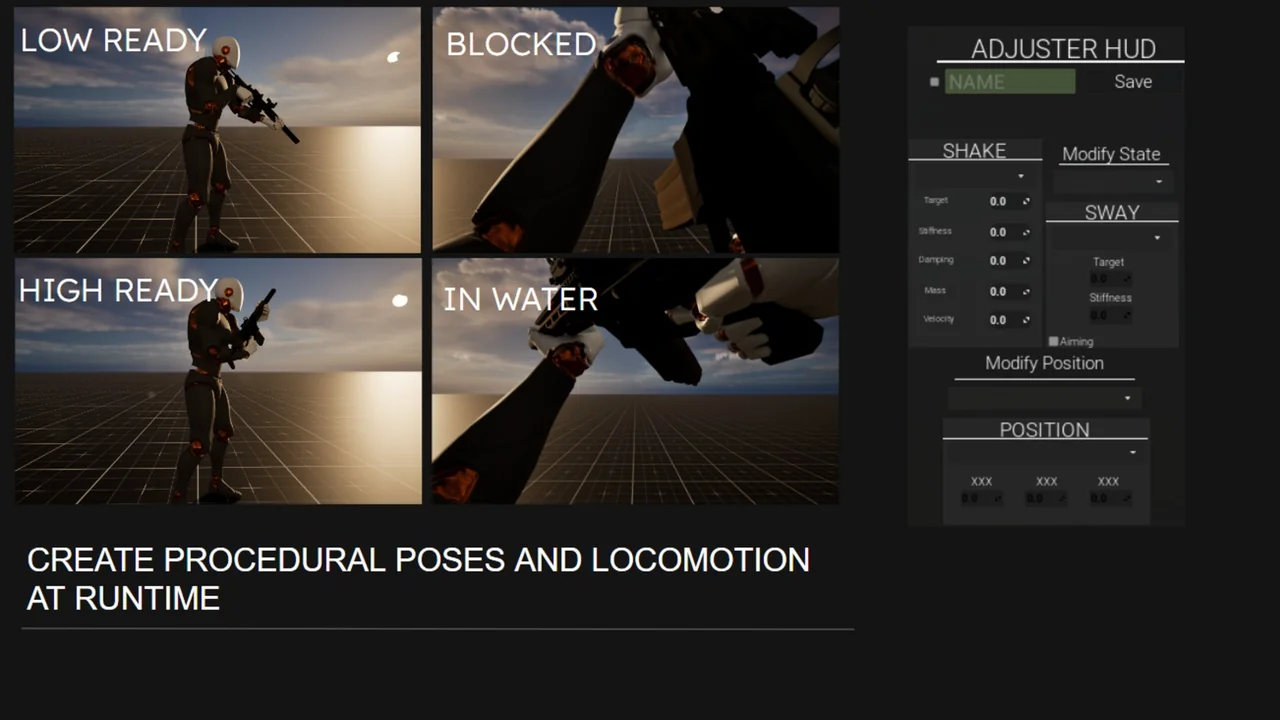
 Procedural Systems
 Procedural Systems
 Engine Tools