"46f9e2e26c9c4336"{"id":"1002141","slug":"physics-based-destructible-vehicle-trailer","title":"Physics-Based Destructible Vehicle Trailer","category":"Cars \u0026 Trucks","engine":"4.26+,5.0+","assetVersion":"","engineVersion":"Engine Version: 4.26+,5.0+","tag":"Cars \u0026 Trucks","accent":"blue","visual":"mech","summary":"Examine the Physics-Based Destructible Vehicle Trailer, featuring 4K textures, constraint physics, modular damage states, and vehicle hitching.","platform":"Unreal Engine","publishedAt":"2026-10-29T09:47:10.086Z","updatedAt":"2026-10-29T09:47:10.086Z","sourceNotes":[],"fileContents":[],"compatibility":["Unreal Engine","Engine Version: 4.26+,5.0+"],"featuredImage":{"alt":"Physics-Based Destructible Vehicle Trailer","src":"/wp-content/uploads/published/2026/10/e233c32bf3a2-f0ff114e-ca10-47ce-ad8c-d88e68c33e02-5a540ff59a.webp"},"hasDownloadLink":true,"downloads":0,"terms":[{"taxonomy":"category","slug":"cars-and-trucks","name":"Cars \u0026 Trucks"}],"galleryImages":[{"src":"/wp-content/uploads/published/2026/10/d4deb230d3fd-0353ba18-57d6-475e-bbee-eba09e6341d1-37d758f119.webp","alt":"Physics-Based Destructible Vehicle Trailer"},{"src":"/wp-content/uploads/published/2026/10/46c900fb854c-65c90538-7487-41a3-8acb-c83fd121bc19-f414682fad.webp","alt":"Physics-Based Destructible Vehicle Trailer"},{"src":"/wp-content/uploads/published/2026/10/e5c60f0d5e51-c57b0878-35c3-4f2d-9e76-97df88c57a92-b980e41600.webp","alt":"Physics-Based Destructible Vehicle Trailer"},{"src":"/wp-content/uploads/published/2026/10/2a4eda6f17a1-ac7cb44b-fcdd-4336-8157-dd03002bb3a2-a28cdc4385.webp","alt":"Physics-Based Destructible Vehicle Trailer"},{"src":"/wp-content/uploads/published/2026/10/1ca69aec68ef-768b9197-3f43-4963-8761-4ef61abc8e8e-07ec75a77c.webp","alt":"Physics-Based Destructible Vehicle Trailer"},{"src":"/wp-content/uploads/published/2026/10/eb2afa6ddb5e-d24c1476-8f53-4f2d-a954-035e08a97372-016ffcab1b.webp","alt":"Physics-Based Destructible Vehicle Trailer"},{"src":"/wp-content/uploads/published/2026/10/6a44ace0d73c-50719589-8b9d-4a7f-be47-1e3b605a6436-64a6ba49f2.webp","alt":"Physics-Based Destructible Vehicle Trailer"},{"src":"/wp-content/uploads/published/2026/10/e44c63ffcecc-a230dba1-c1f5-415e-b57b-90d5d2026e6f-de9b832d8e.webp","alt":"Physics-Based Destructible Vehicle Trailer"},{"src":"/wp-content/uploads/published/2026/10/f2bffa3fab29-f66a2de7-01bd-4d6d-9fd7-26e82fcb3548-3856c2353b.webp","alt":"Physics-Based Destructible Vehicle Trailer"}],"accessPanel":{"kind":"resource","title":"Download this resource","eyebrow":"Free Download","message":"Log in or create a free account to start your download.","fileName":"Physics-Based Destructible Vehicle Trailer.7z","safetyNote":"Resources are manually reviewed before listing to improve quality and reduce obvious risks.","actionLabel":"Download Free","resourceType":"Resource archive"},"contentHtml":"\u003ch2\u003ePhysical Interaction and Runtime Destruction Setup\u003c/h2\u003e\u003cp\u003eAttaching a vehicle trailer to an interactive environment often exposes the rigid limitations of basic static meshes. When an asset needs to respond directly to dynamic forces, collisions, and physical impulses from players, standard kinematic props quickly break immersion. The Physics-Based Destructible Vehicle Trailer resolves this by operating as a constraint-driven interactive object directly responsive to the character controller. Characters can collide with, push, and manipulate the trailer within the scene, allowing it to function both as an attached transport accessory and as a physical road prop.\u003c/p\u003e\u003cp\u003eImplementing destruction does not require engineering a custom damage framework from scratch. The system allows developers to activate destructibility simply by introducing two nodes into their existing logic pipeline. Once connected, incoming forces trigger mechanical detachments and breakage across several distinct structural regions. Because the simulation relies on physics constraints rather than pre-baked geometric fracturing, pieces drop, tumble, and interact with surrounding level geometry in real time based on the vector and magnitude of each impact.\u003c/p\u003e\u003cp\u003eFor situations where advanced destructible calculations are unnecessary or cost-prohibitive for performance budgets, the package also provides an alternative simple physics simulation. This secondary mode bypasses the complex multi-part breakdown routines while still preserving dynamic vehicle-following motion, natural chassis sway, and ground contact responses under runtime driving conditions.\u003c/p\u003e\u003ch2\u003eDestructible Trailer Components and Tailgate Mechanics\u003c/h2\u003e\u003cp\u003eMechanical realism in vehicle incidents depends on distinct sub-assemblies reacting independently. Rather than collapsing into an undifferentiated heap of debris, the trailer segregates its components into logical fracture points. The wheels, jockey wheel assembly, jockey handle bar, and the cargo tailgate exist as distinct physical objects bound by dynamic constraints.\u003c/p\u003e\u003cp\u003eThe rear tailgate features four individual securing latches that govern how the gate remains attached or fails under stress:\u003c/p\u003e\u003cul\u003e\u003cli\u003e\u003cstrong\u003eTwo Levels of Physics Damage:\u003c/strong\u003e The four securing latches support intermediate stress states, allowing them to bend, loosen, or shear partially before full structural separation occurs.\u003c/li\u003e\u003cli\u003e\u003cstrong\u003eDynamic Tailgate Response:\u003c/strong\u003e Once latch constraints fail under impact or directional forces, the tailgate swings freely on remaining connection points or falls away entirely onto the road surface.\u003c/li\u003e\u003cli\u003e\u003cstrong\u003eIndependent Wheel Detachment:\u003c/strong\u003e Both primary transit wheels can break away from the axle mounts under high-velocity crashes or heavy vertical loads.\u003c/li\u003e\u003cli\u003e\u003cstrong\u003eJockey Assembly Disruption:\u003c/strong\u003e The forward jockey wheel and its adjustment handle/bar can absorb hits from roadside obstacles or low-angle vehicle impacts, separating cleanly from the hitch tongue.\u003c/li\u003e\u003c/ul\u003e\u003cp\u003eBy dividing the breakdown sequence into specific hardware failures, collisions against curbs, roadblocks, or opposing vehicles produce varied, unscripted wreckage rather than identical scripted failure animations.\u003c/p\u003e\u003ch2\u003eMaster Blueprint Structure, Child Variations, and Hitching Examples\u003c/h2\u003e\u003cp\u003eThe technical architecture relies on an organized Blueprint hierarchy designed to minimize technical friction when implementing custom trailer configurations. At the core sits one Destructible Master Blueprint containing the primary constraint networks, hit reaction triggers, and socket structures. Branching from this master parent are three distinct Child Classes, each pre-configured with adjusted component arrangements and behavioral variables. This hierarchical separation ensures that any project-level adjustments applied to the Master Blueprint propagate cleanly across all derived classes without manual duplication.\u003c/p\u003e\u003cp\u003eBridging the gap between static level dressing and drivable gameplay, the package provides a working trailer hitching example pre-configured to work directly with the Unreal Engine 4 starter sedan. This implementation demonstrates how the trailer tongue attaches to standard vehicle sockets, handles steering articulation, transfers momentum around corners, and detaches when catastrophic forces sever the hitch connection.\u003c/p\u003e\u003cp\u003eTo support runtime interaction testing right out of the box, an included destructible throwable glass bottle Blueprint provides an immediate testing tool. Developers can pick up and hurl the bottle directly at the trailer's frame, latches, or wheels to inspect constraint thresholds, collision impulses, and hit responses without first binding weapon or driving mechanics.\u003c/p\u003e\u003ch2\u003eVisual Fidelity, 4K Texture Downscaling, and Color Variations\u003c/h2\u003e\u003cp\u003eAssets positioned in the immediate periphery of the camera require meticulous surface detailing to withstand close scrutiny. The trailer model is authored as a hero-quality asset, holding up under third-person following cameras, first-person character inspection, and tight cinematic framings. Welds, hinges, latch pins, and sheet metal surfaces retain sharp visual definition without showing geometric distortion or muddy surface mapping.\u003c/p\u003e\u003cp\u003eAll texture sets are authored natively in 4K resolution, supplying high-frequency surface detail, normal map depth, and micro-roughness variations suitable for high-end rendering pipelines. To accommodate differing memory targets, mobile builds, or background dressing demands, the textures can be downscaled directly inside the engine editor without requiring external image manipulation software.\u003c/p\u003e\u003cp\u003eSurface customization is supported through four complete pre-built color variations, ranging across common industrial and utility vehicle finishes. For projects requiring specific art direction, bespoke fleet branding, or environmental camouflage, a dedicated color mask is integrated into the material pipeline, allowing developers to set exact custom hues across the body panels without painting new base color maps.\u003c/p\u003e\u003ch2\u003eStatic Variations, Simple Physics Simulation, and Custom Collision LODs\u003c/h2\u003e\u003cp\u003eNot every environment demands fully dynamic constraint evaluation. Populating large logistics depots, highway pileups, or junkyard compounds with dozens of fully articulated physics Blueprints can overburden frame times. To address broad background placement, the collection includes seven static variations.\u003c/p\u003e\u003cp\u003eThese static meshes are paired with custom-made collision profiles explicitly tuned for optimal hit detection. Even at extended rendering distances and aggressive level-of-detail (LOD) transitions, projectile registration, character navigation, and vehicle boundary tracking remain reliable. Thin railings, latch points, and wheel wells do not collapse into inaccurate bounding boxes, preventing collision clipping, floating tires, or snags during player contact.\u003c/p\u003e\u003ch2\u003eScene Integration and Practical Application\u003c/h2\u003e\u003cp\u003eBecause the trailer accommodates both high-speed towing and grounded physical interaction, it serves varied design roles across different interactive genres. In vehicular action titles, it provides dynamic cargo towing that alters vehicle handling dynamics until severe impacts dislodge the load. In survival games, it functions as roadside salvage, barricade material, or movable cover that deforms and sheds parts when subjected to gunfire or heavy impacts.\u003c/p\u003e\u003cp\u003eThe asset also notes direct compatibility with the Zombies - Modular Four Pack, making it well suited for post-apocalyptic roadblocks, mobile survivor convoys, and quarantine extraction compounds. Whether deployed as a functional hauler tied to an escape car, a heavy obstruction shoved into a barricade opening, or static roadside scatter, the combination of multi-stage destruction, flexible physics modes, and scalable texture assets delivers a solid mechanical utility asset for game worlds.\u003c/p\u003e\n\n\u003ch2\u003eContinue Browsing Similar Packs\u003c/h2\u003e\n\u003cul\u003e\n\u003cli\u003e\u003ca href=\"https://3dcghub.com/drivable-cars-basic-vehicle-system/\" title=\"Drivable Cars: Basic Vehicle System\"\u003eDrivable Cars: Basic Vehicle System\u003c/a\u003e\u003c/li\u003e\n\u003cli\u003e\u003ca href=\"https://3dcghub.com/drift-car-mamba-drivable-and-customizable/\" title=\"Drift Car Mamba - Drivable and customizable\"\u003eDrift Car Mamba - Drivable and customizable\u003c/a\u003e\u003c/li\u003e\n\u003cli\u003e\u003ca href=\"https://3dcghub.com/abandoned-service-garage-vol-4-vehicles-and-service-machines/\" title=\"Abandoned Service Garage - VOL.4 - Vehicles and Service Machines\"\u003eAbandoned Service Garage - VOL.4 - Vehicles and Service Machines\u003c/a\u003e\u003c/li\u003e\n\u003cli\u003e\u003ca href=\"https://3dcghub.com/vehicles-vol-9-future-cars-low-poly/\" title=\"Vehicles VOL.9- Future Cars (Low Poly)\"\u003eVehicles VOL.9- Future Cars (Low Poly)\u003c/a\u003e\u003c/li\u003e\n\u003cli\u003e\u003ca href=\"https://3dcghub.com/hatchback-car-driveable-animated-realistic-hatchback-car-driveable-vehicle/\" title=\"HatchBack Car Driveable / Animated / Realistic (HatchBack Car Driveable Vehicle)\"\u003eHatchBack Car Driveable / Animated / Realistic (HatchBack Car Driveable Vehicle)\u003c/a\u003e\u003c/li\u003e\n\u003c/ul\u003e","contentTextLength":8069,"navigation":{"current":91,"total":4157,"previous":{"id":"1002142","slug":"pigman","title":"Pigman","category":"Characters \u0026 Creatures","platform":"Unreal Engine","updatedAt":"2026-10-29T09:47:50.343Z"},"next":{"id":"1002140","slug":"physics-based-mesh-placement","title":"Physics Based Mesh Placement","category":"Gameplay Features","platform":"Unreal Engine","updatedAt":"2026-10-29T09:46:21.814Z"}},"relatedResources":[{"id":"5005","slug":"drivable-cars-basic-vehicle-system","title":"Drivable Cars: Basic Vehicle System","category":"Cars \u0026 Trucks","engine":"5.0+","assetVersion":"Engine version: 5.0+","engineVersion":"4.16","tag":"Cars \u0026 Trucks","accent":"blue","visual":"luts","summary":"Build your game's vehicle mechanics with this basic drivable cars framework for UE5. Includes 3 rigged models, interactive dashboards, and core driving physics.","platform":"Unreal Engine","publishedAt":"2026-02-14T17:20:23.000Z","updatedAt":"2026-04-19T15:57:02.000Z","sourceNotes":[],"fileContents":[],"compatibility":["Unreal Engine"],"featuredImage":{"alt":"Drivable Cars: Basic Vehicle System","src":"https://3dcghub.com/wp-content/uploads/2026/02/7d41473f-b8d1-438e-a409-2a0f1d6337fb.webp"},"hasDownloadLink":true,"downloads":3},{"id":"4988","slug":"drift-car-mamba-drivable-and-customizable","title":"Drift Car Mamba - Drivable and customizable","category":"Cars \u0026 Trucks","engine":"5.0+","assetVersion":"Engine version: 5.0+","engineVersion":"5.0","tag":"Cars \u0026 Trucks","accent":"blue","visual":"animation","summary":"Enhance your racing game with the Mamba Drift Car for Unreal Engine 5. It features Chaos Physics, 32 bodykit parts, and a real-time customization system.","platform":"Unreal Engine","publishedAt":"2026-02-14T17:16:52.000Z","updatedAt":"2026-04-19T15:57:02.000Z","sourceNotes":[],"fileContents":[],"compatibility":["Unreal Engine","Engine version: 5.0+"],"featuredImage":{"alt":"Drift Car Mamba - Drivable and customizable","src":"https://3dcghub.com/wp-content/uploads/2026/02/f1d389ee-dd06-44e3-a814-55b1b2a062e4.webp"},"hasDownloadLink":true,"downloads":1},{"id":"1000417","slug":"abandoned-service-garage-vol-4-vehicles-and-service-machines","title":"Abandoned Service Garage - VOL.4 - Vehicles and Service Machines","category":"Cars \u0026 Trucks","engine":"4.26+,5.0+","assetVersion":"","engineVersion":"Engine Version: 4.26+,5.0+","tag":"Cars \u0026 Trucks","accent":"blue","visual":"mech","summary":"Explore the technical setup of Abandoned Service Garage - VOL.4, featuring Unreal Engine assets, vehicles, machinery, and a customized master material system.","platform":"Unreal Engine","publishedAt":"2026-07-08T21:45:16.576Z","updatedAt":"2026-07-08T21:45:16.576Z","sourceNotes":[],"fileContents":[],"compatibility":["Unreal Engine","Engine Version: 4.26+,5.0+"],"featuredImage":{"alt":"Abandoned Service Garage - VOL.4 - Vehicles and Service Machines","src":"/wp-content/uploads/published/2026/07/5ee6bf34b6e6-1a3b6f7e-3f8a-45fc-a351-7c7546eac482-a42bc5cdcd.webp"},"hasDownloadLink":true,"downloads":3}]}
Cars & Trucks
Physics-Based Destructible Vehicle Trailer
Examine the Physics-Based Destructible Vehicle Trailer, featuring 4K textures, constraint physics, modular damage states, and vehicle hitching.
Physical Interaction and Runtime Destruction Setup
Attaching a vehicle trailer to an interactive environment often exposes the rigid limitations of basic static meshes. When an asset needs to respond directly to dynamic forces, collisions, and physical impulses from players, standard kinematic props quickly break immersion. The Physics-Based Destructible Vehicle Trailer resolves this by operating as a constraint-driven interactive object directly responsive to the character controller. Characters can collide with, push, and manipulate the trailer within the scene, allowing it to function both as an attached transport accessory and as a physical road prop.
Implementing destruction does not require engineering a custom damage framework from scratch. The system allows developers to activate destructibility simply by introducing two nodes into their existing logic pipeline. Once connected, incoming forces trigger mechanical detachments and breakage across several distinct structural regions. Because the simulation relies on physics constraints rather than pre-baked geometric fracturing, pieces drop, tumble, and interact with surrounding level geometry in real time based on the vector and magnitude of each impact.
For situations where advanced destructible calculations are unnecessary or cost-prohibitive for performance budgets, the package also provides an alternative simple physics simulation. This secondary mode bypasses the complex multi-part breakdown routines while still preserving dynamic vehicle-following motion, natural chassis sway, and ground contact responses under runtime driving conditions.
Destructible Trailer Components and Tailgate Mechanics
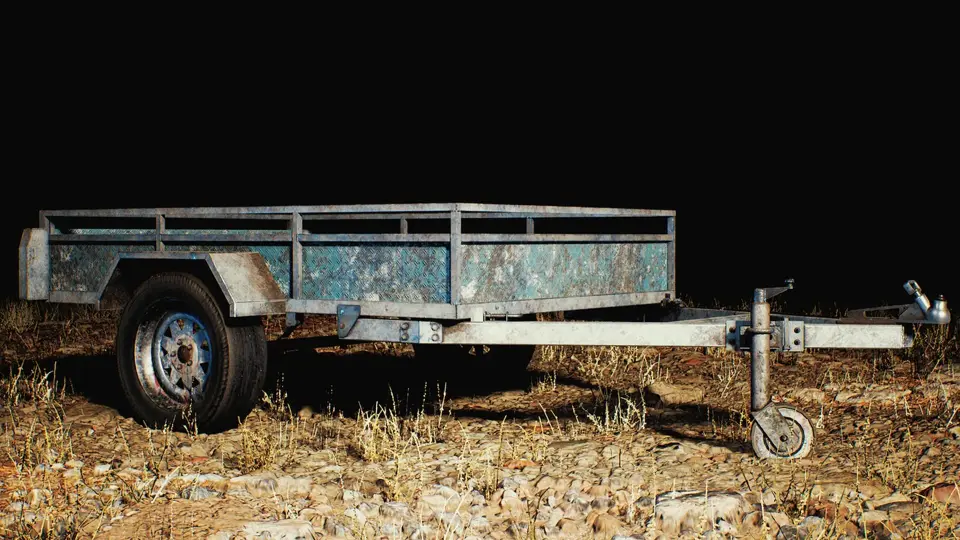
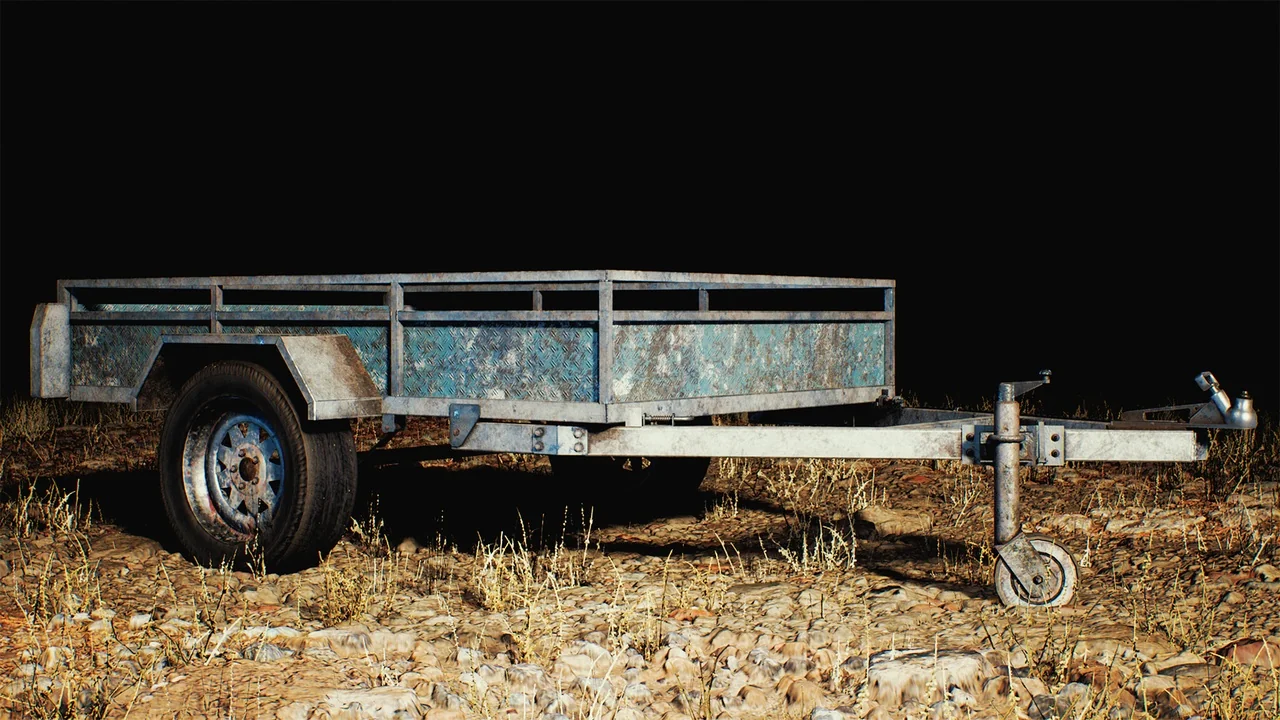
Mechanical realism in vehicle incidents depends on distinct sub-assemblies reacting independently. Rather than collapsing into an undifferentiated heap of debris, the trailer segregates its components into logical fracture points. The wheels, jockey wheel assembly, jockey handle bar, and the cargo tailgate exist as distinct physical objects bound by dynamic constraints.
The rear tailgate features four individual securing latches that govern how the gate remains attached or fails under stress:
Two Levels of Physics Damage: The four securing latches support intermediate stress states, allowing them to bend, loosen, or shear partially before full structural separation occurs.
Dynamic Tailgate Response: Once latch constraints fail under impact or directional forces, the tailgate swings freely on remaining connection points or falls away entirely onto the road surface.
Independent Wheel Detachment: Both primary transit wheels can break away from the axle mounts under high-velocity crashes or heavy vertical loads.
Jockey Assembly Disruption: The forward jockey wheel and its adjustment handle/bar can absorb hits from roadside obstacles or low-angle vehicle impacts, separating cleanly from the hitch tongue.
By dividing the breakdown sequence into specific hardware failures, collisions against curbs, roadblocks, or opposing vehicles produce varied, unscripted wreckage rather than identical scripted failure animations.
Master Blueprint Structure, Child Variations, and Hitching Examples
The technical architecture relies on an organized Blueprint hierarchy designed to minimize technical friction when implementing custom trailer configurations. At the core sits one Destructible Master Blueprint containing the primary constraint networks, hit reaction triggers, and socket structures. Branching from this master parent are three distinct Child Classes, each pre-configured with adjusted component arrangements and behavioral variables. This hierarchical separation ensures that any project-level adjustments applied to the Master Blueprint propagate cleanly across all derived classes without manual duplication.
Bridging the gap between static level dressing and drivable gameplay, the package provides a working trailer hitching example pre-configured to work directly with the Unreal Engine 4 starter sedan. This implementation demonstrates how the trailer tongue attaches to standard vehicle sockets, handles steering articulation, transfers momentum around corners, and detaches when catastrophic forces sever the hitch connection.
To support runtime interaction testing right out of the box, an included destructible throwable glass bottle Blueprint provides an immediate testing tool. Developers can pick up and hurl the bottle directly at the trailer's frame, latches, or wheels to inspect constraint thresholds, collision impulses, and hit responses without first binding weapon or driving mechanics.
Visual Fidelity, 4K Texture Downscaling, and Color Variations
Assets positioned in the immediate periphery of the camera require meticulous surface detailing to withstand close scrutiny. The trailer model is authored as a hero-quality asset, holding up under third-person following cameras, first-person character inspection, and tight cinematic framings. Welds, hinges, latch pins, and sheet metal surfaces retain sharp visual definition without showing geometric distortion or muddy surface mapping.
All texture sets are authored natively in 4K resolution, supplying high-frequency surface detail, normal map depth, and micro-roughness variations suitable for high-end rendering pipelines. To accommodate differing memory targets, mobile builds, or background dressing demands, the textures can be downscaled directly inside the engine editor without requiring external image manipulation software.
Surface customization is supported through four complete pre-built color variations, ranging across common industrial and utility vehicle finishes. For projects requiring specific art direction, bespoke fleet branding, or environmental camouflage, a dedicated color mask is integrated into the material pipeline, allowing developers to set exact custom hues across the body panels without painting new base color maps.
Static Variations, Simple Physics Simulation, and Custom Collision LODs
Not every environment demands fully dynamic constraint evaluation. Populating large logistics depots, highway pileups, or junkyard compounds with dozens of fully articulated physics Blueprints can overburden frame times. To address broad background placement, the collection includes seven static variations.
These static meshes are paired with custom-made collision profiles explicitly tuned for optimal hit detection. Even at extended rendering distances and aggressive level-of-detail (LOD) transitions, projectile registration, character navigation, and vehicle boundary tracking remain reliable. Thin railings, latch points, and wheel wells do not collapse into inaccurate bounding boxes, preventing collision clipping, floating tires, or snags during player contact.
Scene Integration and Practical Application
Because the trailer accommodates both high-speed towing and grounded physical interaction, it serves varied design roles across different interactive genres. In vehicular action titles, it provides dynamic cargo towing that alters vehicle handling dynamics until severe impacts dislodge the load. In survival games, it functions as roadside salvage, barricade material, or movable cover that deforms and sheds parts when subjected to gunfire or heavy impacts.
The asset also notes direct compatibility with the Zombies - Modular Four Pack, making it well suited for post-apocalyptic roadblocks, mobile survivor convoys, and quarantine extraction compounds. Whether deployed as a functional hauler tied to an escape car, a heavy obstruction shoved into a barricade opening, or static roadside scatter, the combination of multi-stage destruction, flexible physics modes, and scalable texture assets delivers a solid mechanical utility asset for game worlds.
 Cars & Trucks
 Cars & Trucks
 Cars & Trucks
 Cars & Trucks