Ropes, rods, and secondary motion in one setup
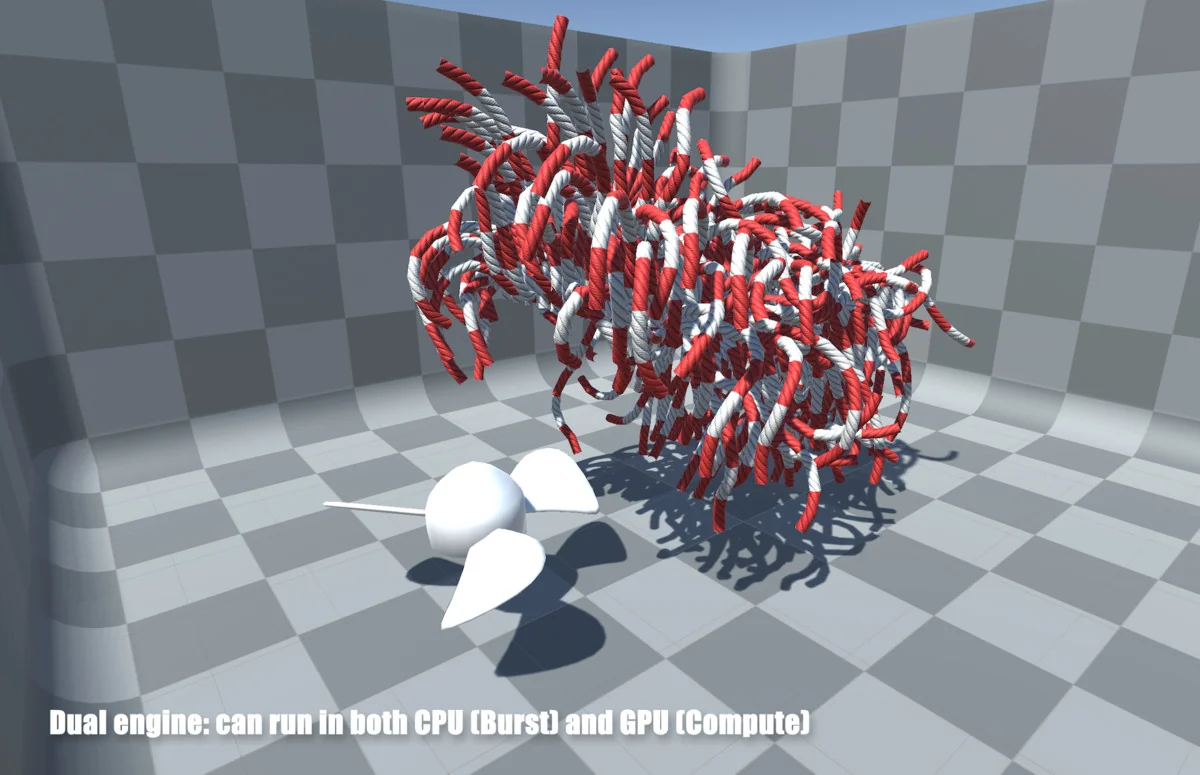
Ropes and rods are often the parts of a scene that need to stay responsive while everything around them holds its shape. Obi Rope fits that kind of work by pairing rope simulation with rod behavior and bone-driven secondary motion inside Unity. The system is built on Obi, an advanced particle-based physics engine that handles a wide range of deformable material behaviors and can run on either the CPU or the GPU.
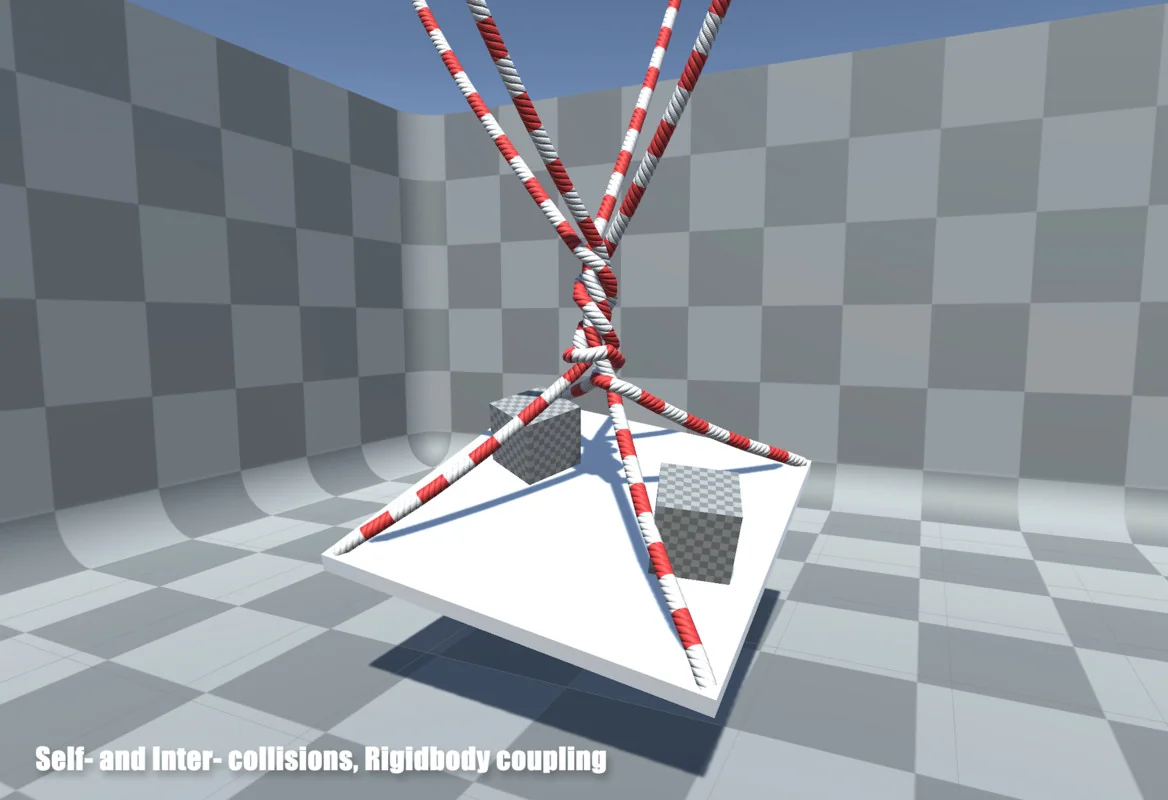
That setup gives the package a broad role in a project. Ropes can be made quickly, rods can carry twisting motion, and bones can add extra movement to character bone hierarchies. The same system also supports collision with the environment and with other simulated objects, so the rope or rod is not isolated from the rest of the scene.
Particles instead of rigid-body chains
Obi Rope does not rely on rigid bodies and joints the way some rope solutions do. Its simulation is based on XPBD particles, which is presented as a lighter, more detailed, and unconditionally stable approach. That makes the structure of the system easy to read: the rope behaves as a particle simulation first, not as a chain of linked rigid bodies.
CPU mode depends on the Burst, Jobs, Collections, and Mathematics packages. GPU mode requires compute shader support. Those requirements matter because they shape how the simulation is executed, whether the project is leaning on the CPU path or taking advantage of GPU compute support.
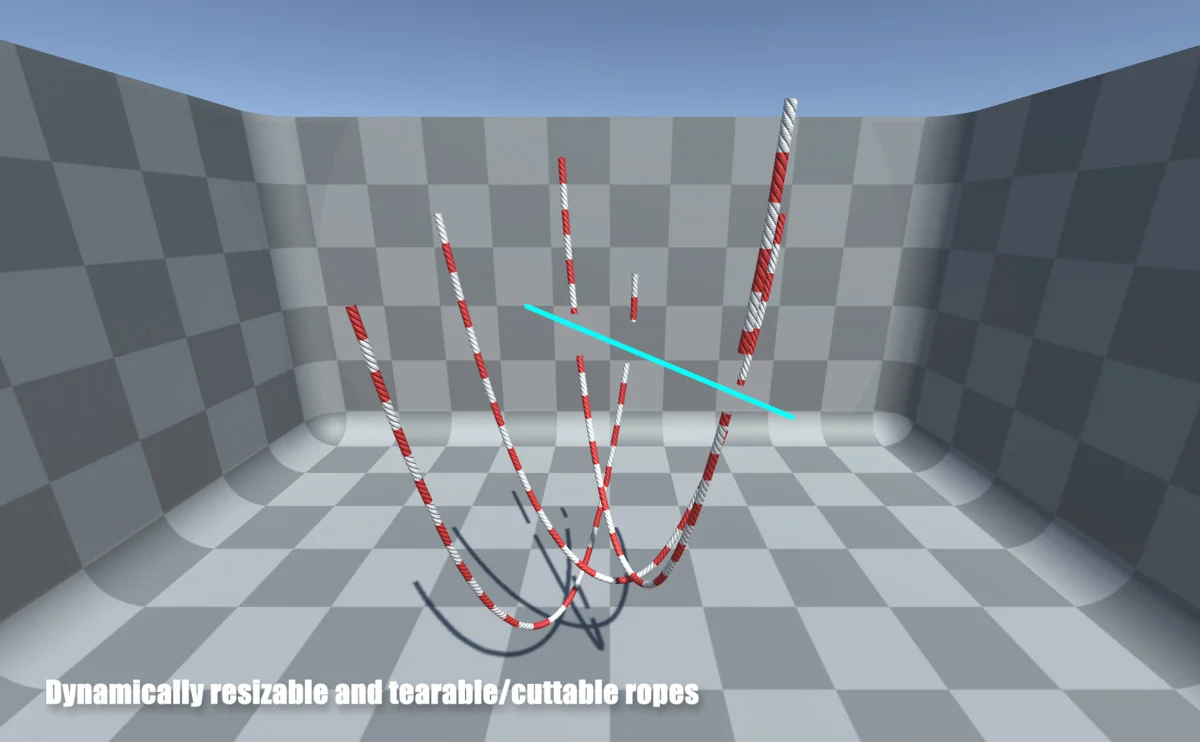
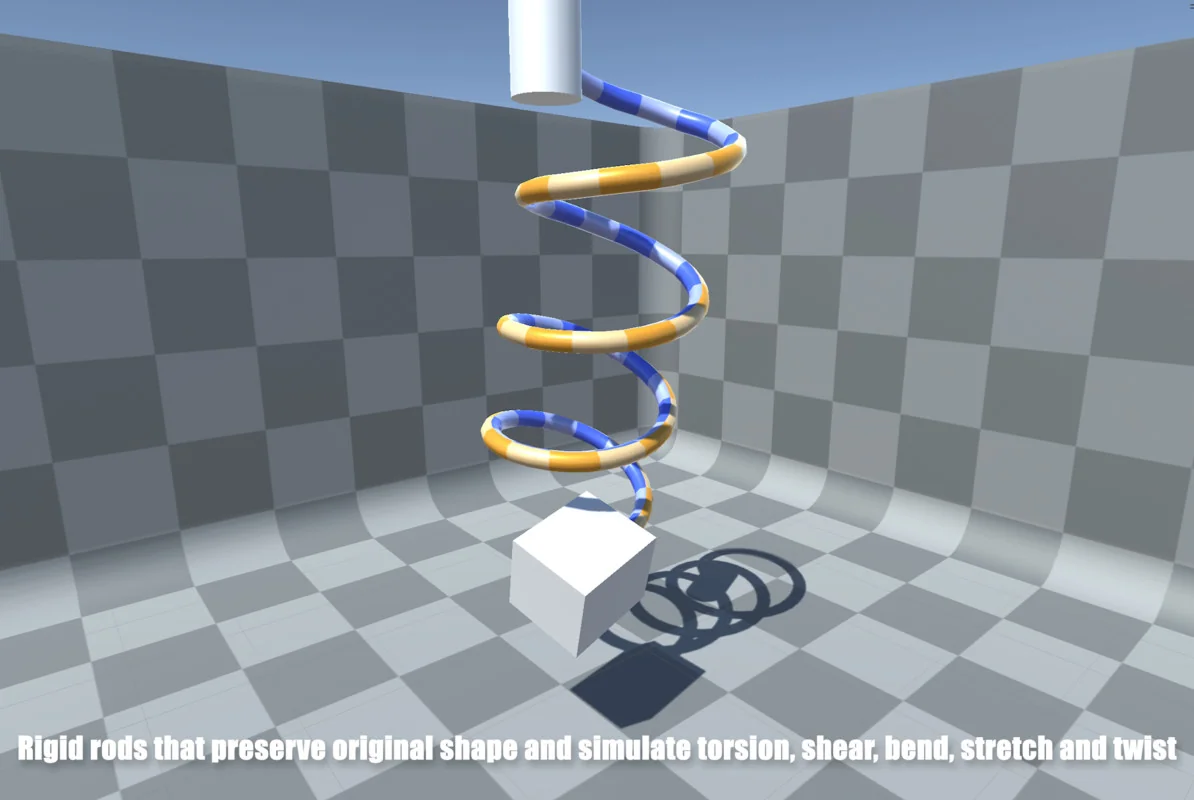
Rods use oriented particle technology, which allows torsion and twisting effects. Ropes are described as more lightweight and can be cut or resized. Both rope and rod setups can be attached to rigid bodies, and the interaction goes both ways so the simulated object and the rigid body influence each other.
Spline editing that stays live while you work
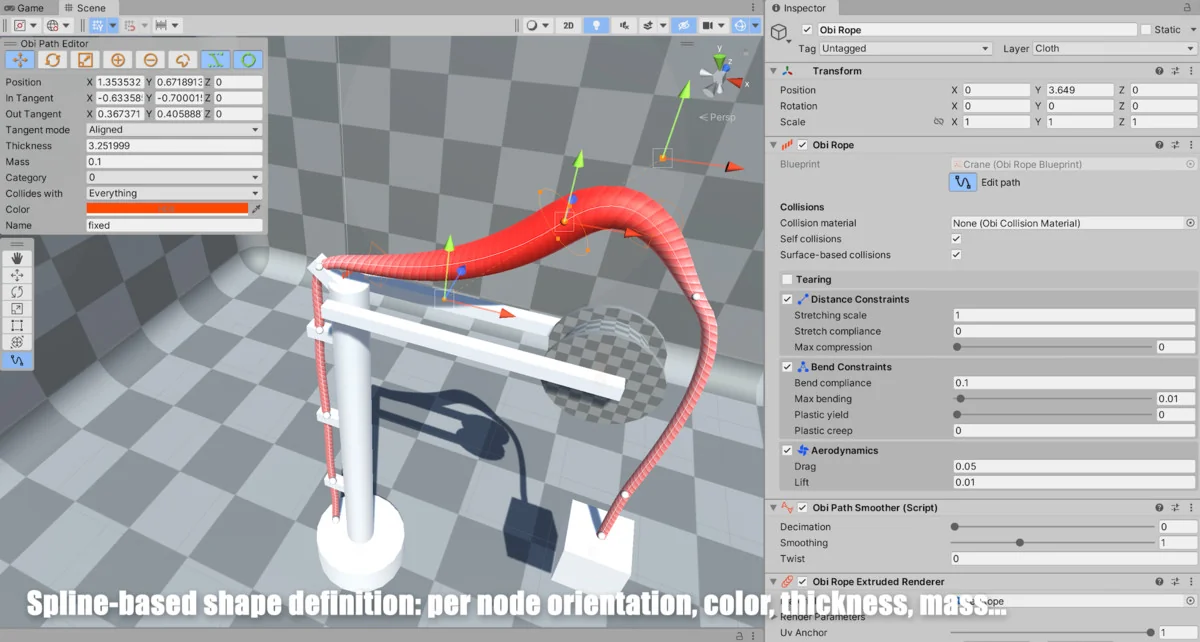
Building a rope does not depend on manual geometry work. Non-linear, non-destructive editing uses splines, and the editor gives immediate visual feedback while the rope is being shaped. That makes the setup process practical for scenes that need quick iteration on length, curve, or layout.
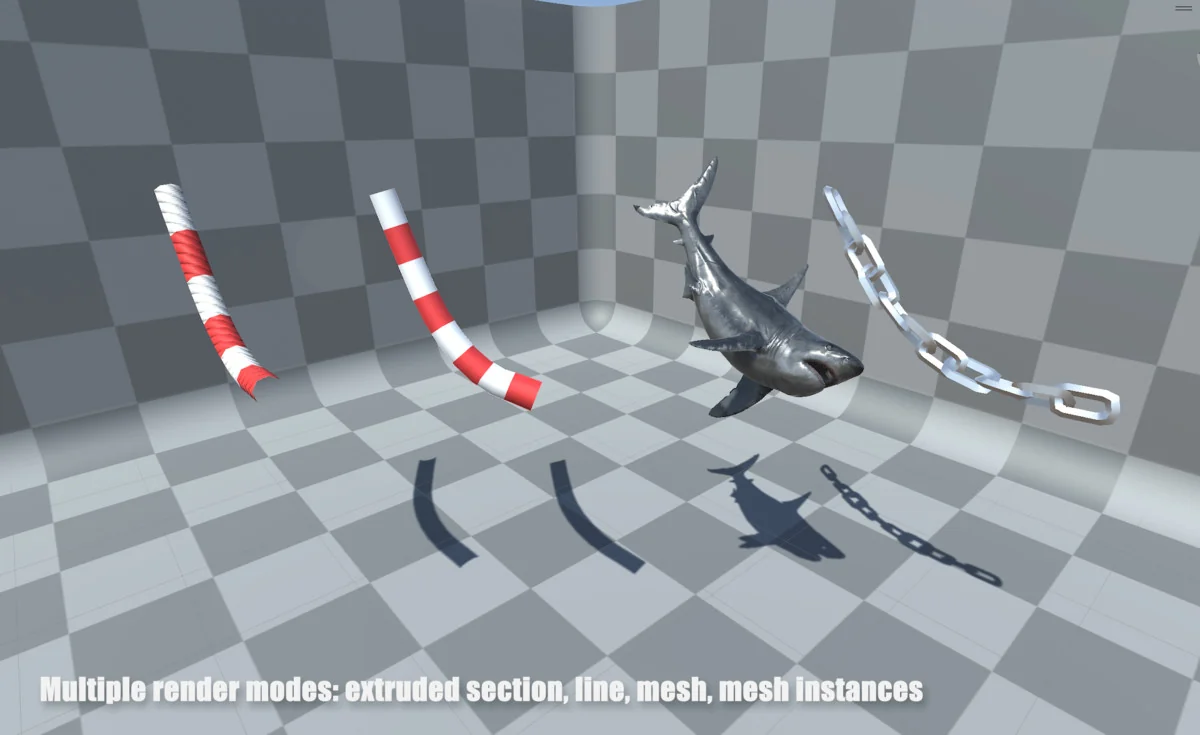
Mesh generation is handled procedurally with splines as well. The generated mesh includes tangent space updating and normal map support, so the rope can carry a cleaner surface without requiring separate geometry creation. Adaptive curvature-based realtime mesh decimation goes a step further by simplifying straight sections more than curved sections, which keeps the geometry aligned with the ropeâs shape.
Controls exposed in the editor and at runtime
- Change rope length at runtime
- Create tearable or cuttable rope
- Build closed loops
- Use modular solver settings so only the needed constraints are evaluated
- Adjust solver iteration counts per module
- Set independent stretch and bending stiffness
- Work with editor particle tools such as selection, brush selection, paintbrush, and property smoothing
Those controls keep the workflow flexible. A rope can be edited in the scene, then adjusted again during play without forcing the setup into a fixed shape. Per-module solver iteration counts and independent stiffness settings also make the simulation more specific, since one part of the rope does not need to behave exactly like another.
Collision, culling, and project fit
Obi Rope supports all standard Unity colliders, which places it in the same collision space as the rest of a typical Unity project. Automatic camera culling is also included, so ropes that are not visible do not keep updating their simulation.
The current technical details list version 7.1, with a latest release date of Jun 12, 2025 and an original publication date of Jun 10, 2016. The original Unity version is 2021.3.4, and render pipeline compatibility is listed for Built-in, HDRP, URP, and Custom SRP on 2021.3.4f1. The package size is 12.0 MB, the asset count is 908, and the package type is unitypackage.
For a project that needs ropes, rods, or bone-linked motion to behave as active scene elements rather than static meshes, Obi Rope gives a single particle-based system for shaping, simulating, colliding, and refining that motion inside Unity.
Project Screenshots
Protected download
Access this resource
All resources are 100% manually reviewed to eliminate all risks.