"a338a1d501976271"{"id":"1000318","slug":"mythical-pack-01","title":"Mythical pack 01","category":"Characters \u0026 Creatures","engine":"4.26+,5.0+","assetVersion":"","engineVersion":"Engine Version: 4.26+,5.0+","tag":"Characters","accent":"blue","visual":"character","summary":"Implement five custom mythical creatures into fantasy projects with detailed Epic Skeleton rigging, custom bone setups, and modular fur meshes.","platform":"Unreal Engine","publishedAt":"2026-07-04T17:00:22.951Z","updatedAt":"2026-07-04T17:00:22.951Z","sourceNotes":[],"fileContents":[],"compatibility":["Unreal Engine","Engine Version: 4.26+,5.0+"],"featuredImage":{"alt":"Mythical pack 01","src":"/wp-content/uploads/published/2026/07/b86d65134c8e-285fd4b3-a7c0-4d85-ab8a-0003a3a908c5-4012e7d8a9.webp"},"hasDownloadLink":true,"downloads":0,"terms":[{"taxonomy":"category","slug":"characters-and-creatures","name":"Characters \u0026 Creatures"}],"galleryImages":[{"src":"/wp-content/uploads/published/2026/07/3e16858b37ff-90ddb944-faca-405d-821c-340a77e1c9d9-2d159e6db7.webp","alt":"Mythical pack 01"},{"src":"/wp-content/uploads/published/2026/07/396c04ee7b51-033e30d1-d2ba-48b7-b6b5-9dca52c24c80-be7a0158c2.webp","alt":"Mythical pack 01"},{"src":"/wp-content/uploads/published/2026/07/223d8ce34ea6-abb3d33f-967a-4a50-9cf4-131fd6310f57-dfdc3d448a.webp","alt":"Mythical pack 01"},{"src":"/wp-content/uploads/published/2026/07/565b43460975-e614997b-cacf-4afd-abe3-b4cf8e80490c-d175d3e3a1.webp","alt":"Mythical pack 01"},{"src":"/wp-content/uploads/published/2026/07/137538fe5b2d-fefb0067-a092-4e5b-a54c-1b3f29824a6b-2cefa06479.webp","alt":"Mythical pack 01"},{"src":"/wp-content/uploads/published/2026/07/4b179edc9e7c-85bcef6e-423e-4f63-b1f9-c8c52c5663d1-599f5cc5f3.webp","alt":"Mythical pack 01"},{"src":"/wp-content/uploads/published/2026/07/fc7ad71639ee-4c1bddab-da09-435e-ab2d-976b6e7ec52d-4360d7a3e9.webp","alt":"Mythical pack 01"},{"src":"/wp-content/uploads/published/2026/07/8fa0e6e7bddc-e75e4230-b92c-435c-b7fa-53071a20d628-50aaba1b68.webp","alt":"Mythical pack 01"},{"src":"/wp-content/uploads/published/2026/07/36a3349ecdfb-ce549366-86a0-4c9f-b693-d74e7d4707a9-53f536e3e2.webp","alt":"Mythical pack 01"},{"src":"/wp-content/uploads/published/2026/07/a0b358f7e5d2-02b567c0-c108-4626-89f7-784ab1c03963-f535990a89.webp","alt":"Mythical pack 01"}],"accessPanel":{"kind":"resource","title":"Download this resource","eyebrow":"Free Download","message":"Log in or create a free account to start your download.","fileName":"Content.7z","safetyNote":"Resources are manually reviewed before listing to improve quality and reduce obvious risks.","actionLabel":"Download Free","resourceType":"Resource archive"},"contentHtml":"\u003cp\u003eIntegrating original enemy and boss characters into fantasy and RPG projects often requires balancing distinct visual designs with standardized animation frameworks. Mythical pack 01 provides five distinct fleshy creatures—the Werewolf, Satyr, Wendigo, Forest Keeper, and Swampman—built from custom concepts and prepared for direct implementation. These realistic characters are tailored to serve as hostile encounters, challenging bosses, or specialized NPCs, bringing unique physical profiles and specific rig additions to game environments. The package provides a structured approach to character setup, ensuring that each creature's specific biology is supported by accessible material controls and robust geometric organization.\u003c/p\u003e \u003ch2\u003eEpic Skeleton Integration and Custom Bone Structures\u003c/h2\u003e\n\u003cp\u003eEvery creature in the collection is rigged to the Epic Skeleton, ensuring immediate compatibility with standard animation blueprints and retargeting pipelines. This foundational setup allows developers to apply existing bipedal animations, combat cycles, and movement scripts directly to the models. However, to support their non-human anatomies and specific physical traits, the creator has implemented additional bone structures across the lineup to handle specialized animations.\u003c/p\u003e\n\u003cp\u003eThe jaw mechanics are consistent across all five models, with \u003ccode\u003eJaw_01\u003c/code\u003e And \u003ccode\u003eJaw_02\u003c/code\u003e Bones provided to control biting, roaring, and chewing animations crucial for aggressive encounters. Eye control varies significantly depending on the creature's specific biology. The Swampman and Forest Keeper utilize \u003ccode\u003eEye_01_r\u003c/code\u003e And \u003ccode\u003eEye_02\u003c/code\u003e Bones for their visual targeting systems. The Wendigo features a complex multi-eye configuration, utilizing separate bones for the right side (\u003ccode\u003eEye_01_r\u003c/code\u003e, \u003ccode\u003eEye_02_r\u003c/code\u003e, \u003ccode\u003eEye_03_r\u003c/code\u003e) and the left side (\u003ccode\u003eEye_01_l\u003c/code\u003e, \u003ccode\u003eEye_02_l\u003c/code\u003e, \u003ccode\u003eEye_03_l\u003c/code\u003e) of its face, allowing for unsettling, independent eye movements. The Satyr and Werewolf feature a more traditional \u003ccode\u003eEye_r\u003c/code\u003e And \u003ccode\u003eEye_l\u003c/code\u003e Setup.\u003c/p\u003e\n\u003cp\u003eIn addition, the Satyr includes specific articulated ear bones (\u003ccode\u003eEar_01_r\u003c/code\u003e, \u003ccode\u003eEar_02_r\u003c/code\u003e, \u003ccode\u003eEar_03_r\u003c/code\u003e, \u003ccode\u003eEar_01_l\u003c/code\u003e, \u003ccode\u003eEar_02_l\u003c/code\u003e, \u003ccode\u003eEar_03_l\u003c/code\u003e). This extensive ear rig allows animators to drive expressive flicks and twitches that react to environmental triggers, idle states, or shifts into combat readiness, adding a layer of realistic creature behavior to the implementation.\u003c/p\u003e \u003ch2\u003eMaterial Customization and PBR Texture Sets\u003c/h2\u003e\n\u003cp\u003eThe visual fidelity of the mythical creatures relies on comprehensive 4K PBR texture sets saved in the uncompressed TGA format, ensuring high-quality rendering without compression artifacts. Most of the characters—the Swampman, Wendigo, Satyr, and Werewolf—utilize four distinct 4096x4096 texture sets. The Swampman manages its visuals through four core materials, two material instances, and 12 individual textures. The Wendigo, Satyr, and Werewolf share a similar structure, each using four materials, three material instances, and 16 individual textures.\u003c/p\u003e\n\u003cp\u003eThe Forest Keeper requires a heavier material footprint to support its complex design, utilizing six 4096x4096 texture sets driven by six materials and five material instances, bringing its total texture count to 23.\u003c/p\u003e\n\u003cp\u003eBeyond the static textures, the material instances provide direct parameter controls for customization. Developers can alter the eye and body colors across the entire roster, allowing for rapid iteration during level design. For the Forest Keeper, Wendigo, Satyr, and Werewolf, the material instances also expose controls to change the color of the fur. This functionality enables the easy creation of biome-specific creature variants—such as an arctic Wendigo or a corrupted forest Satyr—or distinct elite-tier enemies without needing to author entirely new texture maps externally.\u003c/p\u003e \u003ch2\u003eMesh Modularity and Fur Implementation\u003c/h2\u003e\n\u003cp\u003eHandling fur on complex creature models requires deliberate mesh organization to maintain performance and rendering flexibility. For the Wendigo, Satyr, and Werewolf, the creator separated the primary anatomical body from the fur elements, resulting in distinct geometric profiles for each component.\u003c/p\u003e\n\u003cp\u003eThe Wendigo's base body sits at 15,880 vertices (31,714 triangles, 16,710 faces), while its fur layer adds an additional 12,761 vertices (14,456 triangles, 7,218 faces). The Satyr's underlying body is slightly lighter at 10,418 vertices (20,730 triangles, 10,923 faces), but its fur component is significantly denser, requiring 19,618 vertices (22,192 triangles, 11,083 faces) to capture its shaggy profile. The Werewolf pushes the fur geometry the furthest; while its base fleshy body is optimized at 10,644 vertices (21,284 triangles, 11,066 faces), the extensive fur coat demands a heavy 29,651 vertices (36,364 triangles, 18,176 faces).\u003c/p\u003e\n\u003cp\u003eThis separation allows developers to isolate the fur for specialized rendering techniques, physics simulation, or LOD adjustments independently of the main character mesh, providing essential control over scene optimization.\u003c/p\u003e \u003ch2\u003eFacial Animation via Morph Targets\u003c/h2\u003e\n\u003cp\u003eWhile custom jaw and eye bones handle primary structural movements across the pack, the Swampman and Forest Keeper feature extensive blendshape setups for highly nuanced facial animation. The Swampman is equipped with 49 specific morph targets, giving animators fine-tuned control over its fleshy features to create distinct expressions, combat grimaces, or idle breathing states.\u003c/p\u003e\n\u003cp\u003eThe Forest Keeper expands on this capability with 52 individual blendshapes. This morph target approach provides an alternative to pure bone-driven facial animation, allowing for smoother transitions between complex emotional states, subtle ambient twitches, or aggressive reactions during boss encounters and cinematic NPC dialogues.\u003c/p\u003e \u003ch2\u003eGeometry Scaling Across the Roster\u003c/h2\u003e\n\u003cp\u003eThe polygon distribution across the asset pack scales according to the physical bulk and visual complexity of each specific creature. The Swampman is the most geometrically constrained of the group, functioning well as a standard enemy unit with a total of 14,510 vertices, 27,828 triangles, and 14,701 faces.\u003c/p\u003e\n\u003cp\u003eConversely, the Forest Keeper serves as a massive, detailed set-piece character or primary boss encounter, carrying the heaviest geometric weight at 38,758 vertices, 57,972 triangles, and 29,892 faces. The combined body and fur counts for the Wendigo, Satyr, and Werewolf position them in the middle of this performance spectrum. This varied distribution ensures that developers can balance their scene budgets effectively, making informed decisions based on how many of these mythical creatures are spawned simultaneously in a given fantasy environment.\u003c/p\u003e\n\n\u003ch2\u003eExplore Similar Assets\u003c/h2\u003e\n\u003cul\u003e\n\u003cli\u003e\u003ca href=\"https://3dcghub.com/l-chinesewarrior/\" title=\"L: ChineseWarrior\"\u003eL: ChineseWarrior\u003c/a\u003e\u003c/li\u003e\n\u003cli\u003e\u003ca href=\"https://3dcghub.com/super-pack-of-skeletons/\" title=\"Super pack of skeletons\"\u003eSuper pack of skeletons\u003c/a\u003e\u003c/li\u003e\n\u003cli\u003e\u003ca href=\"https://3dcghub.com/maniac-towing-modular-5in1/\" title=\"Maniac Towing Modular 5in1\"\u003eManiac Towing Modular 5in1\u003c/a\u003e\u003c/li\u003e\n\u003cli\u003e\u003ca href=\"https://3dcghub.com/modular-skeleton-mage/\" title=\"Modular Skeleton Mage\"\u003eModular Skeleton Mage\u003c/a\u003e\u003c/li\u003e\n\u003cli\u003e\u003ca href=\"https://3dcghub.com/necromancer-armor/\" title=\"Necromancer Armor\"\u003eNecromancer Armor\u003c/a\u003e\u003c/li\u003e\n\u003c/ul\u003e","contentTextLength":6713,"navigation":{"current":1158,"total":3338,"previous":{"id":"1000319","slug":"orphans-of-the-great-war-props-for-characters-asset-pack","title":"Orphans of the Great War - Props for characters - Asset Pack","category":"Hardware","platform":"Unreal Engine","updatedAt":"2026-07-04T17:21:52.866Z"},"next":{"id":"1000317","slug":"multiplayer-shooter-engine-4-0","title":"Multiplayer Shooter Engine 4.0","category":"Sports","platform":"Unreal Engine","updatedAt":"2026-07-04T16:26:09.124Z"}},"relatedResources":[{"id":"1001072","slug":"valkyrie","title":"Valkyrie","category":"Characters \u0026 Creatures","engine":"4.26+,5.0+","assetVersion":"","engineVersion":"Engine Version: 4.26+,5.0+","tag":"Characters","accent":"blue","visual":"character","summary":"A winged female warrior for Unreal Engine with Epic skeleton setup, separate wing and hair physics rigs, 51 face blendshapes, and detailed poly counts across ev","platform":"Unreal Engine","publishedAt":"2026-09-03T17:22:55.379Z","updatedAt":"2026-09-03T17:22:55.379Z","sourceNotes":[],"fileContents":[],"compatibility":["Unreal Engine","Engine Version: 4.26+,5.0+"],"featuredImage":{"alt":"Valkyrie","src":"/wp-content/uploads/published/2026/09/21dd37643efd-c9f2d675-6063-4800-978e-9fd9101250a7-155a88922a.webp"},"hasDownloadLink":true,"downloads":1},{"id":"1000106","slug":"super-pack-of-skeletons","title":"Super pack of skeletons","category":"Characters \u0026 Creatures","engine":"Engine Version: 4.26+,5.0+","assetVersion":"Engine Version: 4.26+,5.0+","engineVersion":"","tag":"Characters","accent":"blue","visual":"character","summary":"A skeleton character collection for Unreal workflows, featuring multiple undead variants, Epic Skeleton rigging, custom tissue physics, and detailed texture set","platform":"Unreal Engine","publishedAt":"2026-06-07T16:30:49.830Z","updatedAt":"2026-06-07T16:30:49.830Z","sourceNotes":[],"fileContents":[],"compatibility":["Unreal Engine","Engine Version: 4.26+,5.0+"],"featuredImage":{"alt":"Super pack of skeletons","src":"/wp-content/uploads/published/2026/06/450b7a609c00-eee2705a-70e9-473d-bfff-921ba59aead6-6ea6af8489.webp"},"hasDownloadLink":true,"downloads":3},{"id":"1000809","slug":"customized-post-apocalyptic-characters","title":"Customized Post Apocalyptic Characters","category":"Characters \u0026 Creatures","engine":"4.26+,5.0+","assetVersion":"","engineVersion":"Engine Version: 4.26+,5.0+","tag":"Characters","accent":"blue","visual":"character","summary":"Modular post-apocalyptic character pack with interchangeable heads, clothes, masks, backpacks, weapons, and Epic Skeleton rigging for survival and horror scenes","platform":"Unreal Engine","publishedAt":"2026-07-31T08:49:21.684Z","updatedAt":"2026-07-31T08:49:21.684Z","sourceNotes":[],"fileContents":[],"compatibility":["Unreal Engine","Engine Version: 4.26+,5.0+"],"featuredImage":{"alt":"Customized Post Apocalyptic Characters","src":"/wp-content/uploads/published/2026/07/82f2105f5d37-1650b3e7-da11-460d-952c-372e3c366b5b-6eac59119d.webp"},"hasDownloadLink":true,"downloads":1}]}
Characters
Mythical pack 01
Implement five custom mythical creatures into fantasy projects with detailed Epic Skeleton rigging, custom bone setups, and modular fur meshes.
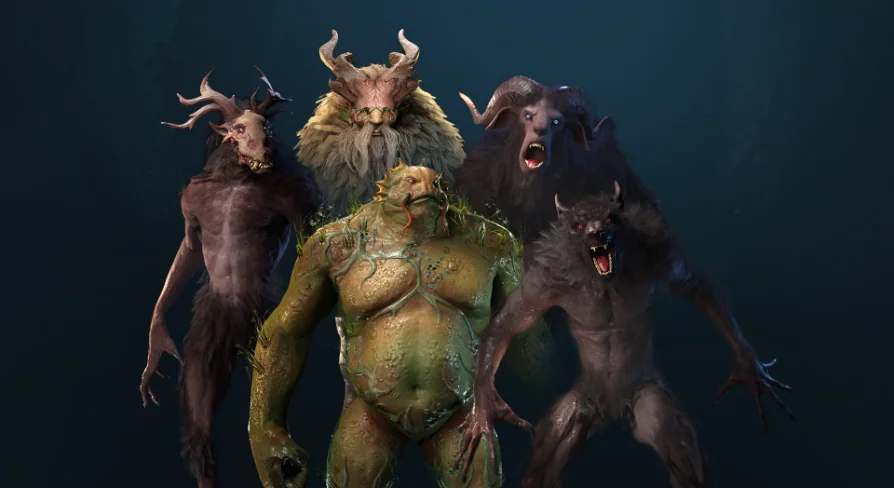
Integrating original enemy and boss characters into fantasy and RPG projects often requires balancing distinct visual designs with standardized animation frameworks. Mythical pack 01 provides five distinct fleshy creatures—the Werewolf, Satyr, Wendigo, Forest Keeper, and Swampman—built from custom concepts and prepared for direct implementation. These realistic characters are tailored to serve as hostile encounters, challenging bosses, or specialized NPCs, bringing unique physical profiles and specific rig additions to game environments. The package provides a structured approach to character setup, ensuring that each creature's specific biology is supported by accessible material controls and robust geometric organization.
Epic Skeleton Integration and Custom Bone Structures
Every creature in the collection is rigged to the Epic Skeleton, ensuring immediate compatibility with standard animation blueprints and retargeting pipelines. This foundational setup allows developers to apply existing bipedal animations, combat cycles, and movement scripts directly to the models. However, to support their non-human anatomies and specific physical traits, the creator has implemented additional bone structures across the lineup to handle specialized animations.
The jaw mechanics are consistent across all five models, with Jaw_01 And Jaw_02 Bones provided to control biting, roaring, and chewing animations crucial for aggressive encounters. Eye control varies significantly depending on the creature's specific biology. The Swampman and Forest Keeper utilize Eye_01_r And Eye_02 Bones for their visual targeting systems. The Wendigo features a complex multi-eye configuration, utilizing separate bones for the right side (Eye_01_r, Eye_02_r, Eye_03_r) and the left side (Eye_01_l, Eye_02_l, Eye_03_l) of its face, allowing for unsettling, independent eye movements. The Satyr and Werewolf feature a more traditional Eye_r And Eye_l Setup.
In addition, the Satyr includes specific articulated ear bones (Ear_01_r, Ear_02_r, Ear_03_r, Ear_01_l, Ear_02_l, Ear_03_l). This extensive ear rig allows animators to drive expressive flicks and twitches that react to environmental triggers, idle states, or shifts into combat readiness, adding a layer of realistic creature behavior to the implementation.
Material Customization and PBR Texture Sets
The visual fidelity of the mythical creatures relies on comprehensive 4K PBR texture sets saved in the uncompressed TGA format, ensuring high-quality rendering without compression artifacts. Most of the characters—the Swampman, Wendigo, Satyr, and Werewolf—utilize four distinct 4096x4096 texture sets. The Swampman manages its visuals through four core materials, two material instances, and 12 individual textures. The Wendigo, Satyr, and Werewolf share a similar structure, each using four materials, three material instances, and 16 individual textures.
The Forest Keeper requires a heavier material footprint to support its complex design, utilizing six 4096x4096 texture sets driven by six materials and five material instances, bringing its total texture count to 23.
Beyond the static textures, the material instances provide direct parameter controls for customization. Developers can alter the eye and body colors across the entire roster, allowing for rapid iteration during level design. For the Forest Keeper, Wendigo, Satyr, and Werewolf, the material instances also expose controls to change the color of the fur. This functionality enables the easy creation of biome-specific creature variants—such as an arctic Wendigo or a corrupted forest Satyr—or distinct elite-tier enemies without needing to author entirely new texture maps externally.
Mesh Modularity and Fur Implementation
Handling fur on complex creature models requires deliberate mesh organization to maintain performance and rendering flexibility. For the Wendigo, Satyr, and Werewolf, the creator separated the primary anatomical body from the fur elements, resulting in distinct geometric profiles for each component.
The Wendigo's base body sits at 15,880 vertices (31,714 triangles, 16,710 faces), while its fur layer adds an additional 12,761 vertices (14,456 triangles, 7,218 faces). The Satyr's underlying body is slightly lighter at 10,418 vertices (20,730 triangles, 10,923 faces), but its fur component is significantly denser, requiring 19,618 vertices (22,192 triangles, 11,083 faces) to capture its shaggy profile. The Werewolf pushes the fur geometry the furthest; while its base fleshy body is optimized at 10,644 vertices (21,284 triangles, 11,066 faces), the extensive fur coat demands a heavy 29,651 vertices (36,364 triangles, 18,176 faces).
This separation allows developers to isolate the fur for specialized rendering techniques, physics simulation, or LOD adjustments independently of the main character mesh, providing essential control over scene optimization.
Facial Animation via Morph Targets
While custom jaw and eye bones handle primary structural movements across the pack, the Swampman and Forest Keeper feature extensive blendshape setups for highly nuanced facial animation. The Swampman is equipped with 49 specific morph targets, giving animators fine-tuned control over its fleshy features to create distinct expressions, combat grimaces, or idle breathing states.
The Forest Keeper expands on this capability with 52 individual blendshapes. This morph target approach provides an alternative to pure bone-driven facial animation, allowing for smoother transitions between complex emotional states, subtle ambient twitches, or aggressive reactions during boss encounters and cinematic NPC dialogues.
Geometry Scaling Across the Roster
The polygon distribution across the asset pack scales according to the physical bulk and visual complexity of each specific creature. The Swampman is the most geometrically constrained of the group, functioning well as a standard enemy unit with a total of 14,510 vertices, 27,828 triangles, and 14,701 faces.
Conversely, the Forest Keeper serves as a massive, detailed set-piece character or primary boss encounter, carrying the heaviest geometric weight at 38,758 vertices, 57,972 triangles, and 29,892 faces. The combined body and fur counts for the Wendigo, Satyr, and Werewolf position them in the middle of this performance spectrum. This varied distribution ensures that developers can balance their scene budgets effectively, making informed decisions based on how many of these mythical creatures are spawned simultaneously in a given fantasy environment.
 Characters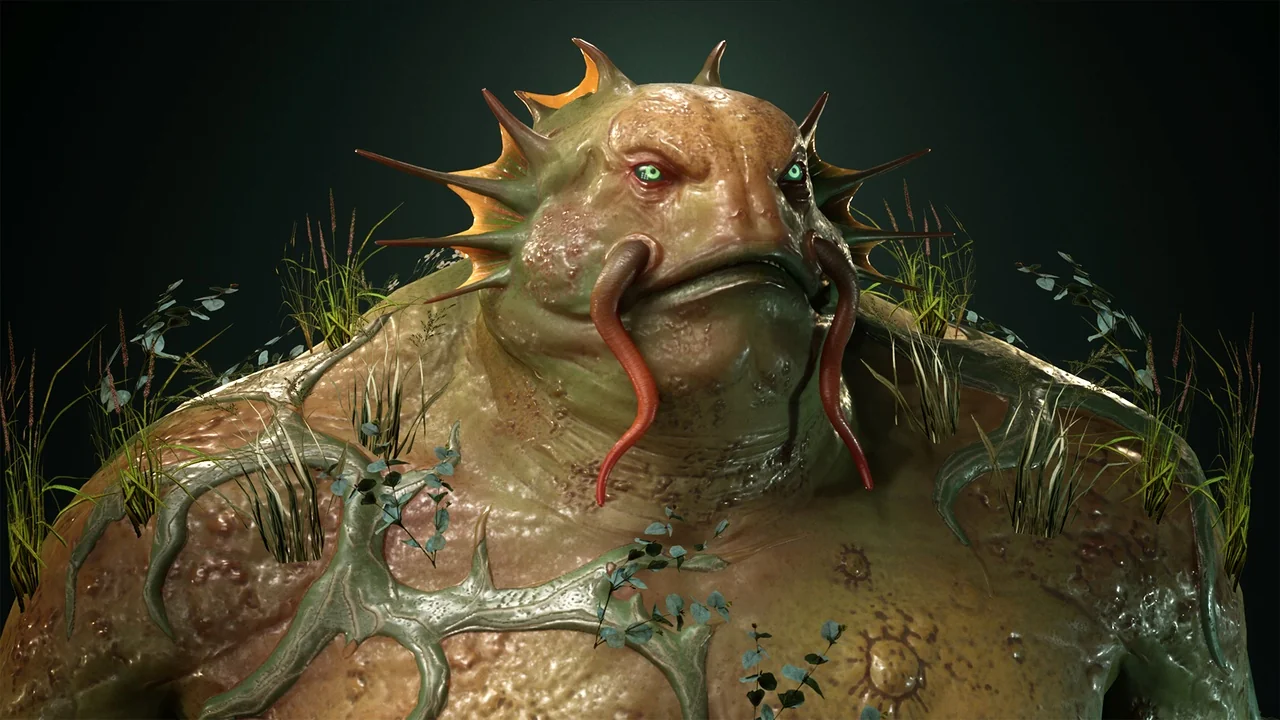
 Characters
 Characters
 Characters