"a338a1d501976271"{"id":"1000319","slug":"orphans-of-the-great-war-props-for-characters-asset-pack","title":"Orphans of the Great War - Props for characters - Asset Pack","category":"Hardware","engine":"5.1+","assetVersion":"","engineVersion":"Engine Version: 5.1+","tag":"Hardware","accent":"blue","visual":"character","summary":"Equip characters and populate post-apocalyptic scenes with this optimized, PBR-ready pack of 19th and 20th-century survival props for mobile and VR.","platform":"Unreal Engine","publishedAt":"2026-07-04T17:21:52.866Z","updatedAt":"2026-07-04T17:21:52.866Z","sourceNotes":[],"fileContents":[],"compatibility":["Unreal Engine","Engine Version: 5.1+"],"featuredImage":{"alt":"Orphans of the Great War - Props for characters - Asset Pack","src":"/wp-content/uploads/published/2026/07/eef360227b9a-d319b326-d0dd-41b4-b299-3068e5a3316d-791ead9f8a.webp"},"hasDownloadLink":true,"downloads":0,"terms":[{"taxonomy":"category","slug":"hardware","name":"Hardware"}],"galleryImages":[{"src":"/wp-content/uploads/published/2026/07/1f4d76df6566-3fa2a3bd-f0aa-4d51-8ee7-bf0a8bdd7c41-40d5c182ce.webp","alt":"Orphans of the Great War - Props for characters - Asset Pack"},{"src":"/wp-content/uploads/published/2026/07/0b083d4745db-97447618-6fe5-468b-80a5-623a323cd6c9-07850f3dc9.webp","alt":"Orphans of the Great War - Props for characters - Asset Pack"},{"src":"/wp-content/uploads/published/2026/07/aa1f44463409-39fadcf6-13a8-40d8-97c7-d2e174d48ceb-05d1cbc765.webp","alt":"Orphans of the Great War - Props for characters - Asset Pack"},{"src":"/wp-content/uploads/published/2026/07/58bc231249f7-31bb96e9-76ab-4041-ac85-42db110d7af7-17647d826a.webp","alt":"Orphans of the Great War - Props for characters - Asset Pack"},{"src":"/wp-content/uploads/published/2026/07/24f217238b81-a64d31b9-a991-4694-82f3-85247c793ecf-b3ec28e1ec.webp","alt":"Orphans of the Great War - Props for characters - Asset Pack"},{"src":"/wp-content/uploads/published/2026/07/7fbb9e5a5d44-38b8210e-f8a5-4068-a083-798ff4a3c75f-14c74627b4.webp","alt":"Orphans of the Great War - Props for characters - Asset Pack"},{"src":"/wp-content/uploads/published/2026/07/36669dec8649-6899b8b2-a770-4e04-9c9c-591d7b2dea3d-92e1ae9811.webp","alt":"Orphans of the Great War - Props for characters - Asset Pack"},{"src":"/wp-content/uploads/published/2026/07/46bbc0425c79-1002c768-d071-4c3c-bf64-f813245f816a-e24f4ebb32.webp","alt":"Orphans of the Great War - Props for characters - Asset Pack"},{"src":"/wp-content/uploads/published/2026/07/4e9ab92086c3-33604d90-fc88-4ccb-b014-c6d29ba446c1-2fe1bc7eb4.webp","alt":"Orphans of the Great War - Props for characters - Asset Pack"},{"src":"/wp-content/uploads/published/2026/07/32800b9e0a6b-00c41d4f-13da-46b6-a241-30d5612758bd-aa7a9b1a29.webp","alt":"Orphans of the Great War - Props for characters - Asset Pack"}],"accessPanel":{"kind":"resource","title":"Download this resource","eyebrow":"Free Download","message":"Log in or create a free account to start your download.","fileName":"Content.7z","safetyNote":"Resources are manually reviewed before listing to improve quality and reduce obvious risks.","actionLabel":"Download Free","resourceType":"Resource archive"},"contentHtml":"\u003ch2\u003eEquipping Characters for 19th and 20th Century Survival\u003c/h2\u003e\n\u003cp\u003eFinding period-appropriate utility gear for historical or survival projects often requires balancing visual fidelity against strict performance budgets. Developers creating environments set in the 19th and 20th centuries need cohesive items that fit seamlessly into the hands of characters or rest naturally within a dark, wartime setting. Procuring individual assets that share the same material treatment and polygon density can slow down level design and character setup.\u003c/p\u003e\n\u003cp\u003eThe Orphans of the Great War - Props for characters - Asset Pack provides a targeted set of six utility items designed to solve this exact pipeline bottleneck. Featuring a flashlight, a shovel, a crowbar, an axe, a knife, and a grenade, the collection covers the essential tools needed for military, horror, or survival scenarios. These assets are built to be modular and game-ready, meaning a developer can quickly hand a character a grunge-covered axe for a combat sequence or leave a rusted crowbar resting on a wooden crate to build environmental storytelling. Because the props share a unified aesthetic rooted in realistic, post-apocalyptic, and retro designs, they help maintain consistent visual logic across a project. By offering these specific items together, the pack ensures that all character equipment feels as though it was pulled from the exact same historical era and set of circumstances.\u003c/p\u003e\n\u003ch2\u003eUtilizing Grunge and Metallic PBR Workflows\u003c/h2\u003e\n\u003cp\u003eEstablishing a gritty, weathered atmosphere relies heavily on how light interacts with varied surfaces like scarred wood and worn metal. When building horror or dark post-apocalyptic environments, the authenticity of the set dressing hinges on materials that look genuinely used and neglected.\u003c/p\u003e\n\u003cp\u003eThe props in this pack rely on a highly detailed PBR pipeline to achieve their realistic appearance. All six items pull from a single, consolidated texture map designated as ORPH_Tools, which is authored at a high-resolution 4096x4096. This consolidated approach ensures that the metallic sheen of the knife blade, the rough wood grain of the shovel handle, and the grunge layered across the grenade all react accurately to dynamic scene lighting. Utilizing a single 4K texture atlas for multiple items also streamlines material management, reducing draw calls when several of these props are rendered in the same scene. For developers targeting platforms with strict memory limitations, this 4K texture map provides a high-quality baseline that can be easily scaled down directly within the game engine. Reducing the texture resolution in-engine allows the assets to maintain their PBR material definition while adhering to the memory constraints of mobile hardware or standalone VR headsets.\u003c/p\u003e\n\u003ch2\u003eBalancing Poly Counts for Mobile and VR Projects\u003c/h2\u003e\n\u003cp\u003eOptimizing geometry for immersive platforms is a constant technical hurdle, particularly when items are held close to the camera in first-person setups. VR projects demand high framerates to prevent motion sickness, while mobile games require strict polygon budgets to ensure smooth performance across a variety of devices.\u003c/p\u003e\n\u003cp\u003eTo accommodate these strict performance demands, the vertex counts across the Orphans of the Great War assets have been carefully managed. The simplest tools maintain an ultra-low profile, with the crowbar requiring only 263 vertices and the knife coming in at just 418. This low-poly approach allows these particular items to be spawned in large numbers without impacting performance, making them ideal for scattered debris or secondary character equipment. As the mechanical complexity of the items increases, the geometry scales appropriately without becoming unmanageable for mobile platforms. The axe uses 971 vertices, providing enough structural detail for the blade and handle connection. The grenade and flashlight utilize 1834 and 1930 vertices, respectively, preserving their rounded shapes, metallic ridges, and functional mechanisms. The shovel represents the most complex mesh in the pack at 2173 vertices, providing enough geometric density to look convincing whether it is actively wielded by a character or leaning against a trench wall.\u003c/p\u003e\n\u003ch2\u003eBuilding Post-Apocalyptic Scenes with Orphans of the Great War Props\u003c/h2\u003e\n\u003cp\u003ePlacing utility tools into a game environment instantly communicates underlying themes of survival, preparation, and conflict. The specific selection of a flashlight, shovel, crowbar, axe, knife, and grenade naturally aligns with mechanics centered around exploration, resource gathering, and combat.\u003c/p\u003e\n\u003cp\u003eWhether constructing a dark horror corridor, a post-apocalyptic shelter, or a retro military encampment, these props serve as vital set dressing and functional gameplay elements. A player might use the flashlight to navigate a pitch-black bunker, rely on the knife and axe for close-quarters encounters, or utilize the crowbar to interact with modular environment pieces. The inclusion of the handgrenade adds an immediate military or war-torn element to the character's arsenal. Because the entire pack is optimized for low-poly rendering and unified by detailed PBR materials, it easily drops into pipelines focused on tense, atmosphere-driven experiences where performance overhead must be kept to an absolute minimum. The assets provide a direct, ready-to-use solution for populating 19th and 20th-century scenes with grounded, realistic equipment.\u003c/p\u003e\n\n\u003ch2\u003eMore From The Same Workflow\u003c/h2\u003e\n\u003cul\u003e\n\u003cli\u003e\u003ca href=\"https://3dcghub.com/polygon-goblin-war-camp/\" title=\"POLYGON - Goblin War Camp\"\u003ePOLYGON - Goblin War Camp\u003c/a\u003e\u003c/li\u003e\n\u003cli\u003e\u003ca href=\"https://3dcghub.com/great-war-trenches/\" title=\"Great War Trenches\"\u003eGreat War Trenches\u003c/a\u003e\u003c/li\u003e\n\u003cli\u003e\u003ca href=\"https://3dcghub.com/electrocomponents-kitbash/\" title=\"Electrocomponents kitbash\"\u003eElectrocomponents kitbash\u003c/a\u003e\u003c/li\u003e\n\u003cli\u003e\u003ca href=\"https://3dcghub.com/power-tools-pack/\" title=\"Power Tools Pack\"\u003ePower Tools Pack\u003c/a\u003e\u003c/li\u003e\n\u003cli\u003e\u003ca href=\"https://3dcghub.com/the-great-tree-environment-fantasy-soulslike-soulslike-fantasy-mystic-art/\" title=\"The Great Tree Environment ( Fantasy Soulslike Soulslike Fantasy Mystic Art )\"\u003eThe Great Tree Environment ( Fantasy Soulslike Soulslike Fantasy Mystic Art )\u003c/a\u003e\u003c/li\u003e\n\u003c/ul\u003e","contentTextLength":5615,"navigation":{"current":1157,"total":3338,"previous":{"id":"1000320","slug":"parkway-home-modern-family-house-with-stylish-interior-environment","title":"Parkway Home – Modern Family House with Stylish Interior Environment","category":"Interior","platform":"Unreal Engine","updatedAt":"2026-07-04T17:34:15.892Z"},"next":{"id":"1000318","slug":"mythical-pack-01","title":"Mythical pack 01","category":"Characters \u0026 Creatures","platform":"Unreal Engine","updatedAt":"2026-07-04T17:00:22.951Z"}},"relatedResources":[{"id":"1000199","slug":"polygon-goblin-war-camp","title":"POLYGON - Goblin War Camp","category":"Towns \u0026 Villages","engine":"4.26+,5.0+","assetVersion":"","engineVersion":"Engine Version: 4.26+,5.0+","tag":"Towns \u0026 Villages","accent":"blue","visual":"mech","summary":"A stylized swamp stronghold pack with 600+ blueprints, 15 rigged characters, war camp buildings, props, weapons, FX, and a demo scene.","platform":"Unreal Engine","publishedAt":"2026-06-23T11:24:33.942Z","updatedAt":"2026-06-23T11:24:33.942Z","sourceNotes":[],"fileContents":[],"compatibility":["Unreal Engine","Engine Version: 4.26+,5.0+"],"featuredImage":{"alt":"POLYGON - Goblin War Camp","src":"/wp-content/uploads/published/2026/06/ed918f3dbe1d-156e1b13-64f9-46db-a4f2-d9f67fae7972-c52baae97f.webp"},"hasDownloadLink":true,"downloads":4},{"id":"1000063","slug":"great-war-trenches","title":"Great War Trenches","category":"Military / Warzone","engine":"5.0+","assetVersion":"","engineVersion":"5.0+","tag":"Military / Warzone","accent":"blue","visual":"mech","summary":"A detailed collection of Nanite-ready meshes, 4K textures, and atmospheric rain systems for building realistic trench environments in Unreal Engine 5.","platform":"Unreal Engine","publishedAt":"2026-05-28T12:31:30.089Z","updatedAt":"2026-05-28T12:31:30.089Z","sourceNotes":[],"fileContents":[],"compatibility":["Unreal Engine","Engine version: 5.0+"],"featuredImage":{"alt":"Great War Trenches","src":"/wp-content/uploads/published/2026/05/7e0b02691ec6-4e26d5ae-0534-4891-9541-beb39f67675b-8b273cd039.webp"},"hasDownloadLink":true,"downloads":2},{"id":"1000699","slug":"toolshed-combo-prop-pack-vol-1-6","title":"Toolshed - COMBO Prop Pack (VOL 1-6)","category":"Hardware","engine":"4.26+,5.0+","assetVersion":"","engineVersion":"Engine Version: 4.26+,5.0+","tag":"Hardware","accent":"blue","visual":"mech","summary":"Unreal Engine prop collection combining Toolshed Volumes 1-6 from Dekogon Kollab, featuring realistic AAA outdoor farm, garden, and workshop assets.","platform":"Unreal Engine","publishedAt":"2026-07-23T23:53:28.594Z","updatedAt":"2026-07-23T23:53:28.594Z","sourceNotes":[],"fileContents":[],"compatibility":["Unreal Engine","Engine Version: 4.26+,5.0+"],"featuredImage":{"alt":"Toolshed - COMBO Prop Pack (VOL 1-6)","src":"/wp-content/uploads/published/2026/07/c57aaed53c9f-a4ee666e-46a5-47f6-8112-239b98760ba0-230b17888c.webp"},"hasDownloadLink":true,"downloads":0}]}
Hardware
Orphans of the Great War - Props for characters - Asset Pack
Equip characters and populate post-apocalyptic scenes with this optimized, PBR-ready pack of 19th and 20th-century survival props for mobile and VR.
Equipping Characters for 19th and 20th Century Survival
Finding period-appropriate utility gear for historical or survival projects often requires balancing visual fidelity against strict performance budgets. Developers creating environments set in the 19th and 20th centuries need cohesive items that fit seamlessly into the hands of characters or rest naturally within a dark, wartime setting. Procuring individual assets that share the same material treatment and polygon density can slow down level design and character setup.
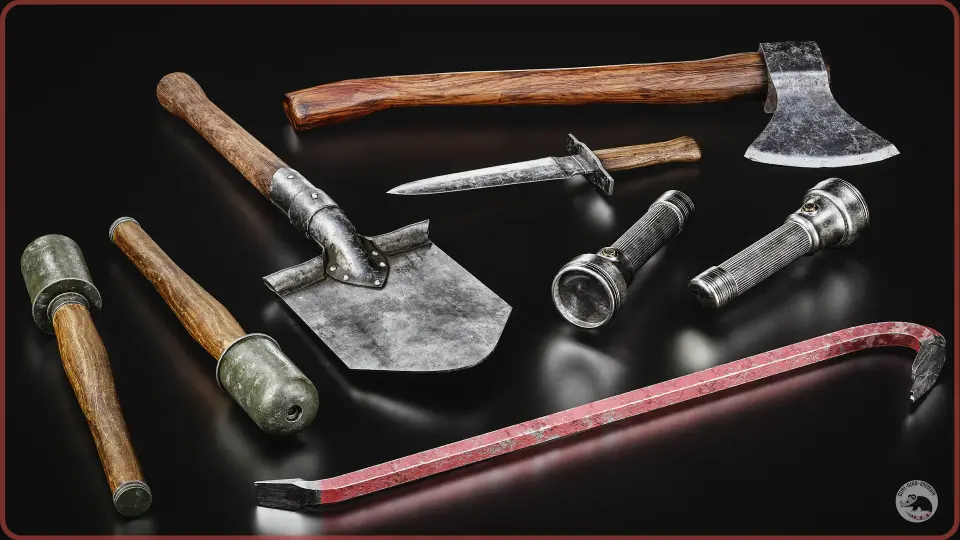
The Orphans of the Great War - Props for characters - Asset Pack provides a targeted set of six utility items designed to solve this exact pipeline bottleneck. Featuring a flashlight, a shovel, a crowbar, an axe, a knife, and a grenade, the collection covers the essential tools needed for military, horror, or survival scenarios. These assets are built to be modular and game-ready, meaning a developer can quickly hand a character a grunge-covered axe for a combat sequence or leave a rusted crowbar resting on a wooden crate to build environmental storytelling. Because the props share a unified aesthetic rooted in realistic, post-apocalyptic, and retro designs, they help maintain consistent visual logic across a project. By offering these specific items together, the pack ensures that all character equipment feels as though it was pulled from the exact same historical era and set of circumstances.
Utilizing Grunge and Metallic PBR Workflows
Establishing a gritty, weathered atmosphere relies heavily on how light interacts with varied surfaces like scarred wood and worn metal. When building horror or dark post-apocalyptic environments, the authenticity of the set dressing hinges on materials that look genuinely used and neglected.
The props in this pack rely on a highly detailed PBR pipeline to achieve their realistic appearance. All six items pull from a single, consolidated texture map designated as ORPH_Tools, which is authored at a high-resolution 4096x4096. This consolidated approach ensures that the metallic sheen of the knife blade, the rough wood grain of the shovel handle, and the grunge layered across the grenade all react accurately to dynamic scene lighting. Utilizing a single 4K texture atlas for multiple items also streamlines material management, reducing draw calls when several of these props are rendered in the same scene. For developers targeting platforms with strict memory limitations, this 4K texture map provides a high-quality baseline that can be easily scaled down directly within the game engine. Reducing the texture resolution in-engine allows the assets to maintain their PBR material definition while adhering to the memory constraints of mobile hardware or standalone VR headsets.
Balancing Poly Counts for Mobile and VR Projects
Optimizing geometry for immersive platforms is a constant technical hurdle, particularly when items are held close to the camera in first-person setups. VR projects demand high framerates to prevent motion sickness, while mobile games require strict polygon budgets to ensure smooth performance across a variety of devices.
To accommodate these strict performance demands, the vertex counts across the Orphans of the Great War assets have been carefully managed. The simplest tools maintain an ultra-low profile, with the crowbar requiring only 263 vertices and the knife coming in at just 418. This low-poly approach allows these particular items to be spawned in large numbers without impacting performance, making them ideal for scattered debris or secondary character equipment. As the mechanical complexity of the items increases, the geometry scales appropriately without becoming unmanageable for mobile platforms. The axe uses 971 vertices, providing enough structural detail for the blade and handle connection. The grenade and flashlight utilize 1834 and 1930 vertices, respectively, preserving their rounded shapes, metallic ridges, and functional mechanisms. The shovel represents the most complex mesh in the pack at 2173 vertices, providing enough geometric density to look convincing whether it is actively wielded by a character or leaning against a trench wall.
Building Post-Apocalyptic Scenes with Orphans of the Great War Props
Placing utility tools into a game environment instantly communicates underlying themes of survival, preparation, and conflict. The specific selection of a flashlight, shovel, crowbar, axe, knife, and grenade naturally aligns with mechanics centered around exploration, resource gathering, and combat.
Whether constructing a dark horror corridor, a post-apocalyptic shelter, or a retro military encampment, these props serve as vital set dressing and functional gameplay elements. A player might use the flashlight to navigate a pitch-black bunker, rely on the knife and axe for close-quarters encounters, or utilize the crowbar to interact with modular environment pieces. The inclusion of the handgrenade adds an immediate military or war-torn element to the character's arsenal. Because the entire pack is optimized for low-poly rendering and unified by detailed PBR materials, it easily drops into pipelines focused on tense, atmosphere-driven experiences where performance overhead must be kept to an absolute minimum. The assets provide a direct, ready-to-use solution for populating 19th and 20th-century scenes with grounded, realistic equipment.
 Hardware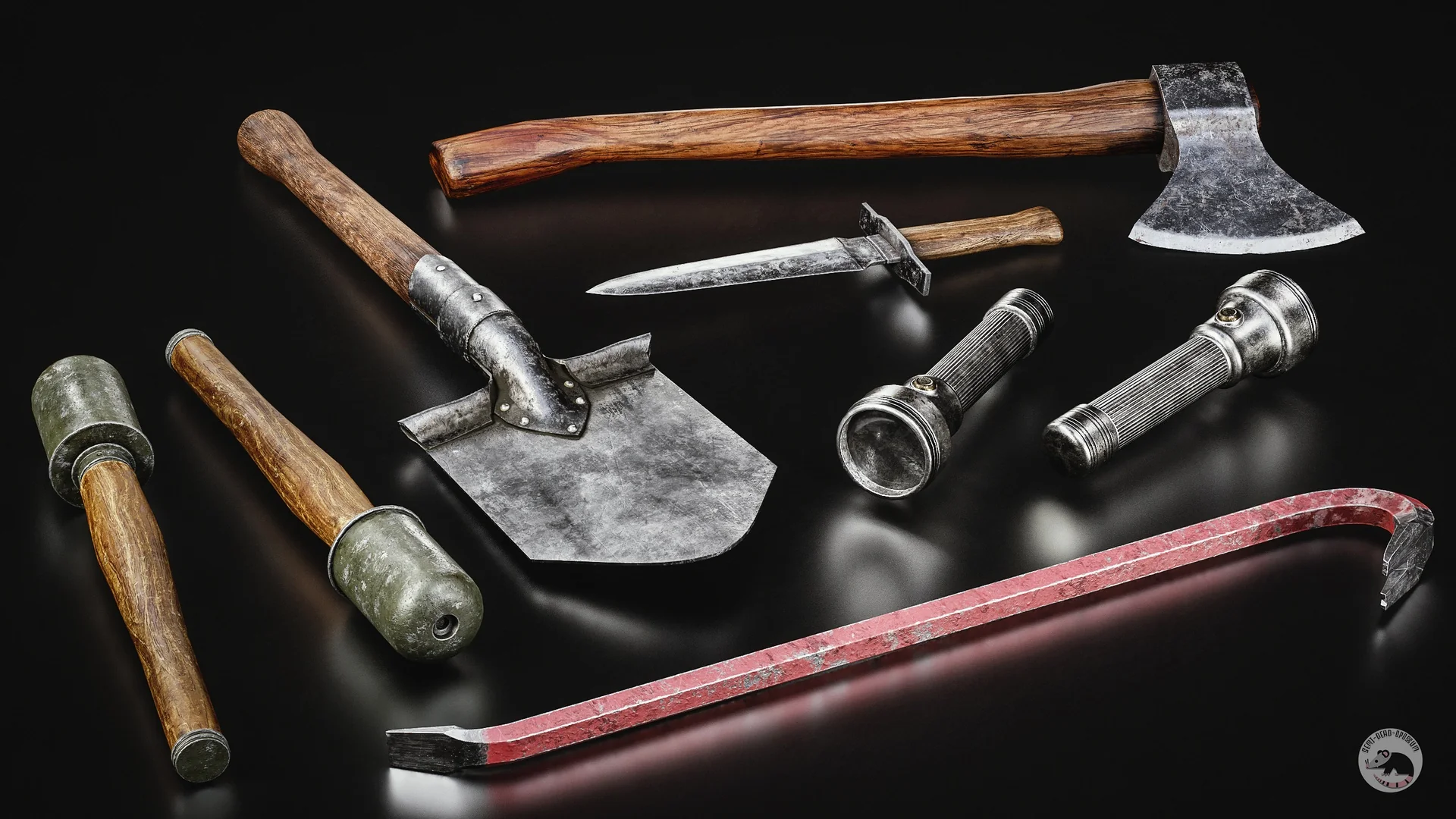
 Towns & Villages
 Military / Warzone
 Hardware