"6c6413bef81af556"{"id":"1000849","slug":"mimic-book","title":"Mimic book","category":"Characters \u0026 Creatures","engine":"4.26+,5.0+","assetVersion":"","engineVersion":"Engine Version: 4.26+,5.0+","tag":"Characters","accent":"blue","visual":"character","summary":"Low poly evil book mimic with common book variation, modular covers, eyeless variant, and infinite page-flipping animation for horror scenes.","platform":"Unreal Engine","publishedAt":"2026-08-04T16:30:33.303Z","updatedAt":"2026-08-04T16:30:33.303Z","sourceNotes":[],"fileContents":[],"compatibility":["Unreal Engine","Engine Version: 4.26+,5.0+"],"featuredImage":{"alt":"Mimic book","src":"/wp-content/uploads/published/2026/08/92425ffa1a35-d6aceb03-ff7d-4629-b230-59fc8820ae8f-77130326db.webp"},"hasDownloadLink":true,"downloads":0,"terms":[{"taxonomy":"category","slug":"characters-and-creatures","name":"Characters \u0026 Creatures"}],"galleryImages":[{"src":"/wp-content/uploads/published/2026/08/6837b77747b0-0a003080-ab1e-42c2-a116-77f4395abbb5-e097b3231b.webp","alt":"Mimic book"},{"src":"/wp-content/uploads/published/2026/08/b17777fbca75-de50a93a-418c-4666-b896-b9917f9e1d73-c98062aa46.webp","alt":"Mimic book"},{"src":"/wp-content/uploads/published/2026/08/eec7d4e57223-fd543a7c-8463-4022-b336-57948b14fe3f-2d13ecd502.webp","alt":"Mimic book"},{"src":"/wp-content/uploads/published/2026/08/6dd18cc66a5d-2c87f059-7a70-4d26-9642-0189c4afa6fb-00e0fd2fad.webp","alt":"Mimic book"},{"src":"/wp-content/uploads/published/2026/08/b1d6382789a8-77a3095d-0aa3-4ae7-8efc-35e7db7da2de-98f2df3b56.webp","alt":"Mimic book"},{"src":"/wp-content/uploads/published/2026/08/2280a7ba023a-59e6bfd9-afaa-4129-ac25-7c980e6663a6-82491920fc.webp","alt":"Mimic book"}],"accessPanel":{"kind":"resource","title":"Download this resource","eyebrow":"Free Download","message":"Log in or create a free account to start your download.","fileName":"Content.7z","safetyNote":"Resources are manually reviewed before listing to improve quality and reduce obvious risks.","actionLabel":"Download Free","resourceType":"Resource archive"},"contentHtml":"\u003cp\u003eA fantasy library only feels real when the shelves are crowded, and a dungeon stops being scary the moment every object behaves itself. The \u003cem\u003eMimic Book\u003c/em\u003e works on both sides of that problem. It is a low-poly model of an evil book mimic, and it ships with a common book variation, so the same asset can disguise a monster among harmless volumes or simply fill a bookshelf with believable set dressing.\u003c/p\u003e\n\n\u003cp\u003eThe creature reads clearly in its shape. Nothing about the design hides the fact that this book wants to bite; the low-poly silhouette keeps it light enough to sit in stylized fantasy or horror scenes without pulling focus from the rest of the environment.\u003c/p\u003e\n\n\u003ch2\u003eThe Evil Book and the Ordinary One Share the Same Shelf\u003c/h2\u003e\n\n\u003cp\u003eThe pairing of the evil mimic with a common book variation is what makes the trick work. A mimic only functions if the player cannot pick it out before it moves. If every book in a scene used the same ominous styling, the ambush would be over the moment the player learned the pattern. The common book variation gives artists a neutral prop to scatter through a room, which means the evil copy can wait among doubles that all look equally harmless.\u003c/p\u003e\n\n\u003cp\u003eOn its own, the common book is also a useful piece of set dressing. Shelves, reading areas, and other prop-dense spots in a Level can be filled with it in scenes that have no mimic at all, and its low-poly profile keeps it consistent with the evil variant when the 2 finally share a room.\u003c/p\u003e\n\n\u003cp\u003eThat makes the asset a practical fit for library-heavy environments. Quiet collection rooms can be populated with the ordinary book, while the evil version sits in the same shelf row for the moment a player reaches for the wrong volume. Because both variations share the same low-poly style, the shelf stays visually consistent until the reveal.\u003c/p\u003e\n\n\u003ch2\u003eModular Cover Parts and the Combiner Script\u003c/h2\u003e\n\n\u003cp\u003eThe V1.5 update, dated May 2024, reshaped how the model is assembled. New meshes for cover parts were added, and the whole structure became modular: roughly 20 pieces that can be combined instead of 1 fixed object. The texture work was also redone in this pass, which refreshes how the covers read up close.\u003c/p\u003e\n\n\u003cp\u003eFor an artist, this shifts the workflow from swapping the whole book to combining pieces. The demo scene includes a script combiner that runs on the \u003ccode\u003eSpacebar\u003c/code\u003e, letting you assemble the book in-engine and test combinations quickly. It is a hands-on tool rather than a rigid 1-click solution: press the button, see how the parts come together, then adjust.\u003c/p\u003e\n\n\u003cp\u003eThe modular build also means the mimic can match its surroundings. Cover parts can be mixed to echo the design of the shelves around it, and because colors and textures sit on top of the same geometry, a project can generate several distinct books without importing extra models.\u003c/p\u003e\n\n\u003cp\u003eCustomization is the point of the modular covers. New cover textures can be added easily, and cover colors are adjustable without touching the mesh. That means several differently skinned mimic books can share the same geometry, animation, and behavior while looking like entirely different volumes on a shelf.\u003c/p\u003e\n\n\u003ch2\u003eEyeless Variant and Pages That Keep Turning\u003c/h2\u003e\n\n\u003cp\u003eThe same update brought an eyeless mimic variant. Removing the eyes changes how the monster reads from across the room: less like a creature watching the player, more like an object that could snap awake at any second. It fits horror scenes where the threat should stay unreadable.\u003c/p\u003e\n\n\u003cp\u003eAnimation work got small tweaks in V1.5, plus 1 standout addition: an infinite page flipping animation. Because the flip does not visibly loop, the book can sit idle in a scene turning pages while it waits. That subtle motion gives the mimic a presence before the ambush, and it works as well for an innocent-looking book as for a hostile one.\u003c/p\u003e\n\n\u003cp\u003eThe package carries the \u003ccode\u003eAnimationBlueprint\u003c/code\u003e tag, which means the motion is set up to work through a Blueprint-driven animation workflow in a game project. The page flip and the other small tweaks stay tied to that setup, so the book can be placed in a Level as a character rather than a static prop.\u003c/p\u003e\n\n\u003ch2\u003ePlacing the Mimic Beside a Mimic Door\u003c/h2\u003e\n\n\u003cp\u003eThe asset fits a specific combination of needs: a low-poly character for fantasy and horror scenes, small enough for a bookshelf, animated, and backed by an Animation Blueprint so the motion can be wired into a game project. The script support covers the combiner in the demo scene, which keeps the creative side—mixing covers and colors—separate from the technical side of getting the pieces to fit.\u003c/p\u003e\n\n\u003cp\u003eThe mimic also lines up with a larger idea: a \u003cem\u003eMimic Door\u003c/em\u003e. Where the door turns the room's exit into a threat, the book does the same to a shelf of props. Set both in 1 space and the environment starts teaching players that nothing static is safe. That shared style gives a dungeon or haunted library a coherent trap language without asking for a brand-new enemy model for every object.\u003c/p\u003e\n\n\u003cp\u003eFor production, the \u003cem\u003eMimic Book\u003c/em\u003e works best as a setup asset with a built-in payoff. The common book variation dresses the space, the evil mimic delivers the jump, the modular covers multiply the number of distinct books that can be staged from 1 model set, and the eyeless variant and infinite page flip offer the extra touches that make the creature feel less like a prop and more like a character.\u003c/p\u003e\n\n\u003ch2\u003eMore From The Same Workflow\u003c/h2\u003e\n\u003cul\u003e\n\u003cli\u003e\u003ca href=\"https://3dcghub.com/blind-creature/\" title=\"Blind Creature\"\u003eBlind Creature\u003c/a\u003e\u003c/li\u003e\n\u003cli\u003e\u003ca href=\"https://3dcghub.com/skinless-mutant/\" title=\"Skinless mutant\"\u003eSkinless mutant\u003c/a\u003e\u003c/li\u003e\n\u003cli\u003e\u003ca href=\"https://3dcghub.com/dystopia-soldier/\" title=\"Dystopia Soldier\"\u003eDystopia Soldier\u003c/a\u003e\u003c/li\u003e\n\u003cli\u003e\u003ca href=\"https://3dcghub.com/spideeye/\" title=\"SpideEye\"\u003eSpideEye\u003c/a\u003e\u003c/li\u003e\n\u003cli\u003e\u003ca href=\"https://3dcghub.com/customized-post-apocalyptic-characters/\" title=\"Customized Post Apocalyptic Characters\"\u003eCustomized Post Apocalyptic Characters\u003c/a\u003e\u003c/li\u003e\n\u003c/ul\u003e","contentTextLength":5410,"navigation":{"current":374,"total":3140,"previous":{"id":"1000850","slug":"mini-game-pack-sliding-puzzle","title":"Mini-Game Pack - Sliding Puzzle","category":"Game Mechanics","platform":"Unreal Engine","updatedAt":"2026-08-04T16:34:39.726Z"},"next":{"id":"1000848","slug":"medieval-architecture-pack","title":"Medieval Architecture Pack","category":"Buildings \u0026 Architecture","platform":"Unreal Engine","updatedAt":"2026-08-04T16:13:16.344Z"}},"relatedResources":[{"id":"1000184","slug":"infinite-characters-collection-over-230-characters-extra-stigma-studios","title":"Infinite Characters Collection – Over 230 Characters + Extra | STIGMA STUDIOS","category":"Characters \u0026 Creatures","engine":"4.27,5.0+","assetVersion":"","engineVersion":"Engine Version: 4.27,5.0+","tag":"Characters","accent":"blue","visual":"character","summary":"A massive Unreal Engine character collection with over 230 characters, armor, weapons, material variants, and ongoing future updates.","platform":"Unreal Engine","publishedAt":"2026-06-21T17:34:28.433Z","updatedAt":"2026-08-23T13:14:17.209Z","sourceNotes":[],"fileContents":[],"compatibility":["Unreal Engine","Engine Version: 4.27,5.0+"],"featuredImage":{"alt":"Infinite Characters Collection – Over 230 Characters + Extra | STIGMA STUDIOS","src":"/wp-content/uploads/published/2026/06/26476fb360bb-f2bcdade-6b80-4803-903a-68e84d350b6b-f00df84586.webp"},"hasDownloadLink":true,"downloads":14},{"id":"1791","slug":"blind-creature","title":"Blind Creature","category":"Characters \u0026 Creatures","engine":"4.26+,5.0+","assetVersion":"Engine version: 4.26+,5.0+","engineVersion":"4.26","tag":"Characters","accent":"blue","visual":"character","summary":"Discover the Blind Creature, a low-poly 3D model rigged for Epic Skeleton. Perfect for horror and RPG games with modular parts and color variations.","platform":"Unreal Engine","publishedAt":"2026-02-06T21:53:52.000Z","updatedAt":"2026-05-31T13:04:44.461Z","sourceNotes":[],"fileContents":[],"compatibility":["Unreal Engine","Engine version: 4.26+,5.0+"],"featuredImage":{"alt":"Blind Creature","src":"https://3dcghub.com/wp-content/uploads/2026/02/5e3af5c4-e2fa-4258-945f-dc477b5c65cb.webp"},"hasDownloadLink":true,"downloads":0},{"id":"1000680","slug":"skinless-mutant","title":"Skinless mutant","category":"Characters \u0026 Creatures","engine":"4.26+,5.0+","assetVersion":"","engineVersion":"Engine Version: 4.26+,5.0+","tag":"Characters","accent":"blue","visual":"character","summary":"Low-poly mutant character for games across RPG, strategy, and first-person shooter genres. Horror creature with animation blueprint and undead modular compatibi","platform":"Unreal Engine","publishedAt":"2026-07-22T15:18:52.308Z","updatedAt":"2026-07-22T15:18:52.308Z","sourceNotes":[],"fileContents":[],"compatibility":["Unreal Engine","Engine Version: 4.26+,5.0+"],"featuredImage":{"alt":"Skinless mutant","src":"/wp-content/uploads/published/2026/07/b667ce1d9c28-bd264074-b15b-4dea-a77a-f0d9cbcec45a-bb6b90d078.webp"},"hasDownloadLink":true,"downloads":0}]}
Characters
Mimic book
Low poly evil book mimic with common book variation, modular covers, eyeless variant, and infinite page-flipping animation for horror scenes.
A fantasy library only feels real when the shelves are crowded, and a dungeon stops being scary the moment every object behaves itself. The Mimic Book works on both sides of that problem. It is a low-poly model of an evil book mimic, and it ships with a common book variation, so the same asset can disguise a monster among harmless volumes or simply fill a bookshelf with believable set dressing.
The creature reads clearly in its shape. Nothing about the design hides the fact that this book wants to bite; the low-poly silhouette keeps it light enough to sit in stylized fantasy or horror scenes without pulling focus from the rest of the environment.
The Evil Book and the Ordinary One Share the Same Shelf
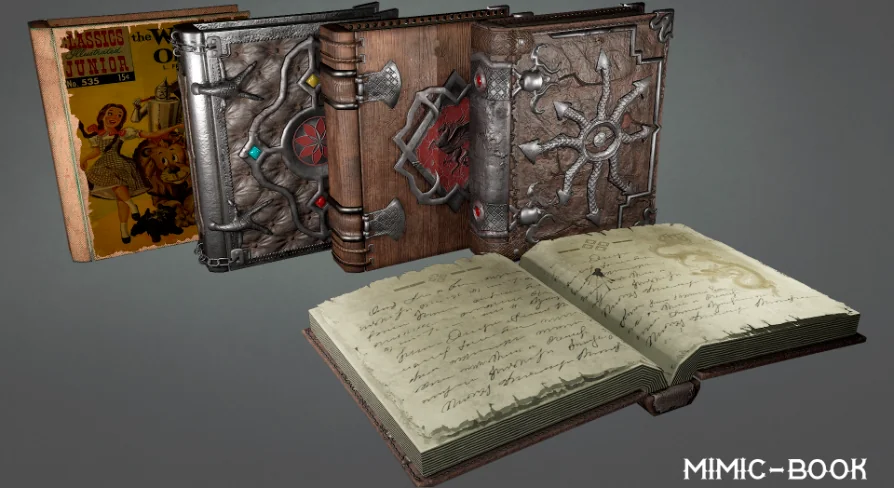
The pairing of the evil mimic with a common book variation is what makes the trick work. A mimic only functions if the player cannot pick it out before it moves. If every book in a scene used the same ominous styling, the ambush would be over the moment the player learned the pattern. The common book variation gives artists a neutral prop to scatter through a room, which means the evil copy can wait among doubles that all look equally harmless.
On its own, the common book is also a useful piece of set dressing. Shelves, reading areas, and other prop-dense spots in a Level can be filled with it in scenes that have no mimic at all, and its low-poly profile keeps it consistent with the evil variant when the 2 finally share a room.
That makes the asset a practical fit for library-heavy environments. Quiet collection rooms can be populated with the ordinary book, while the evil version sits in the same shelf row for the moment a player reaches for the wrong volume. Because both variations share the same low-poly style, the shelf stays visually consistent until the reveal.
Modular Cover Parts and the Combiner Script
The V1.5 update, dated May 2024, reshaped how the model is assembled. New meshes for cover parts were added, and the whole structure became modular: roughly 20 pieces that can be combined instead of 1 fixed object. The texture work was also redone in this pass, which refreshes how the covers read up close.
For an artist, this shifts the workflow from swapping the whole book to combining pieces. The demo scene includes a script combiner that runs on the Spacebar, letting you assemble the book in-engine and test combinations quickly. It is a hands-on tool rather than a rigid 1-click solution: press the button, see how the parts come together, then adjust.
The modular build also means the mimic can match its surroundings. Cover parts can be mixed to echo the design of the shelves around it, and because colors and textures sit on top of the same geometry, a project can generate several distinct books without importing extra models.
Customization is the point of the modular covers. New cover textures can be added easily, and cover colors are adjustable without touching the mesh. That means several differently skinned mimic books can share the same geometry, animation, and behavior while looking like entirely different volumes on a shelf.
Eyeless Variant and Pages That Keep Turning
The same update brought an eyeless mimic variant. Removing the eyes changes how the monster reads from across the room: less like a creature watching the player, more like an object that could snap awake at any second. It fits horror scenes where the threat should stay unreadable.
Animation work got small tweaks in V1.5, plus 1 standout addition: an infinite page flipping animation. Because the flip does not visibly loop, the book can sit idle in a scene turning pages while it waits. That subtle motion gives the mimic a presence before the ambush, and it works as well for an innocent-looking book as for a hostile one.
The package carries the AnimationBlueprint tag, which means the motion is set up to work through a Blueprint-driven animation workflow in a game project. The page flip and the other small tweaks stay tied to that setup, so the book can be placed in a Level as a character rather than a static prop.
Placing the Mimic Beside a Mimic Door
The asset fits a specific combination of needs: a low-poly character for fantasy and horror scenes, small enough for a bookshelf, animated, and backed by an Animation Blueprint so the motion can be wired into a game project. The script support covers the combiner in the demo scene, which keeps the creative side—mixing covers and colors—separate from the technical side of getting the pieces to fit.
The mimic also lines up with a larger idea: a Mimic Door. Where the door turns the room's exit into a threat, the book does the same to a shelf of props. Set both in 1 space and the environment starts teaching players that nothing static is safe. That shared style gives a dungeon or haunted library a coherent trap language without asking for a brand-new enemy model for every object.
For production, the Mimic Book works best as a setup asset with a built-in payoff. The common book variation dresses the space, the evil mimic delivers the jump, the modular covers multiply the number of distinct books that can be staged from 1 model set, and the eyeless variant and infinite page flip offer the extra touches that make the creature feel less like a prop and more like a character.
 Characters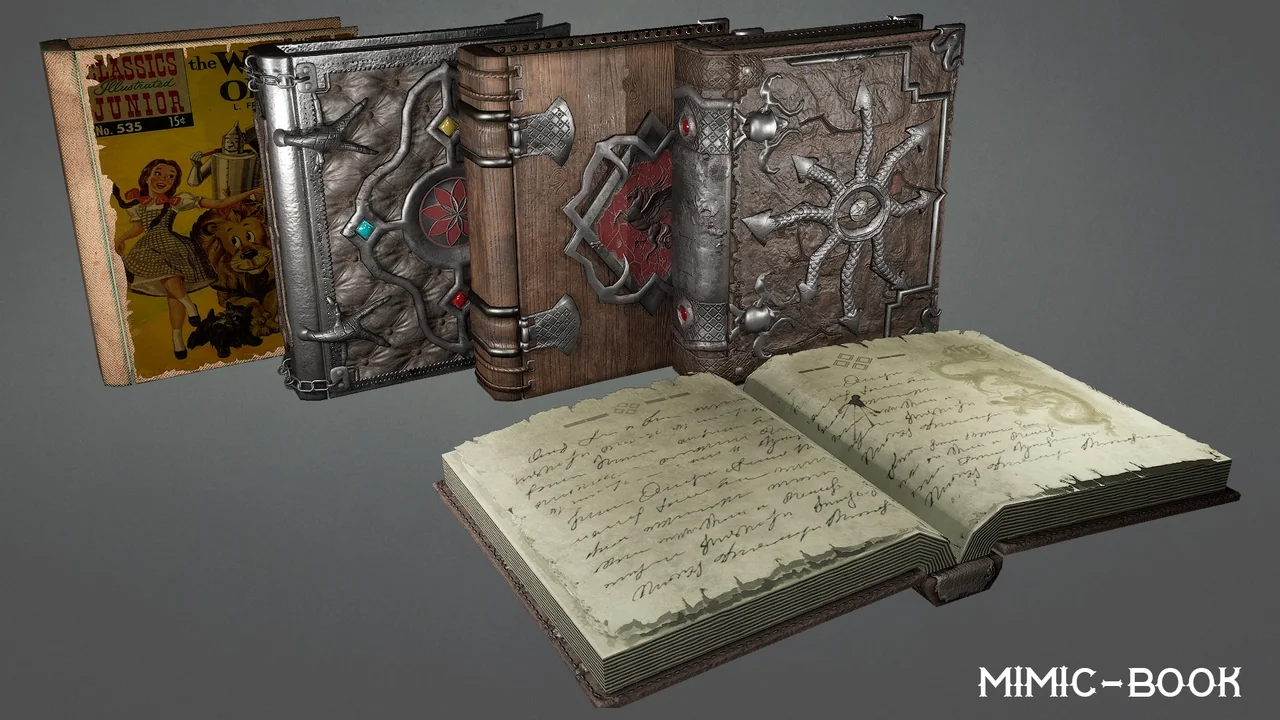
 Characters
 Characters
 Characters