"6c6413bef81af556"{"id":"1000848","slug":"medieval-architecture-pack","title":"Medieval Architecture Pack","category":"Buildings \u0026 Architecture","engine":"4.26+,5.0+","assetVersion":"","engineVersion":"Engine Version: 4.26+,5.0+","tag":"Buildings","accent":"blue","visual":"mech","summary":"High-quality pack for fantasy and medieval environments, centered on blacksmith, house, and tavern structures, with Western Pack-1 Train compatibility.","platform":"Unreal Engine","publishedAt":"2026-08-04T16:13:16.344Z","updatedAt":"2026-08-04T16:13:16.344Z","sourceNotes":[],"fileContents":[],"compatibility":["Unreal Engine","Engine Version: 4.26+,5.0+"],"featuredImage":{"alt":"Medieval Architecture Pack","src":"/wp-content/uploads/published/2026/08/0e3361bee44c-3b2ef458-dae1-4716-9176-aa0c9d7bc9f7-8ca0344342.webp"},"hasDownloadLink":true,"downloads":0,"terms":[{"taxonomy":"category","slug":"buildings-and-architecture","name":"Buildings \u0026 Architecture"}],"galleryImages":[{"src":"/wp-content/uploads/published/2026/08/92e0711e91c6-245e3e81-4f53-49b8-9f15-8317bc9564e2-2355479302.webp","alt":"Medieval Architecture Pack"},{"src":"/wp-content/uploads/published/2026/08/b019f49cff0b-9d1c940a-d970-470c-98b4-403bceb15db6-bc89295e2f.webp","alt":"Medieval Architecture Pack"},{"src":"/wp-content/uploads/published/2026/08/a4920815c3ff-660ff849-cb5b-4177-82bf-893928cdee08-eb28735cce.webp","alt":"Medieval Architecture Pack"},{"src":"/wp-content/uploads/published/2026/08/8cf794b597ed-a0785d0e-1728-4f49-b56a-7d665acbaa5f-537bf54f19.webp","alt":"Medieval Architecture Pack"},{"src":"/wp-content/uploads/published/2026/08/543ba58c641b-e65d5b2c-53f3-4643-9be8-4da689d64ac3-52fa3270b0.webp","alt":"Medieval Architecture Pack"},{"src":"/wp-content/uploads/published/2026/08/f1f513ee0ee8-bcbfae75-3e74-43f5-ab1c-b02d21a90ffe-51dd0ef294.webp","alt":"Medieval Architecture Pack"},{"src":"/wp-content/uploads/published/2026/08/89d4c26237a9-0aab4498-b874-4201-b000-f78e710d8e9d-2670eebbed.webp","alt":"Medieval Architecture Pack"},{"src":"/wp-content/uploads/published/2026/08/bafe4bda1fda-f6b39227-4054-4cb8-8e41-99e3c4187da5-a5185c44b5.webp","alt":"Medieval Architecture Pack"},{"src":"/wp-content/uploads/published/2026/08/ab238d6f568b-7ded5507-eef7-4f70-a102-ecf549175276-a24f001924.webp","alt":"Medieval Architecture Pack"},{"src":"/wp-content/uploads/published/2026/08/028177ea56ec-687d56a1-bfd5-4d2c-a4b8-d9ecb59f3b7c-2e36dce5ee.webp","alt":"Medieval Architecture Pack"}],"accessPanel":{"kind":"resource","title":"Download this resource","eyebrow":"Free Download","message":"Log in or create a free account to start your download.","fileName":"Content.7z","safetyNote":"Resources are manually reviewed before listing to improve quality and reduce obvious risks.","actionLabel":"Download Free","resourceType":"Resource archive"},"contentHtml":"\u003cp\u003eThe \u003cem\u003eMedieval Architecture Pack\u003c/em\u003e is a high-quality asset collection built for 1 clear job: standing up fantasy or medieval environments. Its tag set names the practical core—\u003cem\u003eBlacksmith\u003c/em\u003e, \u003cem\u003eHouse\u003c/em\u003e, and \u003cem\u003eTavern\u003c/em\u003e—3 building types that anchor the villages, towns, and hand-built settlements shared by both genres. The pack also carries compatibility with the \u003cem\u003eWestern Pack-1 Train\u003c/em\u003e, which widens the range of projects it can be dropped into. For environment work, a tight trio of recognizable buildings plus a cross-pack compatibility line is what makes this pack immediately useful.\u003c/p\u003e\n\n\u003ch2\u003eThe Blacksmith, House, and Tavern as the Core Trio\u003c/h2\u003e\n\n\u003cp\u003e3 tags carry most of the weight here: \u003cem\u003eBlacksmith\u003c/em\u003e, \u003cem\u003eHouse\u003c/em\u003e, and \u003cem\u003eTavern\u003c/em\u003e. Together they sketch a small medieval settlement in miniature. The blacksmith shop is the working building—the forge where metal is heated, hammered, and shaped into the goods a village needs. A blacksmith brings an immediate sense of production to a scene, a visible answer to the question of where a town's tools, weapons, and hardware come from. That makes it 1 of the most story-rich buildings in any medieval settlement, since it connects directly to the daily labor of the people who live there.\u003c/p\u003e\n\n\u003cp\u003eThe house is the residential form, the structure where a settlement's inhabitants live. Houses are what make a place feel occupied rather than staged; grouped together, they read as a hamlet or a residential lane instead of a single prop. The tavern is the social anchor, the building where travelers, villagers, and quest-givers naturally gather. A tavern gives a level or a diorama a clear focal point, a structure that invites both characters and cameras. Craft, shelter, and gathering—the 3 functions a working town needs are represented in 1 pack.\u003c/p\u003e\n\n\u003cp\u003eA lone tavern can serve as a roadside inn on the edge of a map. A single house works as an isolated cottage or farmstead. The blacksmith, placed by itself, works as a hamlet's workshop; placed together, the 3 buildings form the nucleus of a larger town that can be extended with additional geometry around it.\u003c/p\u003e\n\n\u003ch2\u003eFantasy and Medieval: 2 Settings from 1 Style Family\u003c/h2\u003e\n\n\u003cp\u003eBoth fantasy and medieval environments are named targets for this pack. The 2 genres ask for different things from architecture. A medieval scene leans on historical plausibility—stone walls, timber framing, low doorways, pitched roofs that read as period-appropriate. A fantasy scene borrows those same forms and pushes them toward the atmospheric: a weathered tavern on a rainy street, a blacksmith tucked between taller buildings in a Role-Playing Game (RPG) hub, a house lived-in enough to hide a quest behind its door.\u003c/p\u003e\n\n\u003cp\u003eMedieval architecture is the visual shorthand both settings share. By staying inside 1 style family, the pack keeps a consistent silhouette across an entire environment. A historically-minded castle town and a fantasy village with its own invented lore can both be built from the same forms, because their references are rooted in real medieval construction. That dual reach is what makes a single architecture pack practical across 2 genres: the threshold between historical and fantasy is, in most cases, a matter of mood, lighting, and dressing.\u003c/p\u003e\n\n\u003ch2\u003eCompatibility with the \u003cem\u003eWestern Pack-1 Train\u003c/em\u003e\u003c/h2\u003e\n\n\u003cp\u003eThe pack carries compatibility with the \u003cem\u003eWestern Pack-1 Train\u003c/em\u003e. For an environment artist or project lead, that detail changes the scope of where the assets can go. Instead of being locked into strictly medieval work, the architecture can be placed beside a Western-oriented product that brings train content into the same scene. This is a practical signal that the set is not a closed medieval island, but something that can coexist with other environment work in a shared project.\u003c/p\u003e\n\n\u003cp\u003eCross-pack compatibility matters in production workflows. A town that layers old medieval quarters around a railway line, a frontier settlement reusing heavy timber and stone forms, or a fantasy world that admits 1 industrial train element are all combinations this makes easier to assemble. For teams building larger worlds with multiple zones, bridging 2 themed packs in a single scene saves the trouble of rebuilding architecture to match. The medieval forms stay intact; the train content comes in beside them. Anyone scouting assets for a mixed-period project gets a direct answer from this compatibility line.\u003c/p\u003e\n\n\u003ch2\u003eWho Gets the Most Use from This Pack\u003c/h2\u003e\n\n\u003cp\u003eThe audience that benefits most is anyone constructing medieval or fantasy environments inside a 3D software tool. Indie game developers building a starting village, environment artists dressing a film set, and hobbyists putting together a period diorama all share the same need: a foundation of credible architecture that can populate a scene quickly. The pack is presented as high quality, so it is positioned for finished shots rather than rough blockouts.\u003c/p\u003e\n\n\u003cp\u003eWith the blacksmith, house, and tavern as the named structure types, a builder can lay out a settlement core fast—place the tavern at the center of a square, cluster houses around it, and run the blacksmith along the main path—then let the surrounding environment fill the gaps. The 3 buildings give a scene immediate points of interest, and the \u003cem\u003eWestern Pack-1 Train\u003c/em\u003e compatibility extends that same foundation toward projects that were not medieval-only from the start. In short, the pack targets the common case: a creator needs believable medieval architecture on short notice, and wants the option to pair it with other scenery in the same project.\u003c/p\u003e\n\n\u003ch2\u003eExplore Similar Assets\u003c/h2\u003e\n\u003cul\u003e\n\u003cli\u003e\u003ca href=\"https://3dcghub.com/gothic-clock-tower-modular-asset-pack-for-unreal-engine/\" title=\"ClockTower\"\u003eClockTower\u003c/a\u003e\u003c/li\u003e\n\u003cli\u003e\u003ca href=\"https://3dcghub.com/medieval-watchtowers-and-platforms-v1/\" title=\"Medieval Watchtowers and Platforms - v1\"\u003eMedieval Watchtowers and Platforms - v1\u003c/a\u003e\u003c/li\u003e\n\u003cli\u003e\u003ca href=\"https://3dcghub.com/lake-house-01-with-interiors-4k-pbr/\" title=\"LAKE HOUSE 01 with INTERIORS 4K PBR\"\u003eLAKE HOUSE 01 with INTERIORS 4K PBR\u003c/a\u003e\u003c/li\u003e\n\u003cli\u003e\u003ca href=\"https://3dcghub.com/wood-structures/\" title=\"Wood Structures\"\u003eWood Structures\u003c/a\u003e\u003c/li\u003e\n\u003cli\u003e\u003ca href=\"https://3dcghub.com/japanese-street/\" title=\"Japanese Street\"\u003eJapanese Street\u003c/a\u003e\u003c/li\u003e\n\u003c/ul\u003e","contentTextLength":5621,"navigation":{"current":375,"total":3140,"previous":{"id":"1000849","slug":"mimic-book","title":"Mimic book","category":"Characters \u0026 Creatures","platform":"Unreal Engine","updatedAt":"2026-08-04T16:30:33.303Z"},"next":{"id":"1000847","slug":"male-emotes","title":"Male Emotes","category":"Gestures","platform":"Unreal Engine","updatedAt":"2026-08-04T16:08:36.950Z"}},"relatedResources":[{"id":"1017","slug":"gothic-clock-tower-modular-asset-pack-for-unreal-engine","title":"ClockTower","category":"Buildings \u0026 Architecture","engine":"4.26+,5.0+","assetVersion":"Engine version: 4.26+,5.0+","engineVersion":"5.3","tag":"Buildings","accent":"blue","visual":"character","summary":"Create stunning Gothic environments with the ClockTower asset pack. Features modular parts, real-time clock Blueprints, and day/night lighting demos for UE5.","platform":"Unreal Engine","publishedAt":"2026-02-06T13:28:33.000Z","updatedAt":"2026-04-19T15:58:29.000Z","sourceNotes":[],"fileContents":[],"compatibility":["Unreal Engine","Engine version: 4.26+,5.0+"],"featuredImage":{"alt":"ClockTower","src":"https://3dcghub.com/wp-content/uploads/2026/02/cf72abd79de4_57d08882-9ecb-409f-9ed1-22b51c6fc39f-18.webp"},"hasDownloadLink":true,"downloads":0},{"id":"1000645","slug":"medieval-watchtowers-and-platforms-v1","title":"Medieval Watchtowers and Platforms - v1","category":"Buildings \u0026 Architecture","engine":"5.0+","assetVersion":"","engineVersion":"Engine Version: 5.0+","tag":"Buildings","accent":"blue","visual":"mech","summary":"Nine medieval watchtowers and platforms built for Unreal Engine 5 with Nanite, Lumen support, tiled materials, and multiple LODs for AAA fantasy RPG production.","platform":"Unreal Engine","publishedAt":"2026-07-21T17:44:36.382Z","updatedAt":"2026-07-21T17:44:36.382Z","sourceNotes":[],"fileContents":[],"compatibility":["Unreal Engine","Engine Version: 5.0+"],"featuredImage":{"alt":"Medieval Watchtowers and Platforms - v1","src":"/wp-content/uploads/published/2026/07/13bfec9e8e92-e3924236-632f-4dc1-b2f2-286bcfc59f88-7a8b235e94.webp"},"hasDownloadLink":true,"downloads":0},{"id":"1264","slug":"lake-house-01-with-interiors-4k-pbr","title":"LAKE HOUSE 01 with INTERIORS 4K PBR","category":"Buildings \u0026 Architecture","engine":"5.5+","assetVersion":"Engine version: 5.5+","engineVersion":"5.5","tag":"Buildings","accent":"blue","visual":"mech","summary":"Enhance your digital environments with 20 detailed 3D lake houses. Featuring 4K PBR textures, full interiors, and optimized assets for games and cinematics.","platform":"Unreal Engine","publishedAt":"2026-02-06T17:29:31.000Z","updatedAt":"2026-04-19T15:58:12.000Z","sourceNotes":[],"fileContents":[],"compatibility":["Unreal Engine","Engine version: 5.5+"],"featuredImage":{"alt":"LAKE HOUSE 01 with INTERIORS 4K PBR","src":"https://3dcghub.com/wp-content/uploads/2026/02/e2f52c34-b0af-40e2-8e2a-be4767d64935.jpg"},"hasDownloadLink":true,"downloads":0}]}
Buildings
Medieval Architecture Pack
High-quality pack for fantasy and medieval environments, centered on blacksmith, house, and tavern structures, with Western Pack-1 Train compatibility.
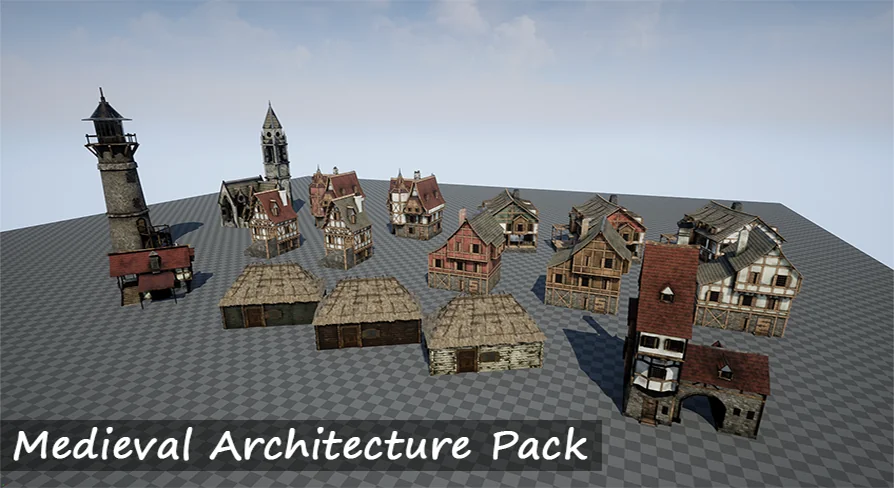
The Medieval Architecture Pack is a high-quality asset collection built for 1 clear job: standing up fantasy or medieval environments. Its tag set names the practical core—Blacksmith, House, and Tavern—3 building types that anchor the villages, towns, and hand-built settlements shared by both genres. The pack also carries compatibility with the Western Pack-1 Train, which widens the range of projects it can be dropped into. For environment work, a tight trio of recognizable buildings plus a cross-pack compatibility line is what makes this pack immediately useful.
The Blacksmith, House, and Tavern as the Core Trio
3 tags carry most of the weight here: Blacksmith, House, and Tavern. Together they sketch a small medieval settlement in miniature. The blacksmith shop is the working building—the forge where metal is heated, hammered, and shaped into the goods a village needs. A blacksmith brings an immediate sense of production to a scene, a visible answer to the question of where a town's tools, weapons, and hardware come from. That makes it 1 of the most story-rich buildings in any medieval settlement, since it connects directly to the daily labor of the people who live there.
The house is the residential form, the structure where a settlement's inhabitants live. Houses are what make a place feel occupied rather than staged; grouped together, they read as a hamlet or a residential lane instead of a single prop. The tavern is the social anchor, the building where travelers, villagers, and quest-givers naturally gather. A tavern gives a level or a diorama a clear focal point, a structure that invites both characters and cameras. Craft, shelter, and gathering—the 3 functions a working town needs are represented in 1 pack.
A lone tavern can serve as a roadside inn on the edge of a map. A single house works as an isolated cottage or farmstead. The blacksmith, placed by itself, works as a hamlet's workshop; placed together, the 3 buildings form the nucleus of a larger town that can be extended with additional geometry around it.
Fantasy and Medieval: 2 Settings from 1 Style Family
Both fantasy and medieval environments are named targets for this pack. The 2 genres ask for different things from architecture. A medieval scene leans on historical plausibility—stone walls, timber framing, low doorways, pitched roofs that read as period-appropriate. A fantasy scene borrows those same forms and pushes them toward the atmospheric: a weathered tavern on a rainy street, a blacksmith tucked between taller buildings in a Role-Playing Game (RPG) hub, a house lived-in enough to hide a quest behind its door.
Medieval architecture is the visual shorthand both settings share. By staying inside 1 style family, the pack keeps a consistent silhouette across an entire environment. A historically-minded castle town and a fantasy village with its own invented lore can both be built from the same forms, because their references are rooted in real medieval construction. That dual reach is what makes a single architecture pack practical across 2 genres: the threshold between historical and fantasy is, in most cases, a matter of mood, lighting, and dressing.
Compatibility with the Western Pack-1 Train
The pack carries compatibility with the Western Pack-1 Train. For an environment artist or project lead, that detail changes the scope of where the assets can go. Instead of being locked into strictly medieval work, the architecture can be placed beside a Western-oriented product that brings train content into the same scene. This is a practical signal that the set is not a closed medieval island, but something that can coexist with other environment work in a shared project.
Cross-pack compatibility matters in production workflows. A town that layers old medieval quarters around a railway line, a frontier settlement reusing heavy timber and stone forms, or a fantasy world that admits 1 industrial train element are all combinations this makes easier to assemble. For teams building larger worlds with multiple zones, bridging 2 themed packs in a single scene saves the trouble of rebuilding architecture to match. The medieval forms stay intact; the train content comes in beside them. Anyone scouting assets for a mixed-period project gets a direct answer from this compatibility line.
Who Gets the Most Use from This Pack
The audience that benefits most is anyone constructing medieval or fantasy environments inside a 3D software tool. Indie game developers building a starting village, environment artists dressing a film set, and hobbyists putting together a period diorama all share the same need: a foundation of credible architecture that can populate a scene quickly. The pack is presented as high quality, so it is positioned for finished shots rather than rough blockouts.
With the blacksmith, house, and tavern as the named structure types, a builder can lay out a settlement core fast—place the tavern at the center of a square, cluster houses around it, and run the blacksmith along the main path—then let the surrounding environment fill the gaps. The 3 buildings give a scene immediate points of interest, and the Western Pack-1 Train compatibility extends that same foundation toward projects that were not medieval-only from the start. In short, the pack targets the common case: a creator needs believable medieval architecture on short notice, and wants the option to pair it with other scenery in the same project.
 Buildings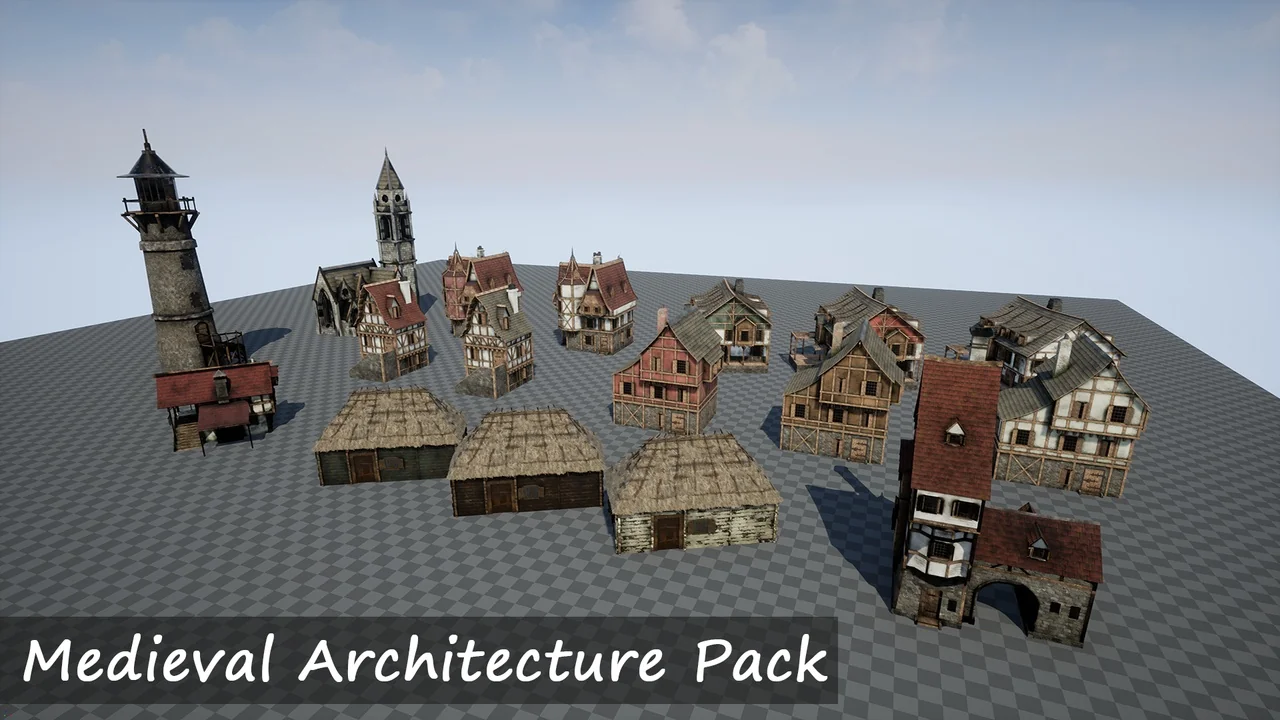
 Buildings
 Buildings
 Buildings