"c68a05d5e51405b3"{"id":"1001102","slug":"military-training-warehouse","title":"Military Training Warehouse","category":"Military / Warzone","engine":"4.27,5.0+","assetVersion":"","engineVersion":"Engine Version: 4.27,5.0+","tag":"Military / Warzone","accent":"blue","visual":"mech","summary":"A photorealistic modular warehouse environment for multiplayer levels, VR training, and military prototyping, with scanned decals, rubble, cover assets, and cus","platform":"Unreal Engine","publishedAt":"2026-09-07T05:17:45.017Z","updatedAt":"2026-09-07T05:17:45.017Z","sourceNotes":[],"fileContents":[],"compatibility":["Unreal Engine","Engine Version: 4.27,5.0+"],"featuredImage":{"alt":"Military Training Warehouse","src":"/wp-content/uploads/published/2026/09/72cf7bab78f1-20754a84-6627-4b7a-8a80-50e3f2b20880-027160fe97.webp"},"hasDownloadLink":true,"downloads":1,"terms":[{"taxonomy":"category","slug":"military-warzone","name":"Military / Warzone"}],"galleryImages":[{"src":"/wp-content/uploads/published/2026/09/ac85ea786748-240de2e6-3785-45d2-bfea-b52b36651fb4-375919b01d.webp","alt":"Military Training Warehouse"},{"src":"/wp-content/uploads/published/2026/09/e014a3918a28-6d93d64e-968f-420b-9d7e-a42efb10c30a-707996e61c.webp","alt":"Military Training Warehouse"},{"src":"/wp-content/uploads/published/2026/09/557f2f1a36b0-9fd2028b-0ab6-4441-b5ab-833eed19713d-17b09993fa.webp","alt":"Military Training Warehouse"},{"src":"/wp-content/uploads/published/2026/09/754a5659f80f-3c644c41-22d5-45f6-a11d-8f292a28da65-eb123a4bb3.webp","alt":"Military Training Warehouse"},{"src":"/wp-content/uploads/published/2026/09/e80b0851bd6f-fcac8384-7a24-4a14-b747-d89caa08756d-32281870a4.webp","alt":"Military Training Warehouse"},{"src":"/wp-content/uploads/published/2026/09/14edbaf1acd6-c65f4a79-db60-4c64-bd83-63617ab3998f-61425933fa.webp","alt":"Military Training Warehouse"},{"src":"/wp-content/uploads/published/2026/09/13fe0acea01f-e7b2a838-dd14-454c-ac9c-1ea1c4c5ef18-25a85c108b.webp","alt":"Military Training Warehouse"},{"src":"/wp-content/uploads/published/2026/09/4dba9f281082-96c3e362-5742-41a9-9786-d38480a0ba03-1bf6d5c225.webp","alt":"Military Training Warehouse"},{"src":"/wp-content/uploads/published/2026/09/76177b011c31-789b8245-d5db-45e0-917a-d9a40b716374-8d8a47f584.webp","alt":"Military Training Warehouse"},{"src":"/wp-content/uploads/published/2026/09/10721426a1e1-19f6a937-02bd-495b-8a78-2adc7a7610d9-d222567b17.webp","alt":"Military Training Warehouse"}],"accessPanel":{"kind":"resource","title":"Download this resource","eyebrow":"Free Download","message":"Log in or create a free account to start your download.","fileName":"MilitaryWarehouse.7z","safetyNote":"Resources are manually reviewed before listing to improve quality and reduce obvious risks.","actionLabel":"Download Free","resourceType":"Resource archive"},"contentHtml":"\u003cp\u003eWarehouse shooters live and die by the clutter between spawn and objective. The Military Training Warehouse treats that clutter as a complete environment: a highly detailed set intended for multiplayer level creation, VR simulation spaces, and military prototyping. A variety of scans, custom props, and modular kits are all present, so a designer can build a working map instead of dressing a single view.\u003c/p\u003e\u003cp\u003eThe environment is structured as a level rather than a gallery of isolated props. Since the scans, custom props, and modular kits are meant to be assembled together, the art direction stays coherent as the map expands.\u003c/p\u003e\u003ch2\u003eTeam Deathmatch and Domination Need Different Room Shapes\u003c/h2\u003e\u003cp\u003eTeam Deathmatch and Domination are both modes for the warehouse, but they push a map in opposite directions. Team Deathmatch rewards routes that spread players out and keep fights moving. Domination needs places where teams collide around a few fixed objectives. The same modular kit can serve both because the layout is not locked down. A designer can make the flow constant or cordon off points of interest using the same walls and cover pieces.\u003c/p\u003e\u003cp\u003eThat sort of iteration is where modular kits earn their place. Initial blocking can be open to see how spawns play. A later pass can narrow a corridor or add a sightline block. Since all the pieces live in one environment, changes do not break the lighting or the material story.\u003c/p\u003e\u003ch2\u003eCover Assets Define the Distance Between Teams\u003c/h2\u003e\u003cp\u003eThe pack includes a wide range of modular and cover assets. In a multiplayer map, cover is the main way to control engagement distance. Tall pieces stop players from seeing across the whole room; low pieces let a player move while crouched; clusters of cover create positions that are worth holding. On a Domination map, the placement of those assets around an objective decides how easy it is to defend or attack.\u003c/p\u003e\u003cp\u003eCustom props keep cover from feeling purely mechanical. They are mixed with the modular segments, so the same overall kit can produce a tucked corner in one room and a central obstacle in the next. The military training atmosphere gives every prop a reason to exist. There is less risk of something looking decorative when the theme is a place suited to drills and exercises.\u003c/p\u003e\u003ch2\u003eScanned Decals and Rubble Carry the Ground Level\u003c/h2\u003e\u003cp\u003eThe ground has its own set of tools. Scanned mesh decals bring wear, cracks, and touch-up marks from real surfaces. Rubble pieces sit on top of that decal layer to make floor contact for weapons or characters more physical. Because the decals come from photogrammetry, they do not fight with the warehouse's realistic style.\u003c/p\u003e\u003cp\u003eGround assets also influence sightlines at floor level. A piece of rubble just large enough to break a silhouette can give the map another moment of tension. A long row of scanned decals or damage marks keeps an open floor from turning into a blur of repeated material. Those small choices add depth while the modular walls handle the main structure.\u003c/p\u003e\u003ch2\u003eVR Simulation Training and Military Prototyping Use the Same Space\u003c/h2\u003e\u003cp\u003eMultiplayer level design is one of the pack's jobs. The creator also positions the kit for building a VR simulation training arena and for military prototyping. A modular layout is a strong fit for VR training because it can be reconfigured quickly for different exercises. One session might require a clear warehouse lane; another exercise could split that lane into separate rooms.\u003c/p\u003e\u003cp\u003ePrototyping work follows the same logic. If the goal is to test a piece of equipment or a tactical concept, the environment needs to look like an occupied military facility. Props, cover, and scanned rubble put the virtual space in the right context without forcing a game-specific structure on it.\u003c/p\u003e\u003cp\u003eThe pack's simulation and weapon tags reinforce this dual role. It is not only a backdrop. The same props that become cover in a firefight become tools, targets, or stage elements in a training session.\u003c/p\u003e\u003ch2\u003eRay Traced Presentation Shows How the Materials Behave\u003c/h2\u003e\u003cp\u003eA video presentation accompanies the full product, and it runs with ray tracing enabled. For an environment with scans and industrial surfaces, ray tracing reveals how adjacent materials react. A metal crate beside worn concrete will bounce reflections differently, and those relationships matter when the floor is populated with rubble and decals. Seeing the space under ray traced light is a better test of a photorealistic level than static thumbnails.\u003c/p\u003e\u003cp\u003eThe ray traced look also suggests how the materials could perform later in a real-time project. Although the video itself is a preview, it does show the intended visual density.\u003c/p\u003e\u003cp\u003eFor a photorealistic warehouse, repeated modules benefit from being checked in motion. The ray traced video makes it easier to spot whether the scans stay convincing when the camera moves through the set.\u003c/p\u003e\u003cp\u003eLevel designers and teams working on Team Deathmatch, Domination, or a VR training exercise can use the Military Training Warehouse as a starting shell. The modular pieces handle structure, cover packages handle combat flow, and scanned ground detail keeps the floor interesting down to the last rubble pile. Combat-focused levels and simulation-driven sessions can build from the same warehouse.\u003c/p\u003e\n\n\u003ch2\u003eExplore Similar Assets\u003c/h2\u003e\n\u003cul\u003e\n\u003cli\u003e\u003ca href=\"https://3dcghub.com/military-training-facility/\" title=\"Military Training Facility\"\u003eMilitary Training Facility\u003c/a\u003e\u003c/li\u003e\n\u003cli\u003e\u003ca href=\"https://3dcghub.com/military-base-megapack-military-base-base-megapack-military-war-3d-army-war/\" title=\"Military Base Megapack ( Military Base Base Megapack Military War 3d Army War )\"\u003eMilitary Base Megapack ( Military Base Base Megapack Military War 3d Army War )\u003c/a\u003e\u003c/li\u003e\n\u003cli\u003e\u003ca href=\"https://3dcghub.com/middle-east/\" title=\"Middle East\"\u003eMiddle East\u003c/a\u003e\u003c/li\u003e\n\u003cli\u003e\u003ca href=\"https://3dcghub.com/battlefield-kit-desert-environment-military-warzone-village/\" title=\"Battlefield Kit - Desert Environment (Military, Warzone Village)\"\u003eBattlefield Kit - Desert Environment (Military, Warzone Village)\u003c/a\u003e\u003c/li\u003e\n\u003cli\u003e\u003ca href=\"https://3dcghub.com/quarantine-medical-tent/\" title=\"Quarantine Medical Tent\"\u003eQuarantine Medical Tent\u003c/a\u003e\u003c/li\u003e\n\u003c/ul\u003e","contentTextLength":5449,"navigation":{"current":873,"total":3860,"previous":{"id":"1001104","slug":"melee-ai-fp-tp-two-hands","title":"Melee+ (AI+FP/TP+Two Hands)","category":"Humans","platform":"Unreal Engine","updatedAt":"2026-09-07T05:37:02.505Z"},"next":{"id":"1001101","slug":"medieval-village","title":"Medieval Village","category":"Medieval","platform":"Unreal Engine","updatedAt":"2026-09-07T04:26:16.624Z"}},"relatedResources":[{"id":"1000527","slug":"military-training-facility","title":"Military Training Facility","category":"Military / Warzone","engine":"5.4+","assetVersion":"","engineVersion":"Engine Version: 5.4+","tag":"Military / Warzone","accent":"blue","visual":"mech","summary":"Unreal Engine Military Training Facility asset pack with 173 meshes plus 176 bonus Pipes and Vents meshes, modular construction, vertex paint floors, and channe","platform":"Unreal Engine","publishedAt":"2026-07-14T16:40:56.294Z","updatedAt":"2026-07-14T16:40:56.294Z","sourceNotes":[],"fileContents":[],"compatibility":["Unreal Engine","Engine Version: 5.4+"],"featuredImage":{"alt":"Military Training Facility","src":"/wp-content/uploads/published/2026/07/8f976fbcb1a4-0de28a22-91bd-46ef-a834-269929e2f4a8-520c369ee2.webp"},"hasDownloadLink":true,"downloads":0},{"id":"1001492","slug":"kitbash3d-warfare","title":"KitBash3D Warfare","category":"Military / Warzone","engine":"4.26+,5.0+","assetVersion":"","engineVersion":"Engine Version: 4.26+,5.0+","tag":"Military / Warzone","accent":"blue","visual":"mech","summary":"Construct detailed modern war zones with 314 tactical models, 105 PBR materials, heavy artillery, and fortified command structures.","platform":"Unreal Engine","publishedAt":"2026-10-08T12:49:54.024Z","updatedAt":"2026-10-08T12:49:54.024Z","sourceNotes":[],"fileContents":[],"compatibility":["Unreal Engine","Engine Version: 4.26+,5.0+"],"featuredImage":{"alt":"KitBash3D Warfare","src":"/wp-content/uploads/published/2026/10/68b1a2ff41b9-war-web-set-gallery-01-9482a9074f.webp"},"hasDownloadLink":true,"downloads":1},{"id":"1001775","slug":"ww2-german-bunker","title":"WW2 German Bunker","category":"Military / Warzone","engine":"4.24+,5.0+","assetVersion":"","engineVersion":"Engine Version: 4.24+,5.0+","tag":"Military / Warzone","accent":"blue","visual":"mech","summary":"Explore the WW2 German Bunker asset pack, featuring around 40 authentic lowpoly interior assets, interactive openable crates, and MRAO texture masks.","platform":"Unreal Engine","publishedAt":"2026-10-20T03:23:51.964Z","updatedAt":"2026-10-20T03:23:51.964Z","sourceNotes":[],"fileContents":[],"compatibility":["Unreal Engine","Engine Version: 4.24+,5.0+"],"featuredImage":{"alt":"WW2 German Bunker","src":"/wp-content/uploads/published/2026/10/ece8666c5de8-0cef4515-8808-44e2-8cf5-fe0d914bcaa6-88d5a6996e.webp"},"hasDownloadLink":true,"downloads":0}]}
Military / Warzone
Military Training Warehouse
A photorealistic modular warehouse environment for multiplayer levels, VR training, and military prototyping, with scanned decals, rubble, cover assets, and cus
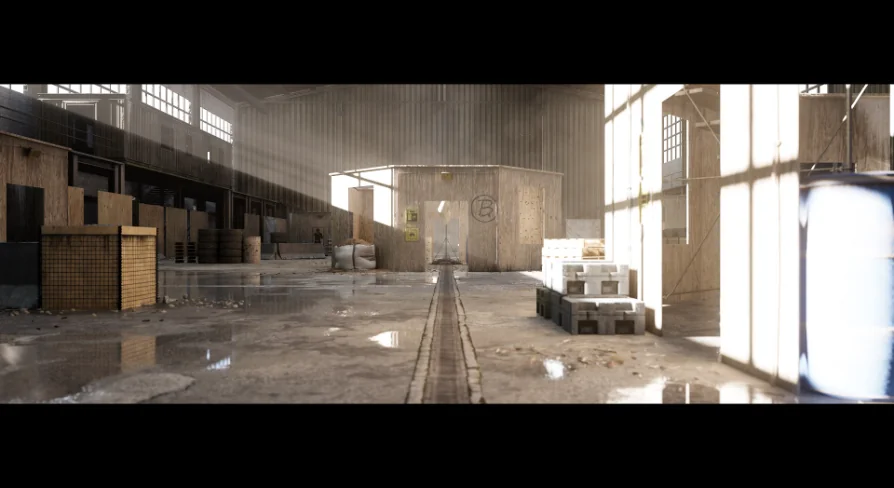
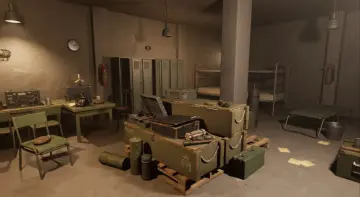
Warehouse shooters live and die by the clutter between spawn and objective. The Military Training Warehouse treats that clutter as a complete environment: a highly detailed set intended for multiplayer level creation, VR simulation spaces, and military prototyping. A variety of scans, custom props, and modular kits are all present, so a designer can build a working map instead of dressing a single view.
The environment is structured as a level rather than a gallery of isolated props. Since the scans, custom props, and modular kits are meant to be assembled together, the art direction stays coherent as the map expands.
Team Deathmatch and Domination Need Different Room Shapes
Team Deathmatch and Domination are both modes for the warehouse, but they push a map in opposite directions. Team Deathmatch rewards routes that spread players out and keep fights moving. Domination needs places where teams collide around a few fixed objectives. The same modular kit can serve both because the layout is not locked down. A designer can make the flow constant or cordon off points of interest using the same walls and cover pieces.
That sort of iteration is where modular kits earn their place. Initial blocking can be open to see how spawns play. A later pass can narrow a corridor or add a sightline block. Since all the pieces live in one environment, changes do not break the lighting or the material story.
Cover Assets Define the Distance Between Teams
The pack includes a wide range of modular and cover assets. In a multiplayer map, cover is the main way to control engagement distance. Tall pieces stop players from seeing across the whole room; low pieces let a player move while crouched; clusters of cover create positions that are worth holding. On a Domination map, the placement of those assets around an objective decides how easy it is to defend or attack.
Custom props keep cover from feeling purely mechanical. They are mixed with the modular segments, so the same overall kit can produce a tucked corner in one room and a central obstacle in the next. The military training atmosphere gives every prop a reason to exist. There is less risk of something looking decorative when the theme is a place suited to drills and exercises.
Scanned Decals and Rubble Carry the Ground Level
The ground has its own set of tools. Scanned mesh decals bring wear, cracks, and touch-up marks from real surfaces. Rubble pieces sit on top of that decal layer to make floor contact for weapons or characters more physical. Because the decals come from photogrammetry, they do not fight with the warehouse's realistic style.
Ground assets also influence sightlines at floor level. A piece of rubble just large enough to break a silhouette can give the map another moment of tension. A long row of scanned decals or damage marks keeps an open floor from turning into a blur of repeated material. Those small choices add depth while the modular walls handle the main structure.
VR Simulation Training and Military Prototyping Use the Same Space
Multiplayer level design is one of the pack's jobs. The creator also positions the kit for building a VR simulation training arena and for military prototyping. A modular layout is a strong fit for VR training because it can be reconfigured quickly for different exercises. One session might require a clear warehouse lane; another exercise could split that lane into separate rooms.
Prototyping work follows the same logic. If the goal is to test a piece of equipment or a tactical concept, the environment needs to look like an occupied military facility. Props, cover, and scanned rubble put the virtual space in the right context without forcing a game-specific structure on it.
The pack's simulation and weapon tags reinforce this dual role. It is not only a backdrop. The same props that become cover in a firefight become tools, targets, or stage elements in a training session.
Ray Traced Presentation Shows How the Materials Behave
A video presentation accompanies the full product, and it runs with ray tracing enabled. For an environment with scans and industrial surfaces, ray tracing reveals how adjacent materials react. A metal crate beside worn concrete will bounce reflections differently, and those relationships matter when the floor is populated with rubble and decals. Seeing the space under ray traced light is a better test of a photorealistic level than static thumbnails.
The ray traced look also suggests how the materials could perform later in a real-time project. Although the video itself is a preview, it does show the intended visual density.
For a photorealistic warehouse, repeated modules benefit from being checked in motion. The ray traced video makes it easier to spot whether the scans stay convincing when the camera moves through the set.
Level designers and teams working on Team Deathmatch, Domination, or a VR training exercise can use the Military Training Warehouse as a starting shell. The modular pieces handle structure, cover packages handle combat flow, and scanned ground detail keeps the floor interesting down to the last rubble pile. Combat-focused levels and simulation-driven sessions can build from the same warehouse.
 Military / Warzone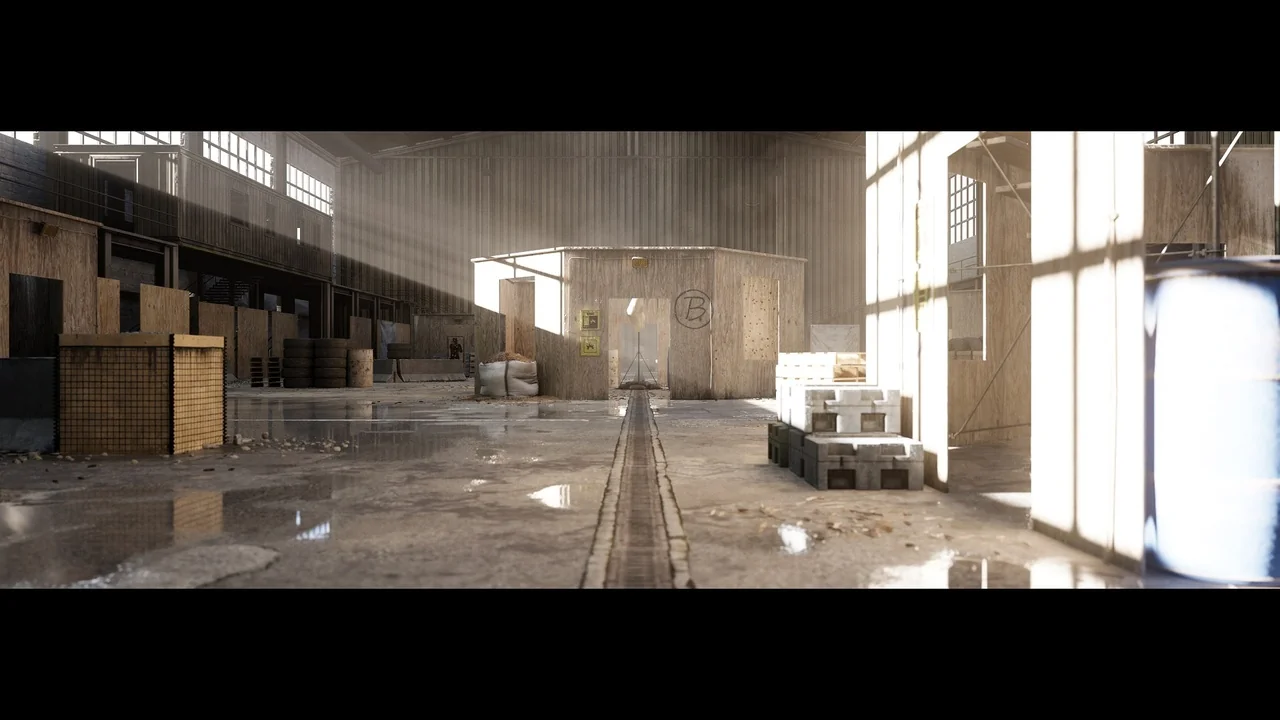
 Military / Warzone
 Military / Warzone
 Military / Warzone