"0148f1904a9b0d16"{"id":"1002585","slug":"mechanic-character-sarah-survival-survivor-action-shooter-adventure-woman-girl","title":"Mechanic Character Sarah - Survival Survivor Action Shooter Adventure Woman Girl","category":"Humans","engine":"5.0+","assetVersion":"","engineVersion":"Engine Version: 5.0+","tag":"Humans","accent":"blue","visual":"character","summary":"Examine Mechanic Character Sarah, a modular UE5 and Unity game-ready female character featuring 52 facial blendshapes, Control Rig, tools, and PBR textures.","platform":"Unreal Engine","indexPolicy":"index","publishedAt":"2026-11-14T05:26:54.794Z","updatedAt":"2026-11-14T05:26:54.794Z","sourceNotes":[],"fileContents":[],"compatibility":["Unreal Engine","Engine Version: 5.0+"],"featuredImage":{"alt":"Mechanic Character Sarah - Survival Survivor Action Shooter Adventure Woman Girl","src":"/wp-content/uploads/published/2026/11/b37030528869-cdd77163-6187-4a33-ba15-aa503aa471c0-f36a6e695b.webp"},"hasDownloadLink":true,"downloads":0,"terms":[{"taxonomy":"category","slug":"humans","name":"Humans"}],"galleryImages":[{"src":"/wp-content/uploads/published/2026/11/dc5bdf596fbf-81e73e56-6290-487d-aa3d-5fffa264fb7b-d02f17ae2a.webp","alt":"Mechanic Character Sarah - Survival Survivor Action Shooter Adventure Woman Girl"},{"src":"/wp-content/uploads/published/2026/11/c18d434470aa-b14d1aa7-7216-4ae2-8359-8567f0f22863-eae070a06d.webp","alt":"Mechanic Character Sarah - Survival Survivor Action Shooter Adventure Woman Girl"},{"src":"/wp-content/uploads/published/2026/11/886bc4cb2f28-603163e7-3fee-42fc-b2fa-c2729bdca8c4-269720fb7a.webp","alt":"Mechanic Character Sarah - Survival Survivor Action Shooter Adventure Woman Girl"},{"src":"/wp-content/uploads/published/2026/11/1a0ae7b4ea93-fe48f587-bea6-4762-8b27-701d2fe09998-c43a11f5da.webp","alt":"Mechanic Character Sarah - Survival Survivor Action Shooter Adventure Woman Girl"},{"src":"/wp-content/uploads/published/2026/11/45d8ac988ebc-a60bad11-c277-4798-a7c7-99b315063f42-6da8dd4501.webp","alt":"Mechanic Character Sarah - Survival Survivor Action Shooter Adventure Woman Girl"},{"src":"/wp-content/uploads/published/2026/11/6d59d7b3bee5-5f0662d5-3aa4-48fd-b166-7e4c04a9cd83-2a5de41e09.webp","alt":"Mechanic Character Sarah - Survival Survivor Action Shooter Adventure Woman Girl"},{"src":"/wp-content/uploads/published/2026/11/8696278402d2-f12219f9-9fe2-45d6-84c9-99db9b9059c3-df03acfeb2.webp","alt":"Mechanic Character Sarah - Survival Survivor Action Shooter Adventure Woman Girl"},{"src":"/wp-content/uploads/published/2026/11/3ab9a8e7735d-69fd2003-f02c-4f7a-9989-fe0b6cb26713-9cbf90270c.webp","alt":"Mechanic Character Sarah - Survival Survivor Action Shooter Adventure Woman Girl"},{"src":"/wp-content/uploads/published/2026/11/add8cfb458c3-a5244414-e5a4-4f35-9054-114c72a741d5-da40ffe2c8.webp","alt":"Mechanic Character Sarah - Survival Survivor Action Shooter Adventure Woman Girl"},{"src":"/wp-content/uploads/published/2026/11/08b84591865c-116cb992-0c85-4b04-b729-723a6a27ab80-05ed64af37.webp","alt":"Mechanic Character Sarah - Survival Survivor Action Shooter Adventure Woman Girl"}],"accessPanel":{"kind":"resource","title":"Get this resource","eyebrow":"Free resource","message":"Download this resource in your browser.","fileName":"Content.7z","safetyNote":"Resources are manually reviewed before listing to improve quality and reduce obvious risks.","actionLabel":"Get this resource","resourceType":"Resource archive","versions":[]},"contentHtml":"\u003ch2\u003eAnatomy and Toolsets of Mechanic Character Sarah\u003c/h2\u003e\u003cp\u003eMechanic Character Sarah provides a specialized female survivor figure centered around technical survival and engineering themes. Modeled at a standing height of 175 centimeters, the character mesh carries a triangle budget of 67,546 polygons, capturing fine surface definition across clothing seams, equipment straps, and physical anatomy. Rather than functioning purely as an aesthetic model, Sarah arrives configured with specialized gear tailored to mechanical maintenance, scavenging, and field repair scenarios.\u003c/p\u003e\u003cp\u003eAlongside traditional combat assets, the character includes dedicated industrial hand tools modeled with distinct polygon allocations:\u003c/p\u003e\u003cul\u003e\u003cli\u003ePistol: 19,306 polygons\u003c/li\u003e\u003cli\u003eAdjustable wrench: 4,674 polygons\u003c/li\u003e\u003cli\u003ePliers: 2,468 polygons\u003c/li\u003e\u003cli\u003eHammer: 1,269 polygons\u003c/li\u003e\u003cli\u003eAxe: 876 polygons\u003c/li\u003e\u003cli\u003eSpanner: 638 polygons\u003c/li\u003e\u003cli\u003eScrewdriver: 472 polygons\u003c/li\u003e\u003c/ul\u003e\u003cp\u003eThese equipment pieces integrate directly into the master character blueprint hierarchy, titled \u003ccode\u003eCharacter_name_All_Parts\u003c/code\u003e, which bundles the entire catalog of meshes, accessories, and held props into a single structured container. This setup allows level designers and gameplay programmers to toggle tools instantly for crafting, repair, or combat interactions without manually retargeting sockets or managing disjointed asset references.\u003c/p\u003e\u003ch2\u003eModular Clothing Systems and Survivor Skins\u003c/h2\u003e\u003cp\u003eSarah features a multi-tiered clothing framework designed to adapt across different environmental tones. The package supplies distinct texture and material skins, spanning Basic, Adventure, Survival, Horror, and stylized themed appearances. Each skin alters fabric weathering, grime, and environmental wear across the garments, accommodating clean industrial staging as well as distressed, post-apocalyptic settings.\u003c/p\u003e\u003cp\u003eUnderneath the outer garments, the package includes an underlying full-body mesh and base underwear layer. To prevent clipping and mesh intersections during rigorous movement, standard production guidelines recommend hiding or disabling occluded body segments rather than running the complete anatomical mesh beneath tight outer layers. Layer separation covers individual head meshes, hairstyles, upper garments, lower garments, and accessories such as watches and amulets.\u003c/p\u003e\u003cp\u003eComponent modularity connects with the broader Adventure character line, allowing cross-character garment swapping via included corrective blendshapes that eliminate edge clipping between non-identical seams. The model also maintains structural compatibility with external modular hair systems, including the ULTIMATE HAIRSTYLE PACK 2026 | 20 PIECES | REALISTIC, expanding visual personalization for custom roster generation. In Unreal Engine, garment swapping operates through the actor's Construction Script, making visual alterations accessible directly from editor viewports without modifying raw mesh geometry.\u003c/p\u003e\u003ch2\u003eSkeletal Architecture and Muscle Deformation\u003c/h2\u003e\u003cp\u003eThe internal rig is built on an expanded version of the Epic Skeleton, integrating supplementary twist and helper bones that maintain volume across joints during complex poses. A dedicated Control Rig is bundled directly in the project, enabling keyframe manipulation, corrective posing, and cinematic sequencing without moving assets out of the engine environment into external digital content creation software. Retargeting workflows rely on pre-configured IK Rig assets, simplifying the process of remapping existing animation sequences, including third-party animation frameworks such as Advanced Locomotion System V4 (ALS4) or the Lyra starter library.\u003c/p\u003e\u003cp\u003eExtreme anatomical deformations are governed by corrective blendshapes designed to simulate dynamic muscle flexing and contraction. As limbs enter deep flexions or extreme rotations, these shapes activate to prevent volume collapse at the elbows, knees, and shoulders. For aesthetic customization, the package incorporates parametric blendshapes that control the proportions of the chest and hips, giving technical artists granular control over the character's silhouette.\u003c/p\u003e\u003cp\u003ePhysical motion runs on customized physics assets mapped to the skeleton. Dynamic movement is calculated for loose hair cards, floating straps, hanging equipment, and secondary body weight, allowing realistic reactive motion during running, jumping, and ragdoll transitions.\u003c/p\u003e\u003ch2\u003eFacial Performance and Live Link Face Integration for Sarah\u003c/h2\u003e\u003cp\u003eCinematic close-ups and dialogue interactions are driven by 52 calibrated facial blendshapes conforming to standard performance capture conventions. These targets support real-time markerless tracking through Faceware, Live Link Face, and mobile capture pipelines using iOS devices. The setup links directly to incoming data streams, translating natural eye darts, jaw mechanics, brow inflections, and lip shapes with zero manual driver mapping required.\u003c/p\u003e\u003cp\u003eDetailed documentation accompanying the package guides users through connecting an external capture device, establishing network communication inside Unreal Engine, calibrating the resting face shape against individual performers, and baking captured facial data directly onto Sequencer tracks. This workflow allows developers to cleanly sync facial recordings with skeletal body animations for cutscene authoring.\u003c/p\u003e\u003cp\u003eMaterial shaders utilize advanced Blueprint-driven master materials featuring Subsurface Scattering (SSS) profiles, dedicated micronormal masks, and segmented ID masks. These ID maps permit per-instance recoloring of hair locks, eye irises, skin tones, garment fabrics, and metal tool surfaces directly inside material instance parameters, eliminating the need to re-author source textures in external painting suites.\u003c/p\u003e\u003ch2\u003ePipeline Implementation in Unreal Engine and Unity\u003c/h2\u003e\u003cp\u003eProject integration extends across multiple engine ecosystems. Unreal Engine environments contain pre-built demoscenes and cinematic demonstration maps populated with custom environment props and five separate biome setups. Users can trigger runtime simulation by entering Play-Selected Viewport mode, using hotkey inputs such as the F key to cycle character displays, test ragdoll transitions, review modular combinations, and inspect material responses under high-tier lighting. Exploiting the full visual fidelity of these scenes requires setting Engine Scalability and Material Quality Levels to their maximum thresholds.\u003c/p\u003e\u003cp\u003eIn Unity, Sarah deploys across the High Definition Render Pipeline (HDRP), Universal Render Pipeline (URP), and the Built-in Render Pipeline with tailored shader configurations for each renderer. The Unity package incorporates a functional Third Person Character Controller out of the box, allowing instant gameplay testing. Dynamic hair and cloth movement functions via Unity Chan scripts natively, while supporting the Magica Cloth 2 plugin for advanced procedural physics simulation. Cross-character clothing transfer inside Unity can be achieved by utilizing Skinned Mesh Transfer plugins alongside the provided integration guidelines.\u003c/p\u003e\n\n\u003ch2\u003eExplore Similar Assets\u003c/h2\u003e\n\u003cul\u003e\n\u003cli\u003e\u003ca href=\"https://3dcghub.com/samurai-girl-tomoe/\" rel=\"noopener noreferrer\"\u003eSamurai Girl Tomoe\u003c/a\u003e\u003c/li\u003e\n\u003cli\u003e\u003ca href=\"https://3dcghub.com/survivor-girl-1-modular/\" rel=\"noopener noreferrer\"\u003eSurvivor Girl 1 (Modular)\u003c/a\u003e\u003c/li\u003e\n\u003cli\u003e\u003ca href=\"https://3dcghub.com/goth-girl/\" rel=\"noopener noreferrer\"\u003eGoth girl\u003c/a\u003e\u003c/li\u003e\n\u003cli\u003e\u003ca href=\"https://3dcghub.com/western-characters-series-2025-adventure-survival-shooter-action-cowboy-man/\" rel=\"noopener noreferrer\"\u003eWestern Characters Series 2025 - Adventure Survival Shooter Action Cowboy Man\u003c/a\u003e\u003c/li\u003e\n\u003cli\u003e\u003ca href=\"https://3dcghub.com/g2-survival-characters/\" rel=\"noopener noreferrer\"\u003eG2: Survival Characters\u003c/a\u003e\u003c/li\u003e\n\u003c/ul\u003e","contentTextLength":7158,"navigation":{"current":64,"total":4543,"previous":{"id":"1002586","slug":"medieval-modular-wall-pack-kitbash-collection","title":"Medieval Modular Wall Pack - Kitbash Collection","category":"Buildings \u0026 Architecture","platform":"Unreal Engine","updatedAt":"2026-11-14T05:28:08.228Z"},"next":{"id":"1002584","slug":"industrial-infrastructure","title":"Industrial Infrastructure","category":"Industrial Buildings","platform":"Unreal Engine","updatedAt":"2026-11-14T05:25:42.660Z"}},"relatedResources":[{"id":"1002405","slug":"samurai-girl-tomoe","title":"Samurai Girl Tomoe","category":"Humans","engine":"4.19+,5.0+","assetVersion":"","engineVersion":"Engine Version: 4.19+,5.0+","tag":"Humans","accent":"blue","visual":"mech","summary":"Modular 3D warrior character Samurai Girl Tomoe featuring 52 ARKit blendshapes, 4K packed textures, and an Epic Skeleton rig for action games.","platform":"Unreal Engine","indexPolicy":"index","publishedAt":"2026-11-10T07:07:18.175Z","updatedAt":"2026-11-10T07:07:18.175Z","sourceNotes":[],"fileContents":[],"compatibility":["Unreal Engine","Engine Version: 4.19+,5.0+"],"featuredImage":{"alt":"Samurai Girl Tomoe","src":"/wp-content/uploads/published/2026/11/5c46690700c0-95be6877-7081-4ad3-b57c-fd636373f3cb-40e5943225.webp"},"hasDownloadLink":true,"downloads":0},{"id":"1000206","slug":"survivor-girl-1-modular","title":"Survivor Girl 1 (Modular)","category":"Humans","engine":"4.26+,5.0+","assetVersion":"","engineVersion":"Engine Version: 4.26+,5.0+","tag":"Humans","accent":"blue","visual":"mech","summary":"A fully rigged, modular female character model designed for apocalyptic survival games, featuring facial blendshapes, 4K PBR textures, and low-poly weapons.","platform":"Unreal Engine","indexPolicy":"index","publishedAt":"2026-06-23T19:35:44.835Z","updatedAt":"2026-06-23T19:35:44.835Z","sourceNotes":[],"fileContents":[],"compatibility":["Unreal Engine","Engine Version: 4.26+,5.0+"],"featuredImage":{"alt":"Survivor Girl 1 (Modular)","src":"/wp-content/uploads/published/2026/06/ea003c542fdd-d82dc264-87e2-40e6-a96c-2a4b916b4cb7-25e2910de6.webp"},"hasDownloadLink":true,"downloads":5},{"id":"1002480","slug":"goth-girl","title":"Goth girl","category":"Humans","engine":"4.25+,5.0+","assetVersion":"","engineVersion":"Engine Version: 4.25+,5.0+","tag":"Humans","accent":"blue","visual":"mech","summary":"Technical analysis of the Goth girl asset, featuring an Epic skeleton rig, secondary chest and eyelash bones, 4K packed ORM textures, and survival compatibility","platform":"Unreal Engine","indexPolicy":"index","publishedAt":"2026-11-12T03:38:12.469Z","updatedAt":"2026-11-12T03:38:12.469Z","sourceNotes":[],"fileContents":[],"compatibility":["Unreal Engine","Engine Version: 4.25+,5.0+"],"featuredImage":{"alt":"Goth girl","src":"/wp-content/uploads/published/2026/11/0f08a1dbae43-41c2b4d5-d946-46ca-a0b7-2557628dd58f-302cc36b91.webp"},"hasDownloadLink":true,"downloads":0}]}
Humans
Mechanic Character Sarah - Survival Survivor Action Shooter Adventure Woman Girl
Examine Mechanic Character Sarah, a modular UE5 and Unity game-ready female character featuring 52 facial blendshapes, Control Rig, tools, and PBR textures.
Category:Unreal Engine,HumansPlatform: Unreal EngineEngine Version: 5.0+Published: Nov 14, 2026
Humans
Resource overview
Anatomy and Toolsets of Mechanic Character Sarah
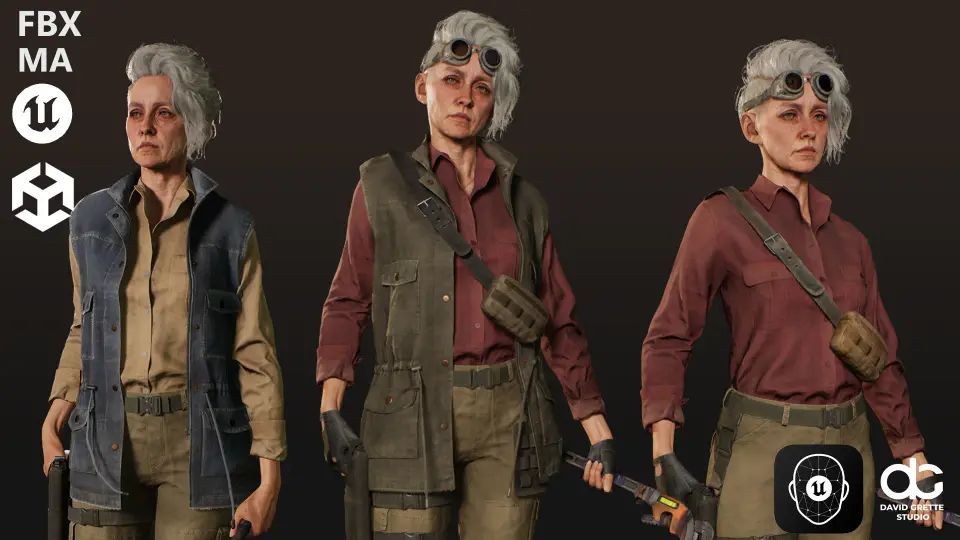
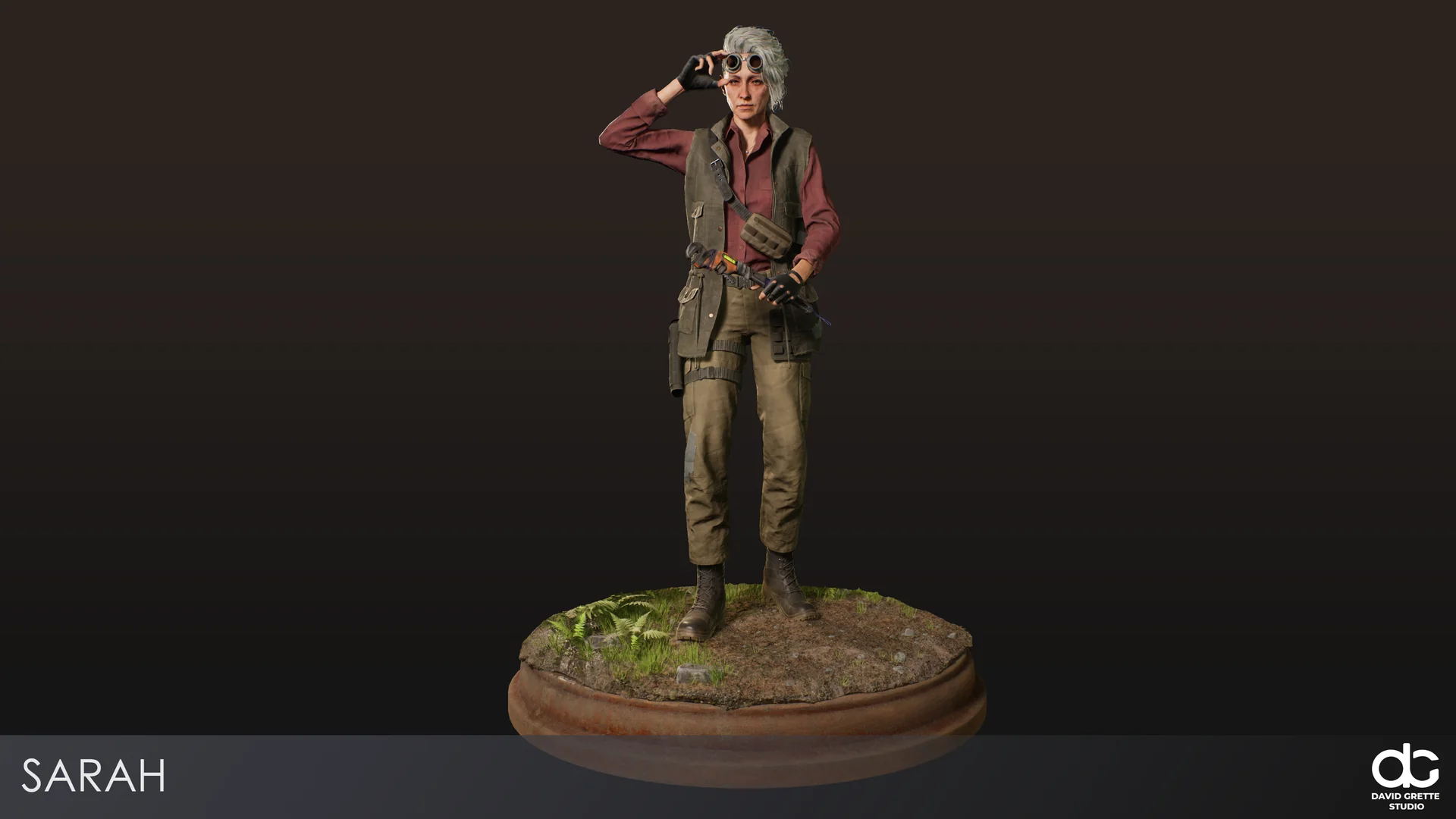
Mechanic Character Sarah provides a specialized female survivor figure centered around technical survival and engineering themes. Modeled at a standing height of 175 centimeters, the character mesh carries a triangle budget of 67,546 polygons, capturing fine surface definition across clothing seams, equipment straps, and physical anatomy. Rather than functioning purely as an aesthetic model, Sarah arrives configured with specialized gear tailored to mechanical maintenance, scavenging, and field repair scenarios.
Alongside traditional combat assets, the character includes dedicated industrial hand tools modeled with distinct polygon allocations:
Pistol: 19,306 polygons
Adjustable wrench: 4,674 polygons
Pliers: 2,468 polygons
Hammer: 1,269 polygons
Axe: 876 polygons
Spanner: 638 polygons
Screwdriver: 472 polygons
These equipment pieces integrate directly into the master character blueprint hierarchy, titled Character_name_All_Parts, which bundles the entire catalog of meshes, accessories, and held props into a single structured container. This setup allows level designers and gameplay programmers to toggle tools instantly for crafting, repair, or combat interactions without manually retargeting sockets or managing disjointed asset references.
Modular Clothing Systems and Survivor Skins
Sarah features a multi-tiered clothing framework designed to adapt across different environmental tones. The package supplies distinct texture and material skins, spanning Basic, Adventure, Survival, Horror, and stylized themed appearances. Each skin alters fabric weathering, grime, and environmental wear across the garments, accommodating clean industrial staging as well as distressed, post-apocalyptic settings.
Underneath the outer garments, the package includes an underlying full-body mesh and base underwear layer. To prevent clipping and mesh intersections during rigorous movement, standard production guidelines recommend hiding or disabling occluded body segments rather than running the complete anatomical mesh beneath tight outer layers. Layer separation covers individual head meshes, hairstyles, upper garments, lower garments, and accessories such as watches and amulets.
Component modularity connects with the broader Adventure character line, allowing cross-character garment swapping via included corrective blendshapes that eliminate edge clipping between non-identical seams. The model also maintains structural compatibility with external modular hair systems, including the ULTIMATE HAIRSTYLE PACK 2026 | 20 PIECES | REALISTIC, expanding visual personalization for custom roster generation. In Unreal Engine, garment swapping operates through the actor's Construction Script, making visual alterations accessible directly from editor viewports without modifying raw mesh geometry.
Skeletal Architecture and Muscle Deformation
The internal rig is built on an expanded version of the Epic Skeleton, integrating supplementary twist and helper bones that maintain volume across joints during complex poses. A dedicated Control Rig is bundled directly in the project, enabling keyframe manipulation, corrective posing, and cinematic sequencing without moving assets out of the engine environment into external digital content creation software. Retargeting workflows rely on pre-configured IK Rig assets, simplifying the process of remapping existing animation sequences, including third-party animation frameworks such as Advanced Locomotion System V4 (ALS4) or the Lyra starter library.
Extreme anatomical deformations are governed by corrective blendshapes designed to simulate dynamic muscle flexing and contraction. As limbs enter deep flexions or extreme rotations, these shapes activate to prevent volume collapse at the elbows, knees, and shoulders. For aesthetic customization, the package incorporates parametric blendshapes that control the proportions of the chest and hips, giving technical artists granular control over the character's silhouette.
Physical motion runs on customized physics assets mapped to the skeleton. Dynamic movement is calculated for loose hair cards, floating straps, hanging equipment, and secondary body weight, allowing realistic reactive motion during running, jumping, and ragdoll transitions.
Facial Performance and Live Link Face Integration for Sarah
Cinematic close-ups and dialogue interactions are driven by 52 calibrated facial blendshapes conforming to standard performance capture conventions. These targets support real-time markerless tracking through Faceware, Live Link Face, and mobile capture pipelines using iOS devices. The setup links directly to incoming data streams, translating natural eye darts, jaw mechanics, brow inflections, and lip shapes with zero manual driver mapping required.
Detailed documentation accompanying the package guides users through connecting an external capture device, establishing network communication inside Unreal Engine, calibrating the resting face shape against individual performers, and baking captured facial data directly onto Sequencer tracks. This workflow allows developers to cleanly sync facial recordings with skeletal body animations for cutscene authoring.
Material shaders utilize advanced Blueprint-driven master materials featuring Subsurface Scattering (SSS) profiles, dedicated micronormal masks, and segmented ID masks. These ID maps permit per-instance recoloring of hair locks, eye irises, skin tones, garment fabrics, and metal tool surfaces directly inside material instance parameters, eliminating the need to re-author source textures in external painting suites.
Pipeline Implementation in Unreal Engine and Unity
Project integration extends across multiple engine ecosystems. Unreal Engine environments contain pre-built demoscenes and cinematic demonstration maps populated with custom environment props and five separate biome setups. Users can trigger runtime simulation by entering Play-Selected Viewport mode, using hotkey inputs such as the F key to cycle character displays, test ragdoll transitions, review modular combinations, and inspect material responses under high-tier lighting. Exploiting the full visual fidelity of these scenes requires setting Engine Scalability and Material Quality Levels to their maximum thresholds.
In Unity, Sarah deploys across the High Definition Render Pipeline (HDRP), Universal Render Pipeline (URP), and the Built-in Render Pipeline with tailored shader configurations for each renderer. The Unity package incorporates a functional Third Person Character Controller out of the box, allowing instant gameplay testing. Dynamic hair and cloth movement functions via Unity Chan scripts natively, while supporting the Magica Cloth 2 plugin for advanced procedural physics simulation. Cross-character clothing transfer inside Unity can be achieved by utilizing Skinned Mesh Transfer plugins alongside the provided integration guidelines.
 Humans
 Humans
 Humans
 Humans