"c14ff6bd758dadb1"{"id":"1000075","slug":"mastering-environment-design-with-unreal-engine-5","title":"Mastering Environment Design with Unreal Engine 5","category":"Unreal Engine","engine":"File Content: video + English subtitles","assetVersion":"Video Language: English","engineVersion":"File Content: video + English subtitles","tag":"Unreal Engine","accent":"blue","visual":"city","summary":"A beginner-focused Unreal Engine 5 course that moves from setup and interface basics into landscapes, lighting, foliage, water, and Liberty Island.","platform":"Unreal Engine","publishedAt":"2026-06-04T11:48:34.690Z","updatedAt":"2026-06-04T11:48:34.690Z","sourceNotes":[],"fileContents":[],"compatibility":["Unreal Engine","Video Language: English","File Content: video + English subtitles"],"featuredImage":{"alt":"Mastering Environment Design with Unreal Engine 5","src":"/wp-content/uploads/published/2026/06/ab718c477394-6356637-409e-2-e37d68d140.webp"},"hasDownloadLink":true,"downloads":4,"terms":[{"taxonomy":"category","slug":"tutoriallibrary-unrealengine","name":"Unreal Engine"}],"galleryImages":[],"accessPanel":{"kind":"video-resource","title":"Access this video resource","eyebrow":"Free Download","message":"Log in or create a free account to start your download.","fileName":"Mastering Environment Design with Unreal Engine 5.7z","safetyNote":"Resources are manually reviewed before listing to improve quality and reduce obvious risks.","actionLabel":"Download Free","resourceType":"Video package"},"contentHtml":"\u003cp\u003eMastering Environment Design with Unreal Engine 5 begins with the setup path that many beginners need most: getting Unreal Engine 5 installed, opening it with confidence, and learning how to move through the interface before any large scene work starts. That opening direction matters because the course is aimed at learners building their understanding from the ground up, not at experienced users jumping straight into advanced production tasks. From there, the training shifts into environment design fundamentals and uses hands-on projects to turn those ideas into actual scene work, with Liberty Island serving as a central practical build.\u003c/p\u003e \u003cp\u003eThe course runs for 8 hours and 6 minutes and is taught at a beginner level. It was published on Apr 11, 2025, and is led by Sharifa Taraki. Its curriculum is laid out in a clear sequence: Introduction, Introduction to Environment Design, UE5 Basics, Materials and Textures, Lighting, Landscapes, Foliage, Water, and Liberty Island Project. That progression gives the course a direct implementation flow, starting with orientation and then moving through the main systems involved in constructing an environment inside Unreal Engine 5.\u003c/p\u003e \u003ch2\u003eStarting in Unreal Engine 5 before building Liberty Island\u003c/h2\u003e\n\u003cp\u003eThe early part of the course focuses on giving students a solid foundation in Unreal Engine 5 itself. That includes installation and learning how to navigate the interface. For beginners, this is the practical entry point into environment work: understanding where tools are located, how the workspace is organized, and how to move from a blank starting point into scene development.\u003c/p\u003e \u003cp\u003eThis setup stage is paired with an introduction to environment design as a discipline. Students learn the fundamentals of environment design and why it matters in both game development and filmmaking. The course also addresses how environment design has evolved over time and why its role continues to grow in immersive media. That broader framing gives context to the software training. Unreal Engine 5 is not treated in isolation; it is presented as the working space where design choices, world-building, and visual storytelling come together.\u003c/p\u003e \u003cp\u003eBecause the course is aimed at beginners, aspiring game developers, 3D artists and designers, indie developers, and content creators, this early section does more than explain tools. It establishes why those tools are relevant across games, films, animation, virtual production, and cinematic storytelling. That makes the opening chapters less about abstract theory and more about preparing students to build believable and expressive spaces.\u003c/p\u003e \u003ch2\u003eLandscapes and terrain as the foundation of environment design\u003c/h2\u003e\n\u003cp\u003eOnce the course moves beyond basic orientation, it turns toward one of the most structural parts of environment work: landscapes. Students learn how to create landscapes and sculpt terrain, forming the base layer of a virtual world. For production work, this places terrain creation at the center of the workflow rather than treating it as a secondary detail.\u003c/p\u003e \u003cp\u003eThat emphasis fits the course’s stated focus on environment design fundamentals. Before smaller props, fine surface detail, or cinematic polish can shape a scene, the world needs landforms that define scale, navigation, and visual identity. The training frames landscape work as the starting point for world construction inside UE5. Students are not only introduced to the existence of landscape tools; they practice using them to shape the space that later systems will build upon.\u003c/p\u003e \u003cp\u003eThe curriculum structure reinforces this idea. Landscapes appears as its own major section, which places terrain creation alongside other core technical areas such as lighting, foliage, and materials. In a beginner course, that separation is useful because it treats the ground plane, elevation changes, and environmental form as skills worth learning directly, not as background tasks hidden inside a larger project.\u003c/p\u003e \u003ch2\u003eMaterials, textures, and lighting in Unreal Engine 5\u003c/h2\u003e\n\u003cp\u003eAfter the world’s forms are established, the course moves into the surface and mood of the environment. Students learn how to apply materials and textures to bring detail and realism to their scenes. This part of the training connects visual richness to the earlier terrain work, helping students move from broad shapes into a more finished environmental look.\u003c/p\u003e \u003cp\u003eMaterials and textures are presented as practical tools for adding believable surface information. In the context of environment design, this means scenes do not stop at sculpted land or rough geometry. They are pushed toward a more developed visual state through texture application and material work. Since the course is positioned for learners interested in games, films, animation, and virtual production, this section supports the broader goal of making environments feel convincing on screen.\u003c/p\u003e \u003cp\u003eLighting then extends that work by changing how those environments read emotionally and visually. Students learn the role of lighting and how to create different moods using dynamic and static lighting techniques. This gives lighting a dual function in the course: it is both technical and expressive. It affects visibility and scene presentation, but it also shapes tone.\u003c/p\u003e \u003cp\u003eThat is especially relevant for learners interested in cinematic environments for storytelling. Mood is not treated as an abstract concept. It is tied directly to the use of dynamic and static lighting techniques inside Unreal Engine 5. By placing lighting after materials and textures in the curriculum, the course follows a sensible scene-building order: establish form, add surface detail, then control atmosphere and visual impact through light.\u003c/p\u003e \u003ch2\u003eFoliage, water, and natural scene dressing with UE5 tools\u003c/h2\u003e\n\u003cp\u003eThe environment pipeline here does not end with terrain and lighting. Students also learn to populate scenes with natural elements using UE5’s foliage tools. Trees, rocks, foliage, and other natural components are part of this stage, turning a basic landscape into a more complete environment.\u003c/p\u003e \u003cp\u003eThis portion of the course shows how scene density and environmental character are developed. Natural elements are not framed as optional decoration. They are part of the practical process of building immersive worlds. For aspiring game developers and indie developers, this is relevant because the visual quality of a project often depends on how effectively empty terrain is transformed into a lived-in or believable setting. For 3D artists, designers, and content creators, it expands the environment from a technical build into a more composed visual space.\u003c/p\u003e \u003cp\u003eWater is also included as a dedicated curriculum section. Its placement alongside foliage suggests that the course addresses another key layer of world creation beyond terrain shaping alone. Water can strongly affect the look and identity of an environment, especially in a project like Liberty Island. Within the course structure, it functions as one more environmental system that students can apply as their scenes become more complete.\u003c/p\u003e \u003cp\u003eTogether, landscapes, foliage, rocks, trees, materials, textures, lighting, and water create a workflow that progresses from empty terrain toward a fuller scene. The course’s structure makes each of those areas distinct enough to study while still keeping them connected inside one environment design process.\u003c/p\u003e \u003ch2\u003eSix projects and the Liberty Island Project as hands-on practice\u003c/h2\u003e\n\u003cp\u003ePractice is a major part of the course. Students work through six unique and creative projects, including a special cinematic scene. That means the training does not stop at isolated lessons on tools or concepts. It gives students repeated chances to apply what they learn across multiple builds.\u003c/p\u003e \u003cp\u003eThe Liberty Island Project stands out as the named project in the curriculum and aligns with the course description’s hands-on focus on Creating Liberty Island. This gives the course a concrete anchor. Rather than learning environment design only through disconnected examples, students follow a recognizable project that ties together terrain creation, material work, lighting, foliage, and water in a unified scene-building exercise.\u003c/p\u003e \u003cp\u003eThe cinematic element in the project work also matches the course’s appeal beyond game development alone. It speaks to learners interested in filmmaking, animation, virtual production, and storytelling through environments. Since one of the stated audiences is content creators who want to design cinematic environments, the presence of a special cinematic scene helps connect technical Unreal Engine 5 training to presentation and atmosphere.\u003c/p\u003e \u003cp\u003eThe audience range is broad but coherent. Beginners get a step-by-step introduction to UE5 and environment design. Aspiring game developers get a path toward immersive world creation. 3D artists and designers can use the course to explore detailed environments for film, animation, or virtual production. Indie developers can focus on improving visual quality. Content creators can approach environment building as part of cinematic storytelling.\u003c/p\u003e \u003cp\u003eAs a practical takeaway, this course is structured as a beginner entry into Unreal Engine 5 environment design that starts with setup and interface basics, then moves through the core production stages of landscapes, materials, lighting, foliage, and water before applying them in six projects centered by Liberty Island.\u003c/p\u003e\n\n\u003ch2\u003eExplore Similar Assets\u003c/h2\u003e\n\u003cul\u003e\n\u003cli\u003e\u003ca href=\"https://3dcghub.com/unreal-engine-5-c-advanced-action-rpg/\" title=\"Unreal Engine 5 C++: Advanced Action RPG\"\u003eUnreal Engine 5 C++: Advanced Action RPG\u003c/a\u003e\u003c/li\u003e\n\u003cli\u003e\u003ca href=\"https://3dcghub.com/unreal-engine-5-c-make-your-own-action-combat-game/\" title=\"Unreal Engine 5 C++: Make Your Own Action Combat Game\"\u003eUnreal Engine 5 C++: Make Your Own Action Combat Game\u003c/a\u003e\u003c/li\u003e\n\u003cli\u003e\u003ca href=\"https://3dcghub.com/mastering-c-for-unreal-engine-beginner-to-pro/\" title=\"Mastering C++ for Unreal Engine (Beginner to Pro)\"\u003eMastering C++ for Unreal Engine (Beginner to Pro)\u003c/a\u003e\u003c/li\u003e\n\u003cli\u003e\u003ca href=\"https://3dcghub.com/make-a-2d-action-platformer-in-unreal-engine-5/\" title=\"Make a 2D Action Platformer in Unreal Engine 5\"\u003eMake a 2D Action Platformer in Unreal Engine 5\u003c/a\u003e\u003c/li\u003e\n\u003cli\u003e\u003ca href=\"https://3dcghub.com/unreal-engine-5-one-course-solution-for-niagara-vfx/\" title=\"Unreal Engine 5: One Course Solution For Niagara VFX\"\u003eUnreal Engine 5: One Course Solution For Niagara VFX\u003c/a\u003e\u003c/li\u003e\n\u003c/ul\u003e","contentTextLength":9617,"navigation":{"current":1788,"total":3719,"previous":{"id":"1000076","slug":"modern-office-environment-modern-office-environment-modern-office-3d-office","title":"Modern Office Environment ( Modern Office Environment Modern Office 3D Office )","category":"Interior","platform":"Unreal Engine","updatedAt":"2026-06-04T14:57:57.733Z"},"next":{"id":"1000073","slug":"make-game-assets-easily-and-export-to-godot-unity-unreal","title":"Make Game Assets Easily And Export To Godot / Unity / Unreal","category":"Tutorial Library","platform":"Unity","updatedAt":"2026-06-03T18:08:30.635Z"}},"relatedResources":[{"id":"1001156","slug":"unreal-engine-5-the-complete-beginner-s-course","title":"Unreal Engine 5: The Complete Beginner’s Course","category":"Unreal Engine","engine":"File Content: video + English subtitles","assetVersion":"Video Language: English","engineVersion":"File Content: video + English subtitles","tag":"Unreal Engine","accent":"blue","visual":"mech","summary":"Explore Unreal Engine 5: The Complete Beginner’s Course by David Nixon, covering level design, Blueprints, inputs, UI, audio, and game logic.","platform":"Unreal Engine","publishedAt":"2026-09-11T00:37:06.865Z","updatedAt":"2026-09-11T00:37:06.865Z","sourceNotes":[],"fileContents":[],"compatibility":["Unreal Engine","Video Language: English","File Content: video + English subtitles"],"featuredImage":{"alt":"Unreal Engine 5: The Complete Beginner’s Course","src":"/wp-content/uploads/published/2026/09/7520d752930b-660600-39b2-5-a470c19787.webp"},"hasDownloadLink":true,"downloads":0},{"id":"1000790","slug":"ui-design-for-games-by-grafit-studio","title":"UI Design for Games by Grafit Studio","category":"Unreal Engine","engine":"File Content: video + English subtitles","assetVersion":"Video Language: English","engineVersion":"File Content: video + English subtitles","tag":"Unreal Engine","accent":"blue","visual":"mech","summary":"Grafit Studio's 8-lesson, 8h 11m course trains junior and middle artists in game UI design, covering references, adaptivity, composition, and export.","platform":"Unreal Engine","publishedAt":"2026-07-30T12:45:28.884Z","updatedAt":"2026-07-30T12:45:28.884Z","sourceNotes":[],"fileContents":[],"compatibility":["Unreal Engine","Video Language: English","File Content: video + English subtitles"],"featuredImage":{"alt":"UI Design for Games by Grafit Studio","src":"https://img-c.udemycdn.com/course/480x270/6130555_3b02_2.jpg"},"hasDownloadLink":true,"downloads":1},{"id":"1000518","slug":"unreal-engine-5-visual-novel-and-narrative-game-design","title":"Unreal Engine 5 Visual Novel and Narrative Game Design","category":"Unreal Engine","engine":"File Content: video + English subtitles","assetVersion":"Video Language: English","engineVersion":"File Content: video + English subtitles","tag":"Unreal Engine","accent":"blue","visual":"mech","summary":"A project-based Unreal Engine 5 course for building interactive visual novels, covering data tables, branching dialogue, UI widgets, and narrative game mechanic","platform":"Unreal Engine","publishedAt":"2026-07-14T11:05:10.698Z","updatedAt":"2026-07-14T11:05:10.698Z","sourceNotes":[],"fileContents":[],"compatibility":["Unreal Engine","Video Language: English","File Content: video + English subtitles"],"featuredImage":{"alt":"Unreal Engine 5 Visual Novel and Narrative Game Design","src":"https://public-files.gumroad.com/x107l9l6mrzczbch3ig6uf9grp45"},"hasDownloadLink":true,"downloads":0}]}
Unreal Engine
Mastering Environment Design with Unreal Engine 5
A beginner-focused Unreal Engine 5 course that moves from setup and interface basics into landscapes, lighting, foliage, water, and Liberty Island.
Category:Unreal EnginePlatform: Unreal EngineVideo Language: EnglishFile Content: video + English subtitlesPublished: Jun 4, 2026
Unreal Engine
Resource overview
Mastering Environment Design with Unreal Engine 5 begins with the setup path that many beginners need most: getting Unreal Engine 5 installed, opening it with confidence, and learning how to move through the interface before any large scene work starts. That opening direction matters because the course is aimed at learners building their understanding from the ground up, not at experienced users jumping straight into advanced production tasks. From there, the training shifts into environment design fundamentals and uses hands-on projects to turn those ideas into actual scene work, with Liberty Island serving as a central practical build.
The course runs for 8 hours and 6 minutes and is taught at a beginner level. It was published on Apr 11, 2025, and is led by Sharifa Taraki. Its curriculum is laid out in a clear sequence: Introduction, Introduction to Environment Design, UE5 Basics, Materials and Textures, Lighting, Landscapes, Foliage, Water, and Liberty Island Project. That progression gives the course a direct implementation flow, starting with orientation and then moving through the main systems involved in constructing an environment inside Unreal Engine 5.
Starting in Unreal Engine 5 before building Liberty Island
The early part of the course focuses on giving students a solid foundation in Unreal Engine 5 itself. That includes installation and learning how to navigate the interface. For beginners, this is the practical entry point into environment work: understanding where tools are located, how the workspace is organized, and how to move from a blank starting point into scene development.
This setup stage is paired with an introduction to environment design as a discipline. Students learn the fundamentals of environment design and why it matters in both game development and filmmaking. The course also addresses how environment design has evolved over time and why its role continues to grow in immersive media. That broader framing gives context to the software training. Unreal Engine 5 is not treated in isolation; it is presented as the working space where design choices, world-building, and visual storytelling come together.
Because the course is aimed at beginners, aspiring game developers, 3D artists and designers, indie developers, and content creators, this early section does more than explain tools. It establishes why those tools are relevant across games, films, animation, virtual production, and cinematic storytelling. That makes the opening chapters less about abstract theory and more about preparing students to build believable and expressive spaces.
Landscapes and terrain as the foundation of environment design
Once the course moves beyond basic orientation, it turns toward one of the most structural parts of environment work: landscapes. Students learn how to create landscapes and sculpt terrain, forming the base layer of a virtual world. For production work, this places terrain creation at the center of the workflow rather than treating it as a secondary detail.
That emphasis fits the course’s stated focus on environment design fundamentals. Before smaller props, fine surface detail, or cinematic polish can shape a scene, the world needs landforms that define scale, navigation, and visual identity. The training frames landscape work as the starting point for world construction inside UE5. Students are not only introduced to the existence of landscape tools; they practice using them to shape the space that later systems will build upon.
The curriculum structure reinforces this idea. Landscapes appears as its own major section, which places terrain creation alongside other core technical areas such as lighting, foliage, and materials. In a beginner course, that separation is useful because it treats the ground plane, elevation changes, and environmental form as skills worth learning directly, not as background tasks hidden inside a larger project.
Materials, textures, and lighting in Unreal Engine 5
After the world’s forms are established, the course moves into the surface and mood of the environment. Students learn how to apply materials and textures to bring detail and realism to their scenes. This part of the training connects visual richness to the earlier terrain work, helping students move from broad shapes into a more finished environmental look.
Materials and textures are presented as practical tools for adding believable surface information. In the context of environment design, this means scenes do not stop at sculpted land or rough geometry. They are pushed toward a more developed visual state through texture application and material work. Since the course is positioned for learners interested in games, films, animation, and virtual production, this section supports the broader goal of making environments feel convincing on screen.
Lighting then extends that work by changing how those environments read emotionally and visually. Students learn the role of lighting and how to create different moods using dynamic and static lighting techniques. This gives lighting a dual function in the course: it is both technical and expressive. It affects visibility and scene presentation, but it also shapes tone.
That is especially relevant for learners interested in cinematic environments for storytelling. Mood is not treated as an abstract concept. It is tied directly to the use of dynamic and static lighting techniques inside Unreal Engine 5. By placing lighting after materials and textures in the curriculum, the course follows a sensible scene-building order: establish form, add surface detail, then control atmosphere and visual impact through light.
Foliage, water, and natural scene dressing with UE5 tools
The environment pipeline here does not end with terrain and lighting. Students also learn to populate scenes with natural elements using UE5’s foliage tools. Trees, rocks, foliage, and other natural components are part of this stage, turning a basic landscape into a more complete environment.
This portion of the course shows how scene density and environmental character are developed. Natural elements are not framed as optional decoration. They are part of the practical process of building immersive worlds. For aspiring game developers and indie developers, this is relevant because the visual quality of a project often depends on how effectively empty terrain is transformed into a lived-in or believable setting. For 3D artists, designers, and content creators, it expands the environment from a technical build into a more composed visual space.
Water is also included as a dedicated curriculum section. Its placement alongside foliage suggests that the course addresses another key layer of world creation beyond terrain shaping alone. Water can strongly affect the look and identity of an environment, especially in a project like Liberty Island. Within the course structure, it functions as one more environmental system that students can apply as their scenes become more complete.
Together, landscapes, foliage, rocks, trees, materials, textures, lighting, and water create a workflow that progresses from empty terrain toward a fuller scene. The course’s structure makes each of those areas distinct enough to study while still keeping them connected inside one environment design process.
Six projects and the Liberty Island Project as hands-on practice
Practice is a major part of the course. Students work through six unique and creative projects, including a special cinematic scene. That means the training does not stop at isolated lessons on tools or concepts. It gives students repeated chances to apply what they learn across multiple builds.
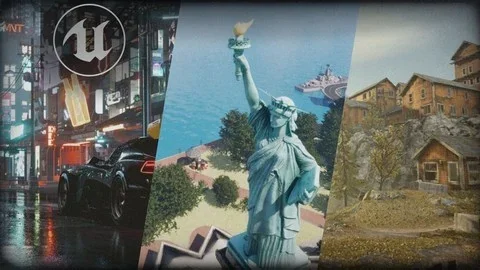
The Liberty Island Project stands out as the named project in the curriculum and aligns with the course description’s hands-on focus on Creating Liberty Island. This gives the course a concrete anchor. Rather than learning environment design only through disconnected examples, students follow a recognizable project that ties together terrain creation, material work, lighting, foliage, and water in a unified scene-building exercise.
The cinematic element in the project work also matches the course’s appeal beyond game development alone. It speaks to learners interested in filmmaking, animation, virtual production, and storytelling through environments. Since one of the stated audiences is content creators who want to design cinematic environments, the presence of a special cinematic scene helps connect technical Unreal Engine 5 training to presentation and atmosphere.
The audience range is broad but coherent. Beginners get a step-by-step introduction to UE5 and environment design. Aspiring game developers get a path toward immersive world creation. 3D artists and designers can use the course to explore detailed environments for film, animation, or virtual production. Indie developers can focus on improving visual quality. Content creators can approach environment building as part of cinematic storytelling.
As a practical takeaway, this course is structured as a beginner entry into Unreal Engine 5 environment design that starts with setup and interface basics, then moves through the core production stages of landscapes, materials, lighting, foliage, and water before applying them in six projects centered by Liberty Island.
 Unreal Engine
 Unreal Engine
 Unreal Engine