"a5ffaf404b9c2b7e"{"id":"1002633","slug":"m1a1-ww2-submachine-gun","title":"M1A1 - WW2 Submachine Gun","category":"Weapons \u0026 Combat","engine":"5.0+","assetVersion":"","engineVersion":"Engine Version: 5.0+","tag":"Weapons \u0026 Combat","accent":"blue","visual":"mech","summary":"Explore the realistic M1A1 WW2 submachine gun 3D model, featuring PBR texturing and bullet details for realistic FPS and TPS combat pipelines.","platform":"Unreal Engine","indexPolicy":"index","publishedAt":"2026-11-15T06:20:22.927Z","updatedAt":"2026-11-15T06:20:22.927Z","sourceNotes":[],"fileContents":[],"compatibility":["Unreal Engine","Engine Version: 5.0+"],"featuredImage":{"alt":"M1A1 - WW2 Submachine Gun","src":"/wp-content/uploads/published/2026/11/d465fdebdda3-417b8d95-14fa-41e6-ac40-77a648780771-3e49cf84f1.webp"},"hasDownloadLink":true,"downloads":0,"terms":[{"taxonomy":"category","slug":"weapons-and-combat","name":"Weapons \u0026 Combat"}],"galleryImages":[{"src":"/wp-content/uploads/published/2026/11/701136f6dce9-f4c6d293-9112-4d33-8c15-1a2749be1122-0fa412b082.webp","alt":"M1A1 - WW2 Submachine Gun"},{"src":"/wp-content/uploads/published/2026/11/dae57ee3b9db-007d776b-c7af-48dd-bf95-4125c1b97726-1729b2c153.webp","alt":"M1A1 - WW2 Submachine Gun"},{"src":"/wp-content/uploads/published/2026/11/6bf0016f923d-3b882de1-b4ff-49d4-bccf-1c2c2c04ca9a-ae38bf7150.webp","alt":"M1A1 - WW2 Submachine Gun"},{"src":"/wp-content/uploads/published/2026/11/76592638600d-02665d49-9610-4a40-b66c-c7de21d323df-1c2641468c.webp","alt":"M1A1 - WW2 Submachine Gun"},{"src":"/wp-content/uploads/published/2026/11/b75a0f92f566-0863a965-d084-4927-966a-a4b285e02383-e9a67e9e2d.webp","alt":"M1A1 - WW2 Submachine Gun"},{"src":"/wp-content/uploads/published/2026/11/08c53f6e00ef-b91c5146-2238-4bd1-b15d-3ed78a126926-467002a9c5.webp","alt":"M1A1 - WW2 Submachine Gun"},{"src":"/wp-content/uploads/published/2026/11/87d9e1709549-f6bfe9c9-c758-41f6-9c47-3781ef552edd-36bd0d74e0.webp","alt":"M1A1 - WW2 Submachine Gun"}],"accessPanel":{"kind":"resource","title":"Get this resource","eyebrow":"Free resource","message":"Download this resource in your browser.","fileName":"Content.7z","safetyNote":"Resources are manually reviewed before listing to improve quality and reduce obvious risks.","actionLabel":"Get this resource","resourceType":"Resource archive","versions":[]},"contentHtml":"\u003ch2\u003eImplementing the M1A1 Across FPS and TPS Weapon Sockets\u003c/h2\u003e\u003cp\u003eIntegrating a dedicated firearm asset into an interactive project begins at the hand rig and the camera viewport. The M1A1 represents the most recognizable American submachine gun configuration of the 20th century, making its geometry and proportions immediately identifiable to players. In a modern development pipeline, positioning this firearm requires accounting for two distinct view models: close-proximity first-person shooter (FPS) perspectives and wider third-person shooter (TPS) character sockets.\u003c/p\u003e\u003cp\u003eWhen aligning the weapon for a realistic FPS framework, camera clearance and eye-relief depth dictate how the receiver, stock, and sights frame the player's view. The weapon must sit cleanly within the screen space without clipping into the field-of-view boundaries during aiming down sights, idling, or sprinting transitions. In third-person configurations, the silhouette of the firearm carries equal weight. The characteristic profile of the stock, barrel, and magazine receiver must read clearly against various character uniforms and combat environments, ensuring players can instantly distinguish the submachine gun from heavier rifles or squad support weapons during rapid gameplay maneuvers.\u003c/p\u003e\u003cp\u003eEnsuring that the mesh attaches reliably to weapon bones or skeletal mesh sockets requires standardizing transform origins. Sockets assigned to the primary grip, the forward handguard, and the shoulder stock establish the baseline anchor points for character inverse kinematics. Because weapon mechanics rely on consistent alignment between hands, sights, and shoulder rests, establishing these reference transforms early prevents unnatural posture stretching across differing character rigs.\u003c/p\u003e\u003ch2\u003ePBR Surface Response for the M1A1 Submachine Gun\u003c/h2\u003e\u003cp\u003ePhysically based rendering (PBR) governs how this asset interacts with lighting conditions across dynamic environments. As a realistic historical weapon asset, the surface definition separates raw metallic components from treated wood elements. The M1A1 relied heavily on stamped and machined steel assemblies combined with wooden furniture, demanding distinct material properties across the model.\u003c/p\u003e\u003cp\u003eIn a PBR material workflow, metallic values delineate bare or blued steel from the organic, non-conductive surfaces of the foregrip, pistol grip, and rear stock. Micro-surface roughness maps dictate the specular highlights across these components. Steel receivers showcase sharper, anisotropic or slightly dulled specular reflections typical of factory machining and field wear, while the wooden portions display broader, diffuse scattering characteristics. Under varying scene illumination—whether in glaring daylight, rainy combat trenches, or dimly lit interiors—the PBR setup maintains visual believability by preventing the wood from appearing unnaturally glossy or the metal from losing its industrial weight.\u003c/p\u003e\u003cp\u003eCamera distance strongly influences how realistic PBR maps are perceived. First-person perspectives expose every edge highlight and surface imperfection directly to the user, requiring precise normal maps and ambient occlusion to define panel seams, screw heads, and receiver pins. In third-person scenes, these same material definitions contribute to realistic contrast and lighting behavior, preventing the weapon from flattening out under indirect sunlight or artificial environmental lights.\u003c/p\u003e\u003ch2\u003eHistorical Grounding of the 20th-Century American Tommygun\u003c/h2\u003e\u003cp\u003eCommonly referred to as the Tommygun, the M1A1 variant holds a defined position in military history as the definitive American submachine gun of World War II. Earlier variants introduced intricate drum magazines, complex cooling fins, and specialized muzzle brakes. The military adaptation simplified the platform into a streamlined, mass-producible firearm suitable for widespread deployment across multiple theaters of war.\u003c/p\u003e\u003cp\u003eBecause the M1A1 is classified across broader tactical categories—functioning as a firearm, machinegun, rifle-class platform, and dedicated submachine gun—its design reflects the shift toward practical close-quarters infantry doctrine. The simplification of the charging handle to the side of the receiver and the adoption of straight box magazines defined the silhouette of Allied infantry units. Maintaining realistic visual historical accuracy in WW2 games hinges on these recognizable physical traits. When virtual soldiers clear rooms or advance through ruined battlefields, the model immediately anchors the scene to its mid-20th-century historical context.\u003c/p\u003e\u003cp\u003eRepresenting this firearm accurately within a game engine also aids historical immersion for titles focused on military campaigns. Weapon collectors, history enthusiasts, and tactical shooter audiences expect the geometric structure to honor the original manufacturing methods of the era. Preserving the plain barrel contour, simple fixed rear sight, and straight magazine architecture ensures the model fulfills its role as an authentic recreation of wartime armament.\u003c/p\u003e\u003ch2\u003eBullet Integration and Mechanical Realism in Combat Encounters\u003c/h2\u003e\u003cp\u003eRealism in modern action titles extends beyond static display geometry to include active firing mechanisms. The presence of modeled bullet assets allows developers to construct authentic weapon cycling sequences, dry-fire states, and tactical reload animations.\u003c/p\u003e\u003cp\u003eDuring high-intensity combat in an FPS framework, the open-bolt operation typical of the M1A1 means that the chamber and bolt carrier assembly are visually exposed during fire cycles. Including detailed bullet geometry allows animators to show rounds feeding correctly from the magazine feed lips into the chamber. As the magazine empties, visual confirmation of remaining ammunition within the magazine well elevates the tactile realism of reloading states. Partial reloads can display unspent cartridges, while empty reloads correctly show an open breech ready to strip the first round from a fresh box magazine.\u003c/p\u003e\u003cp\u003eTPS titles also gain fidelity from dedicated ammunition assets. Ejected cartridge casings bouncing off hard ground surfaces or spent rounds tumbling from the ejection port provide critical kinetic feedback during sustained bursts. These small mechanical interactions collectively reinforce the sense that the firearm is operating as a functioning mechanical device rather than a static visual prop.\u003c/p\u003e\u003ch2\u003eBalancing Realistic Weapon Behavior in Wartime Scenarios\u003c/h2\u003e\u003cp\u003eDeploying the M1A1 submachine gun into dynamic game scenarios requires understanding its operational niche. Within tactical game loops, the asset functions best when tuned for rapid room-clearing, trench warfare, and medium-range urban skirmishes. Its historical ammunition profile provides significant stopping power at short ranges while exhibiting natural ballistic drop over open distances.\u003c/p\u003e\u003cp\u003eDevelopers setting up weapon handling parameters can balance weapon sway, recoil patterns, and muzzle rise based on the robust steel-and-wood mass of the platform. The physical weight of the real-world weapon helped tame the recoil of rapid automatic fire, a trait that translates well into controlled spread patterns in both FPS and TPS targeting systems. Pairing accurate mechanical geometry with authentic kinetic feedback results in a weapon experience that feels anchored, responsive, and true to its 20th-century wartime heritage.\u003c/p\u003e\n\n\u003ch2\u003eRelated Resources Worth Checking\u003c/h2\u003e\n\u003cul\u003e\n\u003cli\u003e\u003ca href=\"https://3dcghub.com/safe-house-vol-1-supplies-and-guns-nanite-and-low-poly/\" rel=\"noopener noreferrer\"\u003eSafe House VOL.1 - Supplies and Guns (Nanite and Low Poly)\u003c/a\u003e\u003c/li\u003e\n\u003cli\u003e\u003ca href=\"https://3dcghub.com/fps-world-war-pack/\" rel=\"noopener noreferrer\"\u003eFPS World War Pack\u003c/a\u003e\u003c/li\u003e\n\u003cli\u003e\u003ca href=\"https://3dcghub.com/ww2-germany-weapons/\" rel=\"noopener noreferrer\"\u003eWW2 Germany Weapons\u003c/a\u003e\u003c/li\u003e\n\u003cli\u003e\u003ca href=\"https://3dcghub.com/cyberpunk-handguns-cyberpunk-handguns-handgun-cyberpunks-weapon-guns/\" rel=\"noopener noreferrer\"\u003eCyberpunk Handguns ( Cyberpunk Handguns Handgun Cyberpunks Weapon Guns )\u003c/a\u003e\u003c/li\u003e\n\u003cli\u003e\u003ca href=\"https://3dcghub.com/low-poly-animated-modern-guns-pack/\" rel=\"noopener noreferrer\"\u003eLow Poly Animated - Modern Guns Pack\u003c/a\u003e\u003c/li\u003e\n\u003c/ul\u003e","contentTextLength":7605,"navigation":{"current":15,"total":4570,"previous":{"id":"1002634","slug":"mediterranean-rustic-interior","title":"Mediterranean Rustic Interior","category":"Buildings \u0026 Architecture","platform":"Unreal Engine","updatedAt":"2026-11-15T06:21:19.001Z"},"next":{"id":"1002632","slug":"grocery-store-props-collection","title":"Grocery store props collection","category":"Environments","platform":"Unreal Engine","updatedAt":"2026-11-15T06:19:13.102Z"}},"relatedResources":[{"id":"1001470","slug":"safe-house-vol-1-supplies-and-guns-nanite-and-low-poly","title":"Safe House VOL.1 - Supplies and Guns (Nanite and Low Poly)","category":"Weapons \u0026 Combat","engine":"5.1+","assetVersion":"","engineVersion":"Engine Version: 5.1+","tag":"Weapons \u0026 Combat","accent":"blue","visual":"mech","summary":"Explore Safe House VOL.1 featuring 300 Nanite and low-poly meshes, 4K channel-packed textures, split gun parts, and Lumen support for Unreal Engine 5.0+.","platform":"Unreal Engine","indexPolicy":"index","publishedAt":"2026-10-08T08:22:20.673Z","updatedAt":"2026-10-08T08:22:20.673Z","sourceNotes":[],"fileContents":[],"compatibility":["Unreal Engine","Engine Version: 5.1+"],"featuredImage":{"alt":"Safe House VOL.1 - Supplies and Guns (Nanite and Low Poly)","src":"/wp-content/uploads/published/2026/10/cb7e2cff71a6-ed31c8e1-535f-4e34-ad4d-c1144503456a-cc5ad0c000.webp"},"hasDownloadLink":true,"downloads":0},{"id":"1001516","slug":"fps-world-war-pack","title":"FPS World War Pack","category":"Weapons \u0026 Combat","engine":"4.16+,5.0+","assetVersion":"","engineVersion":"Engine Version: 4.16+,5.0+","tag":"Weapons \u0026 Combat","accent":"blue","visual":"mech","summary":"FPS World War Pack delivers realistic WW1 and WW2 firearms, 4K textures, animations, integrated FX, LODs, and rigged arms for first-person shooters.","platform":"Unreal Engine","indexPolicy":"index","publishedAt":"2026-10-09T13:17:18.880Z","updatedAt":"2026-10-09T13:17:18.880Z","sourceNotes":[],"fileContents":[],"compatibility":["Unreal Engine","Engine Version: 4.16+,5.0+"],"featuredImage":{"alt":"FPS World War Pack","src":"/wp-content/uploads/published/2026/10/62c84537fa94-8749cd98-e6b1-478b-9cfd-fb968a8ef547-9263acada7.webp"},"hasDownloadLink":true,"downloads":1},{"id":"5506","slug":"ww2-germany-weapons","title":"WW2 Germany Weapons","category":"Weapons \u0026 Combat","engine":"4.26+,5.0+","assetVersion":"Engine version: 4.26+,5.0+","engineVersion":"4.26","tag":"Weapons \u0026 Combat","accent":"blue","visual":"city","summary":"Enhance your historical shooter with this realistic WW2 German weapon pack. Featuring 5 animated guns with high-quality PBR textures for game development.","platform":"Unreal Engine","indexPolicy":"noindex","publishedAt":"2026-02-15T15:35:54.000Z","updatedAt":"2026-04-19T15:56:56.000Z","sourceNotes":[],"fileContents":[],"compatibility":["Unreal Engine","Engine version: 4.26+,5.0+"],"featuredImage":{"alt":"WW2 Germany Weapons","src":"https://3dcghub.com/wp-content/uploads/2026/02/eb836f48-9462-4f7c-9a0c-8938316f45cd.webp"},"hasDownloadLink":true,"downloads":2}]}
Weapons & Combat
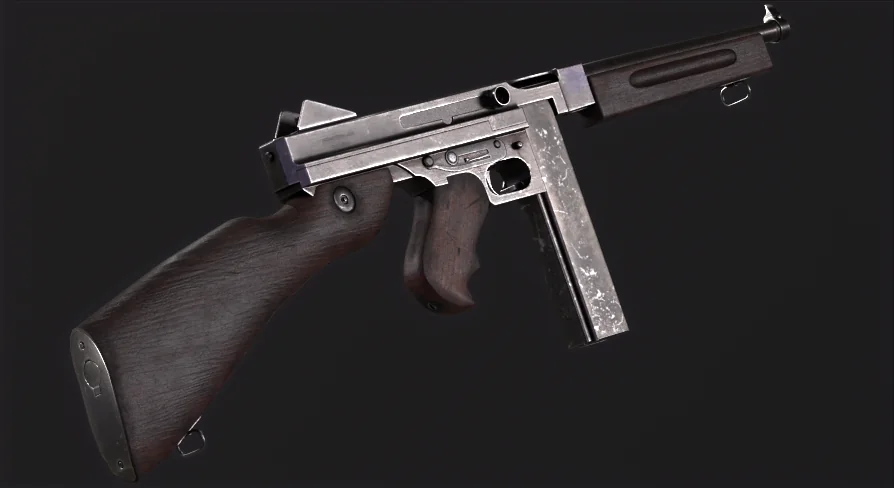
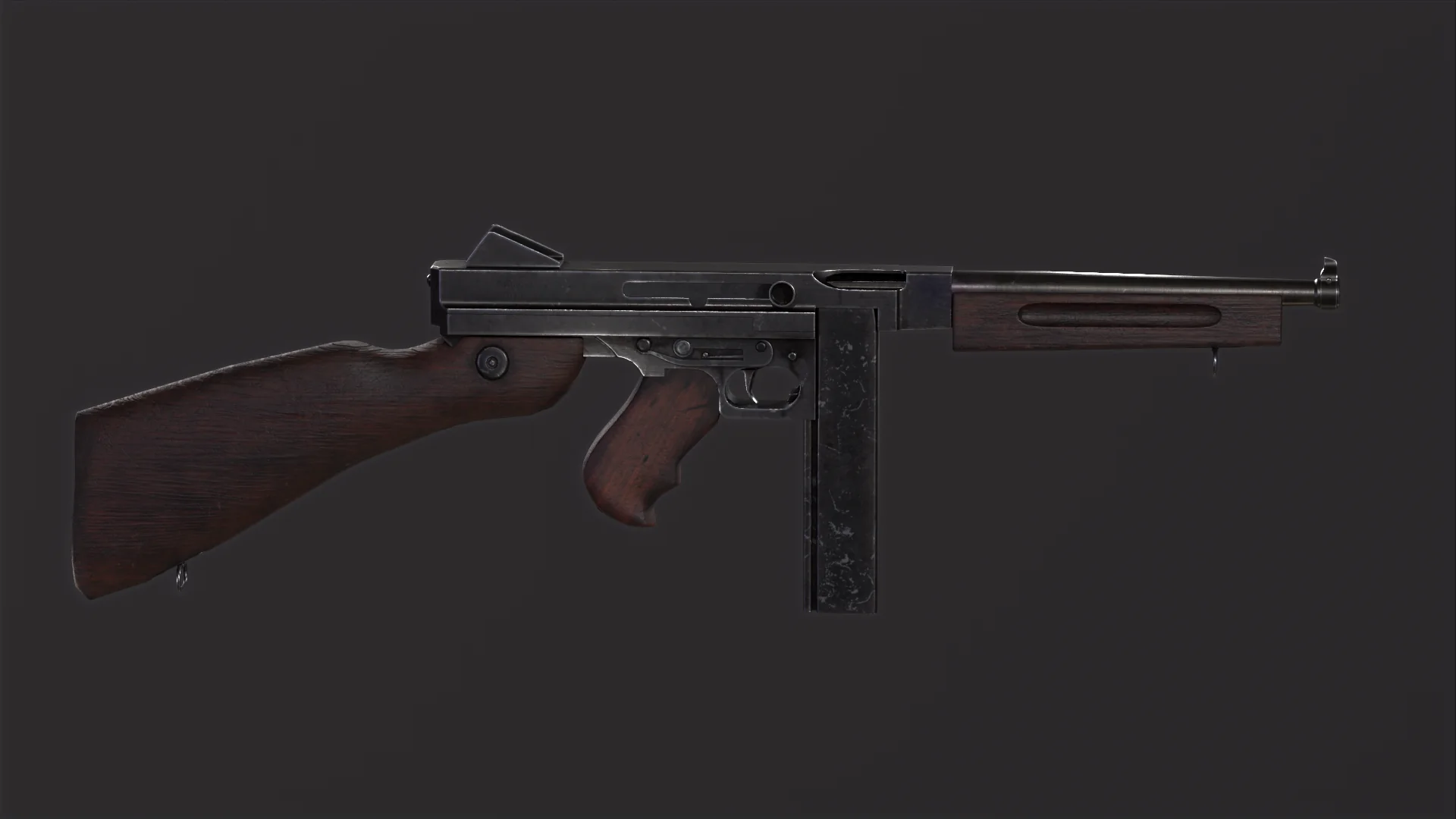
M1A1 - WW2 Submachine Gun
Explore the realistic M1A1 WW2 submachine gun 3D model, featuring PBR texturing and bullet details for realistic FPS and TPS combat pipelines.
Implementing the M1A1 Across FPS and TPS Weapon Sockets
Integrating a dedicated firearm asset into an interactive project begins at the hand rig and the camera viewport. The M1A1 represents the most recognizable American submachine gun configuration of the 20th century, making its geometry and proportions immediately identifiable to players. In a modern development pipeline, positioning this firearm requires accounting for two distinct view models: close-proximity first-person shooter (FPS) perspectives and wider third-person shooter (TPS) character sockets.
When aligning the weapon for a realistic FPS framework, camera clearance and eye-relief depth dictate how the receiver, stock, and sights frame the player's view. The weapon must sit cleanly within the screen space without clipping into the field-of-view boundaries during aiming down sights, idling, or sprinting transitions. In third-person configurations, the silhouette of the firearm carries equal weight. The characteristic profile of the stock, barrel, and magazine receiver must read clearly against various character uniforms and combat environments, ensuring players can instantly distinguish the submachine gun from heavier rifles or squad support weapons during rapid gameplay maneuvers.
Ensuring that the mesh attaches reliably to weapon bones or skeletal mesh sockets requires standardizing transform origins. Sockets assigned to the primary grip, the forward handguard, and the shoulder stock establish the baseline anchor points for character inverse kinematics. Because weapon mechanics rely on consistent alignment between hands, sights, and shoulder rests, establishing these reference transforms early prevents unnatural posture stretching across differing character rigs.
PBR Surface Response for the M1A1 Submachine Gun
Physically based rendering (PBR) governs how this asset interacts with lighting conditions across dynamic environments. As a realistic historical weapon asset, the surface definition separates raw metallic components from treated wood elements. The M1A1 relied heavily on stamped and machined steel assemblies combined with wooden furniture, demanding distinct material properties across the model.
In a PBR material workflow, metallic values delineate bare or blued steel from the organic, non-conductive surfaces of the foregrip, pistol grip, and rear stock. Micro-surface roughness maps dictate the specular highlights across these components. Steel receivers showcase sharper, anisotropic or slightly dulled specular reflections typical of factory machining and field wear, while the wooden portions display broader, diffuse scattering characteristics. Under varying scene illumination—whether in glaring daylight, rainy combat trenches, or dimly lit interiors—the PBR setup maintains visual believability by preventing the wood from appearing unnaturally glossy or the metal from losing its industrial weight.
Camera distance strongly influences how realistic PBR maps are perceived. First-person perspectives expose every edge highlight and surface imperfection directly to the user, requiring precise normal maps and ambient occlusion to define panel seams, screw heads, and receiver pins. In third-person scenes, these same material definitions contribute to realistic contrast and lighting behavior, preventing the weapon from flattening out under indirect sunlight or artificial environmental lights.
Historical Grounding of the 20th-Century American Tommygun
Commonly referred to as the Tommygun, the M1A1 variant holds a defined position in military history as the definitive American submachine gun of World War II. Earlier variants introduced intricate drum magazines, complex cooling fins, and specialized muzzle brakes. The military adaptation simplified the platform into a streamlined, mass-producible firearm suitable for widespread deployment across multiple theaters of war.
Because the M1A1 is classified across broader tactical categories—functioning as a firearm, machinegun, rifle-class platform, and dedicated submachine gun—its design reflects the shift toward practical close-quarters infantry doctrine. The simplification of the charging handle to the side of the receiver and the adoption of straight box magazines defined the silhouette of Allied infantry units. Maintaining realistic visual historical accuracy in WW2 games hinges on these recognizable physical traits. When virtual soldiers clear rooms or advance through ruined battlefields, the model immediately anchors the scene to its mid-20th-century historical context.
Representing this firearm accurately within a game engine also aids historical immersion for titles focused on military campaigns. Weapon collectors, history enthusiasts, and tactical shooter audiences expect the geometric structure to honor the original manufacturing methods of the era. Preserving the plain barrel contour, simple fixed rear sight, and straight magazine architecture ensures the model fulfills its role as an authentic recreation of wartime armament.
Bullet Integration and Mechanical Realism in Combat Encounters
Realism in modern action titles extends beyond static display geometry to include active firing mechanisms. The presence of modeled bullet assets allows developers to construct authentic weapon cycling sequences, dry-fire states, and tactical reload animations.
During high-intensity combat in an FPS framework, the open-bolt operation typical of the M1A1 means that the chamber and bolt carrier assembly are visually exposed during fire cycles. Including detailed bullet geometry allows animators to show rounds feeding correctly from the magazine feed lips into the chamber. As the magazine empties, visual confirmation of remaining ammunition within the magazine well elevates the tactile realism of reloading states. Partial reloads can display unspent cartridges, while empty reloads correctly show an open breech ready to strip the first round from a fresh box magazine.
TPS titles also gain fidelity from dedicated ammunition assets. Ejected cartridge casings bouncing off hard ground surfaces or spent rounds tumbling from the ejection port provide critical kinetic feedback during sustained bursts. These small mechanical interactions collectively reinforce the sense that the firearm is operating as a functioning mechanical device rather than a static visual prop.
Balancing Realistic Weapon Behavior in Wartime Scenarios
Deploying the M1A1 submachine gun into dynamic game scenarios requires understanding its operational niche. Within tactical game loops, the asset functions best when tuned for rapid room-clearing, trench warfare, and medium-range urban skirmishes. Its historical ammunition profile provides significant stopping power at short ranges while exhibiting natural ballistic drop over open distances.
Developers setting up weapon handling parameters can balance weapon sway, recoil patterns, and muzzle rise based on the robust steel-and-wood mass of the platform. The physical weight of the real-world weapon helped tame the recoil of rapid automatic fire, a trait that translates well into controlled spread patterns in both FPS and TPS targeting systems. Pairing accurate mechanical geometry with authentic kinetic feedback results in a weapon experience that feels anchored, responsive, and true to its 20th-century wartime heritage.
 Weapons & Combat
 Weapons & Combat
 Weapons & Combat
 Weapons & Combat