"d4769ebd8b229f47"{"id":"1002094","slug":"low-poly-modern-sci-fi-building-models","title":"Low Poly Modern/Sci-Fi Building Models","category":"Sci-Fi","engine":"4.24+,5.0+","assetVersion":"","engineVersion":"Engine Version: 4.24+,5.0+","tag":"Sci-Fi","accent":"blue","visual":"mech","summary":"Explore 19 optimized low poly modern and sci-fi building models designed with a unified texture atlas, lightmap readiness, and mobile-friendly batching.","platform":"Unreal Engine","publishedAt":"2026-10-29T08:40:07.965Z","updatedAt":"2026-10-29T08:40:07.965Z","sourceNotes":[],"fileContents":[],"compatibility":["Unreal Engine","Engine Version: 4.24+,5.0+"],"featuredImage":{"alt":"Low Poly Modern/Sci-Fi Building Models","src":"/wp-content/uploads/published/2026/10/71b4d62191aa-19f59886-e710-419e-899f-5a611c185d8a-7db6248e00.webp"},"hasDownloadLink":true,"downloads":0,"terms":[{"taxonomy":"category","slug":"sci-fi","name":"Sci-Fi"}],"galleryImages":[{"src":"/wp-content/uploads/published/2026/10/c8b0e8a167bd-91cb1292-f559-445e-b788-3d819d7dc4be-8cd450006b.webp","alt":"Low Poly Modern/Sci-Fi Building Models"},{"src":"/wp-content/uploads/published/2026/10/db0f3c1f5e59-f34654aa-3176-49c2-b265-a7cf13e64d8a-7dada33ec5.webp","alt":"Low Poly Modern/Sci-Fi Building Models"},{"src":"/wp-content/uploads/published/2026/10/c6d614179b1c-9e627612-824c-4a0c-acb7-8a4e51191fe7-4de10f117a.webp","alt":"Low Poly Modern/Sci-Fi Building Models"},{"src":"/wp-content/uploads/published/2026/10/728ffe7db144-9baab4dd-d03e-499f-994c-b3ff78213698-5abf9ccbe8.webp","alt":"Low Poly Modern/Sci-Fi Building Models"},{"src":"/wp-content/uploads/published/2026/10/246a8fb17405-d58d14af-e100-471a-940b-2a78d3d54298-e59b10019e.webp","alt":"Low Poly Modern/Sci-Fi Building Models"},{"src":"/wp-content/uploads/published/2026/10/04c0e61f7331-467c9011-1f55-46aa-a0fa-0d9aed58b860-f0ae4ab600.webp","alt":"Low Poly Modern/Sci-Fi Building Models"},{"src":"/wp-content/uploads/published/2026/10/7cef502d76cf-8e193151-fdf5-4be6-99dc-e53f3b7313cf-2153a46011.webp","alt":"Low Poly Modern/Sci-Fi Building Models"},{"src":"/wp-content/uploads/published/2026/10/70a30f1f3256-c0bcca43-8887-4bd8-937f-81cb16964fcb-91ed7a877b.webp","alt":"Low Poly Modern/Sci-Fi Building Models"},{"src":"/wp-content/uploads/published/2026/10/da422717f172-4807aa0f-7127-4fae-98b7-cbd0fc6eaeaf-aede02e802.webp","alt":"Low Poly Modern/Sci-Fi Building Models"}],"accessPanel":{"kind":"resource","title":"Download this resource","eyebrow":"Free Download","message":"Log in or create a free account to start your download.","fileName":"Content.7z","safetyNote":"Resources are manually reviewed before listing to improve quality and reduce obvious risks.","actionLabel":"Download Free","resourceType":"Resource archive"},"contentHtml":"\u003ch2\u003ePopulating Distant Skylines Across 19 Sci-Fi Building Models\u003c/h2\u003e\n\u003cp\u003eConstructing expansive urban backdrops in games often poses an immediate technical challenge: how to suggest vast architectural density without exhausting the frame budget on secondary background structures. The collection of 19 low poly modern and sci-fi building models resolves this tension by prioritizing structural geometry suited specifically for mid-range and distant perspectives rather than micro-detailed foregrounds. Rather than burdening the pipeline with dense polygon subdivisions or individual material instances, each building delivers recognizable silhouettes of contemporary and speculative architecture that read clearly from a distance.\u003c/p\u003e\n\u003cp\u003eThese 19 meshes allow level designers to block out full city blocks, distant industrial clusters, or sprawling metropolitan horizons. The geometric forms balance clean lines with recognizable modern and sci-fi aesthetics, making them suitable alongside cyberpunk street assets where verticality and dense city layers are essential to selling the scale of the world. Because the package explicitly avoids high-polygon close-up detailing, it allows creators to distribute dozens of structures across wide landscapes without facing immediate geometry bottlenecks.\u003c/p\u003e \u003ch2\u003eDraw Call Batching with a Single Shared Texture Atlas\u003c/h2\u003e\n\u003cp\u003eMaterial overhead is often the primary cause of rendering slowdowns when rendering dense cities. Multiple materials demand separate draw calls, fragmenting the pipeline and draining hardware resources. To counter this, all 19 buildings in this set share a single, unified texture atlas. Combining every architectural surface into one master texture set ensures that rendering engines can batch the buildings together efficiently in memory, cutting draw calls down dramatically when placing multiple structures in a single view frustum.\u003c/p\u003e\n\u003cp\u003eDespite relying on a single atlas, the surface properties maintain visual range through four dedicated texture maps:\u003c/p\u003e\n\u003cul\u003e \u003cli\u003e\u003cstrong\u003eColor:\u003c/strong\u003e Establishes the base palette and structural coloration across walls, roofs, and accents.\u003c/li\u003e \u003cli\u003e\u003cstrong\u003eSpecular:\u003c/strong\u003e Controls the reflectivity and surface response across panels, glass, and metallic framework.\u003c/li\u003e \u003cli\u003e\u003cstrong\u003eNormals:\u003c/strong\u003e Fakes finer architectural recesses, panel seams, and structural extrusions without adding actual polygons.\u003c/li\u003e \u003cli\u003e\u003cstrong\u003eSelf-Illumination:\u003c/strong\u003e Drives emissive elements such as window arrays, neon accents, and sci-fi building beacons that define night scenes.\u003c/li\u003e\n\u003c/ul\u003e\n\u003cp\u003eThe inclusion of a dedicated self-illumination channel is particularly relevant for modern, sci-fi, and cyberpunk settings. It allows building facades to show glowing windows, signage, and structural strip-lighting during nighttime lighting passes without needing real-time light components attached to each window. Paired with normal and specular channels, the single atlas provides surface depth and crisp lighting reactions while preserving optimal batching behavior.\u003c/p\u003e \u003ch2\u003eCamera Angles: Isometric Projections and Flight Simulators\u003c/h2\u003e\n\u003cp\u003eThe design choices behind these buildings make them uniquely suited for specific camera setups, particularly isometric perspectives and flight simulators. In isometric strategy games, city builders, or top-down action titles, the camera remains elevated, observing whole sectors at once. In this configuration, fine-grain surface meshes go entirely unnoticed, but silhouette clarity and rapid rendering of repeated structures matter immensely. The 19 low-poly variations offer enough variety to populate whole sectors without geometric repetition becoming immediately obvious from an elevated vantage point.\u003c/p\u003e\n\u003cp\u003eFlight simulators operate under similar visual constraints. Aircraft moving across high-altitude paths or low-altitude urban corridors demand broad expanses of buildings streaming into the rendering pipeline simultaneously. Because these models are not intended for close-ups, they prevent flight-sim horizons from stuttering as the player approaches or banks over a metropolitan sprawl. They hold structural coherence across medium and distant planes, providing solid horizon fill that respects the hardware limits of broad-view simulation.\u003c/p\u003e \u003ch2\u003eLightmapping Readiness and Medium-Range Placement\u003c/h2\u003e\n\u003cp\u003eLighting static low-poly models efficiently requires proper UV layout for offline baking. These models arrive ready for lightmapping, allowing static indirect illumination, ambient occlusion, and sun shadows to bake cleanly into global illumination systems. Pre-baked lighting softens hard polygon edges, grounds building bases into the surrounding terrain, and ensures that shadow casting matches the rest of the static level geometry seamlessly.\u003c/p\u003e\n\u003cp\u003eBaking lightmaps directly onto low-poly meshes avoids the performance penalty associated with real-time dynamic shadows across dozens of structures. When paired with the self-illumination map, lightmapped buildings provide a convincing balance of pre-calculated environmental lighting and emissive glow. It is crucial, however, to enforce camera discipline during level composition: these meshes function as backdrop and middle-ground filler. Placing them directly against the player camera in a first-person ground encounter will reveal their low-poly nature, whereas placing them just beyond the immediate playable perimeter preserves visual fidelity while optimizing frame rates.\u003c/p\u003e \u003ch2\u003eTargeting Mobile Hardware and Cyberpunk Street Environments\u003c/h2\u003e\n\u003cp\u003eStrict performance budgets are standard in mobile game development, where memory bandwidth and draw calls are severely restricted. The convergence of low polygon counts, lightmapping readiness, and a single shared texture atlas makes these 19 structures thoroughly mobile-friendly. Developers targeting mobile platforms can deploy these assets across complex skylines without generating the material swaps or excessive vertex counts that cause thermal throttling or low frame rates on handheld devices.\u003c/p\u003e\n\u003cp\u003eWhen integrated into broader urban scenes—such as cyberpunk street layouts—these buildings act as the upper floors, secondary layers, and perimeter skylines that frame detailed, ground-level play spaces. By utilizing low-poly structures to build vertical presence above the player's immediate head height, technical directors preserve hardware headroom for the character models, dynamic lights, and interactive elements positioned on the ground floor.\u003c/p\u003e\n\n\u003ch2\u003eRelated Resources Worth Checking\u003c/h2\u003e\n\u003cul\u003e\n\u003cli\u003e\u003ca href=\"https://3dcghub.com/modular-sci-fi-interior/\" title=\"Modular Sci-Fi Interior\"\u003eModular Sci-Fi Interior\u003c/a\u003e\u003c/li\u003e\n\u003cli\u003e\u003ca href=\"https://3dcghub.com/scifi-corridor-environment/\" title=\"SciFi Corridor Environment\"\u003eSciFi Corridor Environment\u003c/a\u003e\u003c/li\u003e\n\u003cli\u003e\u003ca href=\"https://3dcghub.com/sci-fi-interior-pack/\" title=\"Sci-Fi Interior Pack\"\u003eSci-Fi Interior Pack\u003c/a\u003e\u003c/li\u003e\n\u003cli\u003e\u003ca href=\"https://3dcghub.com/scifi-industrial-level-kit-2-0/\" title=\"SciFi/Industrial Level Kit 2.0\"\u003eSciFi/Industrial Level Kit 2.0\u003c/a\u003e\u003c/li\u003e\n\u003cli\u003e\u003ca href=\"https://3dcghub.com/city-skyline-restaurant-and-piano-bar/\" title=\"City Skyline Restaurant \u0026amp; Piano Bar\"\u003eCity Skyline Restaurant \u0026amp; Piano Bar\u003c/a\u003e\u003c/li\u003e\n\u003c/ul\u003e","contentTextLength":6488,"navigation":{"current":44,"total":4063,"previous":{"id":"1002095","slug":"luggage-pack","title":"Luggage Pack","category":"Tools, Objects \u0026 Decor","platform":"Unreal Engine","updatedAt":"2026-10-29T08:40:50.942Z"},"next":{"id":"1002093","slug":"low-poly-animated-modern-guns-pack","title":"Low Poly Animated - Modern Guns Pack","category":"Weapons \u0026 Combat","platform":"Unreal Engine","updatedAt":"2026-10-29T08:39:17.612Z"}},"relatedResources":[{"id":"1001680","slug":"modular-sci-fi-interior","title":"Modular Sci-Fi Interior","category":"Sci-Fi","engine":"4.26+,5.0+","assetVersion":"","engineVersion":"Engine Version: 4.26+,5.0+","tag":"Sci-Fi","accent":"blue","visual":"mech","summary":"Build AAA spaceship corridors, engineering bays, and laboratories with Modular Sci-Fi Interior, featuring 68 compatible parts and customizable materials.","platform":"Unreal Engine","publishedAt":"2026-10-13T15:31:32.670Z","updatedAt":"2026-10-13T15:31:32.670Z","sourceNotes":[],"fileContents":[],"compatibility":["Unreal Engine","Engine Version: 4.26+,5.0+"],"featuredImage":{"alt":"Modular Sci-Fi Interior","src":"/wp-content/uploads/published/2026/10/5f742de1385a-81f27987-eea8-4083-8247-e2f32ed77b80-110aed85b4.webp"},"hasDownloadLink":true,"downloads":1},{"id":"1001665","slug":"scifi-corridor-environment","title":"SciFi Corridor Environment","category":"Sci-Fi","engine":"4.20+,5.0+","assetVersion":"","engineVersion":"Engine Version: 4.20+,5.0+","tag":"Sci-Fi","accent":"blue","visual":"city","summary":"Explore the SciFi Corridor Environment, a modular lowpoly level scene built for current gen games with customizable PBR materials and prop compatibility.","platform":"Unreal Engine","publishedAt":"2026-10-13T15:05:15.324Z","updatedAt":"2026-10-13T15:05:15.324Z","sourceNotes":[],"fileContents":[],"compatibility":["Unreal Engine","Engine Version: 4.20+,5.0+"],"featuredImage":{"alt":"SciFi Corridor Environment","src":"/wp-content/uploads/published/2026/10/522388a562b7-365997bb-848d-475f-be61-3d69c5e3307e-42292051e6.webp"},"hasDownloadLink":true,"downloads":1},{"id":"1001660","slug":"sci-fi-interior-pack","title":"Sci-Fi Interior Pack","category":"Sci-Fi","engine":"4.16+,5.0+","assetVersion":"","engineVersion":"Engine Version: 4.16+,5.0+","tag":"Sci-Fi","accent":"blue","visual":"mech","summary":"Build AAA sci-fi corridors, rooms, and space station halls with the modular meshes, props, and realistic PBR materials in the Sci-Fi Interior Pack.","platform":"Unreal Engine","publishedAt":"2026-10-13T14:49:18.243Z","updatedAt":"2026-10-13T14:49:18.243Z","sourceNotes":[],"fileContents":[],"compatibility":["Unreal Engine","Engine Version: 4.16+,5.0+"],"featuredImage":{"alt":"Sci-Fi Interior Pack","src":"/wp-content/uploads/published/2026/10/feeee675490c-ab3f77c7-91c9-47ea-82e1-43d047947c91-e6293b0541.webp"},"hasDownloadLink":true,"downloads":1}]}
Sci-Fi
Low Poly Modern/Sci-Fi Building Models
Explore 19 optimized low poly modern and sci-fi building models designed with a unified texture atlas, lightmap readiness, and mobile-friendly batching.
Category:Unreal Engine,Sci-FiPlatform: Unreal EngineEngine Version: 4.24+,5.0+Published: Oct 29, 2026
Sci-Fi
Resource overview
Populating Distant Skylines Across 19 Sci-Fi Building Models
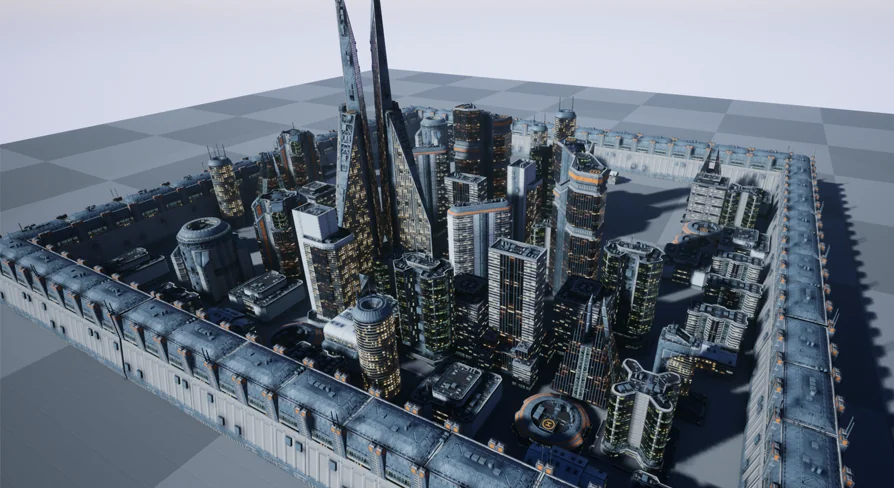
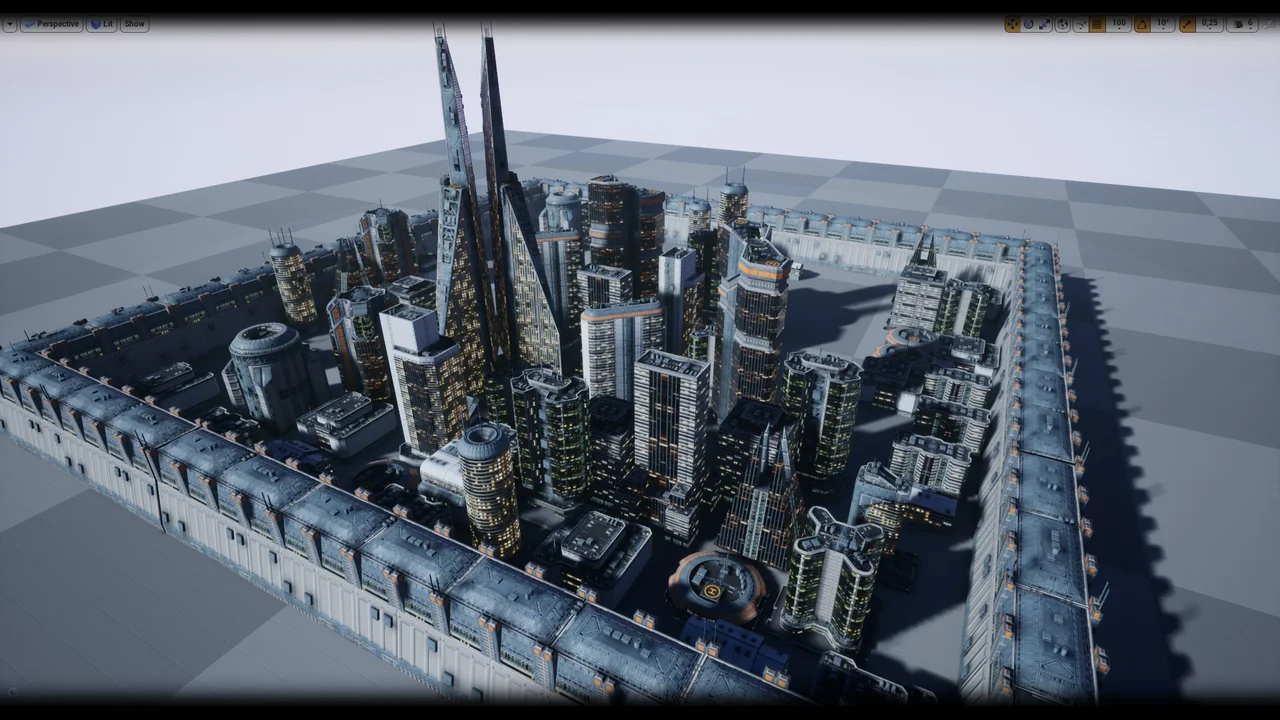
Constructing expansive urban backdrops in games often poses an immediate technical challenge: how to suggest vast architectural density without exhausting the frame budget on secondary background structures. The collection of 19 low poly modern and sci-fi building models resolves this tension by prioritizing structural geometry suited specifically for mid-range and distant perspectives rather than micro-detailed foregrounds. Rather than burdening the pipeline with dense polygon subdivisions or individual material instances, each building delivers recognizable silhouettes of contemporary and speculative architecture that read clearly from a distance.
These 19 meshes allow level designers to block out full city blocks, distant industrial clusters, or sprawling metropolitan horizons. The geometric forms balance clean lines with recognizable modern and sci-fi aesthetics, making them suitable alongside cyberpunk street assets where verticality and dense city layers are essential to selling the scale of the world. Because the package explicitly avoids high-polygon close-up detailing, it allows creators to distribute dozens of structures across wide landscapes without facing immediate geometry bottlenecks.
Draw Call Batching with a Single Shared Texture Atlas
Material overhead is often the primary cause of rendering slowdowns when rendering dense cities. Multiple materials demand separate draw calls, fragmenting the pipeline and draining hardware resources. To counter this, all 19 buildings in this set share a single, unified texture atlas. Combining every architectural surface into one master texture set ensures that rendering engines can batch the buildings together efficiently in memory, cutting draw calls down dramatically when placing multiple structures in a single view frustum.
Despite relying on a single atlas, the surface properties maintain visual range through four dedicated texture maps:
Color: Establishes the base palette and structural coloration across walls, roofs, and accents.
Specular: Controls the reflectivity and surface response across panels, glass, and metallic framework.
Normals: Fakes finer architectural recesses, panel seams, and structural extrusions without adding actual polygons.
Self-Illumination: Drives emissive elements such as window arrays, neon accents, and sci-fi building beacons that define night scenes.
The inclusion of a dedicated self-illumination channel is particularly relevant for modern, sci-fi, and cyberpunk settings. It allows building facades to show glowing windows, signage, and structural strip-lighting during nighttime lighting passes without needing real-time light components attached to each window. Paired with normal and specular channels, the single atlas provides surface depth and crisp lighting reactions while preserving optimal batching behavior.
Camera Angles: Isometric Projections and Flight Simulators
The design choices behind these buildings make them uniquely suited for specific camera setups, particularly isometric perspectives and flight simulators. In isometric strategy games, city builders, or top-down action titles, the camera remains elevated, observing whole sectors at once. In this configuration, fine-grain surface meshes go entirely unnoticed, but silhouette clarity and rapid rendering of repeated structures matter immensely. The 19 low-poly variations offer enough variety to populate whole sectors without geometric repetition becoming immediately obvious from an elevated vantage point.
Flight simulators operate under similar visual constraints. Aircraft moving across high-altitude paths or low-altitude urban corridors demand broad expanses of buildings streaming into the rendering pipeline simultaneously. Because these models are not intended for close-ups, they prevent flight-sim horizons from stuttering as the player approaches or banks over a metropolitan sprawl. They hold structural coherence across medium and distant planes, providing solid horizon fill that respects the hardware limits of broad-view simulation.
Lightmapping Readiness and Medium-Range Placement
Lighting static low-poly models efficiently requires proper UV layout for offline baking. These models arrive ready for lightmapping, allowing static indirect illumination, ambient occlusion, and sun shadows to bake cleanly into global illumination systems. Pre-baked lighting softens hard polygon edges, grounds building bases into the surrounding terrain, and ensures that shadow casting matches the rest of the static level geometry seamlessly.
Baking lightmaps directly onto low-poly meshes avoids the performance penalty associated with real-time dynamic shadows across dozens of structures. When paired with the self-illumination map, lightmapped buildings provide a convincing balance of pre-calculated environmental lighting and emissive glow. It is crucial, however, to enforce camera discipline during level composition: these meshes function as backdrop and middle-ground filler. Placing them directly against the player camera in a first-person ground encounter will reveal their low-poly nature, whereas placing them just beyond the immediate playable perimeter preserves visual fidelity while optimizing frame rates.
Targeting Mobile Hardware and Cyberpunk Street Environments
Strict performance budgets are standard in mobile game development, where memory bandwidth and draw calls are severely restricted. The convergence of low polygon counts, lightmapping readiness, and a single shared texture atlas makes these 19 structures thoroughly mobile-friendly. Developers targeting mobile platforms can deploy these assets across complex skylines without generating the material swaps or excessive vertex counts that cause thermal throttling or low frame rates on handheld devices.
When integrated into broader urban scenes—such as cyberpunk street layouts—these buildings act as the upper floors, secondary layers, and perimeter skylines that frame detailed, ground-level play spaces. By utilizing low-poly structures to build vertical presence above the player's immediate head height, technical directors preserve hardware headroom for the character models, dynamic lights, and interactive elements positioned on the ground floor.
 Sci-Fi
 Sci-Fi
 Sci-Fi
 Sci-Fi