"4481da9c895ef786"{"id":"1000298","slug":"hex-tree-skill-perk-tech","title":"HEX TREE (Skill, Perk, Tech)","category":"Gameplay Features","engine":"5.0+","assetVersion":"","engineVersion":"Engine Version: 5.0+","tag":"Gameplay Features","accent":"blue","visual":"mech","summary":"Integrate a robust progression architecture featuring Skills, Perks, and Technology trees with component-based modularity and secure back-end autosave.","platform":"Unreal Engine","publishedAt":"2026-07-03T18:01:38.886Z","updatedAt":"2026-07-03T18:01:38.886Z","sourceNotes":[],"fileContents":[],"compatibility":["Unreal Engine","Engine Version: 5.0+"],"featuredImage":{"alt":"HEX TREE (Skill, Perk, Tech)","src":"/wp-content/uploads/published/2026/07/8628362c607a-c5fbf025-7a84-426f-bfc1-f270061c125e-08bd66de9d.webp"},"hasDownloadLink":true,"downloads":0,"terms":[{"taxonomy":"category","slug":"gameplay-features","name":"Gameplay Features"}],"galleryImages":[{"src":"/wp-content/uploads/published/2026/07/124f4130330e-8fd6e45b-51a6-4883-bd9d-db2ca809a357-0a9a80cd83.webp","alt":"HEX TREE (Skill, Perk, Tech)"},{"src":"/wp-content/uploads/published/2026/07/accae5a07474-dd073d47-881f-436b-86ad-411e38566091-2633a4c7ad.webp","alt":"HEX TREE (Skill, Perk, Tech)"},{"src":"/wp-content/uploads/published/2026/07/19f2050d73dc-02b1e80c-ca62-4536-853a-22e10f91ca1f-690479e03e.webp","alt":"HEX TREE (Skill, Perk, Tech)"},{"src":"/wp-content/uploads/published/2026/07/b3c21eef7193-18e02c6e-7708-4842-ad10-bd397d098576-5f1f153524.webp","alt":"HEX TREE (Skill, Perk, Tech)"},{"src":"/wp-content/uploads/published/2026/07/84feb3d3a143-912fc302-4c63-4a2c-a74d-0a20b3831b14-9b0e9e1735.webp","alt":"HEX TREE (Skill, Perk, Tech)"},{"src":"/wp-content/uploads/published/2026/07/eff14307c63d-2fab02d3-679d-4c3f-8110-068ede6019a1-2a4e28d8a3.webp","alt":"HEX TREE (Skill, Perk, Tech)"},{"src":"/wp-content/uploads/published/2026/07/d877200b1f40-dad26de8-4c02-4579-b93a-4a4b8cd573b6-29aadb62e2.webp","alt":"HEX TREE (Skill, Perk, Tech)"},{"src":"/wp-content/uploads/published/2026/07/9405591333e8-39451d49-1443-48d9-adcd-1b1f9e877004-f375401ced.webp","alt":"HEX TREE (Skill, Perk, Tech)"}],"accessPanel":{"kind":"resource","title":"Download this resource","eyebrow":"Free Download","message":"Log in or create a free account to start your download.","fileName":"Content.7z","safetyNote":"Resources are manually reviewed before listing to improve quality and reduce obvious risks.","actionLabel":"Download Free","resourceType":"Resource archive"},"contentHtml":"\u003cp\u003eComplex gameplay environments—whether sprawling cooperative RPGs, competitive multiplayer arenas, or deeply strategic technology simulators—rely heavily on robust progression architecture. Players need a clear visual and logical pathway to upgrade their characters, unlock new capabilities, and research advanced tools. The HEX TREE (Skill, Perk, Tech) provides a comprehensive framework for building these pathways natively within Unreal Engine. Rather than hard-coding separate leveling mechanics from scratch, development teams can deploy three distinct progression systems simultaneously using a unified codebase.\u003c/p\u003e \u003ch2\u003eStructuring Progression with Modular Components\u003c/h2\u003e \u003cp\u003eA major challenge when integrating a new progression web into an existing game is avoiding entangled code. When leveling logic is tightly bound to a character pawn or player controller, making adjustments later in development can cause cascading errors across the project. This package bypasses that issue entirely through a modular, \"Component\"-based integration model. By isolating the progression architecture into self-contained components, developers can drop the entire system into a project effortlessly.\u003c/p\u003e \u003cp\u003eBecause it functions independently, the component attaches to the necessary actors, handles the underlying calculations, and communicates with the game environment without requiring a complete rewrite of the existing player framework. This modular approach supports three distinct but unified progression types: Skills, Perks, and Technology trees. While they share the same underlying architecture, having three dedicated systems allows a game to separate active player abilities, passive statistical bonuses, and overarching faction or equipment research. A project can utilize just one of these trees for a straightforward action game, or implement all three side-by-side for a layered, complex character-building experience.\u003c/p\u003e \u003ch2\u003eDesigning the Interface with Drag-and-Drop Hexes\u003c/h2\u003e \u003cp\u003eThe visual presentation of these progression paths is handled through a modern, hexagon-based UI. Hexagonal grids are highly efficient for branching paths, allowing a single central node to connect outwards in multiple directions without the rigid, linear constraints of a standard square grid. This clean and intuitive design accommodates everything from simple, linear upgrade paths to massive, interconnected webs of abilities.\u003c/p\u003e \u003cp\u003eConstructing these webs is a heavily visual process. The system features drag-and-drop hexes, enabling developers to physically arrange the layout of their nodes directly on the interface canvas. Instead of manually scripting the dependencies and level requirements for every individual connection, the framework utilizes smart auto-leveling logic. As developers place and connect hexes, the system automatically calculates the necessary progression flow. This smart logic drastically reduces the time spent configuring tier requirements, allowing designers to iterate quickly on the layout of their skill trees without getting bogged down in manual data entry.\u003c/p\u003e \u003ch2\u003eMultiplayer Security and Back-End Autosave\u003c/h2\u003e \u003cp\u003eProgression systems in modern games must often account for networked environments. The HEX TREE framework includes full support for both multiplayer and single-player modes out of the box. Building a tech tree or skill system for a networked game introduces the immediate risk of data manipulation. If progression data is stored and validated entirely on the local machine, players can easily alter their save files to grant themselves infinite skill points or instantly unlock endgame technology.\u003c/p\u003e \u003cp\u003eTo prevent this, the framework is built with a secure back-end autosave feature. This architecture actively protects against client-side tampering by ensuring that the progression state is saved and validated securely. In a multiplayer context, this means the server or back-end authority maintains control over what a player has legitimately unlocked, neutralizing local attempts to cheat the leveling logic.\u003c/p\u003e \u003ch2\u003eGranular Control and 2025 Enhancements\u003c/h2\u003e \u003cp\u003eA significant portion of the package has been overhauled in the major 2025 update, bringing focused improvements to both the visual design and the underlying code. The UI layout has been refreshed to provide a cleaner user experience, complemented by updated icons and new dynamic visuals that respond to player interactions. Tracking available upgrades is also clearer thanks to a completely redesigned point counter display, which integrates seamlessly into the modern hexagon aesthetic.\u003c/p\u003e \u003cp\u003eBeyond the visual upgrades, the 2025 update implements key user requests to give developers more granular control over the progression flow. While the smart auto-leveling logic handles standard progression, developers now have the ability to manually lock and unlock specific skills. This manual override is essential for story-driven games where a specific ability must remain hidden until a narrative milestone is reached, or for administrative tools in a multiplayer server environment.\u003c/p\u003e \u003cp\u003eThe codebase has been fully optimized and improved, with all reported bugs up to 2025 fixed to ensure a stable foundation. The multiplayer functionality has also been thoroughly tested and refined to guarantee smooth networked replication. Benefiting from frequent updates and fast support, the package has added explicit support for Unreal Engine 4.6 alongside its optimizations. For development teams building out complex player progression, passive bonuses, or research mechanics, the combination of component-based modularity, secure multiplayer validation, and a drag-and-drop hexagon interface provides a complete, production-ready architecture.\u003c/p\u003e\n\n\u003ch2\u003eMore From The Same Workflow\u003c/h2\u003e\n\u003cul\u003e\n\u003cli\u003e\u003ca href=\"https://3dcghub.com/cinematic-cutscene-system/\" title=\"Cinematic Cutscene System\"\u003eCinematic Cutscene System\u003c/a\u003e\u003c/li\u003e\n\u003cli\u003e\u003ca href=\"https://3dcghub.com/npc-ai-queuing-system/\" title=\"NPC AI Queuing System\"\u003eNPC AI Queuing System\u003c/a\u003e\u003c/li\u003e\n\u003cli\u003e\u003ca href=\"https://3dcghub.com/close-combat-fighter/\" title=\"Close Combat: Fighter\"\u003eClose Combat: Fighter\u003c/a\u003e\u003c/li\u003e\n\u003cli\u003e\u003ca href=\"https://3dcghub.com/hyper-basic-pcg-forest-v2/\" title=\"Hyper Basic PCG Forest v2\"\u003eHyper Basic PCG Forest v2\u003c/a\u003e\u003c/li\u003e\n\u003cli\u003e\u003ca href=\"https://3dcghub.com/landscaping-medium-trees-vol-1/\" title=\"Landscaping Medium Trees Vol. 1\"\u003eLandscaping Medium Trees Vol. 1\u003c/a\u003e\u003c/li\u003e\n\u003c/ul\u003e","contentTextLength":5826,"navigation":{"current":1107,"total":3269,"previous":{"id":"1000299","slug":"horror-mansion-low-poly-3d-models-pack","title":"Horror Mansion - Low Poly 3D Models Pack","category":"Horror","platform":"Unreal Engine","updatedAt":"2026-07-03T18:13:03.814Z"},"next":{"id":"1000297","slug":"hero-for-rpg-modular-pbr","title":"Hero for RPG : Modular PBR","category":"Humans","platform":"Unreal Engine","updatedAt":"2026-07-03T17:52:27.983Z"}},"relatedResources":[{"id":"1000383","slug":"modern-rpg-skill-tree","title":"Modern RPG Skill Tree","category":"Game Mechanics","engine":"5.0+","assetVersion":"","engineVersion":"Engine Version: 5.0+","tag":"Game Mechanics","accent":"blue","visual":"mech","summary":"A Blueprint-based UI framework featuring animated slots, a dynamic connecting system, and 30 ready-made abilities for cyberpunk or survival RPGs.","platform":"Unreal Engine","publishedAt":"2026-07-07T08:11:54.174Z","updatedAt":"2026-07-07T08:11:54.174Z","sourceNotes":[],"fileContents":[],"compatibility":["Unreal Engine","Engine Version: 5.0+"],"featuredImage":{"alt":"Modern RPG Skill Tree","src":"/wp-content/uploads/published/2026/07/33db49ae92a4-307a7e31-ece5-4b7f-96d6-82a3752f1f24-40104f2744.webp"},"hasDownloadLink":true,"downloads":0},{"id":"1001053","slug":"general-ai-framework","title":"General AI Framework","category":"Gameplay Features","engine":"5.1+","assetVersion":"","engineVersion":"Engine Version: 5.1+","tag":"Gameplay Features","accent":"blue","visual":"mech","summary":"A Blueprint-based behavior tree framework for Unreal Engine that lets you create different AI types and controllers by reusing and improving the provided trees.","platform":"Unreal Engine","publishedAt":"2026-08-30T13:43:01.611Z","updatedAt":"2026-08-30T13:43:01.611Z","sourceNotes":[],"fileContents":[],"compatibility":["Unreal Engine","Engine Version: 5.1+"],"featuredImage":{"alt":"General AI Framework","src":"/wp-content/uploads/published/2026/08/cd24555bec89-94932f98-7717-4639-99ff-b9756efb05f9-a53d62fd3a.webp"},"hasDownloadLink":true,"downloads":1},{"id":"10637","slug":"cinematic-cutscene-system","title":"Cinematic Cutscene System","category":"Gameplay Features","engine":"5.3+","assetVersion":"Engine version: 5.3+","engineVersion":"4.26","tag":"Gameplay Features","accent":"blue","visual":"animation","summary":"Enhance your game's storytelling with the Cinematic Cutscene System. This tool enables developers to build immersive scenes without writing code or relying on complex Behavior Trees.","platform":"Unreal Engine","publishedAt":"2026-03-03T15:51:35.000Z","updatedAt":"2026-04-19T15:49:58.000Z","sourceNotes":[],"fileContents":[],"compatibility":["Unreal Engine","Engine version: 5.3+"],"featuredImage":{"alt":"Cinematic Cutscene System","src":"https://3dcghub.com/wp-content/uploads/2026/03/e35fc466-fe41-41bb-85f1-65815bca7292.webp"},"hasDownloadLink":true,"downloads":0}]}
Gameplay Features
HEX TREE (Skill, Perk, Tech)
Integrate a robust progression architecture featuring Skills, Perks, and Technology trees with component-based modularity and secure back-end autosave.
Complex gameplay environments—whether sprawling cooperative RPGs, competitive multiplayer arenas, or deeply strategic technology simulators—rely heavily on robust progression architecture. Players need a clear visual and logical pathway to upgrade their characters, unlock new capabilities, and research advanced tools. The HEX TREE (Skill, Perk, Tech) provides a comprehensive framework for building these pathways natively within Unreal Engine. Rather than hard-coding separate leveling mechanics from scratch, development teams can deploy three distinct progression systems simultaneously using a unified codebase.
Structuring Progression with Modular Components
A major challenge when integrating a new progression web into an existing game is avoiding entangled code. When leveling logic is tightly bound to a character pawn or player controller, making adjustments later in development can cause cascading errors across the project. This package bypasses that issue entirely through a modular, "Component"-based integration model. By isolating the progression architecture into self-contained components, developers can drop the entire system into a project effortlessly.
Because it functions independently, the component attaches to the necessary actors, handles the underlying calculations, and communicates with the game environment without requiring a complete rewrite of the existing player framework. This modular approach supports three distinct but unified progression types: Skills, Perks, and Technology trees. While they share the same underlying architecture, having three dedicated systems allows a game to separate active player abilities, passive statistical bonuses, and overarching faction or equipment research. A project can utilize just one of these trees for a straightforward action game, or implement all three side-by-side for a layered, complex character-building experience.
Designing the Interface with Drag-and-Drop Hexes
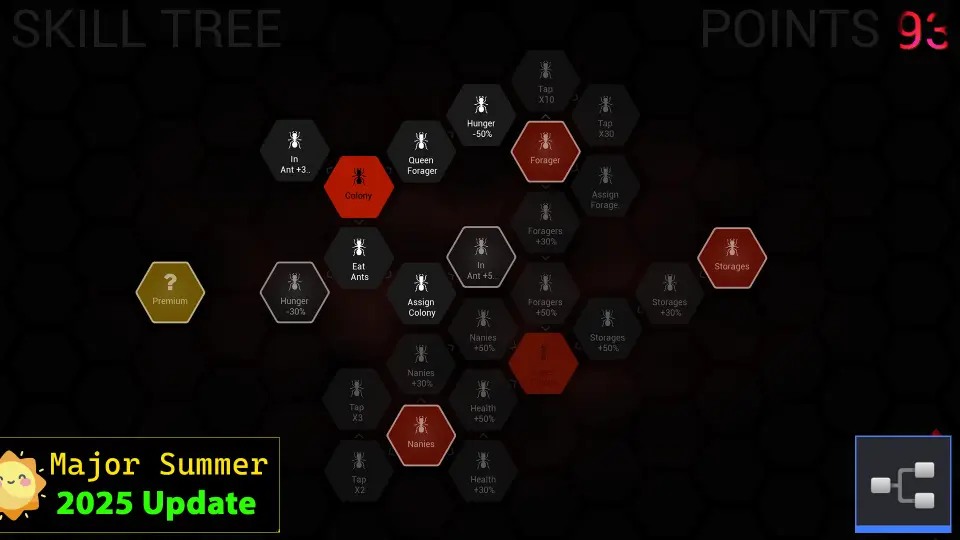
The visual presentation of these progression paths is handled through a modern, hexagon-based UI. Hexagonal grids are highly efficient for branching paths, allowing a single central node to connect outwards in multiple directions without the rigid, linear constraints of a standard square grid. This clean and intuitive design accommodates everything from simple, linear upgrade paths to massive, interconnected webs of abilities.
Constructing these webs is a heavily visual process. The system features drag-and-drop hexes, enabling developers to physically arrange the layout of their nodes directly on the interface canvas. Instead of manually scripting the dependencies and level requirements for every individual connection, the framework utilizes smart auto-leveling logic. As developers place and connect hexes, the system automatically calculates the necessary progression flow. This smart logic drastically reduces the time spent configuring tier requirements, allowing designers to iterate quickly on the layout of their skill trees without getting bogged down in manual data entry.
Multiplayer Security and Back-End Autosave
Progression systems in modern games must often account for networked environments. The HEX TREE framework includes full support for both multiplayer and single-player modes out of the box. Building a tech tree or skill system for a networked game introduces the immediate risk of data manipulation. If progression data is stored and validated entirely on the local machine, players can easily alter their save files to grant themselves infinite skill points or instantly unlock endgame technology.
To prevent this, the framework is built with a secure back-end autosave feature. This architecture actively protects against client-side tampering by ensuring that the progression state is saved and validated securely. In a multiplayer context, this means the server or back-end authority maintains control over what a player has legitimately unlocked, neutralizing local attempts to cheat the leveling logic.
Granular Control and 2025 Enhancements
A significant portion of the package has been overhauled in the major 2025 update, bringing focused improvements to both the visual design and the underlying code. The UI layout has been refreshed to provide a cleaner user experience, complemented by updated icons and new dynamic visuals that respond to player interactions. Tracking available upgrades is also clearer thanks to a completely redesigned point counter display, which integrates seamlessly into the modern hexagon aesthetic.
Beyond the visual upgrades, the 2025 update implements key user requests to give developers more granular control over the progression flow. While the smart auto-leveling logic handles standard progression, developers now have the ability to manually lock and unlock specific skills. This manual override is essential for story-driven games where a specific ability must remain hidden until a narrative milestone is reached, or for administrative tools in a multiplayer server environment.
The codebase has been fully optimized and improved, with all reported bugs up to 2025 fixed to ensure a stable foundation. The multiplayer functionality has also been thoroughly tested and refined to guarantee smooth networked replication. Benefiting from frequent updates and fast support, the package has added explicit support for Unreal Engine 4.6 alongside its optimizations. For development teams building out complex player progression, passive bonuses, or research mechanics, the combination of component-based modularity, secure multiplayer validation, and a drag-and-drop hexagon interface provides a complete, production-ready architecture.
 Gameplay Features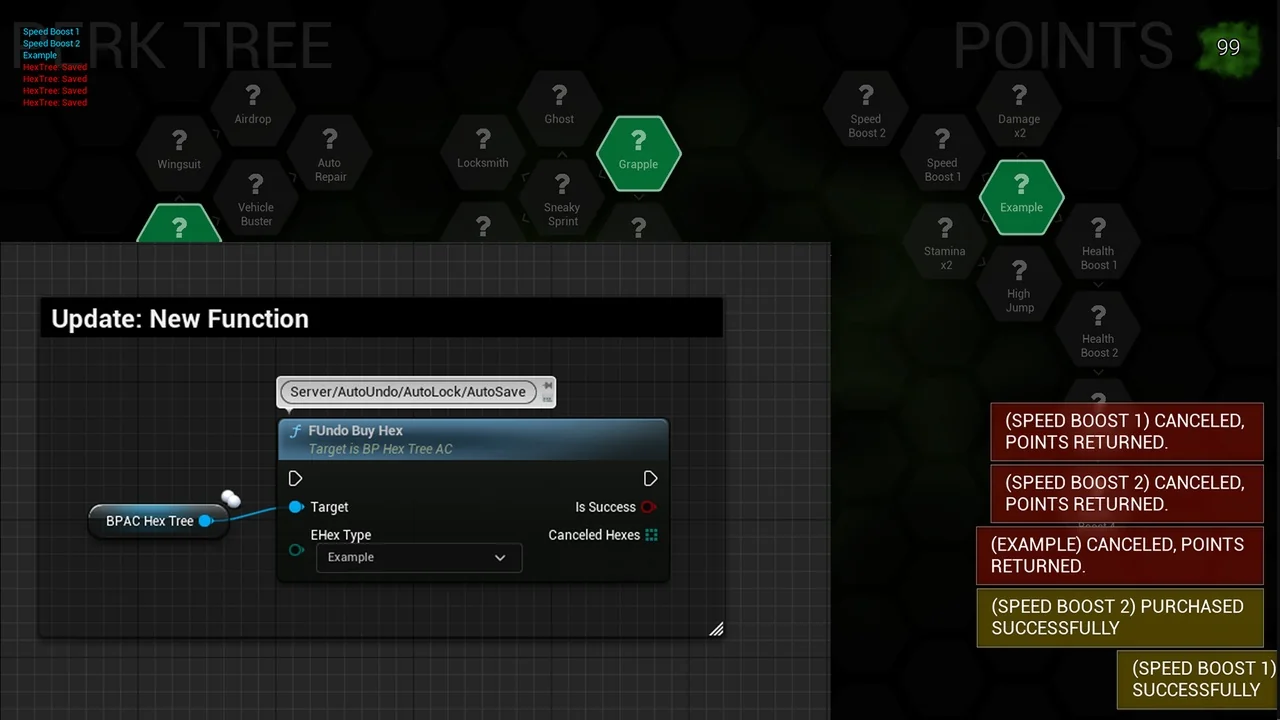
 Game Mechanics
 Gameplay Features
 Gameplay Features