"7ad89cffa44984cf"{"id":"1002532","slug":"hell-acarid","title":"Hell Acarid","category":"Game Development Resource","engine":"4.23+,5.0+","assetVersion":"","engineVersion":"Engine Version: 4.23+,5.0+","tag":"Game Development R","accent":"blue","visual":"mech","summary":"Hell Acarid delivers a small demonic insectoid creature complete with an Animation Blueprint, scripting, and versatile combat and companion roles.","platform":"Unreal Engine","indexPolicy":"index","publishedAt":"2026-11-13T09:35:16.806Z","updatedAt":"2026-11-13T09:35:16.806Z","sourceNotes":[],"fileContents":[],"compatibility":["Unreal Engine","Engine Version: 4.23+,5.0+"],"featuredImage":{"alt":"Hell Acarid","src":"/wp-content/uploads/published/2026/11/cb4aac199efa-4af56954-bc29-4950-85f9-93d621b58feb-5988c43b94.webp"},"hasDownloadLink":true,"downloads":0,"terms":[],"galleryImages":[{"src":"/wp-content/uploads/published/2026/11/47dd33ed9f0f-caccfeb6-0f13-4109-bead-9063183390ae-a46ae0c69f.webp","alt":"Hell Acarid"},{"src":"/wp-content/uploads/published/2026/11/bba4b05d1159-8c2a590b-d20f-4586-a12d-0d722ee49f42-19863b0649.webp","alt":"Hell Acarid"},{"src":"/wp-content/uploads/published/2026/11/c59c5ad6c2fd-b2e461d1-72e9-4488-8a78-f1452e90b794-158388ce6e.webp","alt":"Hell Acarid"},{"src":"/wp-content/uploads/published/2026/11/d23409e9cb27-63972197-9262-42fa-9b51-218e177997e3-93c1ab3c12.webp","alt":"Hell Acarid"}],"accessPanel":{"kind":"resource","title":"Get this resource","eyebrow":"Free resource","message":"Download this resource in your browser.","fileName":"Content.7z","safetyNote":"Resources are manually reviewed before listing to improve quality and reduce obvious risks.","actionLabel":"Get this resource","resourceType":"Resource archive","versions":[]},"contentHtml":"\u003ch2\u003eIntegrating Hell Acarid via Animation Blueprints and Scripting\u003c/h2\u003e\u003cp\u003eDeploying the Hell Acarid begins inside the animation and scripting pipeline, where its specialized motion graph dictates ground traversal and responsive state switching. Because the creature relies on an Animation Blueprint, setting up movement blends requires linking character velocity and angular turning rates directly to the underlying locomotion states. Small insectoid models require quick transitional thresholds between idle twitches, creeping advances, and reactive scurrying so their movement reads as natural rather than mechanical.\u003c/p\u003e\u003cp\u003eThe included script infrastructure governs base behaviors, letting developers hook movement logic directly into standard AI navigation controllers or player-following routines. For automated AI mobs, navigation mesh bounds need tight agent radii to account for the miniature stature of the entity. Configuring the character controller involves lowering collision hulls to match the low-slung torso while keeping ground trace distances short to prevent hovering or clipping across uneven terrain. Once the Animation Blueprint is connected to the pawn class, the creature handles baseline movement cycles smoothly, ready to be driven by pathfinding or direct player inputs.\u003c/p\u003e\u003ch2\u003eAnatomy of the Hell Acarid: Insectoid and Demonic Form\u003c/h2\u003e\u003cp\u003eVisually, the Hell Acarid balances the biological traits of arachnids with demonic, hellish monster themes. Its structure references parasitic ticks and spiders, emphasizing a compact body plan that sits close to the surface. Multiple articulated limbs radiate outward from a dense central mass, producing an unmistakable silhouette that conveys unnatural menace despite its diminutive scale. The fusion of realistic anatomical chitin with demonic styling gives the creature an authentic physical presence, allowing the surface textures to react accurately under dynamic scene illumination.\u003c/p\u003e\u003cp\u003eThe deliberate decision to keep the monster small alters how it catches light and registers to the camera. Chitinous shell plates, segmented leg joints, and predatory mouthparts are concentrated within a tight envelope, ensuring that fine surface definitions remain visible even when viewed from overhead or mid-distance player perspectives. This realistic execution fits environments ranging from scorched subterranean caverns and brimstone pits to decaying dungeon corridors where parasitic demon mobs nest in corners or scuttle across ceilings and walls.\u003c/p\u003e\u003ch2\u003eBehavioral Roles Across Sneaky Mobs, Summons, and Companions\u003c/h2\u003e\u003cp\u003eThe compact footprint of the creature unlocks diverse utility across combat design. In an adversarial context, the asset serves naturally as a sneaky enemy mob. Designers can tuck these low-profile entities behind level geometry, beneath debris, or inside crevices to ambush unwary parties. When paired with stealth or burrowing mechanics, their sudden emergence disrupts player formations, forcing encounters that prioritize rapid target acquisition over brute force.\u003c/p\u003e\u003cp\u003eBeyond basic enemy encounters, the model adapts cleanly to magic systems as a specialized summon. Spellcasting classes oriented around occult, demonic, or verminous schools of magic can conjure these entities in swarms or as temporary reconnaissance units. The script structure supports minion logic, tethering the creature's target priorities to the summoner's actions. Alternatively, the asset functions effectively as a peculiar pet. A companion entity with arachnid-inspired animations brings an unsettling, exotic presence to character inventories, standing out against conventional mammalian or avian follower archetypes while maintaining minimal performance overhead in dense group scenes.\u003c/p\u003e\u003ch2\u003eProduction Deployment in Psymetry and Jobak Compatibility\u003c/h2\u003e\u003cp\u003ePractical application of the creature is demonstrated through its live implementation within the game Psymetry. Operating inside a complete game build verifies that the asset's structural setup withstands the performance demands of active gameplay loops, camera tracking, and environmental collision. Real-world utilization in a finished project provides tangible proof of how the Animation Blueprint and skeletal hierarchy behave when subjected to live gameplay events, damage calculations, and dynamic level geometry.\u003c/p\u003e\u003cp\u003eAlongside its presence in full production, the entity maintains Jobak compatibility. Integrating assets into established production pipelines often fails when skeletal scales, socket references, or animation curves conflict with existing framework standards. Adhering to Jobak compatibility ensures that character controllers, asset managers, and animation playback systems recognize the model's data streams cleanly. This technical alignment reduces initial retargeting or re-rigging friction, allowing technical artists to introduce the creature into existing level prototypes without redesigning core framework logic.\u003c/p\u003e\u003ch2\u003ePipeline Adaptations, Custom Textures, and Feature Expansion\u003c/h2\u003e\u003cp\u003eProduction environments frequently demand variations to accommodate distinct art styles or mechanical requirements. The creature's architecture accommodates iterative expansions, providing clear pathways to introduce supplementary textures, animation clips, or specialized gameplay features. When a project requires elemental variants—such as venomous broods, crystalline mutations, or charred volcanic derivatives—the underlying surface mapping accepts texture adjustments without distorting the anatomical balance of the chitinous shell.\u003c/p\u003e\u003cp\u003eExpanding the animation set follows standard skeletal export and import workflows. Additional behavioral loops, such as wall-climbing, ceiling hangs, latching attacks, or distinctive death sequences, can be authored directly onto the skeleton and patched into the existing Animation Blueprint. Requests for specific functional modifications, customized skin variations, or unique movement clips can be integrated directly into ongoing project builds, allowing developers to scale the asset from a single enemy archetype into an entire family of coordinated demonic vermin.\u003c/p\u003e\n\n\u003ch2\u003eMore From The Same Workflow\u003c/h2\u003e\n\u003cul\u003e\n\u003cli\u003e\u003ca href=\"https://3dcghub.com/animated-2d-hell-platformer-game-ready-environments-asset/\" rel=\"noopener noreferrer\"\u003eAnimated 2d Hell Platformer Game Ready Environments Asset\u003c/a\u003e\u003c/li\u003e\n\u003cli\u003e\u003ca href=\"https://3dcghub.com/character-conversation-mocap-pack/\" rel=\"noopener noreferrer\"\u003eCharacter Conversation - MoCap Pack\u003c/a\u003e\u003c/li\u003e\n\u003cli\u003e\u003ca href=\"https://3dcghub.com/armored-leech/\" rel=\"noopener noreferrer\"\u003eArmored Leech\u003c/a\u003e\u003c/li\u003e\n\u003cli\u003e\u003ca href=\"https://3dcghub.com/fallen-knight/\" rel=\"noopener noreferrer\"\u003eFallen Knight\u003c/a\u003e\u003c/li\u003e\n\u003cli\u003e\u003ca href=\"https://3dcghub.com/cooking-game-sound-effects/\" rel=\"noopener noreferrer\"\u003eCooking Game Sound Effects\u003c/a\u003e\u003c/li\u003e\n\u003c/ul\u003e","contentTextLength":6261,"navigation":{"current":45,"total":4499,"previous":{"id":"1002533","slug":"heroic-fantasy-bosses-reaper","title":"Heroic Fantasy Bosses: Reaper","category":"Characters \u0026 Creatures","platform":"Unreal Engine","updatedAt":"2026-11-13T09:35:58.663Z"},"next":{"id":"1002531","slug":"heavyknight","title":"HeavyKnight","category":"Characters \u0026 Creatures","platform":"Unreal Engine","updatedAt":"2026-11-13T09:29:35.306Z"}},"relatedResources":[{"id":"1002556","slug":"parasite-spider","title":"Parasite_Spider","category":"Game Development Resource","engine":"4.19+,5.0+","assetVersion":"","engineVersion":"Engine Version: 4.19+,5.0+","tag":"Game Development R","accent":"blue","visual":"mech","summary":"Examine the Parasite_Spider creature asset, featuring 56 animations, Animationblueprint setup, and versatile implementation for shooter, fantasy, and horror gam","platform":"Unreal Engine","indexPolicy":"index","publishedAt":"2026-11-13T10:47:59.388Z","updatedAt":"2026-11-13T10:47:59.388Z","sourceNotes":[],"fileContents":[],"compatibility":["Unreal Engine","Engine Version: 4.19+,5.0+"],"featuredImage":{"alt":"Parasite_Spider","src":"/wp-content/uploads/published/2026/11/1ea5e65cab52-33d65b7d-a7b4-435d-998b-54b067e93eb4-524085e3c1.webp"},"hasDownloadLink":true,"downloads":0},{"id":"1002536","slug":"holden","title":"Holden","category":"Game Development Resource","engine":"4.19+,5.0+","assetVersion":"","engineVersion":"Engine Version: 4.19+,5.0+","tag":"Game Development R","accent":"blue","visual":"mech","summary":"A technical look at Holden, a lowpoly anime warrior character featuring modular textures, sword and spear roles, and engine-specific implementation details.","platform":"Unreal Engine","indexPolicy":"index","publishedAt":"2026-11-13T09:39:16.372Z","updatedAt":"2026-11-13T09:39:16.372Z","sourceNotes":[],"fileContents":[],"compatibility":["Unreal Engine","Engine Version: 4.19+,5.0+"],"featuredImage":{"alt":"Holden","src":"/wp-content/uploads/published/2026/11/f4318e578ea4-c6ce4163-c5d2-409c-a49b-b2328659b1cf-a573cd4fb4.webp"},"hasDownloadLink":true,"downloads":0},{"id":"17852","slug":"animated-2d-hell-platformer-game-ready-environments-asset","title":"Animated 2d Hell Platformer Game Ready Environments Asset","category":"Environments","engine":"Original Unity version: 2021.3.16","assetVersion":"Original Unity version: 2021.3.16","engineVersion":"Asset Version:1.0","tag":"Environments","accent":"cyan","visual":"city","summary":"A unique collection of 50 animated Hell elements designed for 2D platformers. This asset pack features 2K resolution textures and full compatibility with modern Unity render pipelines.","platform":"Unity","indexPolicy":"noindex","publishedAt":"2026-03-14T17:13:57.000Z","updatedAt":"2026-04-19T15:43:27.000Z","sourceNotes":[],"fileContents":[],"compatibility":["Unity","Original Unity version: 2021.3.16","Asset Version: 1.0"],"featuredImage":{"alt":"Animated 2d Hell Platformer Game Ready Environments Asset","src":"https://3dcghub.com/wp-content/uploads/2026/03/d0aeb170-c2c6-4f2b-8da5-13ef1232b0a0.webp"},"hasDownloadLink":true,"downloads":0}]}
Game Development R
Hell Acarid
Hell Acarid delivers a small demonic insectoid creature complete with an Animation Blueprint, scripting, and versatile combat and companion roles.
Category:Unreal EnginePlatform: Unreal EngineEngine Version: 4.23+,5.0+Published: Nov 13, 2026
Game Development R
Resource overview
Integrating Hell Acarid via Animation Blueprints and Scripting
Deploying the Hell Acarid begins inside the animation and scripting pipeline, where its specialized motion graph dictates ground traversal and responsive state switching. Because the creature relies on an Animation Blueprint, setting up movement blends requires linking character velocity and angular turning rates directly to the underlying locomotion states. Small insectoid models require quick transitional thresholds between idle twitches, creeping advances, and reactive scurrying so their movement reads as natural rather than mechanical.
The included script infrastructure governs base behaviors, letting developers hook movement logic directly into standard AI navigation controllers or player-following routines. For automated AI mobs, navigation mesh bounds need tight agent radii to account for the miniature stature of the entity. Configuring the character controller involves lowering collision hulls to match the low-slung torso while keeping ground trace distances short to prevent hovering or clipping across uneven terrain. Once the Animation Blueprint is connected to the pawn class, the creature handles baseline movement cycles smoothly, ready to be driven by pathfinding or direct player inputs.
Anatomy of the Hell Acarid: Insectoid and Demonic Form
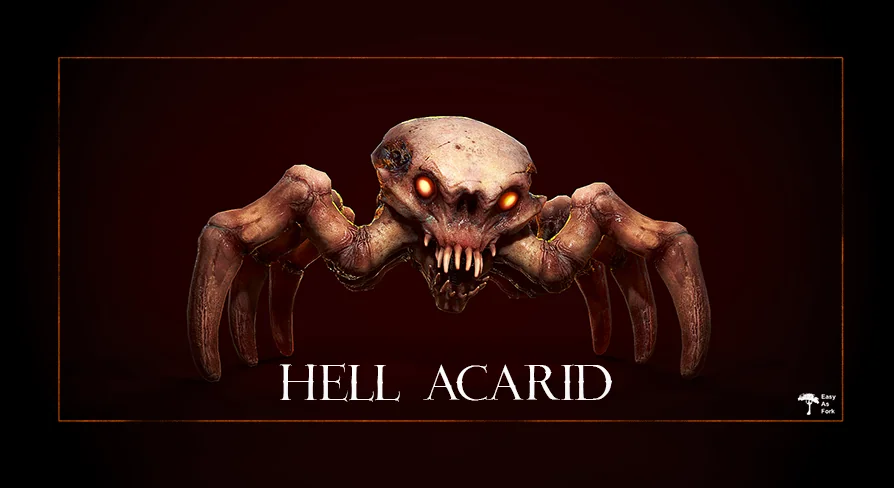
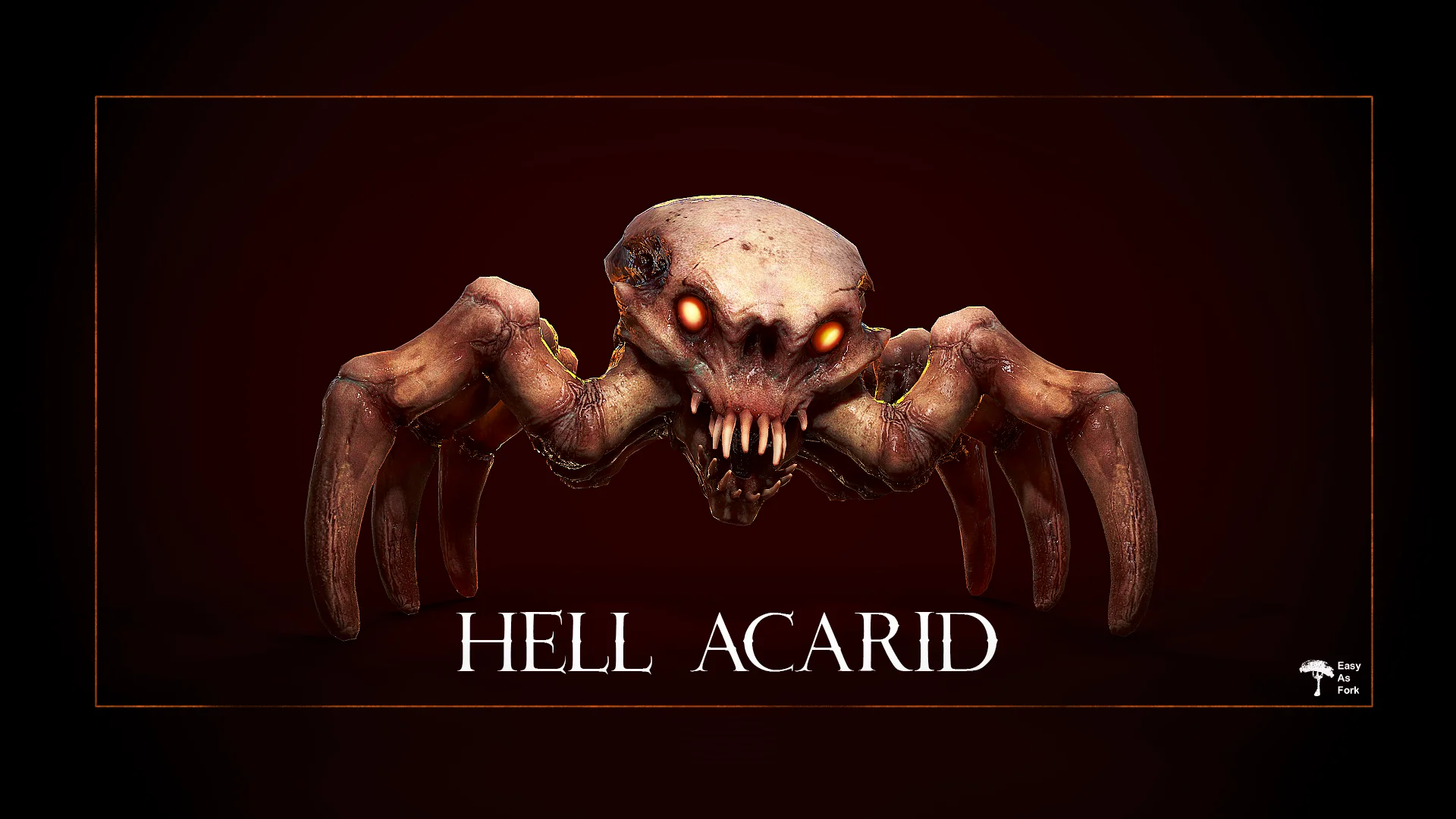
Visually, the Hell Acarid balances the biological traits of arachnids with demonic, hellish monster themes. Its structure references parasitic ticks and spiders, emphasizing a compact body plan that sits close to the surface. Multiple articulated limbs radiate outward from a dense central mass, producing an unmistakable silhouette that conveys unnatural menace despite its diminutive scale. The fusion of realistic anatomical chitin with demonic styling gives the creature an authentic physical presence, allowing the surface textures to react accurately under dynamic scene illumination.
The deliberate decision to keep the monster small alters how it catches light and registers to the camera. Chitinous shell plates, segmented leg joints, and predatory mouthparts are concentrated within a tight envelope, ensuring that fine surface definitions remain visible even when viewed from overhead or mid-distance player perspectives. This realistic execution fits environments ranging from scorched subterranean caverns and brimstone pits to decaying dungeon corridors where parasitic demon mobs nest in corners or scuttle across ceilings and walls.
Behavioral Roles Across Sneaky Mobs, Summons, and Companions
The compact footprint of the creature unlocks diverse utility across combat design. In an adversarial context, the asset serves naturally as a sneaky enemy mob. Designers can tuck these low-profile entities behind level geometry, beneath debris, or inside crevices to ambush unwary parties. When paired with stealth or burrowing mechanics, their sudden emergence disrupts player formations, forcing encounters that prioritize rapid target acquisition over brute force.
Beyond basic enemy encounters, the model adapts cleanly to magic systems as a specialized summon. Spellcasting classes oriented around occult, demonic, or verminous schools of magic can conjure these entities in swarms or as temporary reconnaissance units. The script structure supports minion logic, tethering the creature's target priorities to the summoner's actions. Alternatively, the asset functions effectively as a peculiar pet. A companion entity with arachnid-inspired animations brings an unsettling, exotic presence to character inventories, standing out against conventional mammalian or avian follower archetypes while maintaining minimal performance overhead in dense group scenes.
Production Deployment in Psymetry and Jobak Compatibility
Practical application of the creature is demonstrated through its live implementation within the game Psymetry. Operating inside a complete game build verifies that the asset's structural setup withstands the performance demands of active gameplay loops, camera tracking, and environmental collision. Real-world utilization in a finished project provides tangible proof of how the Animation Blueprint and skeletal hierarchy behave when subjected to live gameplay events, damage calculations, and dynamic level geometry.
Alongside its presence in full production, the entity maintains Jobak compatibility. Integrating assets into established production pipelines often fails when skeletal scales, socket references, or animation curves conflict with existing framework standards. Adhering to Jobak compatibility ensures that character controllers, asset managers, and animation playback systems recognize the model's data streams cleanly. This technical alignment reduces initial retargeting or re-rigging friction, allowing technical artists to introduce the creature into existing level prototypes without redesigning core framework logic.
Pipeline Adaptations, Custom Textures, and Feature Expansion
Production environments frequently demand variations to accommodate distinct art styles or mechanical requirements. The creature's architecture accommodates iterative expansions, providing clear pathways to introduce supplementary textures, animation clips, or specialized gameplay features. When a project requires elemental variants—such as venomous broods, crystalline mutations, or charred volcanic derivatives—the underlying surface mapping accepts texture adjustments without distorting the anatomical balance of the chitinous shell.
Expanding the animation set follows standard skeletal export and import workflows. Additional behavioral loops, such as wall-climbing, ceiling hangs, latching attacks, or distinctive death sequences, can be authored directly onto the skeleton and patched into the existing Animation Blueprint. Requests for specific functional modifications, customized skin variations, or unique movement clips can be integrated directly into ongoing project builds, allowing developers to scale the asset from a single enemy archetype into an entire family of coordinated demonic vermin.
 Game Development R
 Game Development R
 Game Development R
 Environments