"7ad89cffa44984cf"{"id":"1002536","slug":"holden","title":"Holden","category":"Game Development Resource","engine":"4.19+,5.0+","assetVersion":"","engineVersion":"Engine Version: 4.19+,5.0+","tag":"Game Development R","accent":"blue","visual":"mech","summary":"A technical look at Holden, a lowpoly anime warrior character featuring modular textures, sword and spear roles, and engine-specific implementation details.","platform":"Unreal Engine","indexPolicy":"index","publishedAt":"2026-11-13T09:39:16.372Z","updatedAt":"2026-11-13T09:39:16.372Z","sourceNotes":[],"fileContents":[],"compatibility":["Unreal Engine","Engine Version: 4.19+,5.0+"],"featuredImage":{"alt":"Holden","src":"/wp-content/uploads/published/2026/11/f4318e578ea4-c6ce4163-c5d2-409c-a49b-b2328659b1cf-a573cd4fb4.webp"},"hasDownloadLink":true,"downloads":0,"terms":[],"galleryImages":[{"src":"/wp-content/uploads/published/2026/11/c4df3f4a191e-a8006931-4bcc-4d8b-94a8-196af905a757-8959fd2954.webp","alt":"Holden"},{"src":"/wp-content/uploads/published/2026/11/44535591fbe6-081704a0-6966-4c54-83dd-b17fcd7c16c6-5afc5c5e27.webp","alt":"Holden"},{"src":"/wp-content/uploads/published/2026/11/83c009909bea-7b53ff7c-370f-4b34-a5bd-672ec67e958a-b7a4058ebe.webp","alt":"Holden"}],"accessPanel":{"kind":"resource","title":"Get this resource","eyebrow":"Free resource","message":"Download this resource in your browser.","fileName":"Content.7z","safetyNote":"Resources are manually reviewed before listing to improve quality and reduce obvious risks.","actionLabel":"Get this resource","resourceType":"Resource archive","versions":[]},"contentHtml":"\u003ch2\u003ePopulating Stylized Castles and Towns with Holden\u003c/h2\u003e\n\u003cp\u003eStylized fantasy settings, particularly those borrowing visual cues from Japanese historical or anime aesthetics, rely heavily on readable non-player characters to sell their environment. Holden functions directly within this space, serving as a lowpoly cartoon character designed to occupy roles ranging from city guards to sworn knights. In game worlds where high-fidelity realism gives way to simplified geometry and bold artistic silhouettes, such character models establish immediate context for a settlement, patrol post, or military garrison.\u003c/p\u003e\n\u003cp\u003eDeploying Holden within a scene allows world builders to address the visual needs of town garrisons, fortress gates, and wandering encounters. Because the character aligns with warrior, knight, and guard archetypes, placing multiple instances across a level can define the martial presence of a faction. When populating an outpost, an environment artist can stage Holden standing watch at a perimeter gate, patrolling a rampart, or resting inside a barracks common room. The lowpoly cartoon look keeps visual clutter minimal, preventing background defenders from overwhelming the player's immediate field of view while still preserving a recognizable anime identity.\u003c/p\u003e \u003ch2\u003eHolden Texture Separation and Palette Customization\u003c/h2\u003e\n\u003cp\u003eAdapting a single character asset across multiple game roles requires flexibility in how surfaces are partitioned. Holden approaches this by isolating textures into distinct material channels rather than combining the entire model into a single unified map. Specifically, the character divides its surface coverage across four key components:\u003c/p\u003e\n\u003cul\u003e \u003cli\u003eFace\u003c/li\u003e \u003cli\u003eSkin\u003c/li\u003e \u003cli\u003eHair\u003c/li\u003e \u003cli\u003eArmor\u003c/li\u003e\n\u003c/ul\u003e\n\u003cp\u003eDistributing surface elements in this manner directly supports color customization across different instances of the model. Because the armor is mapped independently from the skin and hair, developers can alter the coloring of a battalion's protective gear without altering the underlying character features. A garrison stationed in a northern territory might carry steel-gray or deep-blue armor finishes, while an elite guard unit positioned in a capital district can utilize brighter or more ornate tones. This separation prevents the color bleeding that often occurs when attempting to tint complex single-sheet textures.\u003c/p\u003e\n\u003cp\u003eIndependent control over hair and skin textures functions in the same practical manner. By isolating the hair surface, character variety can be multiplied across several NPC encounters. Two guards standing side by side can display different hair shades or skin tones while sharing the same underlying model and armor structure. The separate face mapping preserves facial clarity, ensuring that changes applied to armor plates or skin undertones do not disrupt the cartoon expression or anime styling drawn onto the facial surface.\u003c/p\u003e \u003ch2\u003eAnimation Handling and Engine Differences\u003c/h2\u003e\n\u003cp\u003eAnimation readiness is central to any character pipeline, and Holden includes verified animation support. The motion showcase for the character is demonstrated within Unity3D, where the animation set can be viewed and tested in active motion. This gives developers working in Unity a direct frame of reference for how the character moves, holds its posture, and carries its equipment during basic actions.\u003c/p\u003e\n\u003cp\u003eWhen migrating or implementing the asset in Unreal Engine, important technical variations must be taken into account. The Unreal Engine version does not include the helper scripts or the custom toon shader present in other environments. As a result, technical artists and developers integrating Holden into Unreal Engine projects must plan around standard shading materials or supply their own custom cel-shading solutions.\u003c/p\u003e\n\u003cp\u003eBecause the toon shader is omitted from the Unreal Engine package, achieving the intended cartoon and anime look in that engine involves hooking the separate texture maps into a custom material graph. Developers can construct a post-process cel shader, apply stepped lighting calculations inside an unlit or custom lighting material, or utilize Unreal's native stylized material workflows to mimic the look demonstrated in Unity. Similarly, because logic scripts are absent in the Unreal release, movement controllers, state machines, and socket attachment logic for weapons must be implemented manually within Blueprints or C++.\u003c/p\u003e \u003ch2\u003eWeapon Profiles for the Holden Warrior Archetype\u003c/h2\u003e\n\u003cp\u003eThe asset's tagging establishes Holden as a combatant based on two classic weapon forms: the sword and the spear. These arms define how the character operates mechanically inside a combat or patrol ecosystem.\u003c/p\u003e\n\u003cp\u003eA spear-wielding guard serves a clear defensive function within stylized game design. In castle gates, chokepoints, and palace corridors, spear-bearing NPCs communicate range control, formal standing, and defensive discipline. Animating Holden with a polearm profile allows designers to construct defensive walls, phalanx units, or simple sentries leaning on their shafts while scanning an open courtyard. The silhouette of a spearhead extending above a helmeted or armored anime figure provides immediate visual feedback to the player from long distances.\u003c/p\u003e\n\u003cp\u003eConversely, assigning a sword to Holden shifts the character's functional profile toward close-quarters combat, knightly duty, or general warrior tasks. Swordsmen can fulfill roles such as wandering patrol leaders, elite personal retainers, or reactive melee enemies in dungeon crawls. Combining both weapon loadouts across a shared character base enables developers to build diverse unit rosters using a uniform visual style, ensuring that frontline spear ranks and backup sword infantry look like members of the same military order.\u003c/p\u003e \u003ch2\u003eSystem Compatibility and Stylized World Building\u003c/h2\u003e\n\u003cp\u003eHolden maintains documented compatibility with the Yippy Kawaii ecosystem. In productions where an entire cast of stylized, cartoon, or anime figures must share an environment without jarring visual conflicts, compatibility across character packs ensures proportional harmony. Head-to-body ratios, limb thickness, and general level of geometric abstraction often vary wildly among independent lowpoly assets. Compatibility with Yippy Kawaii means Holden can stand alongside related characters without requiring manual skeletal retargeting or destructive mesh scaling.\u003c/p\u003e\n\u003cp\u003eThis baseline makes Holden a natural fit for projects prioritizing cohesive, non-photorealistic fantasy worlds. Whether serving as a minor quest giver at a Japanese-inspired rural outpost, a nameless patrolman guarding a stone fortress, or a frontline soldier in an anime-styled battle scenario, the asset delivers the structural components—divided textures, verified animation support, and dual-weapon archetypes—needed to construct active fantasy scenes.\u003c/p\u003e\n\n\u003ch2\u003eExplore Similar Assets\u003c/h2\u003e\n\u003cul\u003e\n\u003cli\u003e\u003ca href=\"https://3dcghub.com/samurai-girl-tomoe/\" rel=\"noopener noreferrer\"\u003eSamurai Girl Tomoe\u003c/a\u003e\u003c/li\u003e\n\u003cli\u003e\u003ca href=\"https://3dcghub.com/medieval-infantry/\" rel=\"noopener noreferrer\"\u003eMedieval Infantry\u003c/a\u003e\u003c/li\u003e\n\u003cli\u003e\u003ca href=\"https://3dcghub.com/viking-warriors/\" rel=\"noopener noreferrer\"\u003eViking Warriors\u003c/a\u003e\u003c/li\u003e\n\u003cli\u003e\u003ca href=\"https://3dcghub.com/l-dark-wizard/\" rel=\"noopener noreferrer\"\u003eL: Dark Wizard\u003c/a\u003e\u003c/li\u003e\n\u003cli\u003e\u003ca href=\"https://3dcghub.com/samurai-warriors/\" rel=\"noopener noreferrer\"\u003eSamurai Warriors\u003c/a\u003e\u003c/li\u003e\n\u003c/ul\u003e","contentTextLength":6872,"navigation":{"current":41,"total":4499,"previous":{"id":"1002537","slug":"humanoids-monsters-pack","title":"Humanoids Monsters Pack","category":"Game Development Resource","platform":"Unreal Engine","updatedAt":"2026-11-13T09:40:58.998Z"},"next":{"id":"1002535","slug":"high-demon","title":"High Demon","category":"Characters \u0026 Creatures","platform":"Unreal Engine","updatedAt":"2026-11-13T09:38:20.796Z"}},"relatedResources":[{"id":"1002564","slug":"sci-fi-gastaroid-queen","title":"SCI FI: GASTAROID QUEEN","category":"Game Development Resource","engine":"4.15+,5.0+","assetVersion":"","engineVersion":"Engine Version: 4.15+,5.0+","tag":"Game Development R","accent":"blue","visual":"mech","summary":"Examine the technical specs, 86-bone Mecanim Generic rig, 4K single-material texture, and 28 animations of the Sci Fi: Gastaroid Queen creature asset.","platform":"Unreal Engine","indexPolicy":"index","publishedAt":"2026-11-13T11:56:42.214Z","updatedAt":"2026-11-13T11:56:42.214Z","sourceNotes":[],"fileContents":[],"compatibility":["Unreal Engine","Engine Version: 4.15+,5.0+"],"featuredImage":{"alt":"SCI FI: GASTAROID QUEEN","src":"/wp-content/uploads/published/2026/11/e81feecea475-b9885b38-03a98c46ea.webp"},"hasDownloadLink":true,"downloads":0},{"id":"1002405","slug":"samurai-girl-tomoe","title":"Samurai Girl Tomoe","category":"Humans","engine":"4.19+,5.0+","assetVersion":"","engineVersion":"Engine Version: 4.19+,5.0+","tag":"Humans","accent":"blue","visual":"mech","summary":"Modular 3D warrior character Samurai Girl Tomoe featuring 52 ARKit blendshapes, 4K packed textures, and an Epic Skeleton rig for action games.","platform":"Unreal Engine","indexPolicy":"index","publishedAt":"2026-11-10T07:07:18.175Z","updatedAt":"2026-11-10T07:07:18.175Z","sourceNotes":[],"fileContents":[],"compatibility":["Unreal Engine","Engine Version: 4.19+,5.0+"],"featuredImage":{"alt":"Samurai Girl Tomoe","src":"/wp-content/uploads/published/2026/11/5c46690700c0-95be6877-7081-4ad3-b57c-fd636373f3cb-40e5943225.webp"},"hasDownloadLink":true,"downloads":0},{"id":"1002485","slug":"medieval-infantry","title":"Medieval Infantry","category":"Characters \u0026 Creatures","engine":"4.19+,5.0+","assetVersion":"","engineVersion":"Engine Version: 4.19+,5.0+","tag":"Characters","accent":"blue","visual":"character","summary":"Customizable realistic medieval warriors with advanced material controls, UE mannequin compatibility, a dedicated weapon asset, and a deployable ballista.","platform":"Unreal Engine","indexPolicy":"index","publishedAt":"2026-11-12T03:49:48.304Z","updatedAt":"2026-11-12T03:49:48.304Z","sourceNotes":[],"fileContents":[],"compatibility":["Unreal Engine","Engine Version: 4.19+,5.0+"],"featuredImage":{"alt":"Medieval Infantry","src":"/wp-content/uploads/published/2026/11/b6de45965936-86df4195-fcaf-4770-a2e1-5228fc98f0d5-86b001c8c2.webp"},"hasDownloadLink":true,"downloads":0}]}
Game Development R
Holden
A technical look at Holden, a lowpoly anime warrior character featuring modular textures, sword and spear roles, and engine-specific implementation details.
Category:Unreal EnginePlatform: Unreal EngineEngine Version: 4.19+,5.0+Published: Nov 13, 2026
Game Development R
Resource overview
Populating Stylized Castles and Towns with Holden
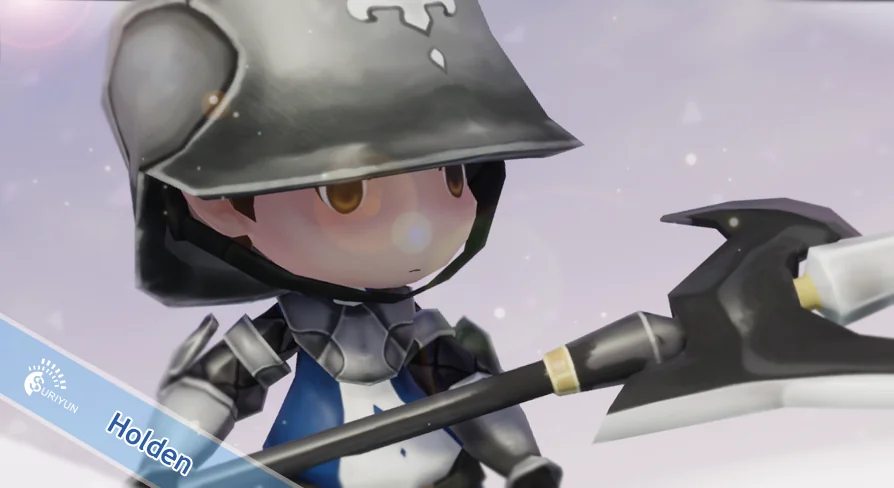
Stylized fantasy settings, particularly those borrowing visual cues from Japanese historical or anime aesthetics, rely heavily on readable non-player characters to sell their environment. Holden functions directly within this space, serving as a lowpoly cartoon character designed to occupy roles ranging from city guards to sworn knights. In game worlds where high-fidelity realism gives way to simplified geometry and bold artistic silhouettes, such character models establish immediate context for a settlement, patrol post, or military garrison.
Deploying Holden within a scene allows world builders to address the visual needs of town garrisons, fortress gates, and wandering encounters. Because the character aligns with warrior, knight, and guard archetypes, placing multiple instances across a level can define the martial presence of a faction. When populating an outpost, an environment artist can stage Holden standing watch at a perimeter gate, patrolling a rampart, or resting inside a barracks common room. The lowpoly cartoon look keeps visual clutter minimal, preventing background defenders from overwhelming the player's immediate field of view while still preserving a recognizable anime identity.
Holden Texture Separation and Palette Customization
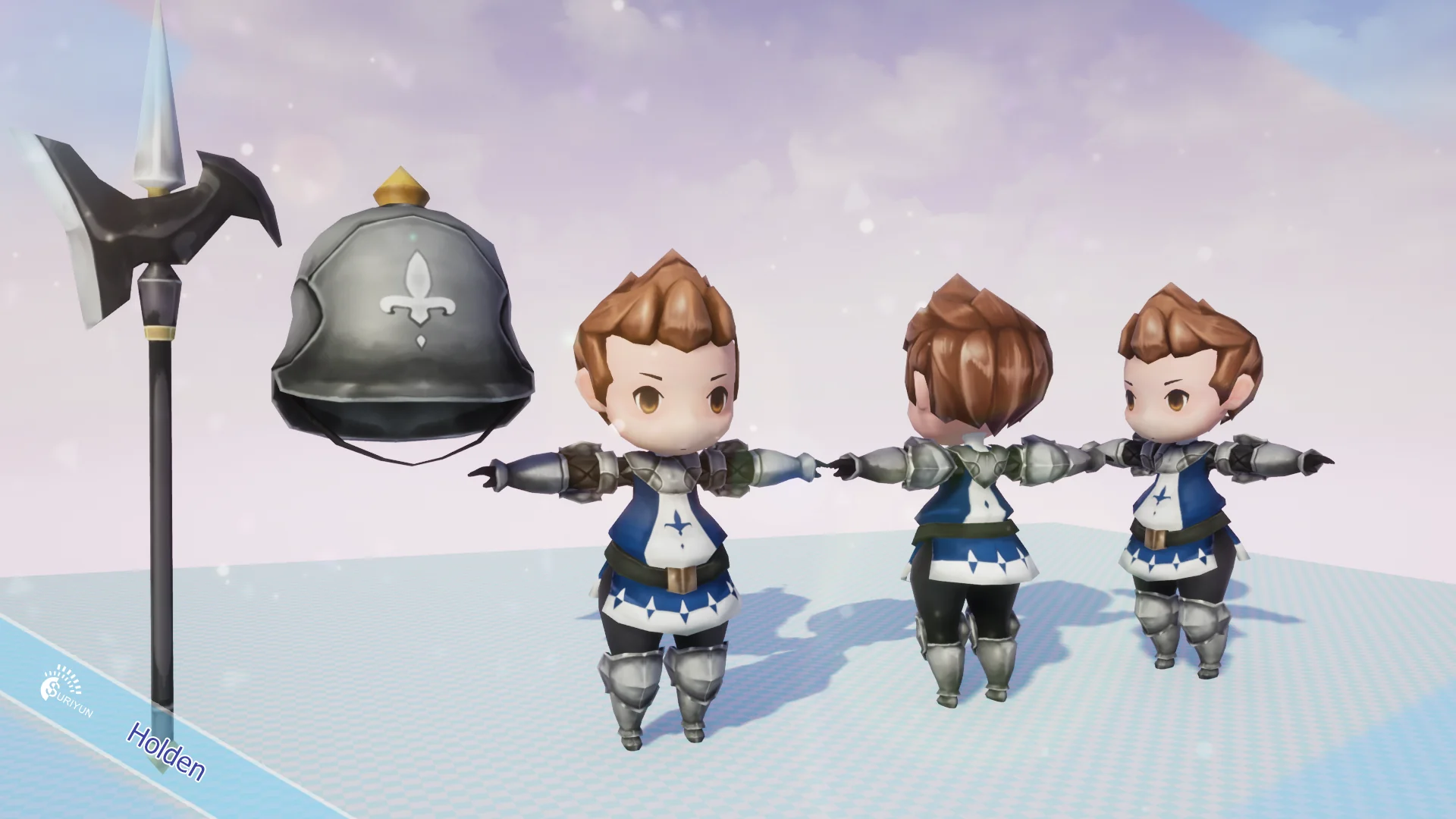
Adapting a single character asset across multiple game roles requires flexibility in how surfaces are partitioned. Holden approaches this by isolating textures into distinct material channels rather than combining the entire model into a single unified map. Specifically, the character divides its surface coverage across four key components:
Face
Skin
Hair
Armor
Distributing surface elements in this manner directly supports color customization across different instances of the model. Because the armor is mapped independently from the skin and hair, developers can alter the coloring of a battalion's protective gear without altering the underlying character features. A garrison stationed in a northern territory might carry steel-gray or deep-blue armor finishes, while an elite guard unit positioned in a capital district can utilize brighter or more ornate tones. This separation prevents the color bleeding that often occurs when attempting to tint complex single-sheet textures.
Independent control over hair and skin textures functions in the same practical manner. By isolating the hair surface, character variety can be multiplied across several NPC encounters. Two guards standing side by side can display different hair shades or skin tones while sharing the same underlying model and armor structure. The separate face mapping preserves facial clarity, ensuring that changes applied to armor plates or skin undertones do not disrupt the cartoon expression or anime styling drawn onto the facial surface.
Animation Handling and Engine Differences
Animation readiness is central to any character pipeline, and Holden includes verified animation support. The motion showcase for the character is demonstrated within Unity3D, where the animation set can be viewed and tested in active motion. This gives developers working in Unity a direct frame of reference for how the character moves, holds its posture, and carries its equipment during basic actions.
When migrating or implementing the asset in Unreal Engine, important technical variations must be taken into account. The Unreal Engine version does not include the helper scripts or the custom toon shader present in other environments. As a result, technical artists and developers integrating Holden into Unreal Engine projects must plan around standard shading materials or supply their own custom cel-shading solutions.
Because the toon shader is omitted from the Unreal Engine package, achieving the intended cartoon and anime look in that engine involves hooking the separate texture maps into a custom material graph. Developers can construct a post-process cel shader, apply stepped lighting calculations inside an unlit or custom lighting material, or utilize Unreal's native stylized material workflows to mimic the look demonstrated in Unity. Similarly, because logic scripts are absent in the Unreal release, movement controllers, state machines, and socket attachment logic for weapons must be implemented manually within Blueprints or C++.
Weapon Profiles for the Holden Warrior Archetype
The asset's tagging establishes Holden as a combatant based on two classic weapon forms: the sword and the spear. These arms define how the character operates mechanically inside a combat or patrol ecosystem.
A spear-wielding guard serves a clear defensive function within stylized game design. In castle gates, chokepoints, and palace corridors, spear-bearing NPCs communicate range control, formal standing, and defensive discipline. Animating Holden with a polearm profile allows designers to construct defensive walls, phalanx units, or simple sentries leaning on their shafts while scanning an open courtyard. The silhouette of a spearhead extending above a helmeted or armored anime figure provides immediate visual feedback to the player from long distances.
Conversely, assigning a sword to Holden shifts the character's functional profile toward close-quarters combat, knightly duty, or general warrior tasks. Swordsmen can fulfill roles such as wandering patrol leaders, elite personal retainers, or reactive melee enemies in dungeon crawls. Combining both weapon loadouts across a shared character base enables developers to build diverse unit rosters using a uniform visual style, ensuring that frontline spear ranks and backup sword infantry look like members of the same military order.
System Compatibility and Stylized World Building
Holden maintains documented compatibility with the Yippy Kawaii ecosystem. In productions where an entire cast of stylized, cartoon, or anime figures must share an environment without jarring visual conflicts, compatibility across character packs ensures proportional harmony. Head-to-body ratios, limb thickness, and general level of geometric abstraction often vary wildly among independent lowpoly assets. Compatibility with Yippy Kawaii means Holden can stand alongside related characters without requiring manual skeletal retargeting or destructive mesh scaling.
This baseline makes Holden a natural fit for projects prioritizing cohesive, non-photorealistic fantasy worlds. Whether serving as a minor quest giver at a Japanese-inspired rural outpost, a nameless patrolman guarding a stone fortress, or a frontline soldier in an anime-styled battle scenario, the asset delivers the structural components—divided textures, verified animation support, and dual-weapon archetypes—needed to construct active fantasy scenes.
 Game Development R
 Game Development R
 Humans
 Characters