"a7cfa646d0d8ae55"{"id":"1001165","slug":"hawknest-shipping-port-modular","title":"HAWKNEST - Shipping Port (Modular)","category":"Industrial","engine":"5.1+","assetVersion":"","engineVersion":"Engine Version: 5.1+","tag":"Industrial","accent":"blue","visual":"mech","summary":"Configure and deploy HAWKNEST - Shipping Port (Modular) in Unreal Engine with drivable vehicles, modular warehouses, Chaos physics, and harbor props.","platform":"Unreal Engine","publishedAt":"2026-09-16T09:15:39.305Z","updatedAt":"2026-09-16T09:15:39.305Z","sourceNotes":[],"fileContents":[],"compatibility":["Unreal Engine","Engine Version: 5.1+"],"featuredImage":{"alt":"HAWKNEST - Shipping Port (Modular)","src":"/wp-content/uploads/published/2026/09/60a683ccfcff-e3eea282-3eb7-4851-afc1-c2d91f2c2c16-c24dcaf1ce.webp"},"hasDownloadLink":true,"downloads":1,"terms":[{"taxonomy":"category","slug":"industrial-environments","name":"Industrial"}],"galleryImages":[{"src":"/wp-content/uploads/published/2026/09/2c1e63dbc7bb-616ddaa0-0b50-455e-8e92-115de4168fc4-0f4ede7a80.webp","alt":"HAWKNEST - Shipping Port (Modular)"},{"src":"/wp-content/uploads/published/2026/09/d649191f7b2a-3e1cbd2f-f1a1-4a6d-9786-00845ac45536-11931a3b59.webp","alt":"HAWKNEST - Shipping Port (Modular)"},{"src":"/wp-content/uploads/published/2026/09/899a740faeed-f3691c4c-3ff2-47a2-83a8-611552f0b72f-3d66cbee0b.webp","alt":"HAWKNEST - Shipping Port (Modular)"},{"src":"/wp-content/uploads/published/2026/09/56f1c0474d1a-e705e9cf-d87c-4853-a282-1bda50db495b-31f98874bc.webp","alt":"HAWKNEST - Shipping Port (Modular)"},{"src":"/wp-content/uploads/published/2026/09/139cde1098a5-2c8bc589-60d8-48f1-8d32-727776b63fd8-7c4bde056d.webp","alt":"HAWKNEST - Shipping Port (Modular)"},{"src":"/wp-content/uploads/published/2026/09/549c7b687eb7-50bd1d3f-c9cd-4e83-9dc8-ef2b8d4ffa5e-80d401b6ce.webp","alt":"HAWKNEST - Shipping Port (Modular)"},{"src":"/wp-content/uploads/published/2026/09/cd45628e859a-519468d0-9c0f-4aa6-ba27-ae1ce2bd4c61-e49e1d33e3.webp","alt":"HAWKNEST - Shipping Port (Modular)"},{"src":"/wp-content/uploads/published/2026/09/1ca9e8304612-ca818cf8-64ec-49d6-8642-0571afbdc2e4-a313414b15.webp","alt":"HAWKNEST - Shipping Port (Modular)"},{"src":"/wp-content/uploads/published/2026/09/fa55a85830ba-b7bd0ed3-e179-4d19-88b1-3eb61a5fdebd-4d08961ae3.webp","alt":"HAWKNEST - Shipping Port (Modular)"},{"src":"/wp-content/uploads/published/2026/09/5731134170cb-59eb2197-3a3e-4811-ae8e-ec99f4fd8ab2-49be581725.webp","alt":"HAWKNEST - Shipping Port (Modular)"}],"accessPanel":{"kind":"resource","title":"Download this resource","eyebrow":"Free Download","message":"Log in or create a free account to start your download.","fileName":"Content.7z","safetyNote":"Resources are manually reviewed before listing to improve quality and reduce obvious risks.","actionLabel":"Download Free","resourceType":"Resource archive"},"contentHtml":"\u003ch2\u003eEnabling ChaosVehiclesPlugin for Drivable Vehicles\u003c/h2\u003e\n\u003cp\u003eDeploying the shipping terminal inside Unreal Engine requires activating the correct physics dependencies before exploring the maps. The project depends directly on Unreal Engine's ChaosVehiclesPlugin to manage the drivetrain, suspension travel, tire friction, and collision dynamics across all included machinery. When importing or opening the project, confirm that the plugin is toggled on inside the engine's Project Settings. Failing to enable this plugin prevents the underlying vehicle animation and simulation graphs from compiling, rendering the ground transport stationary.\u003c/p\u003e\n\u003cp\u003eOnce the Chaos system is operational, the project establishes a fully interactive base where vehicles seamlessly interact with dockside geometry, access roads, and warehouse floors. Every mesh, collision hull, and master material included in the environment loads ready for immediate interaction, allowing scene builders to test driveways, clearances, and staging areas straight out of the box.\u003c/p\u003e \u003ch2\u003eHAWKNEST Vehicle Mechanics and Functional Blueprints\u003c/h2\u003e\n\u003cp\u003eUnlike purely decorative industrial backdrops, this environment provides an active fleet of interactive ground units. Operators can take immediate control of a heavy-duty Forklift, the 4X4 Faster, capable Off Roads, and commercial Cargo Trucks. These machines are set up with dedicated drive systems, making them functional assets for maneuvering cargo between berths and storage facilities.\u003c/p\u003e\n\u003cp\u003eThe operational functionality extends beyond basic driving. The vehicle Blueprints include specific mechanical controls that improve staging depth:\u003c/p\u003e\n\u003cul\u003e \u003cli\u003eInteractive door open and close mechanics for realistic driver boarding and cargo inspection sequences.\u003c/li\u003e \u003cli\u003eHeadlight toggling to match dynamic day-and-night cycles or unlit warehouse interiors.\u003c/li\u003e \u003cli\u003eIndependent flashlight and auxiliary light controls to spotlight specific work zones during night operations.\u003c/li\u003e\n\u003c/ul\u003e\n\u003cp\u003eThe vehicle setup maintains natural compatibility with systems such as the Modular Driveable Vehicle Pack Vol.1, allowing developers running established transportation frameworks to expand their fleet into maritime transport logistics without redesigning vehicle logic.\u003c/p\u003e \u003ch2\u003eConstructing Hangars and Warehouses with Modular Assets\u003c/h2\u003e\n\u003cp\u003eThe package contains around 450 unique high-quality assets crafted to meet the standards of realistic AAA game productions. A central strength of this asset library is its modular structural kit. Instead of locking level designers into rigid, non-customizable building footprints, the pack supplies individual wall sections, structural columns, industrial doors, and roofing components that snap together along consistent grid increments.\u003c/p\u003e\n\u003cp\u003eThis modular framework allows environment artists to assemble specialized logistics structures to fit exact terrain needs. You can erect sprawling distribution warehouses with tall interior clearance for shelving racks, assemble compact customs inspection stations, or construct deep maintenance hangars capable of housing the included trucks and forklifts. Because every architectural piece shares uniform texturing and industrial weathering, custom buildings match the rest of the harbor infrastructure perfectly.\u003c/p\u003e \u003ch2\u003eVessel Staging from Tugboats to Reach Stackers\u003c/h2\u003e\n\u003cp\u003eA convincing maritime environment requires both quayside machinery and waterborne vessels. The library furnishes water areas with multiple boat classes, including a dedicated tugboat, transport boats, and larger cargo ships positioned along the piers. These assets allow technical directors to populate offshore shipping lanes, create dense traffic along approach canals, or tie vessels directly to mooring bollards for dockside loading scenarios.\u003c/p\u003e\n\u003cp\u003eOn the landside aprons, container handling is reinforced through reach stackers and specialized staging gear. These large-scale machines provide the vertical height needed to break up open concrete piers and create labyrinthine paths between intermodal freight containers. Backing this equipment is a vast suite of high-resolution textures applied across all surfaces. Painted hull plates, corrugated metal siding, weathered asphalt, rusted steel beams, and cautionary floor decals all feature calibrated surface responses that react predictably to direct sunlight and artificial yard floods.\u003c/p\u003e \u003ch2\u003eImplementation in Simulators, Digital Twins, and Virtual Production\u003c/h2\u003e\n\u003cp\u003eThe scope and structural accuracy of the port suit several distinct technical applications across interactive and linear media. In traditional game development, the assets serve level art, environment design, and dynamic lighting pipelines, offering expansive industrial lines of sight and dense prop placement opportunities. The AAA fidelity ensures visual cohesion even during close-up first-person inspection.\u003c/p\u003e\n\u003cp\u003eBeyond entertainment applications, the pack adapts directly into digital twin and industrial simulator workflows. Logistics planners and simulation engineers can leverage the drivable Cargo Trucks, Forklifts, and reach stacker layouts to visualize port traffic flow, test loading clearance protocols, or recreate real-world container terminal bottlenecks. Real-time rendering teams and virtual production studios can equally utilize the detailed waterfront, ships, and modular hangars as realistic, high-fidelity backdrops for in-camera visual effects and live-action stage broadcasts.\u003c/p\u003e\n\n\u003ch2\u003eMore From The Same Workflow\u003c/h2\u003e\n\u003cul\u003e\n\u003cli\u003e\u003ca href=\"https://3dcghub.com/container-yard-environment-set/\" title=\"Container Yard Environment Set\"\u003eContainer Yard Environment Set\u003c/a\u003e\u003c/li\u003e\n\u003cli\u003e\u003ca href=\"https://3dcghub.com/hawknest-an-aircraft-factory-hangar-modular/\" title=\"HAWKNEST An Aircraft Factory Hangar (Modular)\"\u003eHAWKNEST An Aircraft Factory Hangar (Modular)\u003c/a\u003e\u003c/li\u003e\n\u003cli\u003e\u003ca href=\"https://3dcghub.com/port/\" title=\"Port\"\u003ePort\u003c/a\u003e\u003c/li\u003e\n\u003cli\u003e\u003ca href=\"https://3dcghub.com/sci-fi-port-environment/\" title=\"Sci-fi Port Environment\"\u003eSci-fi Port Environment\u003c/a\u003e\u003c/li\u003e\n\u003cli\u003e\u003ca href=\"https://3dcghub.com/industrial-harbour-industrial-industrial-harbour-harbour-port-factory-port/\" title=\"Industrial Harbour ( Industrial Industrial Harbour Harbour Port Factory Port )\"\u003eIndustrial Harbour ( Industrial Industrial Harbour Harbour Port Factory Port )\u003c/a\u003e\u003c/li\u003e\n\u003c/ul\u003e","contentTextLength":5571,"navigation":{"current":60,"total":3167,"previous":{"id":"1001166","slug":"lost-temple-vol-1-ancient-ruins","title":"Lost Temple VOL.1 - Ancient Ruins","category":"Buildings \u0026 Architecture","platform":"Unreal Engine","updatedAt":"2026-09-16T13:47:47.064Z"},"next":{"id":"1001164","slug":"castle-grimguard-night-day","title":"Castle Grimguard (Night/Day)","category":"Fantasy","platform":"Unreal Engine","updatedAt":"2026-09-16T02:48:23.211Z"}},"relatedResources":[{"id":"8560","slug":"container-yard-environment-set","title":"Container Yard Environment Set","category":"Industrial","engine":"4.26+,5.0+","assetVersion":"Engine version: 4.26+,5.0+","engineVersion":"4.16","tag":"Industrial","accent":"blue","visual":"city","summary":"Build detailed industrial landscapes with this comprehensive set of shipping containers and port assets. It features customizable materials and background elements for maximum realism.","platform":"Unreal Engine","publishedAt":"2026-02-23T17:50:40.000Z","updatedAt":"2026-04-19T15:55:24.000Z","sourceNotes":[],"fileContents":[],"compatibility":["Unreal Engine","Engine version: 4.26+,5.0+"],"featuredImage":{"alt":"Container Yard Environment Set","src":"https://3dcghub.com/wp-content/uploads/2026/02/f5c20195-e95e-4c0f-8b29-40e11412677d.webp"},"hasDownloadLink":true,"downloads":0},{"id":"8605","slug":"hawknest-an-aircraft-factory-hangar-modular","title":"HAWKNEST An Aircraft Factory Hangar (Modular)","category":"Industrial","engine":"5.1+","assetVersion":"Engine version: 5.1+","engineVersion":"5.1","tag":"Industrial","accent":"blue","visual":"city","summary":"Create stunning industrial spaces with this modular aircraft factory hangar. It features over 340 high-quality assets, animated robots, and fully functional drivable vehicles.","platform":"Unreal Engine","publishedAt":"2026-02-23T18:05:05.000Z","updatedAt":"2026-04-19T15:55:24.000Z","sourceNotes":[],"fileContents":[],"compatibility":["Unreal Engine","Engine version: 5.1+"],"featuredImage":{"alt":"HAWKNEST An Aircraft Factory Hangar (Modular)","src":"https://3dcghub.com/wp-content/uploads/2026/02/0f603211-4c1b-4d0d-b6a4-9fe97117dd12.webp"},"hasDownloadLink":true,"downloads":1},{"id":"1000545","slug":"port","title":"Port","category":"Industrial","engine":"4.26+,5.0+","assetVersion":"","engineVersion":"Engine Version: 4.26+,5.0+","tag":"Industrial","accent":"blue","visual":"mech","summary":"Port industrial environment pack with warehouses, cargo props, vehicles, and a ship for Unreal Engine, supporting versions 4.26 through 5.8.","platform":"Unreal Engine","publishedAt":"2026-07-15T04:07:22.619Z","updatedAt":"2026-07-22T18:15:19.221Z","sourceNotes":[],"fileContents":[],"compatibility":["Unreal Engine","Engine Version: 4.26+,5.0+"],"featuredImage":{"alt":"Port","src":"/wp-content/uploads/published/2026/07/804c7c7ad3d3-dc0b61d5-a785-440c-b062-0837d0068d63-0209f8eedb.webp"},"hasDownloadLink":true,"downloads":2}]}
Industrial
HAWKNEST - Shipping Port (Modular)
Configure and deploy HAWKNEST - Shipping Port (Modular) in Unreal Engine with drivable vehicles, modular warehouses, Chaos physics, and harbor props.
Enabling ChaosVehiclesPlugin for Drivable Vehicles
Deploying the shipping terminal inside Unreal Engine requires activating the correct physics dependencies before exploring the maps. The project depends directly on Unreal Engine's ChaosVehiclesPlugin to manage the drivetrain, suspension travel, tire friction, and collision dynamics across all included machinery. When importing or opening the project, confirm that the plugin is toggled on inside the engine's Project Settings. Failing to enable this plugin prevents the underlying vehicle animation and simulation graphs from compiling, rendering the ground transport stationary.
Once the Chaos system is operational, the project establishes a fully interactive base where vehicles seamlessly interact with dockside geometry, access roads, and warehouse floors. Every mesh, collision hull, and master material included in the environment loads ready for immediate interaction, allowing scene builders to test driveways, clearances, and staging areas straight out of the box.
HAWKNEST Vehicle Mechanics and Functional Blueprints
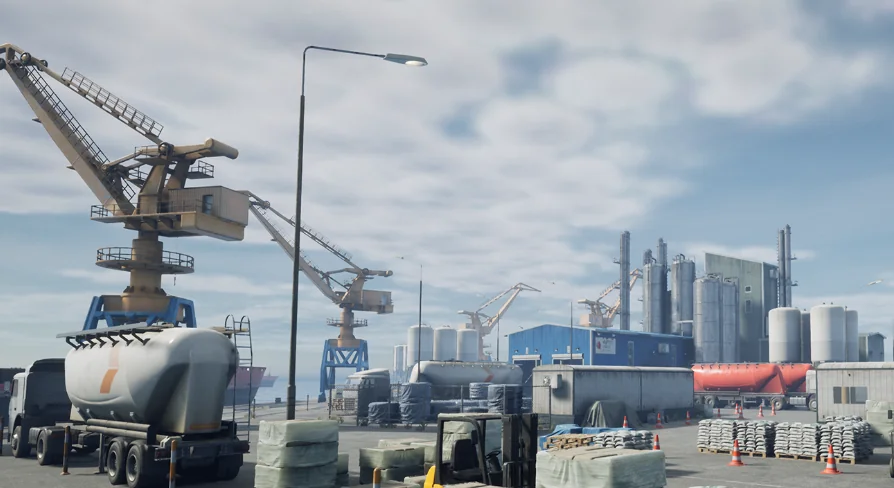
Unlike purely decorative industrial backdrops, this environment provides an active fleet of interactive ground units. Operators can take immediate control of a heavy-duty Forklift, the 4X4 Faster, capable Off Roads, and commercial Cargo Trucks. These machines are set up with dedicated drive systems, making them functional assets for maneuvering cargo between berths and storage facilities.
The operational functionality extends beyond basic driving. The vehicle Blueprints include specific mechanical controls that improve staging depth:
Interactive door open and close mechanics for realistic driver boarding and cargo inspection sequences.
Headlight toggling to match dynamic day-and-night cycles or unlit warehouse interiors.
Independent flashlight and auxiliary light controls to spotlight specific work zones during night operations.
The vehicle setup maintains natural compatibility with systems such as the Modular Driveable Vehicle Pack Vol.1, allowing developers running established transportation frameworks to expand their fleet into maritime transport logistics without redesigning vehicle logic.
Constructing Hangars and Warehouses with Modular Assets
The package contains around 450 unique high-quality assets crafted to meet the standards of realistic AAA game productions. A central strength of this asset library is its modular structural kit. Instead of locking level designers into rigid, non-customizable building footprints, the pack supplies individual wall sections, structural columns, industrial doors, and roofing components that snap together along consistent grid increments.
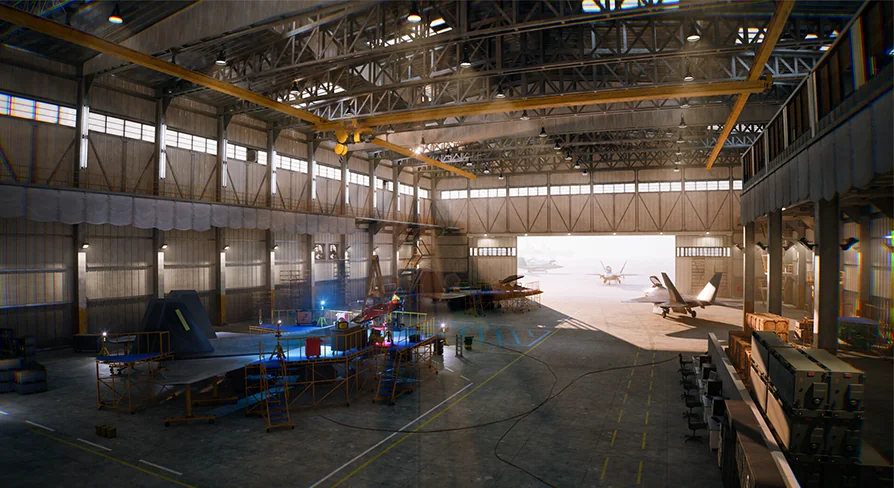
This modular framework allows environment artists to assemble specialized logistics structures to fit exact terrain needs. You can erect sprawling distribution warehouses with tall interior clearance for shelving racks, assemble compact customs inspection stations, or construct deep maintenance hangars capable of housing the included trucks and forklifts. Because every architectural piece shares uniform texturing and industrial weathering, custom buildings match the rest of the harbor infrastructure perfectly.
Vessel Staging from Tugboats to Reach Stackers
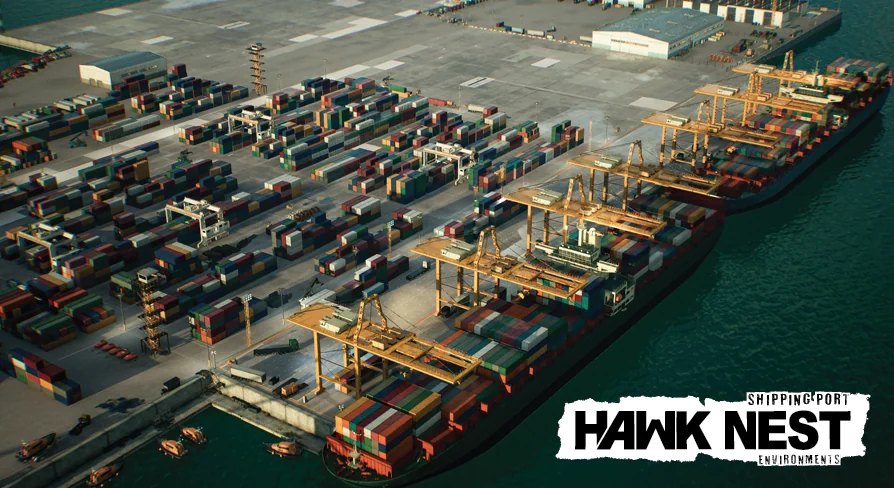
A convincing maritime environment requires both quayside machinery and waterborne vessels. The library furnishes water areas with multiple boat classes, including a dedicated tugboat, transport boats, and larger cargo ships positioned along the piers. These assets allow technical directors to populate offshore shipping lanes, create dense traffic along approach canals, or tie vessels directly to mooring bollards for dockside loading scenarios.
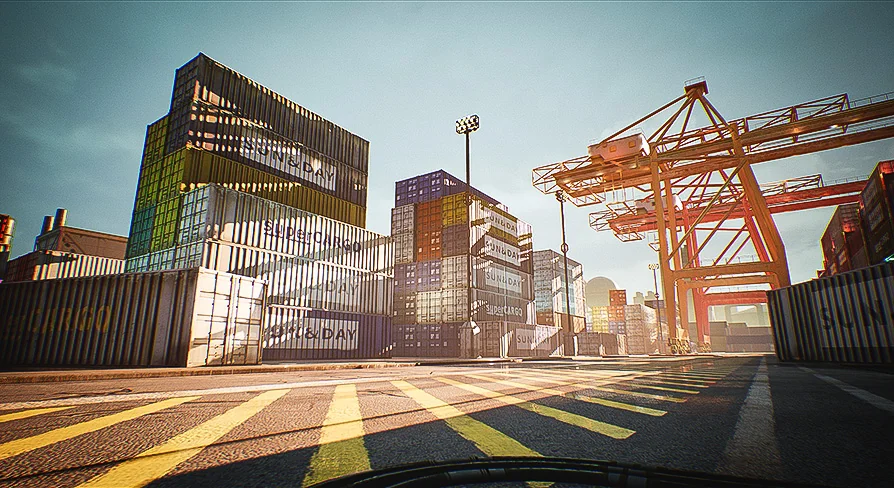
On the landside aprons, container handling is reinforced through reach stackers and specialized staging gear. These large-scale machines provide the vertical height needed to break up open concrete piers and create labyrinthine paths between intermodal freight containers. Backing this equipment is a vast suite of high-resolution textures applied across all surfaces. Painted hull plates, corrugated metal siding, weathered asphalt, rusted steel beams, and cautionary floor decals all feature calibrated surface responses that react predictably to direct sunlight and artificial yard floods.
Implementation in Simulators, Digital Twins, and Virtual Production
The scope and structural accuracy of the port suit several distinct technical applications across interactive and linear media. In traditional game development, the assets serve level art, environment design, and dynamic lighting pipelines, offering expansive industrial lines of sight and dense prop placement opportunities. The AAA fidelity ensures visual cohesion even during close-up first-person inspection.
Beyond entertainment applications, the pack adapts directly into digital twin and industrial simulator workflows. Logistics planners and simulation engineers can leverage the drivable Cargo Trucks, Forklifts, and reach stacker layouts to visualize port traffic flow, test loading clearance protocols, or recreate real-world container terminal bottlenecks. Real-time rendering teams and virtual production studios can equally utilize the detailed waterfront, ships, and modular hangars as realistic, high-fidelity backdrops for in-camera visual effects and live-action stage broadcasts.
 Industrial
 Industrial
 Industrial
 Industrial