"ddd0e3fb95b0aec2"{"id":"1000430","slug":"industrial-harbour-industrial-industrial-harbour-harbour-port-factory-port","title":"Industrial Harbour ( Industrial Industrial Harbour Harbour Port Factory Port )","category":"Streets \u0026 Construction","engine":"5.3+","assetVersion":"","engineVersion":"Engine Version: 5.3+","tag":"Streets","accent":"blue","visual":"mech","summary":"Industrial Harbour delivers 106 unique game-ready meshes with Lumen and Nanite support, plus the Ultimate Level Art Tool for fast modular building construction","platform":"Unreal Engine","publishedAt":"2026-07-09T21:08:29.404Z","updatedAt":"2026-07-09T21:08:29.404Z","sourceNotes":[],"fileContents":[],"compatibility":["Unreal Engine","Engine Version: 5.3+"],"featuredImage":{"alt":"Industrial Harbour ( Industrial Industrial Harbour Harbour Port Factory Port )","src":"/wp-content/uploads/published/2026/07/20b0a94c891b-40b47d63-b75d-4d06-99c3-667a73934fba-0e5004383d.webp"},"hasDownloadLink":true,"downloads":0,"terms":[{"taxonomy":"category","slug":"streets-and-construction","name":"Streets \u0026 Construction"}],"galleryImages":[{"src":"/wp-content/uploads/published/2026/07/71757860ec8c-c8b3792f-0781-492e-b84e-f61a07851f3a-cd8cb0086f.webp","alt":"Industrial Harbour ( Industrial Industrial Harbour Harbour Port Factory Port )"},{"src":"/wp-content/uploads/published/2026/07/9e81e238dd6a-da743bca-6713-40f9-b6da-f20a3b2b4125-73a26430cd.webp","alt":"Industrial Harbour ( Industrial Industrial Harbour Harbour Port Factory Port )"},{"src":"/wp-content/uploads/published/2026/07/ff89d8f155c2-c930e622-aa8d-4bee-94b6-e3d32dd439e5-6b0731a75f.webp","alt":"Industrial Harbour ( Industrial Industrial Harbour Harbour Port Factory Port )"},{"src":"/wp-content/uploads/published/2026/07/0489083021d8-d934e76b-df0c-47d7-aaeb-14717ae19cac-5fd5939c9a.webp","alt":"Industrial Harbour ( Industrial Industrial Harbour Harbour Port Factory Port )"},{"src":"/wp-content/uploads/published/2026/07/e42c3b328291-665b849f-68f0-4a24-a79f-aea7485feda6-396e03ac94.webp","alt":"Industrial Harbour ( Industrial Industrial Harbour Harbour Port Factory Port )"},{"src":"/wp-content/uploads/published/2026/07/a7778fa7ba9c-dfbff0de-6fe4-4996-84ba-ce8793f4a512-cd96371c6f.webp","alt":"Industrial Harbour ( Industrial Industrial Harbour Harbour Port Factory Port )"},{"src":"/wp-content/uploads/published/2026/07/12c9b7e15e8b-3cc8c325-c31e-44e3-b99a-18b573ec2637-ea13238fb7.webp","alt":"Industrial Harbour ( Industrial Industrial Harbour Harbour Port Factory Port )"},{"src":"/wp-content/uploads/published/2026/07/86a453a58076-cac2a1b9-2324-4794-b0e5-b0fe71e70638-ef6453d03b.webp","alt":"Industrial Harbour ( Industrial Industrial Harbour Harbour Port Factory Port )"},{"src":"/wp-content/uploads/published/2026/07/76aca78687be-6bdef964-80d8-48fa-b441-68a03efe04a6-0bf0d08ad0.webp","alt":"Industrial Harbour ( Industrial Industrial Harbour Harbour Port Factory Port )"},{"src":"/wp-content/uploads/published/2026/07/5d61acba2426-0eb9a784-ea4e-47dd-a484-e9bf7fa477a7-7d298056a0.webp","alt":"Industrial Harbour ( Industrial Industrial Harbour Harbour Port Factory Port )"}],"accessPanel":{"kind":"resource","title":"Download this resource","eyebrow":"Free Download","message":"Log in or create a free account to start your download.","fileName":"IndustrialHarbour.7z","safetyNote":"Resources are manually reviewed before listing to improve quality and reduce obvious risks.","actionLabel":"Download Free","resourceType":"Resource archive"},"contentHtml":"\u003cp\u003eBuilding a credible dockside or cargo-handling scene means assembling a dense collection of shipping containers, warehouse walls, dockside cranes, and weathered steel structures without every piece looking like a duplicate. Industrial Harbour is an environment pack aimed at exactly that workload — a collection of 106 unique meshes covering maritime industry, factory zones, cargo loading areas, and the rust-and-grime aesthetic that those settings demand. The pack is built for Unreal Engine and positioned for game environments and virtual production levels where the visual target is realistic rather than stylised.\u003c/p\u003e \u003ch2\u003eWhat the Industrial Harbour Environment Pack Contains\u003c/h2\u003e \u003cp\u003eThe core offering is 106 unique meshes, all showcased in a preassembled scene that comes included with the pack. Rather than handing over a loose bin of objects and leaving placement entirely to the user, the creator provides the demonstrated scene assembled and ready to inspect. That preassembled scene functions as both a reference and a working starting point: level designers can pull it apart, study how the modular pieces fit, and then rearrange components to suit their own layout requirements.\u003c/p\u003e \u003cp\u003eThe asset set encompasses the objects you would expect to find across a working port — shipping containers, dockside cranes, warehouse structures, steel beams, rusted walls, heavy equipment, and mechanical assets. The tagging language associated with the pack points to cargo shipyards, manufacturing areas, freight terminals, logistics centres, and oil refinery clusters, suggesting the meshes are varied enough to support multiple industrial sub-settings without forcing the scene to look like a single narrow location. Weathered surfaces, grime and rust, and smokestacks are all called out, which signals that the materials lean toward an aged, lived-in look rather than a pristine factory floor.\u003c/p\u003e \u003cp\u003eEach mesh is described as high-quality with a good level of detail, and the pack is explicitly optimised for game-ready projects. The creator identifies the assets as well-optimised, meaning the geometry and material setup should hold up when multiple instances populate a view at once — a relevant concern in port scenes where rows of containers and stacked cargo can quickly drive up draw calls and triangle counts if the underlying assets are heavy.\u003c/p\u003e \u003ch3\u003eLumen, Nanite, and Engine Compatibility\u003c/h3\u003e \u003cp\u003eThe pack ships with Lumen enabled and includes Nanite meshes, placing it squarely in the Unreal Engine 5 technology stack. Lumen provides the dynamic global illumination that makes dockside lighting — where shadows cast by cranes, stacked containers, and industrial overhead structures shift as light sources move — behave without requiring baked lightmaps. Nanite handles the high-detail geometry, allowing dense hard-surface models like mechanical equipment and structural steel to render efficiently without manual LOD setup.\u003c/p\u003e \u003cp\u003eCompatibility is listed for Unreal Engine versions 5.0 through 5.7, covering the range from the initial UE5 release through recent point updates. This span means the pack works for projects that started on early UE5 builds and for those tracking the latest engine revisions.\u003c/p\u003e \u003ch2\u003eBundling the Ultimate Level Art Tool\u003c/h2\u003e \u003cp\u003eIncluded with the environment pack is the Ultimate Level Art Tool, abbreviated as ULAT. The tool's full descriptive name translates to a modular design development tool for mobile and web-based systems. Its practical function inside the pack is to let users create custom modular buildings quickly and to populate scenes in what the creator describes as a seamless and distinctive way.\u003c/p\u003e \u003cp\u003eThe environment pack is built to be compatible with ULAT, which means the meshes conform to the modular grid and naming conventions the tool expects for snapping pieces together. Rather than manually aligning wall panels, floors, and roof sections, a level designer can use ULAT to generate building variations from the modular kit at a faster pace than placing each piece by hand. The tool is obtained by creating a ticket after acquiring the pack, rather than being delivered as a separate automatic download.\u003c/p\u003e \u003cp\u003eThe creator notes that ULAT originally carried a separate price for this product, and bundling it into the environment pack means the tool and the art assets are intended to work as a paired system — the meshes provide the visual content, and ULAT provides the assembly mechanism for turning those meshes into larger structures.\u003c/p\u003e \u003ch2\u003eWhere Industrial Harbour Fits in a Production Pipeline\u003c/h2\u003e \u003cp\u003eThis pack targets two overlapping but distinct production scenarios. The first is game development, where the modular harbour and dockyard aesthetic can serve as a gameplay area — a cargo loading zone, a freight terminal, or a warehouse district where players move between containers and industrial structures. The preassembled scene gives a team something playable or walkable almost immediately, which can then be modified as design requirements change.\u003c/p\u003e \u003cp\u003eThe second scenario is virtual production. The pack's Lumen support and Nanite geometry make it suitable for real-time rendering environments where lighting quality and geometric detail matter on camera. Dockside lighting, smoggy skylines, and weathered surfaces are all elements that read strongly on screen, and the tag list points repeatedly toward environmental storytelling — suggesting the assets carry enough surface variation and wear to communicate a sense of place without heavy manual decoration.\u003c/p\u003e \u003cp\u003eThe modular building workflow also matters here. When a production calls for a specific harbour layout that matches a script or storyboard, relying on pre-built structures is limiting. A modular system paired with ULAT allows a environment artist to assemble the required building configurations on demand, matching camera angles and scene beats without returning to a modelling package for every variation.\u003c/p\u003e \u003ch3\u003eAsset Categories and Scene Coverage\u003c/h3\u003e \u003cp\u003eThe tag list accompanying the pack is extensive and reveals the breadth of industrial vocabulary the assets are meant to cover. The recurring terms fall into several practical clusters:\u003c/p\u003e \u003cul\u003e\n\u003cli\u003e\u003cstrong\u003eCargo and logistics infrastructure:\u003c/strong\u003e Shipping containers, loading bays, freight terminals, distribution centres, bulk storage, supply depots.\u003c/li\u003e\n\u003cli\u003e\u003cstrong\u003eHeavy machinery and mechanical equipment:\u003c/strong\u003e Dockside cranes, heavy-duty cranes, harbour machinery, mechanised systems, heavy gear, material handling equipment.\u003c/li\u003e\n\u003cli\u003e\u003cstrong\u003eStructural and architectural elements:\u003c/strong\u003e Steel structures, metal beams, rusted walls, warehouse interiors, warehouse offices, weathered buildings, modular harbour components.\u003c/li\u003e\n\u003cli\u003e\u003cstrong\u003eScene dressing and atmosphere:\u003c/strong\u003e Rusted elements, grunge textures, smokestacks, oil refinery structures, railway tracks, power station components, pollution-implying elements like smoggy skylines.\u003c/li\u003e\n\u003c/ul\u003e \u003cp\u003eThe presence of tags like historic dockyards, old shipyard, ship repair yard, and fisherman wharf alongside commercial seaport, port authority, and shipping administration suggests the mesh set spans enough variety to dress scenes ranging from active modern freight operations to decaying or repurposed harbour zones. That range gives a level designer flexibility in the narrative the environment communicates — a working, efficient logistics hub reads differently from a weathered, semi-abandoned dockyard, and the asset collection appears built to support both.\u003c/p\u003e \u003cp\u003eThe physically based rendering tag and the repeated emphasis on authentic textures and realistic building materials indicate that the surfacing work is intended to hold up under scrutiny, not just read as correct from a distance. Industrial scenes place significant demands on material quality because rust, grime, paint flaking, and metal oxidation are visually complex surfaces. When those materials are done poorly, hard-surface environments look synthetic; when done well, they disappear into the scene and let the layout carry the storytelling.\u003c/p\u003e \u003ch2\u003ePractical Takeaway for Project Planning\u003c/h2\u003e \u003cp\u003eIndustrial Harbour is best understood as a combined environment-and-tool package rather than a standalone mesh dump. The 106 unique meshes provide the port, factory, and dockyard vocabulary; Lumen and Nanite support handle the rendering demands of dense industrial geometry; and the bundled Ultimate Level Art Tool gives a level designer a mechanism for assembling modular buildings beyond what manual placement would allow. For teams working in Unreal Engine 5.0 through 5.7 who need a realistic maritime industrial setting — whether for a cargo-loading gameplay area or a virtual production dockside sequence — the pack covers the asset ground and supplies the workflow tooling to keep scene construction efficient.\u003c/p\u003e\n\n\u003ch2\u003eMore From The Same Workflow\u003c/h2\u003e\n\u003cul\u003e\n\u003cli\u003e\u003ca href=\"https://3dcghub.com/hawknest-an-aircraft-factory-hangar-modular/\" title=\"HAWKNEST An Aircraft Factory Hangar (Modular)\"\u003eHAWKNEST An Aircraft Factory Hangar (Modular)\u003c/a\u003e\u003c/li\u003e\n\u003cli\u003e\u003ca href=\"https://3dcghub.com/factory/\" title=\"Factory\"\u003eFactory\u003c/a\u003e\u003c/li\u003e\n\u003cli\u003e\u003ca href=\"https://3dcghub.com/polygon-street-racer/\" title=\"POLYGON - Street Racer\"\u003ePOLYGON - Street Racer\u003c/a\u003e\u003c/li\u003e\n\u003cli\u003e\u003ca href=\"https://3dcghub.com/old-factory/\" title=\"Old Factory\"\u003eOld Factory\u003c/a\u003e\u003c/li\u003e\n\u003cli\u003e\u003ca href=\"https://3dcghub.com/sci-fi-robot-factory-environment/\" title=\"Sci-Fi Robot Factory Environment\"\u003eSci-Fi Robot Factory Environment\u003c/a\u003e\u003c/li\u003e\n\u003c/ul\u003e","contentTextLength":8775,"navigation":{"current":1220,"total":3511,"previous":{"id":"1000431","slug":"item-pickup-set","title":"Item Pickup Set","category":"Variety","platform":"Unreal Engine","updatedAt":"2026-07-09T21:20:09.863Z"},"next":{"id":"1000429","slug":"forester","title":"Forester","category":"Characters \u0026 Creatures","platform":"Unreal Engine","updatedAt":"2026-07-09T21:01:19.852Z"}},"relatedResources":[{"id":"1001165","slug":"hawknest-shipping-port-modular","title":"HAWKNEST - Shipping Port (Modular)","category":"Industrial","engine":"5.1+","assetVersion":"","engineVersion":"Engine Version: 5.1+","tag":"Industrial","accent":"blue","visual":"mech","summary":"Configure and deploy HAWKNEST - Shipping Port (Modular) in Unreal Engine with drivable vehicles, modular warehouses, Chaos physics, and harbor props.","platform":"Unreal Engine","publishedAt":"2026-09-16T09:15:39.305Z","updatedAt":"2026-09-16T09:15:39.305Z","sourceNotes":[],"fileContents":[],"compatibility":["Unreal Engine","Engine Version: 5.1+"],"featuredImage":{"alt":"HAWKNEST - Shipping Port (Modular)","src":"/wp-content/uploads/published/2026/09/60a683ccfcff-e3eea282-3eb7-4851-afc1-c2d91f2c2c16-c24dcaf1ce.webp"},"hasDownloadLink":true,"downloads":1},{"id":"8605","slug":"hawknest-an-aircraft-factory-hangar-modular","title":"HAWKNEST An Aircraft Factory Hangar (Modular)","category":"Industrial","engine":"5.1+","assetVersion":"Engine version: 5.1+","engineVersion":"5.1","tag":"Industrial","accent":"blue","visual":"city","summary":"Create stunning industrial spaces with this modular aircraft factory hangar. It features over 340 high-quality assets, animated robots, and fully functional drivable vehicles.","platform":"Unreal Engine","publishedAt":"2026-02-23T18:05:05.000Z","updatedAt":"2026-04-19T15:55:24.000Z","sourceNotes":[],"fileContents":[],"compatibility":["Unreal Engine","Engine version: 5.1+"],"featuredImage":{"alt":"HAWKNEST An Aircraft Factory Hangar (Modular)","src":"https://3dcghub.com/wp-content/uploads/2026/02/0f603211-4c1b-4d0d-b6a4-9fe97117dd12.webp"},"hasDownloadLink":true,"downloads":1},{"id":"8578","slug":"factory","title":"Factory","category":"Industrial","engine":"5.0+","assetVersion":"Engine version: 5.0+","engineVersion":"4.19","tag":"Industrial","accent":"blue","visual":"city","summary":"Create immersive industrial levels with this comprehensive Factory asset pack. It features detailed hangars, vehicles, and warehouse props optimized for current-gen game performance.","platform":"Unreal Engine","publishedAt":"2026-02-23T17:56:47.000Z","updatedAt":"2026-04-19T15:55:24.000Z","sourceNotes":[],"fileContents":[],"compatibility":["Unreal Engine","Engine version: 5.0+"],"featuredImage":{"alt":"Factory","src":"https://3dcghub.com/wp-content/uploads/2026/02/734c461d-2f71-4e20-9013-8f92821b5f73.webp"},"hasDownloadLink":true,"downloads":0}]}
Streets
Industrial Harbour ( Industrial Industrial Harbour Harbour Port Factory Port )
Industrial Harbour delivers 106 unique game-ready meshes with Lumen and Nanite support, plus the Ultimate Level Art Tool for fast modular building construction
Building a credible dockside or cargo-handling scene means assembling a dense collection of shipping containers, warehouse walls, dockside cranes, and weathered steel structures without every piece looking like a duplicate. Industrial Harbour is an environment pack aimed at exactly that workload — a collection of 106 unique meshes covering maritime industry, factory zones, cargo loading areas, and the rust-and-grime aesthetic that those settings demand. The pack is built for Unreal Engine and positioned for game environments and virtual production levels where the visual target is realistic rather than stylised.
What the Industrial Harbour Environment Pack Contains
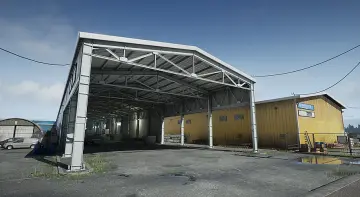
The core offering is 106 unique meshes, all showcased in a preassembled scene that comes included with the pack. Rather than handing over a loose bin of objects and leaving placement entirely to the user, the creator provides the demonstrated scene assembled and ready to inspect. That preassembled scene functions as both a reference and a working starting point: level designers can pull it apart, study how the modular pieces fit, and then rearrange components to suit their own layout requirements.
The asset set encompasses the objects you would expect to find across a working port — shipping containers, dockside cranes, warehouse structures, steel beams, rusted walls, heavy equipment, and mechanical assets. The tagging language associated with the pack points to cargo shipyards, manufacturing areas, freight terminals, logistics centres, and oil refinery clusters, suggesting the meshes are varied enough to support multiple industrial sub-settings without forcing the scene to look like a single narrow location. Weathered surfaces, grime and rust, and smokestacks are all called out, which signals that the materials lean toward an aged, lived-in look rather than a pristine factory floor.
Each mesh is described as high-quality with a good level of detail, and the pack is explicitly optimised for game-ready projects. The creator identifies the assets as well-optimised, meaning the geometry and material setup should hold up when multiple instances populate a view at once — a relevant concern in port scenes where rows of containers and stacked cargo can quickly drive up draw calls and triangle counts if the underlying assets are heavy.
Lumen, Nanite, and Engine Compatibility
The pack ships with Lumen enabled and includes Nanite meshes, placing it squarely in the Unreal Engine 5 technology stack. Lumen provides the dynamic global illumination that makes dockside lighting — where shadows cast by cranes, stacked containers, and industrial overhead structures shift as light sources move — behave without requiring baked lightmaps. Nanite handles the high-detail geometry, allowing dense hard-surface models like mechanical equipment and structural steel to render efficiently without manual LOD setup.
Compatibility is listed for Unreal Engine versions 5.0 through 5.7, covering the range from the initial UE5 release through recent point updates. This span means the pack works for projects that started on early UE5 builds and for those tracking the latest engine revisions.
Bundling the Ultimate Level Art Tool
Included with the environment pack is the Ultimate Level Art Tool, abbreviated as ULAT. The tool's full descriptive name translates to a modular design development tool for mobile and web-based systems. Its practical function inside the pack is to let users create custom modular buildings quickly and to populate scenes in what the creator describes as a seamless and distinctive way.
The environment pack is built to be compatible with ULAT, which means the meshes conform to the modular grid and naming conventions the tool expects for snapping pieces together. Rather than manually aligning wall panels, floors, and roof sections, a level designer can use ULAT to generate building variations from the modular kit at a faster pace than placing each piece by hand. The tool is obtained by creating a ticket after acquiring the pack, rather than being delivered as a separate automatic download.
The creator notes that ULAT originally carried a separate price for this product, and bundling it into the environment pack means the tool and the art assets are intended to work as a paired system — the meshes provide the visual content, and ULAT provides the assembly mechanism for turning those meshes into larger structures.
Where Industrial Harbour Fits in a Production Pipeline
This pack targets two overlapping but distinct production scenarios. The first is game development, where the modular harbour and dockyard aesthetic can serve as a gameplay area — a cargo loading zone, a freight terminal, or a warehouse district where players move between containers and industrial structures. The preassembled scene gives a team something playable or walkable almost immediately, which can then be modified as design requirements change.
The second scenario is virtual production. The pack's Lumen support and Nanite geometry make it suitable for real-time rendering environments where lighting quality and geometric detail matter on camera. Dockside lighting, smoggy skylines, and weathered surfaces are all elements that read strongly on screen, and the tag list points repeatedly toward environmental storytelling — suggesting the assets carry enough surface variation and wear to communicate a sense of place without heavy manual decoration.
The modular building workflow also matters here. When a production calls for a specific harbour layout that matches a script or storyboard, relying on pre-built structures is limiting. A modular system paired with ULAT allows a environment artist to assemble the required building configurations on demand, matching camera angles and scene beats without returning to a modelling package for every variation.
Asset Categories and Scene Coverage
The tag list accompanying the pack is extensive and reveals the breadth of industrial vocabulary the assets are meant to cover. The recurring terms fall into several practical clusters:
Cargo and logistics infrastructure: Shipping containers, loading bays, freight terminals, distribution centres, bulk storage, supply depots.
Heavy machinery and mechanical equipment: Dockside cranes, heavy-duty cranes, harbour machinery, mechanised systems, heavy gear, material handling equipment.
Structural and architectural elements: Steel structures, metal beams, rusted walls, warehouse interiors, warehouse offices, weathered buildings, modular harbour components.
Scene dressing and atmosphere: Rusted elements, grunge textures, smokestacks, oil refinery structures, railway tracks, power station components, pollution-implying elements like smoggy skylines.
The presence of tags like historic dockyards, old shipyard, ship repair yard, and fisherman wharf alongside commercial seaport, port authority, and shipping administration suggests the mesh set spans enough variety to dress scenes ranging from active modern freight operations to decaying or repurposed harbour zones. That range gives a level designer flexibility in the narrative the environment communicates — a working, efficient logistics hub reads differently from a weathered, semi-abandoned dockyard, and the asset collection appears built to support both.
The physically based rendering tag and the repeated emphasis on authentic textures and realistic building materials indicate that the surfacing work is intended to hold up under scrutiny, not just read as correct from a distance. Industrial scenes place significant demands on material quality because rust, grime, paint flaking, and metal oxidation are visually complex surfaces. When those materials are done poorly, hard-surface environments look synthetic; when done well, they disappear into the scene and let the layout carry the storytelling.
Practical Takeaway for Project Planning
Industrial Harbour is best understood as a combined environment-and-tool package rather than a standalone mesh dump. The 106 unique meshes provide the port, factory, and dockyard vocabulary; Lumen and Nanite support handle the rendering demands of dense industrial geometry; and the bundled Ultimate Level Art Tool gives a level designer a mechanism for assembling modular buildings beyond what manual placement would allow. For teams working in Unreal Engine 5.0 through 5.7 who need a realistic maritime industrial setting — whether for a cargo-loading gameplay area or a virtual production dockside sequence — the pack covers the asset ground and supplies the workflow tooling to keep scene construction efficient.
 Streets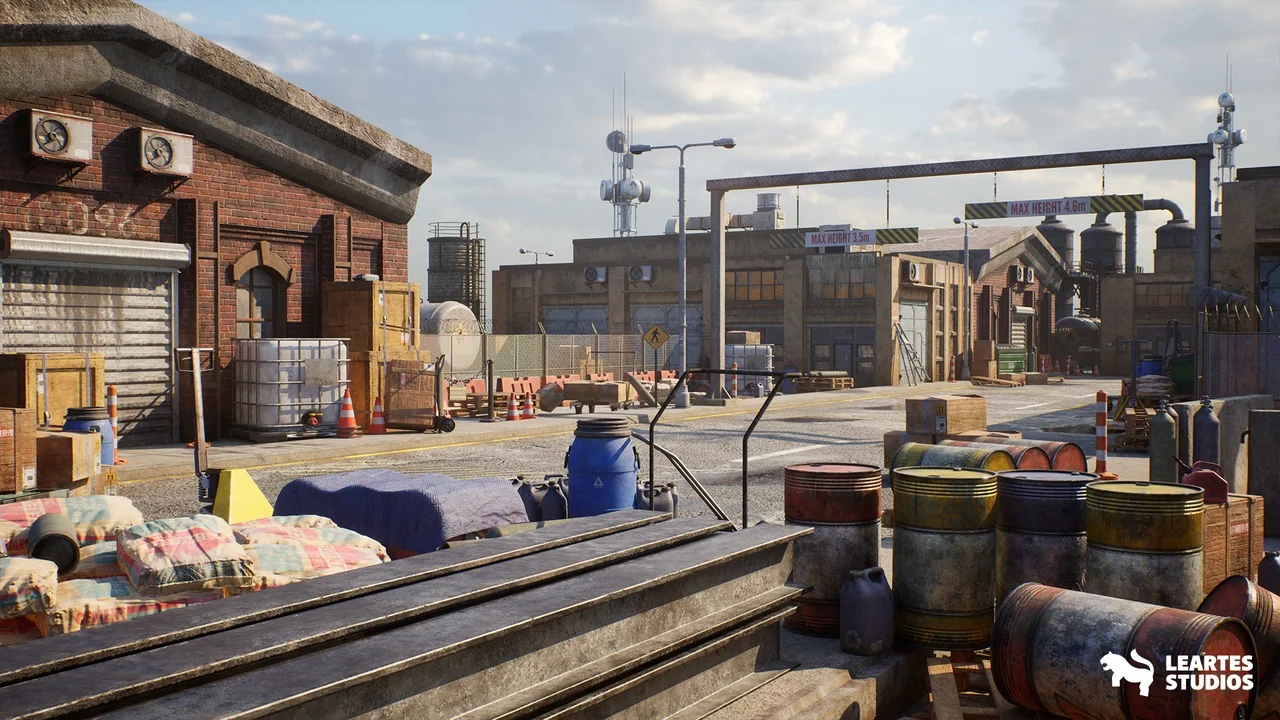
 Industrial
 Industrial
 Industrial