"d037b61901c110d2"{"id":"1002670","slug":"greenwood-fantasy-village","title":"Greenwood Fantasy Village","category":"Fantasy","engine":"5.0+","assetVersion":"","engineVersion":"Engine Version: 5.0+","tag":"Fantasy","accent":"blue","visual":"mech","summary":"Explore Greenwood Fantasy Village, a stylized lowpoly 3D environment pack featuring modular terrain, shared atlased textures, and over 100 props.","platform":"Unreal Engine","indexPolicy":"index","publishedAt":"2026-11-16T22:20:45.576Z","updatedAt":"2026-11-16T22:20:45.576Z","sourceNotes":[],"fileContents":[],"compatibility":["Unreal Engine","Engine Version: 5.0+"],"featuredImage":{"alt":"Greenwood Fantasy Village","src":"/wp-content/uploads/published/2026/11/d253a758f6ef-1b23f55f-5c41-4af9-851a-1fff5106a441-4fcf22acfe.webp"},"fileSizeBytes":1237319716,"hasDownloadLink":true,"downloads":0,"terms":[{"taxonomy":"category","slug":"fantasy","name":"Fantasy"}],"galleryImages":[{"src":"/wp-content/uploads/published/2026/11/accc89010248-b3e71f9a-cd34-4a10-8a5a-542308a76712-0b3a77dc0c.webp","alt":"Greenwood Fantasy Village"},{"src":"/wp-content/uploads/published/2026/11/89266d428963-72703e97-83dd-41f5-b4f8-cca30f886271-d2d2d897bf.webp","alt":"Greenwood Fantasy Village"},{"src":"/wp-content/uploads/published/2026/11/aa3bcbd9fc9b-a52d2c60-a360-4997-8694-0dce1d0d2978-6d74bbb25a.webp","alt":"Greenwood Fantasy Village"},{"src":"/wp-content/uploads/published/2026/11/c4513ccdd6c9-3527937e-f75f-4784-8c6d-4146bc8083cb-16eb58da3f.webp","alt":"Greenwood Fantasy Village"},{"src":"/wp-content/uploads/published/2026/11/758d5001c936-7a629043-04a4-4c8f-a8cd-7b4aca205c0f-45dd66119d.webp","alt":"Greenwood Fantasy Village"},{"src":"/wp-content/uploads/published/2026/11/17e37dc56d48-fdc1023b-6c72-4d8e-90ac-0ebaf1f5888f-53ead3eeda.webp","alt":"Greenwood Fantasy Village"},{"src":"/wp-content/uploads/published/2026/11/7d083d412cb6-ce421d89-e8f1-4743-a69e-4b2a0fb2b35f-6c02bb9248.webp","alt":"Greenwood Fantasy Village"},{"src":"/wp-content/uploads/published/2026/11/2bb7c5bfc984-74810410-913f-46f9-9444-8e68bc34b0ab-b6fc34fa4f.webp","alt":"Greenwood Fantasy Village"},{"src":"/wp-content/uploads/published/2026/11/e3dd72560b50-f7601b19-4997-4fe1-ae60-eaad84ccf299-849df94cf8.webp","alt":"Greenwood Fantasy Village"},{"src":"/wp-content/uploads/published/2026/11/410ccc07b9de-b78e3cfd-fc19-462c-a9bf-60fd8f000eee-4f69a09afb.webp","alt":"Greenwood Fantasy Village"}],"accessPanel":{"kind":"resource","title":"Get this resource","eyebrow":"Free resource","message":"Download this resource in your browser.","fileName":"Content.7z","safetyNote":"Resources are manually reviewed before listing to improve quality and reduce obvious risks.","actionLabel":"Get this resource","resourceType":"Resource archive","versions":[]},"contentHtml":"\u003ch2\u003eConstructing Settlements with Greenwood Fantasy Village Assets\u003c/h2\u003e\u003cp\u003eCozy hamlets tucked into enchanted valleys, vibrant medieval market squares, and secluded woodland enclaves all rely on structural coherence to feel believable within an imaginary setting. Greenwood Fantasy Village delivers a flexible collection of stylized 3D models designed specifically to assemble these types of settings. The collection pairs architectural components and community props with specialized materials and integrated particle effects, all rendered in a distinctly cute, fairytale aesthetic.\u003c/p\u003e\u003cp\u003ePopulating a village requires diversity across both structural assets and incidental clutter. With more than 100 individual objects included for world dressing, environment artists can configure lively scenes without immediate repetition. The structural elements are completely modular, enabling creators to piece together unique cottages, storehouses, workshops, and communal hubs. Placing small decorative objects alongside larger residential structures grounds each building in daily village life, transforming plain clusters of houses into purposeful, lived-in fantasy spaces.\u003c/p\u003e\u003cp\u003eThe visual signature throughout the package is shaped by handpainted, cartoon texturing. Rather than leaning into gritty realism or harsh wear, the surfaces emphasize soft charm, saturated clarity, and readable silhouettes. This makes the models immediately readable from various camera distances, whether a project uses an overhead isometric viewpoint, an orbital strategy perspective, or a third-person camera following a player character through narrow village alleys.\u003c/p\u003e\u003ch2\u003eModular Landscapes and Greenwood Environment Dressing\u003c/h2\u003e\u003cp\u003ePopulating man-made dwellings is only half of the world-building process. A fairytale town cannot exist in a vacuum; it requires rolling hills, pathways, elevation changes, and supporting flora to contextualize the settlement. Greenwood Fantasy Village incorporates a modular landscape system that integrates directly with the architectural set pieces, allowing designers to sculpt the surrounding natural geography alongside the settlement itself.\u003c/p\u003e\u003cp\u003eBecause the terrain pieces are modular, creating varied elevations such as terraced farmland, cliffside approaches, riverbanks, or sunken roads requires no external sculpting tools. Developers can assemble ground forms that lead directly into village gateways or wrap gentle slopes around residential perimeters. This modularity ensures that structural pieces settle cleanly onto surfaces rather than clipping awkwardly into irregular geometry.\u003c/p\u003e\u003cp\u003eThe package expands this terrain foundation with environment-dressing elements that complete the outdoor scenery. Foliage, landscape accents, and natural props bridge the gap between open wilderness and constructed streets. Particle effects enhance this environment layer further, injecting motion into static scenes. Gentle airborne particles, atmospheric motes, or localized environmental effects reinforce the fantasy theme, giving calm clearings and bustling village lanes a subtle pulse of movement.\u003c/p\u003e\u003ch2\u003eOptimization Pipeline: Shared Atlased Textures and Low Tris Counts\u003c/h2\u003e\u003cp\u003eStylized games frequently face performance challenges when dense scenes accumulate dozens of unique materials and draw calls. Greenwood Fantasy Village targets high rendering efficiency through two primary technical decisions: aggressive lowpoly geometry and unified texture atlasing. Every mesh in the package maintains a very low triangle count, stripping away superfluous geometric detail while preserving crisp, expressive cartoon silhouettes.\u003c/p\u003e\u003cp\u003eThe efficiency of the geometry is paired with shared atlased textures. Instead of assigning individual texture files and materials to every small barrel, fence post, wall segment, or chimney, the package routes multiple models through consolidated texture atlases. This architectural choice dramatically cuts down the total material count required by a finished scene.\u003c/p\u003e\u003cp\u003eConsolidated atlasing produces tangible runtime advantages:\u003c/p\u003e\u003cul\u003e\u003cli\u003eDraw calls drop significantly because the game engine can batch distinct meshes that share a single material.\u003c/li\u003e\u003cli\u003eTexture memory overhead remains minimal, leaving valuable VRAM headroom for gameplay logic, UI systems, and character rigs.\u003c/li\u003e\u003cli\u003ePipeline management is simplified, as scenes containing dozens of distinct props only reference a consolidated set of texture sheets.\u003c/li\u003e\u003cli\u003eState changes within the graphics pipeline are minimized during scene rendering.\u003c/li\u003e\u003c/ul\u003e\u003cp\u003eThese optimization measures make the entire kit deployable on performance-constrained hardware. Mobile devices, browser-based games, and handheld systems benefit substantially from minimal triangle throughput and unified atlasing, avoiding the frame drops and thermal throttling that heavier asset libraries often cause.\u003c/p\u003e\u003ch2\u003eScaling from Compact Outposts to Sprawling Worlds\u003c/h2\u003e\u003cp\u003eAlthough the name emphasizes a village scope, the modular design allows for broader geographic scaling. The components can establish a small roadside tavern with a handful of outbuildings, or expand into large, multifaceted fantasy realms with distinct districts, outlying agricultural plots, and sprawling wilderness borders.\u003c/p\u003e\u003cp\u003eLevel designers can lay out distinct sub-zones within a single map by rearranging the 100-plus prop models and landscape modules. One corner of the map can represent a dense civic center filled with layered buildings, while another zone shifts toward an open woodland outpost or an agrarian valley dotted with scattered sheds and fences. The modular landscape connects these disparate zones smoothly, maintaining thematic consistency from one boundary of the map to the other.\u003c/p\u003e\u003cp\u003eThe fairytale aesthetic supports this sense of expansion. Because the cartoon stylization relies on identifiable shapes and clean colors rather than noisy surface micro-details, sprawling scenes remain clean and visually digestible. Players navigating broad vistas or large game boards can identify pathways, landmarks, and interactable points of interest at a glance, eliminating visual clutter even when the screen is populated by dozens of modular pieces.\u003c/p\u003e\u003ch2\u003eTarget Platforms and Ideal Production Fits\u003c/h2\u003e\u003cp\u003eThe combination of mobile-first optimization, modular landscape pieces, and fairytale art direction places Greenwood Fantasy Village in a distinct production niche. Projects built for mobile phones and tablets represent the most natural fit, directly benefiting from the low triangle counts and atlased draw-call savings. However, the kit is equally suitable for stylized indie titles on PC or consoles where clean performance and consistent cartoon art direction are essential.\u003c/p\u003e\u003cp\u003eIn terms of game genres, the package readily supports:\u003c/p\u003e\u003cul\u003e\u003cli\u003eCasual city builders and settlement-management games that require modular structures and clear visual states.\u003c/li\u003e\u003cli\u003eTop-down, isometric, or action RPGs that need lightweight village hubs and surrounding wilderness zones.\u003c/li\u003e\u003cli\u003eCozy crafting and farming adventures set in whimsical, fairytale-inspired realms.\u003c/li\u003e\u003cli\u003eStylized level prototyping where rapid assembly of functional, attractive layouts is needed early in production.\u003c/li\u003e\u003c/ul\u003e\u003cp\u003eFor independent developers, game-jam teams, and small studios producing stylized fantasy games, Greenwood Fantasy Village provides an all-in-one world-building framework. By uniting lowpoly efficiency, complete terrain modularity, and a library of more than 100 stylized objects, it supplies the necessary components to shape everything from a humble woodland clearing to an expansive, storybook kingdom.\u003c/p\u003e\n\n\u003ch2\u003eRelated Resources Worth Checking\u003c/h2\u003e\n\u003cul\u003e\n\u003cli\u003e\u003ca href=\"https://3dcghub.com/stylized-village-modular-stylized-fantasy-village-environment/\" rel=\"noopener noreferrer\"\u003eStylized Village - Modular Stylized Fantasy Village Environment\u003c/a\u003e\u003c/li\u003e\n\u003cli\u003e\u003ca href=\"https://3dcghub.com/fantasy-medieval-kingdom-stylized-castle-town-village-dungeon-kingdom/\" rel=\"noopener noreferrer\"\u003eFantasy Medieval Kingdom (Stylized Castle, Town, Village, Dungeon, Kingdom)\u003c/a\u003e\u003c/li\u003e\n\u003cli\u003e\u003ca href=\"https://3dcghub.com/house-along-the-river-house-river-village-stylized-stylised-environment-3d/\" rel=\"noopener noreferrer\"\u003eHouse Along the River ( House River Village Stylized Stylised Environment 3d )\u003c/a\u003e\u003c/li\u003e\n\u003cli\u003e\u003ca href=\"https://3dcghub.com/frozen-norse-environment-frozen-environment-norse-north-north-arctic-norse/\" rel=\"noopener noreferrer\"\u003eFrozen Norse Environment ( Frozen Environment Norse North North Arctic Norse )\u003c/a\u003e\u003c/li\u003e\n\u003cli\u003e\u003ca href=\"https://3dcghub.com/stylized-azure-hillside-stylized-hillside-azure-hilltop-stylized-hill-azure/\" rel=\"noopener noreferrer\"\u003eStylized Azure Hillside ( Stylized Hillside Azure Hilltop Stylized Hill Azure )\u003c/a\u003e\u003c/li\u003e\n\u003c/ul\u003e","contentTextLength":7907,"navigation":{"current":19,"total":4611,"previous":{"id":"1002671","slug":"isometric-world-sky-temple","title":"Isometric World : Sky Temple","category":"Fantasy","platform":"Unreal Engine","updatedAt":"2026-11-16T22:21:46.669Z"},"next":{"id":"1002669","slug":"greek-island","title":"Greek Island","category":"Historical","platform":"Unreal Engine","updatedAt":"2026-11-16T22:18:50.173Z"}},"relatedResources":[{"id":"1000483","slug":"stylized-village-modular-stylized-fantasy-village-environment","title":"Stylized Village - Modular Stylized Fantasy Village Environment","category":"Fantasy","engine":"5.1+","assetVersion":"","engineVersion":"Engine Version: 5.1+","tag":"Fantasy","accent":"blue","visual":"city","summary":"A stylized medieval village environment with over 370 meshes, modular buildings with interiors, procedural landscape materials, and spline-based river tools.","platform":"Unreal Engine","indexPolicy":"index","publishedAt":"2026-07-12T06:24:10.420Z","updatedAt":"2026-07-12T06:24:10.420Z","sourceNotes":[],"fileContents":[],"compatibility":["Unreal Engine","Engine Version: 5.1+"],"featuredImage":{"alt":"Stylized Village - Modular Stylized Fantasy Village Environment","src":"/wp-content/uploads/published/2026/07/7f9edeb5854f-251e2ae6-7945-4fc0-ae51-4b047d96cc2d-a0488c1705.webp"},"fileSizeBytes":1951519288,"hasDownloadLink":true,"downloads":6},{"id":"1001086","slug":"fantasy-medieval-kingdom-stylized-castle-town-village-dungeon-kingdom","title":"Fantasy Medieval Kingdom (Stylized Castle, Town, Village, Dungeon, Kingdom)","category":"Fantasy","engine":"5.0+","assetVersion":"","engineVersion":"Engine Version: 5.0+","tag":"Fantasy","accent":"blue","visual":"mech","summary":"Fully playable 2x2 km stylized medieval open world with castle city, village, magic forest, dungeons, docks, underwater zones, modular buildings, and full inter","platform":"Unreal Engine","indexPolicy":"index","publishedAt":"2026-09-04T16:54:26.409Z","updatedAt":"2026-09-04T16:54:26.409Z","sourceNotes":[],"fileContents":[],"compatibility":["Unreal Engine","Engine Version: 5.0+"],"featuredImage":{"alt":"Fantasy Medieval Kingdom (Stylized Castle, Town, Village, Dungeon, Kingdom)","src":"/wp-content/uploads/published/2026/09/a67503d4b022-dd68fe93-0fdf-41df-bcd0-363d13ef92f5-d48693974f.webp"},"fileSizeBytes":2716630656,"hasDownloadLink":true,"downloads":7},{"id":"1001520","slug":"house-along-the-river-house-river-village-stylized-stylised-environment-3d","title":"House Along the River ( House River Village Stylized Stylised Environment 3d )","category":"Fantasy","engine":"5.5+","assetVersion":"","engineVersion":"Engine Version: 5.5+","tag":"Fantasy","accent":"blue","visual":"city","summary":"Examine implementation workflows, Lumen lighting setup, and 73 unique meshes in the House Along the River stylized 3D environment pack.","platform":"Unreal Engine","indexPolicy":"index","publishedAt":"2026-10-09T13:20:19.696Z","updatedAt":"2026-10-09T13:20:19.696Z","sourceNotes":[],"fileContents":[],"compatibility":["Unreal Engine","Engine Version: 5.5+"],"featuredImage":{"alt":"House Along the River ( House River Village Stylized Stylised Environment 3d )","src":"/wp-content/uploads/published/2026/10/ea27a07cefa7-52b6fdec-f550-4920-b878-5bdbb82979cb-00737b95ec.webp"},"fileSizeBytes":617721345,"hasDownloadLink":true,"downloads":1}]}
Resource screenshots
1 / 10
Fantasy
Greenwood Fantasy Village
Explore Greenwood Fantasy Village, a stylized lowpoly 3D environment pack featuring modular terrain, shared atlased textures, and over 100 props.
Constructing Settlements with Greenwood Fantasy Village Assets
Cozy hamlets tucked into enchanted valleys, vibrant medieval market squares, and secluded woodland enclaves all rely on structural coherence to feel believable within an imaginary setting. Greenwood Fantasy Village delivers a flexible collection of stylized 3D models designed specifically to assemble these types of settings. The collection pairs architectural components and community props with specialized materials and integrated particle effects, all rendered in a distinctly cute, fairytale aesthetic.
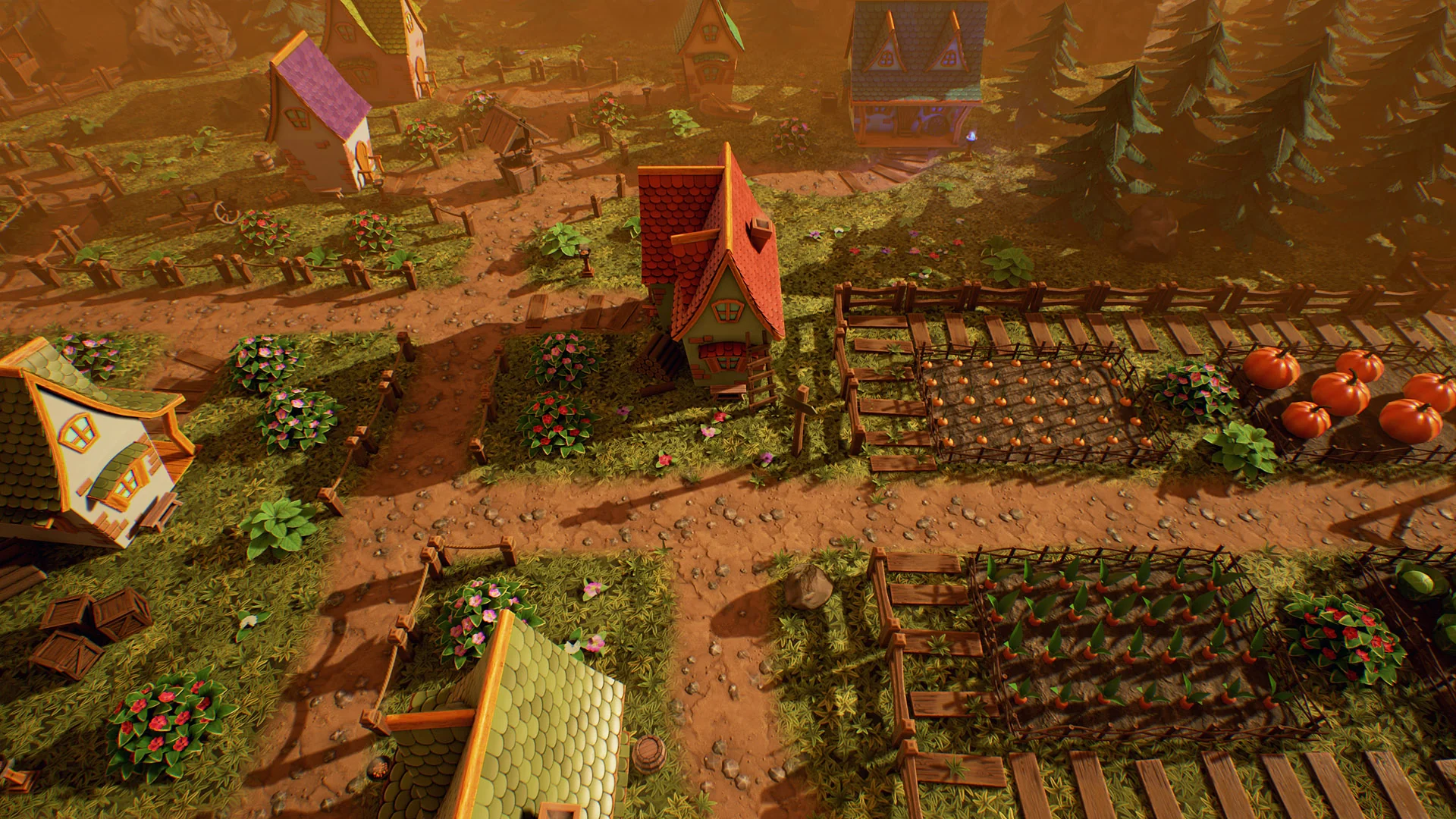
Populating a village requires diversity across both structural assets and incidental clutter. With more than 100 individual objects included for world dressing, environment artists can configure lively scenes without immediate repetition. The structural elements are completely modular, enabling creators to piece together unique cottages, storehouses, workshops, and communal hubs. Placing small decorative objects alongside larger residential structures grounds each building in daily village life, transforming plain clusters of houses into purposeful, lived-in fantasy spaces.
The visual signature throughout the package is shaped by handpainted, cartoon texturing. Rather than leaning into gritty realism or harsh wear, the surfaces emphasize soft charm, saturated clarity, and readable silhouettes. This makes the models immediately readable from various camera distances, whether a project uses an overhead isometric viewpoint, an orbital strategy perspective, or a third-person camera following a player character through narrow village alleys.
Modular Landscapes and Greenwood Environment Dressing
Populating man-made dwellings is only half of the world-building process. A fairytale town cannot exist in a vacuum; it requires rolling hills, pathways, elevation changes, and supporting flora to contextualize the settlement. Greenwood Fantasy Village incorporates a modular landscape system that integrates directly with the architectural set pieces, allowing designers to sculpt the surrounding natural geography alongside the settlement itself.
Because the terrain pieces are modular, creating varied elevations such as terraced farmland, cliffside approaches, riverbanks, or sunken roads requires no external sculpting tools. Developers can assemble ground forms that lead directly into village gateways or wrap gentle slopes around residential perimeters. This modularity ensures that structural pieces settle cleanly onto surfaces rather than clipping awkwardly into irregular geometry.
The package expands this terrain foundation with environment-dressing elements that complete the outdoor scenery. Foliage, landscape accents, and natural props bridge the gap between open wilderness and constructed streets. Particle effects enhance this environment layer further, injecting motion into static scenes. Gentle airborne particles, atmospheric motes, or localized environmental effects reinforce the fantasy theme, giving calm clearings and bustling village lanes a subtle pulse of movement.
Optimization Pipeline: Shared Atlased Textures and Low Tris Counts
Stylized games frequently face performance challenges when dense scenes accumulate dozens of unique materials and draw calls. Greenwood Fantasy Village targets high rendering efficiency through two primary technical decisions: aggressive lowpoly geometry and unified texture atlasing. Every mesh in the package maintains a very low triangle count, stripping away superfluous geometric detail while preserving crisp, expressive cartoon silhouettes.
The efficiency of the geometry is paired with shared atlased textures. Instead of assigning individual texture files and materials to every small barrel, fence post, wall segment, or chimney, the package routes multiple models through consolidated texture atlases. This architectural choice dramatically cuts down the total material count required by a finished scene.
Draw calls drop significantly because the game engine can batch distinct meshes that share a single material.
Texture memory overhead remains minimal, leaving valuable VRAM headroom for gameplay logic, UI systems, and character rigs.
Pipeline management is simplified, as scenes containing dozens of distinct props only reference a consolidated set of texture sheets.
State changes within the graphics pipeline are minimized during scene rendering.
These optimization measures make the entire kit deployable on performance-constrained hardware. Mobile devices, browser-based games, and handheld systems benefit substantially from minimal triangle throughput and unified atlasing, avoiding the frame drops and thermal throttling that heavier asset libraries often cause.
Scaling from Compact Outposts to Sprawling Worlds
Although the name emphasizes a village scope, the modular design allows for broader geographic scaling. The components can establish a small roadside tavern with a handful of outbuildings, or expand into large, multifaceted fantasy realms with distinct districts, outlying agricultural plots, and sprawling wilderness borders.
Level designers can lay out distinct sub-zones within a single map by rearranging the 100-plus prop models and landscape modules. One corner of the map can represent a dense civic center filled with layered buildings, while another zone shifts toward an open woodland outpost or an agrarian valley dotted with scattered sheds and fences. The modular landscape connects these disparate zones smoothly, maintaining thematic consistency from one boundary of the map to the other.
The fairytale aesthetic supports this sense of expansion. Because the cartoon stylization relies on identifiable shapes and clean colors rather than noisy surface micro-details, sprawling scenes remain clean and visually digestible. Players navigating broad vistas or large game boards can identify pathways, landmarks, and interactable points of interest at a glance, eliminating visual clutter even when the screen is populated by dozens of modular pieces.
Target Platforms and Ideal Production Fits
The combination of mobile-first optimization, modular landscape pieces, and fairytale art direction places Greenwood Fantasy Village in a distinct production niche. Projects built for mobile phones and tablets represent the most natural fit, directly benefiting from the low triangle counts and atlased draw-call savings. However, the kit is equally suitable for stylized indie titles on PC or consoles where clean performance and consistent cartoon art direction are essential.
In terms of game genres, the package readily supports:
Casual city builders and settlement-management games that require modular structures and clear visual states.
Top-down, isometric, or action RPGs that need lightweight village hubs and surrounding wilderness zones.
Cozy crafting and farming adventures set in whimsical, fairytale-inspired realms.
Stylized level prototyping where rapid assembly of functional, attractive layouts is needed early in production.
For independent developers, game-jam teams, and small studios producing stylized fantasy games, Greenwood Fantasy Village provides an all-in-one world-building framework. By uniting lowpoly efficiency, complete terrain modularity, and a library of more than 100 stylized objects, it supplies the necessary components to shape everything from a humble woodland clearing to an expansive, storybook kingdom.
 Fantasy
 Fantasy
 Fantasy