"d037b61901c110d2"{"id":"1002669","slug":"greek-island","title":"Greek Island","category":"Historical","engine":"5.0+","assetVersion":"","engineVersion":"Engine Version: 5.0+","tag":"Historical","accent":"blue","visual":"mech","summary":"Build historical and mythical coastal levels with the Greek Island pack for Unreal Engine 5, featuring 130 meshes, modular architecture, and Lumen.","platform":"Unreal Engine","indexPolicy":"index","publishedAt":"2026-11-16T22:18:50.173Z","updatedAt":"2026-11-16T22:18:50.173Z","sourceNotes":[],"fileContents":[],"compatibility":["Unreal Engine","Engine Version: 5.0+"],"featuredImage":{"alt":"Greek Island","src":"/wp-content/uploads/published/2026/11/784ec9db35fa-48d2a0b9-1228-44cd-827f-5eb62a60aa29-6cdfdb8328.webp"},"fileSizeBytes":1118434522,"hasDownloadLink":true,"downloads":0,"terms":[{"taxonomy":"category","slug":"historical","name":"Historical"}],"galleryImages":[{"src":"/wp-content/uploads/published/2026/11/edf96473d826-676021ea-e3e5-4e99-86c9-25f9b50ec8df-e48ff6e6c5.webp","alt":"Greek Island"},{"src":"/wp-content/uploads/published/2026/11/6dbe94340611-6d52eda3-1c44-4591-9655-87d9e22173c7-7b384a0566.webp","alt":"Greek Island"},{"src":"/wp-content/uploads/published/2026/11/b7d759a914e5-0fa7c2aa-c81f-45d9-9d6a-dd9d5be26071-ad410a14a2.webp","alt":"Greek Island"},{"src":"/wp-content/uploads/published/2026/11/06ca9a706848-8afe24ae-1e40-4a4e-a700-13974f59ddff-2deaa98673.webp","alt":"Greek Island"},{"src":"/wp-content/uploads/published/2026/11/69ed45c4b54e-e1f5152a-f090-4111-951e-c71d3eba1394-76a8cc6ce6.webp","alt":"Greek Island"},{"src":"/wp-content/uploads/published/2026/11/67b6b3649284-7fe218ca-7045-4488-a00d-b137a72e233f-eff328d8fb.webp","alt":"Greek Island"},{"src":"/wp-content/uploads/published/2026/11/98a513a4b8f9-fab72124-e546-4b7d-93f7-176470ddec9a-ac1879bdf1.webp","alt":"Greek Island"},{"src":"/wp-content/uploads/published/2026/11/3ade0426e06d-2e7f53cf-78c7-40b3-be29-3744966bc5db-dc7855e070.webp","alt":"Greek Island"},{"src":"/wp-content/uploads/published/2026/11/eed6ec2c23a1-8bf6e761-83ea-49be-a733-5202a7d54308-b976ddafc4.webp","alt":"Greek Island"},{"src":"/wp-content/uploads/published/2026/11/e84ed5dbf2f8-a192dcf7-0f2d-48b0-8625-af93e2533a96-272188422a.webp","alt":"Greek Island"}],"accessPanel":{"kind":"resource","title":"Get this resource","eyebrow":"Free resource","message":"Download this resource in your browser.","fileName":"Content.7z","safetyNote":"Resources are manually reviewed before listing to improve quality and reduce obvious risks.","actionLabel":"Get this resource","resourceType":"Resource archive","versions":[]},"contentHtml":"\u003cp\u003eConstructing believable Mediterranean coastlines, ancient sanctuaries, and seaside villages requires a balanced combination of organic topography and structural masonry. Greek Island provides a comprehensive toolkit of 130 high-quality static meshes built to assemble classical ruins, coastal settlements, and rugged geography within Unreal Engine. Combining foundational building blocks with detailed domestic props, natural terrain formations, ocean elements, and dedicated blueprint placement utilities, the collection serves as a complete foundation for atmospheric island levels, historical adventures, and mythical fantasy settings.\u003c/p\u003e \u003ch2\u003eModular Architecture Across the Greek Island\u003c/h2\u003e\n\u003cp\u003eAt the core of the environment kit is a fully modular architectural system developed to assemble custom temples, stepped pathways, elevated stone courtyards, and residential clusters. Rather than relying solely on fixed, prefabricated buildings, the modular assets allow level designers to freely snap, align, and stack individual components to construct complex architectural layouts that adapt to steep, rocky terrain. Designers can construct everything from expansive ceremonial complexes framed by classical columns to compact village arrangements featuring traditional stone houses.\u003c/p\u003e\n\u003cp\u003eThe structural assets cover broad architectural needs, including foundational slabs, stone stairways, supporting columns, wall sections, and roofing components. Because the pieces are structured through standardized modular boundaries, they connect cleanly to form continuous paved roads, fortified coastal terraces, or multi-level village dwellings nestled into the hillside. Every architectural asset is systematically scaled to the Epic Skeleton. This strict standardization ensures that door frames, interior heights, steps, outdoor terraces, and open-air corridors maintain immediate proportion with standard player characters and third-person camera angles, eliminating the need for manual resizing or post-import scaling adjustments.\u003c/p\u003e \u003ch2\u003eNatural Formations and Ocean Elements on the Island\u003c/h2\u003e\n\u003cp\u003eClassical Mediterranean settlements are inextricably tied to their dramatic maritime geography. Greek Island addresses this by pairing its man-made stone structures with a versatile suite of natural landscape meshes. The library includes steep cliffs, jagged coastal rocks, expansive sand patches, and dynamic water assets that allow level creators to carve out dramatic coastal promontories, secluded coves, and windswept shores overlooking the open sea.\u003c/p\u003e\n\u003cp\u003eWorldbuilding along the waterline is supported by dedicated ocean elements, historical ship models, and aquatic life, including sharks. Creators can use these assets to build lively coastal anchorages, establish reef-strewn shallows, or place isolated shipwrecks beside exposed reefs. The contrasting physical properties of fine sand surfaces and dark, weathered cliff faces facilitate natural vertical transitions. Level designers can seamlessly guide the player journey from sea level, across sandy beaches, along sheer stone cliff edges, and upward along winding stone pathways toward elevated temple terraces.\u003c/p\u003e \u003ch2\u003eClassical Set Dressing from Village Houses to Mythic Ruins\u003c/h2\u003e\n\u003cp\u003eA convincing environment relies heavily on detailed prop dressing to communicate history, habitation, and cultural context. Greek Island includes an assortment of thematic props designed to enrich both domestic everyday scenes and grand mythological locales. Residential settings can be outfitted with domestic pottery, clay dishes, ceramic vases, and traditional village accessories, giving life to rustic kitchens, shaded porticos, exterior yards, and portside trade stations.\u003c/p\u003e\n\u003cp\u003eTo support historical recreations and mythical fantasy narratives, the pack provides dedicated temple ruins and fragmented architectural masonry evoking the presence of Zeus and ancient mythology. Weathered architraves, cracked pediments, tumbled pillar drums, and sacred stone fragments can be distributed across grassy hillsides or assembled into crumbling sanctuaries that have withstood centuries of exposure. Combining intact modular components with damaged ruin meshes makes it simple to establish contrasting states of preservation, whether designing an active historical village or a long-abandoned coastal shrine reclaimed by coastal winds and vegetation.\u003c/p\u003e \u003ch2\u003eSpline-Driven Blueprints and Decals for Greek Island Layouts\u003c/h2\u003e\n\u003cp\u003eTo accelerate level assembly and eliminate repetitive placement tasks, the package integrates blueprint-driven fence utilities. Operating on a spline-based placement workflow, these blueprints allow artists to draw continuous fence lines across uneven, sloping island terrain with minimal effort. Instead of individually positioning, rotating, and aligning dozens of separate boundary segments, creators can simply manipulate spline points to follow the natural contours of rocky hillsides, delineate village property lines, or wall off sheer cliff drop-offs with continuous, correctly joined barriers.\u003c/p\u003e\n\u003cp\u003eSurface realism is further elevated through a specialized library of detail decals. While modular stonework provides clean geometric forms, the included decals introduce authentic signs of age, wear, and physical history. Artists can project surface cracks, accumulated dirt, grime, and ancient markings directly over structural walls, paved pathways, and natural stone faces. Strategically applying these decals across modular seams breaks repetitive tiling patterns and lends freshly placed stonework the seasoned appearance of an ancient Mediterranean settlement battered by salty air, storms, and centuries of foot traffic.\u003c/p\u003e \u003ch2\u003eLumen Configuration and Optimization in Unreal Engine 5\u003c/h2\u003e\n\u003cp\u003eGreek Island is engineered specifically for Unreal Engine 5.0 and newer versions, taking full advantage of modern real-time rendering pipelines. The environment is configured to utilize Lumen for dynamic global illumination and high-fidelity indirect lighting. To achieve the intended visual fidelity, users must ensure that both Global Illumination and Distance Fields are enabled within project project settings. With these settings active, direct sunlight casts sharp, believable shadows against limestone walls, while bounced light softly illuminates covered colonnades, interior house corners, and shaded cavernous cliff crevices.\u003c/p\u003e\n\u003cp\u003eAlongside its high visual standard, the package is built with real-time performance and gameplay stability in mind. All 130 static meshes include pre-configured levels of detail (LODs), which automatically step down geometric complexity at increasing distances from the player camera to maintain high frame rates across large open vistas. Accurate collision meshes are integrated directly into all structural, prop, and rock assets, ensuring smooth character navigation without snagging or clipping along jagged cliffs and stone steps. Proper lightmap unwrap channels are also included on all meshes, providing flexibility for projects utilizing baked lighting scenarios alongside dynamic Lumen setups. The package then offers a fully optimized, production-ready asset framework suited for realistic historical adventures, mythological storytelling, and immersive coastal exploration.\u003c/p\u003e\n\n\u003ch2\u003eMore From The Same Workflow\u003c/h2\u003e\n\u003cul\u003e\n\u003cli\u003e\u003ca href=\"https://3dcghub.com/stylized-greek-island-stylized-greek-island-greek-island-island-low-poly-3d/\" rel=\"noopener noreferrer\"\u003eStylized Greek Island ( Stylized Greek Island Greek Island Island Low Poly 3D )\u003c/a\u003e\u003c/li\u003e\n\u003cli\u003e\u003ca href=\"https://3dcghub.com/neptune-s-roman-bath-roman-roman-baths-neptune-roman-medieval-greek-bath-3d/\" rel=\"noopener noreferrer\"\u003eNeptune\u0026#039;s Roman Bath ( Roman Roman Baths Neptune Roman Medieval Greek Bath 3D )\u003c/a\u003e\u003c/li\u003e\n\u003cli\u003e\u003ca href=\"https://3dcghub.com/roman-volcanic-temple-ancient-medieval-village-greek-buildings-city-street/\" rel=\"noopener noreferrer\"\u003eRoman Volcanic Temple ( Ancient Medieval Village Greek Buildings City Street )\u003c/a\u003e\u003c/li\u003e\n\u003cli\u003e\u003ca href=\"https://3dcghub.com/polygon-ancient-empire/\" rel=\"noopener noreferrer\"\u003ePOLYGON - Ancient Empire\u003c/a\u003e\u003c/li\u003e\n\u003cli\u003e\u003ca href=\"https://3dcghub.com/roman-street-environment-roman-street-street-ancient-historical-vintage-3d/\" rel=\"noopener noreferrer\"\u003eRoman Street Environment ( Roman Street Street Ancient Historical Vintage 3D )\u003c/a\u003e\u003c/li\u003e\n\u003c/ul\u003e","contentTextLength":7582,"navigation":{"current":20,"total":4611,"previous":{"id":"1002670","slug":"greenwood-fantasy-village","title":"Greenwood Fantasy Village","category":"Fantasy","platform":"Unreal Engine","updatedAt":"2026-11-16T22:20:45.576Z"},"next":{"id":"1002668","slug":"gaea","title":"Gaea","category":"Forest \u0026 Jungle","platform":"Unreal Engine","updatedAt":"2026-11-16T22:17:58.625Z"}},"relatedResources":[{"id":"1001606","slug":"stylized-greek-island-stylized-greek-island-greek-island-island-low-poly-3d","title":"Stylized Greek Island ( Stylized Greek Island Greek Island Island Low Poly 3D )","category":"Historical","engine":"4.26+,5.0+","assetVersion":"","engineVersion":"Engine Version: 4.26+,5.0+","tag":"Historical","accent":"blue","visual":"mech","summary":"Build stylized Mediterranean coastal scenes using 90 game-ready assets, material instance parameters, included example levels, and modular tool support.","platform":"Unreal Engine","indexPolicy":"index","publishedAt":"2026-10-10T16:30:55.700Z","updatedAt":"2026-10-10T16:30:55.700Z","sourceNotes":[],"fileContents":[],"compatibility":["Unreal Engine","Engine Version: 4.26+,5.0+"],"featuredImage":{"alt":"Stylized Greek Island ( Stylized Greek Island Greek Island Island Low Poly 3D )","src":"/wp-content/uploads/published/2026/10/077d910da793-b73b81f6-d368-446b-8032-c0f258daa327-c5dfab581c.webp"},"fileSizeBytes":916031923,"hasDownloadLink":true,"downloads":1},{"id":"1001062","slug":"neptune-s-roman-bath-roman-roman-baths-neptune-roman-medieval-greek-bath-3d","title":"Neptune's Roman Bath ( Roman Roman Baths Neptune Roman Medieval Greek Bath 3D )","category":"Historical","engine":"5.1+","assetVersion":"","engineVersion":"Engine Version: 5.1+","tag":"Historical","accent":"blue","visual":"mech","summary":"Neptune's Roman Bath adds 82 unique Unreal environment meshes for Roman bathhouse levels plus ULAT modular tool. Foliage and fire effects are external.","platform":"Unreal Engine","indexPolicy":"index","publishedAt":"2026-09-03T13:12:39.407Z","updatedAt":"2026-09-03T13:12:39.407Z","sourceNotes":[],"fileContents":[],"compatibility":["Unreal Engine","Engine Version: 5.1+"],"featuredImage":{"alt":"Neptune's Roman Bath ( Roman Roman Baths Neptune Roman Medieval Greek Bath 3D )","src":"/wp-content/uploads/published/2026/09/dcfd2defe710-3426baa8-5e69-4fce-bd53-9fc7d1829fe1-4c82150a40.webp"},"fileSizeBytes":1147201539,"hasDownloadLink":true,"downloads":0},{"id":"8425","slug":"roman-volcanic-temple-ancient-medieval-village-greek-buildings-city-street","title":"Roman Volcanic Temple ( Ancient Medieval Village Greek Buildings City Street )","category":"Historical","engine":"5.0+","assetVersion":"Engine version: 5.0+","engineVersion":"5.0","tag":"Historical","accent":"blue","visual":"city","summary":"Create breathtaking historical landscapes with this professional environment pack. Featuring 178 unique meshes and advanced modular tools, it is perfectly optimized for modern game engines.","platform":"Unreal Engine","indexPolicy":"noindex","publishedAt":"2026-02-23T17:15:27.000Z","updatedAt":"2026-04-19T15:55:27.000Z","sourceNotes":[],"fileContents":[],"compatibility":["Unreal Engine","Engine version: 5.0+"],"featuredImage":{"alt":"Roman Volcanic Temple ( Ancient Medieval Village Greek Buildings City Street )","src":"https://3dcghub.com/wp-content/uploads/2026/02/8467189c-8385-4dbb-8cdb-da000bb759bb.webp"},"fileSizeBytes":1528000905,"hasDownloadLink":true,"downloads":0}]}
Resource screenshots
1 / 10
Historical
Greek Island
Build historical and mythical coastal levels with the Greek Island pack for Unreal Engine 5, featuring 130 meshes, modular architecture, and Lumen.
Constructing believable Mediterranean coastlines, ancient sanctuaries, and seaside villages requires a balanced combination of organic topography and structural masonry. Greek Island provides a comprehensive toolkit of 130 high-quality static meshes built to assemble classical ruins, coastal settlements, and rugged geography within Unreal Engine. Combining foundational building blocks with detailed domestic props, natural terrain formations, ocean elements, and dedicated blueprint placement utilities, the collection serves as a complete foundation for atmospheric island levels, historical adventures, and mythical fantasy settings.
Modular Architecture Across the Greek Island
At the core of the environment kit is a fully modular architectural system developed to assemble custom temples, stepped pathways, elevated stone courtyards, and residential clusters. Rather than relying solely on fixed, prefabricated buildings, the modular assets allow level designers to freely snap, align, and stack individual components to construct complex architectural layouts that adapt to steep, rocky terrain. Designers can construct everything from expansive ceremonial complexes framed by classical columns to compact village arrangements featuring traditional stone houses.
The structural assets cover broad architectural needs, including foundational slabs, stone stairways, supporting columns, wall sections, and roofing components. Because the pieces are structured through standardized modular boundaries, they connect cleanly to form continuous paved roads, fortified coastal terraces, or multi-level village dwellings nestled into the hillside. Every architectural asset is systematically scaled to the Epic Skeleton. This strict standardization ensures that door frames, interior heights, steps, outdoor terraces, and open-air corridors maintain immediate proportion with standard player characters and third-person camera angles, eliminating the need for manual resizing or post-import scaling adjustments.
Natural Formations and Ocean Elements on the Island
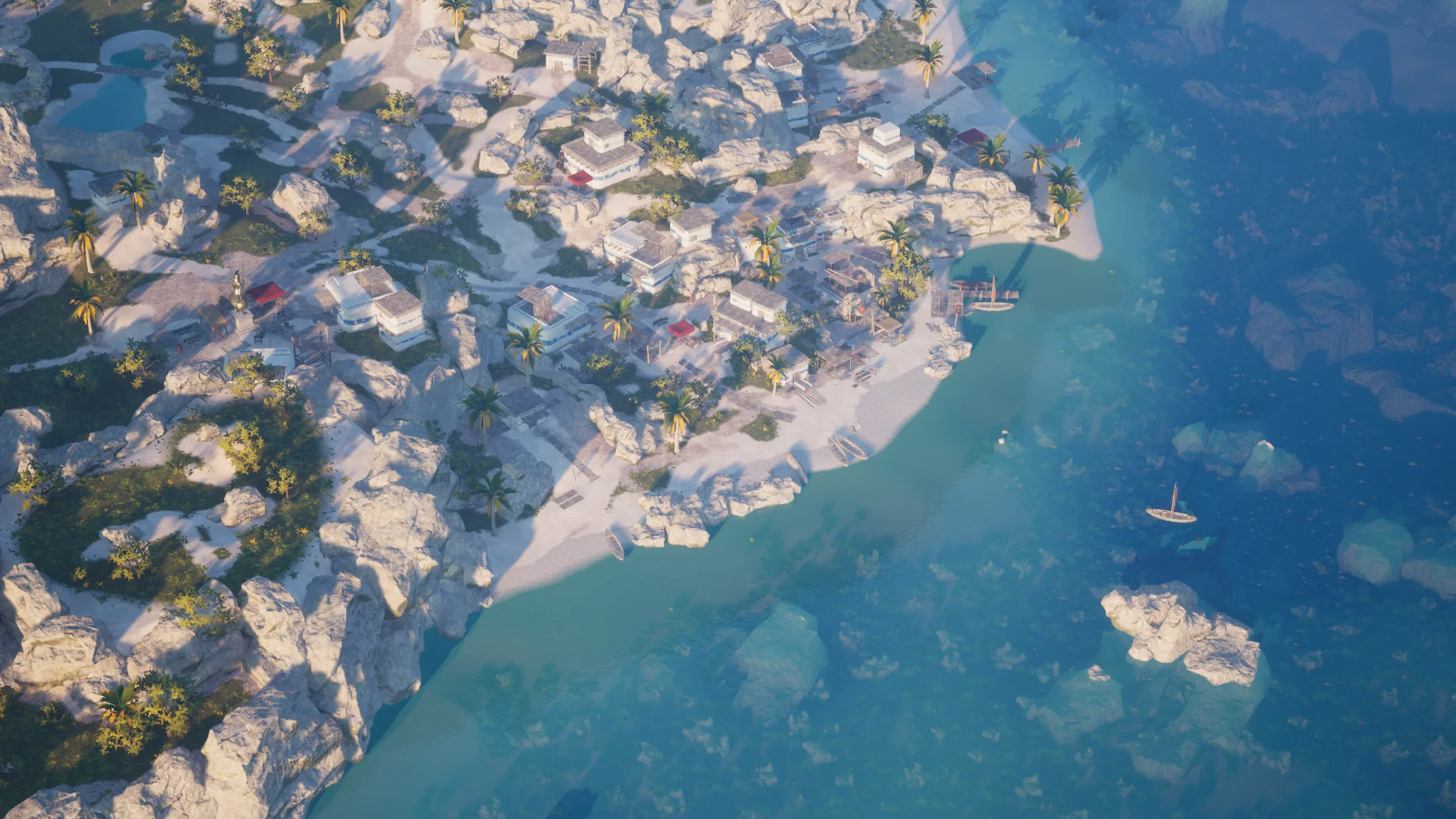
Classical Mediterranean settlements are inextricably tied to their dramatic maritime geography. Greek Island addresses this by pairing its man-made stone structures with a versatile suite of natural landscape meshes. The library includes steep cliffs, jagged coastal rocks, expansive sand patches, and dynamic water assets that allow level creators to carve out dramatic coastal promontories, secluded coves, and windswept shores overlooking the open sea.
Worldbuilding along the waterline is supported by dedicated ocean elements, historical ship models, and aquatic life, including sharks. Creators can use these assets to build lively coastal anchorages, establish reef-strewn shallows, or place isolated shipwrecks beside exposed reefs. The contrasting physical properties of fine sand surfaces and dark, weathered cliff faces facilitate natural vertical transitions. Level designers can seamlessly guide the player journey from sea level, across sandy beaches, along sheer stone cliff edges, and upward along winding stone pathways toward elevated temple terraces.
Classical Set Dressing from Village Houses to Mythic Ruins
A convincing environment relies heavily on detailed prop dressing to communicate history, habitation, and cultural context. Greek Island includes an assortment of thematic props designed to enrich both domestic everyday scenes and grand mythological locales. Residential settings can be outfitted with domestic pottery, clay dishes, ceramic vases, and traditional village accessories, giving life to rustic kitchens, shaded porticos, exterior yards, and portside trade stations.
To support historical recreations and mythical fantasy narratives, the pack provides dedicated temple ruins and fragmented architectural masonry evoking the presence of Zeus and ancient mythology. Weathered architraves, cracked pediments, tumbled pillar drums, and sacred stone fragments can be distributed across grassy hillsides or assembled into crumbling sanctuaries that have withstood centuries of exposure. Combining intact modular components with damaged ruin meshes makes it simple to establish contrasting states of preservation, whether designing an active historical village or a long-abandoned coastal shrine reclaimed by coastal winds and vegetation.
Spline-Driven Blueprints and Decals for Greek Island Layouts
To accelerate level assembly and eliminate repetitive placement tasks, the package integrates blueprint-driven fence utilities. Operating on a spline-based placement workflow, these blueprints allow artists to draw continuous fence lines across uneven, sloping island terrain with minimal effort. Instead of individually positioning, rotating, and aligning dozens of separate boundary segments, creators can simply manipulate spline points to follow the natural contours of rocky hillsides, delineate village property lines, or wall off sheer cliff drop-offs with continuous, correctly joined barriers.
Surface realism is further elevated through a specialized library of detail decals. While modular stonework provides clean geometric forms, the included decals introduce authentic signs of age, wear, and physical history. Artists can project surface cracks, accumulated dirt, grime, and ancient markings directly over structural walls, paved pathways, and natural stone faces. Strategically applying these decals across modular seams breaks repetitive tiling patterns and lends freshly placed stonework the seasoned appearance of an ancient Mediterranean settlement battered by salty air, storms, and centuries of foot traffic.
Lumen Configuration and Optimization in Unreal Engine 5
Greek Island is engineered specifically for Unreal Engine 5.0 and newer versions, taking full advantage of modern real-time rendering pipelines. The environment is configured to utilize Lumen for dynamic global illumination and high-fidelity indirect lighting. To achieve the intended visual fidelity, users must ensure that both Global Illumination and Distance Fields are enabled within project project settings. With these settings active, direct sunlight casts sharp, believable shadows against limestone walls, while bounced light softly illuminates covered colonnades, interior house corners, and shaded cavernous cliff crevices.
Alongside its high visual standard, the package is built with real-time performance and gameplay stability in mind. All 130 static meshes include pre-configured levels of detail (LODs), which automatically step down geometric complexity at increasing distances from the player camera to maintain high frame rates across large open vistas. Accurate collision meshes are integrated directly into all structural, prop, and rock assets, ensuring smooth character navigation without snagging or clipping along jagged cliffs and stone steps. Proper lightmap unwrap channels are also included on all meshes, providing flexibility for projects utilizing baked lighting scenarios alongside dynamic Lumen setups. The package then offers a fully optimized, production-ready asset framework suited for realistic historical adventures, mythological storytelling, and immersive coastal exploration.
 Historical
 Historical
 Historical