"a5ffaf404b9c2b7e"{"id":"1002631","slug":"goblin-warrior-modular","title":"Goblin warrior. Modular","category":"Characters \u0026 Creatures","engine":"5.0+","assetVersion":"","engineVersion":"Engine Version: 5.0+","tag":"Characters","accent":"blue","visual":"character","summary":"Explore setup, rigging integration, and modular customization for the stylized lowpoly Goblin warrior creature with multiple armor, weapon, and shield setups.","platform":"Unreal Engine","indexPolicy":"index","publishedAt":"2026-11-15T06:10:53.171Z","updatedAt":"2026-11-15T06:10:53.171Z","sourceNotes":[],"fileContents":[],"compatibility":["Unreal Engine","Engine Version: 5.0+"],"featuredImage":{"alt":"Goblin warrior. Modular","src":"/wp-content/uploads/published/2026/11/4c6b42c75688-563ce833-aa6d-4802-9c83-cc68f20c4b86-a293b7e2aa.webp"},"hasDownloadLink":true,"downloads":0,"terms":[{"taxonomy":"category","slug":"characters-and-creatures","name":"Characters \u0026 Creatures"}],"galleryImages":[{"src":"/wp-content/uploads/published/2026/11/a9ec71236f3c-936a7fa4-6508-455c-b3f0-bc15b3f486dc-c0a346ddfc.webp","alt":"Goblin warrior. Modular"},{"src":"/wp-content/uploads/published/2026/11/a901b8386798-b446db6c-8dea-4045-a987-bb3b04febe9b-b12cfd25a5.webp","alt":"Goblin warrior. Modular"},{"src":"/wp-content/uploads/published/2026/11/7703f0c9cd4a-47fcc019-ff2d-4448-a14f-626423b78224-1ff2d609d1.webp","alt":"Goblin warrior. Modular"},{"src":"/wp-content/uploads/published/2026/11/037627a6c4d1-e270ccbc-ee13-4dba-9e4b-bf6434eb2fbc-91d7b53cc2.webp","alt":"Goblin warrior. Modular"},{"src":"/wp-content/uploads/published/2026/11/f2da3da61e94-5866c4b5-f038-4871-a746-7acd7fca416a-8fb18c8bd3.webp","alt":"Goblin warrior. Modular"},{"src":"/wp-content/uploads/published/2026/11/72c0850a541b-55f86625-158b-4f0c-924d-5deb190d68eb-7c3c352d9b.webp","alt":"Goblin warrior. Modular"},{"src":"/wp-content/uploads/published/2026/11/20c732cd5676-1fc2560c-45d0-47f9-b70d-522d58c32333-2bf98ea341.webp","alt":"Goblin warrior. Modular"},{"src":"/wp-content/uploads/published/2026/11/029902e2ae16-c47df284-7cbb-4893-b271-c5b6bd2607f9-613cabf838.webp","alt":"Goblin warrior. Modular"},{"src":"/wp-content/uploads/published/2026/11/0110429cad99-d8841dce-df6a-4750-985a-992a816a3965-72a4de8aeb.webp","alt":"Goblin warrior. Modular"}],"accessPanel":{"kind":"resource","title":"Get this resource","eyebrow":"Free resource","message":"Download this resource in your browser.","fileName":"Content.7z","safetyNote":"Resources are manually reviewed before listing to improve quality and reduce obvious risks.","actionLabel":"Get this resource","resourceType":"Resource archive","versions":[]},"contentHtml":"\u003ch2\u003eEncounter Scenarios for the Goblin Warrior\u003c/h2\u003e\u003cp\u003eStylized fantasy dungeons, forest ambushes, and fortified encampments frequently demand hostile enemy mobs that do not look completely identical. When populating an encounter zone with creatures, using a single static model quickly leads to noticeable repetition across the battlefield. The Goblin warrior modular character directly addresses this production hurdle by providing interchangeable equipment options that allow a single base creature to fill multiple tactical tiers within an encounter.\u003c/p\u003e\u003cp\u003eIn a typical action RPG or dungeon crawler scenario, combat encounters rely on immediate visual communication. Players must recognize whether an approaching creature is a fragile scout, a heavily armored vanguard, or a backline spellcaster. Because this stylized creature model encompasses tags ranging from heavy warrior to mage and wizard, encounter designers can stage cohesive raiding parties where every combatant shares the same visual language while displaying distinct battlefield responsibilities.\u003c/p\u003e\u003ch2\u003eModular Equipment Combinations for Goblin Combat Classes\u003c/h2\u003e\u003cp\u003eThe package provides a defined set of modular components: six armor options, four weapons, and three shields. These assets enable systematic variation across enemy ranks without requiring separate character rigs for each unit type. By combining these modular pieces, technical artists can construct distinct visual profiles for different gameplay functions.\u003c/p\u003e\u003ch3\u003eFrontline Swordsmen and Shield Bearers\u003c/h3\u003e\u003cp\u003ePairing one of the four available weapons—such as a sword—with one of the three shields establishes a classic frontline infantry archetype. The shield choices provide tangible silhouettes for blocking states, parry mechanics, and defensive shield-wall behaviors. By rotating through the six armor components, developers can assemble light, medium, and heavy infantry variants. A baseline skirmisher might carry only a sword and minimal armor, whereas an elite guard can be outfitted with heavy plating and a bulky shield to signal higher damage resistance and poised defense.\u003c/p\u003e\u003ch3\u003eHeavy Bruisers and Unshielded Shock Troops\u003c/h3\u003e\u003cp\u003eOmitting the shield entirely and outfitting the goblin character with aggressive armor combinations produces dedicated shock units. These builds focus the visual weight on the armor itself, reinforcing the heavy tag associated with the asset. In gameplay, such combinations naturally represent aggressive damage dealers that forego blocking in favor of fast swings or uninterruptible heavy attacks.\u003c/p\u003e\u003ch3\u003eWizards, Mages, and Magical Threat Profiles\u003c/h3\u003e\u003cp\u003eWith verified support for magic, mage, and wizard themes, the equipment pool allows for arcane unit variants alongside standard melee fighters. Equipping the goblin with lighter armor combinations or selective pieces lets developers visually differentiate spellcasters from frontline brawlers. Assigning magical attack animations to weapon-wielding variants turns the character into a battle-mage or backline summoner, keeping the visual consistency of the goblin tribe while diversifying the mechanical threats faced by the player.\u003c/p\u003e\u003ch2\u003eEpic Skeleton Alignment and Skeletal Mesh Implementation\u003c/h2\u003e\u003cp\u003eA critical technical facet of this character package is its preview integration with the standard Epic Skeleton hierarchy. Using an established skeletal structure streamlines the technical setup required to bring the lowpoly creature into an active game environment.\u003c/p\u003e\u003cp\u003eBecause the creature aligns with the Epic Skeleton, developers can leverage existing animation libraries structured through standard humanoid bone naming conventions and hierarchies. Locomotion loops, sprint cycles, hit reactions, staggered states, and directional deaths can be shared directly across goblin variants. This compatibility drastically reduces the production overhead of rigging custom creature skeletons from scratch and allows rapid prototyping of attack combos, whether the goblin is slashing with a sword, raising a shield, or channeling magic.\u003c/p\u003e\u003cp\u003eImplementing the modular armor and equipment pieces typically follows one of two standard real-time workflows:\u003c/p\u003e\u003cul\u003e\u003cli\u003e\u003cstrong\u003eSocket Attachment:\u003c/strong\u003e Handheld equipment, including the four weapons and three shields, attach directly to designated weapon sockets placed on the right and left hand bones of the Epic Skeleton. This approach allows dynamic sheathing, disarming, and weapon swapping during live combat loops.\u003c/li\u003e\u003cli\u003e\u003cstrong\u003eModular Mesh Merging or Master Pose:\u003c/strong\u003e The six armor parts can be driven via a shared skeleton system, where each armor piece is skinned to the same joint hierarchy as the base goblin body. This structure prevents clipping during extreme poses and ensures that heavy shoulder guards, chest pieces, or leg armor deform naturally during combat maneuvers.\u003c/li\u003e\u003c/ul\u003e\u003ch2\u003eLowpoly Styling and Visual Consistency in Real-Time Engines\u003c/h2\u003e\u003cp\u003eBuilt with a stylized aesthetic, the Goblin warrior package prioritizes bold shapes, readable contours, and clean silhouettes. The lowpoly construction ensures that scenes featuring numerous goblins remain performant, even when multiple squads clash on screen at once. Low-polygon meshes reduce draw-call strain and memory footprint, making the character suitable for games targeting platforms with strict hardware budgets or dense enemy counts.\u003c/p\u003e\u003cp\u003ePreviewed via turntable presentations and interactive 3D viewers such as Sketchfab and YouTube, the model demonstrates consistent proportions and texturing across every angle. The stylized texturing technique emphasizes exaggerated creature features—expressive facial structures, long ears, and rugged gear detailing—that remain legible when viewed from top-down isometric perspectives as well as third-person over-the-shoulder cameras.\u003c/p\u003e\u003ch2\u003ePipeline Suitability for Independent and Mid-Scale Studios\u003c/h2\u003e\u003cp\u003eSolo developers, small studios, and technical gameplay designers constructing fantasy action games gain the most utility from this asset. Teams building combat prototypes need ready-to-animate enemies that conform to industry-standard skeletal rigs without requiring extensive cleanup. Because the asset supplies modular armor, multiple weapons, shields, and compatibility with the Epic Skeleton, it serves as an efficient foundation for populating goblin tribes, dungeon encounters, and horde-style defense waves.\u003c/p\u003e\n\n\u003ch2\u003eExplore Similar Assets\u003c/h2\u003e\n\u003cul\u003e\n\u003cli\u003e\u003ca href=\"https://3dcghub.com/warrior/\" rel=\"noopener noreferrer\"\u003eWarrior\u003c/a\u003e\u003c/li\u003e\n\u003cli\u003e\u003ca href=\"https://3dcghub.com/warrior-maiden/\" rel=\"noopener noreferrer\"\u003eWarrior Maiden\u003c/a\u003e\u003c/li\u003e\n\u003cli\u003e\u003ca href=\"https://3dcghub.com/f3-warrior-girl-scarlett/\" rel=\"noopener noreferrer\"\u003eF3 Warrior Girl Scarlett\u003c/a\u003e\u003c/li\u003e\n\u003cli\u003e\u003ca href=\"https://3dcghub.com/gladiator-warrior/\" rel=\"noopener noreferrer\"\u003eGladiator Warrior\u003c/a\u003e\u003c/li\u003e\n\u003cli\u003e\u003ca href=\"https://3dcghub.com/warrior-hero/\" rel=\"noopener noreferrer\"\u003eWarrior Hero\u003c/a\u003e\u003c/li\u003e\n\u003c/ul\u003e","contentTextLength":6355,"navigation":{"current":17,"total":4570,"previous":{"id":"1002632","slug":"grocery-store-props-collection","title":"Grocery store props collection","category":"Environments","platform":"Unreal Engine","updatedAt":"2026-11-15T06:19:13.102Z"},"next":{"id":"1002630","slug":"fences-vol-2-farm-and-town-modular-nanite-and-low-poly","title":"Fences VOL.2 - Farm and Town Modular (Nanite and Low Poly)","category":"Railings \u0026 Fences","platform":"Unreal Engine","updatedAt":"2026-11-15T06:09:57.419Z"}},"relatedResources":[{"id":"1002609","slug":"warrior","title":"Warrior","category":"Characters \u0026 Creatures","engine":"5.0+","assetVersion":"","engineVersion":"Engine Version: 5.0+","tag":"Characters","accent":"blue","visual":"character","summary":"Technical analysis of the Warrior character asset, featuring Epic Skeleton IK rigging, 47,554 vertices, 43 animations, and PBR textures for UE4 and UE5.","platform":"Unreal Engine","indexPolicy":"index","publishedAt":"2026-11-14T06:08:11.574Z","updatedAt":"2026-11-14T06:08:11.574Z","sourceNotes":[],"fileContents":[],"compatibility":["Unreal Engine","Engine Version: 5.0+"],"featuredImage":{"alt":"Warrior","src":"/wp-content/uploads/published/2026/11/5e217024f3b8-34038cd4-4e74-42de-997a-b7cd541109da-e2f859c8e2.webp"},"hasDownloadLink":true,"downloads":0},{"id":"1002566","slug":"warrior-maiden","title":"Warrior Maiden","category":"Characters \u0026 Creatures","engine":"5.0+","assetVersion":"","engineVersion":"Engine Version: 5.0+","tag":"Characters","accent":"blue","visual":"character","summary":"Examine the Warrior Maiden low-poly realistic female character, featuring 17 combat animations, two skins, 4K textures, and 61k triangles for RPGs.","platform":"Unreal Engine","indexPolicy":"index","publishedAt":"2026-11-13T12:12:45.731Z","updatedAt":"2026-11-13T12:12:45.731Z","sourceNotes":[],"fileContents":[],"compatibility":["Unreal Engine","Engine Version: 5.0+"],"featuredImage":{"alt":"Warrior Maiden","src":"/wp-content/uploads/published/2026/11/b6da87ab81a4-d5c22ae6-d182-4183-9df3-22e3a38df8ee-0296ddbbc8.webp"},"hasDownloadLink":true,"downloads":0},{"id":"1001804","slug":"f3-warrior-girl-scarlett","title":"F3 Warrior Girl Scarlett","category":"Characters \u0026 Creatures","engine":"5.1+","assetVersion":"","engineVersion":"Engine Version: 5.1+","tag":"Characters","accent":"blue","visual":"character","summary":"Explore F3 Warrior Girl Scarlett for UE5, featuring modular parts, Epic Skeleton rigging, ARkit blendshapes, and Xandra Character Creator support.","platform":"Unreal Engine","indexPolicy":"index","publishedAt":"2026-10-21T07:55:59.371Z","updatedAt":"2026-10-21T07:55:59.371Z","sourceNotes":[],"fileContents":[],"compatibility":["Unreal Engine","Engine Version: 5.1+"],"featuredImage":{"alt":"F3 Warrior Girl Scarlett","src":"/wp-content/uploads/published/2026/10/3ff4a3d9c180-93e6847a-6539-400c-b282-f7230a72232c-bc82cfec5c.webp"},"hasDownloadLink":true,"downloads":1}]}
Characters
Goblin warrior. Modular
Explore setup, rigging integration, and modular customization for the stylized lowpoly Goblin warrior creature with multiple armor, weapon, and shield setups.
Stylized fantasy dungeons, forest ambushes, and fortified encampments frequently demand hostile enemy mobs that do not look completely identical. When populating an encounter zone with creatures, using a single static model quickly leads to noticeable repetition across the battlefield. The Goblin warrior modular character directly addresses this production hurdle by providing interchangeable equipment options that allow a single base creature to fill multiple tactical tiers within an encounter.
In a typical action RPG or dungeon crawler scenario, combat encounters rely on immediate visual communication. Players must recognize whether an approaching creature is a fragile scout, a heavily armored vanguard, or a backline spellcaster. Because this stylized creature model encompasses tags ranging from heavy warrior to mage and wizard, encounter designers can stage cohesive raiding parties where every combatant shares the same visual language while displaying distinct battlefield responsibilities.
Modular Equipment Combinations for Goblin Combat Classes
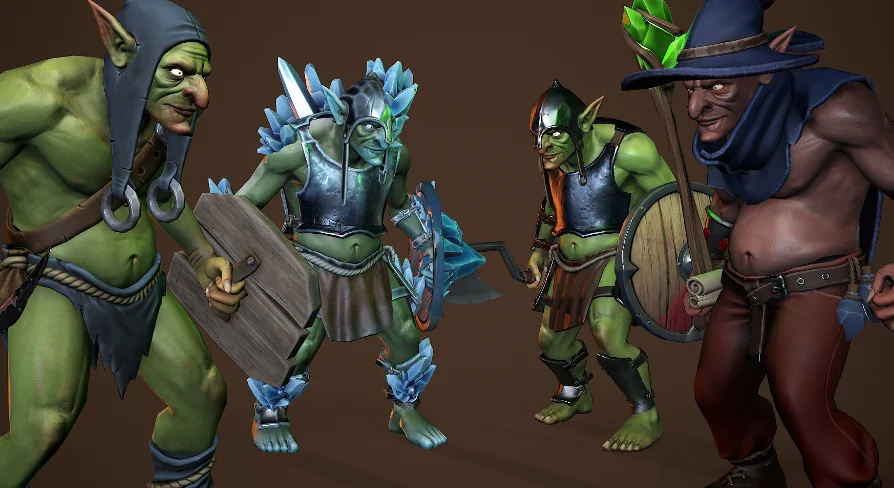
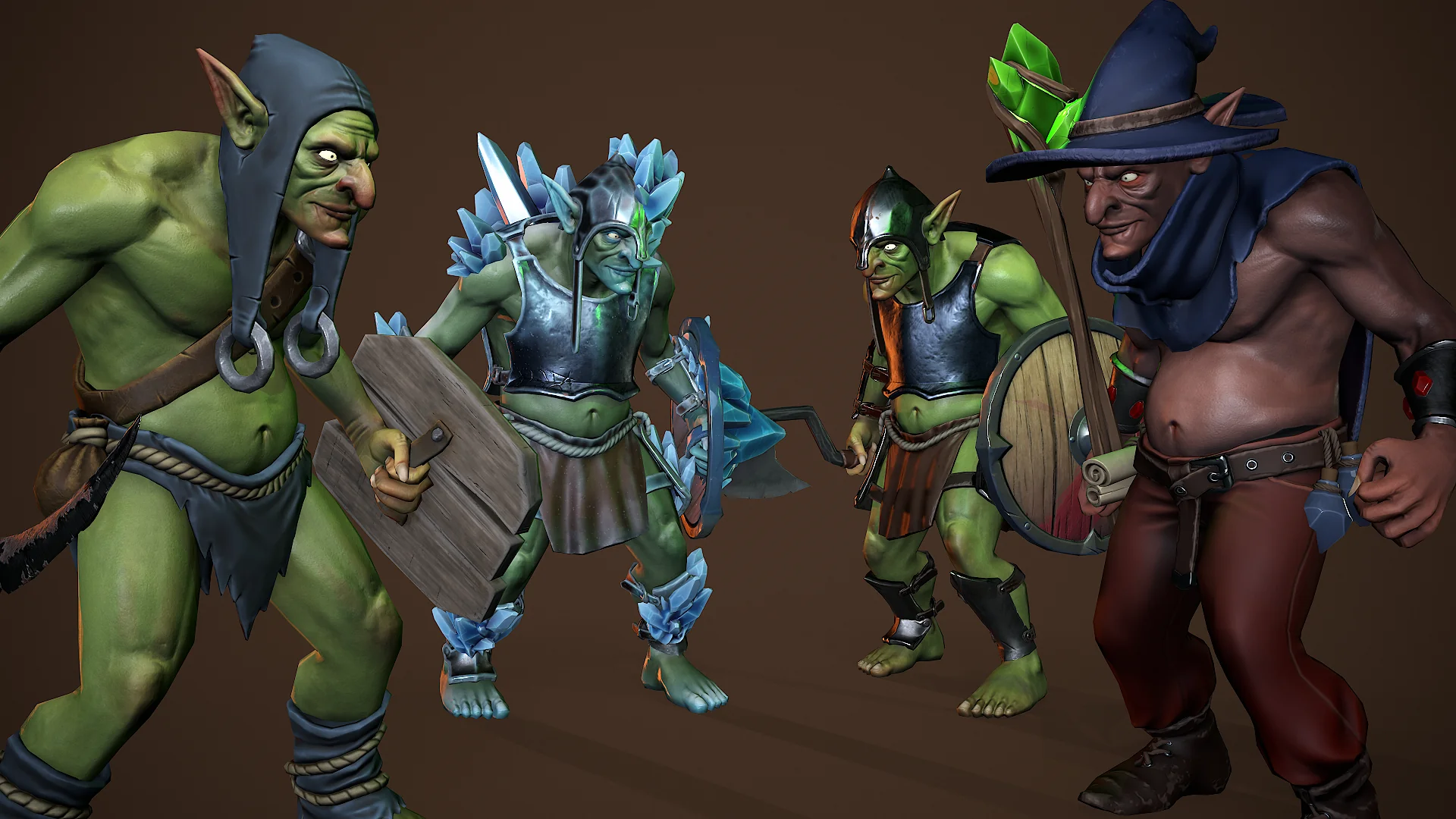
The package provides a defined set of modular components: six armor options, four weapons, and three shields. These assets enable systematic variation across enemy ranks without requiring separate character rigs for each unit type. By combining these modular pieces, technical artists can construct distinct visual profiles for different gameplay functions.
Frontline Swordsmen and Shield Bearers
Pairing one of the four available weapons—such as a sword—with one of the three shields establishes a classic frontline infantry archetype. The shield choices provide tangible silhouettes for blocking states, parry mechanics, and defensive shield-wall behaviors. By rotating through the six armor components, developers can assemble light, medium, and heavy infantry variants. A baseline skirmisher might carry only a sword and minimal armor, whereas an elite guard can be outfitted with heavy plating and a bulky shield to signal higher damage resistance and poised defense.
Heavy Bruisers and Unshielded Shock Troops
Omitting the shield entirely and outfitting the goblin character with aggressive armor combinations produces dedicated shock units. These builds focus the visual weight on the armor itself, reinforcing the heavy tag associated with the asset. In gameplay, such combinations naturally represent aggressive damage dealers that forego blocking in favor of fast swings or uninterruptible heavy attacks.
Wizards, Mages, and Magical Threat Profiles
With verified support for magic, mage, and wizard themes, the equipment pool allows for arcane unit variants alongside standard melee fighters. Equipping the goblin with lighter armor combinations or selective pieces lets developers visually differentiate spellcasters from frontline brawlers. Assigning magical attack animations to weapon-wielding variants turns the character into a battle-mage or backline summoner, keeping the visual consistency of the goblin tribe while diversifying the mechanical threats faced by the player.
Epic Skeleton Alignment and Skeletal Mesh Implementation
A critical technical facet of this character package is its preview integration with the standard Epic Skeleton hierarchy. Using an established skeletal structure streamlines the technical setup required to bring the lowpoly creature into an active game environment.
Because the creature aligns with the Epic Skeleton, developers can leverage existing animation libraries structured through standard humanoid bone naming conventions and hierarchies. Locomotion loops, sprint cycles, hit reactions, staggered states, and directional deaths can be shared directly across goblin variants. This compatibility drastically reduces the production overhead of rigging custom creature skeletons from scratch and allows rapid prototyping of attack combos, whether the goblin is slashing with a sword, raising a shield, or channeling magic.
Implementing the modular armor and equipment pieces typically follows one of two standard real-time workflows:
Socket Attachment: Handheld equipment, including the four weapons and three shields, attach directly to designated weapon sockets placed on the right and left hand bones of the Epic Skeleton. This approach allows dynamic sheathing, disarming, and weapon swapping during live combat loops.
Modular Mesh Merging or Master Pose: The six armor parts can be driven via a shared skeleton system, where each armor piece is skinned to the same joint hierarchy as the base goblin body. This structure prevents clipping during extreme poses and ensures that heavy shoulder guards, chest pieces, or leg armor deform naturally during combat maneuvers.
Lowpoly Styling and Visual Consistency in Real-Time Engines
Built with a stylized aesthetic, the Goblin warrior package prioritizes bold shapes, readable contours, and clean silhouettes. The lowpoly construction ensures that scenes featuring numerous goblins remain performant, even when multiple squads clash on screen at once. Low-polygon meshes reduce draw-call strain and memory footprint, making the character suitable for games targeting platforms with strict hardware budgets or dense enemy counts.
Previewed via turntable presentations and interactive 3D viewers such as Sketchfab and YouTube, the model demonstrates consistent proportions and texturing across every angle. The stylized texturing technique emphasizes exaggerated creature features—expressive facial structures, long ears, and rugged gear detailing—that remain legible when viewed from top-down isometric perspectives as well as third-person over-the-shoulder cameras.
Pipeline Suitability for Independent and Mid-Scale Studios
Solo developers, small studios, and technical gameplay designers constructing fantasy action games gain the most utility from this asset. Teams building combat prototypes need ready-to-animate enemies that conform to industry-standard skeletal rigs without requiring extensive cleanup. Because the asset supplies modular armor, multiple weapons, shields, and compatibility with the Epic Skeleton, it serves as an efficient foundation for populating goblin tribes, dungeon encounters, and horde-style defense waves.
 Characters
 Characters
 Characters
 Characters