"a19e0535960bd083"{"id":"1002036","slug":"gameplay-ability-system-gas-fully-optimized-game-ready","title":"Gameplay Ability System ( GAS ), Fully Optimized, Game-Ready","category":"Gameplay Features","engine":"5.0+","assetVersion":"","engineVersion":"Engine Version: 5.0+","tag":"Gameplay Features","accent":"blue","visual":"mech","summary":"Explore an optimized, game-ready Gameplay Ability System Blueprint framework built with interfaces and event timers for smooth performance across genres.","platform":"Unreal Engine","publishedAt":"2026-10-26T13:58:26.755Z","updatedAt":"2026-10-26T13:58:26.755Z","sourceNotes":[],"fileContents":[],"compatibility":["Unreal Engine","Engine Version: 5.0+"],"featuredImage":{"alt":"Gameplay Ability System ( GAS ), Fully Optimized, Game-Ready","src":"/wp-content/uploads/published/2026/10/fb66f2b25878-f007a6d0-9fd0-4bbf-8cb6-249f97833b71-4bb764b479.webp"},"hasDownloadLink":true,"downloads":0,"terms":[{"taxonomy":"category","slug":"gameplay-features","name":"Gameplay Features"}],"galleryImages":[{"src":"/wp-content/uploads/published/2026/10/a6492ce1b72a-0a28ca3e-eb14-44ac-8eab-b3b847464c2b-66a161a648.webp","alt":"Gameplay Ability System ( GAS ), Fully Optimized, Game-Ready"},{"src":"/wp-content/uploads/published/2026/10/e6228980cdd9-28e7121e-f995-4dd4-9644-1a6da50a72f4-09f89bd849.webp","alt":"Gameplay Ability System ( GAS ), Fully Optimized, Game-Ready"},{"src":"/wp-content/uploads/published/2026/10/73a0df792068-d08320b7-8e25-494d-9e9f-2551c53311e0-a91c124a4e.webp","alt":"Gameplay Ability System ( GAS ), Fully Optimized, Game-Ready"},{"src":"/wp-content/uploads/published/2026/10/b65abbbb7e64-72803f08-a7dd-43c8-b42c-87a1013018cb-4677aec29c.webp","alt":"Gameplay Ability System ( GAS ), Fully Optimized, Game-Ready"},{"src":"/wp-content/uploads/published/2026/10/0726be621617-2215a0d2-2b6e-4eb8-8226-336e91fea9b4-a1431d2e30.webp","alt":"Gameplay Ability System ( GAS ), Fully Optimized, Game-Ready"},{"src":"/wp-content/uploads/published/2026/10/82b15f68fac9-d39b2ad3-bb95-477a-8777-5b5875b73fa2-2c16abba8f.webp","alt":"Gameplay Ability System ( GAS ), Fully Optimized, Game-Ready"},{"src":"/wp-content/uploads/published/2026/10/69897ec38bd8-86e913a6-8733-4ff8-9248-6df7ca211a0e-6db2566a70.webp","alt":"Gameplay Ability System ( GAS ), Fully Optimized, Game-Ready"},{"src":"/wp-content/uploads/published/2026/10/10375bf1cff4-cc606a31-23d0-4bb3-a7d1-3a7431bd94f5-f4cc60b17d.webp","alt":"Gameplay Ability System ( GAS ), Fully Optimized, Game-Ready"},{"src":"/wp-content/uploads/published/2026/10/218511526dab-f4071f26-6f0b-424c-9e31-127d0f518041-5aed82cbbd.webp","alt":"Gameplay Ability System ( GAS ), Fully Optimized, Game-Ready"},{"src":"/wp-content/uploads/published/2026/10/58ae2b910ed2-89e3cf3b-d75a-4853-8a76-6f3e1995b6cf-a8d14846e9.webp","alt":"Gameplay Ability System ( GAS ), Fully Optimized, Game-Ready"}],"accessPanel":{"kind":"resource","title":"Download this resource","eyebrow":"Free Download","message":"Log in or create a free account to start your download.","fileName":"Content.7z","safetyNote":"Resources are manually reviewed before listing to improve quality and reduce obvious risks.","actionLabel":"Download Free","resourceType":"Resource archive"},"contentHtml":"\u003cp\u003eEstablishing responsive mechanics for character abilities requires an architecture that maintains fluid framerates across a wide spectrum of hardware. The Gameplay Ability System ( GAS ), Fully Optimized, Game-Ready collection provides a pre-constructed logic foundation tailored for projects that require fast mechanical execution without accumulating technical overhead. Whether constructing high-speed gauntlets found in an endless runner, isometric skirmishes in a top-down tactical title, or close-quarters encounters within first-person and third-person role-playing environments, the blueprint logic is constructed to function immediately upon placement.\u003c/p\u003e \u003ch2\u003eBlueprint Interface Architecture Without Event Tick\u003c/h2\u003e\n\u003cp\u003eMany prototype frameworks rely heavily on execution chains that strain system resources over extended play sessions. This Blueprint framework deliberately eliminates continuous per-frame polling and hard reference dependencies by excluding four performance-draining node types: \"EVENT TICK\", \"CAST TO\", \"DELAY\", and \"BINDING\". In standard production pipelines, heavy reliance on \"CAST TO\" introduces tight asset coupling that loads unnecessary reference trees into system memory, inflating Disk and RAM memory footprints. Similarly, unrestricted \"EVENT TICK\" calls and traditional widget \"BINDING\" routines force constant computational overhead every frame, frequently triggering stutter and destabilizing performance on older personal computers.\u003c/p\u003e \u003cp\u003eTo preserve processing cycles and ensure baseline smoothness, the internal communications within this system rely entirely on decoupled alternatives. Logic flow is driven by Blueprint Interface calls, custom events, dedicated variables, and Timer By Event nodes. By routing ability triggers, scoring updates, and mechanical states through interface messaging, individual gameplay actors communicate cleanly without forcing parent or child casts. Timed operations that would otherwise stall execution threads or consume polling bandwidth are delegated strictly to targeted event timers, firing only at designated execution intervals rather than every single frame.\u003c/p\u003e \u003ch2\u003eMechanical Scope Across RPG and Runner Archetypes\u003c/h2\u003e\n\u003cp\u003eThe core gameplay mechanics included in the framework are adaptable across varied project genres. Its structure easily conforms to third-person action formats, first-person titles, sprawling RPG setups, and top-down perspectives. Furthermore, the framework integrates alongside templates such as the Endless Runner: Mega Template, allowing developers to implement dynamic player actions, spell-like interactions, casting behaviors, and point or score accumulations into fast-paced spatial layouts without restructuring the base logic.\u003c/p\u003e \u003cp\u003eBecause the mechanical base is decoupled from specific aesthetic representations, it adapts to diverse thematic genres. Developers constructing fantasy spellbooks, magical utility suites, or physical character abilities can hook their own assets into the underlying execution flow. It is important to account for specific asset boundaries within the package: character portrait textures and visual explosion effects are not included. Creators supply their own visual effects and portrait artwork, wiring them directly into the pre-established Blueprint events that manage state changes, ability firing, and interface responses.\u003c/p\u003e \u003ch2\u003eDirect Variable Customization and Bug-Free User Interface\u003c/h2\u003e\n\u003cp\u003eAdjusting the operational flow of core features requires no deep code manipulation. Parameter modifications are handled through accessible variables that allow game rules to be tailored in a matter of clicks. Setting game durations, cooldown intervals, or encounter limits follows a transparent, parameter-driven workflow directly inside the editor details panels.\u003c/p\u003e \u003cp\u003eFor example, configuring a mission countdown or session timer involves updating baseline numeric fields without reworking underlying timing functions:\u003c/p\u003e\n\u003cul\u003e \u003cli\u003eTo establish a round or gameplay timer of three minutes, select the \"Minutes\" variable and enter a value of 3.\u003c/li\u003e \u003cli\u003eTo set a more granular duration, such as three minutes and fifteen seconds, set the \"Minutes\" variable to 3 and input 15 into the corresponding \"Seconds\" variable.\u003c/li\u003e\n\u003c/ul\u003e \u003cp\u003eWorking alongside these underlying game mechanics is a basic yet fully functional user interface layer designed to run free of bugs. Because traditional UI bindings are omitted to prevent the continuous polling that plagues unoptimized interfaces, visual updates occur dynamically via event updates. This ensures that score tallies, active timers, and ability states reflect accurate game data without degrading display rendering performance.\u003c/p\u003e \u003ch2\u003eScalable Hardware Execution for Prototypes and Production\u003c/h2\u003e\n\u003cp\u003eA primary objective of building on an interface-driven Blueprint foundation is minimizing the weeks or months typically lost to programming basic mechanics, managing references, and tracing debugging errors. When games powered by this framework launch, execution adjusts to run at the smoothest frame rate achievable by the host computer, automatically scaling output performance relative to the local machine specifications.\u003c/p\u003e \u003cp\u003eBy avoiding heavy node architectures that trap processing bandwidth on low-spec configurations, projects can safely target a broad range of target setups. The resulting implementation offers a robust, game-ready baseline suitable for launching early startup concepts, crafting immediate gameplay prototypes, or underpinning larger modular game systems.\u003c/p\u003e\n\n\u003ch2\u003eMore From The Same Workflow\u003c/h2\u003e\n\u003cul\u003e\n\u003cli\u003e\u003ca href=\"https://3dcghub.com/advanced-framework-vr-mobile-desktop/\" title=\"Advanced Framework - VR, Mobile \u0026amp; Desktop\"\u003eAdvanced Framework - VR, Mobile \u0026amp; Desktop\u003c/a\u003e\u003c/li\u003e\n\u003cli\u003e\u003ca href=\"https://3dcghub.com/hologram-vfx-with-niagara-2/\" title=\"HOLOGRAM VFX With Niagara 2\"\u003eHOLOGRAM VFX With Niagara 2\u003c/a\u003e\u003c/li\u003e\n\u003cli\u003e\u003ca href=\"https://3dcghub.com/instant-photo-camera/\" title=\"Instant Photo Camera\"\u003eInstant Photo Camera\u003c/a\u003e\u003c/li\u003e\n\u003cli\u003e\u003ca href=\"https://3dcghub.com/stationary-weapon-ciws/\" title=\"Stationary weapon : CIWS\"\u003eStationary weapon : CIWS\u003c/a\u003e\u003c/li\u003e\n\u003cli\u003e\u003ca href=\"https://3dcghub.com/hyper-outliner-and-symbol-system-v4/\" title=\"Hyper Outliner and Symbol System v4\"\u003eHyper Outliner and Symbol System v4\u003c/a\u003e\u003c/li\u003e\n\u003c/ul\u003e","contentTextLength":5650,"navigation":{"current":55,"total":4026,"previous":{"id":"1002037","slug":"gangster-3","title":"Gangster 3","category":"Humans","platform":"Unreal Engine","updatedAt":"2026-10-26T14:17:08.633Z"},"next":{"id":"1002035","slug":"game-character-english-warrior-sound-effects","title":"Game Character English Warrior Sound Effects","category":"Sound Effects","platform":"Unreal Engine","updatedAt":"2026-10-26T13:49:06.441Z"}},"relatedResources":[{"id":"28394","slug":"advanced-framework-vr-mobile-desktop","title":"Advanced Framework - VR, Mobile \u0026 Desktop","category":"Gameplay Features","engine":"5.0+","assetVersion":"Engine version: 5.0+","engineVersion":"","tag":"Gameplay Features","accent":"blue","visual":"luts","summary":"Advanced Framework is a production-ready foundation for VR, desktop, and mobile applications. It combines first-person control setups, interaction systems, multiplayer replication, navigation modes, and adaptable UI tools in one package.","platform":"Unreal Engine","publishedAt":"2026-05-12T09:33:53.000Z","updatedAt":"2026-05-12T09:33:54.000Z","sourceNotes":[],"fileContents":[],"compatibility":["Unreal Engine","Engine version: 5.0+"],"featuredImage":{"alt":"Advanced Framework - VR, Mobile \u0026 Desktop","src":"https://3dcghub.com/wp-content/uploads/2026/05/98ecd66b1773_1af6d69e-fbe1-435d-abdf-cc772ef3b31f.webp"},"hasDownloadLink":true,"downloads":0},{"id":"28262","slug":"hologram-vfx-with-niagara-2","title":"HOLOGRAM VFX With Niagara 2","category":"Gameplay Features","engine":"5.0+","assetVersion":"Engine version: 5.0+","engineVersion":"","tag":"Gameplay Features","accent":"blue","visual":"mech","summary":"HOLOGRAM VFX With Niagara Pack 2 gathers hologram effects, materials, UI imagery, sci-fi modules, and display props into one production-ready set. It is aimed at projects that need customizable hologram visuals for screens, devices, props, and futuristic en...","platform":"Unreal Engine","publishedAt":"2026-05-06T15:41:40.000Z","updatedAt":"2026-05-06T15:41:42.000Z","sourceNotes":[],"fileContents":[],"compatibility":["Unreal Engine","Engine version: 5.0+"],"featuredImage":{"alt":"HOLOGRAM VFX With Niagara 2","src":"https://3dcghub.com/wp-content/uploads/2026/05/4afc48995ce4_429769af-bbda-4040-96aa-1cb94942512e.webp"},"hasDownloadLink":true,"downloads":0},{"id":"10977","slug":"instant-photo-camera","title":"Instant Photo Camera","category":"Gameplay Features","engine":"4.26+,5.0+","assetVersion":"Engine version: 4.26+,5.0+","engineVersion":"4.27","tag":"Gameplay Features","accent":"blue","visual":"character","summary":"Add professional photography mechanics to your project with the Instant Photo Camera. This asset includes a textured mesh, animations, and a fully functional photo gallery interface.","platform":"Unreal Engine","publishedAt":"2026-03-03T16:35:57.000Z","updatedAt":"2026-04-19T15:49:53.000Z","sourceNotes":[],"fileContents":[],"compatibility":["Unreal Engine","Engine version: 4.26+,5.0+"],"featuredImage":{"alt":"Instant Photo Camera","src":"https://3dcghub.com/wp-content/uploads/2026/03/e22a56ef-e73b-491e-90d0-8b34e4f52078.webp"},"hasDownloadLink":true,"downloads":0}]}
Gameplay Features
Gameplay Ability System ( GAS ), Fully Optimized, Game-Ready
Explore an optimized, game-ready Gameplay Ability System Blueprint framework built with interfaces and event timers for smooth performance across genres.
Establishing responsive mechanics for character abilities requires an architecture that maintains fluid framerates across a wide spectrum of hardware. The Gameplay Ability System ( GAS ), Fully Optimized, Game-Ready collection provides a pre-constructed logic foundation tailored for projects that require fast mechanical execution without accumulating technical overhead. Whether constructing high-speed gauntlets found in an endless runner, isometric skirmishes in a top-down tactical title, or close-quarters encounters within first-person and third-person role-playing environments, the blueprint logic is constructed to function immediately upon placement.
Blueprint Interface Architecture Without Event Tick
Many prototype frameworks rely heavily on execution chains that strain system resources over extended play sessions. This Blueprint framework deliberately eliminates continuous per-frame polling and hard reference dependencies by excluding four performance-draining node types: "EVENT TICK", "CAST TO", "DELAY", and "BINDING". In standard production pipelines, heavy reliance on "CAST TO" introduces tight asset coupling that loads unnecessary reference trees into system memory, inflating Disk and RAM memory footprints. Similarly, unrestricted "EVENT TICK" calls and traditional widget "BINDING" routines force constant computational overhead every frame, frequently triggering stutter and destabilizing performance on older personal computers.
To preserve processing cycles and ensure baseline smoothness, the internal communications within this system rely entirely on decoupled alternatives. Logic flow is driven by Blueprint Interface calls, custom events, dedicated variables, and Timer By Event nodes. By routing ability triggers, scoring updates, and mechanical states through interface messaging, individual gameplay actors communicate cleanly without forcing parent or child casts. Timed operations that would otherwise stall execution threads or consume polling bandwidth are delegated strictly to targeted event timers, firing only at designated execution intervals rather than every single frame.
Mechanical Scope Across RPG and Runner Archetypes
The core gameplay mechanics included in the framework are adaptable across varied project genres. Its structure easily conforms to third-person action formats, first-person titles, sprawling RPG setups, and top-down perspectives. Furthermore, the framework integrates alongside templates such as the Endless Runner: Mega Template, allowing developers to implement dynamic player actions, spell-like interactions, casting behaviors, and point or score accumulations into fast-paced spatial layouts without restructuring the base logic.
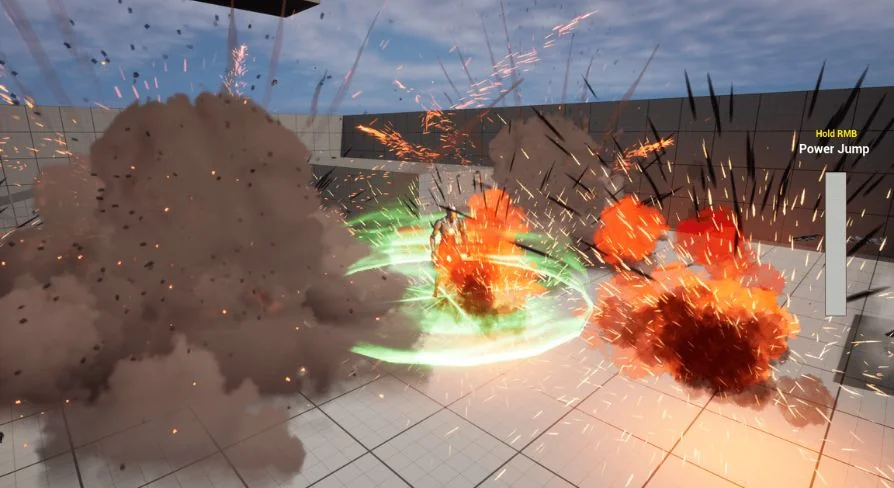
Because the mechanical base is decoupled from specific aesthetic representations, it adapts to diverse thematic genres. Developers constructing fantasy spellbooks, magical utility suites, or physical character abilities can hook their own assets into the underlying execution flow. It is important to account for specific asset boundaries within the package: character portrait textures and visual explosion effects are not included. Creators supply their own visual effects and portrait artwork, wiring them directly into the pre-established Blueprint events that manage state changes, ability firing, and interface responses.
Direct Variable Customization and Bug-Free User Interface
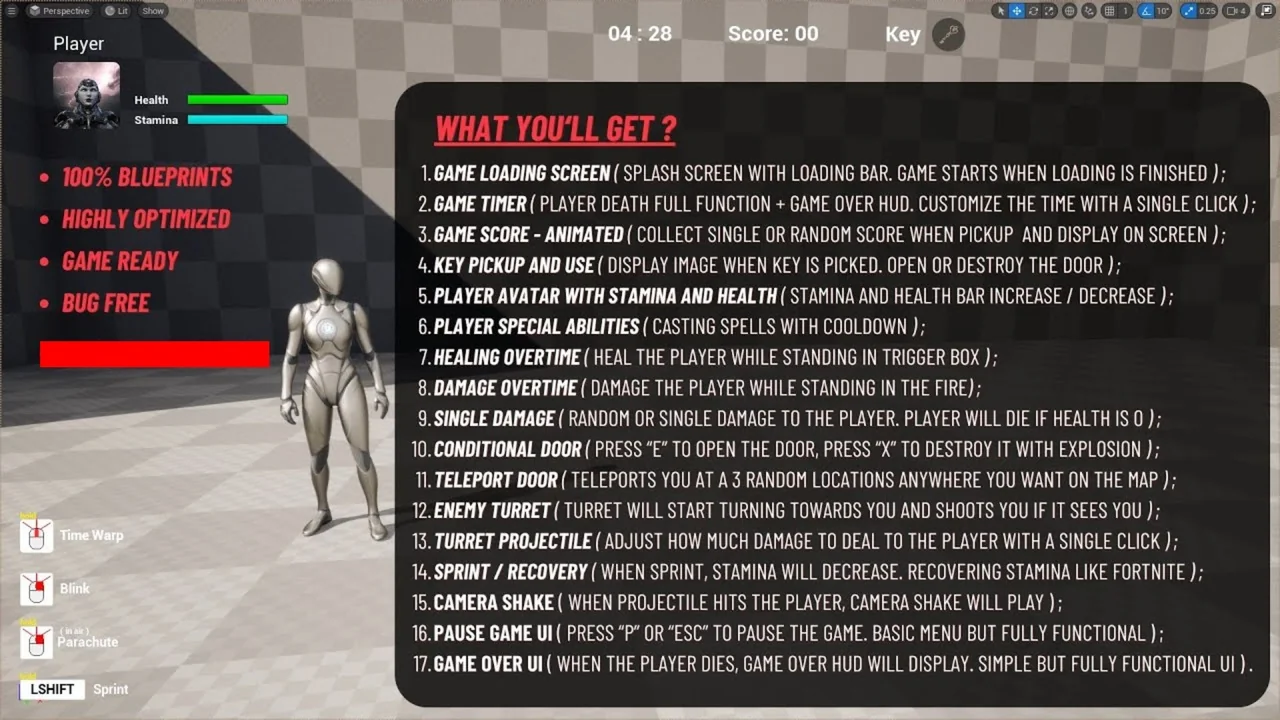
Adjusting the operational flow of core features requires no deep code manipulation. Parameter modifications are handled through accessible variables that allow game rules to be tailored in a matter of clicks. Setting game durations, cooldown intervals, or encounter limits follows a transparent, parameter-driven workflow directly inside the editor details panels.
For example, configuring a mission countdown or session timer involves updating baseline numeric fields without reworking underlying timing functions:
To establish a round or gameplay timer of three minutes, select the "Minutes" variable and enter a value of 3.
To set a more granular duration, such as three minutes and fifteen seconds, set the "Minutes" variable to 3 and input 15 into the corresponding "Seconds" variable.
Working alongside these underlying game mechanics is a basic yet fully functional user interface layer designed to run free of bugs. Because traditional UI bindings are omitted to prevent the continuous polling that plagues unoptimized interfaces, visual updates occur dynamically via event updates. This ensures that score tallies, active timers, and ability states reflect accurate game data without degrading display rendering performance.
Scalable Hardware Execution for Prototypes and Production
A primary objective of building on an interface-driven Blueprint foundation is minimizing the weeks or months typically lost to programming basic mechanics, managing references, and tracing debugging errors. When games powered by this framework launch, execution adjusts to run at the smoothest frame rate achievable by the host computer, automatically scaling output performance relative to the local machine specifications.
By avoiding heavy node architectures that trap processing bandwidth on low-spec configurations, projects can safely target a broad range of target setups. The resulting implementation offers a robust, game-ready baseline suitable for launching early startup concepts, crafting immediate gameplay prototypes, or underpinning larger modular game systems.
 Gameplay Features
 Gameplay Features
 Gameplay Features
 Gameplay Features