"95fdaf16012263fa"{"id":"1002317","slug":"forest-trunks-photoscanned-vol-2-by-unimodels","title":"Forest Trunks Photoscanned Vol. 2 by Unimodels","category":"Trees","engine":"4.26+,5.0+","assetVersion":"","engineVersion":"Engine Version: 4.26+,5.0+","tag":"Trees","accent":"blue","visual":"mech","summary":"Thirty photoscanned tree trunks for forest and jungle scenes, with a mix of fully closed and open meshes, captured for photorealistic VR and PC game environment","platform":"Unreal Engine","indexPolicy":"index","publishedAt":"2026-11-06T06:18:58.089Z","updatedAt":"2026-11-06T06:18:58.089Z","sourceNotes":[],"fileContents":[],"compatibility":["Unreal Engine","Engine Version: 4.26+,5.0+"],"featuredImage":{"alt":"Forest Trunks Photoscanned Vol. 2 by Unimodels","src":"/wp-content/uploads/published/2026/11/85b82c080244-4ec11174-6cd2-4b35-bf9f-735594a8ede0-1b4430d981.webp"},"hasDownloadLink":true,"downloads":0,"terms":[{"taxonomy":"category","slug":"trees","name":"Trees"}],"galleryImages":[{"src":"/wp-content/uploads/published/2026/11/ca996be8c1cf-ce35c083-4fdb-4866-a545-bbec952af361-a2f52c88e9.webp","alt":"Forest Trunks Photoscanned Vol. 2 by Unimodels"},{"src":"/wp-content/uploads/published/2026/11/fea15fc5a4a1-5d6d0dac-42eb-4521-96f7-ce1818c2618c-0e45168ad0.webp","alt":"Forest Trunks Photoscanned Vol. 2 by Unimodels"},{"src":"/wp-content/uploads/published/2026/11/ebb37df5ed1c-b9b8a6d9-49a8-472e-b412-3ff2c62b4a20-ff7d28ecb3.webp","alt":"Forest Trunks Photoscanned Vol. 2 by Unimodels"},{"src":"/wp-content/uploads/published/2026/11/b132929ced74-5f98ff2e-0e3a-4053-97fc-c3c188fa4376-ce69060902.webp","alt":"Forest Trunks Photoscanned Vol. 2 by Unimodels"},{"src":"/wp-content/uploads/published/2026/11/8d57290567c8-ad33d073-a78b-48a9-b6ee-f88e74837fc8-56e6ee2c96.webp","alt":"Forest Trunks Photoscanned Vol. 2 by Unimodels"},{"src":"/wp-content/uploads/published/2026/11/3d269fa17562-c9e476cc-ba17-4ea8-ba8f-bf258335fc9a-922b6832e3.webp","alt":"Forest Trunks Photoscanned Vol. 2 by Unimodels"},{"src":"/wp-content/uploads/published/2026/11/734196b46b00-1355237f-5c24-429d-b425-5b7f58522d9d-0d41cdf86f.webp","alt":"Forest Trunks Photoscanned Vol. 2 by Unimodels"},{"src":"/wp-content/uploads/published/2026/11/400a15e17528-9870e9d8-817a-4257-b09e-ec82134c29a5-3ffeea349e.webp","alt":"Forest Trunks Photoscanned Vol. 2 by Unimodels"},{"src":"/wp-content/uploads/published/2026/11/1a9bc7e69bd5-fdffa317-e8f7-48cb-baed-1c9a2a9c3f17-68198ede20.webp","alt":"Forest Trunks Photoscanned Vol. 2 by Unimodels"},{"src":"/wp-content/uploads/published/2026/11/0d3fa142df8f-ea95f9eb-f40e-4725-86ff-8ba0a6f4128b-c412649667.webp","alt":"Forest Trunks Photoscanned Vol. 2 by Unimodels"}],"accessPanel":{"kind":"resource","title":"Get this resource","eyebrow":"Free resource","message":"3DCGHUB is the service provider for this listing. Access is fulfilled through the official publisher channel.","fileName":"Content.7z","safetyNote":"Resources are manually reviewed before listing to improve quality and reduce obvious risks.","actionLabel":"Get this resource","resourceType":"Resource archive","versions":[]},"contentHtml":"\u003cp\u003eA tree trunk does most of its work at eye level. It sits where the camera passes, where a player walks within arm's reach, and — in a headset — where the surface is examined at a distance of inches. Forest Trunks Photoscanned Vol. 2 puts thirty of those surfaces into one set, every one of them captured through photogrammetry and tagged as photorealistic rather than hand-painted or stylised.\u003c/p\u003e \u003cp\u003eThat combination of a large count and scanned detail is what shapes the way the pack behaves once it is dropped into a scene: the trunks read as real bark up close, and there are enough distinct pieces to line a path without the eye catching the same silhouette twice.\u003c/p\u003e \u003ch2\u003eThirty trunks for forest and jungle treelines\u003c/h2\u003e \u003cp\u003eThe setting the set is built for is stated plainly — forest and jungle. Both environments depend on density, on trunks stacked in layers so the middle distance reads as continued growth rather than a backdrop. Thirty separate trunks give enough variation to fill a near layer, a mid layer and a far layer without repeating the same piece in all three, and each one carries its own scanned surface rather than a shared tiling material.\u003c/p\u003e \u003cp\u003eThat matters most at the scale where a player actually travels. A jungle corridor or a woodline looks convincing when the trunks closest to the path differ from one another in the way real growth differs. Working with a set this size means the difference is available without mixing in trunks from another pack.\u003c/p\u003e \u003ch3\u003eSome meshes are completely closed, others are not\u003c/h3\u003e \u003cp\u003eThis is the detail that decides how the set is placed. Some of the trunks are completely closed meshes; others are not. The sample video shows an example of each, which makes the split easy to see before committing to a layout.\u003c/p\u003e \u003cp\u003eThe distinction carries real weight in a VR build, where a player can look anywhere and walk around an object rather than past it. Trunks a player can circle belong in the closed group — the mesh presents a finished surface from every angle. The open meshes suit the places where geometry already hides the ends: buried in the ground plane, lost inside canopy, or tucked behind other trunks and undergrowth. Choosing per trunk, rather than per pack, is how the closed and open split turns into an advantage instead of a surprise.\u003c/p\u003e \u003ch2\u003eWhat photogrammetry brings to bark\u003c/h2\u003e \u003cp\u003eThe tags attached to the set — tree, photogrammetry, photorealistic, trunk — describe the capture method and the result in the same breath. Photogrammetry records a real trunk and rebuilds it as a mesh, so the ridges, splits and irregular thickness of bark survive into the asset instead of being approximated by a texture artist.\u003c/p\u003e \u003cp\u003eFor a forest scene that detail does quiet work. Bark is the surface a player passes at close range hundreds of times, and it is usually the first thing that reveals whether an environment was built from scanned material or from tiling. A trunk held up to the light in a headset is an unforgiving test; photoscanned surfaces are what make that test survivable.\u003c/p\u003e \u003cp\u003eHyper-realistic is the term the set uses for itself, and it matches the intent behind the scan pipeline — the trunks are meant to be believable as trees, not as stylised versions of trees.\u003c/p\u003e \u003ch2\u003eWhere the trunks land in a VR or PC project\u003c/h2\u003e \u003cp\u003eVR and PC games are named as the fit. Both are environments where the player moves through the scene on foot, at human height, with trunks filling the space around the route. In VR the stakes go up: head tracking means an object can be inspected from any angle, and the closed meshes in the set are the ones that survive that scrutiny.\u003c/p\u003e \u003cp\u003eFor a PC game the same assets cover a wider range of camera behaviour — third-person, first-person, flythroughs, cutscenes that push in close on a tree. A trunk that holds up at cutscene distance also holds up at player distance, which is why scanned surfaces travel well across both.\u003c/p\u003e \u003ch3\u003eMixing closed and open trunks without breaking the scene\u003c/h3\u003e \u003cp\u003eA workable pattern falls out of the closed-versus-open split. Reserve the completely closed meshes for the trees along the walkable route and for any trunk a player can orbit. Use the open ones deeper into the treeline, or at points where the top disappears into canopy and the bottom disappears into ground. The scene reads as one continuous forest, while the mesh choice follows what the camera can actually see.\u003c/p\u003e \u003cp\u003eThirty trunks also support that layout at the scale of a full level not just one clearing — enough pieces to populate a route and still keep a reserve for the areas the player lingers in.\u003c/p\u003e \u003ch2\u003eWhere the set sits next to the creator's interior work\u003c/h2\u003e \u003cp\u003eThe same creator's other content includes Office Vol. 1 – Complete Corporate Interior, a corporate interior set that has nothing in common with a jungle floor. Teams scanning a creator's catalogue for range will find outdoor scanning on one side and an office environment on the other, so the two sets serve entirely separate scenes and would not be combined in the same build.\u003c/p\u003e \u003cp\u003eBark, canopy and undergrowth ask for different things from an environment than desks, partitions and ceiling grids do, and the trunk set stays inside its own territory.\u003c/p\u003e \u003cp\u003eFor a forest or jungle level that needs realistic trunks at player height — and especially for VR, where the camera gets close enough to see whether a mesh is sealed — the thirty pieces, the closed-and-open split and the photogrammetry behind the surfaces are the concrete reasons to build the treeline from this set.\u003c/p\u003e\n\n\u003ch2\u003eRelated Resources Worth Checking\u003c/h2\u003e\n\u003cul\u003e\n\u003cli\u003e\u003ca href=\"https://3dcghub.com/foliage-vol-4-spruce-trees-nanite-and-low-poly/\" rel=\"noopener noreferrer\"\u003eFoliage VOL.4 - Spruce Trees (Nanite and Low Poly)\u003c/a\u003e\u003c/li\u003e\n\u003cli\u003e\u003ca href=\"https://3dcghub.com/floors-and-walls-vol-1-photoscanned-textures/\" rel=\"noopener noreferrer\"\u003eFloors and Walls Vol.1 Photoscanned textures\u003c/a\u003e\u003c/li\u003e\n\u003cli\u003e\u003ca href=\"https://3dcghub.com/stylized-forest-vol-3/\" rel=\"noopener noreferrer\"\u003eStylized Forest VOL 3\u003c/a\u003e\u003c/li\u003e\n\u003cli\u003e\u003ca href=\"https://3dcghub.com/stylized-trees-pack-2/\" rel=\"noopener noreferrer\"\u003eStylized Trees Pack 2\u003c/a\u003e\u003c/li\u003e\n\u003cli\u003e\u003ca href=\"https://3dcghub.com/procedural-oak-forest-forest-winter-forest-spring-forest-autumn-forest/\" rel=\"noopener noreferrer\"\u003eProcedural Oak Forest ( Forest , Winter Forest , Spring Forest , Autumn Forest )\u003c/a\u003e\u003c/li\u003e\n\u003c/ul\u003e","contentTextLength":5677,"navigation":{"current":51,"total":4291,"previous":{"id":"1002318","slug":"ghost-trails","title":"Ghost Trails","category":"Gameplay Features","platform":"Unreal Engine","updatedAt":"2026-11-06T06:19:39.056Z"},"next":{"id":"1002316","slug":"force-shields","title":"Force Shields","category":"Shaders","platform":"Unreal Engine","updatedAt":"2026-11-06T06:18:05.220Z"}},"relatedResources":[{"id":"1000506","slug":"foliage-vol-4-spruce-trees-nanite-and-low-poly","title":"Foliage VOL.4 - Spruce Trees (Nanite and Low Poly)","category":"Trees","engine":"5.1+","assetVersion":"","engineVersion":"Engine Version: 5.1+","tag":"Trees","accent":"blue","visual":"mech","summary":"Dekogon's spruce tree pack delivers 22 Nanite and low-poly Unreal Engine meshes with 4K textures, master material controls, and Lumen support for forest scenes.","platform":"Unreal Engine","indexPolicy":"index","publishedAt":"2026-07-13T12:22:03.502Z","updatedAt":"2026-07-13T12:22:03.502Z","sourceNotes":[],"fileContents":[],"compatibility":["Unreal Engine","Engine Version: 5.1+"],"featuredImage":{"alt":"Foliage VOL.4 - Spruce Trees (Nanite and Low Poly)","src":"/wp-content/uploads/published/2026/07/c33fe7178295-c87ac621-c13d-4fa3-a77a-6df6066263b8-831370d73c.webp"},"hasDownloadLink":true,"downloads":0},{"id":"1002306","slug":"floors-and-walls-vol-1-photoscanned-textures","title":"Floors and Walls Vol.1 Photoscanned textures","category":"Nature \u0026 Plants","engine":"4.27+,5.0+","assetVersion":"","engineVersion":"Engine Version: 4.27+,5.0+","tag":"Nature \u0026 Plants","accent":"blue","visual":"luts","summary":"A practical look at Floors and Walls Vol.1 Photoscanned textures: 34 stone wall meshes, 20 tiled wall textures, 15 tiled floor textures, plus leaves and mud.","platform":"Unreal Engine","indexPolicy":"index","publishedAt":"2026-11-05T10:06:31.464Z","updatedAt":"2026-11-05T10:06:31.464Z","sourceNotes":[],"fileContents":[],"compatibility":["Unreal Engine","Engine Version: 4.27+,5.0+"],"featuredImage":{"alt":"Floors and Walls Vol.1 Photoscanned textures","src":"/wp-content/uploads/published/2026/11/4bb2d3ac47c6-c0fc7266-8901-4d7a-85c6-d9cd2f8ede9f-5fdf77fcf7.webp"},"hasDownloadLink":true,"downloads":0},{"id":"1002218","slug":"stylized-forest-vol-3","title":"Stylized Forest VOL 3","category":"Forest \u0026 Jungle","engine":"4.26+,5.0+","assetVersion":"","engineVersion":"Engine Version: 4.26+,5.0+","tag":"Forest \u0026 Jungle","accent":"blue","visual":"mech","summary":"Stylized Forest VOL 3 delivers a compact collection of stylized forest environments and fantasy landscapes built for level composition and world design.","platform":"Unreal Engine","indexPolicy":"index","publishedAt":"2026-10-29T15:17:11.563Z","updatedAt":"2026-10-29T15:17:11.563Z","sourceNotes":[],"fileContents":[],"compatibility":["Unreal Engine","Engine Version: 4.26+,5.0+"],"featuredImage":{"alt":"Stylized Forest VOL 3","src":"/wp-content/uploads/published/2026/10/a725e4b0e479-6d308f4e-528c-4b1c-916d-348a75ee55ec-ea6630b357.webp"},"hasDownloadLink":true,"downloads":0}]}
Trees
Forest Trunks Photoscanned Vol. 2 by Unimodels
Thirty photoscanned tree trunks for forest and jungle scenes, with a mix of fully closed and open meshes, captured for photorealistic VR and PC game environment
Category:Unreal Engine,TreesPlatform: Unreal EngineEngine Version: 4.26+,5.0+Published: Nov 6, 2026
Trees
Resource overview
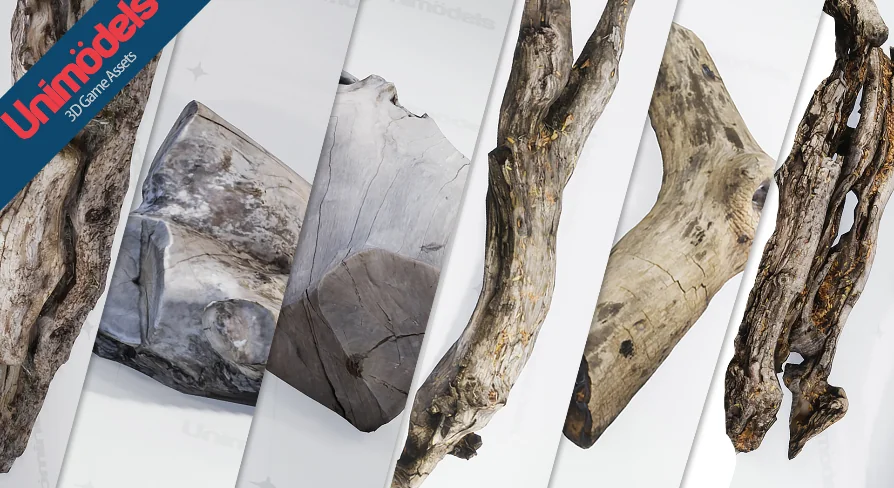
A tree trunk does most of its work at eye level. It sits where the camera passes, where a player walks within arm's reach, and — in a headset — where the surface is examined at a distance of inches. Forest Trunks Photoscanned Vol. 2 puts thirty of those surfaces into one set, every one of them captured through photogrammetry and tagged as photorealistic rather than hand-painted or stylised.
That combination of a large count and scanned detail is what shapes the way the pack behaves once it is dropped into a scene: the trunks read as real bark up close, and there are enough distinct pieces to line a path without the eye catching the same silhouette twice.
Thirty trunks for forest and jungle treelines
The setting the set is built for is stated plainly — forest and jungle. Both environments depend on density, on trunks stacked in layers so the middle distance reads as continued growth rather than a backdrop. Thirty separate trunks give enough variation to fill a near layer, a mid layer and a far layer without repeating the same piece in all three, and each one carries its own scanned surface rather than a shared tiling material.
That matters most at the scale where a player actually travels. A jungle corridor or a woodline looks convincing when the trunks closest to the path differ from one another in the way real growth differs. Working with a set this size means the difference is available without mixing in trunks from another pack.
Some meshes are completely closed, others are not
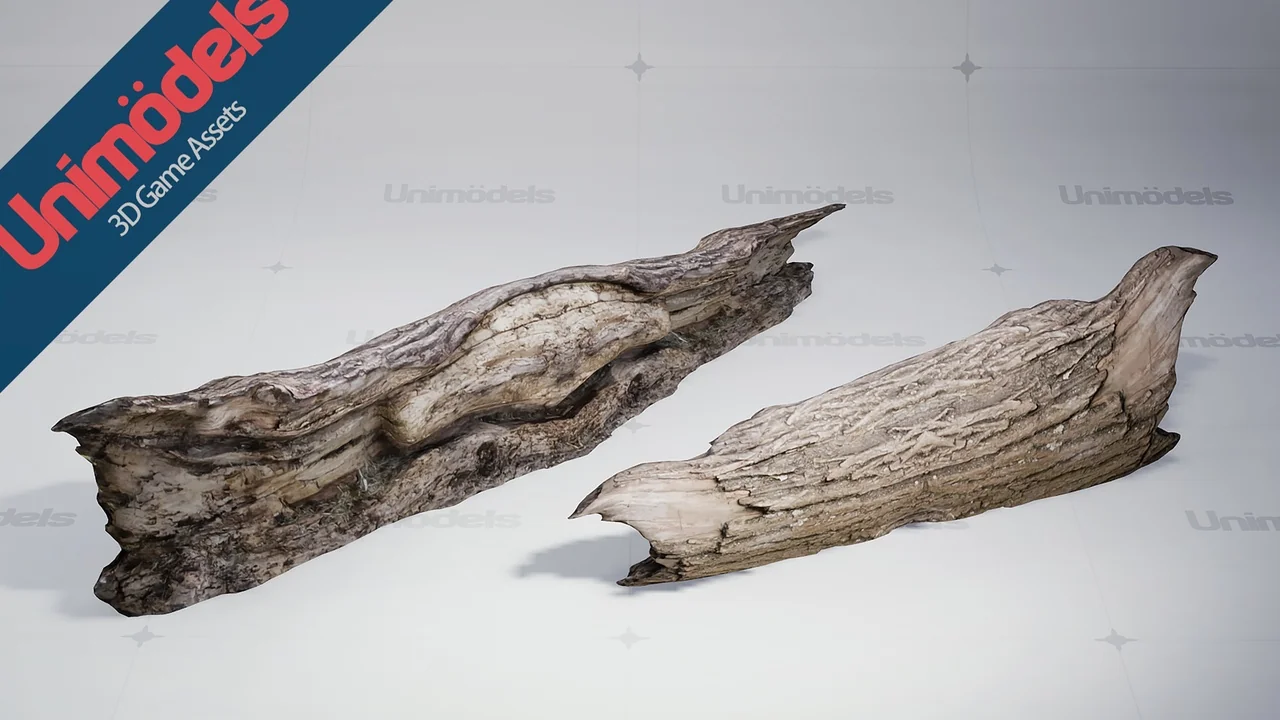
This is the detail that decides how the set is placed. Some of the trunks are completely closed meshes; others are not. The sample video shows an example of each, which makes the split easy to see before committing to a layout.
The distinction carries real weight in a VR build, where a player can look anywhere and walk around an object rather than past it. Trunks a player can circle belong in the closed group — the mesh presents a finished surface from every angle. The open meshes suit the places where geometry already hides the ends: buried in the ground plane, lost inside canopy, or tucked behind other trunks and undergrowth. Choosing per trunk, rather than per pack, is how the closed and open split turns into an advantage instead of a surprise.
What photogrammetry brings to bark
The tags attached to the set — tree, photogrammetry, photorealistic, trunk — describe the capture method and the result in the same breath. Photogrammetry records a real trunk and rebuilds it as a mesh, so the ridges, splits and irregular thickness of bark survive into the asset instead of being approximated by a texture artist.
For a forest scene that detail does quiet work. Bark is the surface a player passes at close range hundreds of times, and it is usually the first thing that reveals whether an environment was built from scanned material or from tiling. A trunk held up to the light in a headset is an unforgiving test; photoscanned surfaces are what make that test survivable.
Hyper-realistic is the term the set uses for itself, and it matches the intent behind the scan pipeline — the trunks are meant to be believable as trees, not as stylised versions of trees.
Where the trunks land in a VR or PC project
VR and PC games are named as the fit. Both are environments where the player moves through the scene on foot, at human height, with trunks filling the space around the route. In VR the stakes go up: head tracking means an object can be inspected from any angle, and the closed meshes in the set are the ones that survive that scrutiny.
For a PC game the same assets cover a wider range of camera behaviour — third-person, first-person, flythroughs, cutscenes that push in close on a tree. A trunk that holds up at cutscene distance also holds up at player distance, which is why scanned surfaces travel well across both.
Mixing closed and open trunks without breaking the scene
A workable pattern falls out of the closed-versus-open split. Reserve the completely closed meshes for the trees along the walkable route and for any trunk a player can orbit. Use the open ones deeper into the treeline, or at points where the top disappears into canopy and the bottom disappears into ground. The scene reads as one continuous forest, while the mesh choice follows what the camera can actually see.
Thirty trunks also support that layout at the scale of a full level not just one clearing — enough pieces to populate a route and still keep a reserve for the areas the player lingers in.
Where the set sits next to the creator's interior work
The same creator's other content includes Office Vol. 1 – Complete Corporate Interior, a corporate interior set that has nothing in common with a jungle floor. Teams scanning a creator's catalogue for range will find outdoor scanning on one side and an office environment on the other, so the two sets serve entirely separate scenes and would not be combined in the same build.
Bark, canopy and undergrowth ask for different things from an environment than desks, partitions and ceiling grids do, and the trunk set stays inside its own territory.
For a forest or jungle level that needs realistic trunks at player height — and especially for VR, where the camera gets close enough to see whether a mesh is sealed — the thirty pieces, the closed-and-open split and the photogrammetry behind the surfaces are the concrete reasons to build the treeline from this set.
 Trees
 Trees
 Nature & Plants
 Forest & Jungle