"a7cfa646d0d8ae55"{"id":"1001216","slug":"ep-master-materials","title":"EP Master Materials","category":"Variety","engine":"5.0+","assetVersion":"","engineVersion":"Engine Version: 5.0+","tag":"Variety","accent":"blue","visual":"luts","summary":"EP Master Materials delivers an optimized PBR shader system for PC and VR, featuring 80 material instances, POM, vertex paint, and tessellation.","platform":"Unreal Engine","publishedAt":"2026-09-19T08:57:25.445Z","updatedAt":"2026-09-19T08:57:25.445Z","sourceNotes":[],"fileContents":[],"compatibility":["Unreal Engine","Engine Version: 5.0+"],"featuredImage":{"alt":"EP Master Materials","src":"/wp-content/uploads/published/2026/09/e28b3c3a0069-7af3d985-bf3b-4663-bd08-0b6332821e01-86ce146760.webp"},"hasDownloadLink":true,"downloads":0,"terms":[{"taxonomy":"category","slug":"variety","name":"Variety"}],"galleryImages":[{"src":"/wp-content/uploads/published/2026/09/29a1ace71c4f-3a3aff10-716d-4ef5-83c8-4803429a88b1-f48be3ec34.webp","alt":"EP Master Materials"},{"src":"/wp-content/uploads/published/2026/09/56de7f1e9985-bd56be18-ed56-4d70-9579-42c2c519df39-f694c9b02f.webp","alt":"EP Master Materials"},{"src":"/wp-content/uploads/published/2026/09/af5c1372990a-310f1b91-7b71-4d04-af27-3ea7c1e11723-e57ee2523a.webp","alt":"EP Master Materials"},{"src":"/wp-content/uploads/published/2026/09/971d7f118aea-5dd015b6-4c33-4a70-8522-607fda782577-1f85d60b62.webp","alt":"EP Master Materials"},{"src":"/wp-content/uploads/published/2026/09/8a9adf24721a-96545efb-2eb8-4e85-8013-89525393218b-760c2dd157.webp","alt":"EP Master Materials"},{"src":"/wp-content/uploads/published/2026/09/ba944a74c079-11cc9221-6175-4793-b2d1-2ccec618fdac-0ef5a3a0b0.webp","alt":"EP Master Materials"},{"src":"/wp-content/uploads/published/2026/09/00404a368a8f-2e1e9f36-fc97-4596-a822-fea2b2071f50-e8b081c66a.webp","alt":"EP Master Materials"},{"src":"/wp-content/uploads/published/2026/09/263009d76e8d-9201b1e9-fdad-46ce-a9dc-e63066af4b76-93194c1f56.webp","alt":"EP Master Materials"},{"src":"/wp-content/uploads/published/2026/09/729557218c3f-af720540-0f20-4b7d-8d8a-bf19732a693e-2dd1b069eb.webp","alt":"EP Master Materials"},{"src":"/wp-content/uploads/published/2026/09/d0b135c070e2-85021658-a1c1-435f-8a5f-a3b8d3416de3-f10dffb9b2.webp","alt":"EP Master Materials"}],"accessPanel":{"kind":"resource","title":"Download this resource","eyebrow":"Free Download","message":"Log in or create a free account to start your download.","fileName":"Content.7z","safetyNote":"Resources are manually reviewed before listing to improve quality and reduce obvious risks.","actionLabel":"Download Free","resourceType":"Resource archive"},"contentHtml":"\u003cp\u003eSurface rendering in interactive environments demands a delicate compromise between visual fidelity and strict render budgets. EP Master Materials approaches this balance through an optimized architecture designed to handle diverse PBR surface types across game props and modular architecture. Instead of burdening assets with static, unyielding shader overhead, the system relies on a modular approach where specific features are engaged only when a surface requires them.\u003c/p\u003e \u003ch2\u003eModular Wall Shaders for Dirt, Plaster, and Metallic Erosion\u003c/h2\u003e\n\u003cp\u003eEnvironmental storytelling often depends on layering wear, decay, and environmental damage across repeated architectural pieces. EP Master Materials targets these requirements directly, supplying master networks structured for modular walls and ground surfaces. Ground dirt floors, cracked plaster walls, and metallic surfaces showing advanced erosion represent the core physical conditions addressed by the system. By structuring the inputs around realistic PBR channels, assets can transition from clean structural components into weathered elements without rebuilding custom shader graphs for individual assets.\u003c/p\u003e \u003cp\u003eUrban and grunge environments frequently suffer from visual repetition when modular kits are placed in direct proximity. The shader networks in this pack resolve that challenge by pairing high-frequency normal and displacement maps with multi-layered surface masks. Whether handling a gritty floor plane or an oxidized metal panel, the master shader maintains consistent light response across diffuse, roughness, and metallic boundaries, keeping the scene cohesive under varied dynamic or static lighting conditions.\u003c/p\u003e \u003ch2\u003eThe Use Only What You Need Architecture for PC and VR\u003c/h2\u003e\n\u003cp\u003eRendering budgets in virtual reality leave virtually no room for redundant shader instructions. EP Master Materials adopts a strict functional architecture built on a philosophy of using only what you need. In practical application, this means individual feature branches within the master material do not penalize runtime performance when they remain dormant. If a prop requires simple albedo, roughness, and normal interpretation, the complex code paths governing height manipulation or light scattering can remain completely inactive.\u003c/p\u003e \u003cp\u003eThis design makes the package suitable for dual-target production across standard PC games and high-framerate VR projects. In VR rendering pipelines, stereoscopic calculation doubles the strain of heavy pixel shaders. By stripping away processing overhead on background props and passive environment structures, the engine retains sufficient GPU headroom to handle critical geometry and post-processing without dropping frames below target thresholds.\u003c/p\u003e \u003ch2\u003eVertex Paint Workflows and the Grunge Wall Setup\u003c/h2\u003e\n\u003cp\u003eOne of the primary demonstrations within the package centers on vertex painting through a dedicated grunge wall material. Vertex painting allows level designers and environment artists to paint wear, grime, and secondary materials directly onto mesh geometry inside the editor, bypassing the need to export assets for external re-texturing.\u003c/p\u003e \u003cp\u003eIn this workflow, the master shader uses vertex color channels to reveal under-layers, such as exposed masonry beneath peeling plaster or heavy road grime caked onto the base of an urban curb. Because the transition is managed through vertex weights, memory usage remains minimal. Artists can use identical wall meshes across an entire city block while varying the distribution of dampness, grunge, and broken surfaces on each separate instance.\u003c/p\u003e \u003ch2\u003eDistance-Based Tessellation, POM, and Displacement Performance\u003c/h2\u003e\n\u003cp\u003eGeometric depth can be handled through multiple technological pathways depending on the distance of the camera and the silhouette profile of the mesh. EP Master Materials includes presets covering Parallax Occlusion Mapping (POM), true displacement, and distance-based tessellation. Each method serves a distinct visual and technical role:\u003c/p\u003e \u003cul\u003e \u003cli\u003e\u003cstrong\u003eParallax Occlusion Mapping:\u003c/strong\u003e Simulates deep surface crevices, bumpy masonry, and surface relief entirely within pixel shading, creating convincing depth on flat polygons without adding vertex count.\u003c/li\u003e \u003cli\u003e\u003cstrong\u003eDisplacement and Tessellation:\u003c/strong\u003e Physically subdivides and displaces the surface geometry, allowing real silhouette alteration on rugged ground dirt floors and broken stone edges.\u003c/li\u003e \u003cli\u003e\u003cstrong\u003eDistance Scaling:\u003c/strong\u003e Prevents geometric bottlenecks by attenuating tessellation density as the camera retreats, preserving performance over long view distances.\u003c/li\u003e\n\u003c/ul\u003e \u003cp\u003eBy offering distinct presets for displacement and POM, the pack allows creators to choose between pixel-driven depth techniques and geometry-driven tessellation based on target hardware limits.\u003c/p\u003e \u003ch2\u003e80 Material Instances Tuned for Rapid Production\u003c/h2\u003e\n\u003cp\u003eBuilding master materials is only half the battle; establishing functional, production-ready instances is where production speed is gained. EP Master Materials comes packaged with 80 configured material instances spanning specific material types. These instances act as both practical production assets and clear technical examples demonstrating how to properly configure parameters.\u003c/p\u003e \u003cp\u003eIncluded configurations touch on critical shader behaviors such as emissive channels for glowing elements, subsurface scattering (SubSurface) for materials that require light transmission through thin volumes, and specialized normal map configurations for bumpy urban wear. Teams can immediately apply these instances to modular collections, including assets like the Roman VOL1 Columns Kit, or repurpose the parameter presets to quickly generate new surface varieties for custom assets.\u003c/p\u003e \u003ch2\u003eTechnical Takeaway for Production Teams\u003c/h2\u003e\n\u003cp\u003eEP Master Materials provides an organized, performance-conscious foundation for projects that rely on heavy modularity and diverse surface aging. By combining distance-scaled displacement, POM presets, vertex-painted grunge workflows, and 80 readymade instances under an opt-in instruction model, the package equips artists to maintain visual density across both traditional PC platforms and performance-critical VR titles.\u003c/p\u003e\n\n\u003ch2\u003eRelated Resources Worth Checking\u003c/h2\u003e\n\u003cul\u003e\n\u003cli\u003e\u003ca href=\"https://3dcghub.com/mars-master-material/\" title=\"MARS Master Material\"\u003eMARS Master Material\u003c/a\u003e\u003c/li\u003e\n\u003cli\u003e\u003ca href=\"https://3dcghub.com/gothic-texture-pack/\" title=\"Gothic Texture Pack\"\u003eGothic Texture Pack\u003c/a\u003e\u003c/li\u003e\n\u003cli\u003e\u003ca href=\"https://3dcghub.com/ascii-post-process-material/\" title=\"ASCII Post Process Material\"\u003eASCII Post Process Material\u003c/a\u003e\u003c/li\u003e\n\u003cli\u003e\u003ca href=\"https://3dcghub.com/master-materials-and-layer-system-for-daz3d-imports/\" title=\"Master Materials and Layer System for Daz3D Imports\"\u003eMaster Materials and Layer System for Daz3D Imports\u003c/a\u003e\u003c/li\u003e\n\u003cli\u003e\u003ca href=\"https://3dcghub.com/stylized-animated-lava-material-pack-85-pcs/\" title=\"Stylized Animated Lava Material Pack 85 Pcs\"\u003eStylized Animated Lava Material Pack 85 Pcs\u003c/a\u003e\u003c/li\u003e\n\u003c/ul\u003e","contentTextLength":6260,"navigation":{"current":9,"total":3167,"previous":{"id":"1001217","slug":"hologram-shader","title":"Hologram Shader","category":"Variety","platform":"Unreal Engine","updatedAt":"2026-09-19T09:00:05.221Z"},"next":{"id":"1001215","slug":"advanced-crt-tv-vcr-vhs-effects","title":"Advanced CRT TV - VCR - VHS Effects","category":"Variety","platform":"Unreal Engine","updatedAt":"2026-09-19T08:55:15.447Z"}},"relatedResources":[{"id":"13183","slug":"mars-master-material","title":"MARS Master Material","category":"Variety","engine":"4.26+,5.0+","assetVersion":"Engine version: 4.26+,5.0+","engineVersion":"4.25","tag":"Variety","accent":"blue","visual":"luts","summary":"The MARS Master Material is a powerful shading framework updated for UE5.7 and Substrate. It features a massive library of material functions, specialized master materials, and custom editor widgets to optimize the game development workflow.","platform":"Unreal Engine","publishedAt":"2026-03-10T16:10:47.000Z","updatedAt":"2026-04-19T15:46:31.000Z","sourceNotes":[],"fileContents":[],"compatibility":["Unreal Engine","Engine version: 4.26+,5.0+"],"featuredImage":{"alt":"MARS Master Material","src":"https://3dcghub.com/wp-content/uploads/2026/03/127326ad-e6aa-4aad-a701-0f2b6257391c.webp"},"hasDownloadLink":true,"downloads":0},{"id":"1001219","slug":"necro-s-utility-material-pack","title":"Necro's Utility Material Pack","category":"Variety","engine":"5.0+","assetVersion":"","engineVersion":"Engine Version: 5.0+","tag":"Variety","accent":"blue","visual":"luts","summary":"Necro's Utility Material Pack brings parameterized master materials to Unreal Engine, featuring custom photo textures, sculpted normals, and vertex painting.","platform":"Unreal Engine","publishedAt":"2026-09-19T09:05:32.482Z","updatedAt":"2026-09-19T09:05:32.482Z","sourceNotes":[],"fileContents":[],"compatibility":["Unreal Engine","Engine Version: 5.0+"],"featuredImage":{"alt":"Necro's Utility Material Pack","src":"/wp-content/uploads/published/2026/09/bbaf3b6f9ecb-26703fa4-b260-4dc4-8daf-fa4b2f8f01af-e880551a27.webp"},"hasDownloadLink":true,"downloads":0},{"id":"13145","slug":"gothic-texture-pack","title":"Gothic Texture Pack","category":"Variety","engine":"4.26+,5.0+","assetVersion":"Engine version: 4.26+,5.0+","engineVersion":"4.23","tag":"Variety","accent":"blue","visual":"luts","summary":"Enhance your environment design with the Gothic Texture Pack, a collection of 10 high-quality, seamless material sets. This pack includes master materials and vertex paint support for damage and snow effects.","platform":"Unreal Engine","publishedAt":"2026-03-10T16:00:43.000Z","updatedAt":"2026-04-19T15:46:31.000Z","sourceNotes":[],"fileContents":[],"compatibility":["Unreal Engine","Engine version: 4.26+,5.0+"],"featuredImage":{"alt":"Gothic Texture Pack","src":"https://3dcghub.com/wp-content/uploads/2026/03/3051331b-b736-48cd-b9a1-a69aab2c3da8.webp"},"hasDownloadLink":true,"downloads":0}]}
Variety
EP Master Materials
EP Master Materials delivers an optimized PBR shader system for PC and VR, featuring 80 material instances, POM, vertex paint, and tessellation.
Surface rendering in interactive environments demands a delicate compromise between visual fidelity and strict render budgets. EP Master Materials approaches this balance through an optimized architecture designed to handle diverse PBR surface types across game props and modular architecture. Instead of burdening assets with static, unyielding shader overhead, the system relies on a modular approach where specific features are engaged only when a surface requires them.
Modular Wall Shaders for Dirt, Plaster, and Metallic Erosion
Environmental storytelling often depends on layering wear, decay, and environmental damage across repeated architectural pieces. EP Master Materials targets these requirements directly, supplying master networks structured for modular walls and ground surfaces. Ground dirt floors, cracked plaster walls, and metallic surfaces showing advanced erosion represent the core physical conditions addressed by the system. By structuring the inputs around realistic PBR channels, assets can transition from clean structural components into weathered elements without rebuilding custom shader graphs for individual assets.
Urban and grunge environments frequently suffer from visual repetition when modular kits are placed in direct proximity. The shader networks in this pack resolve that challenge by pairing high-frequency normal and displacement maps with multi-layered surface masks. Whether handling a gritty floor plane or an oxidized metal panel, the master shader maintains consistent light response across diffuse, roughness, and metallic boundaries, keeping the scene cohesive under varied dynamic or static lighting conditions.
The Use Only What You Need Architecture for PC and VR
Rendering budgets in virtual reality leave virtually no room for redundant shader instructions. EP Master Materials adopts a strict functional architecture built on a philosophy of using only what you need. In practical application, this means individual feature branches within the master material do not penalize runtime performance when they remain dormant. If a prop requires simple albedo, roughness, and normal interpretation, the complex code paths governing height manipulation or light scattering can remain completely inactive.
This design makes the package suitable for dual-target production across standard PC games and high-framerate VR projects. In VR rendering pipelines, stereoscopic calculation doubles the strain of heavy pixel shaders. By stripping away processing overhead on background props and passive environment structures, the engine retains sufficient GPU headroom to handle critical geometry and post-processing without dropping frames below target thresholds.
Vertex Paint Workflows and the Grunge Wall Setup
One of the primary demonstrations within the package centers on vertex painting through a dedicated grunge wall material. Vertex painting allows level designers and environment artists to paint wear, grime, and secondary materials directly onto mesh geometry inside the editor, bypassing the need to export assets for external re-texturing.
In this workflow, the master shader uses vertex color channels to reveal under-layers, such as exposed masonry beneath peeling plaster or heavy road grime caked onto the base of an urban curb. Because the transition is managed through vertex weights, memory usage remains minimal. Artists can use identical wall meshes across an entire city block while varying the distribution of dampness, grunge, and broken surfaces on each separate instance.
Distance-Based Tessellation, POM, and Displacement Performance
Geometric depth can be handled through multiple technological pathways depending on the distance of the camera and the silhouette profile of the mesh. EP Master Materials includes presets covering Parallax Occlusion Mapping (POM), true displacement, and distance-based tessellation. Each method serves a distinct visual and technical role:
Parallax Occlusion Mapping: Simulates deep surface crevices, bumpy masonry, and surface relief entirely within pixel shading, creating convincing depth on flat polygons without adding vertex count.
Displacement and Tessellation: Physically subdivides and displaces the surface geometry, allowing real silhouette alteration on rugged ground dirt floors and broken stone edges.
Distance Scaling: Prevents geometric bottlenecks by attenuating tessellation density as the camera retreats, preserving performance over long view distances.
By offering distinct presets for displacement and POM, the pack allows creators to choose between pixel-driven depth techniques and geometry-driven tessellation based on target hardware limits.
80 Material Instances Tuned for Rapid Production
Building master materials is only half the battle; establishing functional, production-ready instances is where production speed is gained. EP Master Materials comes packaged with 80 configured material instances spanning specific material types. These instances act as both practical production assets and clear technical examples demonstrating how to properly configure parameters.
Included configurations touch on critical shader behaviors such as emissive channels for glowing elements, subsurface scattering (SubSurface) for materials that require light transmission through thin volumes, and specialized normal map configurations for bumpy urban wear. Teams can immediately apply these instances to modular collections, including assets like the Roman VOL1 Columns Kit, or repurpose the parameter presets to quickly generate new surface varieties for custom assets.
Technical Takeaway for Production Teams
EP Master Materials provides an organized, performance-conscious foundation for projects that rely on heavy modularity and diverse surface aging. By combining distance-scaled displacement, POM presets, vertex-painted grunge workflows, and 80 readymade instances under an opt-in instruction model, the package equips artists to maintain visual density across both traditional PC platforms and performance-critical VR titles.
 Variety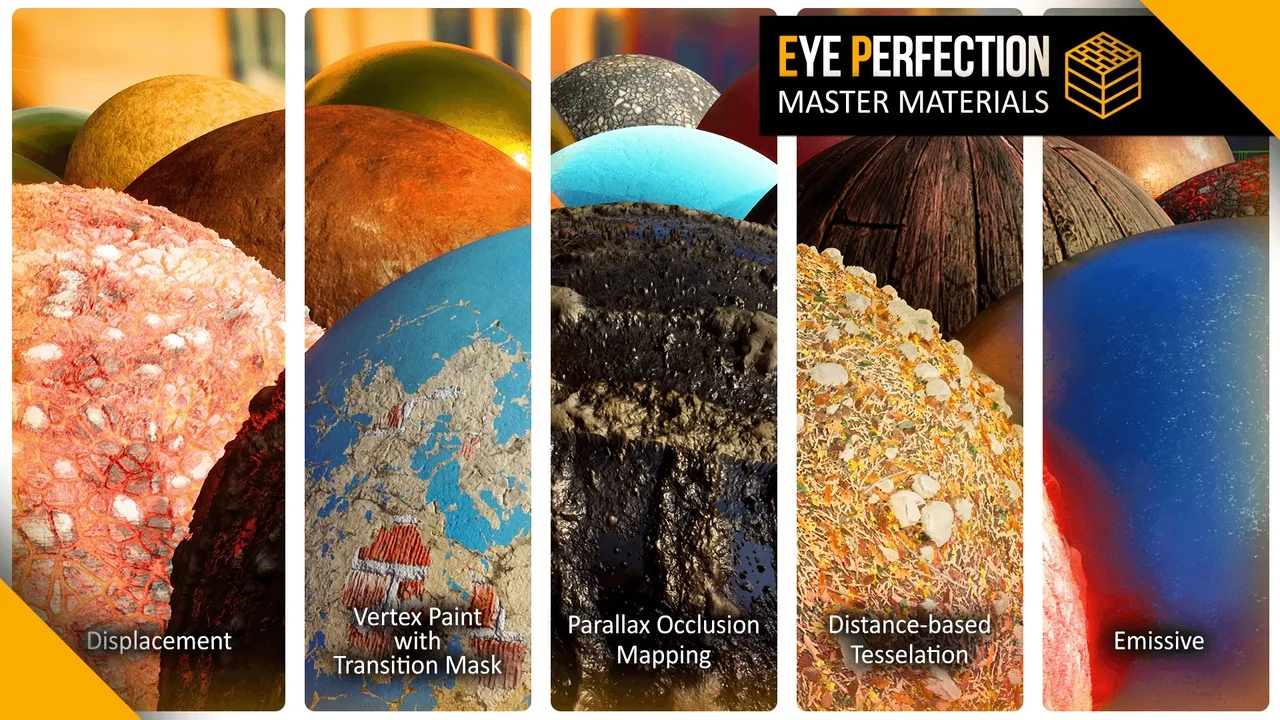
 Variety
 Variety
 Variety