"6c6413bef81af556"{"id":"1000815","slug":"dynamic-grass-system","title":"Dynamic Grass System","category":"Gameplay Features","engine":"5.1+","assetVersion":"","engineVersion":"Engine Version: 5.1+","tag":"Gameplay Features","accent":"blue","visual":"mech","summary":"Blueprint-based Unreal Engine grass system with shockwaves, burning, fire propagation, cutting, growing, and Lumen compatibility. Spawn dynamically or use UE fo","platform":"Unreal Engine","publishedAt":"2026-07-31T11:15:55.604Z","updatedAt":"2026-07-31T11:15:55.604Z","sourceNotes":[],"fileContents":[],"compatibility":["Unreal Engine","Engine Version: 5.1+"],"featuredImage":{"alt":"Dynamic Grass System","src":"/wp-content/uploads/published/2026/07/2f8f16037fa7-f0b60d8c-d48f-479c-9af4-35dff0cbde20-0671a127a5.webp"},"hasDownloadLink":true,"downloads":1,"terms":[{"taxonomy":"category","slug":"gameplay-features","name":"Gameplay Features"}],"galleryImages":[{"src":"/wp-content/uploads/published/2026/07/14553ce1d0cb-795c029d-188c-4d5f-bb27-ffe951a95ceb-197a2b9871.webp","alt":"Dynamic Grass System"},{"src":"/wp-content/uploads/published/2026/07/13676e91954e-a1f0d1c4-2a1b-481e-a8ed-a22fdead6f0f-7cd3b0b843.webp","alt":"Dynamic Grass System"},{"src":"/wp-content/uploads/published/2026/07/a9479b40898f-232ffe4d-1d29-466a-bd69-56ed002ccdb5-7a4d1c9c8a.webp","alt":"Dynamic Grass System"},{"src":"/wp-content/uploads/published/2026/07/aa3b30f72161-f8dcbb5a-42cd-48b2-a109-8f3c549d204f-a11ed2afde.webp","alt":"Dynamic Grass System"},{"src":"/wp-content/uploads/published/2026/07/bd58df71b3f1-d0b9aac9-8094-4453-bb31-935e81290b58-ab2e976e0a.webp","alt":"Dynamic Grass System"}],"accessPanel":{"kind":"resource","title":"Download this resource","eyebrow":"Free Download","message":"Log in or create a free account to start your download.","fileName":"Content.7z","safetyNote":"Resources are manually reviewed before listing to improve quality and reduce obvious risks.","actionLabel":"Download Free","resourceType":"Resource archive"},"contentHtml":"\u003cp\u003e\u003cem\u003eDynamic Grass System\u003c/em\u003e is a Blueprint-based toolkit for Unreal Engine that applies real-time interactive behavior to any grass mesh. Rather than relying on static vegetation placement, the system turns grass into a reactive element that bends, burns, cuts, grows, and deforms based on in-game events. It integrates with the existing Unreal Engine Foliage Tool and supports runtime spawning, making it viable for both editor-authored environments and procedural generation.\u003c/p\u003e\n\n\u003ch2\u003eConstructing Interactive Grass with Blueprints\u003c/h2\u003e\n\u003cp\u003eThe entire system is made 100% in Blueprints. This design choice removes the need for custom C++ compilation while still exposing a full range of interaction parameters. Developers can apply the dynamic behavior to any grass mesh they choose, and the Material options have been expanded in recent updates to ease the process of using custom meshes. This means the system is not locked to a single grass type or aesthetic; it can accommodate custom mesh shapes without requiring a Material rewrite from scratch.\u003c/p\u003e\n\n\u003cp\u003eBecause it runs entirely through Blueprints, the implementation path is accessible to teams without dedicated programming support. The internal logic has been simplified in the \u003ccode\u003e4.26+\u003c/code\u003e overhaul, which reduces the complexity of setting up interactions and maintaining the system across a project.\u003c/p\u003e\n\n\u003ch2\u003eInteraction Behavior and Effects Included\u003c/h2\u003e\n\u003cp\u003e\u003cem\u003eDynamic Grass System\u003c/em\u003e ships with a broad set of interaction effects included by default. Shockwaves allow grass to react to impacts and explosions visibly. The deforming system lets grass bend and flatten under pressure or movement. Burning is combined with fire propagation, meaning fire can spread across grass instances rather than simply playing a fixed animation on one patch. Cutting, growing, removing, and ground blending round out the default behavior set.\u003c/p\u003e\n\n\u003cp\u003eThese behaviors can be triggered whether the grass is placed through the Unreal Engine Foliage Tool or spawned dynamically during gameplay. The \u003ccode\u003e4.26+\u003c/code\u003e overhaul greatly optimized the interaction system itself, improved the interaction effects, and added new interaction parameters, giving developers more control over how grass responds to stimuli. Wind behavior has also seen dedicated attention in earlier updates: in-game smooth wind strength and wind direction change effects were improved in the \u003ccode\u003e4.22+\u003c/code\u003e version, and a bug causing grass stretch under strong wind parameters was fixed.\u003c/p\u003e\n\n\u003ch2\u003eFire Propagation and Cutting Mechanics\u003c/h2\u003e\n\u003cp\u003eAmong the interaction effects, fire propagation and cutting stand out as mechanics that change how grass functions as gameplay. Fire propagation means that once burning starts on a patch of grass, it can spread across connected instances, creating a simulation where the firefront advances through the field. This is distinct from a purely cosmetic burning effect; the spread behavior implies a State Machine running across grass instances.\u003c/p\u003e\n\n\u003cp\u003eCutting adds a different gameplay vector, allowing grass to be removed or altered by player or environmental action. Combined with the growing and removing effects, developers can build sequences where grass is destroyed and regrown within a single play session. The Level of Detail (LOD) deform bug on the Hierarchical Instanced Static Mesh (\u003ccode\u003eHISM\u003c/code\u003e) component that previously appeared when removing instances in Unreal Engine 4.22 was fixed, which stabilized the cutting and removing workflows for that version.\u003c/p\u003e\n\n\u003ch2\u003ePerformance and Chunking in Grass Simulation\u003c/h2\u003e\n\u003cp\u003ePerformance is a central concern for any interactive foliage system. The \u003ccode\u003e4.26+\u003c/code\u003e update overhauled the internal systems specifically to make the tool more optimized, flexible, and visually improved. The interaction system was greatly optimized, and the default grass shader received its own optimization pass. Faster loading times were achieved by optimizing the initial chunking process, the method by which grass instances are divided into manageable spatial groups for processing.\u003c/p\u003e\n\n\u003cp\u003eThe internal logic was simplified, which reduced overhead and made the system easier to maintain. For projects targeting modern rendering pipelines, the system has been tuned to work with the Lumen system without issues, and the \u003ccode\u003e4.26\u003c/code\u003e version is compatible with Unreal Engine 5 Early Access. This makes the tool a candidate for projects transitioning from UE4 to UE5 without requiring a full foliage rewrite.\u003c/p\u003e\n\n\u003ch2\u003eGround Blending and Material Flexibility\u003c/h2\u003e\n\u003cp\u003eGround blending is included as one of the default effects, allowing grass to integrate visually with the underlying terrain rather than sitting as a separate layer. The grass Material received additional options in the \u003ccode\u003e4.26+\u003c/code\u003e update, specifically aimed at easing the process of using custom meshes. This reduces the friction of introducing new vegetation types into the system.\u003c/p\u003e\n\n\u003cp\u003eThe default grass shader was optimized for performance, and the expanded Material options mean that the look and feel of the grass can be adjusted without leaving the Blueprint framework. Whether the project calls for lush fields, scattered bushes, or wheat-like growth, the Material System is set up to accept those variations.\u003c/p\u003e\n\n\u003ch2\u003eRuntime Spawning Dynamics and UE Foliage Tool Integration\u003c/h2\u003e\n\u003cp\u003eThe system supports 2 primary placement workflows. The first is the Unreal Engine Foliage Tool, the built-in editor method for painting vegetation across landscapes. The second is dynamic in-game spawning, where grass instances are generated at runtime based on gameplay logic or procedural rules. Both paths support the full interaction set, including shockwaves, burning, and cutting.\u003c/p\u003e\n\n\u003cp\u003eFor the \u003ccode\u003e4.22+\u003c/code\u003e version, the demo effects were improved and eye adaptation in demo scenes was changed to match the new 4.22 standard. A new demo executable is available for the \u003ccode\u003e4.26+\u003c/code\u003e version, allowing developers to evaluate the interaction system in a standalone build before implementing it in their own projects. A backup of the project is recommended before applying the \u003ccode\u003e4.26+\u003c/code\u003e update, given the scale of the internal overhaul.\u003c/p\u003e\n\n\u003cp\u003eThe tag set associated with the system reflects its scope: it spans gameplay, simulation, procedural generation, and environmental art. Tags such as \u003cem\u003eBurning\u003c/em\u003e, \u003cem\u003eWind\u003c/em\u003e, \u003cem\u003eInteractive\u003c/em\u003e, \u003cem\u003eSpread\u003c/em\u003e, and \u003cem\u003eSimulation\u003c/em\u003e point to the runtime behavior side, while \u003cem\u003eFoliage\u003c/em\u003e, \u003cem\u003eGrass\u003c/em\u003e, \u003cem\u003eBush\u003c/em\u003e, and \u003cem\u003eField\u003c/em\u003e point to the environmental application side. The inclusion of \u003cem\u003eUniversal\u003c/em\u003e and \u003cem\u003eBlueprint\u003c/em\u003e in the tag set aligns with the system's Blueprint-only architecture and its compatibility with any grass mesh.\u003c/p\u003e\n\n\u003cp\u003e\u003cem\u003eDynamic Grass System\u003c/em\u003e is set up to handle interactive vegetation across 2 workflows, editor-painted and runtime-spawned, with a tested set of effects that cover destruction, growth, fire spread, and environmental reaction. The \u003ccode\u003e4.26+\u003c/code\u003e overhaul brought optimization, Lumen compatibility, and Unreal Engine 5 Early Access (UE5 EA) support, while the Blueprint foundation keeps the implementation path accessible without custom code.\u003c/p\u003e\n\n\u003ch2\u003eRelated Resources Worth Checking\u003c/h2\u003e\n\u003cul\u003e\n\u003cli\u003e\u003ca href=\"https://3dcghub.com/vehicles-gravity-template-vgt/\" title=\"Vehicles Gravity Template - VGT\"\u003eVehicles Gravity Template - VGT\u003c/a\u003e\u003c/li\u003e\n\u003cli\u003e\u003ca href=\"https://3dcghub.com/dynamic-parkour-trace-system/\" title=\"Dynamic Parkour Trace System\"\u003eDynamic Parkour Trace System\u003c/a\u003e\u003c/li\u003e\n\u003cli\u003e\u003ca href=\"https://3dcghub.com/powerline-generator/\" title=\"Powerline Generator\"\u003ePowerline Generator\u003c/a\u003e\u003c/li\u003e\n\u003cli\u003e\u003ca href=\"https://3dcghub.com/multiplayer-object-throwing-system/\" title=\"Multiplayer Object Throwing System\"\u003eMultiplayer Object Throwing System\u003c/a\u003e\u003c/li\u003e\n\u003cli\u003e\u003ca href=\"https://3dcghub.com/city-traffic-pro/\" title=\"City Traffic Pro\"\u003eCity Traffic Pro\u003c/a\u003e\u003c/li\u003e\n\u003c/ul\u003e","contentTextLength":7035,"navigation":{"current":409,"total":3140,"previous":{"id":"1000816","slug":"easy-decal-roads-rvt","title":"Easy Decal Roads RVT","category":"Procedural Systems","platform":"Unreal Engine","updatedAt":"2026-07-31T11:21:41.063Z"},"next":{"id":"1000814","slug":"downhill-bike-mtb","title":"Downhill BIke (MTB)","category":"Characters \u0026 Creatures","platform":"Unreal Engine","updatedAt":"2026-07-31T11:12:37.598Z"}},"relatedResources":[{"id":"1001117","slug":"open-world-locomotion-system","title":"Open World Locomotion System","category":"Gameplay Features","engine":"5.5+","assetVersion":"","engineVersion":"Engine Version: 5.5+","tag":"Gameplay Features","accent":"blue","visual":"animation","summary":"Unreal Engine asset providing a modular traversal system—dynamic climbing, ledge and ladder movement, vaulting, ground states, gliding, skydiving, and swimming.","platform":"Unreal Engine","publishedAt":"2026-09-07T12:46:04.945Z","updatedAt":"2026-09-07T12:46:04.945Z","sourceNotes":[],"fileContents":[],"compatibility":["Unreal Engine","Engine Version: 5.5+"],"featuredImage":{"alt":"Open World Locomotion System","src":"/wp-content/uploads/published/2026/09/07540a2a5f5f-0da0244c-d992-45ec-8019-81f190296c97-48c7de02be.webp"},"hasDownloadLink":true,"downloads":1},{"id":"10803","slug":"dynamic-parkour-trace-system","title":"Dynamic Parkour Trace System","category":"Gameplay Features","engine":"5.5+","assetVersion":"Engine version: 5.5+","engineVersion":"5.1","tag":"Gameplay Features","accent":"blue","visual":"audio","summary":"Enhance your game with the Dynamic Parkour Trace System, a powerful tool for creating fluid climbing and vaulting mechanics. This system utilizes advanced tracing and data-driven animation selection for professional results.","platform":"Unreal Engine","publishedAt":"2026-03-03T16:17:06.000Z","updatedAt":"2026-04-19T15:49:55.000Z","sourceNotes":[],"fileContents":[],"compatibility":["Unreal Engine","Engine version: 5.5+"],"featuredImage":{"alt":"Dynamic Parkour Trace System","src":"https://3dcghub.com/wp-content/uploads/2026/03/e0232b6e-d747-4264-9f92-0e727c9e6e57.webp"},"hasDownloadLink":true,"downloads":0},{"id":"11202","slug":"vehicles-gravity-template-vgt","title":"Vehicles Gravity Template - VGT","category":"Gameplay Features","engine":"5.1+","assetVersion":"Engine version: 5.1+","engineVersion":"4.26","tag":"Gameplay Features","accent":"blue","visual":"luts","summary":"Add dynamic gravity to your wheeled vehicles with the Vehicles Gravity Template - VGT. This easy-to-use component supports cars, trucks, and even planet-based gravity systems.","platform":"Unreal Engine","publishedAt":"2026-03-03T17:07:05.000Z","updatedAt":"2026-04-19T15:48:15.000Z","sourceNotes":[],"fileContents":[],"compatibility":["Unreal Engine","Engine version: 5.1+"],"featuredImage":{"alt":"Vehicles Gravity Template - VGT","src":"https://3dcghub.com/wp-content/uploads/2026/03/35b35294-0d23-4e47-b452-3c03cbc645a1.webp"},"hasDownloadLink":true,"downloads":0}]}
Gameplay Features
Dynamic Grass System
Blueprint-based Unreal Engine grass system with shockwaves, burning, fire propagation, cutting, growing, and Lumen compatibility. Spawn dynamically or use UE fo
Dynamic Grass System is a Blueprint-based toolkit for Unreal Engine that applies real-time interactive behavior to any grass mesh. Rather than relying on static vegetation placement, the system turns grass into a reactive element that bends, burns, cuts, grows, and deforms based on in-game events. It integrates with the existing Unreal Engine Foliage Tool and supports runtime spawning, making it viable for both editor-authored environments and procedural generation.
Constructing Interactive Grass with Blueprints
The entire system is made 100% in Blueprints. This design choice removes the need for custom C++ compilation while still exposing a full range of interaction parameters. Developers can apply the dynamic behavior to any grass mesh they choose, and the Material options have been expanded in recent updates to ease the process of using custom meshes. This means the system is not locked to a single grass type or aesthetic; it can accommodate custom mesh shapes without requiring a Material rewrite from scratch.
Because it runs entirely through Blueprints, the implementation path is accessible to teams without dedicated programming support. The internal logic has been simplified in the 4.26+ overhaul, which reduces the complexity of setting up interactions and maintaining the system across a project.
Interaction Behavior and Effects Included
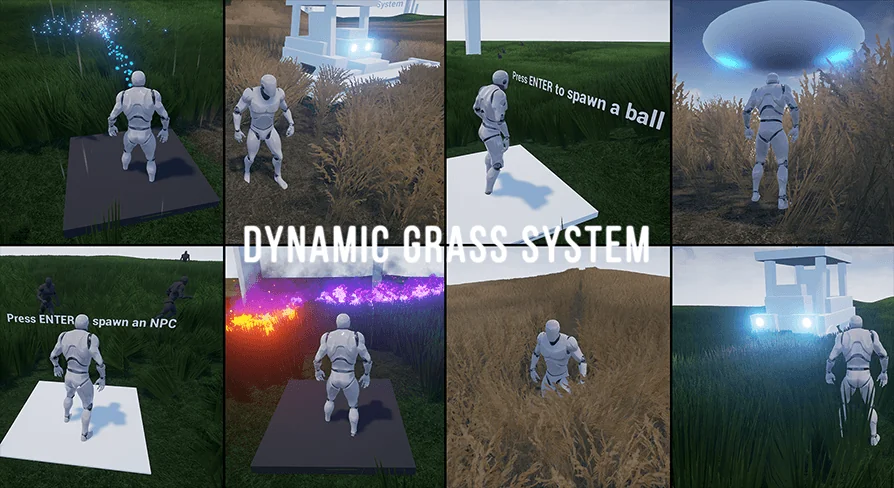
Dynamic Grass System ships with a broad set of interaction effects included by default. Shockwaves allow grass to react to impacts and explosions visibly. The deforming system lets grass bend and flatten under pressure or movement. Burning is combined with fire propagation, meaning fire can spread across grass instances rather than simply playing a fixed animation on one patch. Cutting, growing, removing, and ground blending round out the default behavior set.
These behaviors can be triggered whether the grass is placed through the Unreal Engine Foliage Tool or spawned dynamically during gameplay. The 4.26+ overhaul greatly optimized the interaction system itself, improved the interaction effects, and added new interaction parameters, giving developers more control over how grass responds to stimuli. Wind behavior has also seen dedicated attention in earlier updates: in-game smooth wind strength and wind direction change effects were improved in the 4.22+ version, and a bug causing grass stretch under strong wind parameters was fixed.
Fire Propagation and Cutting Mechanics
Among the interaction effects, fire propagation and cutting stand out as mechanics that change how grass functions as gameplay. Fire propagation means that once burning starts on a patch of grass, it can spread across connected instances, creating a simulation where the firefront advances through the field. This is distinct from a purely cosmetic burning effect; the spread behavior implies a State Machine running across grass instances.
Cutting adds a different gameplay vector, allowing grass to be removed or altered by player or environmental action. Combined with the growing and removing effects, developers can build sequences where grass is destroyed and regrown within a single play session. The Level of Detail (LOD) deform bug on the Hierarchical Instanced Static Mesh (HISM) component that previously appeared when removing instances in Unreal Engine 4.22 was fixed, which stabilized the cutting and removing workflows for that version.
Performance and Chunking in Grass Simulation
Performance is a central concern for any interactive foliage system. The 4.26+ update overhauled the internal systems specifically to make the tool more optimized, flexible, and visually improved. The interaction system was greatly optimized, and the default grass shader received its own optimization pass. Faster loading times were achieved by optimizing the initial chunking process, the method by which grass instances are divided into manageable spatial groups for processing.
The internal logic was simplified, which reduced overhead and made the system easier to maintain. For projects targeting modern rendering pipelines, the system has been tuned to work with the Lumen system without issues, and the 4.26 version is compatible with Unreal Engine 5 Early Access. This makes the tool a candidate for projects transitioning from UE4 to UE5 without requiring a full foliage rewrite.
Ground Blending and Material Flexibility
Ground blending is included as one of the default effects, allowing grass to integrate visually with the underlying terrain rather than sitting as a separate layer. The grass Material received additional options in the 4.26+ update, specifically aimed at easing the process of using custom meshes. This reduces the friction of introducing new vegetation types into the system.
The default grass shader was optimized for performance, and the expanded Material options mean that the look and feel of the grass can be adjusted without leaving the Blueprint framework. Whether the project calls for lush fields, scattered bushes, or wheat-like growth, the Material System is set up to accept those variations.
Runtime Spawning Dynamics and UE Foliage Tool Integration
The system supports 2 primary placement workflows. The first is the Unreal Engine Foliage Tool, the built-in editor method for painting vegetation across landscapes. The second is dynamic in-game spawning, where grass instances are generated at runtime based on gameplay logic or procedural rules. Both paths support the full interaction set, including shockwaves, burning, and cutting.
For the 4.22+ version, the demo effects were improved and eye adaptation in demo scenes was changed to match the new 4.22 standard. A new demo executable is available for the 4.26+ version, allowing developers to evaluate the interaction system in a standalone build before implementing it in their own projects. A backup of the project is recommended before applying the 4.26+ update, given the scale of the internal overhaul.
The tag set associated with the system reflects its scope: it spans gameplay, simulation, procedural generation, and environmental art. Tags such as Burning, Wind, Interactive, Spread, and Simulation point to the runtime behavior side, while Foliage, Grass, Bush, and Field point to the environmental application side. The inclusion of Universal and Blueprint in the tag set aligns with the system's Blueprint-only architecture and its compatibility with any grass mesh.
Dynamic Grass System is set up to handle interactive vegetation across 2 workflows, editor-painted and runtime-spawned, with a tested set of effects that cover destruction, growth, fire spread, and environmental reaction. The 4.26+ overhaul brought optimization, Lumen compatibility, and Unreal Engine 5 Early Access (UE5 EA) support, while the Blueprint foundation keeps the implementation path accessible without custom code.
 Gameplay Features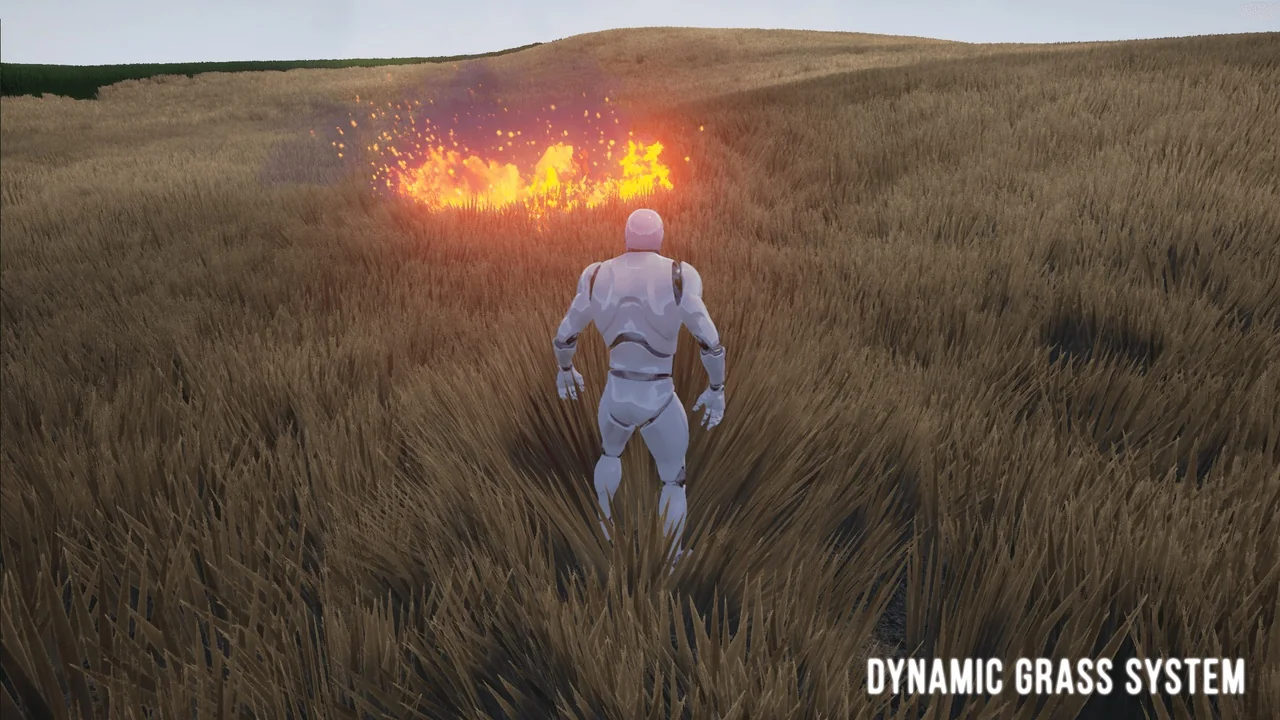
 Gameplay Features
 Gameplay Features
 Gameplay Features