"7b46a695175d8694"{"id":"1001513","slug":"dust-and-smoke-effects-50-niagara-systems","title":"Dust \u0026 Smoke Effects | 50+ Niagara Systems","category":"Smoke","engine":"4.25+,5.0+","assetVersion":"","engineVersion":"Engine Version: 4.25+,5.0+","tag":"Smoke","accent":"blue","visual":"mech","summary":"Layer environments with over 50 Niagara dust and smoke systems, spline-based smoke placement, exposed parameters, and cinematic scalability settings.","platform":"Unreal Engine","publishedAt":"2026-10-09T13:13:35.970Z","updatedAt":"2026-10-09T13:13:35.970Z","sourceNotes":[],"fileContents":[],"compatibility":["Unreal Engine","Engine Version: 4.25+,5.0+"],"featuredImage":{"alt":"Dust \u0026 Smoke Effects | 50+ Niagara Systems","src":"/wp-content/uploads/published/2026/10/7cda999243c5-69a4857b-7fcd-42bd-9953-cec1f67e8d1a-6f9efbf21c.webp"},"hasDownloadLink":true,"downloads":0,"terms":[{"taxonomy":"category","slug":"smoke","name":"Smoke"}],"galleryImages":[{"src":"/wp-content/uploads/published/2026/10/a14070ce65a7-918eb265-ae8b-4643-b3c9-5e709b4f350a-754b842ae9.webp","alt":"Dust \u0026 Smoke Effects | 50+ Niagara Systems"},{"src":"/wp-content/uploads/published/2026/10/4614732fa047-4e3710b1-ba8f-47e4-98b1-0a1b31967cf8-c67f875075.webp","alt":"Dust \u0026 Smoke Effects | 50+ Niagara Systems"},{"src":"/wp-content/uploads/published/2026/10/0329e19e13ab-91d4fc3e-dc3e-4860-9743-5be8b1ea91f2-91dba6418e.webp","alt":"Dust \u0026 Smoke Effects | 50+ Niagara Systems"},{"src":"/wp-content/uploads/published/2026/10/75c2d6d10b02-92dbd00e-d280-4fd3-9161-e87e6e08281c-2ac403f644.webp","alt":"Dust \u0026 Smoke Effects | 50+ Niagara Systems"},{"src":"/wp-content/uploads/published/2026/10/a870ddfc7265-da99148b-ccd8-410e-9804-a5461e0dc30e-8da8f22476.webp","alt":"Dust \u0026 Smoke Effects | 50+ Niagara Systems"},{"src":"/wp-content/uploads/published/2026/10/6a68bd78782a-3caa706e-50fe-4f8e-8383-22a430f021a5-463c43d43c.webp","alt":"Dust \u0026 Smoke Effects | 50+ Niagara Systems"},{"src":"/wp-content/uploads/published/2026/10/87a78715d69d-0b7491d7-c819-4124-9f15-e1d045324b03-3f61899d3b.webp","alt":"Dust \u0026 Smoke Effects | 50+ Niagara Systems"},{"src":"/wp-content/uploads/published/2026/10/ca6200fa327e-7615620f-4276-4a74-b363-4768033b6f1f-b3b4384a47.webp","alt":"Dust \u0026 Smoke Effects | 50+ Niagara Systems"},{"src":"/wp-content/uploads/published/2026/10/a30b30d19421-bdfd8f02-2079-4a73-929b-532c25c17f49-7376c9b8af.webp","alt":"Dust \u0026 Smoke Effects | 50+ Niagara Systems"},{"src":"/wp-content/uploads/published/2026/10/14d87f7e0648-1288ad81-ab73-4cb6-8416-92588cbfa1f5-8fecfda17b.webp","alt":"Dust \u0026 Smoke Effects | 50+ Niagara Systems"}],"accessPanel":{"kind":"resource","title":"Download this resource","eyebrow":"Free Download","message":"Log in or create a free account to start your download.","fileName":"Content.7z","safetyNote":"Resources are manually reviewed before listing to improve quality and reduce obvious risks.","actionLabel":"Download Free","resourceType":"Resource archive"},"contentHtml":"\u003ch2\u003eAtmospheric Density and Environmental Depth Challenges\u003c/h2\u003e\u003cp\u003ePopulating a digital environment with realistic air movement often stalls when particle effects lack volumetric variety or force artists to scatter identical sprites across an entire level.\u003c/p\u003e\u003cp\u003eStandard atmospheric dressing requires distinct silhouettes, varying drift speeds, and localized density to feel natural. Instead of relying on uniform fog cards, working with shaped smoke, moving dust, and controllable atmosphere gives level designers the ability to establish clear visual depth. Introducing dynamic particle flow transforms sterile scenes into living spaces where moving air, background haze, and lingering particulate matter interact believably with world geometry.\u003c/p\u003e\u003ch2\u003eStructuring Formations with the Spline Smoke Blueprint\u003c/h2\u003e\u003cp\u003eLarge-scale smoke formations often require continuous, guided coverage rather than isolated circular bursts.\u003c/p\u003e\u003cp\u003eThe included Spline Smoke Blueprint addresses this placement challenge by allowing artists to distribute larger smoke volumes along arbitrary linear and curved paths. By drawing splines across ravines, along damaged building walls, through trenches, or along road boundaries, smoke can be routed precisely through environmental architecture. This system eliminates the need to manually align dozens of individual particle emitters to cover long distances, creating cohesive visual bands of rolling smoke that hug terrain and architectural features.\u003c/p\u003e\u003ch2\u003eAdjusting 50+ Niagara Systems for Varied Motion and Scale\u003c/h2\u003e\u003cp\u003eThe collection provides more than 50 Niagara systems tailored to diverse environmental conditions, collision responses, and air turbulence types.\u003c/p\u003e\u003cp\u003eThese systems feature varied smoke shapes, distinct dust formations, and differing motion profiles to suit wide-ranging scene demands. Exposed effect parameters allow artists to tweak core behavioral attributes directly within the engine without opening underlying emitter logic. These controls make it straightforward to tailor the velocity, life cycle, and visual thickness to match scenes involving ground debris, structural explosions, tree collisions, falling water spray, or active war zones.\u003c/p\u003e\u003ch2\u003eConfiguring Emitter Scalability for Cinematic Passes\u003c/h2\u003e\u003cp\u003eHigh-end cinematic rendering demands uncompromised visual density that real-time game optimization settings typically prune or scale down.\u003c/p\u003e\u003cp\u003eTo configure these systems for offline or cinematic capture, open the specific emitter assets—including EnvEmitter, GasEmitter, HitEmitter, and VehicleEmitter. Within each asset, navigate to the Emitter Update section and uncheck every option listed under the Scalability category. Disabling these real-time culling rules forces the Niagara systems to maintain full particle fidelity regardless of camera proximity or rendering load, after which scene performance should be tested to ensure the hardware accommodates the unconstrained particle counts.\u003c/p\u003e\u003ch2\u003eIntegration Constraints and Pipeline Placement\u003c/h2\u003e\u003cp\u003eReal-time rendering features have explicit boundaries within this particle suite that dictate where and how the effects can be deployed.\u003c/p\u003e\u003cp\u003eThe package is not compatible with Path Tracing, meaning all particle rendering must occur through standard rasterized or screen-space lighting pipelines. Furthermore, the accompanying demo content—including showcase environments, character models, and audio elements—serves exclusively as reference presentation and is not bundled with the effect library itself. Because these assets are also included within Dust and SandStorm FX, checking current project libraries prevents unnecessary asset redundancy when outfitting real-time destruction sequences, vehicle tire kickup, and environmental drift.\u003c/p\u003e\n\n\u003ch2\u003eRelated Resources Worth Checking\u003c/h2\u003e\n\u003cul\u003e\n\u003cli\u003e\u003ca href=\"https://3dcghub.com/realistic-shockwaves-2d-effects-pack/\" title=\"Realistic Shockwaves 2d Effects Pack\"\u003eRealistic Shockwaves 2d Effects Pack\u003c/a\u003e\u003c/li\u003e\n\u003cli\u003e\u003ca href=\"https://3dcghub.com/loop-smoke-niagara-02/\" title=\"Loop Smoke Niagara 02\"\u003eLoop Smoke Niagara 02\u003c/a\u003e\u003c/li\u003e\n\u003cli\u003e\u003ca href=\"https://3dcghub.com/toxic-gas-pack/\" title=\"Toxic Gas Pack\"\u003eToxic Gas Pack\u003c/a\u003e\u003c/li\u003e\n\u003cli\u003e\u003ca href=\"https://3dcghub.com/stylized-dust-impact/\" title=\"Stylized Dust Impact\"\u003eStylized Dust Impact\u003c/a\u003e\u003c/li\u003e\n\u003cli\u003e\u003ca href=\"https://3dcghub.com/smoke-burst-fx-vdb/\" title=\"Smoke Burst FX VDB\"\u003eSmoke Burst FX VDB\u003c/a\u003e\u003c/li\u003e\n\u003c/ul\u003e","contentTextLength":3822,"navigation":{"current":32,"total":3481,"previous":{"id":"1001514","slug":"dviz-realistic-house-archviz-project","title":"DVIZ Realistic House Archviz Project","category":"Buildings \u0026 Architecture","platform":"Unreal Engine","updatedAt":"2026-10-09T13:14:25.715Z"},"next":{"id":"1001512","slug":"deserted-industrial-ruins-abandoned-oasis","title":"Deserted Industrial Ruins - Abandoned Oasis","category":"Desert","platform":"Unreal Engine","updatedAt":"2026-10-09T13:12:37.199Z"}},"relatedResources":[{"id":"16042","slug":"loop-smoke-niagara-02","title":"Loop Smoke Niagara 02","category":"Smoke","engine":"4.26+,5.0+","assetVersion":"Engine version: 4.26+,5.0+","engineVersion":"4.27","tag":"Smoke","accent":"blue","visual":"luts","summary":"Enhance your Unreal Engine projects with Loop Smoke Niagara 02, a specialized pack featuring 10 looping smoke effects. These assets include slow-motion capabilities and are built using the Niagara Particle System.","platform":"Unreal Engine","publishedAt":"2026-03-12T16:04:37.000Z","updatedAt":"2026-04-19T15:44:38.000Z","sourceNotes":[],"fileContents":[],"compatibility":["Unreal Engine","Engine version: 4.26+,5.0+"],"featuredImage":{"alt":"Loop Smoke Niagara 02","src":"https://3dcghub.com/wp-content/uploads/2026/03/9714c98b-68c8-4846-b24e-eaab11544da9.webp"},"hasDownloadLink":true,"downloads":0},{"id":"16055","slug":"realistic-shockwaves-2d-effects-pack","title":"Realistic Shockwaves 2d Effects Pack","category":"Smoke","engine":"4.26+,5.0+","assetVersion":"Engine version: 4.26+,5.0+","engineVersion":"4.26","tag":"Smoke","accent":"blue","visual":"city","summary":"Enhance your Unreal Engine projects with the Realistic Shockwaves 2d Effects Pack. This collection features 10 high-quality 2D effects with customizable controls for speed, color, and emission.","platform":"Unreal Engine","publishedAt":"2026-03-12T16:04:50.000Z","updatedAt":"2026-04-19T15:44:38.000Z","sourceNotes":[],"fileContents":[],"compatibility":["Unreal Engine","Engine version: 4.26+,5.0+"],"featuredImage":{"alt":"Realistic Shockwaves 2d Effects Pack","src":"https://3dcghub.com/wp-content/uploads/2026/03/bca5763b-5fed-4b27-9637-26702c2dfcf4.webp"},"hasDownloadLink":true,"downloads":0},{"id":"16136","slug":"toxic-gas-pack","title":"Toxic Gas Pack","category":"Smoke","engine":"4.26+,5.0+","assetVersion":"Engine version: 4.26+,5.0+","engineVersion":"4.26","tag":"Smoke","accent":"blue","visual":"luts","summary":"The Toxic Gas Pack offers a collection of 14 realistic VFX assets designed for game development. Utilizing the Niagara system, these effects create immersive smoke and gas environments for various digital projects.","platform":"Unreal Engine","publishedAt":"2026-03-12T16:22:04.000Z","updatedAt":"2026-04-19T15:44:37.000Z","sourceNotes":[],"fileContents":[],"compatibility":["Unreal Engine","Engine version: 4.26+,5.0+"],"featuredImage":{"alt":"Toxic Gas Pack","src":"https://3dcghub.com/wp-content/uploads/2026/03/dbd2da01-c44e-4352-a2cd-448c26a97c15.webp"},"hasDownloadLink":true,"downloads":0}]}
Smoke
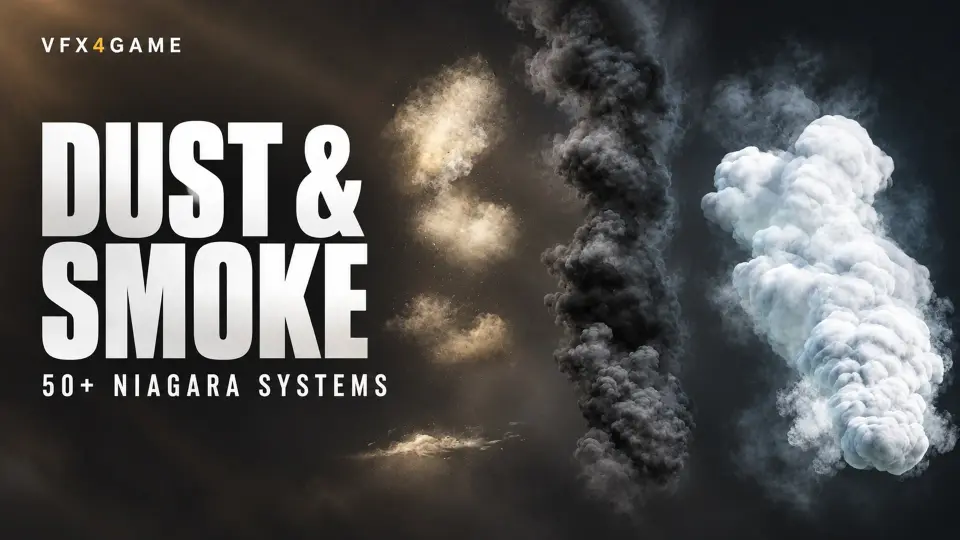
Dust & Smoke Effects | 50+ Niagara Systems
Layer environments with over 50 Niagara dust and smoke systems, spline-based smoke placement, exposed parameters, and cinematic scalability settings.
Category:Unreal Engine,SmokePlatform: Unreal EngineEngine Version: 4.25+,5.0+Published: Oct 9, 2026
Smoke
Resource overview
Atmospheric Density and Environmental Depth Challenges
Populating a digital environment with realistic air movement often stalls when particle effects lack volumetric variety or force artists to scatter identical sprites across an entire level.
Standard atmospheric dressing requires distinct silhouettes, varying drift speeds, and localized density to feel natural. Instead of relying on uniform fog cards, working with shaped smoke, moving dust, and controllable atmosphere gives level designers the ability to establish clear visual depth. Introducing dynamic particle flow transforms sterile scenes into living spaces where moving air, background haze, and lingering particulate matter interact believably with world geometry.
Structuring Formations with the Spline Smoke Blueprint
Large-scale smoke formations often require continuous, guided coverage rather than isolated circular bursts.
The included Spline Smoke Blueprint addresses this placement challenge by allowing artists to distribute larger smoke volumes along arbitrary linear and curved paths. By drawing splines across ravines, along damaged building walls, through trenches, or along road boundaries, smoke can be routed precisely through environmental architecture. This system eliminates the need to manually align dozens of individual particle emitters to cover long distances, creating cohesive visual bands of rolling smoke that hug terrain and architectural features.
Adjusting 50+ Niagara Systems for Varied Motion and Scale
The collection provides more than 50 Niagara systems tailored to diverse environmental conditions, collision responses, and air turbulence types.
These systems feature varied smoke shapes, distinct dust formations, and differing motion profiles to suit wide-ranging scene demands. Exposed effect parameters allow artists to tweak core behavioral attributes directly within the engine without opening underlying emitter logic. These controls make it straightforward to tailor the velocity, life cycle, and visual thickness to match scenes involving ground debris, structural explosions, tree collisions, falling water spray, or active war zones.
Configuring Emitter Scalability for Cinematic Passes
High-end cinematic rendering demands uncompromised visual density that real-time game optimization settings typically prune or scale down.
To configure these systems for offline or cinematic capture, open the specific emitter assets—including EnvEmitter, GasEmitter, HitEmitter, and VehicleEmitter. Within each asset, navigate to the Emitter Update section and uncheck every option listed under the Scalability category. Disabling these real-time culling rules forces the Niagara systems to maintain full particle fidelity regardless of camera proximity or rendering load, after which scene performance should be tested to ensure the hardware accommodates the unconstrained particle counts.
Integration Constraints and Pipeline Placement
Real-time rendering features have explicit boundaries within this particle suite that dictate where and how the effects can be deployed.
The package is not compatible with Path Tracing, meaning all particle rendering must occur through standard rasterized or screen-space lighting pipelines. Furthermore, the accompanying demo content—including showcase environments, character models, and audio elements—serves exclusively as reference presentation and is not bundled with the effect library itself. Because these assets are also included within Dust and SandStorm FX, checking current project libraries prevents unnecessary asset redundancy when outfitting real-time destruction sequences, vehicle tire kickup, and environmental drift.
 Smoke
Smoke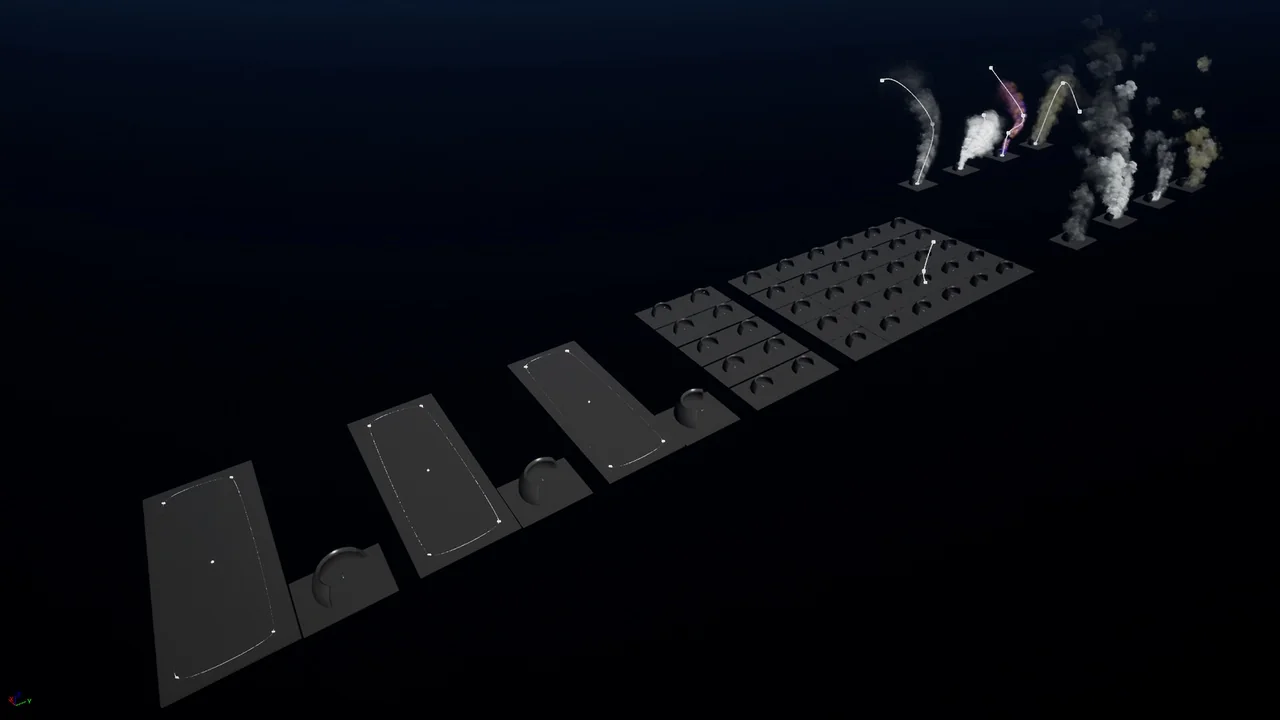
 Smoke
Smoke Smoke
Smoke Smoke
Smoke