"1062d43bc714d570"{"id":"1001440","slug":"detective-office-kit","title":"Detective office kit","category":"Office","engine":"4.26+,5.0+","assetVersion":"","engineVersion":"Engine Version: 4.26+,5.0+","tag":"Office","accent":"blue","visual":"mech","summary":"Explore the Detective office kit featuring ready-made workplace furniture, PBR materials, brick and wood surfaces, and props for games and cinematics.","platform":"Unreal Engine","publishedAt":"2026-10-07T08:33:14.213Z","updatedAt":"2026-10-07T08:33:14.213Z","sourceNotes":[],"fileContents":[],"compatibility":["Unreal Engine","Engine Version: 4.26+,5.0+"],"featuredImage":{"alt":"Detective office kit","src":"/wp-content/uploads/published/2026/10/b5d363f7da93-56234d8e-1bcb-4944-ab39-e5a63e14142d-a2b50462b3.webp"},"hasDownloadLink":true,"downloads":0,"terms":[{"taxonomy":"category","slug":"office","name":"Office"}],"galleryImages":[{"src":"/wp-content/uploads/published/2026/10/ac7df81bff58-70be9667-6146-4218-b572-4dfa9ed6154f-3b2c659886.webp","alt":"Detective office kit"},{"src":"/wp-content/uploads/published/2026/10/f5b62edf571d-aaae19ff-2aea-4f71-8656-f5ebeb56516e-5cb26dd758.webp","alt":"Detective office kit"},{"src":"/wp-content/uploads/published/2026/10/5c0f150023c5-5527bb26-1cef-48a6-a5c2-90b71eaebb0a-952619035b.webp","alt":"Detective office kit"},{"src":"/wp-content/uploads/published/2026/10/2b5745a1a55b-e67f39fe-9ce5-442d-a3fc-165bf098353d-0cd88fe9bf.webp","alt":"Detective office kit"},{"src":"/wp-content/uploads/published/2026/10/896f6e466797-28f7cafb-4e05-400d-adde-431b251725a6-06d69f7d8b.webp","alt":"Detective office kit"},{"src":"/wp-content/uploads/published/2026/10/e956d9453703-f5b5da91-b495-493d-b0bc-29b9dc9afaeb-ebc3e9e737.webp","alt":"Detective office kit"},{"src":"/wp-content/uploads/published/2026/10/ca9b36b32cae-3f28592a-2f63-4e3d-84fb-98d6a96f6aea-f15ed14ec8.webp","alt":"Detective office kit"},{"src":"/wp-content/uploads/published/2026/10/845b145d13ee-5c1ea4c6-63c0-4483-b344-e2ccb2ce5416-9d7cbc6605.webp","alt":"Detective office kit"},{"src":"/wp-content/uploads/published/2026/10/142a0848f29f-aef03cc6-c3ed-4633-9e18-c73902e44b3a-54a30c3804.webp","alt":"Detective office kit"},{"src":"/wp-content/uploads/published/2026/10/661b317ab12c-7b2575d8-5874-4737-ad39-7c0195ab1c72-2d0d93a5a2.webp","alt":"Detective office kit"}],"accessPanel":{"kind":"resource","title":"Download this resource","eyebrow":"Free Download","message":"Log in or create a free account to start your download.","fileName":"Content.7z","safetyNote":"Resources are manually reviewed before listing to improve quality and reduce obvious risks.","actionLabel":"Download Free","resourceType":"Resource archive"},"contentHtml":"\u003ch2\u003eReady-Made Workplace with Table, Armchair, and Office Elements\u003c/h2\u003e\u003cp\u003eA central workplace setup forms the core of the Detective office kit, grouping practical seating and surfaces into an immediately recognizable workstation. At the center of the configuration sits a primary work table paired with an armchair, establishing the spatial foundation needed for an investigative interior. These primary furniture pieces define the room layout, giving directors and level designers an anchored focal point around which surrounding props can be arranged.\u003c/p\u003e\u003cp\u003eRather than leaving the furniture bare, the kit organizes supporting items directly on and around the primary surfaces. Having a ready-made workplace configuration simplifies scene composition, allowing the relationship between the seating, desk area, and background architecture to function right away. This pre-assembled arrangement works as presented in preview material, ensuring that spatial proportions between the desk, the seated position, and nearby boundary surfaces remain consistent.\u003c/p\u003e\u003cp\u003eThe foundational layout mirrors the gritty, concentrated focus expected of an investigative space. The spatial interplay between the wooden desk and the armchair creates an immediate center of gravity, useful for dialogue scenes, cutscenes, or player-driven inspection mechanics where a character must approach an occupied or recently abandoned post.\u003c/p\u003e\u003ch2\u003eRealistic PBR Materials: Wood, Brick Wall, and Floor Surfaces\u003c/h2\u003e\u003cp\u003eSurface definition across the Detective office kit relies on a physically based rendering (PBR) workflow, ensuring accurate light response across both hard surfaces and contextual architecture. The architectural backdrop combines structural brick walls with solid floor planes, establishing the tactile boundaries of an interior room. Brickwork brings rough, uneven texturing into the background, contrasting with the smooth planes and edges of the central wooden furniture.\u003c/p\u003e\u003cp\u003ePBR material maps dictate how light bounces across these varied material types. Direct illumination catching the brick surface reveals crevices and mortar lines without flattening out under harsh lighting angles. Similarly, floor materials are calibrated to reflect ambient illumination naturally, grounding the heavy furniture resting on top of them.\u003c/p\u003e\u003cp\u003eWood surfaces on the main table carry distinct specular and roughness responses that differentiate finished carpentry from the masonry behind it. In game engines and offline rendering engines alike, this material separation helps maintain scene readability. Whether a project relies on baked lighting, dynamic ray tracing, or simple forward rendering, the realistic PBR material setup ensures that the wood, brick, and floor surfaces react consistently to changing light colors and exposure levels.\u003c/p\u003e\u003ch2\u003eDocument Props, Desk Accessories, and Trash Elements for Atmospheric Staging\u003c/h2\u003e\u003cp\u003eAtmosphere in an investigative setting depends heavily on fine details, which this set supplies through dedicated document props, general office accessories, and scattered trash. Clean desks rarely convey the pressure or exhaustion common to detective work; the presence of loose paperwork and debris shifts the tone of the space into something lived-in and actively utilized.\u003c/p\u003e\u003cp\u003eThe included documents provide natural set dressing for the tabletop and adjacent floor zones. Piles of paperwork or isolated pages can be spread out across the table to indicate active research, open cases, or neglected organizational duties. Because these document assets match the visual fidelity of the furniture, they integrate cleanly into close-up compositions without breaking immersion.\u003c/p\u003e\u003cp\u003eBeyond case files and paperwork, the pack introduces smaller accessories alongside explicit trash elements. These items break up clean lines and add realistic clutter around the armchair, under the table, or along the corners where the floor meets the brick wall. Introducing worn accessories and discarded waste changes the narrative weight of the room, turning a pristine architectural visualization into a moody, narrative-heavy environment suitable for dramatic storytelling.\u003c/p\u003e\u003ch2\u003eIntegration Across Game Engines, Rendering Engines, and Snow pack Set.1\u003c/h2\u003e\u003cp\u003eFlexibility across technical pipelines is a central trait of the package. The assets are prepared to operate within interactive real-time game engines as well as offline rendering engines, bridging the gap between interactive gameplay and pre-rendered cinematic visualization. Asset geometry and material properties are balanced to render cleanly in modern real-time viewports while retaining sufficient surface detail for high-resolution render passes.\u003c/p\u003e\u003cp\u003eTechnical compatibility also extends specifically to Snow pack Set.1. This cross-compatibility allows creators working with that specific collection to combine structural assets, materials, or props across both environments without suffering aesthetic clashes or technical workflow mismatches. Combining the pieces expands the scope of potential interior layouts while preserving consistent texture density and shading behaviors.\u003c/p\u003e\u003cp\u003eIn pipeline terms, having models that work equally well across rendering formats removes the need to rebuild shaders or re-author texture maps from scratch. An asset imported into a real-time game level behaves predictably under engine-native lights, and that same model can be migrated into a dedicated rendering suite for high-end cinematic stills without requiring material overhauls.\u003c/p\u003e\u003ch2\u003eScene Assembly for Interactive Games and Cinematics\u003c/h2\u003e\u003cp\u003eThe Detective office kit supports varied production types, explicitly serving video game development, cinematic film sequences, and adjacent creative projects. In game levels, the ready-made workplace can function as an interactive hub, a point-and-click examination zone, or a narrative backdrop discovered during exploration. The distinct presence of the table, chair, documents, and architectural elements provides clear visual landmarks for navigating interior spaces.\u003c/p\u003e\u003cp\u003eFor cinematic productions, the pack offers instant staging value. Camera operators can set up framing over the shoulder of the armchair, aim low-angle shots against the brick wall, or track down across the document-covered desk surface. The presence of incidental trash and realistic wear allows close-up camera passes to hold visual interest without exposing plain, untextured polygonal voids.\u003c/p\u003e\u003cp\u003eThe package equips 3D artists, level designers, and cinematic animators with a coherent, atmospheric interior ready for immediate placement. By unifying structural surfaces, essential furniture, and narrative clutter under a realistic PBR standard, it resolves the core requirements of an investigative interior space in a single modular set.\u003c/p\u003e\n\n\u003ch2\u003eExplore Similar Assets\u003c/h2\u003e\n\u003cul\u003e\n\u003cli\u003e\u003ca href=\"https://3dcghub.com/retro-office-prop/\" title=\"Retro Office Prop\"\u003eRetro Office Prop\u003c/a\u003e\u003c/li\u003e\n\u003cli\u003e\u003ca href=\"https://3dcghub.com/modern-modular-office/\" title=\"Modern Modular Office\"\u003eModern Modular Office\u003c/a\u003e\u003c/li\u003e\n\u003cli\u003e\u003ca href=\"https://3dcghub.com/detective-office/\" title=\"Detective Office\"\u003eDetective Office\u003c/a\u003e\u003c/li\u003e\n\u003cli\u003e\u003ca href=\"https://3dcghub.com/1940s-abandoned-office-modular/\" title=\"1940\u0026#039;s Abandoned Office (Modular)\"\u003e1940\u0026#039;s Abandoned Office (Modular)\u003c/a\u003e\u003c/li\u003e\n\u003cli\u003e\u003ca href=\"https://3dcghub.com/airport-set-vol2/\" title=\"Airport Set Vol2\"\u003eAirport Set Vol2\u003c/a\u003e\u003c/li\u003e\n\u003c/ul\u003e","contentTextLength":6850,"navigation":{"current":4,"total":3379,"previous":{"id":"1001441","slug":"foliage-vol-23-ivy-low-poly","title":"Foliage VOL.23 - Ivy (Low Poly)","category":"Plants","platform":"Unreal Engine","updatedAt":"2026-10-07T08:34:14.081Z"},"next":{"id":"1001439","slug":"hq-benches-vol-1","title":"HQ Benches Vol. 1","category":"Buildings \u0026 Architecture","platform":"Unreal Engine","updatedAt":"2026-10-07T08:32:21.093Z"}},"relatedResources":[{"id":"4078","slug":"retro-office-prop","title":"Retro Office Prop","category":"Office","engine":"4.26+,5.0+","assetVersion":"Engine version: 4.26+,5.0+","engineVersion":"5.3","tag":"Office","accent":"blue","visual":"city","summary":"Enhance your digital environments with this Retro Office Prop collection. Featuring 16 high-quality PBR assets, it is perfect for vintage game scenes.","platform":"Unreal Engine","publishedAt":"2026-02-09T13:27:00.000Z","updatedAt":"2026-04-19T15:57:30.000Z","sourceNotes":[],"fileContents":[],"compatibility":["Unreal Engine","Engine version: 4.26+,5.0+"],"featuredImage":{"alt":"Retro Office Prop","src":"https://3dcghub.com/wp-content/uploads/2026/02/e99cf6e2-e20d-4ca6-bd9d-85847769c484.webp"},"hasDownloadLink":true,"downloads":0},{"id":"1000529","slug":"modern-modular-office","title":"Modern Modular Office","category":"Interior","engine":"4.26+,5.0+","assetVersion":"","engineVersion":"Engine Version: 4.26+,5.0+","tag":"Interior","accent":"blue","visual":"mech","summary":"A modular office environment kit with tileable surfaces, furniture, electronics, plants, artworks, and lighting for building game levels or visualizations.","platform":"Unreal Engine","publishedAt":"2026-07-14T16:51:54.078Z","updatedAt":"2026-07-14T16:51:54.078Z","sourceNotes":[],"fileContents":[],"compatibility":["Unreal Engine","Engine Version: 4.26+,5.0+"],"featuredImage":{"alt":"Modern Modular Office","src":"/wp-content/uploads/published/2026/07/ed8be52323cb-cae80e79-411f-44b7-ac5e-dda04be3a570-3e76fb12df.webp"},"hasDownloadLink":true,"downloads":0},{"id":"8820","slug":"detective-office","title":"Detective Office","category":"Interior","engine":"4.26+,5.0+","assetVersion":"Engine version: 4.26+,5.0+","engineVersion":"4.19","tag":"Interior","accent":"blue","visual":"city","summary":"Transform your game project with a high-quality Detective Office environment. This pack features detailed interior and exterior designs perfect for immersive noir storytelling and investigative gameplay.","platform":"Unreal Engine","publishedAt":"2026-02-25T17:55:32.000Z","updatedAt":"2026-04-19T15:51:22.000Z","sourceNotes":[],"fileContents":[],"compatibility":["Unreal Engine","Engine version: 4.26+,5.0+"],"featuredImage":{"alt":"Detective Office","src":"https://3dcghub.com/wp-content/uploads/2026/02/b1654675-d705-444f-9269-75f68738ba6f.webp"},"hasDownloadLink":true,"downloads":1}]}
Office
Detective office kit
Explore the Detective office kit featuring ready-made workplace furniture, PBR materials, brick and wood surfaces, and props for games and cinematics.
Category:Unreal Engine,OfficePlatform: Unreal EngineEngine Version: 4.26+,5.0+Published: Oct 7, 2026
Office
Resource overview
Ready-Made Workplace with Table, Armchair, and Office Elements
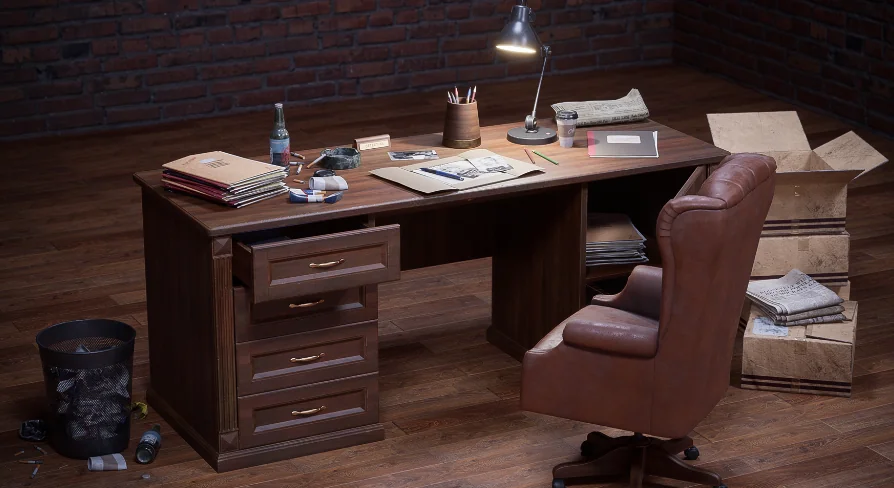
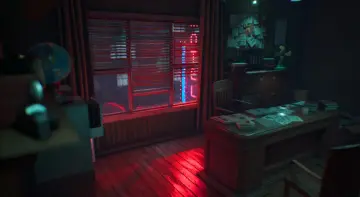
A central workplace setup forms the core of the Detective office kit, grouping practical seating and surfaces into an immediately recognizable workstation. At the center of the configuration sits a primary work table paired with an armchair, establishing the spatial foundation needed for an investigative interior. These primary furniture pieces define the room layout, giving directors and level designers an anchored focal point around which surrounding props can be arranged.
Rather than leaving the furniture bare, the kit organizes supporting items directly on and around the primary surfaces. Having a ready-made workplace configuration simplifies scene composition, allowing the relationship between the seating, desk area, and background architecture to function right away. This pre-assembled arrangement works as presented in preview material, ensuring that spatial proportions between the desk, the seated position, and nearby boundary surfaces remain consistent.
The foundational layout mirrors the gritty, concentrated focus expected of an investigative space. The spatial interplay between the wooden desk and the armchair creates an immediate center of gravity, useful for dialogue scenes, cutscenes, or player-driven inspection mechanics where a character must approach an occupied or recently abandoned post.
Realistic PBR Materials: Wood, Brick Wall, and Floor Surfaces
Surface definition across the Detective office kit relies on a physically based rendering (PBR) workflow, ensuring accurate light response across both hard surfaces and contextual architecture. The architectural backdrop combines structural brick walls with solid floor planes, establishing the tactile boundaries of an interior room. Brickwork brings rough, uneven texturing into the background, contrasting with the smooth planes and edges of the central wooden furniture.
PBR material maps dictate how light bounces across these varied material types. Direct illumination catching the brick surface reveals crevices and mortar lines without flattening out under harsh lighting angles. Similarly, floor materials are calibrated to reflect ambient illumination naturally, grounding the heavy furniture resting on top of them.
Wood surfaces on the main table carry distinct specular and roughness responses that differentiate finished carpentry from the masonry behind it. In game engines and offline rendering engines alike, this material separation helps maintain scene readability. Whether a project relies on baked lighting, dynamic ray tracing, or simple forward rendering, the realistic PBR material setup ensures that the wood, brick, and floor surfaces react consistently to changing light colors and exposure levels.
Document Props, Desk Accessories, and Trash Elements for Atmospheric Staging
Atmosphere in an investigative setting depends heavily on fine details, which this set supplies through dedicated document props, general office accessories, and scattered trash. Clean desks rarely convey the pressure or exhaustion common to detective work; the presence of loose paperwork and debris shifts the tone of the space into something lived-in and actively utilized.
The included documents provide natural set dressing for the tabletop and adjacent floor zones. Piles of paperwork or isolated pages can be spread out across the table to indicate active research, open cases, or neglected organizational duties. Because these document assets match the visual fidelity of the furniture, they integrate cleanly into close-up compositions without breaking immersion.
Beyond case files and paperwork, the pack introduces smaller accessories alongside explicit trash elements. These items break up clean lines and add realistic clutter around the armchair, under the table, or along the corners where the floor meets the brick wall. Introducing worn accessories and discarded waste changes the narrative weight of the room, turning a pristine architectural visualization into a moody, narrative-heavy environment suitable for dramatic storytelling.
Integration Across Game Engines, Rendering Engines, and Snow pack Set.1
Flexibility across technical pipelines is a central trait of the package. The assets are prepared to operate within interactive real-time game engines as well as offline rendering engines, bridging the gap between interactive gameplay and pre-rendered cinematic visualization. Asset geometry and material properties are balanced to render cleanly in modern real-time viewports while retaining sufficient surface detail for high-resolution render passes.
Technical compatibility also extends specifically to Snow pack Set.1. This cross-compatibility allows creators working with that specific collection to combine structural assets, materials, or props across both environments without suffering aesthetic clashes or technical workflow mismatches. Combining the pieces expands the scope of potential interior layouts while preserving consistent texture density and shading behaviors.
In pipeline terms, having models that work equally well across rendering formats removes the need to rebuild shaders or re-author texture maps from scratch. An asset imported into a real-time game level behaves predictably under engine-native lights, and that same model can be migrated into a dedicated rendering suite for high-end cinematic stills without requiring material overhauls.
Scene Assembly for Interactive Games and Cinematics
The Detective office kit supports varied production types, explicitly serving video game development, cinematic film sequences, and adjacent creative projects. In game levels, the ready-made workplace can function as an interactive hub, a point-and-click examination zone, or a narrative backdrop discovered during exploration. The distinct presence of the table, chair, documents, and architectural elements provides clear visual landmarks for navigating interior spaces.
For cinematic productions, the pack offers instant staging value. Camera operators can set up framing over the shoulder of the armchair, aim low-angle shots against the brick wall, or track down across the document-covered desk surface. The presence of incidental trash and realistic wear allows close-up camera passes to hold visual interest without exposing plain, untextured polygonal voids.
The package equips 3D artists, level designers, and cinematic animators with a coherent, atmospheric interior ready for immediate placement. By unifying structural surfaces, essential furniture, and narrative clutter under a realistic PBR standard, it resolves the core requirements of an investigative interior space in a single modular set.
 Office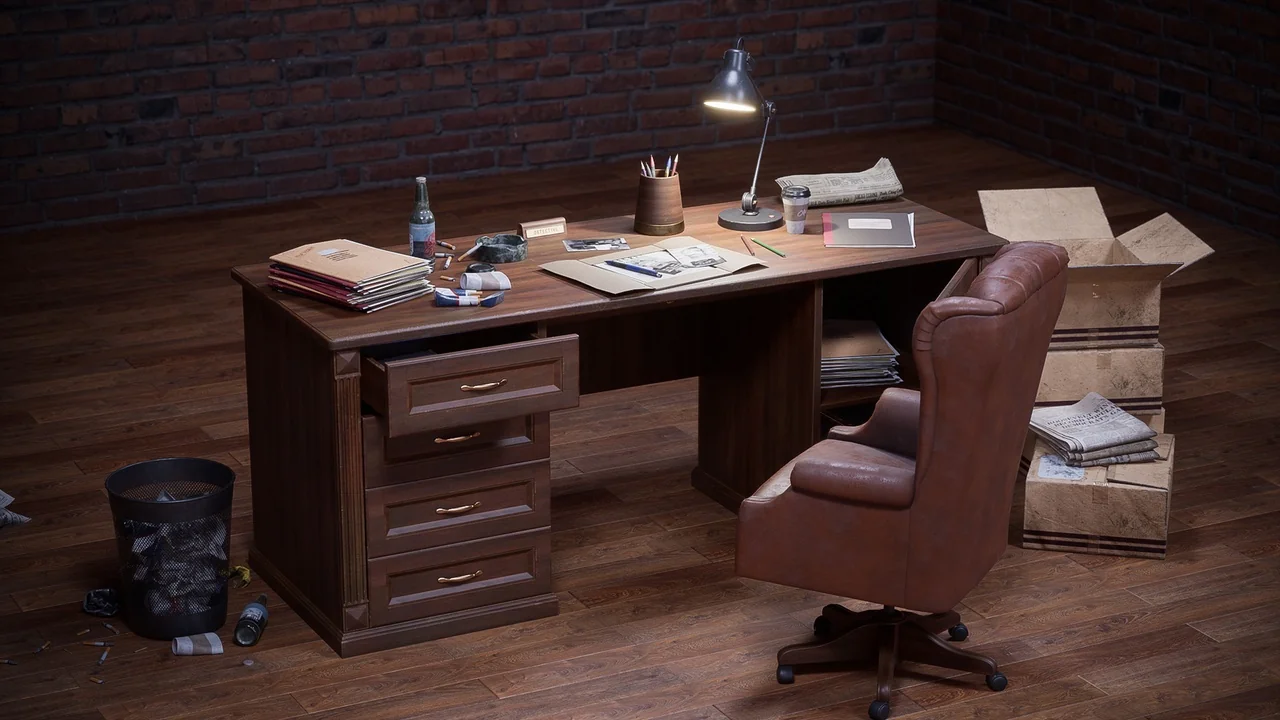
 Office
 Interior
 Interior