"82ee98b2ee2793f1"{"id":"1002427","slug":"cute-pet","title":"Cute Pet","category":"Animals","engine":"4.23+,5.0+","assetVersion":"","engineVersion":"Engine Version: 4.23+,5.0+","tag":"Animals","accent":"blue","visual":"mech","summary":"Examine the Cute Pet collection featuring 22 lowpoly animals, nine core animations, engine workflows across Unity3D and UE, and Yippy Kawaii compatibility.","platform":"Unreal Engine","indexPolicy":"index","publishedAt":"2026-11-10T18:20:59.773Z","updatedAt":"2026-11-10T18:20:59.773Z","sourceNotes":[],"fileContents":[],"compatibility":["Unreal Engine","Engine Version: 4.23+,5.0+"],"featuredImage":{"alt":"Cute Pet","src":"/wp-content/uploads/published/2026/11/da33d9c04bb9-6f70a7ba-8479-4cd9-a8bc-36f517b45ac1-4f5c3eba05.webp"},"hasDownloadLink":true,"downloads":0,"terms":[{"taxonomy":"category","slug":"animals","name":"Animals"}],"galleryImages":[{"src":"/wp-content/uploads/published/2026/11/c20ed0bb5bf4-100843bd-c732-449d-8fd0-6b70aedcf99e-f9f8f5df82.webp","alt":"Cute Pet"},{"src":"/wp-content/uploads/published/2026/11/25491bc8b0da-1680cba6-4941-4ee7-b2cb-5d8223aac8e9-6cf7b600f6.webp","alt":"Cute Pet"},{"src":"/wp-content/uploads/published/2026/11/c268b5f68cc3-45c1af14-b139-4e51-ba3e-3f2090a33ebe-1d013b8d0f.webp","alt":"Cute Pet"}],"accessPanel":{"kind":"resource","title":"Get this resource","eyebrow":"Free resource","message":"Download this resource in your browser.","fileName":"Content.7z","safetyNote":"Resources are manually reviewed before listing to improve quality and reduce obvious risks.","actionLabel":"Get this resource","resourceType":"Resource archive","versions":[]},"contentHtml":"\u003cp\u003eA small animal wanders across a stylized field, transitions smoothly into a grazing pose, and darts away when startled. In games that prioritize bright, welcoming aesthetics, non-player creatures must express recognizable emotional beats and life-like routines without demanding hyper-realistic skeletal rigs. The Cute Pet collection targets this specific production requirement by delivering a roster of twenty-two lowpoly animals supported by a standardized suite of fundamental behavioral animations.\u003c/p\u003e \u003ch2\u003eCute Pet Movement and Core Animation Cycles\u003c/h2\u003e\n\u003cp\u003eReal-time creatures require a dependable set of baseline motions to function convincingly in interactive environments. Cute Pet approaches this by implementing nine distinct animation clips across its characters. These clips cover the essential actions needed to assemble functional state machines for roaming wildlife, docile farm stock, or companion companions.\u003c/p\u003e \u003cp\u003eThe locomotion states form the operational backbone of the animation set:\u003c/p\u003e\n\u003cul\u003e\n\u003cli\u003e\u003cstrong\u003eIdle:\u003c/strong\u003e Establishes the neutral posture of the animal when resting between actions or awaiting navigation input.\u003c/li\u003e\n\u003cli\u003e\u003cstrong\u003eWalk:\u003c/strong\u003e Provides the pacing clip for ambient wander behaviors, basic follow commands, or relaxed patrol paths.\u003c/li\u003e\n\u003cli\u003e\u003cstrong\u003eRun:\u003c/strong\u003e Elevates movement speed to support fleeing, chasing, or fast-travel companion behaviors.\u003c/li\u003e\n\u003cli\u003e\u003cstrong\u003eJump:\u003c/strong\u003e Handles elevation shifts, clearing ground obstacles, or expressing energetic hops.\u003c/li\u003e\n\u003c/ul\u003e \u003cp\u003eBeyond simple locomotion, the animation suite features specific behavioral and combat-adjacent actions that broaden how creatures interact with their surroundings. The Eat animation introduces ambient life, allowing farm animals to graze or pets to consume food items directly from the game world. The Rest animation provides a secondary resting state, ideal for night-time routines, sleeping enclosures, or idling beside a player character.\u003c/p\u003e \u003cp\u003eWhen interactive scenes demand conflict or hazard responses, the Attack, Damage, and Die animations complete the gameplay loop. The Attack clip allows standard interactions such as defending a territory or executing a playful nip. The Damage motion supplies immediate feedback when a creature collides with a hazard or takes a hit, while the Die animation provides a clean terminal state for combat mechanics or life-cycle simulations.\u003c/p\u003e \u003ch2\u003eRoster Breakdown Across the Cute Pet Farm and Domestic Species\u003c/h2\u003e\n\u003cp\u003ePopulating stylized villages, ranches, and domestic interiors usually requires balancing multiple animal archetypes so scenes do not feel repetitive. With twenty-two unique animals in the package, creators can assemble diverse ecologies composed of familiar pets and agricultural livestock.\u003c/p\u003e \u003cp\u003eDomestic life forms a major pillar of the roster, featuring core house companions like the dog and the cat. These animals easily slide into pet-raising mechanics, domestic hub areas, or roaming neighborhood encounters. Their movement profiles accommodate close-range player following, home-based idle routines, and playful park interactions.\u003c/p\u003e \u003cp\u003eThe agricultural and rural side of the library introduces extensive variety across traditional barnyard fauna. Species such as the cow, horse, pig, sheep, and goat establish complete pastoral meadows and working farm enclosures. Because each animal shares the lowpoly aesthetic, these models can be grouped together in pens, pastures, or mountain slopes without visual discordance. The presence of both sheep and goats allows differentiation between lowland pens and rocky terrain, while cows and horses anchor larger paddocks.\u003c/p\u003e \u003cp\u003ePoultry and smaller fowl round out the agricultural selection, incorporating chickens, chicks, and ducks. The contrast between adult chickens and smaller chicks enables multi-stage animal growth systems, agricultural breeding loops, or vibrant barnyard scatter mechanics where mother hens lead groups of young fowl through fields.\u003c/p\u003e \u003ch2\u003eStylistic Consistency and Yippy Kawaii Compatibility\u003c/h2\u003e\n\u003cp\u003eVisual cohesion remains a critical hurdle when combining third-party assets in stylized projects. Models with mismatched polygon densities, conflicting edge treatments, or divergent proportions quickly shatter immersion. Cute Pet solves this by applying a unified lowpoly approach across all twenty-two species, reducing complex anatomical forms into clean, readable surfaces that suit lighthearted or whimsical visual targets.\u003c/p\u003e \u003cp\u003eThe package maintains direct compatibility with the Yippy Kawaii ecosystem. This compatibility ensures that the proportions, silhouette simplification, and overall aesthetic align with broader character, prop, and environment collections bearing the same visual signature. In practice, this means an animal from this lineup can sit alongside other Yippy Kawaii assets without appearing too angular, too detailed, or awkwardly proportioned relative to accompanying characters.\u003c/p\u003e \u003ch2\u003ePipeline Differences Between Unity3D and Unreal Engine Implementations\u003c/h2\u003e\n\u003cp\u003eIntegrating Cute Pet across different game engines involves understanding key differences in how the assets are bundled and configured for each platform environment.\u003c/p\u003e \u003cp\u003eIn Unity3D, the package functions as an out-of-the-box showcase. The animation examples are demonstrated directly inside Unity3D, allowing developers to inspect clip transitions, rig alignments, and playback speeds in the native Unity animator. Furthermore, the Unity3D implementation includes dedicated scripting and a specialized Toon shader, making it straightforward to replicate the flat, bright, shaded look seen in preview demonstrations without writing custom surface shaders or interaction controllers.\u003c/p\u003e \u003cp\u003eThe Unreal Engine (UE) version of the asset delivers the same core meshes and skeletal structures, but it does not come with the custom script or the Toon shader included in the Unity setup. For Unreal Engine teams, this structural difference requires specific workflow adjustments:\u003c/p\u003e\n\u003cul\u003e\n\u003cli\u003e\u003cstrong\u003eShading Strategy:\u003c/strong\u003e Unreal Engine developers must construct their own stylized materials, whether by leveraging unlit emissive shading, custom post-process Cel shaders, or specialized material graphs to match the intended cute aesthetic.\u003c/li\u003e\n\u003cli\u003e\u003cstrong\u003eLogic and Scripting:\u003c/strong\u003e Because engine-specific scripts are omitted in the UE version, state logic, movement handling, and AI controllers must be authored within Unreal Engine using Blueprints or C++.\u003c/li\u003e\n\u003cli\u003e\u003cstrong\u003eAnimation Assembly:\u003c/strong\u003e The nine animations map naturally into Unreal Engine Animation Blueprints and Blend Spaces, but state transitions between Idle, Walk, Run, and action clips require manual state machine configuration.\u003c/li\u003e\n\u003c/ul\u003e \u003ch2\u003eEvaluating Practical Production Roles\u003c/h2\u003e\n\u003cp\u003eCute Pet delivers practical value for productions targeting farming simulations, casual pet simulators, top-down adventure games, and stylized mobile titles. Because the package emphasizes lowpoly geometry, the twenty-two models generate minimal rendering overhead, permitting large herds of sheep, roaming packs of dogs, or sprawling poultry pens on resource-constrained platforms.\u003c/p\u003e \u003cp\u003eTeams building in Unity3D can deploy the assets rapidly by capitalizing on the supplied scripts and Toon shader. Teams working inside Unreal Engine should account for the brief material and Blueprint setup time needed to integrate the bare models and animation sequences into their native pipelines. In either framework, the combination of twenty-two distinct species, nine essential animation states, and explicit Yippy Kawaii compatibility provides an efficient, stylized foundation for any game environment calling for charming animal life.\u003c/p\u003e\n\n\u003ch2\u003eContinue Browsing Similar Packs\u003c/h2\u003e\n\u003cul\u003e\n\u003cli\u003e\u003ca href=\"https://3dcghub.com/cute-hamsters/\" rel=\"noopener noreferrer\"\u003eCute Hamsters\u003c/a\u003e\u003c/li\u003e\n\u003cli\u003e\u003ca href=\"https://3dcghub.com/spiders-pack/\" rel=\"noopener noreferrer\"\u003eSpiders pack\u003c/a\u003e\u003c/li\u003e\n\u003cli\u003e\u003ca href=\"https://3dcghub.com/yippy-kawaii/\" rel=\"noopener noreferrer\"\u003eYippy Kawaii\u003c/a\u003e\u003c/li\u003e\n\u003cli\u003e\u003ca href=\"https://3dcghub.com/animal-pack-ultra/\" rel=\"noopener noreferrer\"\u003eAnimal Pack Ultra\u003c/a\u003e\u003c/li\u003e\n\u003cli\u003e\u003ca href=\"https://3dcghub.com/cats-pack/\" rel=\"noopener noreferrer\"\u003eCats Pack\u003c/a\u003e\u003c/li\u003e\n\u003c/ul\u003e","contentTextLength":7529,"navigation":{"current":23,"total":4372,"previous":{"id":"1002428","slug":"cute-whale","title":"Cute Whale","category":"Animals","platform":"Unreal Engine","updatedAt":"2026-11-10T18:21:28.224Z"},"next":{"id":"1002426","slug":"cute-kitten","title":"Cute Kitten","category":"Characters \u0026 Creatures","platform":"Unreal Engine","updatedAt":"2026-11-10T18:20:17.778Z"}},"relatedResources":[{"id":"1002428","slug":"cute-whale","title":"Cute Whale","category":"Animals","engine":"4.19+,5.0+","assetVersion":"","engineVersion":"Engine Version: 4.19+,5.0+","tag":"Animals","accent":"blue","visual":"mech","summary":"Explore the low-poly Cute Whale asset, featuring 25 color variants, emotion textures, Unity animation setups, and Yippy Kawaii compatibility.","platform":"Unreal Engine","indexPolicy":"index","publishedAt":"2026-11-10T18:21:28.224Z","updatedAt":"2026-11-10T18:21:28.224Z","sourceNotes":[],"fileContents":[],"compatibility":["Unreal Engine","Engine Version: 4.19+,5.0+"],"featuredImage":{"alt":"Cute Whale","src":"/wp-content/uploads/published/2026/11/99e8d15fc0fb-90f4a311-ac19-413a-8b2f-a246e91f74cf-5630d0ffd1.webp"},"hasDownloadLink":true,"downloads":0},{"id":"1002313","slug":"cute-hamsters","title":"Cute Hamsters","category":"Animals","engine":"4.20+,5.0+","assetVersion":"","engineVersion":"Engine Version: 4.20+,5.0+","tag":"Animals","accent":"blue","visual":"mech","summary":"Cute Hamsters packs 31 hamster characters and 12 animations, with a Unity3D animation example and a UE version that omits the script and Toon shader.","platform":"Unreal Engine","indexPolicy":"index","publishedAt":"2026-11-06T06:15:37.558Z","updatedAt":"2026-11-06T06:15:37.558Z","sourceNotes":[],"fileContents":[],"compatibility":["Unreal Engine","Engine Version: 4.20+,5.0+"],"featuredImage":{"alt":"Cute Hamsters","src":"/wp-content/uploads/published/2026/11/cd85b9463262-766c2630-3b0e-416b-a94d-4f2be305d982-f7b99950c0.webp"},"hasDownloadLink":true,"downloads":0},{"id":"1001364","slug":"spiders-pack","title":"Spiders pack","category":"Animals","engine":"4.23+,5.0+","assetVersion":"","engineVersion":"Engine Version: 4.23+,5.0+","tag":"Animals","accent":"blue","visual":"mech","summary":"Explore Spiders pack, featuring three unique meshes, six materials, and thirteen animations for cave, forest, and swamp fantasy creature encounters.","platform":"Unreal Engine","indexPolicy":"index","publishedAt":"2026-10-04T10:33:17.972Z","updatedAt":"2026-10-04T10:33:17.972Z","sourceNotes":[],"fileContents":[],"compatibility":["Unreal Engine","Engine Version: 4.23+,5.0+"],"featuredImage":{"alt":"Spiders pack","src":"/wp-content/uploads/published/2026/10/7fa8ce563f7a-bbb98fb7-f42c-41e4-b9bd-2282c79826c7-486fdee7a2.webp"},"hasDownloadLink":true,"downloads":3}]}
Animals
Cute Pet
Examine the Cute Pet collection featuring 22 lowpoly animals, nine core animations, engine workflows across Unity3D and UE, and Yippy Kawaii compatibility.
Category:Unreal Engine,AnimalsPlatform: Unreal EngineEngine Version: 4.23+,5.0+Published: Nov 10, 2026
Animals
Resource overview
A small animal wanders across a stylized field, transitions smoothly into a grazing pose, and darts away when startled. In games that prioritize bright, welcoming aesthetics, non-player creatures must express recognizable emotional beats and life-like routines without demanding hyper-realistic skeletal rigs. The Cute Pet collection targets this specific production requirement by delivering a roster of twenty-two lowpoly animals supported by a standardized suite of fundamental behavioral animations.
Cute Pet Movement and Core Animation Cycles
Real-time creatures require a dependable set of baseline motions to function convincingly in interactive environments. Cute Pet approaches this by implementing nine distinct animation clips across its characters. These clips cover the essential actions needed to assemble functional state machines for roaming wildlife, docile farm stock, or companion companions.
The locomotion states form the operational backbone of the animation set:
Idle: Establishes the neutral posture of the animal when resting between actions or awaiting navigation input.
Walk: Provides the pacing clip for ambient wander behaviors, basic follow commands, or relaxed patrol paths.
Run: Elevates movement speed to support fleeing, chasing, or fast-travel companion behaviors.
Beyond simple locomotion, the animation suite features specific behavioral and combat-adjacent actions that broaden how creatures interact with their surroundings. The Eat animation introduces ambient life, allowing farm animals to graze or pets to consume food items directly from the game world. The Rest animation provides a secondary resting state, ideal for night-time routines, sleeping enclosures, or idling beside a player character.
When interactive scenes demand conflict or hazard responses, the Attack, Damage, and Die animations complete the gameplay loop. The Attack clip allows standard interactions such as defending a territory or executing a playful nip. The Damage motion supplies immediate feedback when a creature collides with a hazard or takes a hit, while the Die animation provides a clean terminal state for combat mechanics or life-cycle simulations.
Roster Breakdown Across the Cute Pet Farm and Domestic Species
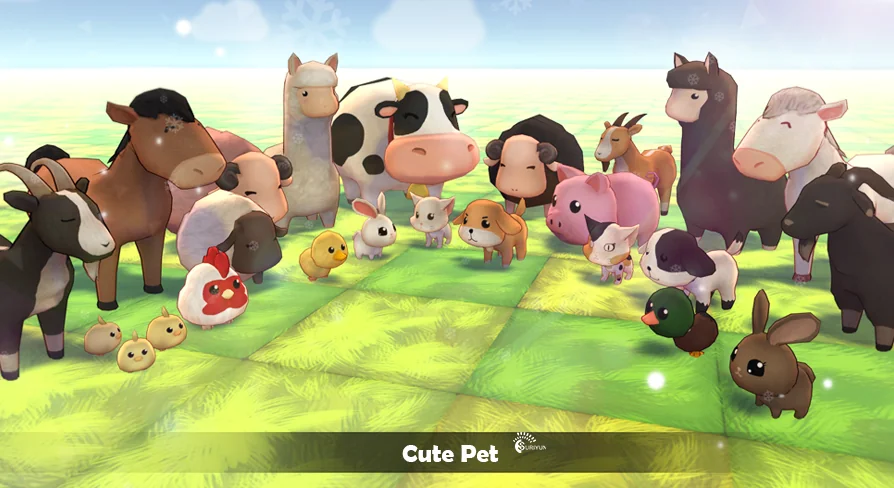
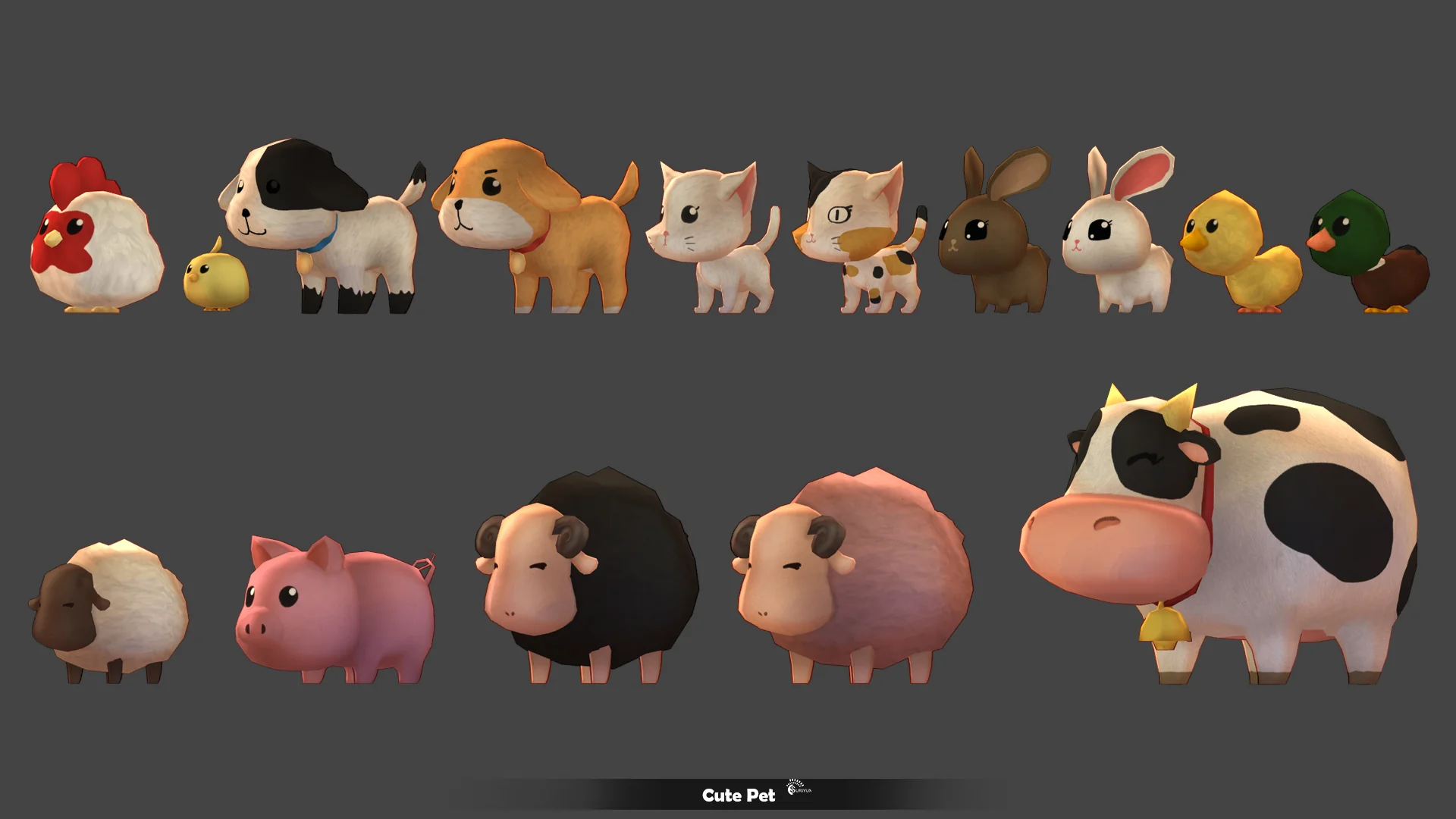
Populating stylized villages, ranches, and domestic interiors usually requires balancing multiple animal archetypes so scenes do not feel repetitive. With twenty-two unique animals in the package, creators can assemble diverse ecologies composed of familiar pets and agricultural livestock.
Domestic life forms a major pillar of the roster, featuring core house companions like the dog and the cat. These animals easily slide into pet-raising mechanics, domestic hub areas, or roaming neighborhood encounters. Their movement profiles accommodate close-range player following, home-based idle routines, and playful park interactions.
The agricultural and rural side of the library introduces extensive variety across traditional barnyard fauna. Species such as the cow, horse, pig, sheep, and goat establish complete pastoral meadows and working farm enclosures. Because each animal shares the lowpoly aesthetic, these models can be grouped together in pens, pastures, or mountain slopes without visual discordance. The presence of both sheep and goats allows differentiation between lowland pens and rocky terrain, while cows and horses anchor larger paddocks.
Poultry and smaller fowl round out the agricultural selection, incorporating chickens, chicks, and ducks. The contrast between adult chickens and smaller chicks enables multi-stage animal growth systems, agricultural breeding loops, or vibrant barnyard scatter mechanics where mother hens lead groups of young fowl through fields.
Stylistic Consistency and Yippy Kawaii Compatibility
Visual cohesion remains a critical hurdle when combining third-party assets in stylized projects. Models with mismatched polygon densities, conflicting edge treatments, or divergent proportions quickly shatter immersion. Cute Pet solves this by applying a unified lowpoly approach across all twenty-two species, reducing complex anatomical forms into clean, readable surfaces that suit lighthearted or whimsical visual targets.
The package maintains direct compatibility with the Yippy Kawaii ecosystem. This compatibility ensures that the proportions, silhouette simplification, and overall aesthetic align with broader character, prop, and environment collections bearing the same visual signature. In practice, this means an animal from this lineup can sit alongside other Yippy Kawaii assets without appearing too angular, too detailed, or awkwardly proportioned relative to accompanying characters.
Pipeline Differences Between Unity3D and Unreal Engine Implementations
Integrating Cute Pet across different game engines involves understanding key differences in how the assets are bundled and configured for each platform environment.
In Unity3D, the package functions as an out-of-the-box showcase. The animation examples are demonstrated directly inside Unity3D, allowing developers to inspect clip transitions, rig alignments, and playback speeds in the native Unity animator. Furthermore, the Unity3D implementation includes dedicated scripting and a specialized Toon shader, making it straightforward to replicate the flat, bright, shaded look seen in preview demonstrations without writing custom surface shaders or interaction controllers.
The Unreal Engine (UE) version of the asset delivers the same core meshes and skeletal structures, but it does not come with the custom script or the Toon shader included in the Unity setup. For Unreal Engine teams, this structural difference requires specific workflow adjustments:
Shading Strategy: Unreal Engine developers must construct their own stylized materials, whether by leveraging unlit emissive shading, custom post-process Cel shaders, or specialized material graphs to match the intended cute aesthetic.
Logic and Scripting: Because engine-specific scripts are omitted in the UE version, state logic, movement handling, and AI controllers must be authored within Unreal Engine using Blueprints or C++.
Animation Assembly: The nine animations map naturally into Unreal Engine Animation Blueprints and Blend Spaces, but state transitions between Idle, Walk, Run, and action clips require manual state machine configuration.
Evaluating Practical Production Roles
Cute Pet delivers practical value for productions targeting farming simulations, casual pet simulators, top-down adventure games, and stylized mobile titles. Because the package emphasizes lowpoly geometry, the twenty-two models generate minimal rendering overhead, permitting large herds of sheep, roaming packs of dogs, or sprawling poultry pens on resource-constrained platforms.
Teams building in Unity3D can deploy the assets rapidly by capitalizing on the supplied scripts and Toon shader. Teams working inside Unreal Engine should account for the brief material and Blueprint setup time needed to integrate the bare models and animation sequences into their native pipelines. In either framework, the combination of twenty-two distinct species, nine essential animation states, and explicit Yippy Kawaii compatibility provides an efficient, stylized foundation for any game environment calling for charming animal life.
 Animals
 Animals
 Animals
 Animals