"a19e0535960bd083"{"id":"1002084","slug":"crystals","title":"Crystals","category":"Tools, Objects \u0026 Decor","engine":"4.22+,5.0+","assetVersion":"","engineVersion":"Engine Version: 4.22+,5.0+","tag":"Tools","accent":"blue","visual":"mech","summary":"A close look at Crystals, featuring ten dynamic crystal materials with integrated visual shader effects, character appearance use, and dissolve behaviors.","platform":"Unreal Engine","publishedAt":"2026-10-26T15:53:48.524Z","updatedAt":"2026-10-26T15:53:48.524Z","sourceNotes":[],"fileContents":[],"compatibility":["Unreal Engine","Engine Version: 4.22+,5.0+"],"featuredImage":{"alt":"Crystals","src":"/wp-content/uploads/published/2026/10/3d3f811432f4-9db3a354-b1c7-4c83-a6d9-ed03c8d2dd66-15ba8596de.webp"},"hasDownloadLink":true,"downloads":0,"terms":[{"taxonomy":"category","slug":"tools-objects-and-decor","name":"Tools, Objects \u0026 Decor"}],"galleryImages":[{"src":"/wp-content/uploads/published/2026/10/d974aebd817e-5adbc953-fcb4-4411-b776-a5fae3f7fd99-b0328dd3d9.webp","alt":"Crystals"},{"src":"/wp-content/uploads/published/2026/10/3f39be284033-b309386d-a18b-4494-aea4-fd1929f2b481-0af7e3a7b0.webp","alt":"Crystals"},{"src":"/wp-content/uploads/published/2026/10/3036873d62b2-9c551ca6-f7d8-4be8-8c6a-e1608fa03de9-fb70a8c96b.webp","alt":"Crystals"},{"src":"/wp-content/uploads/published/2026/10/08e5a920106c-afa47ac4-d788-4457-bb01-2fe4cbe5d8fd-603f1b2396.webp","alt":"Crystals"},{"src":"/wp-content/uploads/published/2026/10/5a8efd30f73d-7d876486-0493-4b53-ad08-6eedbe46b5c2-e281fb917a.webp","alt":"Crystals"},{"src":"/wp-content/uploads/published/2026/10/ff10652dc10c-2ff06a35-a056-4ec4-b0db-26cd1abd2156-c0e6185b06.webp","alt":"Crystals"},{"src":"/wp-content/uploads/published/2026/10/ae968dc654ca-922b8d89-e809-42f8-9772-c1cf7f2b77d1-06d884c188.webp","alt":"Crystals"},{"src":"/wp-content/uploads/published/2026/10/19c08986d25d-b5c84a80-4b90-4648-98e4-fd9b6bb39563-5f44cbde94.webp","alt":"Crystals"},{"src":"/wp-content/uploads/published/2026/10/8c01b177cc4f-4eef2953-1277-4aba-a398-4cc32c87db1e-2882d4dbf3.webp","alt":"Crystals"},{"src":"/wp-content/uploads/published/2026/10/0ec0ab077c0a-76efe39c-ed47-4958-8b99-548b5e0a25ea-36315c8e63.webp","alt":"Crystals"}],"accessPanel":{"kind":"resource","title":"Download this resource","eyebrow":"Free Download","message":"Log in or create a free account to start your download.","fileName":"Content.7z","safetyNote":"Resources are manually reviewed before listing to improve quality and reduce obvious risks.","actionLabel":"Download Free","resourceType":"Resource archive"},"contentHtml":"\u003ch2\u003eCrystalline Shaders and Dynamic Surface Behavior\u003c/h2\u003e\u003cp\u003eLight shifting across a multifaceted mineral face demands nuanced surface interactions. Rather than treating crystal as a static, flat translucent texture, mineral surfaces require complex internal depth, refraction illusions, and dynamic reaction to environmental lighting. Crystals provides ten distinct crystal materials equipped with custom visual effects that respond dynamically across geometry. The collection emphasizes optical complexity, allowing developers to apply multifaceted crystalline looks directly onto scene assets without building complex procedural shader networks from the ground up.\u003c/p\u003e\u003cp\u003eBecause crystalline structures can range from rough raw geodes to precision-cut gemstones, having specialized shader effects attached directly to the materials changes how light disperses across hard edges and translucent volumes. These materials handle visual elements such as inner glow, light dispersion, and surface reflectivity. Whether deployed as small pickup items, massive environmental pillars, or dynamic asset overlays, the shaders manage internal volume rendering cues that distinguish crystalline structures from standard glass or plain glossy plastics.\u003c/p\u003e\u003ch2\u003eTen Crystal Materials Across Distinct Aesthetic Themes\u003c/h2\u003e\u003cp\u003eThe library contains ten separate crystal materials, each offering its own balance of color density, refraction simulation, and accompanying visual effects. Having ten individual variations allows creators to establish visual hierarchies within a single project. Different colors and internal behaviors can represent distinct elemental affinities, material rarities, or alien compositions without requiring artists to duplicate and manually retune complex node trees.\u003c/p\u003e\u003cp\u003eThese ten presets cover a broad aesthetic spectrum identified through three core styles: realistic, fantasy, and space.\u003c/p\u003e\u003cul\u003e\u003cli\u003e\u003cstrong\u003eRealistic:\u003c/strong\u003e Naturalistic minerals that evoke real-world geology, raw quartz, amethyst clusters, or mined rock strata where surface grit and internal fractures ground the asset in physical reality.\u003c/li\u003e\u003cli\u003e\u003cstrong\u003eFantasy:\u003c/strong\u003e Arcane mana stones, enchanted weapon infusions, runic catalysts, and dungeon relics that pulse with internal light and active shader effects.\u003c/li\u003e\u003cli\u003e\u003cstrong\u003eSpace:\u003c/strong\u003e Extraterrestrial minerals, meteoric deposits, void crystals, and exotic planetary formations carrying unusual hue shifts and otherworldly energetic resonance.\u003c/li\u003e\u003c/ul\u003e\u003cp\u003eBy moving between natural geological tones and hyper-stylized alien palettes, the materials adapt easily across radically different art directions without losing their essential physical qualities.\u003c/p\u003e\u003ch2\u003eAdapting Crystal Materials to Character Appearance\u003c/h2\u003e\u003cp\u003eApplying specialized mineral shaders directly to character models creates immediate narrative impact. Crystals includes direct compatibility for character appearance, allowing artists to map crystal materials across skeletal meshes, biological surfaces, and creature anatomies. This extends the package well beyond passive background props and world geometry.\u003c/p\u003e\u003cp\u003eIn character workflows, these materials enable effects such as petrification curses, crystal-armored monsters, or characters with mineralized skin and crystalline limbs. Because the materials are built to live on moving forms, the underlying visual effects maintain their volumetric depth and specular clarity even as the character deforms through animation cycles. The contrast between soft character geometry and the hard, refractive behavior of crystal shading creates an instantly striking creature or hero design.\u003c/p\u003e\u003ch2\u003eDissolve Effects and Mesh Transitions\u003c/h2\u003e\u003cp\u003eA major technical utility within Crystals is its support for dissolve effects. Dissolve mechanics bridge the gap between static surface appearance and dynamic gameplay states. Instead of relying on a sudden mesh swap or an external particle cloud to hide an object's despawn, the dissolve integration allows assets to burn away, crystallize, or disintegrate directly at the shader level.\u003c/p\u003e\u003cp\u003eThis dissolve behavior operates seamlessly alongside the visual effects already embedded in each crystal material. As a mesh dissolves, the threshold borders interact with the crystal's emissive and refractive properties, creating bright, energetic edges as geometry transitions in or out of the scene. Practical applications include:\u003c/p\u003e\u003cul\u003e\u003cli\u003eDefeated enemies dissolving into shattered crystal dust or fading away through mineral evaporation.\u003c/li\u003e\u003cli\u003eMagical weapons or crystal shields materializing out of thin air onto a character's hand during combat transitions.\u003c/li\u003e\u003cli\u003eInteractive mining nodes or environmental energy deposits fading smoothly after an extraction action is completed.\u003c/li\u003e\u003cli\u003eSci-fi teleportation and phased matter shifts where characters dissolve into high-energy crystalline forms before disappearing entirely.\u003c/li\u003e\u003c/ul\u003e\u003ch2\u003eImplementation Context and Pipeline Utility\u003c/h2\u003e\u003cp\u003eGenerating believable crystal shaders from scratch is often a bottleneck in technical art pipelines. Shaders of this type typically demand custom math for rim lighting, faux interior depth, Fresnel reflections, and custom alpha modulation to manage edge falloff. Crystals bypasses that setup phase by supplying ten fully realized material instances pre-configured with shader effects and dynamic dissolve functionality.\u003c/p\u003e\u003cp\u003eFor teams developing projects rooted in dark fantasy, deep-space exploration, or stylized action, having ready access to ten verified crystal variations keeps asset production moving forward. Whether decorating ancient subterranean ruins, setting up extraterrestrial landing sites, or configuring character transmutation abilities, the combination of realistic and stylized material variants delivers immediate visual polish with minimal shader overhead.\u003c/p\u003e\n\n\u003ch2\u003eExplore Similar Assets\u003c/h2\u003e\n\u003cul\u003e\n\u003cli\u003e\u003ca href=\"https://3dcghub.com/american-bar/\" title=\"American Bar\"\u003eAmerican Bar\u003c/a\u003e\u003c/li\u003e\n\u003cli\u003e\u003ca href=\"https://3dcghub.com/deco-statue-collection/\" title=\"Deco Statue Collection\"\u003eDeco Statue Collection\u003c/a\u003e\u003c/li\u003e\n\u003cli\u003e\u003ca href=\"https://3dcghub.com/kitchen-accessories-pack/\" title=\"Kitchen Accessories Pack\"\u003eKitchen Accessories Pack\u003c/a\u003e\u003c/li\u003e\n\u003cli\u003e\u003ca href=\"https://3dcghub.com/steampunk-parts-machines-gear-industry/\" title=\"STEAMPUNK-PARTS-MACHINES-GEAR-INDUSTRY\"\u003eSTEAMPUNK-PARTS-MACHINES-GEAR-INDUSTRY\u003c/a\u003e\u003c/li\u003e\n\u003cli\u003e\u003ca href=\"https://3dcghub.com/tribal-totem/\" title=\"Tribal totem\"\u003eTribal totem\u003c/a\u003e\u003c/li\u003e\n\u003c/ul\u003e","contentTextLength":5791,"navigation":{"current":7,"total":4026,"previous":{"id":"1002085","slug":"cyberpunk-street-girl","title":"Cyberpunk Street Girl","category":"Humans","platform":"Unreal Engine","updatedAt":"2026-10-26T15:54:43.180Z"},"next":{"id":"1002083","slug":"black-hole-creator","title":"Black Hole Creator","category":"Procedural Systems","platform":"Unreal Engine","updatedAt":"2026-10-26T15:53:01.518Z"}},"relatedResources":[{"id":"1001946","slug":"american-bar","title":"American Bar","category":"Tools, Objects \u0026 Decor","engine":"4.26+,5.0+","assetVersion":"","engineVersion":"Engine Version: 4.26+,5.0+","tag":"Tools","accent":"blue","visual":"mech","summary":"Configure the American Bar game props kit with custom materials on static mesh surfaces and manage surface adjustments through object properties.","platform":"Unreal Engine","publishedAt":"2026-10-24T11:20:17.570Z","updatedAt":"2026-10-24T11:20:17.570Z","sourceNotes":[],"fileContents":[],"compatibility":["Unreal Engine","Engine Version: 4.26+,5.0+"],"featuredImage":{"alt":"American Bar","src":"/wp-content/uploads/published/2026/10/5568197c90f3-e1a448bb-84b8-4700-ae13-10824c578603-ca43e406ad.webp"},"hasDownloadLink":true,"downloads":1},{"id":"1001998","slug":"deco-statue-collection","title":"Deco Statue Collection","category":"Tools, Objects \u0026 Decor","engine":"4.26+,5.0+","assetVersion":"","engineVersion":"Engine Version: 4.26+,5.0+","tag":"Tools","accent":"blue","visual":"mech","summary":"Examine the Deco Statue Collection featuring 8 meshes averaging 10,000 triangles, 33 materials, and adjustable instance parameters for architectural scenes.","platform":"Unreal Engine","publishedAt":"2026-10-26T12:16:23.968Z","updatedAt":"2026-10-26T12:16:23.968Z","sourceNotes":[],"fileContents":[],"compatibility":["Unreal Engine","Engine Version: 4.26+,5.0+"],"featuredImage":{"alt":"Deco Statue Collection","src":"/wp-content/uploads/published/2026/10/08396c7b12d7-8a051218-6a69-418e-a35d-01bb11494334-683012efb3.webp"},"hasDownloadLink":true,"downloads":0},{"id":"1001889","slug":"kitchen-accessories-pack","title":"Kitchen Accessories Pack","category":"Tools, Objects \u0026 Decor","engine":"4.26+,5.0+","assetVersion":"","engineVersion":"Engine Version: 4.26+,5.0+","tag":"Tools","accent":"blue","visual":"mech","summary":"Explore the Kitchen Accessories Pack, featuring 15 retro UK static meshes, 24 model iterations, shared UV mapping, and packed PBR textures.","platform":"Unreal Engine","publishedAt":"2026-10-22T11:29:29.726Z","updatedAt":"2026-10-22T11:29:29.726Z","sourceNotes":[],"fileContents":[],"compatibility":["Unreal Engine","Engine Version: 4.26+,5.0+"],"featuredImage":{"alt":"Kitchen Accessories Pack","src":"/wp-content/uploads/published/2026/10/1efbd1ef4b39-f2571efa-fade-4d0c-8f74-d7b863450ec2-2fa2b3163d.webp"},"hasDownloadLink":true,"downloads":0}]}
Tools
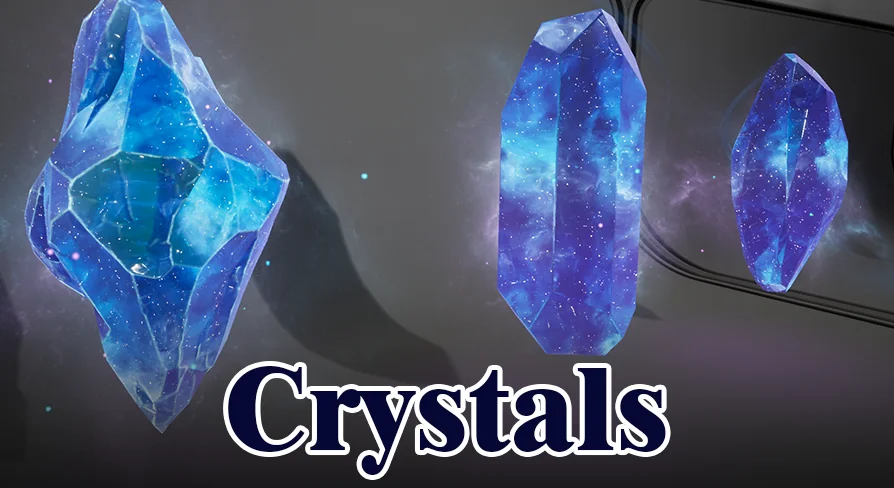
Crystals
A close look at Crystals, featuring ten dynamic crystal materials with integrated visual shader effects, character appearance use, and dissolve behaviors.
Light shifting across a multifaceted mineral face demands nuanced surface interactions. Rather than treating crystal as a static, flat translucent texture, mineral surfaces require complex internal depth, refraction illusions, and dynamic reaction to environmental lighting. Crystals provides ten distinct crystal materials equipped with custom visual effects that respond dynamically across geometry. The collection emphasizes optical complexity, allowing developers to apply multifaceted crystalline looks directly onto scene assets without building complex procedural shader networks from the ground up.
Because crystalline structures can range from rough raw geodes to precision-cut gemstones, having specialized shader effects attached directly to the materials changes how light disperses across hard edges and translucent volumes. These materials handle visual elements such as inner glow, light dispersion, and surface reflectivity. Whether deployed as small pickup items, massive environmental pillars, or dynamic asset overlays, the shaders manage internal volume rendering cues that distinguish crystalline structures from standard glass or plain glossy plastics.
Ten Crystal Materials Across Distinct Aesthetic Themes
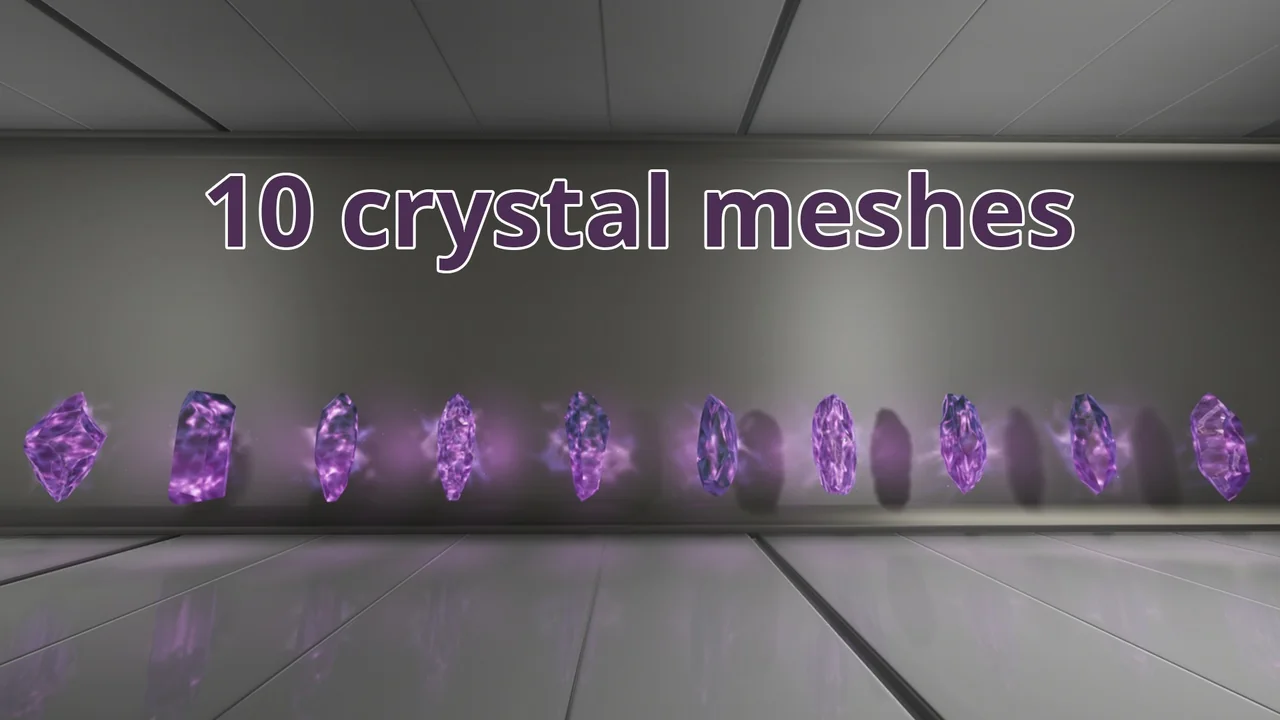
The library contains ten separate crystal materials, each offering its own balance of color density, refraction simulation, and accompanying visual effects. Having ten individual variations allows creators to establish visual hierarchies within a single project. Different colors and internal behaviors can represent distinct elemental affinities, material rarities, or alien compositions without requiring artists to duplicate and manually retune complex node trees.
These ten presets cover a broad aesthetic spectrum identified through three core styles: realistic, fantasy, and space.
Realistic: Naturalistic minerals that evoke real-world geology, raw quartz, amethyst clusters, or mined rock strata where surface grit and internal fractures ground the asset in physical reality.
Fantasy: Arcane mana stones, enchanted weapon infusions, runic catalysts, and dungeon relics that pulse with internal light and active shader effects.
Space: Extraterrestrial minerals, meteoric deposits, void crystals, and exotic planetary formations carrying unusual hue shifts and otherworldly energetic resonance.
By moving between natural geological tones and hyper-stylized alien palettes, the materials adapt easily across radically different art directions without losing their essential physical qualities.
Adapting Crystal Materials to Character Appearance
Applying specialized mineral shaders directly to character models creates immediate narrative impact. Crystals includes direct compatibility for character appearance, allowing artists to map crystal materials across skeletal meshes, biological surfaces, and creature anatomies. This extends the package well beyond passive background props and world geometry.
In character workflows, these materials enable effects such as petrification curses, crystal-armored monsters, or characters with mineralized skin and crystalline limbs. Because the materials are built to live on moving forms, the underlying visual effects maintain their volumetric depth and specular clarity even as the character deforms through animation cycles. The contrast between soft character geometry and the hard, refractive behavior of crystal shading creates an instantly striking creature or hero design.
Dissolve Effects and Mesh Transitions
A major technical utility within Crystals is its support for dissolve effects. Dissolve mechanics bridge the gap between static surface appearance and dynamic gameplay states. Instead of relying on a sudden mesh swap or an external particle cloud to hide an object's despawn, the dissolve integration allows assets to burn away, crystallize, or disintegrate directly at the shader level.
This dissolve behavior operates seamlessly alongside the visual effects already embedded in each crystal material. As a mesh dissolves, the threshold borders interact with the crystal's emissive and refractive properties, creating bright, energetic edges as geometry transitions in or out of the scene. Practical applications include:
Defeated enemies dissolving into shattered crystal dust or fading away through mineral evaporation.
Magical weapons or crystal shields materializing out of thin air onto a character's hand during combat transitions.
Interactive mining nodes or environmental energy deposits fading smoothly after an extraction action is completed.
Sci-fi teleportation and phased matter shifts where characters dissolve into high-energy crystalline forms before disappearing entirely.
Implementation Context and Pipeline Utility
Generating believable crystal shaders from scratch is often a bottleneck in technical art pipelines. Shaders of this type typically demand custom math for rim lighting, faux interior depth, Fresnel reflections, and custom alpha modulation to manage edge falloff. Crystals bypasses that setup phase by supplying ten fully realized material instances pre-configured with shader effects and dynamic dissolve functionality.
For teams developing projects rooted in dark fantasy, deep-space exploration, or stylized action, having ready access to ten verified crystal variations keeps asset production moving forward. Whether decorating ancient subterranean ruins, setting up extraterrestrial landing sites, or configuring character transmutation abilities, the combination of realistic and stylized material variants delivers immediate visual polish with minimal shader overhead.
 Tools
 Tools
 Tools
 Tools