"a19e0535960bd083"{"id":"1001998","slug":"deco-statue-collection","title":"Deco Statue Collection","category":"Tools, Objects \u0026 Decor","engine":"4.26+,5.0+","assetVersion":"","engineVersion":"Engine Version: 4.26+,5.0+","tag":"Tools","accent":"blue","visual":"mech","summary":"Examine the Deco Statue Collection featuring 8 meshes averaging 10,000 triangles, 33 materials, and adjustable instance parameters for architectural scenes.","platform":"Unreal Engine","publishedAt":"2026-10-26T12:16:23.968Z","updatedAt":"2026-10-26T12:16:23.968Z","sourceNotes":[],"fileContents":[],"compatibility":["Unreal Engine","Engine Version: 4.26+,5.0+"],"featuredImage":{"alt":"Deco Statue Collection","src":"/wp-content/uploads/published/2026/10/08396c7b12d7-8a051218-6a69-418e-a35d-01bb11494334-683012efb3.webp"},"hasDownloadLink":true,"downloads":0,"terms":[{"taxonomy":"category","slug":"tools-objects-and-decor","name":"Tools, Objects \u0026 Decor"}],"galleryImages":[{"src":"/wp-content/uploads/published/2026/10/2e865faa12ea-65e18bf5-9b0f-4274-9108-041a06c874e4-ceb1d324ac.webp","alt":"Deco Statue Collection"},{"src":"/wp-content/uploads/published/2026/10/42ef36c1f4ff-da8bbf3e-9490-4519-ba8b-800a5f68dd40-d3516fa122.webp","alt":"Deco Statue Collection"},{"src":"/wp-content/uploads/published/2026/10/9b5472b0d2cc-296bcbe8-4d6e-4f6c-8826-029c19a72c74-e31d6f0e5a.webp","alt":"Deco Statue Collection"},{"src":"/wp-content/uploads/published/2026/10/b1950d497d7d-0e692ba6-df47-41fc-9473-b33a03ec2172-43c2b811de.webp","alt":"Deco Statue Collection"},{"src":"/wp-content/uploads/published/2026/10/8245f8280f16-448a982f-e5ae-4e1c-b124-95fdba9c2366-638d188619.webp","alt":"Deco Statue Collection"},{"src":"/wp-content/uploads/published/2026/10/4463fff5b419-d47f23f9-56bb-432b-a1fb-508fac778e29-7bab39394a.webp","alt":"Deco Statue Collection"},{"src":"/wp-content/uploads/published/2026/10/f5c8f9e58548-42e22603-a09b-41d4-ac9c-cc60e0e565a5-cfb3df0624.webp","alt":"Deco Statue Collection"},{"src":"/wp-content/uploads/published/2026/10/f347e5014615-3b713675-8d1d-4196-86f2-9952844e9dc7-8040c17a5c.webp","alt":"Deco Statue Collection"},{"src":"/wp-content/uploads/published/2026/10/7e567aa884d9-1dea09fa-c259-4c41-9a8e-da7fd4dd516e-6cdc9d0756.webp","alt":"Deco Statue Collection"},{"src":"/wp-content/uploads/published/2026/10/7b5ac7642e33-2918a2b5-7946-4548-84e8-1642556efa63-ac9189ce03.webp","alt":"Deco Statue Collection"}],"accessPanel":{"kind":"resource","title":"Download this resource","eyebrow":"Free Download","message":"Log in or create a free account to start your download.","fileName":"Content.7z","safetyNote":"Resources are manually reviewed before listing to improve quality and reduce obvious risks.","actionLabel":"Download Free","resourceType":"Resource archive"},"contentHtml":"\u003ch2\u003eResolving Environmental Dressing with Deco Statue Collection\u003c/h2\u003e\u003cp\u003ePopulating architectural interiors and grand corridors frequently stalls when unique sculptural elements require custom geometry and extensive texturing passes. Deco Statue Collection supplies dedicated sculptural assets that fill these spatial voids without requiring separate prop development workflows.\u003c/p\u003e\u003cp\u003eThe package centers on ornamental forms built to establish scale, historical weight, and decorative prestige within an environment. By pairing a distinct set of sculpts with a versatile surface matrix, the collection offers immediate decorative variety across indoor galleries, ritual sanctuaries, and grand public halls.\u003c/p\u003e\u003ch2\u003eGeometry Budgets Across 8 Meshes at 10000 Triangles\u003c/h2\u003e\u003cp\u003eThe pack is structured around 8 meshes, giving environment artists a targeted selection of sculptural assets.\u003c/p\u003e\u003cp\u003eEach model operates with an average density of 10,000 triangles. This specific polycount provides sufficient geometric definition to capture silhouette contours, draped elements, and anatomical or ornamental curves cleanly without overwhelming the real-time polygon budget. At roughly 10,000 triangles, each piece retains clean edge transitions up close while remaining light enough to duplicate across colonnades, grand staircases, or multi-statue display halls.\u003c/p\u003e\u003ch2\u003eMaterial Distribution from Bronze and Copper to Marble Stone\u003c/h2\u003e\u003cp\u003eA library of 33 materials accompanies the 8 meshes, providing substantial aesthetic variety across different architectural traditions.\u003c/p\u003e\u003cp\u003eThese options cover six distinct surface types: bronze, chrome, concrete, copper, marble stone, and steel. Assigning concrete or marble stone grounds a statue firmly within classical, monolithic, or brutalist architecture, emphasizing mineral mass and structural permanence. Switching the same mesh to metallic finishes like bronze, copper, steel, or chrome transforms the tone completely. Polished chrome and brushed steel align with sleek, contemporary, or modern installations, whereas bronze and copper introduce traditional foundry craftsmanship suitable for heritage civic monuments or weathered sanctuaries.\u003c/p\u003e\u003ch2\u003eParameter Control: Roughness Level, Color Tint, and Normal Texture Intensity\u003c/h2\u003e\u003cp\u003eMaterial flexibility extends beyond pre-configured surfaces through adjustable material instance parameters.\u003c/p\u003e\u003cp\u003eArtists can manipulate the roughness level, color tint, and normal texture intensity directly within the material instances. Tuning the roughness level alters surface micro-reflectivity, taking steel or chrome from mirror-like specular highlights to dull, worn satin sheens, or shifting marble stone into a buffed, polished glaze. The color tint parameter provides immediate color matching against surrounding room lighting or local stone accents without requiring external texture editing. Modulating normal texture intensity adjusts the perceived relief depth of surface tooling, cast imperfections, or stone grain, allowing developers to balance subtle finishes against harsh, dramatic directional lighting.\u003c/p\u003e\u003ch2\u003eStaging Statues within Hall Of Dark Temple Architecture\u003c/h2\u003e\u003cp\u003eDeco Statue Collection maintains direct compatibility with Hall Of Dark Temple environments, framing how these pieces deploy in thematic spaces.\u003c/p\u003e\u003cp\u003eThe mixture of heavy stone surfaces and patinated metals suits solemn, cavernous halls, subterranean temples, and monumental chambers. A marble stone or concrete statue provides an anchor for vaulted alcoves and ritual pedestals, blending naturally with dark masonry. In contrast, placement of bronze or copper meshes near point lights, braziers, or shafts of ambient light generates rich metallic rim lighting, establishing clear visual landmarks that guide players through complex level layouts.\u003c/p\u003e\u003ch2\u003ePlacement Pipeline for Architectural Environments\u003c/h2\u003e\u003cp\u003eThe combination of uniform geometric budgets and flexible surface properties streamlines set dressing across diverse level designs.\u003c/p\u003e\u003cp\u003eEnvironment artists, level designers, and lighting specialists benefit most from this layout when pacing player movement through corridors, courtyards, and grand sanctums. The eight meshes act as ready-made focal points, while the 33 material assignments allow identical sculptural forms to occupy varied narrative roles within the same project.\u003c/p\u003e\n\n\u003ch2\u003eExplore Similar Assets\u003c/h2\u003e\n\u003cul\u003e\n\u003cli\u003e\u003ca href=\"https://3dcghub.com/interior-props/\" title=\"Interior Props\"\u003eInterior Props\u003c/a\u003e\u003c/li\u003e\n\u003cli\u003e\u003ca href=\"https://3dcghub.com/death-male-body-parts-collection-vol-vii/\" title=\"Death Male Body Parts Collection VOL.VII\"\u003eDeath Male Body Parts Collection VOL.VII\u003c/a\u003e\u003c/li\u003e\n\u003cli\u003e\u003ca href=\"https://3dcghub.com/buttons-levers-knobs-a-customizable-puzzles-asset-pack/\" title=\"Buttons, Levers, Knobs - A customizable puzzles asset-pack\"\u003eButtons, Levers, Knobs - A customizable puzzles asset-pack\u003c/a\u003e\u003c/li\u003e\n\u003cli\u003e\u003ca href=\"https://3dcghub.com/handy-hands-pack-vr-hands-megapack/\" title=\"Handy Hands Pack - VR Hands Megapack\"\u003eHandy Hands Pack - VR Hands Megapack\u003c/a\u003e\u003c/li\u003e\n\u003cli\u003e\u003ca href=\"https://3dcghub.com/japanese-school-collection-5-asset-packs-over-200-assets/\" title=\"Japanese School Collection - 5 Asset Packs, Over 200 Assets\"\u003eJapanese School Collection - 5 Asset Packs, Over 200 Assets\u003c/a\u003e\u003c/li\u003e\n\u003c/ul\u003e","contentTextLength":4484,"navigation":{"current":93,"total":4026,"previous":{"id":"1001999","slug":"dialog-animations","title":"Dialog Animations","category":"Variety","platform":"Unreal Engine","updatedAt":"2026-10-26T12:17:30.647Z"},"next":{"id":"1001997","slug":"dark-knight","title":"Dark Knight","category":"Characters \u0026 Creatures","platform":"Unreal Engine","updatedAt":"2026-10-26T12:15:31.161Z"}},"relatedResources":[{"id":"1000121","slug":"interior-props","title":"Interior Props","category":"Tools, Objects \u0026 Decor","engine":"4.26+,5.0+","assetVersion":"","engineVersion":"Engine Version: 4.26+,5.0+","tag":"Tools","accent":"blue","visual":"mech","summary":"A realistic set-dressing collection featuring a pre-built scene of five modular shelf-sets, complete with vases, decor items, and different material options.","platform":"Unreal Engine","publishedAt":"2026-06-09T15:24:05.523Z","updatedAt":"2026-06-09T15:24:05.523Z","sourceNotes":[],"fileContents":[],"compatibility":["Unreal Engine","Engine Version: 4.26+,5.0+"],"featuredImage":{"alt":"Interior Props","src":"/wp-content/uploads/published/2026/06/b4e28cdc2d1e-2c5047dd-94c5-4f31-aeb4-85b0c79812d8-488dc32cca.webp"},"hasDownloadLink":true,"downloads":2},{"id":"4563","slug":"death-male-body-parts-collection-vol-vii","title":"Death Male Body Parts Collection VOL.VII","category":"Tools, Objects \u0026 Decor","engine":"4.26+,5.0+","assetVersion":"Engine version: 4.26+,5.0+","engineVersion":"4.20","tag":"Tools","accent":"blue","visual":"luts","summary":"Elevate your game design with this high-quality male body parts collection. Ideal for horror, RPG, and shooter games, featuring PBR textures and low-poly optimi","platform":"Unreal Engine","publishedAt":"2026-02-13T08:46:42.000Z","updatedAt":"2026-04-19T15:57:07.000Z","sourceNotes":[],"fileContents":[],"compatibility":["Unreal Engine","Engine version: 4.26+,5.0+"],"featuredImage":{"alt":"Death Male Body Parts Collection VOL.VII","src":"https://3dcghub.com/wp-content/uploads/2026/02/252494ab-70a2-4488-a775-8e31b8ecf255.webp"},"hasDownloadLink":true,"downloads":0},{"id":"1001867","slug":"buttons-levers-knobs-a-customizable-puzzles-asset-pack","title":"Buttons, Levers, Knobs - A customizable puzzles asset-pack","category":"Tools, Objects \u0026 Decor","engine":"4.19+,5.0+","assetVersion":"","engineVersion":"Engine Version: 4.19+,5.0+","tag":"Tools","accent":"blue","visual":"mech","summary":"Examine the technical layout, 1u grid snapping, dial UV overlays, dynamic paint masks, and blueprint logic in this customizable puzzle asset collection.","platform":"Unreal Engine","publishedAt":"2026-10-22T11:10:36.562Z","updatedAt":"2026-10-22T11:10:36.562Z","sourceNotes":[],"fileContents":[],"compatibility":["Unreal Engine","Engine Version: 4.19+,5.0+"],"featuredImage":{"alt":"Buttons, Levers, Knobs - A customizable puzzles asset-pack","src":"/wp-content/uploads/published/2026/10/90ab85e3c92a-e92271ee-771a-4fd9-9620-37f2a1ba47c2-2f40fb6739.webp"},"hasDownloadLink":true,"downloads":0}]}
Tools
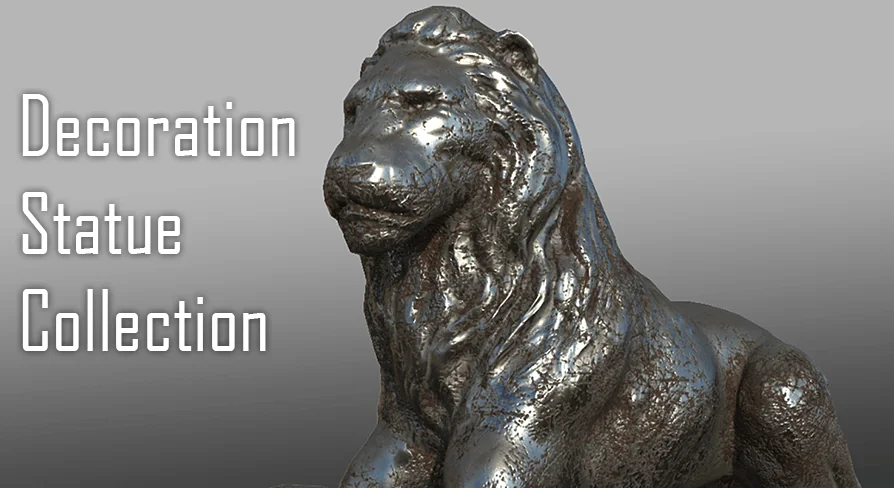
Deco Statue Collection
Examine the Deco Statue Collection featuring 8 meshes averaging 10,000 triangles, 33 materials, and adjustable instance parameters for architectural scenes.
Resolving Environmental Dressing with Deco Statue Collection
Populating architectural interiors and grand corridors frequently stalls when unique sculptural elements require custom geometry and extensive texturing passes. Deco Statue Collection supplies dedicated sculptural assets that fill these spatial voids without requiring separate prop development workflows.
The package centers on ornamental forms built to establish scale, historical weight, and decorative prestige within an environment. By pairing a distinct set of sculpts with a versatile surface matrix, the collection offers immediate decorative variety across indoor galleries, ritual sanctuaries, and grand public halls.
Geometry Budgets Across 8 Meshes at 10000 Triangles
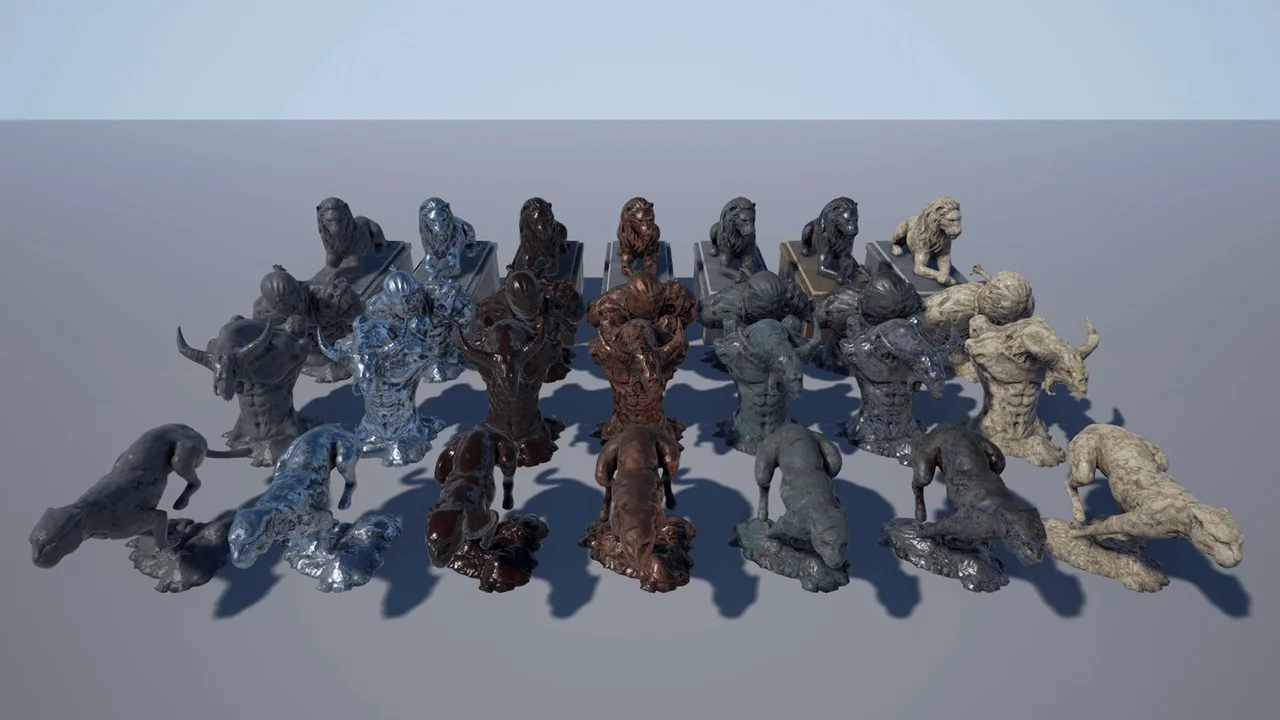
The pack is structured around 8 meshes, giving environment artists a targeted selection of sculptural assets.
Each model operates with an average density of 10,000 triangles. This specific polycount provides sufficient geometric definition to capture silhouette contours, draped elements, and anatomical or ornamental curves cleanly without overwhelming the real-time polygon budget. At roughly 10,000 triangles, each piece retains clean edge transitions up close while remaining light enough to duplicate across colonnades, grand staircases, or multi-statue display halls.
Material Distribution from Bronze and Copper to Marble Stone
A library of 33 materials accompanies the 8 meshes, providing substantial aesthetic variety across different architectural traditions.
These options cover six distinct surface types: bronze, chrome, concrete, copper, marble stone, and steel. Assigning concrete or marble stone grounds a statue firmly within classical, monolithic, or brutalist architecture, emphasizing mineral mass and structural permanence. Switching the same mesh to metallic finishes like bronze, copper, steel, or chrome transforms the tone completely. Polished chrome and brushed steel align with sleek, contemporary, or modern installations, whereas bronze and copper introduce traditional foundry craftsmanship suitable for heritage civic monuments or weathered sanctuaries.
Parameter Control: Roughness Level, Color Tint, and Normal Texture Intensity
Material flexibility extends beyond pre-configured surfaces through adjustable material instance parameters.
Artists can manipulate the roughness level, color tint, and normal texture intensity directly within the material instances. Tuning the roughness level alters surface micro-reflectivity, taking steel or chrome from mirror-like specular highlights to dull, worn satin sheens, or shifting marble stone into a buffed, polished glaze. The color tint parameter provides immediate color matching against surrounding room lighting or local stone accents without requiring external texture editing. Modulating normal texture intensity adjusts the perceived relief depth of surface tooling, cast imperfections, or stone grain, allowing developers to balance subtle finishes against harsh, dramatic directional lighting.
Staging Statues within Hall Of Dark Temple Architecture
Deco Statue Collection maintains direct compatibility with Hall Of Dark Temple environments, framing how these pieces deploy in thematic spaces.
The mixture of heavy stone surfaces and patinated metals suits solemn, cavernous halls, subterranean temples, and monumental chambers. A marble stone or concrete statue provides an anchor for vaulted alcoves and ritual pedestals, blending naturally with dark masonry. In contrast, placement of bronze or copper meshes near point lights, braziers, or shafts of ambient light generates rich metallic rim lighting, establishing clear visual landmarks that guide players through complex level layouts.
Placement Pipeline for Architectural Environments
The combination of uniform geometric budgets and flexible surface properties streamlines set dressing across diverse level designs.
Environment artists, level designers, and lighting specialists benefit most from this layout when pacing player movement through corridors, courtyards, and grand sanctums. The eight meshes act as ready-made focal points, while the 33 material assignments allow identical sculptural forms to occupy varied narrative roles within the same project.
 Tools
 Tools
 Tools
 Tools