"7aa4acc705f0d80b"{"id":"1001967","slug":"boat-and-submarine","title":"Boat and Submarine","category":"Vehicles \u0026 Transportation","engine":"5.0+","assetVersion":"","engineVersion":"Engine Version: 5.0+","tag":"Vehicles","accent":"blue","visual":"mech","summary":"Explore the Boat and Submarine blueprint package, featuring 8 plug-and-play templates, line-trace enter and exit logic, and custom watercraft mesh setup.","platform":"Unreal Engine","publishedAt":"2026-10-24T13:32:06.854Z","updatedAt":"2026-10-24T13:32:06.854Z","sourceNotes":[],"fileContents":[],"compatibility":["Unreal Engine","Engine Version: 5.0+"],"featuredImage":{"alt":"Boat and Submarine","src":"/wp-content/uploads/published/2026/10/070c3131189f-64583866-f203-4779-8a90-ad091f2302eb-81e20c3fb6.webp"},"hasDownloadLink":true,"downloads":0,"terms":[{"taxonomy":"category","slug":"vehicles-and-transportation","name":"Vehicles \u0026 Transportation"}],"galleryImages":[{"src":"/wp-content/uploads/published/2026/10/a9124cdc52f8-eb419add-c227-43f0-9d13-412935f63c6e-b5c6827625.webp","alt":"Boat and Submarine"},{"src":"/wp-content/uploads/published/2026/10/80bec6d0f14e-006e7b4d-0458-418a-a0ce-b497c5ea0cc8-3055fb8fb1.webp","alt":"Boat and Submarine"},{"src":"/wp-content/uploads/published/2026/10/5ff07aa6b86b-b6ae319c-462b-4db4-9239-1a94169cc0c6-7ae054429c.webp","alt":"Boat and Submarine"}],"accessPanel":{"kind":"resource","title":"Download this resource","eyebrow":"Free Download","message":"Log in or create a free account to start your download.","fileName":"Boat and Submarine.7z","safetyNote":"Resources are manually reviewed before listing to improve quality and reduce obvious risks.","actionLabel":"Download Free","resourceType":"Resource archive"},"contentHtml":"\u003ch2\u003eInteractive Watercraft in Real-Time Environments\u003c/h2\u003e\u003cp\u003ePopulating aquatic environments with functional vehicles often introduces friction during the gameplay scripting phase. Whether a project features expansive coastal waterways, industrial harbors, or submerged oceanic depths, providing players with immediate control over maritime craft requires robust interaction and physics handling. The Boat and Submarine package supplies a foundational vehicle system designed to bypass low-level scripting through pre-configured boat blueprints, ready-to-run templates, and exposed variables that govern movement dynamics.\u003c/p\u003e\u003cp\u003eRather than requiring developers to construct buoyancy response curves, basic throttle logic, or seat-occupancy frameworks from scratch, the system establishes a rapid implementation pipeline. Built to support drivable setups ranging from high-speed motorboats to sub-surface exploration vessels, it addresses the core operational demands of navigation, player entry, and custom mesh replacement.\u003c/p\u003e\u003ch2\u003eLine Trace Boarding and Third-Person Enter/Exit Logic\u003c/h2\u003e\u003cp\u003eOne of the persistent hurdles when scripting vehicle interactions in third-person frameworks is managing the entry trigger. Many traditional vehicle setups rely on static volume triggers or direct collision overlap components positioned around the helm or cabin. In practice, this forces the player pawn to wade into precise coordinates alongside the vessel—an approach that frequently breaks down when dealing with floating assets that bob in the water or drift against docks.\u003c/p\u003e\u003cp\u003eThis framework resolves vehicle boarding by utilizing line trace queries. Integrated directly into the third-person template, the interaction checks player line-of-sight toward the target craft. Players do not need to stand directly adjacent to the hull or hunt for a concealed collision box to climb aboard. Instead, aiming the camera or view vector directly at the vessel and pressing the assigned interaction key (F) triggers the entry transition.\u003c/p\u003e\u003cp\u003eBy relying on a directional trace rather than localized trigger volumes, the logic accommodates varied shoreline topography, floating piers, and deep-water swimming situations. The transition script handles the handoff between the free-roaming character pawn and the drivable watercraft, ensuring that player control shifts cleanly into the vehicle blueprint upon activation.\u003c/p\u003e\u003ch2\u003eDeploying the Eight Templates for Speedboat and Submarine Mechanics\u003c/h2\u003e\u003cp\u003eTo reduce setup overhead, the collection features eight distinct templates configured for immediate plug-and-play deployment. These pre-assembled assets allow developers to drop functional watercraft directly into a level and evaluate movement characteristics without manual variable assignment.\u003c/p\u003e\u003cp\u003eThe range covers key vehicle classes indicated by the core system tags, including speedboats, motorboats, and submersible craft:\u003c/p\u003e\u003cul\u003e\u003cli\u003e\u003cstrong\u003eSpeedboat Configurations:\u003c/strong\u003e Geared toward rapid surface transit, emphasizing forward acceleration and sharp directional response across open water surfaces.\u003c/li\u003e\u003cli\u003e\u003cstrong\u003eMotorboat Blueprints:\u003c/strong\u003e Balanced for standard maritime navigation, utility transport, and river or canal maneuvering.\u003c/li\u003e\u003cli\u003e\u003cstrong\u003eSubmarine Templates:\u003c/strong\u003e Scripted to address navigation beneath the water plane, accommodating the unique movement profiles demanded by underwater environments.\u003c/li\u003e\u003c/ul\u003e\u003cp\u003eEach of the eight configurations provides a baseline calibration of movement variables. Because the logic is modular, developers can study the template parameters to understand how throttle, steering, and stability settings interact before tuning their own vessel profiles.\u003c/p\u003e\u003ch2\u003eCustom Boat Models, X-Axis Alignment, and Tilt Angle Control\u003c/h2\u003e\u003cp\u003eIntegrating proprietary 3D models into third-person vehicle blueprints can often lead to unexpected rotational glitches or erratic handling if the imported mesh does not respect the blueprint's forward movement vector. In this system, custom vehicle meshes require a specific orientation to function correctly: the front of the model must align with the positive X axis.\u003c/p\u003e\u003cp\u003eWhen a custom boat or submarine mesh is imported with an alternative forward orientation—such as Y-forward or Z-up without proper pivot remapping—the internal rotational calculations can generate unnatural movement artifacts. The vehicle logic incorporates a dynamic tilt mechanic that simulates hull leaning during turns and maneuvers. If the coordinate alignment is mismatched, this tilt calculation amplifies the misalignment, causing the vessel to roll awkwardly or pitch sideways during basic acceleration.\u003c/p\u003e\u003cp\u003eTo solve this without forcing an immediate round-trip back into a digital content creation program, the blueprint exposes an explicit tilt angle variable. If the source mesh pivot cannot be rotated to ensure the X axis represents the front of the craft, setting the tilt angle parameter down to 0 deactivates the rotational lean. This stabilizes the craft, preventing unnatural tilt behaviors and allowing non-standard meshes to navigate smoothly while keeping standard forward drive mechanics intact.\u003c/p\u003e\u003ch2\u003eTuning Blueprint Variables for Drivable Watercraft\u003c/h2\u003e\u003cp\u003eA primary advantage of working with blueprint-based vehicle systems is the ease with which operational parameters can be iterated. The Boat and Submarine blueprints centralize core functional controls into accessible variables, allowing developers to balance vehicle physics without deep code refactoring.\u003c/p\u003e\u003cp\u003eAdjusting properties such as turning rates, stability limits, and responsiveness requires minimal manual intervention. The exposed variable architecture makes it straightforward to differentiate the handling feel between craft types. A lightweight motorboat can be assigned a lively, reactive profile, while an industrial submarine template can be weighted down with slower angular velocities to convey mass and resistance.\u003c/p\u003e\u003cp\u003eFor teams seeking to implement watercraft into larger environment frameworks, the blueprint architecture maintains broad utility, pairing effectively with systemic level designs such as city generation layouts where urban canals or coastal waterways demand interactive vehicle traffic.\u003c/p\u003e\u003ch2\u003eProject Scope and Lighthouse Integration Context\u003c/h2\u003e\u003cp\u003eWhen selecting assets for a production pipeline, understanding project scope and existing asset relationships prevents unnecessary duplication. The functional blueprints provided in this package also exist within the broader Lighthouse and Drivable Boat project. While the standalone package focuses squarely on delivering the eight watercraft templates and their underlying drive scripts, the expanded lighthouse counterpart incorporates these exact blueprints alongside additional architectural models and coastal environment assets.\u003c/p\u003e\u003cp\u003eFor developers who already maintain the lighthouse package within their library, this standalone project is redundant, as future updates to that broader release integrate all blueprint systems found here. Conversely, teams that strictly require the drivable boat scripts, submarine mechanics, and line-trace interaction logic without extraneous environment geometry benefit from the isolated, lightweight footprint of this standalone compilation.\u003c/p\u003e\u003ch2\u003eApplication and Project Fit\u003c/h2\u003e\u003cp\u003eThe Boat and Submarine blueprint package serves developers, level designers, and technical designers who need responsive marine vehicles operational in short order. By providing eight distinct templates out of the box, it removes the typical hurdles associated with watercraft prototyping. The inclusion of trace-based third-person boarding simplifies player interaction across uneven terrain, while exposed orientation and tilt parameters ensure that custom vehicle models can be integrated cleanly into maritime, coastal, or subterranean game scenes.\u003c/p\u003e\n\n\u003ch2\u003eRelated Resources Worth Checking\u003c/h2\u003e\n\u003cul\u003e\n\u003cli\u003e\u003ca href=\"https://3dcghub.com/military-boat-rigged-bp-controllable-w-skins-military-boat-boats-soldier/\" title=\"Military Boat - Rigged/BP Controllable W/Skins ( Military Boat Boats Soldier )\"\u003eMilitary Boat - Rigged/BP Controllable W/Skins ( Military Boat Boats Soldier )\u003c/a\u003e\u003c/li\u003e\n\u003cli\u003e\u003ca href=\"https://3dcghub.com/ultimate-fishing-megapack/\" title=\"Ultimate Fishing Megapack\"\u003eUltimate Fishing Megapack\u003c/a\u003e\u003c/li\u003e\n\u003cli\u003e\u003ca href=\"https://3dcghub.com/replicated-drivable-gokart-blueprint/\" title=\"Replicated Drivable Gokart (Blueprint)\"\u003eReplicated Drivable Gokart (Blueprint)\u003c/a\u003e\u003c/li\u003e\n\u003cli\u003e\u003ca href=\"https://3dcghub.com/polygon-pro-racer/\" title=\"POLYGON - Pro Racer\"\u003ePOLYGON - Pro Racer\u003c/a\u003e\u003c/li\u003e\n\u003cli\u003e\u003ca href=\"https://3dcghub.com/emergency-vehicles-premium-drivable-and-interactable/\" title=\"Emergency Vehicles - Premium - Drivable and Interactable\"\u003eEmergency Vehicles - Premium - Drivable and Interactable\u003c/a\u003e\u003c/li\u003e\n\u003c/ul\u003e","contentTextLength":7941,"navigation":{"current":23,"total":3925,"previous":{"id":"1001968","slug":"boat-pack-vol-1","title":"Boat Pack Vol_1","category":"Boats","platform":"Unreal Engine","updatedAt":"2026-10-24T13:51:34.304Z"},"next":{"id":"1001966","slug":"blood-splatter-blueprint-system","title":"Blood Splatter Blueprint System","category":"Weapons \u0026 Combat","platform":"Unreal Engine","updatedAt":"2026-10-24T13:31:45.156Z"}},"relatedResources":[{"id":"28204","slug":"military-boat-rigged-bp-controllable-w-skins-military-boat-boats-soldier","title":"Military Boat - Rigged/BP Controllable W/Skins ( Military Boat Boats Soldier )","category":"Vehicles \u0026 Transportation","engine":"4.26+,5.0+","assetVersion":"Engine version: 4.26+,5.0+","engineVersion":"","tag":"Vehicles","accent":"blue","visual":"audio","summary":"Military Boat – Rigged/BP Controllable W/Skins brings a drivable military watercraft into Unreal Engine with a setup that already includes assets, maps, and materials. Its rigged and Blueprint-based structure gives artists and developers a clear starting po...","platform":"Unreal Engine","publishedAt":"2026-05-06T13:56:55.000Z","updatedAt":"2026-05-06T13:56:56.000Z","sourceNotes":[],"fileContents":[],"compatibility":["Unreal Engine","Engine version: 4.26+,5.0+"],"featuredImage":{"alt":"Military Boat - Rigged/BP Controllable W/Skins ( Military Boat Boats Soldier )","src":"https://3dcghub.com/wp-content/uploads/2026/05/293c1dc006da_32830d07-e5b5-4939-b7ff-4caf04bcfd06.webp"},"hasDownloadLink":true,"downloads":2},{"id":"1000031","slug":"ultimate-fishing-megapack","title":"Ultimate Fishing Megapack","category":"Vehicles \u0026 Transportation","engine":"4.27,5.0+","assetVersion":"","engineVersion":"4.27,5.0+","tag":"Vehicles","accent":"blue","visual":"mech","summary":"Construct realistic waterside environments with the Ultimate Fishing Megapack, featuring nearly 100 optimized props, docks, boats, and animated fish.","platform":"Unreal Engine","publishedAt":"2026-05-21T08:50:01.340Z","updatedAt":"2026-05-21T08:50:01.340Z","sourceNotes":[],"fileContents":[],"compatibility":["Unreal Engine","Engine version: 4.27,5.0+"],"featuredImage":{"alt":"Ultimate Fishing Megapack","src":"/wp-content/uploads/published/2026/05/385613305c7b-5e6e75d1-c272-4ce1-a0b3-57baaa2ad21b-09101b7b29.webp"},"hasDownloadLink":true,"downloads":0},{"id":"1001828","slug":"replicated-drivable-gokart-blueprint","title":"Replicated Drivable Gokart (Blueprint)","category":"Vehicles \u0026 Transportation","engine":"5.0+","assetVersion":"","engineVersion":"Engine Version: 5.0+","tag":"Vehicles","accent":"blue","visual":"mech","summary":"Explore the Replicated Drivable Gokart for Unreal Engine, featuring native vehicle physics, multiplayer replication, rigged skeletal meshes, and custom lighting","platform":"Unreal Engine","publishedAt":"2026-10-21T08:20:49.526Z","updatedAt":"2026-10-21T08:20:49.526Z","sourceNotes":[],"fileContents":[],"compatibility":["Unreal Engine","Engine Version: 5.0+"],"featuredImage":{"alt":"Replicated Drivable Gokart (Blueprint)","src":"/wp-content/uploads/published/2026/10/0158e36d8f36-baa6c062-d685-4943-b955-32c41359465d-ce1bf6a53f.webp"},"hasDownloadLink":true,"downloads":0}]}
Vehicles
Boat and Submarine
Explore the Boat and Submarine blueprint package, featuring 8 plug-and-play templates, line-trace enter and exit logic, and custom watercraft mesh setup.
Populating aquatic environments with functional vehicles often introduces friction during the gameplay scripting phase. Whether a project features expansive coastal waterways, industrial harbors, or submerged oceanic depths, providing players with immediate control over maritime craft requires robust interaction and physics handling. The Boat and Submarine package supplies a foundational vehicle system designed to bypass low-level scripting through pre-configured boat blueprints, ready-to-run templates, and exposed variables that govern movement dynamics.
Rather than requiring developers to construct buoyancy response curves, basic throttle logic, or seat-occupancy frameworks from scratch, the system establishes a rapid implementation pipeline. Built to support drivable setups ranging from high-speed motorboats to sub-surface exploration vessels, it addresses the core operational demands of navigation, player entry, and custom mesh replacement.
Line Trace Boarding and Third-Person Enter/Exit Logic
One of the persistent hurdles when scripting vehicle interactions in third-person frameworks is managing the entry trigger. Many traditional vehicle setups rely on static volume triggers or direct collision overlap components positioned around the helm or cabin. In practice, this forces the player pawn to wade into precise coordinates alongside the vessel—an approach that frequently breaks down when dealing with floating assets that bob in the water or drift against docks.
This framework resolves vehicle boarding by utilizing line trace queries. Integrated directly into the third-person template, the interaction checks player line-of-sight toward the target craft. Players do not need to stand directly adjacent to the hull or hunt for a concealed collision box to climb aboard. Instead, aiming the camera or view vector directly at the vessel and pressing the assigned interaction key (F) triggers the entry transition.
By relying on a directional trace rather than localized trigger volumes, the logic accommodates varied shoreline topography, floating piers, and deep-water swimming situations. The transition script handles the handoff between the free-roaming character pawn and the drivable watercraft, ensuring that player control shifts cleanly into the vehicle blueprint upon activation.
Deploying the Eight Templates for Speedboat and Submarine Mechanics
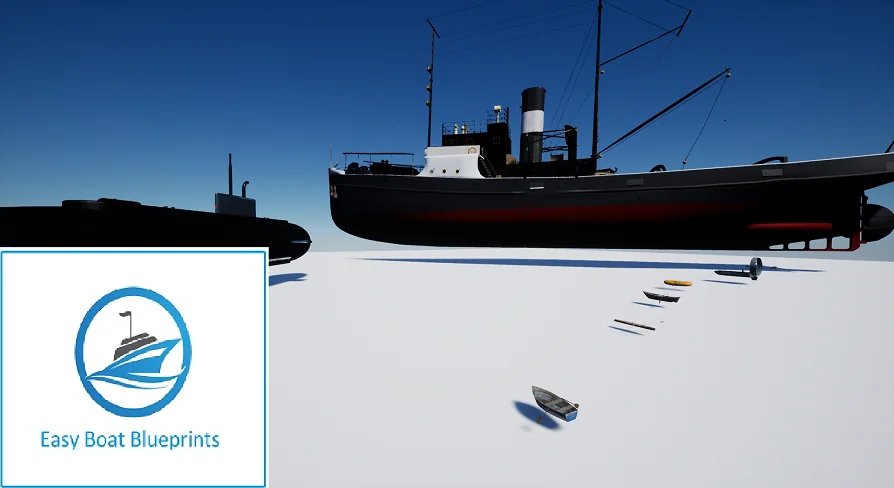
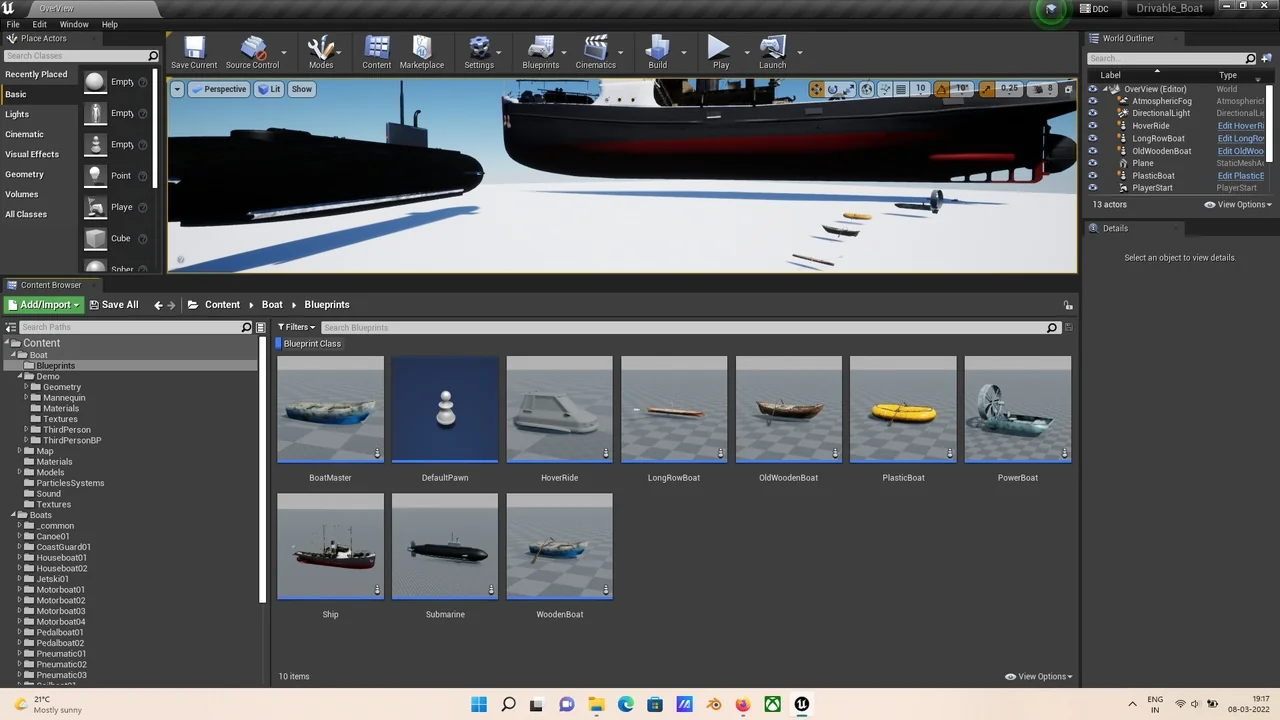
To reduce setup overhead, the collection features eight distinct templates configured for immediate plug-and-play deployment. These pre-assembled assets allow developers to drop functional watercraft directly into a level and evaluate movement characteristics without manual variable assignment.
The range covers key vehicle classes indicated by the core system tags, including speedboats, motorboats, and submersible craft:
Speedboat Configurations: Geared toward rapid surface transit, emphasizing forward acceleration and sharp directional response across open water surfaces.
Motorboat Blueprints: Balanced for standard maritime navigation, utility transport, and river or canal maneuvering.
Submarine Templates: Scripted to address navigation beneath the water plane, accommodating the unique movement profiles demanded by underwater environments.
Each of the eight configurations provides a baseline calibration of movement variables. Because the logic is modular, developers can study the template parameters to understand how throttle, steering, and stability settings interact before tuning their own vessel profiles.
Custom Boat Models, X-Axis Alignment, and Tilt Angle Control
Integrating proprietary 3D models into third-person vehicle blueprints can often lead to unexpected rotational glitches or erratic handling if the imported mesh does not respect the blueprint's forward movement vector. In this system, custom vehicle meshes require a specific orientation to function correctly: the front of the model must align with the positive X axis.
When a custom boat or submarine mesh is imported with an alternative forward orientation—such as Y-forward or Z-up without proper pivot remapping—the internal rotational calculations can generate unnatural movement artifacts. The vehicle logic incorporates a dynamic tilt mechanic that simulates hull leaning during turns and maneuvers. If the coordinate alignment is mismatched, this tilt calculation amplifies the misalignment, causing the vessel to roll awkwardly or pitch sideways during basic acceleration.
To solve this without forcing an immediate round-trip back into a digital content creation program, the blueprint exposes an explicit tilt angle variable. If the source mesh pivot cannot be rotated to ensure the X axis represents the front of the craft, setting the tilt angle parameter down to 0 deactivates the rotational lean. This stabilizes the craft, preventing unnatural tilt behaviors and allowing non-standard meshes to navigate smoothly while keeping standard forward drive mechanics intact.
Tuning Blueprint Variables for Drivable Watercraft
A primary advantage of working with blueprint-based vehicle systems is the ease with which operational parameters can be iterated. The Boat and Submarine blueprints centralize core functional controls into accessible variables, allowing developers to balance vehicle physics without deep code refactoring.
Adjusting properties such as turning rates, stability limits, and responsiveness requires minimal manual intervention. The exposed variable architecture makes it straightforward to differentiate the handling feel between craft types. A lightweight motorboat can be assigned a lively, reactive profile, while an industrial submarine template can be weighted down with slower angular velocities to convey mass and resistance.
For teams seeking to implement watercraft into larger environment frameworks, the blueprint architecture maintains broad utility, pairing effectively with systemic level designs such as city generation layouts where urban canals or coastal waterways demand interactive vehicle traffic.
Project Scope and Lighthouse Integration Context
When selecting assets for a production pipeline, understanding project scope and existing asset relationships prevents unnecessary duplication. The functional blueprints provided in this package also exist within the broader Lighthouse and Drivable Boat project. While the standalone package focuses squarely on delivering the eight watercraft templates and their underlying drive scripts, the expanded lighthouse counterpart incorporates these exact blueprints alongside additional architectural models and coastal environment assets.
For developers who already maintain the lighthouse package within their library, this standalone project is redundant, as future updates to that broader release integrate all blueprint systems found here. Conversely, teams that strictly require the drivable boat scripts, submarine mechanics, and line-trace interaction logic without extraneous environment geometry benefit from the isolated, lightweight footprint of this standalone compilation.
Application and Project Fit
The Boat and Submarine blueprint package serves developers, level designers, and technical designers who need responsive marine vehicles operational in short order. By providing eight distinct templates out of the box, it removes the typical hurdles associated with watercraft prototyping. The inclusion of trace-based third-person boarding simplifies player interaction across uneven terrain, while exposed orientation and tilt parameters ensure that custom vehicle models can be integrated cleanly into maritime, coastal, or subterranean game scenes.
 Vehicles
 Vehicles
 Vehicles
 Vehicles