"c14ff6bd758dadb1"{"id":"1000566","slug":"ble-utilities-v2","title":"BLE Utilities V2","category":"Engine Tools","engine":"5.1 - 5.7","assetVersion":"Asset Version: 2.0.4 - 2.1.1","engineVersion":"Engine Version: 5.1 - 5.7","tag":"Engine Tools","accent":"blue","visual":"mech","summary":"BLE Utilities V2 adds Android and iOS blueprint nodes for discovering nearby Bluetooth devices and performing characteristic read, write, and subscribe operatio","platform":"Unreal Engine","publishedAt":"2026-07-16T05:28:31.784Z","updatedAt":"2026-07-16T05:28:31.784Z","sourceNotes":[],"fileContents":[],"compatibility":["Unreal Engine","Asset Version: 2.0.4 - 2.1.1","Engine Version: 5.1 - 5.7"],"featuredImage":{"alt":"BLE Utilities V2","src":"/wp-content/uploads/published/2026/07/df6f2fb6589b-06c39d7e-7ccf-4d1f-afe8-d0c3817d93de-e191750640.webp"},"hasDownloadLink":true,"downloads":0,"terms":[{"taxonomy":"category","slug":"engine-tools-tools-and-plugins","name":"Engine Tools"}],"galleryImages":[{"src":"/wp-content/uploads/published/2026/07/95ddeb1a9ac8-bb2c6c3e-5e26-4e62-8aea-399f30857f13-03e0ca4a12.webp","alt":"BLE Utilities V2"},{"src":"/wp-content/uploads/published/2026/07/368943e9fb23-8b40d7a9-3455-40b6-9dc0-5ecf3553d35f-ffb874ad16.webp","alt":"BLE Utilities V2"},{"src":"/wp-content/uploads/published/2026/07/ddc5e09f22ca-e290819e-29b2-488a-b94f-f44679a69a35-7011cfda79.webp","alt":"BLE Utilities V2"}],"accessPanel":{"kind":"resource","title":"Download this resource","eyebrow":"Free Download","message":"Log in or create a free account to start your download.","fileName":"BLE Utilities V2.7z","safetyNote":"Resources are manually reviewed before listing to improve quality and reduce obvious risks.","actionLabel":"Download Free","resourceType":"Resource archive"},"contentHtml":"\u003cp\u003eBluetooth-equipped hardware can become a direct gameplay or interactive storytelling input once the Unreal Engine project can reliably talk to nearby devices. A phone running a build could react to a paired sensor, trigger events from a custom physical controller, or stream telemetry from a wearable. BLE Utilities V2 operates strictly within that mobile domain, exposing the discovery and communication pipeline as visual scripting nodes so that the device-to-game data flow stays inside blueprints rather than requiring native C++ wrappers.\u003c/p\u003e \u003ch3\u003ePlatform Scope: Android And iOS Only\u003c/h3\u003e \u003cp\u003eThe plugin's most defining constraint sits in its compatibility scope. BLE Utilities V2 functions exclusively on Android and iOS. It does not work on desktop platforms, which sets the target clearly for development teams: the live build must ship to a mobile device for any of the exposed nodes to execute meaningfully. Desktop editor testing can take a project only so far, and pairing, scanning, and characteristic operations will need real mobile hardware for validation.\u003c/p\u003e \u003cp\u003eThis platform boundary shapes early pre-production planning. If the creative concept involves Bluetooth peripherals reacting to gameplay or pushing telemetry into a PC or console title, the plugin will not support that configuration. Concepts designed around mobile gameplay, mobile installations, point-of-sale interactions, or location-based entertainment apps running on phones and tablets, however, land squarely within the supported surface. The Android and iOS limitation keeps the plugin lean and mobile-focused rather than attempting a cross-platform BLE abstraction that would dilute reliability.\u003c/p\u003e \u003cp\u003eThe Unreal Engine versions supported span 5.4 through 5.7, which covers active and recent engine releases. Teams shipping on the current generation of mobile Unreal pipelines can integrate the plugin without version-blocking delays, and projects still maintaining slightly older releases remain compatible. The four-version spread also means that migrating forward through point releases during production should not break the BLE workflow as long as the target engine stays within that band.\u003c/p\u003e \u003ch4\u003eBlueprint Nodes For The Full BLE Workflow\u003c/h4\u003e \u003cp\u003eThe functional identity of BLE Utilities V2 is a set of blueprint nodes built for easy BLE workflows. Rather than exposing a low-level API surface that forces developers to construct native callbacks and handle platform-specific Bluetooth stacks manually, the plugin organizes the common operations into visual scripting equivalents. The three categories of operation that define the plugin's practical scope are discovery, subscription, and characteristic-level input and output.\u003c/p\u003e Discovering Nearby Devices Through Specific Services \u003cp\u003eThe discovery layer allows projects to find nearby Bluetooth Low Energy devices that are advertising specific services. Filtered scanning matters because BLE environments are noisy—the plugin letting a project target devices running a defined service UUID prevents every random Bluetooth gadget in range from flooding scan results. By filtering at the service level, scenes can look for the exact peripheral type they expect, such as a heart-rate chest strap, a custom environmental sensor, or a branded interactive prop, and ignore everything else broadcasting in the vicinity.\u003c/p\u003e \u003cp\u003eFrom a creative standpoint, this filtered discovery enables implicit scene triggers. A location-based app could detect when a player carrying a registered BLE beacon enters range, unlock content the moment the beacon's service advertisement passes the scan filter, and then hand off the connection to the characteristic pipeline for ongoing data exchange. The discovery node surfaces nearby devices, and the rest of the workflow picks up from there.\u003c/p\u003e \u003ch4\u003eCharacteristic-Level Operations: Subscribe, Read, Write\u003c/h4\u003e \u003cp\u003eOnce the project has located and connected to a device, the plugin transfers focus to characteristic-level operations. BLE communication depends on three core interactions with characteristics: subscribing, reading, and writing. BLE Utilities V2 provides nodes covering all three.\u003c/p\u003e \u003cp\u003e\u003cstrong\u003eSubscribe\u003c/strong\u003e Operations let the project listen for notifications or indications coming from a characteristic. If a physical peripheral continuously sends sensor data, subscribing to the correct characteristic turns it into a live data feed. Read operations pull the current state on demand, which is useful for polling style interactions or confirming the latest stored value before acting. Write operations handle project-to-device communication, letting the scene actively push data back to the hardware, toggle a state on the peripheral, or command an actuator.\u003c/p\u003e \u003cp\u003eThe combination of subscribe, read, and write on available characteristics covers the full round-trip communication path. A wearable that sends orientation data could feed a subscribe node continuously, a read node cold-opened the battery level at connection time, and a write node could feed a haptic command or configuration update back to that same wearable. The visual scripting workflow exposes each interaction as a blueprint node rather than a native callback, which means gameplay logic, animation state machines, and UI reactions can sit directly adjacent to the nodes that produce or consume the data.\u003c/p\u003e \u003ch4\u003eMobile Gameplay And Bluetooth Peripherals As Live Input\u003c/h4\u003e \u003cp\u003eThe creative angle for using BLE Utilities V2 centers on turning Bluetooth peripherals into live input sources, interaction devices, or state holders that can feed Unreal gameplay logic in real time. Mobile games and interactive experiences often live and die by what the player has in hand. If the game can subscribe to a real sensor from inside a mobile build, the gameplay effects stop being a touch-screen-only loop and extend to the player's environment. Physical props can pair to mobile player characters. Custom hardware made for escape rooms, puzzle games, educational experiences, or retail demonstrations can push live state into the build directly if it advertises a supported service and exposes compatible characteristics.\u003c/p\u003e \u003cp\u003eFor an installation running on an iPad or Android tablet, the project could scan when the app launches, connect to the in-room hardware via filtered discovery, and then use characteristic writes to trigger that hardware at key story beats. The same project could read it back between beats, or maintain an ongoing subscribe connection to reflect live physical state in the virtual environment. The separation between discovery and characteristic operations within the node set lets teams design their gameplay loop around availability, polling, and real-time streaming in a logical sequence rather than baking the whole pipeline into one rigid call.\u003c/p\u003e \u003cp\u003eBecause the nodes exist within blueprints, gameplay and interaction designers can prototype without stepping into a native code editor. The plugin acts as the translation layer between the Bluetooth hardware world and Unreal's visual scripting representation. Quick experiments become feasible: toggle a parameter on a device, subscribe to one of its characteristics, and watch the resulting data flow into a gameplay update node. Iteration stays inside the editor as long as the mobile device remains connected.\u003c/p\u003e \u003ch3\u003eFit And Limitations For Production Teams\u003c/h3\u003e \u003cp\u003eFor teams evaluating whether BLE Utilities V2 fits the intended experience, the deciding factors come down to platform, engine version, and the nature of the BLE interaction the project demands. The Android and iOS exclusivity anchors the plugin firmly in the mobile space. Engine support across 5.4 through 5.7 covers active and recent releases, giving projects room to align the integration with their current engine and migrate within that band without breaking the BLE node surface.\u003c/p\u003e \u003cp\u003eIf the creative relies on nearby Bluetooth Low Energy devices on mobile—if the project needs to discover peripherals running specific services, subscribe to characteristic updates, read current state on demand, or write values to hardware—BLE Utilities V2 exposes that entire pipeline from within Unreal blueprints. The strongest takeaway is the round-trip coverage: the plugin takes a project from filtered device discovery all the way to bidirectional characteristic communication, entirely through blueprint nodes, on the two platforms where mobile BLE interaction actually ships.\u003c/p\u003e\n\n\u003ch2\u003eRelated Resources Worth Checking\u003c/h2\u003e\n\u003cul\u003e\n\u003cli\u003e\u003ca href=\"https://3dcghub.com/athena-ai-a-utility-ai-framework-v2/\" title=\"Athena AI: A Utility AI Framework - V2\"\u003eAthena AI: A Utility AI Framework - V2\u003c/a\u003e\u003c/li\u003e\n\u003cli\u003e\u003ca href=\"https://3dcghub.com/quick-merge-skeletal-mesh/\" title=\"Quick Merge Skeletal Mesh\"\u003eQuick Merge Skeletal Mesh\u003c/a\u003e\u003c/li\u003e\n\u003cli\u003e\u003ca href=\"https://3dcghub.com/pdf-viewer/\" title=\"PDF Viewer\"\u003ePDF Viewer\u003c/a\u003e\u003c/li\u003e\n\u003cli\u003e\u003ca href=\"https://3dcghub.com/groom-export/\" title=\"Groom Export\"\u003eGroom Export\u003c/a\u003e\u003c/li\u003e\n\u003cli\u003e\u003ca href=\"https://3dcghub.com/externaltextureplugin/\" title=\"ExternalTexturePlugin\"\u003eExternalTexturePlugin\u003c/a\u003e\u003c/li\u003e\n\u003c/ul\u003e","contentTextLength":8482,"navigation":{"current":1298,"total":3719,"previous":{"id":"1000565","slug":"bjorn-viking","title":"Bjorn Viking","category":"Characters \u0026 Creatures","platform":"Unreal Engine","updatedAt":"2026-07-16T05:28:46.622Z"},"next":{"id":"1000564","slug":"bacon-combo-graph","title":"Bacon Combo Graph","category":"Game Mechanics","platform":"Unreal Engine","updatedAt":"2026-07-16T05:12:09.313Z"}},"relatedResources":[{"id":"13714","slug":"athena-ai-a-utility-ai-framework-v2","title":"Athena AI: A Utility AI Framework - V2","category":"Engine Tools","engine":"5.1 - 5.4","assetVersion":"Engine version: 5.1 - 5.4","engineVersion":"Asset Version:2.0","tag":"Engine Tools","accent":"blue","visual":"audio","summary":"Athena AI: A Utility AI Framework - V2 provides a powerful and modular system for creating smarter NPCs. It replaces rigid condition trees with reactive, data-driven behaviors using curves and structured logic.","platform":"Unreal Engine","publishedAt":"2026-03-11T09:45:45.000Z","updatedAt":"2026-04-19T15:46:23.000Z","sourceNotes":[],"fileContents":[],"compatibility":["Unreal Engine","Engine version: 5.1 - 5.4","Asset Version: 2.0"],"featuredImage":{"alt":"Athena AI: A Utility AI Framework - V2","src":"https://3dcghub.com/wp-content/uploads/2026/03/8e651a50-5518-47d7-8584-284991c6cb2c.webp"},"hasDownloadLink":true,"downloads":0},{"id":"13982","slug":"externaltextureplugin","title":"ExternalTexturePlugin","category":"Engine Tools","engine":"5.0 - 5.8","assetVersion":"Asset Version:1.0.1 - 1.0.2","engineVersion":"Engine version: 5.0 - 5.8","tag":"Engine Tools","accent":"blue","visual":"luts","summary":"The ExternalTexturePlugin provides a seamless way to integrate local and network-based images into your project at runtime using Blueprints. It supports standard formats like JPG, PNG, TGA, and BMP.","platform":"Unreal Engine","publishedAt":"2026-03-11T10:54:44.000Z","updatedAt":"2026-09-29T09:03:01.541Z","sourceNotes":[],"fileContents":[],"compatibility":["Unreal Engine","Asset Version:1.0.1 - 1.0.2","Engine version: 5.0 - 5.8"],"featuredImage":{"alt":"ExternalTexturePlugin","src":"https://3dcghub.com/wp-content/uploads/2026/03/cf5764e9-fff8-49cf-b24b-274e326c864f.webp"},"hasDownloadLink":true,"downloads":1},{"id":"14379","slug":"quick-merge-skeletal-mesh","title":"Quick Merge Skeletal Mesh","category":"Engine Tools","engine":"5.4 - 5.8","assetVersion":"Asset Version:1.0","engineVersion":"Engine version: 5.4 - 5.8","tag":"Engine Tools","accent":"blue","visual":"character","summary":"Streamline your Unreal Engine 5 workflow by combining multiple skeletal meshes into a single asset. This tool ensures efficient asset management while maintaining skeleton consistency across your project.","platform":"Unreal Engine","publishedAt":"2026-03-11T17:51:53.000Z","updatedAt":"2026-09-07T14:11:56.503Z","sourceNotes":[],"fileContents":[],"compatibility":["Unreal Engine","Asset Version:1.0","Engine version: 5.4 - 5.8"],"featuredImage":{"alt":"Quick Merge Skeletal Mesh","src":"https://3dcghub.com/wp-content/uploads/2026/03/8b1e8a33-5fdf-4566-af9c-54f93949ddf6.webp"},"hasDownloadLink":true,"downloads":2}]}
Engine Tools
BLE Utilities V2
BLE Utilities V2 adds Android and iOS blueprint nodes for discovering nearby Bluetooth devices and performing characteristic read, write, and subscribe operatio
Bluetooth-equipped hardware can become a direct gameplay or interactive storytelling input once the Unreal Engine project can reliably talk to nearby devices. A phone running a build could react to a paired sensor, trigger events from a custom physical controller, or stream telemetry from a wearable. BLE Utilities V2 operates strictly within that mobile domain, exposing the discovery and communication pipeline as visual scripting nodes so that the device-to-game data flow stays inside blueprints rather than requiring native C++ wrappers.
Platform Scope: Android And iOS Only
The plugin's most defining constraint sits in its compatibility scope. BLE Utilities V2 functions exclusively on Android and iOS. It does not work on desktop platforms, which sets the target clearly for development teams: the live build must ship to a mobile device for any of the exposed nodes to execute meaningfully. Desktop editor testing can take a project only so far, and pairing, scanning, and characteristic operations will need real mobile hardware for validation.
This platform boundary shapes early pre-production planning. If the creative concept involves Bluetooth peripherals reacting to gameplay or pushing telemetry into a PC or console title, the plugin will not support that configuration. Concepts designed around mobile gameplay, mobile installations, point-of-sale interactions, or location-based entertainment apps running on phones and tablets, however, land squarely within the supported surface. The Android and iOS limitation keeps the plugin lean and mobile-focused rather than attempting a cross-platform BLE abstraction that would dilute reliability.
The Unreal Engine versions supported span 5.4 through 5.7, which covers active and recent engine releases. Teams shipping on the current generation of mobile Unreal pipelines can integrate the plugin without version-blocking delays, and projects still maintaining slightly older releases remain compatible. The four-version spread also means that migrating forward through point releases during production should not break the BLE workflow as long as the target engine stays within that band.
Blueprint Nodes For The Full BLE Workflow
The functional identity of BLE Utilities V2 is a set of blueprint nodes built for easy BLE workflows. Rather than exposing a low-level API surface that forces developers to construct native callbacks and handle platform-specific Bluetooth stacks manually, the plugin organizes the common operations into visual scripting equivalents. The three categories of operation that define the plugin's practical scope are discovery, subscription, and characteristic-level input and output.
Discovering Nearby Devices Through Specific Services
The discovery layer allows projects to find nearby Bluetooth Low Energy devices that are advertising specific services. Filtered scanning matters because BLE environments are noisy—the plugin letting a project target devices running a defined service UUID prevents every random Bluetooth gadget in range from flooding scan results. By filtering at the service level, scenes can look for the exact peripheral type they expect, such as a heart-rate chest strap, a custom environmental sensor, or a branded interactive prop, and ignore everything else broadcasting in the vicinity.
From a creative standpoint, this filtered discovery enables implicit scene triggers. A location-based app could detect when a player carrying a registered BLE beacon enters range, unlock content the moment the beacon's service advertisement passes the scan filter, and then hand off the connection to the characteristic pipeline for ongoing data exchange. The discovery node surfaces nearby devices, and the rest of the workflow picks up from there.
Once the project has located and connected to a device, the plugin transfers focus to characteristic-level operations. BLE communication depends on three core interactions with characteristics: subscribing, reading, and writing. BLE Utilities V2 provides nodes covering all three.
Subscribe Operations let the project listen for notifications or indications coming from a characteristic. If a physical peripheral continuously sends sensor data, subscribing to the correct characteristic turns it into a live data feed. Read operations pull the current state on demand, which is useful for polling style interactions or confirming the latest stored value before acting. Write operations handle project-to-device communication, letting the scene actively push data back to the hardware, toggle a state on the peripheral, or command an actuator.
The combination of subscribe, read, and write on available characteristics covers the full round-trip communication path. A wearable that sends orientation data could feed a subscribe node continuously, a read node cold-opened the battery level at connection time, and a write node could feed a haptic command or configuration update back to that same wearable. The visual scripting workflow exposes each interaction as a blueprint node rather than a native callback, which means gameplay logic, animation state machines, and UI reactions can sit directly adjacent to the nodes that produce or consume the data.
Mobile Gameplay And Bluetooth Peripherals As Live Input
The creative angle for using BLE Utilities V2 centers on turning Bluetooth peripherals into live input sources, interaction devices, or state holders that can feed Unreal gameplay logic in real time. Mobile games and interactive experiences often live and die by what the player has in hand. If the game can subscribe to a real sensor from inside a mobile build, the gameplay effects stop being a touch-screen-only loop and extend to the player's environment. Physical props can pair to mobile player characters. Custom hardware made for escape rooms, puzzle games, educational experiences, or retail demonstrations can push live state into the build directly if it advertises a supported service and exposes compatible characteristics.
For an installation running on an iPad or Android tablet, the project could scan when the app launches, connect to the in-room hardware via filtered discovery, and then use characteristic writes to trigger that hardware at key story beats. The same project could read it back between beats, or maintain an ongoing subscribe connection to reflect live physical state in the virtual environment. The separation between discovery and characteristic operations within the node set lets teams design their gameplay loop around availability, polling, and real-time streaming in a logical sequence rather than baking the whole pipeline into one rigid call.
Because the nodes exist within blueprints, gameplay and interaction designers can prototype without stepping into a native code editor. The plugin acts as the translation layer between the Bluetooth hardware world and Unreal's visual scripting representation. Quick experiments become feasible: toggle a parameter on a device, subscribe to one of its characteristics, and watch the resulting data flow into a gameplay update node. Iteration stays inside the editor as long as the mobile device remains connected.
Fit And Limitations For Production Teams
For teams evaluating whether BLE Utilities V2 fits the intended experience, the deciding factors come down to platform, engine version, and the nature of the BLE interaction the project demands. The Android and iOS exclusivity anchors the plugin firmly in the mobile space. Engine support across 5.4 through 5.7 covers active and recent releases, giving projects room to align the integration with their current engine and migrate within that band without breaking the BLE node surface.
If the creative relies on nearby Bluetooth Low Energy devices on mobile—if the project needs to discover peripherals running specific services, subscribe to characteristic updates, read current state on demand, or write values to hardware—BLE Utilities V2 exposes that entire pipeline from within Unreal blueprints. The strongest takeaway is the round-trip coverage: the plugin takes a project from filtered device discovery all the way to bidirectional characteristic communication, entirely through blueprint nodes, on the two platforms where mobile BLE interaction actually ships.
 Engine Tools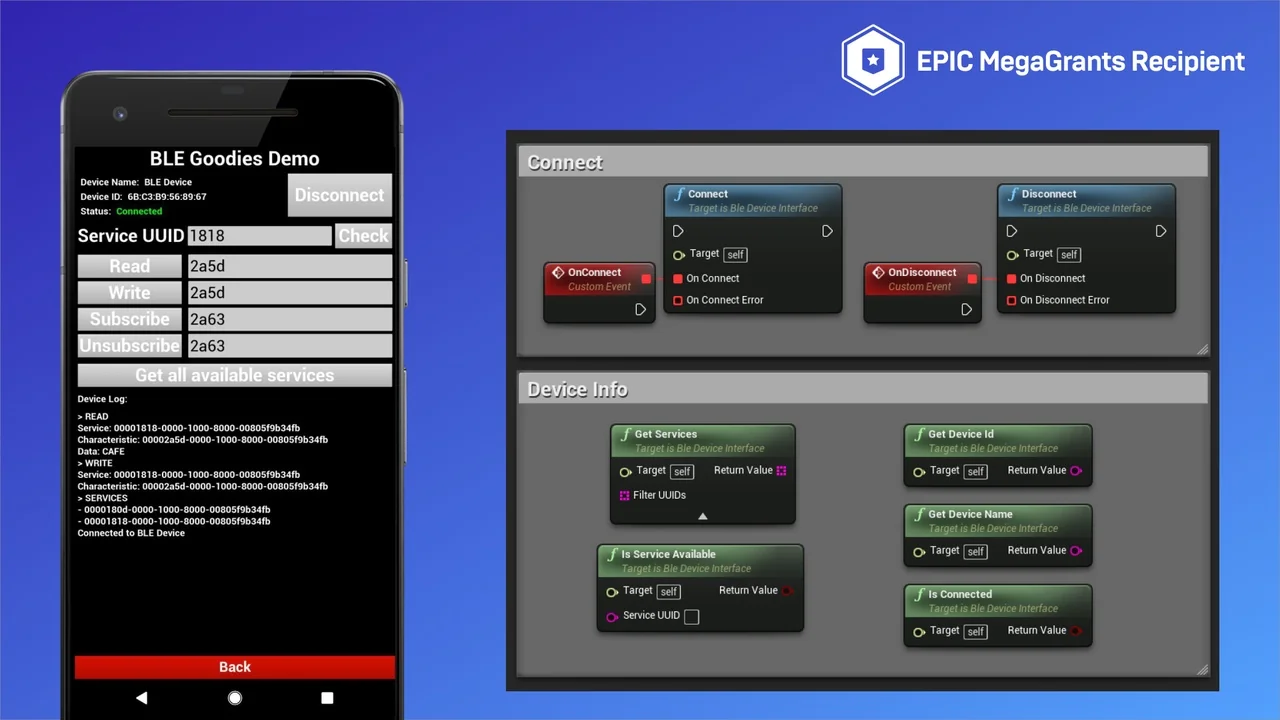
 Engine Tools
 Engine Tools
 Engine Tools