"b00678cacce53329"{"id":"1002773","slug":"art-of-explosions-with-sounds","title":"Art of Explosions with Sounds","category":"Fire \u0026 Explosions","engine":"4.24+,5.0+","assetVersion":"","engineVersion":"Engine Version: 4.24+,5.0+","tag":"Fire \u0026 Explosions","accent":"blue","visual":"mech","summary":"Explore the particle effects, sound layering, materials, and Niagara integration inside Art of Explosions with Sounds for PC combat games.","platform":"Unreal Engine","indexPolicy":"index","publishedAt":"2026-11-20T06:52:30.031Z","updatedAt":"2026-11-20T06:52:30.031Z","sourceNotes":[],"fileContents":[],"compatibility":["Unreal Engine","Engine Version: 4.24+,5.0+"],"featuredImage":{"alt":"Art of Explosions with Sounds","src":"/wp-content/uploads/published/2026/11/705c6f3b2387-ccab41a5-78a8-45c1-9490-183f38a3d597-b5148bbec5.webp"},"fileSizeBytes":212935770,"hasDownloadLink":true,"downloads":0,"terms":[{"taxonomy":"category","slug":"fire-and-explosions","name":"Fire \u0026 Explosions"}],"galleryImages":[{"src":"/wp-content/uploads/published/2026/11/dd554d989929-279ed64d-9b61-4f5a-9d84-be821aa7ed24-bac6c928c5.webp","alt":"Art of Explosions with Sounds"},{"src":"/wp-content/uploads/published/2026/11/9d9ccaad0125-9fe1569e-c091-4b40-b501-adbadf4986e1-64fc78d896.webp","alt":"Art of Explosions with Sounds"},{"src":"/wp-content/uploads/published/2026/11/f957968d835a-c95e4bb1-d4f2-4b28-b68f-d243afbc98f0-af4fcdcc0d.webp","alt":"Art of Explosions with Sounds"},{"src":"/wp-content/uploads/published/2026/11/aff4eb47438a-d0ab200e-0ed0-43ac-ad9a-c67cece96c82-00e0dbb0e0.webp","alt":"Art of Explosions with Sounds"}],"accessPanel":{"kind":"resource","title":"Get this resource","safetyNote":"Resources are manually reviewed before listing to improve quality and reduce obvious risks.","fileName":"Content.7z","resourceType":"Resource archive","versions":[]},"contentHtml":"\u003cp\u003eA sudden strike detonating above an open field sets off distinct visual and acoustic dynamics compared to an artillery hit pulverizing earth or a torpedo throwing plumes of spray out of the ocean. Art of Explosions with Sounds tackles these distinct environmental interactions by supplying 34 individual explosion particle effects paired directly with audio playback systems. Target scenarios span land warfare, aerial combat, and naval skirmishes, delivering an integrated approach where high-impact visuals execute alongside matched audio layers.\u003c/p\u003e\u003ch2\u003eArticulating Battlefield Explosions Across Air, Ground, and Water\u003c/h2\u003e\u003cp\u003eCombat games routinely require distinct detonations that reflect different ballistic payloads, target materials, and environments. Within this asset collection, the 34 particle effects are split across three primary operational domains: air explosions, ground explosions, and water strikes. Rather than relying on a one-size-fits-all burst, the library accounts for specific military and tactical events across these media.\u003c/p\u003e\u003cp\u003eGround-based warfare scenarios make up a major portion of the operational footprint. The visual systems support artillery barrages, howitzer impacts, cannon hits, landmines, and hand grenade detonations. When armored targets take direct hits, the collection provides dedicated visual representations for tank damage alongside general vehicle destruction. Prolonged thermal destruction is covered through napalm explosions and burning flame elements, while tactical cover and line-of-sight concealment are addressed through dedicated smokescreens. Each of these surface phenomena alters the balance of fire, flash, and residual smoke to match the weapon type being portrayed.\u003c/p\u003e\u003cp\u003eAerial engagements demand a completely different visual behavior, where shockwaves and debris dissipate into open space without ground friction. The package accommodates air bombing explosions, aircraft damage states, and large-scale zeppelin strikes. These high-altitude events capture the immediate flash and expanding fiery fireball typical of mid-air structural failures, giving dogfights and flak barrages clear visual markers.\u003c/p\u003e\u003cp\u003eWater strikes introduce unique fluid interactions that require heavy upward kinetic plumes and falling spray. The visual assets cover coastal artillery strikes slamming into shorelines, torpedo hits impacting ship hulls or open sea surfaces, and airplanes strafing straight into water bodies. The rapid displacement of water, combined with lingering mist and spray, distinguishes these maritime detonations from soil-based craters or aerial bursts.\u003c/p\u003e\u003ch2\u003eDynamic Sounds and Audio Layering Mechanics\u003c/h2\u003e\u003cp\u003eA convincing explosion relies as heavily on acoustic depth as it does on volumetric fire and smoke. To prevent the repetitive, synthetic feel that comes from triggering a single static sound cue on every detonation, the asset includes 49 dedicated high-quality audio files configured for organic variation.\u003c/p\u003e\u003cp\u003eInstead of mapping one audio sample to a single visual burst, each particle effect pulls between 6 and 12 different sounds simultaneously in randomized combinations. This multi-layered composite strategy mixes initial blast transients, mid-frequency body impacts, resonant rumbles, and environmental echoes on the fly. Because the engine shuffles through the available sound files for every detonation event, repetitive actions such as continuous artillery bombardments or high-speed strafing runs produce varied acoustic signatures. This acoustic structure is engineered to deliver realistic audio performance specifically calibrated for PC games, where spatial clarity and dynamic range are critical to player immersion.\u003c/p\u003e\u003ch2\u003eMaterial Instances and High-Resolution Texture Architecture\u003c/h2\u003e\u003cp\u003eThe visual believability of flame, fiery cores, expanding debris, and dense smoke banks depends on the underlying shader and material framework. Across the library, visual rendering is driven by 75 materials and material instances supported by specialized shaders.\u003c/p\u003e\u003cp\u003eBy structuring the visual pipeline around flexible material instances, individual explosion properties can be adjusted to match varying lighting setups, scene moods, and environmental parameters without requiring entirely new material graphs. These materials are powered by 39 individual textures, with select maps supplied in 4K resolution. The high pixel density preserves fine details in the wisps of lingering smoke, the sharp luminosity of instantaneous flashes, and the turbulent transitions between combusting flame and cooler soot. Whether viewing an exploding grenade up close in an infantry skirmish or watching coastal artillery shells fall from a long distance, the textures retain crisp structural definition.\u003c/p\u003e\u003ch2\u003eDeploying Niagara and Cascade Explosions for PC Releases\u003c/h2\u003e\u003cp\u003eEngine pipeline compatibility remains a key consideration when integrating combat visual effects into active production environments. The package provides native implementations for both major particle simulation frameworks in Unreal Engine: the legacy Cascade system and the modern Niagara framework.\u003c/p\u003e\u003cp\u003eNiagara particle systems were integrated into the package in version 5.31, giving teams the freedom to choose the pipeline that best fits their project's technical framework. Both systems are organized neatly into separate project folders, preventing naming collisions or dependency conflicts. In tandem with the Niagara rollout, particle parameters were reviewed and corrected to ensure stable, predictable performance across newer Unreal Engine version releases.\u003c/p\u003e\u003cp\u003eThe package focuses its performance tuning and asset profile specifically on PC platforms. The combination of 4K texture support, complex material instances, and multi-layered audio cues creates a resource-rich footprint designed to take full advantage of PC processing power and modern display fidelities.\u003c/p\u003e\u003ch2\u003eImplementation Considerations for Combat Workflows\u003c/h2\u003e\u003cp\u003eIntegrating Art of Explosions with Sounds into an existing combat game project involves evaluating how the 34 visual effects and 49 sound files map onto project-specific gameplay tags and damage tables. Because the collection provides tailored effects for specific combat interactions—such as mine detonations, vehicle damage, cannon strikes, and torpedo splashes—game logic can bind directly to specialized assets rather than reusing generic bursts.\u003c/p\u003e\u003cp\u003eTeams moving their visual pipelines toward Niagara can leverage the dedicated Niagara folder, while projects maintaining older engine structures can draw from the parallel Cascade directory. With randomized multi-sound layering already configured within the particles, setting up artillery barrages, aerial dogfights, or coastal bombardments requires minimal extra audio script assembly, allowing developers to focus on balancing gameplay timing and combat feedback.\u003c/p\u003e\n\n\u003ch2\u003eExplore Similar Assets\u003c/h2\u003e\n\u003cul\u003e\n\u003cli\u003e\u003ca href=\"https://3dcghub.com/stylized-vfx-fire/\" rel=\"noopener noreferrer\"\u003eStylized VFX - Fire\u003c/a\u003e\u003c/li\u003e\n\u003cli\u003e\u003ca href=\"https://3dcghub.com/100-explosion-pack-niagara/\" rel=\"noopener noreferrer\"\u003e100 Explosion Pack Niagara\u003c/a\u003e\u003c/li\u003e\n\u003cli\u003e\u003ca href=\"https://3dcghub.com/fire-and-explosion-fx-pack/\" rel=\"noopener noreferrer\"\u003eFire and Explosion FX Pack\u003c/a\u003e\u003c/li\u003e\n\u003cli\u003e\u003ca href=\"https://3dcghub.com/niagara-stylized-fire-vol-1/\" rel=\"noopener noreferrer\"\u003eNiagara Stylized Fire Vol. 1\u003c/a\u003e\u003c/li\u003e\n\u003cli\u003e\u003ca href=\"https://3dcghub.com/volcano-environment-vfx/\" rel=\"noopener noreferrer\"\u003eVolcano Environment VFX\u003c/a\u003e\u003c/li\u003e\n\u003c/ul\u003e","contentTextLength":6967,"navigation":{"current":107,"total":4797,"previous":{"id":"1002774","slug":"aurora-borealis","title":"Aurora Borealis","category":"Game Development Resource","platform":"Unreal Engine","updatedAt":"2026-11-20T06:53:18.862Z"},"next":{"id":"1002772","slug":"aoe-shock-wave-visual-effects-pack","title":"AoE Shock Wave Visual Effects Pack","category":"Variety","platform":"Unreal Engine","updatedAt":"2026-11-20T06:50:58.405Z"}},"relatedResources":[{"id":"1002281","slug":"stylized-vfx-fire","title":"Stylized VFX - Fire","category":"Fire \u0026 Explosions","engine":"4.26+,5.0+","assetVersion":"","engineVersion":"Engine Version: 4.26+,5.0+","tag":"Fire \u0026 Explosions","accent":"blue","visual":"mech","summary":"Explore Stylized VFX - Fire, featuring 70 unique fire element effects built with optimized Sub UV materials for instant drag-and-drop game integration.","platform":"Unreal Engine","indexPolicy":"noindex","publishedAt":"2026-10-29T16:40:51.715Z","updatedAt":"2026-10-29T16:40:51.715Z","sourceNotes":[],"fileContents":[],"compatibility":["Unreal Engine","Engine Version: 4.26+,5.0+"],"featuredImage":{"alt":"Stylized VFX - Fire","src":"/wp-content/uploads/published/2026/10/057bd2631882-ab64453d-fecf-4944-9fc0-3b59cd7b749c-66a5cc8e61.webp"},"fileSizeBytes":21207103,"hasDownloadLink":true,"downloads":3},{"id":"1002854","slug":"vfx-grenade-pack","title":"VFX Grenade Pack","category":"Fire \u0026 Explosions","engine":"4.26+,5.0+","assetVersion":"","engineVersion":"Engine Version: 4.26+,5.0+","tag":"Fire \u0026 Explosions","accent":"blue","visual":"mech","summary":"VFX Grenade Pack delivers material-specific explosions for Niagara and Cascade in Unreal Engine, featuring Blueprints, decals, and camera shakes.","platform":"Unreal Engine","indexPolicy":"index","publishedAt":"2026-11-20T12:35:58.420Z","updatedAt":"2026-11-20T12:35:58.420Z","sourceNotes":[],"fileContents":[],"compatibility":["Unreal Engine","Engine Version: 4.26+,5.0+"],"featuredImage":{"alt":"VFX Grenade Pack","src":"/wp-content/uploads/published/2026/11/6558a19cbb7f-b11a8f0d-0f45-43c4-9e0e-9dd9232faa13-41a5e4c368.webp"},"fileSizeBytes":18032032,"hasDownloadLink":true,"downloads":0},{"id":"1002853","slug":"vfx-fire-pack","title":"VFX Fire Pack","category":"Fire \u0026 Explosions","engine":"4.26+,5.0+","assetVersion":"","engineVersion":"Engine Version: 4.26+,5.0+","tag":"Fire \u0026 Explosions","accent":"blue","visual":"mech","summary":"VFX Fire Pack delivers complete fire effects updated for Unreal Engine 5 with Niagara emitters, embedded lights, lit smoke, and environmental blueprints.","platform":"Unreal Engine","indexPolicy":"index","publishedAt":"2026-11-20T12:34:58.772Z","updatedAt":"2026-11-20T12:34:58.772Z","sourceNotes":[],"fileContents":[],"compatibility":["Unreal Engine","Engine Version: 4.26+,5.0+"],"featuredImage":{"alt":"VFX Fire Pack","src":"/wp-content/uploads/published/2026/11/9bb5dd81c644-56f491fb-6a1e-4ff8-a8ff-7823b382ff71-72b196ffb0.webp"},"fileSizeBytes":162136848,"hasDownloadLink":true,"downloads":0}]}
Resource screenshots
1 / 4
Join our channel
Follow 3DCGHUB on Telegram for new resource drops, migration updates, and community notices.
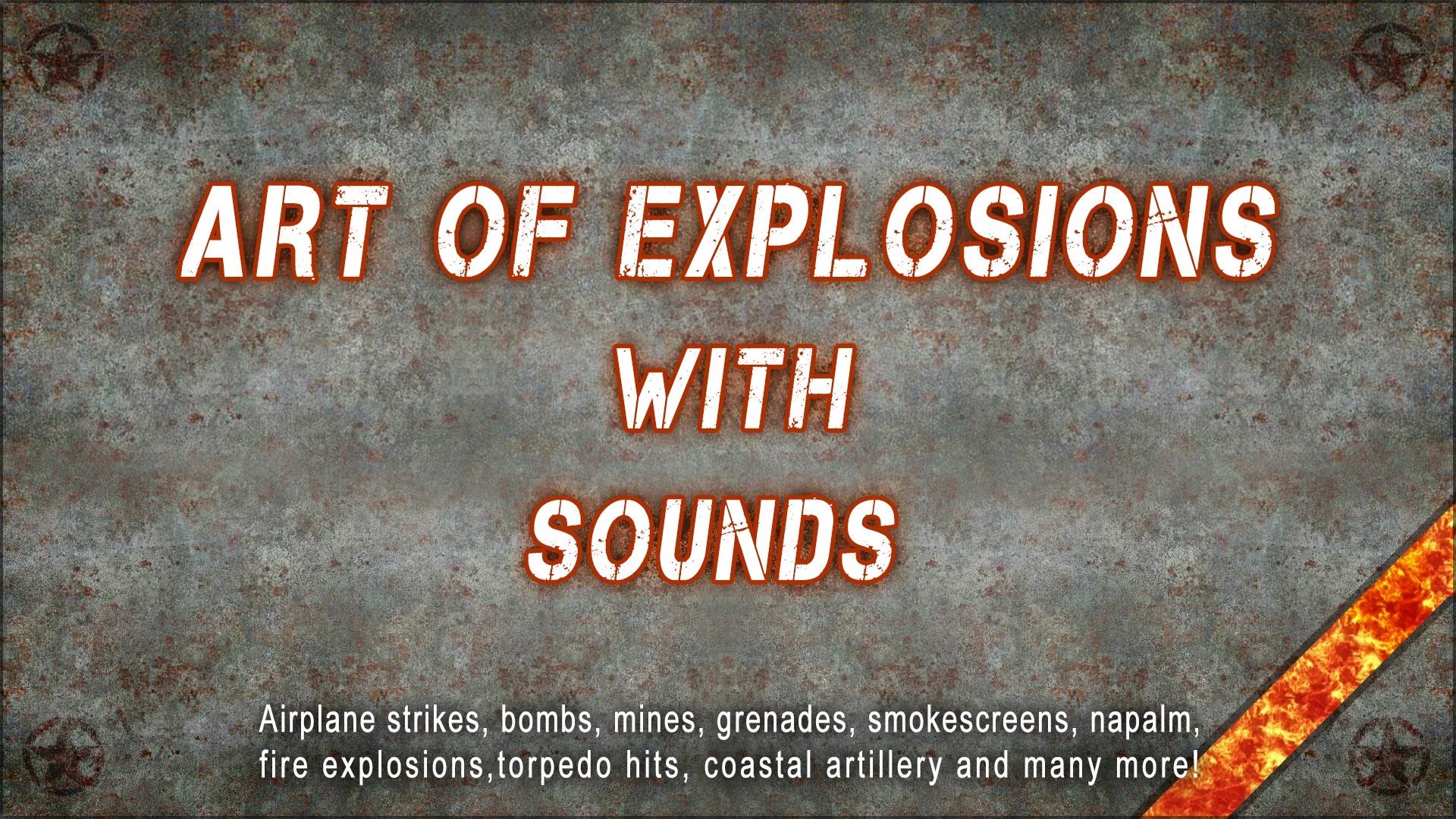
A sudden strike detonating above an open field sets off distinct visual and acoustic dynamics compared to an artillery hit pulverizing earth or a torpedo throwing plumes of spray out of the ocean. Art of Explosions with Sounds tackles these distinct environmental interactions by supplying 34 individual explosion particle effects paired directly with audio playback systems. Target scenarios span land warfare, aerial combat, and naval skirmishes, delivering an integrated approach where high-impact visuals execute alongside matched audio layers.
Articulating Battlefield Explosions Across Air, Ground, and Water
Combat games routinely require distinct detonations that reflect different ballistic payloads, target materials, and environments. Within this asset collection, the 34 particle effects are split across three primary operational domains: air explosions, ground explosions, and water strikes. Rather than relying on a one-size-fits-all burst, the library accounts for specific military and tactical events across these media.
Ground-based warfare scenarios make up a major portion of the operational footprint. The visual systems support artillery barrages, howitzer impacts, cannon hits, landmines, and hand grenade detonations. When armored targets take direct hits, the collection provides dedicated visual representations for tank damage alongside general vehicle destruction. Prolonged thermal destruction is covered through napalm explosions and burning flame elements, while tactical cover and line-of-sight concealment are addressed through dedicated smokescreens. Each of these surface phenomena alters the balance of fire, flash, and residual smoke to match the weapon type being portrayed.
Aerial engagements demand a completely different visual behavior, where shockwaves and debris dissipate into open space without ground friction. The package accommodates air bombing explosions, aircraft damage states, and large-scale zeppelin strikes. These high-altitude events capture the immediate flash and expanding fiery fireball typical of mid-air structural failures, giving dogfights and flak barrages clear visual markers.
Water strikes introduce unique fluid interactions that require heavy upward kinetic plumes and falling spray. The visual assets cover coastal artillery strikes slamming into shorelines, torpedo hits impacting ship hulls or open sea surfaces, and airplanes strafing straight into water bodies. The rapid displacement of water, combined with lingering mist and spray, distinguishes these maritime detonations from soil-based craters or aerial bursts.
Dynamic Sounds and Audio Layering Mechanics
A convincing explosion relies as heavily on acoustic depth as it does on volumetric fire and smoke. To prevent the repetitive, synthetic feel that comes from triggering a single static sound cue on every detonation, the asset includes 49 dedicated high-quality audio files configured for organic variation.
Instead of mapping one audio sample to a single visual burst, each particle effect pulls between 6 and 12 different sounds simultaneously in randomized combinations. This multi-layered composite strategy mixes initial blast transients, mid-frequency body impacts, resonant rumbles, and environmental echoes on the fly. Because the engine shuffles through the available sound files for every detonation event, repetitive actions such as continuous artillery bombardments or high-speed strafing runs produce varied acoustic signatures. This acoustic structure is engineered to deliver realistic audio performance specifically calibrated for PC games, where spatial clarity and dynamic range are critical to player immersion.
Material Instances and High-Resolution Texture Architecture
The visual believability of flame, fiery cores, expanding debris, and dense smoke banks depends on the underlying shader and material framework. Across the library, visual rendering is driven by 75 materials and material instances supported by specialized shaders.
By structuring the visual pipeline around flexible material instances, individual explosion properties can be adjusted to match varying lighting setups, scene moods, and environmental parameters without requiring entirely new material graphs. These materials are powered by 39 individual textures, with select maps supplied in 4K resolution. The high pixel density preserves fine details in the wisps of lingering smoke, the sharp luminosity of instantaneous flashes, and the turbulent transitions between combusting flame and cooler soot. Whether viewing an exploding grenade up close in an infantry skirmish or watching coastal artillery shells fall from a long distance, the textures retain crisp structural definition.
Deploying Niagara and Cascade Explosions for PC Releases
Engine pipeline compatibility remains a key consideration when integrating combat visual effects into active production environments. The package provides native implementations for both major particle simulation frameworks in Unreal Engine: the legacy Cascade system and the modern Niagara framework.
Niagara particle systems were integrated into the package in version 5.31, giving teams the freedom to choose the pipeline that best fits their project's technical framework. Both systems are organized neatly into separate project folders, preventing naming collisions or dependency conflicts. In tandem with the Niagara rollout, particle parameters were reviewed and corrected to ensure stable, predictable performance across newer Unreal Engine version releases.
The package focuses its performance tuning and asset profile specifically on PC platforms. The combination of 4K texture support, complex material instances, and multi-layered audio cues creates a resource-rich footprint designed to take full advantage of PC processing power and modern display fidelities.
Implementation Considerations for Combat Workflows
Integrating Art of Explosions with Sounds into an existing combat game project involves evaluating how the 34 visual effects and 49 sound files map onto project-specific gameplay tags and damage tables. Because the collection provides tailored effects for specific combat interactions—such as mine detonations, vehicle damage, cannon strikes, and torpedo splashes—game logic can bind directly to specialized assets rather than reusing generic bursts.
Teams moving their visual pipelines toward Niagara can leverage the dedicated Niagara folder, while projects maintaining older engine structures can draw from the parallel Cascade directory. With randomized multi-sound layering already configured within the particles, setting up artillery barrages, aerial dogfights, or coastal bombardments requires minimal extra audio script assembly, allowing developers to focus on balancing gameplay timing and combat feedback.
 Fire & Explosions
 Fire & Explosions
 Fire & Explosions