"b00678cacce53329"{"id":"1002854","slug":"vfx-grenade-pack","title":"VFX Grenade Pack","category":"Fire \u0026 Explosions","engine":"4.26+,5.0+","assetVersion":"","engineVersion":"Engine Version: 4.26+,5.0+","tag":"Fire \u0026 Explosions","accent":"blue","visual":"mech","summary":"VFX Grenade Pack delivers material-specific explosions for Niagara and Cascade in Unreal Engine, featuring Blueprints, decals, and camera shakes.","platform":"Unreal Engine","indexPolicy":"index","publishedAt":"2026-11-20T12:35:58.420Z","updatedAt":"2026-11-20T12:35:58.420Z","sourceNotes":[],"fileContents":[],"compatibility":["Unreal Engine","Engine Version: 4.26+,5.0+"],"featuredImage":{"alt":"VFX Grenade Pack","src":"/wp-content/uploads/published/2026/11/6558a19cbb7f-b11a8f0d-0f45-43c4-9e0e-9dd9232faa13-41a5e4c368.webp"},"fileSizeBytes":18032032,"hasDownloadLink":true,"downloads":0,"terms":[{"taxonomy":"category","slug":"fire-and-explosions","name":"Fire \u0026 Explosions"}],"galleryImages":[{"src":"/wp-content/uploads/published/2026/11/78bf215d9eb3-19af6cfd-8ff6-4294-954c-d8d379829a4d-f794e11a08.webp","alt":"VFX Grenade Pack"},{"src":"/wp-content/uploads/published/2026/11/beb9537d7a71-71e214f4-abb7-4207-80bb-c425907dbe37-91c3ac0ece.webp","alt":"VFX Grenade Pack"},{"src":"/wp-content/uploads/published/2026/11/d56ae200a659-f6583879-f61a-480e-9d87-627ecbc58aa7-ae07f8cdee.webp","alt":"VFX Grenade Pack"},{"src":"/wp-content/uploads/published/2026/11/f02c72910403-ca3a13e4-70e2-4381-9cca-fb4f4c7124d3-a56b2d0c35.webp","alt":"VFX Grenade Pack"},{"src":"/wp-content/uploads/published/2026/11/565dc48f9806-0a082154-931a-4f92-86d6-06b2d99a5bd6-dce3299393.webp","alt":"VFX Grenade Pack"},{"src":"/wp-content/uploads/published/2026/11/0c62e0437da7-b1a6313f-294c-4762-8f5a-64ff4ed271e3-13b6d9a172.webp","alt":"VFX Grenade Pack"},{"src":"/wp-content/uploads/published/2026/11/d0ef39303780-be0404b6-1735-4f8e-9a77-40ab74fc2a6e-4d23625292.webp","alt":"VFX Grenade Pack"},{"src":"/wp-content/uploads/published/2026/11/171946816e87-f2c2dc77-1c9c-4e6e-8ba1-440ca5a81910-c46721d2ff.webp","alt":"VFX Grenade Pack"},{"src":"/wp-content/uploads/published/2026/11/c83ba3a8f6f0-cd1d1233-107b-4b94-99dc-90ae285802d6-e6a5fc2f9c.webp","alt":"VFX Grenade Pack"},{"src":"/wp-content/uploads/published/2026/11/cd0c3dbcfd53-936598ed-281e-4df7-a2ee-f59895504b67-d5aeb76363.webp","alt":"VFX Grenade Pack"}],"accessPanel":{"kind":"resource","title":"Get this resource","safetyNote":"Resources are manually reviewed before listing to improve quality and reduce obvious risks.","fileName":"Content.7z","resourceType":"Resource archive","versions":[]},"contentHtml":"\u003cp\u003eSurface context defines how a believable explosion behaves. An explosive charge detonating in open air looks fundamentally distinct from one striking compacted dirt, shattering brittle ice, or churning up foam across deep water. The VFX Grenade Pack establishes this relationship directly through physical materials, anchoring blast aesthetics to the physical properties of whatever surface the projectile contacts within Unreal Engine.\u003c/p\u003e \u003ch2\u003ePhysical Material Responses in the VFX Grenade Pack\u003c/h2\u003e\n\u003cp\u003eExplosion visuals within the pack are built to address ten distinct physical material states: Default, Air, Concrete, Dirt, Grass, Ice, Metal, Snow, Wood, and Water. Rather than treating an explosive impact as a generic fireburst, the particle behaviors account for the specific debris, particulate dispersal, and impact shock associated with each medium.\u003c/p\u003e\n\u003cp\u003eDetonations on concrete and metal emphasize hard-surface resistance, throwing sharp shrapnel and concentrated blast bursts that speak to rigid structural resistance. In contrast, impacts on dirt, grass, and snow disperse softer particulate matter, throwing up loose clumps, sod, and powder suited to penetrable ground. The ice interaction handles brittle fracture visuals, while wood creates splintered destruction upon blast contact. Water handles the unique visual requirement of displaced liquid, generating upward splashes and surface disruption rather than dry debris.\u003c/p\u003e\n\u003cp\u003eAir detonations handle scenarios where the projectile triggers mid-flight without contacting a surface volume. This ensures proximity or timed fuses present an unconstrained, spherically expanding shockwave without clipping artificial ground dust into empty space. The default material assignment serves as the fallback standard, allowing any unassigned collision geometry or generic props to trigger a balanced, generalized blast profile that fits typical combat encounters.\u003c/p\u003e \u003ch2\u003eCascade and Niagara Emitter Architecture\u003c/h2\u003e\n\u003cp\u003eParticle authoring spans both Cascade and Niagara frameworks, providing full access to modern visual effects workflows while preserving legacy asset support. Within each effect, visual complexity is distributed across a hybrid mixture of CPU emitters, GPU emitters, and mesh emitters.\u003c/p\u003e\n\u003cp\u003eCPU emitters provide stable execution for core explosion elements that interact with immediate collision logic or precise lifetime events. GPU emitters take over high-volume particulate tasks, handling the dense plumes of sparks, lingering smoke trails, fine dust clouds, and peripheral embers that require massive particle counts without burdening basic thread allocation. Mesh emitters introduce volumetric geometry directly into the blast, launching solid fragments, physical debris, and stylized shrapnel outward to give weight and mass to the exploding ordnance.\u003c/p\u003e\n\u003cp\u003eEvery effect type is split between regular and lightweight versions across both Cascade and Niagara. Regular presets feature the complete particle payload, rendering high-density dust plumes, detailed mesh shrapnel, and layered smoke stages suitable for focal weapon gameplay or high-end target platforms. Lightweight presets pare down emitter layers, reducing active particle counts and rendering overhead. This split allows performance scaling across different hardware profiles, multiplayer stress levels, or scenarios where dozens of explosions occur in rapid succession.\u003c/p\u003e \u003ch2\u003eGrenade Blueprint Logic, Decals, and Camera Shake Dynamics\u003c/h2\u003e\n\u003cp\u003eThe visual effects do not operate in isolation; they are tied into dedicated Blueprint grenade examples that manage the end-to-end explosion sequence. These Blueprints handle the orchestration between projectile lifecycle, spatial audio triggers, camera shakes, and persistent surface alterations.\u003c/p\u003e\n\u003cp\u003eWhen a grenade reaches detonation, the Blueprint coordinates the following synchronized components:\u003c/p\u003e\n\u003cul\u003e\n\u003cli\u003e\u003cstrong\u003eSound playback:\u003c/strong\u003e Triggers contextual audio to reinforce the mechanical impact and shockwave of the detonation.\u003c/li\u003e\n\u003cli\u003e\u003cstrong\u003eScorch decals:\u003c/strong\u003e Projects dedicated blast marks onto nearby surfaces, drawing from included materials and textures to anchor the explosion site permanently into the environment.\u003c/li\u003e\n\u003cli\u003e\u003cstrong\u003eGeo camera shake Blueprint:\u003c/strong\u003e Imparts a physical impulse to the player's viewport, shaking the camera frame based on spatial proximity to simulate concussive air pressure.\u003c/li\u003e\n\u003cli\u003e\u003cstrong\u003eParticle spawning:\u003c/strong\u003e Selects and fires either the Cascade or Niagara emitter system corresponding to the underlying surface type and performance tier.\u003c/li\u003e\n\u003c/ul\u003e\n\u003cp\u003eThe included materials and textures support the scorch decal workflow, giving the blast radius an incinerated, soot-covered footprint that matches the outward vector of the explosion. By combining camera displacement, visual blast geometry, audio cues, and decal projection inside a single Blueprint actor, the asset provides a cohesive mechanical foundation ready to be tied into larger weapon mechanics, damage systems, or AI throw behaviors.\u003c/p\u003e \u003ch2\u003eInteractive Testing in the Grenade Content Map\u003c/h2\u003e\n\u003cp\u003eEvaluating explosive visual timing requires hands-on scene interaction. The pack includes an example map—the grenade content map—pre-configured for live testing and immediate comparison across all included variations.\u003c/p\u003e\n\u003cp\u003eInput controls are mapped directly inside the level blueprint, binding grenade throwing functions across four designated keys: G, H, B, and N. This layout allows rapid cycling between Cascade and Niagara executions, as well as switching between full-density regular effects and performance-friendly lightweight presets. Testers can toss projectiles directly into different physical material zones within the level to verify how the collision trace detects a surface and subsequently triggers the correct blast profile.\u003c/p\u003e\n\u003cp\u003eReviewing the level blueprint setup also provides a clear reference for technical implementation. It demonstrates how input signals translate into projectile spawning, how the grenade Blueprint receives transform and velocity vectors, and how the physical material trace routes directly into the final particle emitter selection.\u003c/p\u003e \u003ch2\u003eEngine Compatibility and Deployment\u003c/h2\u003e\n\u003cp\u003eThe VFX Grenade Pack maintains compatibility spanning from its 4.25 update up through Unreal Engine 5. Projects operating within modern Unreal Engine 5 environments can leverage the full Niagara toolset, taking advantage of updated particle rendering pipelines, while teams maintaining established Cascade workflows retain complete parity across all physical surface reactions and Blueprint bindings.\u003c/p\u003e\n\n\u003ch2\u003eRelated Resources Worth Checking\u003c/h2\u003e\n\u003cul\u003e\n\u003cli\u003e\u003ca href=\"https://3dcghub.com/stylized-vfx-fire/\" rel=\"noopener noreferrer\"\u003eStylized VFX - Fire\u003c/a\u003e\u003c/li\u003e\n\u003cli\u003e\u003ca href=\"https://3dcghub.com/vfx-fire-pack/\" rel=\"noopener noreferrer\"\u003eVFX Fire Pack\u003c/a\u003e\u003c/li\u003e\n\u003cli\u003e\u003ca href=\"https://3dcghub.com/stylized-shooting-vfx-niagara-muzzle-bullet-trail-impact/\" rel=\"noopener noreferrer\"\u003eStylized Shooting VFX Niagara (Muzzle - Bullet Trail - Impact)\u003c/a\u003e\u003c/li\u003e\n\u003cli\u003e\u003ca href=\"https://3dcghub.com/power-explosions-vfx-pack-color-explosions-dust-and-sand-explosions/\" rel=\"noopener noreferrer\"\u003ePower Explosions VFX Pack // Color Explosions // Dust and Sand explosions\u003c/a\u003e\u003c/li\u003e\n\u003cli\u003e\u003ca href=\"https://3dcghub.com/m5-vfx-vol1-smoke-and-big-explosion-niagara/\" rel=\"noopener noreferrer\"\u003eM5 VFX Vol1. Smoke and Big Explosion(Niagara)\u003c/a\u003e\u003c/li\u003e\n\u003c/ul\u003e","contentTextLength":6672,"navigation":{"current":26,"total":4797,"previous":{"id":"1002855","slug":"vfx-playground","title":"VFX Playground","category":"Variety","platform":"Unreal Engine","updatedAt":"2026-11-20T12:36:41.568Z"},"next":{"id":"1002853","slug":"vfx-fire-pack","title":"VFX Fire Pack","category":"Fire \u0026 Explosions","platform":"Unreal Engine","updatedAt":"2026-11-20T12:34:58.772Z"}},"relatedResources":[{"id":"1002281","slug":"stylized-vfx-fire","title":"Stylized VFX - Fire","category":"Fire \u0026 Explosions","engine":"4.26+,5.0+","assetVersion":"","engineVersion":"Engine Version: 4.26+,5.0+","tag":"Fire \u0026 Explosions","accent":"blue","visual":"mech","summary":"Explore Stylized VFX - Fire, featuring 70 unique fire element effects built with optimized Sub UV materials for instant drag-and-drop game integration.","platform":"Unreal Engine","indexPolicy":"noindex","publishedAt":"2026-10-29T16:40:51.715Z","updatedAt":"2026-10-29T16:40:51.715Z","sourceNotes":[],"fileContents":[],"compatibility":["Unreal Engine","Engine Version: 4.26+,5.0+"],"featuredImage":{"alt":"Stylized VFX - Fire","src":"/wp-content/uploads/published/2026/10/057bd2631882-ab64453d-fecf-4944-9fc0-3b59cd7b749c-66a5cc8e61.webp"},"fileSizeBytes":21207103,"hasDownloadLink":true,"downloads":3},{"id":"1002853","slug":"vfx-fire-pack","title":"VFX Fire Pack","category":"Fire \u0026 Explosions","engine":"4.26+,5.0+","assetVersion":"","engineVersion":"Engine Version: 4.26+,5.0+","tag":"Fire \u0026 Explosions","accent":"blue","visual":"mech","summary":"VFX Fire Pack delivers complete fire effects updated for Unreal Engine 5 with Niagara emitters, embedded lights, lit smoke, and environmental blueprints.","platform":"Unreal Engine","indexPolicy":"index","publishedAt":"2026-11-20T12:34:58.772Z","updatedAt":"2026-11-20T12:34:58.772Z","sourceNotes":[],"fileContents":[],"compatibility":["Unreal Engine","Engine Version: 4.26+,5.0+"],"featuredImage":{"alt":"VFX Fire Pack","src":"/wp-content/uploads/published/2026/11/9bb5dd81c644-56f491fb-6a1e-4ff8-a8ff-7823b382ff71-72b196ffb0.webp"},"fileSizeBytes":162136848,"hasDownloadLink":true,"downloads":0},{"id":"1002842","slug":"stylized-shooting-vfx-niagara-muzzle-bullet-trail-impact","title":"Stylized Shooting VFX Niagara (Muzzle - Bullet Trail - Impact)","category":"Fire \u0026 Explosions","engine":"4.26+,5.0+","assetVersion":"","engineVersion":"Engine Version: 4.26+,5.0+","tag":"Fire \u0026 Explosions","accent":"blue","visual":"mech","summary":"A technical breakdown of the 17 Niagara FX included in Stylized Shooting VFX Niagara, spanning muzzle flashes, bullet trails, ribbons, and impacts.","platform":"Unreal Engine","indexPolicy":"index","publishedAt":"2026-11-20T12:23:46.116Z","updatedAt":"2026-11-20T12:23:46.116Z","sourceNotes":[],"fileContents":[],"compatibility":["Unreal Engine","Engine Version: 4.26+,5.0+"],"featuredImage":{"alt":"Stylized Shooting VFX Niagara (Muzzle - Bullet Trail - Impact)","src":"/wp-content/uploads/published/2026/11/2982b94a8a48-32843b42-3712-436e-9699-f1872f57f17e-55d053e3b3.webp"},"fileSizeBytes":21027598,"hasDownloadLink":true,"downloads":0}]}
Resource screenshots
1 / 10
Join our channel
Follow 3DCGHUB on Telegram for new resource drops, migration updates, and community notices.
Surface context defines how a believable explosion behaves. An explosive charge detonating in open air looks fundamentally distinct from one striking compacted dirt, shattering brittle ice, or churning up foam across deep water. The VFX Grenade Pack establishes this relationship directly through physical materials, anchoring blast aesthetics to the physical properties of whatever surface the projectile contacts within Unreal Engine.
Physical Material Responses in the VFX Grenade Pack
Explosion visuals within the pack are built to address ten distinct physical material states: Default, Air, Concrete, Dirt, Grass, Ice, Metal, Snow, Wood, and Water. Rather than treating an explosive impact as a generic fireburst, the particle behaviors account for the specific debris, particulate dispersal, and impact shock associated with each medium.
Detonations on concrete and metal emphasize hard-surface resistance, throwing sharp shrapnel and concentrated blast bursts that speak to rigid structural resistance. In contrast, impacts on dirt, grass, and snow disperse softer particulate matter, throwing up loose clumps, sod, and powder suited to penetrable ground. The ice interaction handles brittle fracture visuals, while wood creates splintered destruction upon blast contact. Water handles the unique visual requirement of displaced liquid, generating upward splashes and surface disruption rather than dry debris.
Air detonations handle scenarios where the projectile triggers mid-flight without contacting a surface volume. This ensures proximity or timed fuses present an unconstrained, spherically expanding shockwave without clipping artificial ground dust into empty space. The default material assignment serves as the fallback standard, allowing any unassigned collision geometry or generic props to trigger a balanced, generalized blast profile that fits typical combat encounters.
Cascade and Niagara Emitter Architecture
Particle authoring spans both Cascade and Niagara frameworks, providing full access to modern visual effects workflows while preserving legacy asset support. Within each effect, visual complexity is distributed across a hybrid mixture of CPU emitters, GPU emitters, and mesh emitters.
CPU emitters provide stable execution for core explosion elements that interact with immediate collision logic or precise lifetime events. GPU emitters take over high-volume particulate tasks, handling the dense plumes of sparks, lingering smoke trails, fine dust clouds, and peripheral embers that require massive particle counts without burdening basic thread allocation. Mesh emitters introduce volumetric geometry directly into the blast, launching solid fragments, physical debris, and stylized shrapnel outward to give weight and mass to the exploding ordnance.
Every effect type is split between regular and lightweight versions across both Cascade and Niagara. Regular presets feature the complete particle payload, rendering high-density dust plumes, detailed mesh shrapnel, and layered smoke stages suitable for focal weapon gameplay or high-end target platforms. Lightweight presets pare down emitter layers, reducing active particle counts and rendering overhead. This split allows performance scaling across different hardware profiles, multiplayer stress levels, or scenarios where dozens of explosions occur in rapid succession.
Grenade Blueprint Logic, Decals, and Camera Shake Dynamics
The visual effects do not operate in isolation; they are tied into dedicated Blueprint grenade examples that manage the end-to-end explosion sequence. These Blueprints handle the orchestration between projectile lifecycle, spatial audio triggers, camera shakes, and persistent surface alterations.
When a grenade reaches detonation, the Blueprint coordinates the following synchronized components:
Sound playback: Triggers contextual audio to reinforce the mechanical impact and shockwave of the detonation.
Scorch decals: Projects dedicated blast marks onto nearby surfaces, drawing from included materials and textures to anchor the explosion site permanently into the environment.
Geo camera shake Blueprint: Imparts a physical impulse to the player's viewport, shaking the camera frame based on spatial proximity to simulate concussive air pressure.
Particle spawning: Selects and fires either the Cascade or Niagara emitter system corresponding to the underlying surface type and performance tier.
The included materials and textures support the scorch decal workflow, giving the blast radius an incinerated, soot-covered footprint that matches the outward vector of the explosion. By combining camera displacement, visual blast geometry, audio cues, and decal projection inside a single Blueprint actor, the asset provides a cohesive mechanical foundation ready to be tied into larger weapon mechanics, damage systems, or AI throw behaviors.
Interactive Testing in the Grenade Content Map
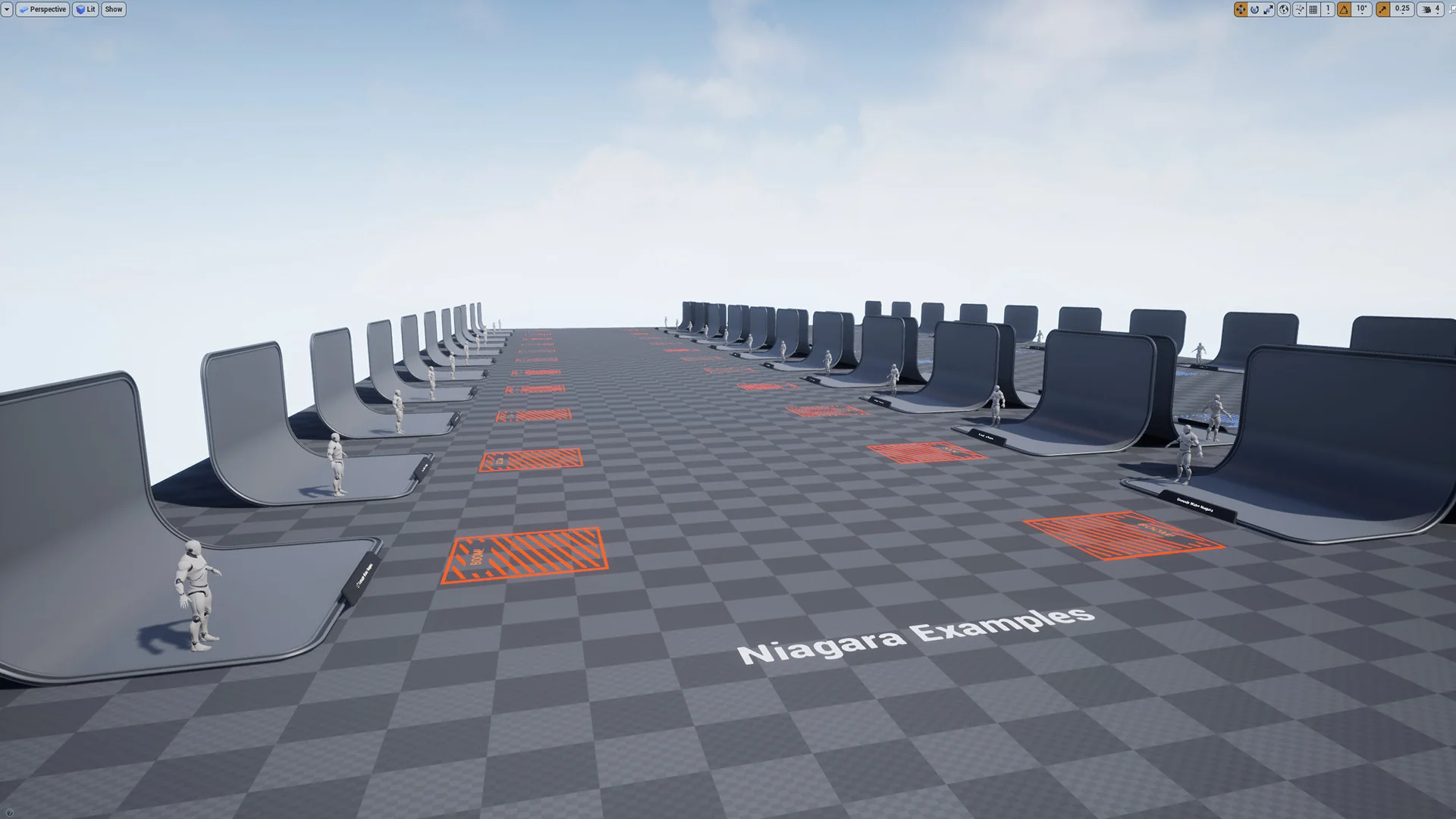
Evaluating explosive visual timing requires hands-on scene interaction. The pack includes an example map—the grenade content map—pre-configured for live testing and immediate comparison across all included variations.
Input controls are mapped directly inside the level blueprint, binding grenade throwing functions across four designated keys: G, H, B, and N. This layout allows rapid cycling between Cascade and Niagara executions, as well as switching between full-density regular effects and performance-friendly lightweight presets. Testers can toss projectiles directly into different physical material zones within the level to verify how the collision trace detects a surface and subsequently triggers the correct blast profile.
Reviewing the level blueprint setup also provides a clear reference for technical implementation. It demonstrates how input signals translate into projectile spawning, how the grenade Blueprint receives transform and velocity vectors, and how the physical material trace routes directly into the final particle emitter selection.
Engine Compatibility and Deployment
The VFX Grenade Pack maintains compatibility spanning from its 4.25 update up through Unreal Engine 5. Projects operating within modern Unreal Engine 5 environments can leverage the full Niagara toolset, taking advantage of updated particle rendering pipelines, while teams maintaining established Cascade workflows retain complete parity across all physical surface reactions and Blueprint bindings.
 Fire & Explosions
 Fire & Explosions
 Fire & Explosions