"0341a2901a4ae9aa"{"id":"1000719","slug":"alpine-landscape","title":"ALPINE LANDSCAPE","category":"Forest \u0026 Jungle","engine":"5.3+","assetVersion":"","engineVersion":"Engine Version: 5.3+","tag":"Forest \u0026 Jungle","accent":"blue","visual":"city","summary":"ALPINE LANDSCAPE delivers a 64-square-kilometer Nanite-based environment for Unreal Engine, featuring PCG-distributed trees, rocks, procedural grass, and update","platform":"Unreal Engine","publishedAt":"2026-07-26T07:07:57.036Z","updatedAt":"2026-07-26T07:07:57.036Z","sourceNotes":[],"fileContents":[],"compatibility":["Unreal Engine","Engine Version: 5.3+"],"featuredImage":{"alt":"ALPINE LANDSCAPE","src":"/wp-content/uploads/published/2026/07/79f9716718d0-25cb063a-352f-4f5a-85f2-3ab810ee7310-cf08985c98.webp"},"hasDownloadLink":true,"downloads":0,"terms":[{"taxonomy":"category","slug":"forest-and-jungle","name":"Forest \u0026 Jungle"}],"galleryImages":[{"src":"/wp-content/uploads/published/2026/07/9f7a2a2d67cb-33c4b949-62b2-4ad3-b5dc-43fde7de56ac-562b91fa0d.webp","alt":"ALPINE LANDSCAPE"},{"src":"/wp-content/uploads/published/2026/07/25b69dd03260-a61b0f76-321e-4cca-af97-cc74990bd990-9e3d46d802.webp","alt":"ALPINE LANDSCAPE"},{"src":"/wp-content/uploads/published/2026/07/282e42a67dab-fbe470df-109b-42ed-ad8c-fb450655d200-9119a8d9ab.webp","alt":"ALPINE LANDSCAPE"},{"src":"/wp-content/uploads/published/2026/07/d814817f31b8-fe4527fc-bbc4-4fb8-be60-5b96bf7d5601-39e49a637a.webp","alt":"ALPINE LANDSCAPE"},{"src":"/wp-content/uploads/published/2026/07/357ca09d8722-02a46061-d539-44ea-8669-5f8f1bb74c08-f98471d90c.webp","alt":"ALPINE LANDSCAPE"},{"src":"/wp-content/uploads/published/2026/07/09d9e4b7f442-ac3b9b7d-ae42-4d04-995f-4cebe57c3dd8-19f98876d0.webp","alt":"ALPINE LANDSCAPE"},{"src":"/wp-content/uploads/published/2026/07/02a5dc664d46-7aad065b-f608-421a-8d36-958c42dc1b35-31f0b3c1fc.webp","alt":"ALPINE LANDSCAPE"},{"src":"/wp-content/uploads/published/2026/07/85f7a97e3054-14fed4e1-31cf-4a59-9fe5-fa0d08cff6ef-3149979aaa.webp","alt":"ALPINE LANDSCAPE"},{"src":"/wp-content/uploads/published/2026/07/61bd3fc2140d-60643f62-3422-4187-810c-ce36f7971260-d909b41c12.webp","alt":"ALPINE LANDSCAPE"}],"accessPanel":{"kind":"resource","title":"Download this resource","eyebrow":"Free Download","message":"Log in or create a free account to start your download.","fileName":"Content.7z","safetyNote":"Resources are manually reviewed before listing to improve quality and reduce obvious risks.","actionLabel":"Download Free","resourceType":"Resource archive"},"contentHtml":"\u003ch2\u003eGetting Started with ALPINE LANDSCAPE\u003c/h2\u003e\n\u003cp\u003eBefore opening the project, two Unreal Engine plugins must be active: \u003cstrong\u003eWater\u003c/strong\u003e and \u003cstrong\u003ePCG\u003c/strong\u003e. These are not optional extras—they drive the water features and the procedural scattering of larger vegetation and rock elements throughout the 64-square-kilometer playable area. Once those plugins are enabled, the environment is ready to load and explore without additional setup steps.\u003c/p\u003e\n\n\u003cp\u003eThe asset is built for Unreal Engine 5.6, with the current version dated August 30, 2025. This places it on a recent UE5 branch, meaning artists working in Nanite- and Lumen-based pipelines can integrate it without compatibility friction on supported builds.\u003c/p\u003e\n\n\u003ch2\u003e64 Square Kilometers of Nanite Terrain\u003c/h2\u003e\n\u003cp\u003eThe playable landscape spans \u003cstrong\u003e64 square kilometers\u003c/strong\u003e, a scale large enough to support open-world level design, vehicle-based traversal, or expansive cinematic establishing shots. The entire background environment is constructed using Nanite meshes, which allows the terrain, rocks, and other geometry-heavy elements to maintain high visual density without relying on traditional LOD chains.\u003c/p\u003e\n\n\u003cp\u003eLumen is tagged as part of the visual profile, indicating the environment takes advantage of dynamic global illumination and reflections. That pairing with Nanite positions the asset for photorealistic rendering directly inside the engine without baked lightmap dependencies.\u003c/p\u003e\n\n\u003ch3\u003eProcedural Foliage Distribution Pipeline\u003c/h3\u003e\n\u003cp\u003eFoliage across the landscape is handled through two distinct procedural systems, each targeting different element sizes:\u003c/p\u003e\n\u003cul\u003e\n \u003cli\u003e\u003cstrong\u003eGrass Types\u003c/strong\u003e – Bushes, grass, pebbles, and stones are distributed using the Grass Types system. This ties ground-cover placement directly to the landscape material, so the presence and density of small-scale elements respond automatically to the underlying terrain surface.\u003c/li\u003e\n \u003cli\u003e\u003cstrong\u003ePCG\u003c/strong\u003e – Trees and rocks are scattered using Unreal Engine's PCG (Procedural Content Generation) framework. This allows larger structural elements to be positioned across the 64 km² area non-destructively, with rules governing where and how they populate the terrain.\u003c/li\u003e\n\u003c/ul\u003e\n\n\u003cp\u003eThis split pipeline matters for creative iteration. An artist can modify landscape material layers and see bush and grass coverage react accordingly, while separately tuning the PCG graph to control forest density, rock clusters, or clearings at the macro scale.\u003c/p\u003e\n\n\u003ch3\u003eVersion 1.1 Material and Mesh Updates\u003c/h3\u003e\n\u003cp\u003eThe August 30, 2025 update brought substantial changes across both surface and geometry assets:\u003c/p\u003e\n\u003cp\u003e\u003cstrong\u003eTextures:\u003c/strong\u003e Bark and leaf textures were updated for tree elements. Landscape textures and the landscape material itself received revisions, along with a material function update pass. Demo map lighting was refined to reflect the new material and texture work.\u003c/p\u003e\n\n\u003cp\u003e\u003cstrong\u003eGeometry:\u003c/strong\u003e Rock and stone meshes were completely reworked. Tessellation was added to both rock and stone surfaces, giving them displacement detail rather than relying on normal maps alone for depth perception.\u003c/p\u003e\n\n\u003cp\u003e\u003cstrong\u003eGrass additions:\u003c/strong\u003e Nine new Nanite grass meshes were introduced. These include Pivot Painter 2 wind, meaning the grass blades respond to directional wind influence through texture-baked motion data rather than simple vertex noise sway.\u003c/p\u003e\n\n\u003cp\u003e\u003cstrong\u003eMaps:\u003c/strong\u003e Both the demo map and the overview map were updated as part of this version cycle. A playable demo for version 1.0 was released on October 10, 2023, though the developer notes that this older demo looks different from the current screenshots and represents a prior iteration of the environment.\u003c/p\u003e\n\n\u003ch2\u003eBuilding Scenes Across the Alpine Biome\u003c/h2\u003e\n\u003cp\u003eThe tags associated with the project paint a clear picture of intended use: pine, spruce, and fir forests across mountain and mountain-adjacent terrain. Lake features sit within the Water Plugin scope, and the natural photorealistic style targets outdoor environments rather than stylized or fantasy settings. Tags like \u003cem\u003eMedieval\u003c/em\u003e and \u003cem\u003eModern\u003c/em\u003e suggest the terrain and foliage set are flexible across time-period contexts—an open mountain valley can serve a medieval village scene as readily as a modern wilderness exploration game.\u003c/p\u003e\n\n\u003cp\u003eThe combination of PCG-controlled tree placement and Grass Types-driven ground cover means a level designer can clear a section of mountain slope for a settlement or encounter area and let the procedural systems repopulate the surrounding wilderness without manual hand-placement of every bush and tree.\u003c/p\u003e\n\n\u003ch2\u003ePractical Takeaway for Unreal Engine Projects\u003c/h2\u003e\n\u003cp\u003eALPINE LANDSCAPE is production-ready for Unreal Engine 5.6 projects that need a large-scale, natural environment with modern rendering features. The Nanite background ensures the 64 km² terrain and scattered elements remain performant, while PCG and Grass Types give artists control over the two procedural layers independently. With tessellation-enabled rocks, Pivot Painter 2 wind grass, and updated textures across bark, leaves, and landscape surfaces, the version 1.1 release represents a refined iteration over the original October 2023 release, with a playable demo available for comparison to the current visual output.\u003c/p\u003e\n\n\u003ch2\u003eContinue Browsing Similar Packs\u003c/h2\u003e\n\u003cul\u003e\n\u003cli\u003e\u003ca href=\"https://3dcghub.com/norwegian-winter-island-village-megapack/\" title=\"Norwegian Winter Island Village Megapack\"\u003eNorwegian Winter Island Village Megapack\u003c/a\u003e\u003c/li\u003e\n\u003cli\u003e\u003ca href=\"https://3dcghub.com/red-pine-biome/\" title=\"Red Pine Biome\"\u003eRed Pine Biome\u003c/a\u003e\u003c/li\u003e\n\u003cli\u003e\u003ca href=\"https://3dcghub.com/stylized-summer-forest/\" title=\"Stylized Summer Forest\"\u003eStylized Summer Forest\u003c/a\u003e\u003c/li\u003e\n\u003cli\u003e\u003ca href=\"https://3dcghub.com/procedural-biomes/\" title=\"Procedural Biomes\"\u003eProcedural Biomes\u003c/a\u003e\u003c/li\u003e\n\u003cli\u003e\u003ca href=\"https://3dcghub.com/stylescape-stylized-environment-kit/\" title=\"Stylescape: Stylized Environment Kit\"\u003eStylescape: Stylized Environment Kit\u003c/a\u003e\u003c/li\u003e\n\u003c/ul\u003e","contentTextLength":5184,"navigation":{"current":1447,"total":4017,"previous":{"id":"1000720","slug":"ancient-greek-fantasy-megapack-volcano-dragon","title":"Ancient Greek Fantasy Megapack ( Volcano, Dragon )","category":"Fantasy","platform":"Unreal Engine","updatedAt":"2026-07-26T07:37:14.487Z"},"next":{"id":"1000718","slug":"abandoned-industrial-stairwell","title":"Abandoned Industrial Stairwell","category":"Abandoned","platform":"Unreal Engine","updatedAt":"2026-07-25T19:16:38.332Z"}},"relatedResources":[{"id":"1001735","slug":"lowpoly-style-woodlands-pack","title":"Lowpoly Style Woodlands Pack","category":"Forest \u0026 Jungle","engine":"4.26+,5.0+","assetVersion":"","engineVersion":"Engine Version: 4.26+,5.0+","tag":"Forest \u0026 Jungle","accent":"blue","visual":"mech","summary":"Construct stylized alpine landscapes and woodland camps using the Lowpoly Style Woodlands Pack, featuring unified material batching and modular nature assets.","platform":"Unreal Engine","publishedAt":"2026-10-20T02:40:02.803Z","updatedAt":"2026-10-20T02:40:02.803Z","sourceNotes":[],"fileContents":[],"compatibility":["Unreal Engine","Engine Version: 4.26+,5.0+"],"featuredImage":{"alt":"Lowpoly Style Woodlands Pack","src":"/wp-content/uploads/published/2026/10/066b0cf4ab99-f8e12b2e-0c2b-4e5d-9ccd-60d3246ca57a-d7f06bb336.webp"},"hasDownloadLink":true,"downloads":0},{"id":"1001848","slug":"forest-environment-riverside-forest-with-pine-and-tropical-trees","title":"Forest Environment ( Riverside Forest with Pine and Tropical Trees )","category":"Forest \u0026 Jungle","engine":"5.0+","assetVersion":"","engineVersion":"Engine Version: 5.0+","tag":"Forest \u0026 Jungle","accent":"blue","visual":"city","summary":"Explore the Forest Environment pack featuring pine and tropical trees, procedural rock and tree generation, auto landscape materials, and pivot painter wind.","platform":"Unreal Engine","publishedAt":"2026-10-21T08:39:46.495Z","updatedAt":"2026-10-21T08:39:46.495Z","sourceNotes":[],"fileContents":[],"compatibility":["Unreal Engine","Engine Version: 5.0+"],"featuredImage":{"alt":"Forest Environment ( Riverside Forest with Pine and Tropical Trees )","src":"/wp-content/uploads/published/2026/10/2f78926ae744-e7f77afd-d678-4a31-ad5f-9c463e3aca9d-1fc817319c.webp"},"hasDownloadLink":true,"downloads":0},{"id":"1001369","slug":"the-cursed-plateau-dead-environment-for-dark-fantasy-rpgs","title":"The Cursed Plateau: Dead Environment for Dark Fantasy RPGs","category":"Forest \u0026 Jungle","engine":"5.1+","assetVersion":"","engineVersion":"Engine Version: 5.1+","tag":"Forest \u0026 Jungle","accent":"blue","visual":"city","summary":"Build bleak, decaying dark fantasy landscapes with The Cursed Plateau, featuring Nanite high-poly cliffs, dead vegetation, Lumen support, and dual maps.","platform":"Unreal Engine","publishedAt":"2026-10-04T10:37:04.051Z","updatedAt":"2026-10-04T10:37:04.051Z","sourceNotes":[],"fileContents":[],"compatibility":["Unreal Engine","Engine Version: 5.1+"],"featuredImage":{"alt":"The Cursed Plateau: Dead Environment for Dark Fantasy RPGs","src":"/wp-content/uploads/published/2026/10/5128e93da71e-f66b7d6a-a3ea-48af-83ab-766860a6f11b-14faf49546.webp"},"hasDownloadLink":true,"downloads":0}]}
Forest & Jungle
ALPINE LANDSCAPE
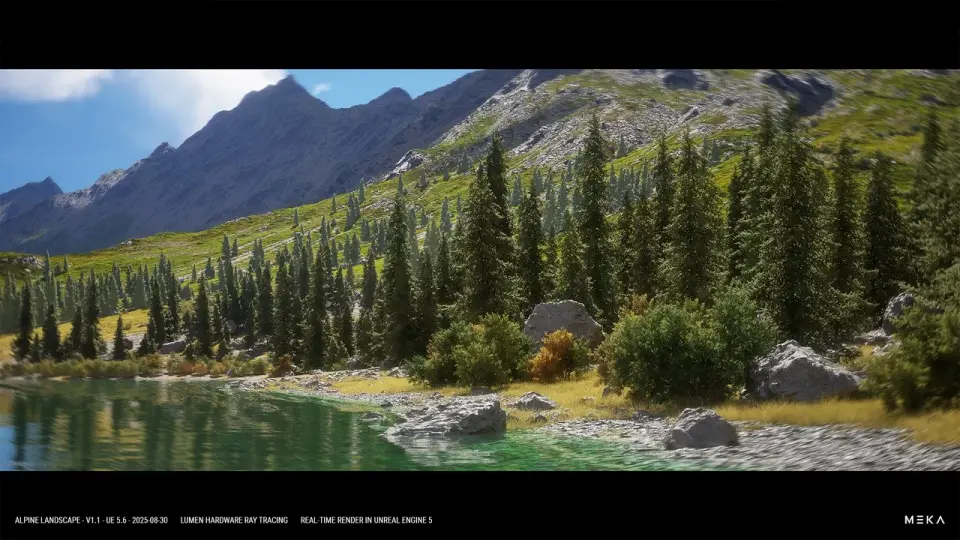
ALPINE LANDSCAPE delivers a 64-square-kilometer Nanite-based environment for Unreal Engine, featuring PCG-distributed trees, rocks, procedural grass, and update
Before opening the project, two Unreal Engine plugins must be active: Water and PCG. These are not optional extras—they drive the water features and the procedural scattering of larger vegetation and rock elements throughout the 64-square-kilometer playable area. Once those plugins are enabled, the environment is ready to load and explore without additional setup steps.
The asset is built for Unreal Engine 5.6, with the current version dated August 30, 2025. This places it on a recent UE5 branch, meaning artists working in Nanite- and Lumen-based pipelines can integrate it without compatibility friction on supported builds.
64 Square Kilometers of Nanite Terrain
The playable landscape spans 64 square kilometers, a scale large enough to support open-world level design, vehicle-based traversal, or expansive cinematic establishing shots. The entire background environment is constructed using Nanite meshes, which allows the terrain, rocks, and other geometry-heavy elements to maintain high visual density without relying on traditional LOD chains.
Lumen is tagged as part of the visual profile, indicating the environment takes advantage of dynamic global illumination and reflections. That pairing with Nanite positions the asset for photorealistic rendering directly inside the engine without baked lightmap dependencies.
Procedural Foliage Distribution Pipeline
Foliage across the landscape is handled through two distinct procedural systems, each targeting different element sizes:
Grass Types – Bushes, grass, pebbles, and stones are distributed using the Grass Types system. This ties ground-cover placement directly to the landscape material, so the presence and density of small-scale elements respond automatically to the underlying terrain surface.
PCG – Trees and rocks are scattered using Unreal Engine's PCG (Procedural Content Generation) framework. This allows larger structural elements to be positioned across the 64 km² area non-destructively, with rules governing where and how they populate the terrain.
This split pipeline matters for creative iteration. An artist can modify landscape material layers and see bush and grass coverage react accordingly, while separately tuning the PCG graph to control forest density, rock clusters, or clearings at the macro scale.
Version 1.1 Material and Mesh Updates
The August 30, 2025 update brought substantial changes across both surface and geometry assets:
Textures: Bark and leaf textures were updated for tree elements. Landscape textures and the landscape material itself received revisions, along with a material function update pass. Demo map lighting was refined to reflect the new material and texture work.
Geometry: Rock and stone meshes were completely reworked. Tessellation was added to both rock and stone surfaces, giving them displacement detail rather than relying on normal maps alone for depth perception.
Grass additions: Nine new Nanite grass meshes were introduced. These include Pivot Painter 2 wind, meaning the grass blades respond to directional wind influence through texture-baked motion data rather than simple vertex noise sway.
Maps: Both the demo map and the overview map were updated as part of this version cycle. A playable demo for version 1.0 was released on October 10, 2023, though the developer notes that this older demo looks different from the current screenshots and represents a prior iteration of the environment.
Building Scenes Across the Alpine Biome
The tags associated with the project paint a clear picture of intended use: pine, spruce, and fir forests across mountain and mountain-adjacent terrain. Lake features sit within the Water Plugin scope, and the natural photorealistic style targets outdoor environments rather than stylized or fantasy settings. Tags like Medieval and Modern suggest the terrain and foliage set are flexible across time-period contexts—an open mountain valley can serve a medieval village scene as readily as a modern wilderness exploration game.
The combination of PCG-controlled tree placement and Grass Types-driven ground cover means a level designer can clear a section of mountain slope for a settlement or encounter area and let the procedural systems repopulate the surrounding wilderness without manual hand-placement of every bush and tree.
Practical Takeaway for Unreal Engine Projects
ALPINE LANDSCAPE is production-ready for Unreal Engine 5.6 projects that need a large-scale, natural environment with modern rendering features. The Nanite background ensures the 64 km² terrain and scattered elements remain performant, while PCG and Grass Types give artists control over the two procedural layers independently. With tessellation-enabled rocks, Pivot Painter 2 wind grass, and updated textures across bark, leaves, and landscape surfaces, the version 1.1 release represents a refined iteration over the original October 2023 release, with a playable demo available for comparison to the current visual output.
 Forest & Jungle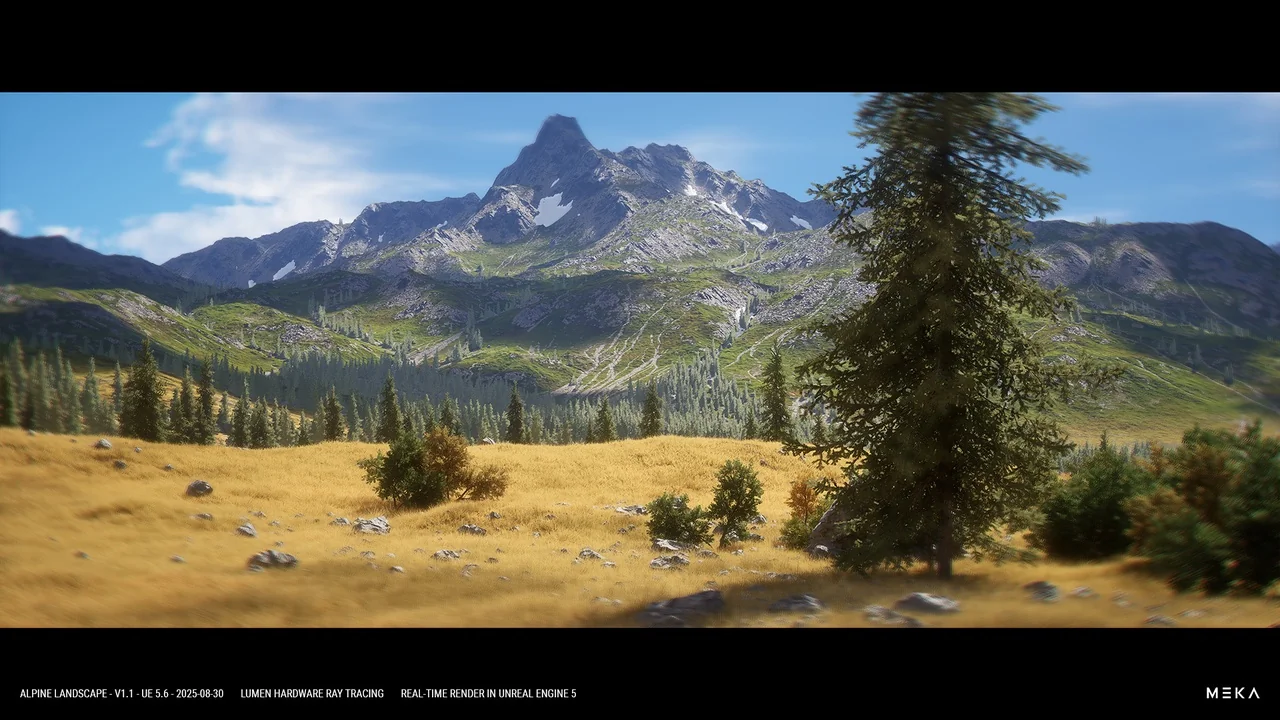
 Forest & Jungle
 Forest & Jungle
 Forest & Jungle