"c14ff6bd758dadb1"{"id":"1001735","slug":"lowpoly-style-woodlands-pack","title":"Lowpoly Style Woodlands Pack","category":"Forest \u0026 Jungle","engine":"4.26+,5.0+","assetVersion":"","engineVersion":"Engine Version: 4.26+,5.0+","tag":"Forest \u0026 Jungle","accent":"blue","visual":"mech","summary":"Construct stylized alpine landscapes and woodland camps using the Lowpoly Style Woodlands Pack, featuring unified material batching and modular nature assets.","platform":"Unreal Engine","publishedAt":"2026-10-20T02:40:02.803Z","updatedAt":"2026-10-20T02:40:02.803Z","sourceNotes":[],"fileContents":[],"compatibility":["Unreal Engine","Engine Version: 4.26+,5.0+"],"featuredImage":{"alt":"Lowpoly Style Woodlands Pack","src":"/wp-content/uploads/published/2026/10/066b0cf4ab99-f8e12b2e-0c2b-4e5d-9ccd-60d3246ca57a-d7f06bb336.webp"},"hasDownloadLink":true,"downloads":0,"terms":[{"taxonomy":"category","slug":"forest-and-jungle","name":"Forest \u0026 Jungle"}],"galleryImages":[{"src":"/wp-content/uploads/published/2026/10/02df3eb9589b-22bd1a5b-95e9-46ea-9472-f7237ec62efb-9a3131935e.webp","alt":"Lowpoly Style Woodlands Pack"},{"src":"/wp-content/uploads/published/2026/10/9d447c621ee0-c4643c64-1f7a-4379-8b02-9144c109fef6-70097b6ba5.webp","alt":"Lowpoly Style Woodlands Pack"},{"src":"/wp-content/uploads/published/2026/10/41a393f73178-421c52fe-bb57-47c4-91a9-95ad43860c4f-793b354e8f.webp","alt":"Lowpoly Style Woodlands Pack"},{"src":"/wp-content/uploads/published/2026/10/ac13cbe47210-7ccdae95-1607-42a5-8878-9bbeac08a935-a19bd87ddb.webp","alt":"Lowpoly Style Woodlands Pack"},{"src":"/wp-content/uploads/published/2026/10/d02b165f6640-8f3e8fd0-fe41-4a32-941d-df6807ca9a13-58c58c9012.webp","alt":"Lowpoly Style Woodlands Pack"},{"src":"/wp-content/uploads/published/2026/10/57cf83344d84-0c234cce-49bc-4ebe-8a80-ad22a9143fad-fcdb63b8b9.webp","alt":"Lowpoly Style Woodlands Pack"},{"src":"/wp-content/uploads/published/2026/10/5d0d32a8c227-963e905b-a124-41d8-a8b7-fd9d30954688-3b747489bc.webp","alt":"Lowpoly Style Woodlands Pack"},{"src":"/wp-content/uploads/published/2026/10/71b86670dd51-9c2e74c8-dd64-4724-b8d7-928de5993527-ed0428b2db.webp","alt":"Lowpoly Style Woodlands Pack"}],"accessPanel":{"kind":"resource","title":"Download this resource","eyebrow":"Free Download","message":"Log in or create a free account to start your download.","fileName":"Content.7z","safetyNote":"Resources are manually reviewed before listing to improve quality and reduce obvious risks.","actionLabel":"Download Free","resourceType":"Resource archive"},"contentHtml":"\u003cp\u003eConstructing stylized outdoor spaces requires a careful balance between distinct visual silhouettes and lightweight rendering overhead. Lowpoly Style Woodlands Pack approaches scene assembly by pairing faceted nature assets with modular human outposts, allowing alpine slopes, dense timberlines, and lakeside settlements to take shape within a unified aesthetic system.\u003c/p\u003e \u003ch2\u003eShaping Woodland Levels and Alpine Landscapes\u003c/h2\u003e\n\u003cp\u003eNatural topography forms the backbone of the package. Level designers can carve out expansive mountain passes and alpine valleys by arranging the included rock formations and mountain meshes. Because stylized environments rely heavily on clean geometric edges rather than noisy surface micro-details, the shapes of the rocks and ridgelines provide the primary sense of scale across a horizon.\u003c/p\u003e\n\u003cp\u003eFoliage layers establish the transition from bare mountain peaks down to lush forest floors. The asset collection includes trees and smaller plants that can be populated across varying elevations. Grouping clusters of trees along uneven terrain produces dense woodland canopies, while scattering individual plant pieces alongside natural stone formations breaks up flat ground planes. Designers can carve riverbanks, ponds, and open lake clearings into the scenery, placing vegetation directly at the water's edge to establish believable organic biomes.\u003c/p\u003e \u003ch2\u003eConstructing Camps, Tents, and Village Settlements\u003c/h2\u003e\n\u003cp\u003eBeyond wild wilderness, the pack introduces human elements that integrate directly into the landscape. Included buildings, camps, tents, and boundary walls enable the construction of remote outposts, active forestry settlements, or defensive mountain camps. These structures mirror the faceted geometry of the surrounding environment, ensuring that artificial settlements appear native to the terrain rather than contrasting awkwardly against natural landforms.\u003c/p\u003e\n\u003cp\u003eWalls can be aligned to enclose small woodland hamlets, secure perimeter lines around hillside fortifications, or guide player navigation along established trails. Placing clusters of tents and camping equipment among trees establishes temporary expedition bases or rest stops near water features. The modular nature of these pieces allows village layouts to scale from isolated wilderness shelters up to multi-structure compounds embedded deep within alpine valleys.\u003c/p\u003e \u003ch2\u003eSingle Material Batching and Draw Call Management\u003c/h2\u003e\n\u003cp\u003eRendering performance in dense nature scenes often degrades when dozens of distinct meshes request separate draw calls from the graphics hardware. Lowpoly Style Woodlands Pack addresses this specific bottleneck through an aggressive material consolidation strategy: everything in the pack—with the sole exception of water—shares a single material and a single texture atlas.\u003c/p\u003e\n\u003cp\u003eThis structural setup allows diverse scene components to be batched together seamlessly. A scene containing trees, plants, stone crags, modular walls, and residential buildings can be processed efficiently because the rendering pipeline does not need to constantly swap materials or bind new texture maps when drawing different mesh types. By maintaining one uniform material across the structural and natural elements, draw calls remain exceptionally low, freeing up hardware performance for lighting, complex level logic, or larger camera view distances. The water surface remains the only element operating on its own separate material, preserving its unique visual surface requirements.\u003c/p\u003e \u003ch2\u003eAssembling Layouts from the Included Demoscene\u003c/h2\u003e\n\u003cp\u003eTo demonstrate how these individual pieces interact across a complete level, a huge demoscene is provided directly within the package. Rather than requiring developers to test scale, asset grouping, and lighting from scratch on an empty canvas, the demoscene serves as a fully constructed proof of concept showcasing proper environmental density.\u003c/p\u003e\n\u003cp\u003eStudying the demoscene reveals practical methods for blending alpine peaks into low-lying woodlands, positioning modular walls against jagged rocks, and placing tents around lakes and clearings. Developers can inspect how tree lines are broken up to prevent repetitive visual patterns, or examine how ground clutter like smaller plants can mask seams between modular terrain pieces. The demoscene functions both as a spatial reference for composition and as an immediate staging area for rapid scene prototyping.\u003c/p\u003e \u003ch2\u003eIntegration Across Lowpoly Style Biomes\u003c/h2\u003e\n\u003cp\u003eThe pack functions as an interconnected piece within a broader low-poly ecosystem. It offers native compatibility with the Lowpoly Style Ultra Pack and matches the artistic conventions established across the creator's broader series of stylized environments, which includes the Winter Pack, Desert Pack, Forest Pack, Tropical Pack, Asia Pack, and the comprehensive Mega Pack.\u003c/p\u003e\n\u003cp\u003eBecause these packs adhere to the same underlying polygonal styling and modular principles, assets from the Woodlands collection can blend into adjacent biomes without visual friction. A woodland trail can climb upward into frozen passes derived from the Winter Pack, or give way to dense foliage setups borrowed from the Forest or Tropical packs. This compatibility makes the asset set particularly suited for projects that require interconnected regions, world maps with variable climates, or transitions between quiet woodland settlements and distant mountain peaks.\u003c/p\u003e\n\n\u003ch2\u003eContinue Browsing Similar Packs\u003c/h2\u003e\n\u003cul\u003e\n\u003cli\u003e\u003ca href=\"https://3dcghub.com/stylized-summer-forest/\" title=\"Stylized Summer Forest\"\u003eStylized Summer Forest\u003c/a\u003e\u003c/li\u003e\n\u003cli\u003e\u003ca href=\"https://3dcghub.com/winter-forest-set/\" title=\"Winter Forest Set\"\u003eWinter Forest Set\u003c/a\u003e\u003c/li\u003e\n\u003cli\u003e\u003ca href=\"https://3dcghub.com/camp-in-the-tropic-forest/\" title=\"Camp in the Tropic Forest\"\u003eCamp in the Tropic Forest\u003c/a\u003e\u003c/li\u003e\n\u003cli\u003e\u003ca href=\"https://3dcghub.com/stylized-forest-cave/\" title=\"Stylized Forest Cave\"\u003eStylized Forest Cave\u003c/a\u003e\u003c/li\u003e\n\u003cli\u003e\u003ca href=\"https://3dcghub.com/planet-venus-landscape/\" title=\"Planet Venus Landscape\"\u003ePlanet Venus Landscape\u003c/a\u003e\u003c/li\u003e\n\u003c/ul\u003e","contentTextLength":5495,"navigation":{"current":48,"total":3719,"previous":{"id":"1001736","slug":"magnum-combat","title":"Magnum Combat","category":"Combat","platform":"Unreal Engine","updatedAt":"2026-10-20T02:42:05.396Z"},"next":{"id":"1001734","slug":"lowpoly-alchemist-s-house","title":"Lowpoly Alchemist's House","category":"Fantasy","platform":"Unreal Engine","updatedAt":"2026-10-20T02:39:03.250Z"}},"relatedResources":[{"id":"8299","slug":"stylized-summer-forest","title":"Stylized Summer Forest","category":"Forest \u0026 Jungle","engine":"5.2+","assetVersion":"Engine version: 5.2+","engineVersion":"5.2","tag":"Forest \u0026 Jungle","accent":"blue","visual":"city","summary":"Build a lush, artistic woodland with the Stylized Summer Forest asset pack. This comprehensive collection for Unreal Engine 5 includes over 60 unique meshes and optimized PBR materials.","platform":"Unreal Engine","publishedAt":"2026-02-23T16:43:33.000Z","updatedAt":"2026-05-31T12:48:26.238Z","sourceNotes":[],"fileContents":[],"compatibility":["Unreal Engine","Engine version: 5.2+"],"featuredImage":{"alt":"Stylized Summer Forest","src":"https://3dcghub.com/wp-content/uploads/2026/02/dcc18fe1-4b99-4e39-aa8b-71fbab817f3f.webp"},"hasDownloadLink":true,"downloads":2},{"id":"1001678","slug":"winter-forest-set","title":"Winter Forest Set","category":"Forest \u0026 Jungle","engine":"4.26+,5.0+","assetVersion":"","engineVersion":"Engine Version: 4.26+,5.0+","tag":"Forest \u0026 Jungle","accent":"blue","visual":"mech","summary":"Build realistic snowy woodland environments in Unreal Engine with the Winter Forest Set, featuring trees, rocks, grass, stumps, twigs, and branches.","platform":"Unreal Engine","publishedAt":"2026-10-13T15:29:18.961Z","updatedAt":"2026-10-13T15:29:18.961Z","sourceNotes":[],"fileContents":[],"compatibility":["Unreal Engine","Engine Version: 4.26+,5.0+"],"featuredImage":{"alt":"Winter Forest Set","src":"/wp-content/uploads/published/2026/10/a8b1cfc95208-73164c04-d2bd-478f-957b-96219f0e6f31-21b5e7a28a.webp"},"hasDownloadLink":true,"downloads":1},{"id":"1001621","slug":"camp-in-the-tropic-forest","title":"Camp in the Tropic Forest","category":"Forest \u0026 Jungle","engine":"4.26+,5.0+","assetVersion":"","engineVersion":"Engine Version: 4.26+,5.0+","tag":"Forest \u0026 Jungle","accent":"blue","visual":"mech","summary":"Explore Camp in the Tropic Forest, a compact stylized environment collection designed for fantasy levels and compatible with 50 terrain materials.","platform":"Unreal Engine","publishedAt":"2026-10-13T01:53:26.798Z","updatedAt":"2026-10-13T01:53:26.798Z","sourceNotes":[],"fileContents":[],"compatibility":["Unreal Engine","Engine Version: 4.26+,5.0+"],"featuredImage":{"alt":"Camp in the Tropic Forest","src":"https://media.fab.com/image_previews/gallery_images/19d2eefd-80cc-4eb8-9315-bde8ed8a63fc/eb1cd14c-0c66-40db-be2c-e5a6ba509794.png"},"hasDownloadLink":true,"downloads":1}]}
Forest & Jungle
Lowpoly Style Woodlands Pack
Construct stylized alpine landscapes and woodland camps using the Lowpoly Style Woodlands Pack, featuring unified material batching and modular nature assets.
Constructing stylized outdoor spaces requires a careful balance between distinct visual silhouettes and lightweight rendering overhead. Lowpoly Style Woodlands Pack approaches scene assembly by pairing faceted nature assets with modular human outposts, allowing alpine slopes, dense timberlines, and lakeside settlements to take shape within a unified aesthetic system.
Shaping Woodland Levels and Alpine Landscapes
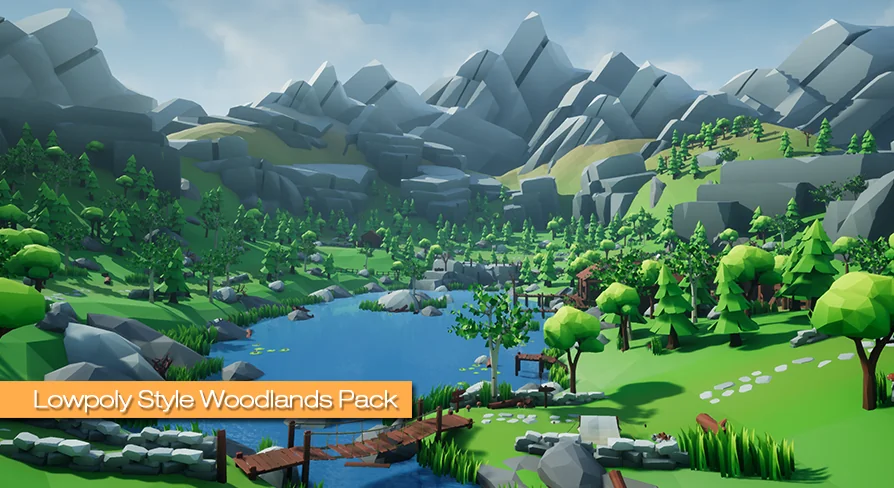
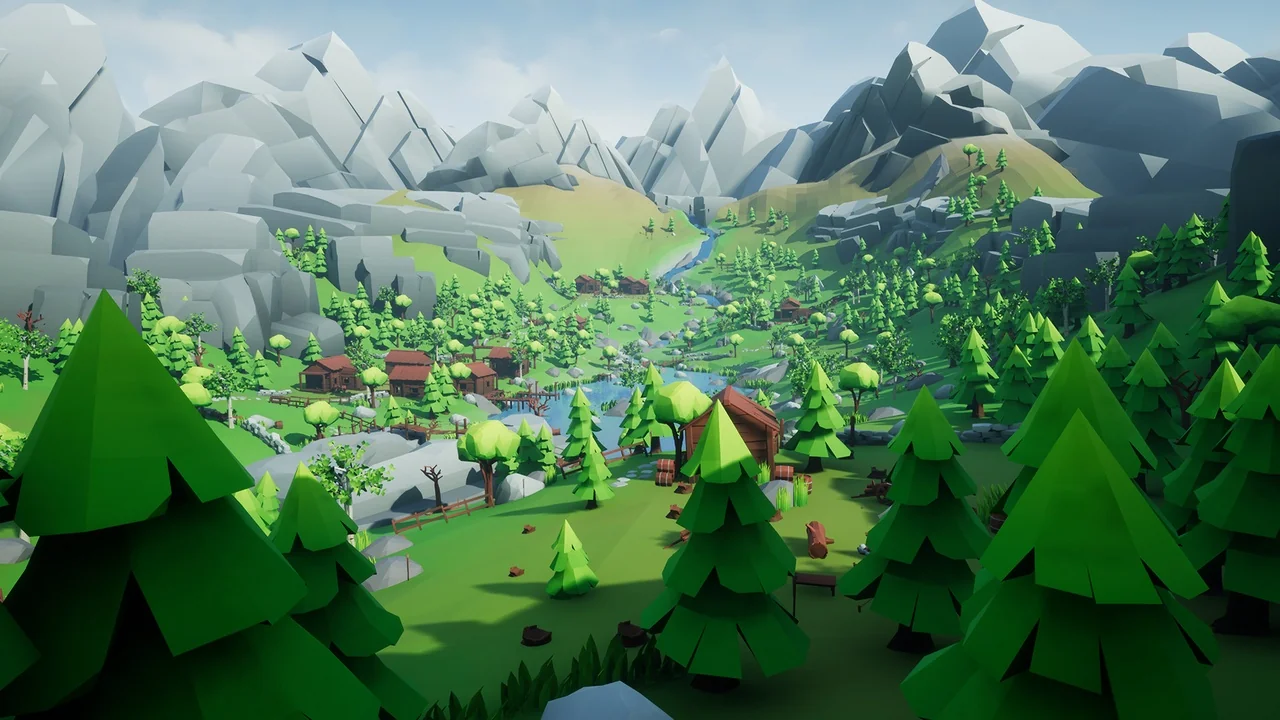
Natural topography forms the backbone of the package. Level designers can carve out expansive mountain passes and alpine valleys by arranging the included rock formations and mountain meshes. Because stylized environments rely heavily on clean geometric edges rather than noisy surface micro-details, the shapes of the rocks and ridgelines provide the primary sense of scale across a horizon.
Foliage layers establish the transition from bare mountain peaks down to lush forest floors. The asset collection includes trees and smaller plants that can be populated across varying elevations. Grouping clusters of trees along uneven terrain produces dense woodland canopies, while scattering individual plant pieces alongside natural stone formations breaks up flat ground planes. Designers can carve riverbanks, ponds, and open lake clearings into the scenery, placing vegetation directly at the water's edge to establish believable organic biomes.
Constructing Camps, Tents, and Village Settlements
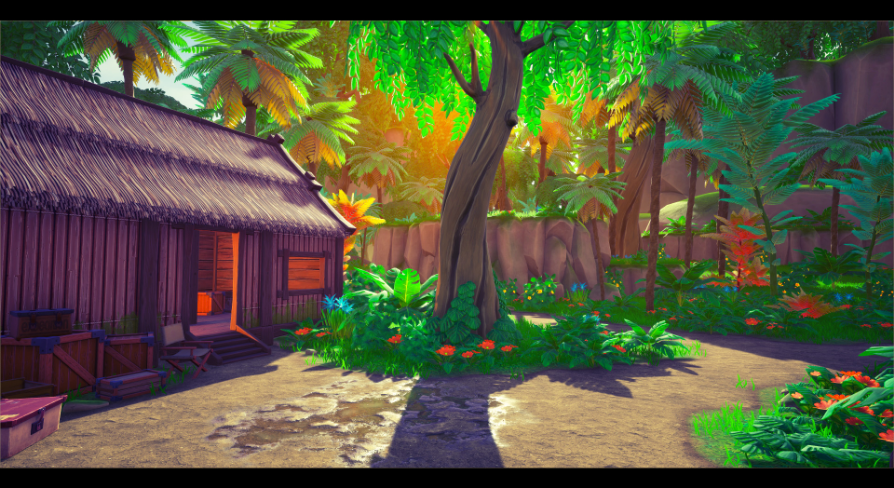
Beyond wild wilderness, the pack introduces human elements that integrate directly into the landscape. Included buildings, camps, tents, and boundary walls enable the construction of remote outposts, active forestry settlements, or defensive mountain camps. These structures mirror the faceted geometry of the surrounding environment, ensuring that artificial settlements appear native to the terrain rather than contrasting awkwardly against natural landforms.
Walls can be aligned to enclose small woodland hamlets, secure perimeter lines around hillside fortifications, or guide player navigation along established trails. Placing clusters of tents and camping equipment among trees establishes temporary expedition bases or rest stops near water features. The modular nature of these pieces allows village layouts to scale from isolated wilderness shelters up to multi-structure compounds embedded deep within alpine valleys.
Single Material Batching and Draw Call Management
Rendering performance in dense nature scenes often degrades when dozens of distinct meshes request separate draw calls from the graphics hardware. Lowpoly Style Woodlands Pack addresses this specific bottleneck through an aggressive material consolidation strategy: everything in the pack—with the sole exception of water—shares a single material and a single texture atlas.
This structural setup allows diverse scene components to be batched together seamlessly. A scene containing trees, plants, stone crags, modular walls, and residential buildings can be processed efficiently because the rendering pipeline does not need to constantly swap materials or bind new texture maps when drawing different mesh types. By maintaining one uniform material across the structural and natural elements, draw calls remain exceptionally low, freeing up hardware performance for lighting, complex level logic, or larger camera view distances. The water surface remains the only element operating on its own separate material, preserving its unique visual surface requirements.
Assembling Layouts from the Included Demoscene
To demonstrate how these individual pieces interact across a complete level, a huge demoscene is provided directly within the package. Rather than requiring developers to test scale, asset grouping, and lighting from scratch on an empty canvas, the demoscene serves as a fully constructed proof of concept showcasing proper environmental density.
Studying the demoscene reveals practical methods for blending alpine peaks into low-lying woodlands, positioning modular walls against jagged rocks, and placing tents around lakes and clearings. Developers can inspect how tree lines are broken up to prevent repetitive visual patterns, or examine how ground clutter like smaller plants can mask seams between modular terrain pieces. The demoscene functions both as a spatial reference for composition and as an immediate staging area for rapid scene prototyping.
Integration Across Lowpoly Style Biomes
The pack functions as an interconnected piece within a broader low-poly ecosystem. It offers native compatibility with the Lowpoly Style Ultra Pack and matches the artistic conventions established across the creator's broader series of stylized environments, which includes the Winter Pack, Desert Pack, Forest Pack, Tropical Pack, Asia Pack, and the comprehensive Mega Pack.
Because these packs adhere to the same underlying polygonal styling and modular principles, assets from the Woodlands collection can blend into adjacent biomes without visual friction. A woodland trail can climb upward into frozen passes derived from the Winter Pack, or give way to dense foliage setups borrowed from the Forest or Tropical packs. This compatibility makes the asset set particularly suited for projects that require interconnected regions, world maps with variable climates, or transitions between quiet woodland settlements and distant mountain peaks.
 Forest & Jungle
 Forest & Jungle
 Forest & Jungle
 Forest & Jungle